
North One
Published 4 May 2020Due to copyright restrictions, some music and scenes have been altered or removed in this upload. You can find the original unaltered documentary here: The Story Of The …
Jeremy Clarkson tells the story of the audacious commando raid on the German occupied dry dock at St Nazaire in France on March 28th 1942. Made for the BBC in 2007 by North One.
(more…)
September 19, 2023
Jeremy Clarkson’s The Greatest Raid of All
Comments Off on Jeremy Clarkson’s The Greatest Raid of All
September 9, 2023
The US military’s recruiting crisis
As I joked earlier this year after one or another of the US services reported falling significantly short of their recruiting goal, “I find this hard to believe now that Uncle Sugar is not only willing to fund your gender transition, but will then guarantee that you won’t be sent into a combat zone.” Kulak has been reading some histories of the 20th century and was surprised to find that the recruiting problem faced by most military organizations in that time was having too many good recruits:
This was after WW1! Millions of young men had just died as part of regiments many little different than this. And yet there was this much demand from young men to be part of the martial world.
This is because the Military and military life was ACTUALLY a good career move, and ACTUALLY formed life long bonds in the early 20th century.
Amidst the population boom of the early 20th century and all the excess young men with little inheritance… the military and militia life was a major vehicle for social mobility and aspiration and forming social connections…
So what changed? Why is it almost completely the opposite in early 21st century America?
These attitudes survived the world wars, even the western front of WW1 …
But they were devoured by Vietnam and the Civil Rights era.
Implicit in a lot of 19th and 20th century militarism was the vision of “Every Soldier a Citizen, Every Citizen a Soldier” this ethos was first expressed during the french revolution … It was aspirational. The subjects divorced from the state and military were now armed and able to participate in civic and military life, they were now citizens … of course by the early 20th century this sounds very menacing… Soldiers must obey orders, every day … if every citizen is a soldier, and bound to obey, on pain of death, that’s Totalitarianism.
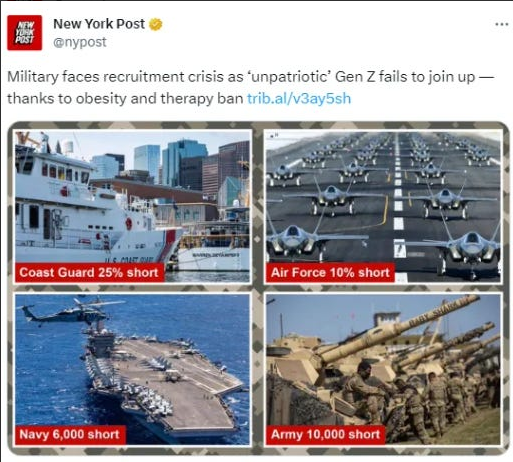
You can make a strong case that US military recruiting never fully recovered from the Vietnam era, even through the temporary boost of the post-9/11 patriotic rush.
America has gone from over 1% of the population actively serving at any one time to nearly a third of that.
The “Professionalization” of the US military to an “All Volunteer force” has in effect just been a cover for this collapse in recruiting capacity.
America’s military isn’t significantly structurally different. These aren’t really professionals.
Your average 3 year contract private isn’t making some obscene Yuppie amount of money for his ambitious professional commitment. A private makes under 30k a year. A Second Lieutenant, with a university degree and years of professional development, who may have had to plan out his career from 16 years old getting a Congressman’s letter of recommendation to attend West Point or another service academy … Makes 40-60k a year.
US GDP per capita is 72k. If that Lieutenant had gone to a second tier school and gotten a Computer Science degree he’d be making 6 figures and have vastly more control over his life.
It’s not a good career move, in the 1780s or 1900s and ambitious scion of a decayed noble family desiring to conquer the world might want to become an artillery officer… Today he wants to work on wall street or at Google.
Even if you’re starting out from a very rough place there ar almost certainly a dozen better things you could do to advance yourself faster, for better money, and with less effort than joining the Military.
The only appeal of the US military, for decades now, has been to people who really want to escape their situation, who really felt they needed to hard reboot their life, or who are really drawn to military life out of sheer love of it.
And then the Army went woke.
The long-serving senior officers of every branch of the US military are now locked in to pushing diversity in all its manifold ways, to the point of knowingly discouraging non-diverse service members out of the way to make room for this month’s gender, racial, or other quotas.
So America’s effective recruitment capacity and civic feeling will continue to collapse even as Americans hate each other and their government even more.
You think recruit capacity is bad now? Wait til they imprison Trump.
Comments Off on The US military’s recruiting crisis
September 6, 2023
Some key planks from Scott Alexander’s presidential platform
I was a bit surprised to find that Scott Alexander has decided to toss his hat into not one, but two party primaries for the 2024 presidential nomination:
The American people deserve a choice. They deserve a candidate who will reject the failed policies of the past and embrace the failed policies of the future. It is my honor to announce I am throwing my hat into both the Democratic and Republican primaries (to double my chances), with the following platform:
Ensure Naval Supremacy And Reduce Wealth Inequality By Bringing Back The Liturgy
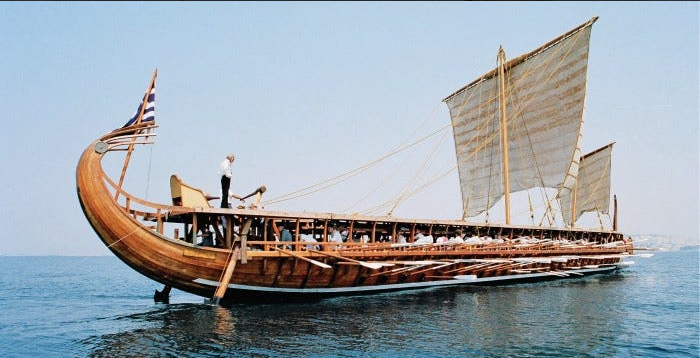
The liturgy was a custom of ancient Athens. When the state needed something (usually a new warship) it would ask for volunteers among its richest citizens. Usually one would step up to gain glory or avoid scorn; if nobody did, the courts were allowed to choose the richest person who hadn’t helped out recently. The liturgist would fund the warship and command it as captain for two years, after which his debt to the state was considered discharged and he was given a golden crown. Historians treat the liturgy as a gray area between voluntary service and compulsory taxation; most rich Athenians were eager to serve and gain the relevant honor, but they also knew that if they didn’t, they could be compelled to perform the same service with less benefit to their personal reputation.
Defense analysts warn that America’s naval dominance is declining:
Only 25 per cent of America’s 114 commissioned surface combatants (cruisers, destroyers, and littoral combat ships) are less than a decade old. By comparison more than 80 per cent of China’s 141 destroyers, frigates, and corvettes have been commissioned in the past decade. In the same time period, the United States commissioned 30 surface combatants … The nearly 600-ship Navy of the late 1980s deployed only 15 per cent of the fleet on average. Today, with fewer than 300 ships, the US Navy deploys more than 35 per cent to service its global missions, contributing to a material death spiral.
So America is short on warships. But it is very long on rich people with big egos. An aircraft carrier would cost the richest American billionaires about the same fraction of their wealth as a trireme cost the richest Athenian aristocrats. So I say: bring back the liturgy!
(source)
The American rich already enjoy spending their money on exciting vehicles — yachts for the normies, rockets for the more ambitious, Titanic submersibles for the suicidal. Why not redirect this impulse towards public service? Imagine the fear it would strike into the hearts of the Chinese when the USS Musk enters Ludicrous Mode in the waters off the Taiwan Strait, with Elon himself at the wheel. Imagine how efficiently the USS Jeff Bezos will deliver its payloads! And does anyone doubt that billionaires – usually careful to avoid taxes — will jump at the chance to do this?
The Athenians had a parallel liturgy for rich people who would select and sponsor theater productions, but I think we can skip this one for now.
[…]
Legalize Lying About Your College On Resumes
Colleges trap Americans in a cycle of burdensome loans and act to reinforce class privilege. I have previously advocated making college degree a protected characteristic which it is illegal to ask people about on job applications. But this would be hard to enforce, and people would come up with other ways to communicate their education level.
So let’s think different: let’s make it legal to lie about your college on resumes (it is already not technically illegal to lie on a resume, but companies can ask for slightly different forms of corroboration which it is illegal to lie on). Everyone can just say “Harvard”, and nobody will have any unfair advantage over anyone else.
Start An Internet-Pop-Up Trade War With The European Union
For too long, Americans have groaned under the weight of foreign cookie-related-pop-ups which they and their elected representatives have no control over. It’s time to fight back.
When I am elected, I will mandate that all American websites serve popups to European Union residents explaining why the GDPR is annoying and why it affects even Americans who have no say in it. If the Europeans want to be able to access Google, Facebook, Twitter, or any other US-based site without clicking “I understand” every time they reload it, they’ll have to pressure their government to do something about GDPR.
Appoint Donald Trump Constitutional Monarch
This would require a constitutional amendment, but I’m sure I could convince enough people.
The British experience suggests that the role of a constitutional monarch is to flaunt how rich they are, get 24-7 news coverage regardless of whether or not they do anything interesting, and have scandals. Donald Trump is the best person in the world at all three of these things
Trump wants to be on top, but is not that interested in governing. Meanwhile, American liberals (by revealed preference) want to continue thinking about him every hour of every day forever, but also don’t want him to govern. Constitutional monarchy would satisfy everyone’s preferences. If Trump is destined to destroy democracy — and everyone agrees that he is — let’s make it happen as gently and non-destructively as possible.
Obviously the royal family can’t participate in regular electoral politics, which means no Trump would ever be able to run for office ever again. This is the only way we are ever getting rid of them, you know this is true, please don’t throw away this chance.
I would support reverse primogeniture-based inheritance — ie the youngest son takes the throne — just so we can have a “King Barron”.
Comments Off on Some key planks from Scott Alexander’s presidential platform
August 18, 2023
One Day in August – Dieppe – Part 2 – The Plan
WW2TV
Published 17 Jan 2021Part 2 – The Plan With David O’Keefe
David O’Keefe joins us again. In Part 1 he talked about the real reason for the raid on Dieppe in August 1942. In Part 2 we talk about the plan for Operation Jubilee and David will share his presentation about the intentions of the raid and how it was supposed to unfold.
A final show sometime in the summer will come live from Dieppe to explain how the plan unravelled and how the nearly 1,000 British, Canadian and American commandos died.
(more…)
Comments Off on One Day in August – Dieppe – Part 2 – The Plan
July 25, 2023
If you bet on Admiral Franchetti becoming the next CNO for the US Navy, collect your winnings
I don’t follow US military appointments closely because I’m not in the military, nor an American, so the first time I think I heard of Admiral Franchetti was back in May where Brent Ramsey’s report touted her as the one to watch for the upcoming appointment as the Chief of Naval Operations (she became VCNO in September 2022). Now, CDR Salamander confirms that Admiral Franchetti is almost certainly now the “CNO in waiting”:
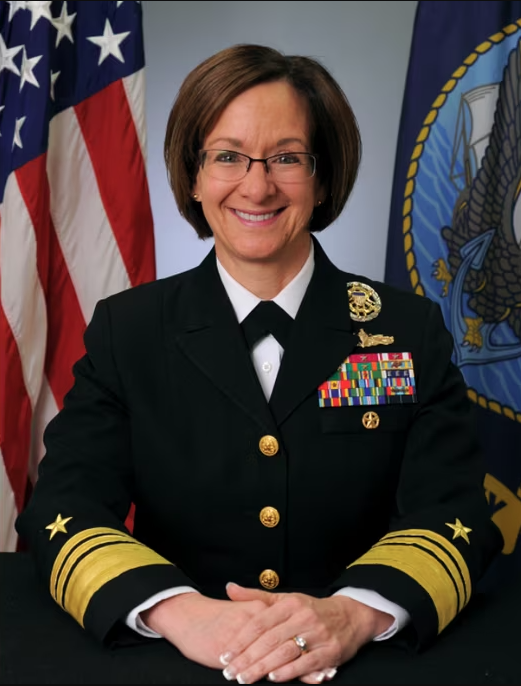
Admiral Lisa Franchetti, Vice-Chief of Naval Operations, US Navy.
I am sure that everyone here understands that at the end of last week white smoke rose over The Navy Yard signaling that we had an official nominee for the next Chief of Naval Operations (CNO).
Barring some Ottomanesque bureaucratic defenestration like we saw as Admiral Moran was set to be CNO after Admiral Richardson, the nominee to replace Admiral Gilday as CNO will be Admiral Franchetti — presently the Vice CNO.
Because people in DC can’t seem to keep their mouths shut when they should, unfortunately in mid-month there were some leaks coming out that Admiral Paparo would — surprisingly as the general consensus was the Franchetti was slotted to be the next CNO — be recommended to be the next CNO.
Read the link above it you’re interested in the state of play on the 13th, but things wound up heading as most thought with Franchetti getting the nod. Exceptionally well prepared for INDOPACOM, Paparo will head to there where he is expected to continue to do great and important things for the Navy and the nation it serves at at time where we have no luxury for a learning curve.
Despite Ramsey’s article not-so-subtly raising doubts about Admiral Franchetti’s qualifications for the post, CDR Salamander seems to be signally unruffled with the news:
Her wiki page has a nice concise summary;
Since promotion to flag rank, Franchetti has held appointments as: commander, United States Naval Forces Korea; commander Carrier Strike Group 9; commander, Carrier Strike Group 15; and chief of staff, Joint Staff, J-5, Strategy, Plans and Policy; and Commander, United States Sixth Fleet, Naval Striking and Support Forces NATO; deputy commander, United States Naval Forces Europe; deputy commander United States Naval Forces Africa; and Joint Force Maritime Component Commander.
- Western Pacific: she knows Korea and all associated areas. She also has Pappy coming in to INDOPACOM — an exceptional partner. I hope they have a solid professional relationship already.
- Fleet Challenges: from maintenance to readiness, her time leading CSG-9 and CSG-15 gave her a first person look at it. She knows it.
- JS J5: that speaks for itself.
- C6F et al: she knows Europe and has already built a working and personal relationship with many of her peers in NATO. She’s seen up close what they do and how they do it. Invaluable.
- VCNO: the most important. She’s seen OPNAV and the Potomac Flotilla up close. The greatest danger to her tenure as CNO — and as such our Navy and the nation it serves — is not spotty relationships with the SECNAV and his staff; it not Congress; is not the press; is not the economy; and it sure isn’t her Sailors writ large — no — the greatest threat is the long-dwell nomenklatura in a commuting distance of The Pentagon and The Hill who do not see their job as adjusting their responsibilities to support the CNO, but to bend the CNO towards their personal agendas, projects, and job security. There are some exceptional and valuable people there to support the CNO, but the organization is worm-ridden with rent seekers and bad actors. She’s seen that up close. She knows it.
Since making Flag, she managed to walk around all the rakes, had good luck and timing (part of any success), and she did a solid job as assigned. She has the right experience and performance.
I know a handful of people, some friends of mine for over two decades, who know her personally and have since they were both JOs. With one mild exception, these people I would trust my family with speak well of her. That combined with what I’ve seen in open source works for me.
Comments Off on If you bet on Admiral Franchetti becoming the next CNO for the US Navy, collect your winnings
July 18, 2023
Seaplanes? How 1940s. No, we’re seeking to “leverage emerging technologies” instead
CDR Salamander wonders about a modern need for military sea rescue capability that the US Navy filled with flying boats and seaplanes during the Second World War, then supplemented with helicopters during Korea and Vietnam. For ocean search-and-rescue in a combat environment in the present or near future, what are the USN’s plans?
I will be the first person to admit that good, well-meaning, and informed people can disagree with seaplanes in general or the US-2 specifically, but they have to engage the conversation. Directly argue the requirement or offer realistic alternatives.
This does neither. If anything is demonstrates the narrowness of thought and fragility of substance used in opposition.
What an patronizingly toxic stew that answer is. I highly doubt Lung typed out that answer himself, so my commentary below is not directed at him personally, but … and it is what comes after the “but” that counts — but at the three-digit J or N code that extruded that from the random acquisitions professional statement subroutine from ChatGPT.
Let’s give that answer a full Fisking;
- “The Indo-Pacific operational environment has evolved significantly since World War II”:
Let me check my WWII Pacific chart, my Vietnam War era globe, and GoogleEarth … and … no. The geography has not changed. The distances have not changed. The requirement of thousands of years to take and hold territory or eliminate your enemy from access to it has not changed. All the little islands, regardless of what Al Gore and John Kerry say, are still there. As we are seeing in the Russo-Ukrainian War, a million PPT slides saying so does not change the fundamentals of war.
Sentence one is invalid.
- “The employment of seaplanes today would not meet the operational demands and current threat scenario.”
Is there an operational demand for us to rescue downed airmen and to be able to reach remote islands without airfields? Yes. Does your “current threat scenario” run from Northern Japan through to Darwin, Australia? Yes.
Sentence two is invalid.
- “However, we support the continuous development of new and innovative solutions that may provide solutions to logistical challenges.”
So, you define “new” as something that only exists on PPT slides? By “continuous development” you mean never matures as a design that goes into production. By “innovative” you mean high on technology risk. Undefined program risk. Unknown design risk. No known production line or remote estimate to IOC, much less FOC when we know that the next decade is the time of most danger of the next Great Pacific War.
Sentence three is irresponsible and professionally embarrassing given the history of transformational wunderwaffe this century.
- “As an example, DARPA’s Liberty Lifter X-Plane seeks to leverage emerging technologies that may demonstrate seaborn strategic and tactical lift capabilities.”
Well, goodness, we will have to micro-Fisk this gaslighting horror show of a sentence. To start with, they are talking about either this from General Atomics;
… that could only be used on a very few select beaches under ideal weather in a completely permissive environment and could only be used for one specific mission and nowhere any possible hostile aircraft or ground forces. Also looks like we’d need a whole new engine and a small town’s worth of engine mechanics to maintain the maintenance schedule on those engines.
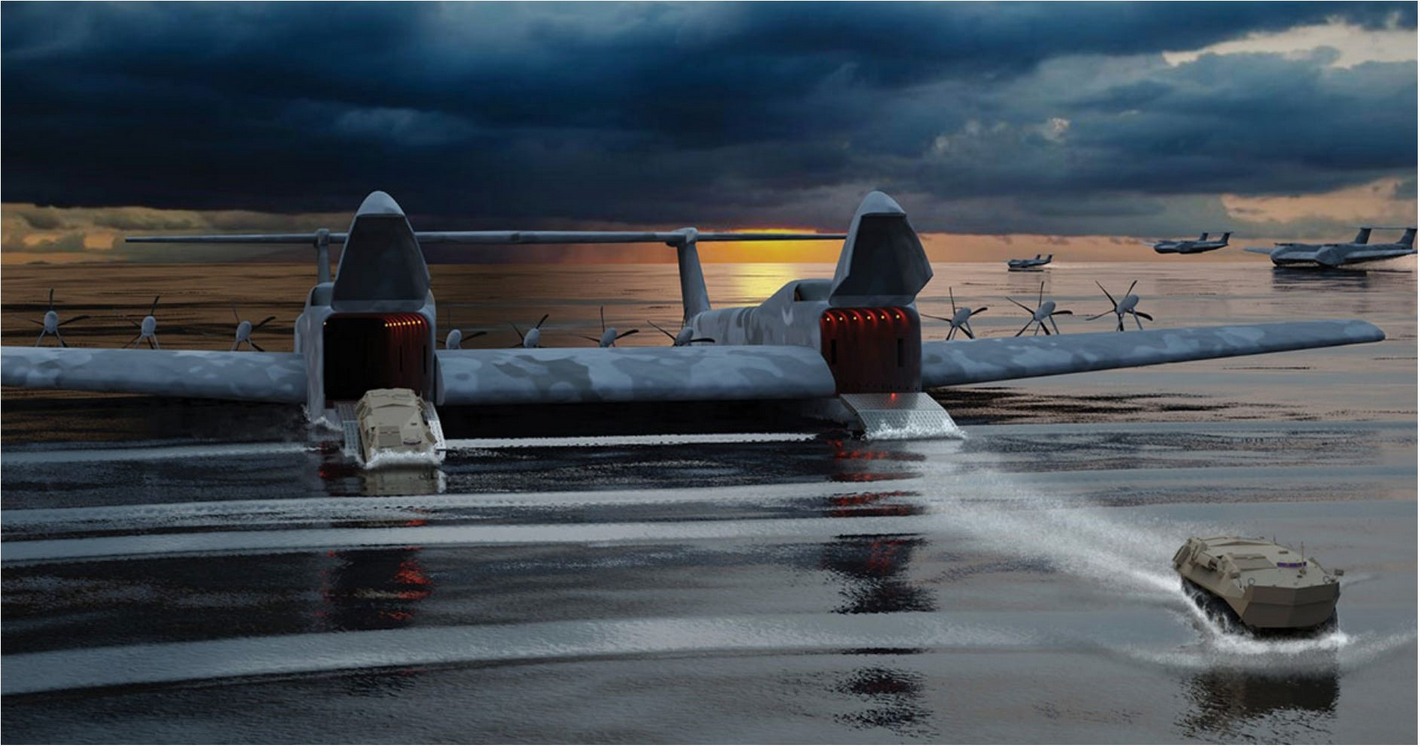
Then we have this offspring of an accidental mating of the Spruce Goose with the Caspian Sea Monster idea from Aurora Flight Sciences;
I give the odds of either one of those taking to the air prior to 2035, if ever, on par with a return of the submarine LST of Cold War fame (deck gun not included).
Let’s get back to the wording of that dog’s breakfast of a final sentence. Feel slimy reading it? You should;
- “seeks to leverage” — that is just a way of saying, “hope in magic beans.” Gobbledegook.
- “emerging technologies” — oh, you mean something that hasn’t left the computer, white board, or PPT slide.
- “that may demonstrate” — so, even if our magic beans managed to fuse unobtainium with Amrita, we’re not really sure if the strip mining of strange blue creatures’s holy sites and drilling holes in the soft pallet of whale-like thing will result in something of use.
- “strategic and tactical lift capabilities” — I’m sorry, an eight or ten-engined aircraft that any goober with a 1960s-era iron-sighted RPG-7 could target at maximum range is going do anything “tactical” — especially at the expected price of those things and the resulting precious few that wind up displacing water. Oh, and you admit that it will only be used for cargo, so it can’t do the full range of possible missions the US-2 can … just cargo. On just a few beaches that are fully surveyed ahead of time. At the right tide. In the right weather. In a 100% safe and permissive environment.
- The final sentence is a caricature.
Rep. Austin Scott (R-GA) should feel at least mildly insulted by this reply. It was a serious question given a canned answer that, slightly modified, could have been provided at any time in the last quarter century by the lethargically complacent maintainers of the suboptimal habits of the mistakingly entitled acquisitions nomenklatura


Comments Off on Seaplanes? How 1940s. No, we’re seeking to “leverage emerging technologies” instead
July 10, 2023
Echoes of War: Accounts of Operation Husky and the Allied Landings in Sicily
OTD Military History
Published 9 Jul 2023On July 9/10 Allied forces launched Operation Husky, the invasion of Sicily. This video presents accounts from various Allied military personnel who were there that day.
(more…)
Comments Off on Echoes of War: Accounts of Operation Husky and the Allied Landings in Sicily
Remington-Lee Model 1885
Forgotten Weapons
Published 5 Sept 2015The model of 1885 (a modern collector designation; Remington called these the “Remington Magazine Rifle” and did not differentiate between the different versions) was the final iteration of James Paris Lee’s bolt action rifle made by Remington. It incorporated a number of improvements from the earlier versions, including a relocated bolt handle, improved bolt head, and a magazine that could now hold cartridges securely without the use of a sliding catch at the nose.
These rifles were made in .45-70 caliber for US use and in .43 Spanish for export sales. The US Navy purchased most of the .45-70 guns that were made, and this particular rifle is one of those Navy guns. By the time these rifles were actually in production, Great Britain had also decided to adopt the Lee system in 1888, which would go through several iterations and ultimately become the iconic SMLE that would be the mainstay of British infantry during the First World War.
(more…)
Comments Off on Remington-Lee Model 1885
July 3, 2023
Three Forgotten Roman Megaprojects
toldinstone
Published 31 Mar 2023The longest tunnel in ancient history. A highway suspended over a raging river. A secret harbor for the Roman navy. These are three of the most impressive Roman engineering projects that you’ve probably never heard of.
(more…)
Comments Off on Three Forgotten Roman Megaprojects
June 21, 2023
Scuttling of the German High Seas Fleet at Scapa Flow, Orkney, 21 June 1919 in the Great War
CEFRG (Canadian Expeditionary Force Research Group)
Published 3 Apr 2020The German High Seas Fleet decided to sink as many of its own ships as possible to prevent them from falling into Allied hands. In total, 52 of 74 ships were sabotaged to keep them from Britain, France, Italy and the USA. Most of these nations wanted a share for their navies, and knowing she could not have them all to herself, Britain wanted the ships scrapped to prevent other nations from gaining naval superiority.
On the morning of 21 June 1919, the British fleet left Scapa Flow for exercises, and Rear Admiral Sydney Freemantle, commander of the 1st Battle Squadron guarding the ships, planned to return two days later to board and seize the ships.
Already occupying Germany west of the Rhine, the Allied Powers expected Germany to accept all articles of the Treaty of Versailles by 23 June, and threatened to occupy territory east of the Rhine if all demands were not met. German Rear Admiral Ludwig von Reuter, following orders he had received after the breakdown of negotiations, seized the opportunity with the British fleet having just left the harbour, gave the order to scuttle all ships as his crews opened seacocks, torpedo tubes and portholes to flood them, and once again hoisted the flag of the Imperial German Navy.
The final battle casualties of the Great War occurred on this day, with nine German sailors killed and sixteen wounded by the British during brawls when they refused to help save the ships. For his part, von Reuter was imprisoned along with 1,800 of his men, but was released the following year. Upon his return to Germany, he was praised as the man who had preserved the honour of the German High Seas Fleet (in typical fashion, Freemantle had angrily accused von Reuter of having behaved without honour).
Of the 52 ships scuttled in 1919, seven remain at the bottom of the sea today. They are registered under the Ancient Monuments and Archaeological Areas Act 1979, and provide some of the best shipwreck diving in Europe.
Comments Off on Scuttling of the German High Seas Fleet at Scapa Flow, Orkney, 21 June 1919 in the Great War
June 14, 2023
Wednesday web-droppings
A few items that I didn’t feel required a full post of their own, but might be of interest:
- “Teacher, leave them kids alone!” – Middle schoolers staged a revolt on the day they were told to wear rainbow colors to celebrate pride. They wore red, white, and blue, and said their pronouns were “U.S.A.” Woke faculty is freaking out.
- Sir Humphrey answers the question “Is the Royal Navy still a truly ‘blue water navy’?“
- Brendan O’Neill is nostalgic for a long-distant past before everyone started sounding like off-brand Unabomber disciples.
- Tim Harford on “Giffen goods“
- Random meme of the day:

Comments Off on Wednesday web-droppings
The sinking of Norwegian frigate HNoMS Helge Ingstad in 2018
CDR Salamander must follow Norwegian court cases more closely than I do … which is “not at all” in my case. Oddly, I was just thinking about the loss of HNoMS Helge Ingstad last week, and here’s follow-up information from the appeals process:
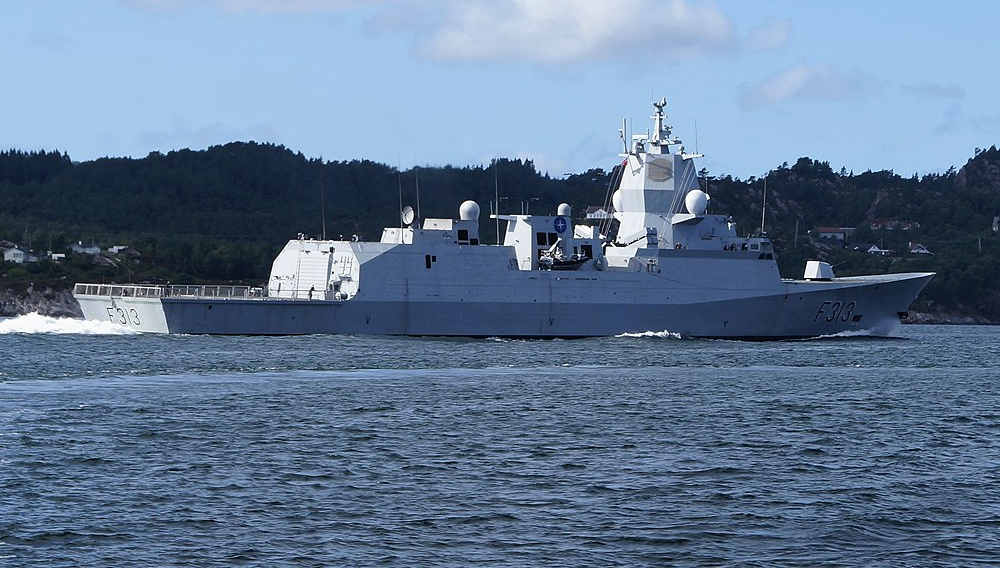
HNoMS Helge Ingstad, a Fridtjof Nansen-class frigate commissioned in 2009.
Photo detail via Wikimedia Commons.
The court case against the officer of the watch (vaktleder) and its appeals has brought the issue back to the front in Norway.
In yesterday’s Forsvarets Forums article (remember to translate it), retired Norwegian naval officer with multiple command tours, Hans Petter Midttun, outlines a must read wire brushing of the entire “optimal manning” concept.
You will see that his view of what it caused to the Norwegian Navy’s nightmare is a direct parallel of that happened to the US Navy in that horrible month of 2017; too much to do with too little people with too thin training.
Let’s dive in;
The Ministry of Defense (FD), the Defense Staff (FST) and the Norwegian Navy (SST) have, in my opinion, knowingly or unknowingly breached the prerequisites for proper operation of the frigates.
My claim is rooted in 23 years of frigate competence. I have held most of the operational positions in the frigate force. This includes the positions as ship commander at KNM Narvik and KNM Roald Amundsen, as well as a period at the Navy’s competence center and two periods as staff officer for the “shipowner”.
That is the extended way of saying, “I know you because I am you“. He’s raising his voice here because it is personal and he wants to go on the record that there are causes to this mishap much deeper than just the one officer on trial.
In light of the extensive changes that lay before the Armed Forces in 2004, we considered it crucial to describe the assumptions on which the staffing concept was based. It was not a new concept. It just hadn’t been described before. It had been developed as a consequence of continuous efficiency measures in the 90s.
One of our main messages was:
The Lean Manning Concept was not chosen because it was operationally smart. It was chosen because it enabled the Navy to man and sail (at the time) a balanced structure. It was an absolute minimum crew that could only work if all the prerequisites were met.
The last part — here on the Front Porch we describe that as “exquisite“. Everything — and everyone — has to work just right to make the formula work.
It doesn’t work that way outside the briefing room. Never does.
During a five-year period, the crew sailed one year less than what Nato considered necessary to maintain the operational level (for a frigate with a larger crew). But in addition, the crews never reached more than a maximum of 80 percent of their expected combat power. This meant that each year the training activity started at a lower level than the previous year.
You design minimum manning — and you get 80% of the minimum. It might work for awhile in peace — but it unquestionably won’t work in combat. Exactly the stew that contributed to the McCain & Fitzgerald collisions. Senior leaders try to convince everyone that 9-to-11 month deployments are a “new normal” and humans can do 100-hr work weeks for weeks to months on end with no downside. Just sadistic malpractice.
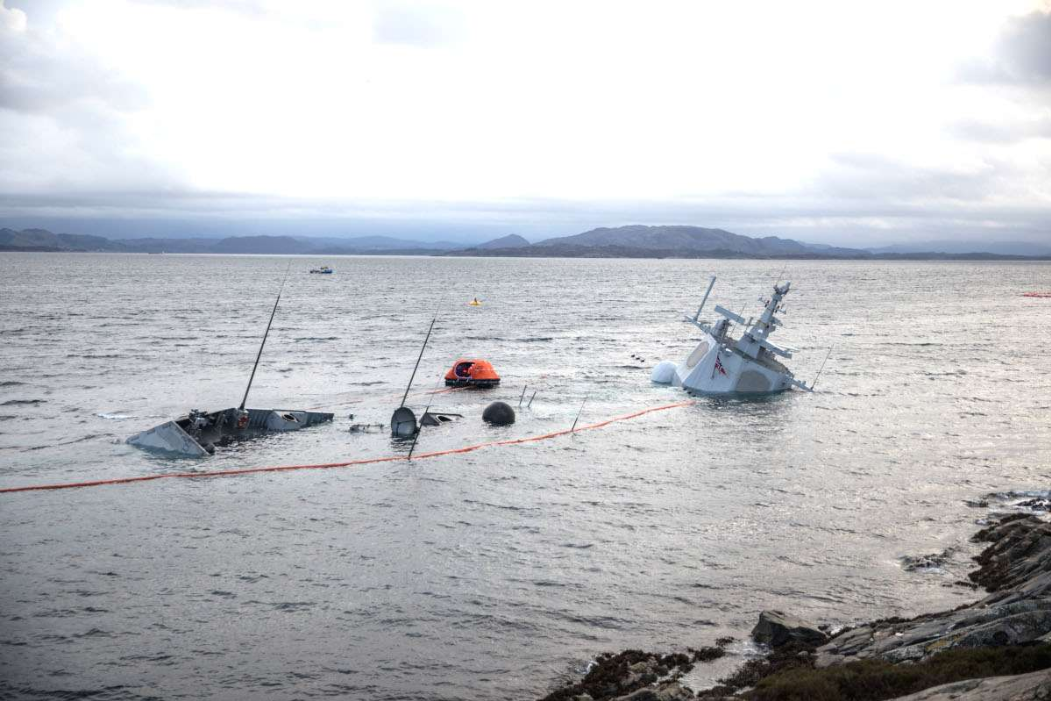
HNoMS Helge Ingstad after grounding, 13 November 2018. Immediately after the collision, the ship was run ashore to prevent it sinking, but she slowly slid down and eventually was almost completely underwater.
Photo via The Drive.
Comments Off on The sinking of Norwegian frigate HNoMS Helge Ingstad in 2018
May 24, 2023
The American flagship of Standing NATO Maritime Group 2 (SNMG2)
CDR Salamander has thoughts on the state of the current flagship of Standing NATO Maritime Group 2 (SNMG2), USS James E. Williams … unhappy thoughts:
One of the most high profile alliance units is Standing NATO Maritime Group 2 (SNMG2).
Consisting of a half dozen or so destroyers and frigates from assorted alliance members, it cruises about refining how we work together, conducting exercises, and showing the flag around the Mediterranean and Atlantic as time and livers allow. It is also an opportunity for nations to show their allies their professionalism.
Really, for a Sailor of any nation, it is some of the best duty you can find this side of BALTOPS … but I digress. We’ll return to BALTOPS at the bottom of the post.
Because of its high profile and extended operations with alliance nations, the ships we assign to SNMG2 don’t just represent the USA as any warship that “shows the flag” does, but it imprints on the mind of military and civilian leaders in Europe the quality of the US Navy and by extension, the nation it serves.
Our opponents in the world will also see it as an indication of our general health, morale, and the respect we show our friends.
I had an interesting seat as a junior officer. A little more than a month after reporting to my first sea duty command, I found myself with a front row seat to not just Desert Shield/Storm, but to the last year or so of the Soviet Union. I then watched from the Mediterranean and Atlantic the slow decay of the now Russian naval forces through the 1990s. A common refrain was as we got a close look at them was, “Did you see the condition they’re in?”
Looks matter. With ships, even more than people, the external manifestations of poor condition are a warning of significant problems inside the skin of the ship
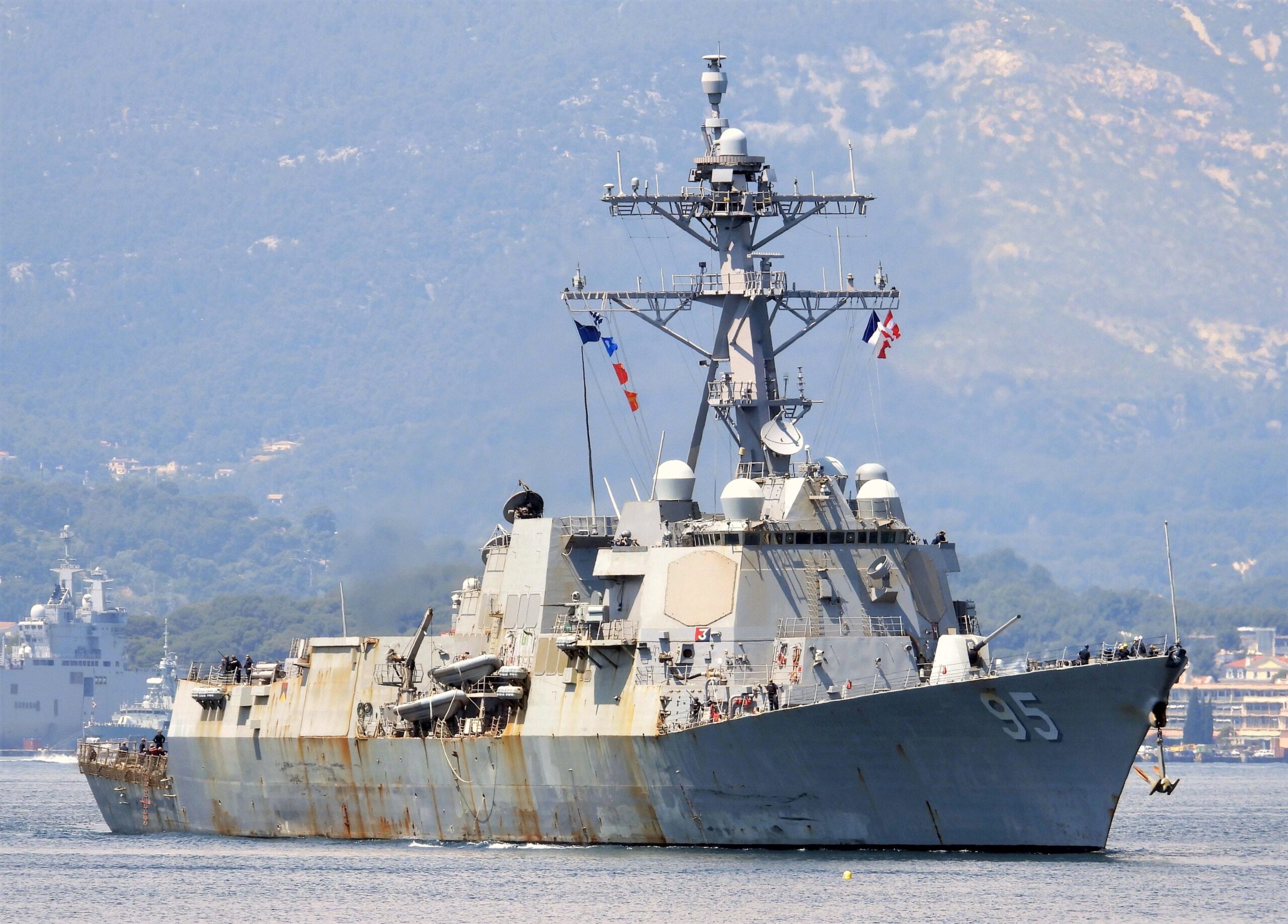
The Arleigh Burke-class Flight IIA guided missile destroyer USS James E. Williams (DDG 95) as it was leaving Toulon, France, May 22, 2023. Yes, the ship named after a Boatswain’s Mate First Class looks like that. I am sorry BM1, we tried.
Photo from https://twitter.com/WarshipCam/status/1660740976942501893.
SNMG2 decided to honor the United States Navy by having one of its destroyers be its flagship. That’s right kiddies; that rusting eyesore is the flagship of SNMG2.
The US Navy decided that this was the warship they wanted to represent the US Navy and the nation it serves. This was an act of commission – of intent – as conscious of an act as that which ensured that in the last few years that warship was not manned, trained, equipped, or maintained at a level which would allow for basic maintenance. Even as she got ready to get underway, no one stopped her. No one tried a last minute fix. The whole evolution has an ambiance of, “Who cares. Send her.”
Don’t think the insult isn’t properly understood, if not to Congress and the American people, but to our friends and competitors. Don’t think this isn’t the talk of allied wardrooms.
Comments Off on The American flagship of Standing NATO Maritime Group 2 (SNMG2)
May 5, 2023
The kinder, gentler US Naval War College
CDR Salamander on a recent symposium at the U.S. Naval War College, showing just how much the American military has adapted itself to the Current Year:
Let’s take a look around the planet with a maritime national security lens, shall we?
- The largest land war in Europe since WWII is raging on the north shore of the Black Sea.
- The People’s Republic of China surpassed the United States of America as the world’s largest navy.
- The Iranians are hijacking oil tankers willy-nilly.
- The Western economy relies on undersea cables & pipelines we have allowed to go undefended and are now the subject of attention by mal-actors on the world stage.
- The Navy is experiencing readiness and recruiting problems not seen since the 1970s.
There’s my top-5 off the top of my head this AM, yours may differ.
It sure seems to differ in Newport.
So, in the last week of April there was a 2-day symposium at the U.S. Naval War College, an opportune time to examine the most critically important challenges in 2023 — hopefully from a maritime perspective — wouldn’t you think?
Any conference, especially a 2-day affair with both on and off campus event locations, sure cost a lot of money and even more stacked manhours to plan, attend, participate, and manage.
We sure want to make sure the juice is worth the squeeze, right?
If you’re a regular here, you know where this is going. I warned everyone about this back in 2017. If you’re a new reader not fully up to speed on the broader portfolio we manage here at CDRSalamander, well, take a red pill and a seat.
Our war colleges are not what you think they are.
With each passing year there is less focus on war, and more on college. At the Naval War College, just getting additional time, money, faculty, and leadership focus on the “naval” portion has become a challenge with all the other ancillary agendas trying to keep pace with the cool kids cross-town at Salve Regina University.
Here’s a perfect example.
The Naval War College (NWC) will host its 9th annual Women, Peace and Security (WPS) Symposium, 26-28 April 2023, in Newport, Rhode Island. This year’s theme is “Women, Peace, and Security in a Fragile World: Perspectives on Warfighting, Crisis Management, and Post-Conflict Transitions“.
Well, let’s go in with an open mind. Perhaps there’s something here. Hope isn’t a plan, but when the Party demands things of you, hope is often all you have.
If you voluntarily attended (I am reliably told that Party cadre informed the proles that attendance was required for staff, at least online), what kind of panel discussions would you be able to listen to? Let’s browse over the agenda.
In totally unrelated news, Brent Ramsey updates the odds on who will be promoted to be the US Navy’s next Chief of Naval Operations:
Admiral Lisa Franchetti, Vice-Chief of Naval Operations, US Navy.
Last September, the Navy promoted and installed a new Vice Chief of Naval Operations. Then Vice Admiral Lisa Franchetti got her 4th star and was appointed to the second-highest position in the Navy. Now after a scant seven months, the betting line going around D.C. is that she will likely be the next CNO based on the identity politics track record of President Biden. When President Biden had an opportunity to appoint to the Supreme Court, before assessing anyone’s qualifications, he announced that a black woman would get that seat, and he followed up on that promise. Would an identity-based selection for the Navy’s top leader be in the best interest of the Navy and the Nation? No, the nation needs and deserves the very best warrior to lead the Navy into our threatened future.
Admiral Franchetti is a journalism graduate of Northwestern University NROTC, a non-STEM degree which itself is unusual, as the Navy strongly favors STEM degrees for officers. She has a Master’s Degree in organizational management from the University of Phoenix, an online university. Her biography does not mention any war college credential. In contrast, her predecessor Admiral William Lescher had multiple commands in combat zones, was a test pilot, had multiple advanced degrees in naval technical fields and his commands won multiple combat zone merit awards. To naval professionals, for someone to have been promoted to the Navy’s highest rank and second highest position based on a NROTC commissioning source with a liberal arts degree, an online masters, no war college or combat zone credentials, would be considered inconceivable. Perhaps her success is based on a particularly spectacular service record?
Admiral Franchetti’s career path reveals sea tours on a tender, oiler, and three destroyers including command of the USS Ross (DDG-71) and command of a destroyer squadron. Her biography does not mention any of her commands received awards while she was in command.
I’m not a betting man, but if I was, I think I’d be putting down a few jellybeans on Admiral Franchetti’s next posting …
Comments Off on The kinder, gentler US Naval War College
April 29, 2023
Okinawa 1945: Planning Operation ICEBERG
Army University Press
Published 7 Dec 2021On 1 April 1945, U.S. forces invaded the Japanese home island of Okinawa. It was the largest joint amphibious assault mounted during World War II in the Pacific Theater. The invasion of Okinawa was the culmination of three years of operations in the Pacific against Imperial Japan. The film explores the planning and preparation for Operation ICEBERG from September 1944 to 1 April 1945.
“Okinawa 1945: Planning Operation ICEBERG” examines the U.S. Army operations process as well as planning by echelon from field army, corps, and division with special emphasis on current Joint doctrine. This film is the first in a two-part series covering Operation ICEBERG and the U.S. Tenth Army’s securing of Okinawa.
(more…)
Comments Off on Okinawa 1945: Planning Operation ICEBERG


