In Ages of Discord, Peter Turchin describes the consequences of elite overproduction. Middle-class youths strive for a college degree to ascend the social ladder. But because the true elites are always a small group, an excess of college graduates saturates the job market with mid-level managers. As these managers fight for scarce spots at the top, intra-elite jockeying becomes more fierce. Tests of ideological purity become a way of winnowing the competition. Those most insecure in their elite status do the most virtue signaling, and punch down on the “unenlightened” lower white classes as a way of confirming their rank. Ultimately, these people end up filling the ever-increasing number of mid-level positions in government, media, and universities.
The managerial class in Canada is much more powerful than that in the U.S., for several reasons. First, the managerial class makes up a much larger share of Canada’s population, because far more Canadians go to college. Whereas 51.9 percent of Americans between the ages of 25–34 have tertiary education, in Canada it is almost 65 percent. While America’s elites are decentralized (Wall Street and Silicon Valley are very different), Canada’s elites are concentrated in the Laurentian corridor of Toronto-Ottawa-Montreal. And there is a revolving door between the managerial institutions. Since Lester Pearson, prime minister from 1963 to 1968, every leader of the Liberal party has begun his career as either a civil servant, academic, professional party hack, Bay Street lawyer, or leader of one of Canada’s Laurentian “continental corporations” — or as the son of one of these. These institutions receive generous federal funding. So does the Canadian media, which is now financially dependent on the federal government. Because these institutions are regionally concentrated and rely on symbiotic relationships with one another, Canada’s managerial classes hold hegemonic political power.
Canada’s vassalage to the U.S. intensifies the harmful effects of this situation. Once Canada surrendered its British character and integrated itself into the American empire, it became part of the continental system of elite overproduction. Ambitious Canadians seeking the top-tier education that will gain them elite status quickly discover that Canada’s universities are, as one professor once told me, “frustratingly above-average”. The most talented young Canadians therefore tend to jump ship and move to the U.S. The sine qua non for their success is mastering the American empire’s language, which is the language of liberalism. Every ambitious Canadian learns that to ascend, you must talk like American liberal elites. The Canadians who become fluent succeed: They get a top-tier U.S. degree and join the prestigious American networks. By and large, these people do not then want to move back to the imperial backwater. The few who do — such as former Liberal party leader Michael Ignatieff, who taught at Harvard, and the current Deputy Prime Minister Chrystia Freeland, who studied at Harvard and married a New York Times reporter — return home confident that they will be the big fish in the small pond. Hence Canada suffers a protracted brain drain to the U.S.
Nathan Pinkoski, “What Led To Canada’s Crisis”, First Things, 2022-02-24.
May 27, 2022
QotD: Elite overproduction and Canada’s managerial class
September 30, 2021
Petrol shortages in the UK
I’ve seen several reports on the somewhat sudden rash of petrol (gasoline to US/Canadian readers) shortages in Britain, and most of those reports airily pin the blame for the situation on Brexit. To the media, Brexit seems to be an all-purpose explanation for anything that goes wrong (in the same way that previous administrations get the blame for current problems even many years after they left power). Sean Gabb says that despite the frequent glib blaming of Brexit, in this case it is part of the reason:
There is in the United Kingdom a shortage of lorry drivers. This means a dislocation of much economic activity. Because it cannot be delivered, there is no petrol in the filling stations. Because there are not enough drivers, and a shortage of fuel, we may soon have shortages of food in the shops. Christmas this year may not involve its usual material abundance.
These difficulties are wholly an effect of the new political economy that has emerged in England and in many other Western countries since about 1980. An army of managers, of agents, of administrators, of consultants and advisers and trainers, and of other middle class parasites has appropriated a growing share of the national income. This has happened with at least the active connivance of the rich and the powerful. Since, in the short term, the distribution of the national income is a zero-sum game, the necessary result is low and falling real wages for those who actually produce. So long as the productive classes can be kept up by immigration from countries where even lower wages are on offer, the system will remain stable. Because leaving the European Union has reduced the supply of cheap labour, the system is no longer stable in England.
There are two obvious solutions. The first is to rearrange the distribution of income, to make the productive classes more able and more willing to produce. Since this would mean reducing the numbers or incomes or both of the parasite classes, the second is the solution we mostly read about in the newspapers. This is to restore the flow of cheap foreign labour.
In summary, that is my explanation of what is happening. For those who are interested, I will now explain at greater length. According to the mainstream theory of wages, labour is a commodity. Though workers are human beings, the labour they supply to employers is of the same general nature as machine tools and copper wire and cash registers and whatever else is bought and sold in the markets for producer goods. A wage therefore is a price, and we can illustrate the formation of wage rates with the same supply and demand diagrams as we use for illustrating the formation of prices:
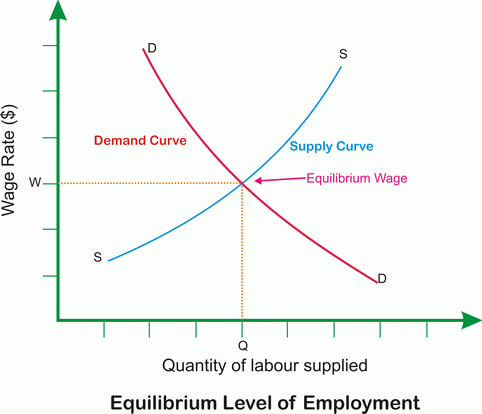
The supply curve slopes upwards because most work is a nuisance. Every hour of labour supplied is an hour that cannot be spent doing something more enjoyable. Beyond a certain level, workers can only be persuaded to supply more labour if more money is offered for each additional hour of labour. As with other producer goods, the shape of the demand curve is determined both by the price of what labour can be used to produce and by the law of diminishing returns.
[…]
Our problem in England is that large areas of economic activity have been rigged. There is an immensely large state sector, paid for by taxes on the productive. Most formally private activity is engrossed by large organisations that are able to be so large either because of limited liability laws or by regulations that only large organisations can obey. The result is that wages are often determined less by market forces than by administrative choice. In this kind of rigged market, we cannot explain the distribution of income as a matter of continual choice between marginal increments of competing inputs until the whole has been distributed. It may be better to look at a modified wages fund theory. A large organisation has a pot of money left over from the sale of whatever its product may be, minus payments to outside suppliers, and minus whatever the directors choose to classify as profit. This is then distributed according to the free choice of the directors, or how hard they can be pushed. Or we can keep the mainstream cross-diagrams, but accept that the demand curve is determined less by marginal productivity than by the overall prejudices of those in charge.
Therefore the growth of a large and unproductive middle class, and the screwing down of all other wages to pay for this. This is not inevitable in rigged markets, but is possible. It has come about since the 1980s for three reasons:
First, the otherwise unemployable products of an expanded higher education sector have used all possible means to get nice jobs for themselves and their friends;
Second, the rich and the powerful have accommodated this because higher wages and greater security for the productive might encourage them to become as assertive as they were before the 1980s;
Third, that these rich and powerful see the parasite classes as a useful transmitter of their own political and moral prejudices.

August 2, 2021
Who is Colt? A History of the Colt Patent Firearms Manufacturing Company
Forgotten Weapons
Published 23 Feb 2017Today we will take a look at the history of the Colt company, from Sam Colt’s first efforts in Paterson (and before) to the West Hartford remnants that survive today. If you enjoy this type of history, please let me know in the comments!
http://www.patreon.com/ForgottenWeapons
Cool Forgotten Weapons merch! http://shop.bbtv.com/collections/forg…
If you enjoy Forgotten Weapons, check out its sister channel, InRangeTV! http://www.youtube.com/InRangeTVShow
Gun display racking provided by Matrix Armory: http://www.matrixarmory.com
June 12, 2021
May 6, 2021
April 16, 2021
QotD: “Declaring passionate belief in freedom of speech”
One of the phrases in the mouth of managers or bureaucrats that indicates almost unfailingly that they are about to commit an act of betrayal is, “We believe passionately in.”
The only thing that most managers or bureaucrats believe in passionately is their career, in the broad sense of that term: for they are quite willing to abandon or sacrifice a career completely in the narrow sense if it is in the interest of their career in a broader sense.
I learned this in the hospitals in which I worked. As soon as a hospital manager said “I believe passionately in the work that Department X has been doing,” I knew that Department X was about to be closed down by that very same manager.
Thus, when I read that a publisher claimed that “We believe passionately in freedom of speech,” I knew at once that the publisher was about to withdraw a book from publication that it had previously advertised for publication.
Theodore Dalrymple, “‘Passionate’ Belief in Freedom of Speech and Multiplying Orthodoxies”, New English Review, 2020-12-22.
February 15, 2021
The current (and future) rash of newsroom purges
Some thoughts from The Line on why people like former New York Times science reporter Donald McNeil are being given the show trial treatment and why it’s not going to stop quickly:

The New York Times Building in New York City, 1 January, 2008.
Photo by Frieder Blickle via Wikimedia Commons.
The first issue, of course, is a steady weaponization of HR processes and unions. Vehicles intended to fix problems like unfair pay structures, workplace misconduct and lack of due process are being re-deployed as tools of ideological conformity — fuelled by healthy doses of personal dislike and professional resentment.
Make no mistake: there are bad people in journalism, as there are in any profession. Abusers should be rooted out, and there should always be clear processes in place to handle toxic personalities fairly, decisively and effectively. (“Fairly” isn’t a buzzword here — the accused must have rights, too.)
But there has also been a steady lowering of the bar as to what evils warrant an HR intervention. Every newsroom should be a safe place from abuse, harassment and violence — but not from ideas that are offensive. We recognize the entirely legitimate concerns of employees who are from marginalized groups about historic injustices, microaggressions and systemic power imbalances. But being in the world sometimes involves working with people who are simply insensitive assholes. Drawing the line between the merely difficult and the truly dysfunctional isn’t always easy.
Further, many of the complaints now being bandied about are strategic. They are being used to pummel terrified HR staffs and weak, ineffectual managers into compliance with ideological agendas. A staff at war with itself and ever-fearful of the axe is easier to silence and control. Owners have long understood this; it’s a grim irony that our peers have now decided to take up the hood and the blade.
These workplace revolts always boil down to an internal struggle for control. The very concept of where power rests is being challenged by those who think the traditional way of running newsrooms is as obsolete as a classifieds page. Uprisings are about who decides institutional values, and who gets to enforce those values. An entire class of leaders needs to wake up to the fact that they’re three campaigns deep into a battle for their own legitimacy. And they’re losing.
That brings us to the third issue: management. We’ve said this before, but managers need to show some spine. The most consistent theme in all these newsroom eruptions is management either lacking the confidence to assert its authority, or hesitating to do so just long enough to make things worse. Too many leaders have been selected for their affability rather than their toughness. We at The Line suspect this is no accident. Powerful editors, necessary for effective management of staff, are inconvenient for owners intent on slashing said newsrooms. The kind of people who’d be most effective at crushing the odd staff rebellion also annoy the suits. So instead, we get nice people — truly nice people — who know the right folks and subscribe to the right politics, and shy away from embarrassment, conflict, and loss of status. They’re marks.
July 26, 2020
QotD: Bureaucracy at its heart
Nassim Nicholas Taleb summed up in a simple aphorism what most of us instinctively know about bureaucracies:
Bureaucracy is a construction designed to maximize the distance between a decision-maker and the risks of the decision.
When something goes wrong, the bureaucrats play the blame-shifting game. Musical chairs will begin, and some poor fool will be stuck without a chair. When something goes right, of course, executive management will take credit. Your job as a bureaucrat is to be an implicitly political creature; to make your boss look good and, for yourself, to evade blame.
Bureaucracies become much worse when they are divorced from the profit motive. At least a large corporation must theoretically serve its customers in some positive manner, or they won’t remain in business for long. So while the internal politics of a large corporation are likely to suck like a Hoover, the external face of the company is often still somewhat pleasant for the customer.
With government bureaucracy, even that small consolation is lost. Go to the DMV, or any large government bureau. Long lines, smelly “customers”, and agents with extremely unpleasant attitudes abound. The motive is not to serve citizens well, or even to serve them quickly, but rather to meet the bare minimum necessary to avoid blame — and sometimes not even that.
Thales, “Bureacracy is Designed to Suck”, The Declination, 2018-05-02.
June 19, 2020
National Defence Headquarters needs to go on a crash diet
Ted Campbell knows how Canada’s NDHQ got into the state it is in, and has some suggestions for getting it out of its critical state of administrative morbid obesity:

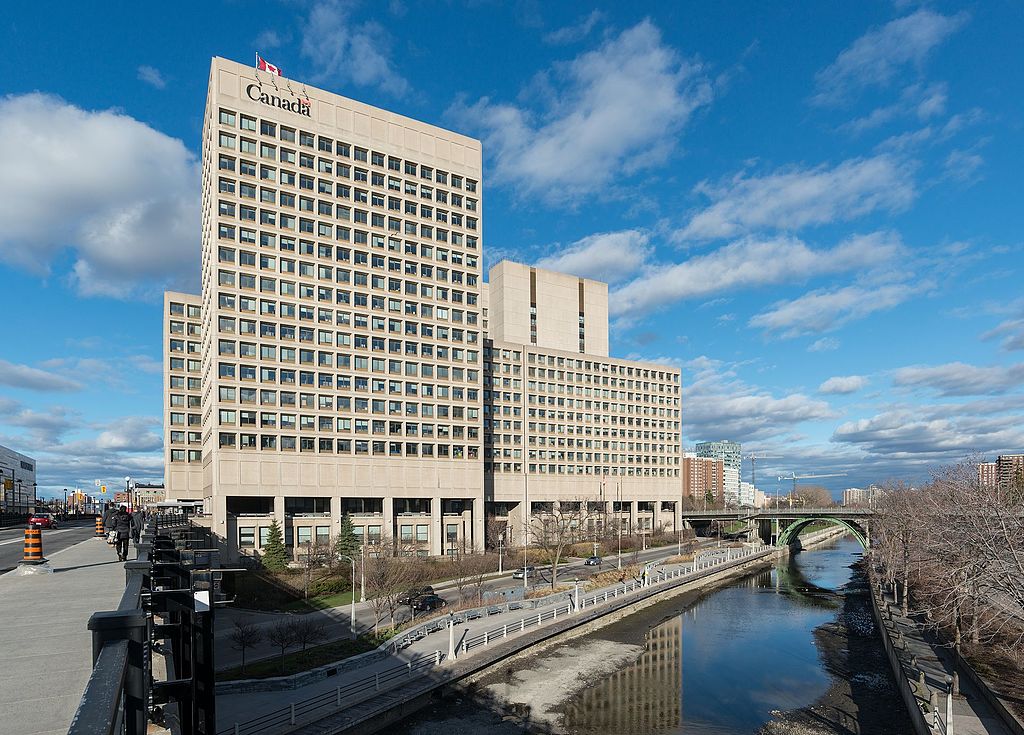
Major General George R. Pearkes Building in Ottawa, home of National Defence Headquarters on Colonel By Drive.
Photo by DXR via Wikimedia Commons.
National Defence Headquarters is a HUGE place with diverse functions. First: it is, simultaneously, the management centre of the Department of National Defence, which is a very large (and complex) department of government that includes the Canadian Armed Forces (but the CAF is just one of DND’s “arms”), and it is the national command centre for the Canadian Armed Forces. Second: it is one of the biggest budget departments in Canada. Defence spending supports many hundreds of thousands of jobs in the military, in the civil service and all across the spectrum of Canadian industry from the highest of high-tech enterprises through to janitorial services. It is never surprising when things fall through the cracks in any large, complex organization, is it?
But there are two other problems:
As defence spending has declined, year-after-year, always in terms of GDP and often in terms of its share of the public accounts and sometimes in real, dollar terms, too, the headquarters, especially the military’s command and control (C²) superstructure, has grown. A bit of growth is not surprising when one must “do more with less” as I well remember being told during the rounds of budget and staff cuts in the 1990s. Although to their credit, defence ministers in the Chrétien-Martin era imposed a series of staff cuts on the HQs in Ottawa, there was a bit of growth in the (largely civil service) policy and financial management areas. But in the Harper era that all changed. Budget pursestrings were loosened by governments after 2001 and, under e.g. Conservative Defence Minister Gordon O’Connor the Canadian Forces began to receive some much needed new equipment including the big CC-177 Globemaster III transport planes, new CH-147F Chinook transport helicopters and Leopard tanks ~ all procured on sole-source contracts, over the objections of many. But then O’Connor was replaced by Peter MacKay and, it appeared to me, the generals and admirals took over and the HQ went from lean to overweight and then to downright fat. Then, in the Trudeau era, the HQ went from simply being fat to being morbidly obese. There are, now, hundreds of admirals and generals, managing a military force that numbers in the (too few) thousands. Even serving flag and general officers have told me that cutting the highest ranks by ⅓ would do no harm and some retired officers and civil servants (with intimate knowledge of the inner workings of the HQ at the highest levels) say that a 50% cut would be healthy. The simple fact is that the Canadian Forces have too many very smart, very able senior officers with too little real work to do. They, not surprisingly, fill the time available with “work” of their own devising which, often, involves creating new and more complex command structures which require more and more general officers. The process seems unconstrained from the top.
Why? What happened?
Well, it started with the very best of intentions. I recall being told by one very, very fine general that we, the Canadian Forces, must, above all else, be “interoperable” with our American allies and that, he explained, meant adapting to their command and control system, poor as he thought it was. He said, and he meant, adapting, not adopting. But he retired and a new generation of officers entered the most senior ranks and some of them seemed, to me, to be more interested in adopting than in just adapting to. We seemed, in the 2000s, to be seized by a giant case of military penis envy and we seemed to want to have a local version of whatever the Americans had. The result was a proliferation of new command and control organizations, all put in place as the combat elements were actually shrinking. The end result was an unconscionable GOFO [General Officer/Flag Officer] to combat sailor and solder ratio and a bloated and, in my opinion, weak and inefficient command and control superstructure.
May 20, 2020
Bidding farewell to “the dumbest management fad of all time”
Jessica Stillman hails one positive likely outcome of the Wuhan Coronavirus epidemic … the end of the “open office plan”:
My Inc.com colleague Geoffrey James memorably called open-plan offices “the dumbest management fad of all time.” And with good reason. Not only do many workers loathe the interruption-prone, privacy-free spaces, but science shows they don’t even achieve their stated aim of fostering greater collaboration.
The current pandemic is a heart-breaking tragedy of epic proportions, but according to experts, it might at least have one small silver lining. Maybe, just maybe it will spell the end of the hated open-plan office.
[…]
All this means employers will need to find creative solutions to get work done even though far fewer people can safely fit in the same space. Continued work-from-home arrangements will certainly be part of the answer, but creative reconfiguring of your physical office is likely to be necessary too.
That’s a headache for facilities managers and bosses, but better news for open-plan office haters. In a post-coronavirus world, you will almost certainly have more privacy at work. In trade for that personal space, however, expect to submit to measures like temperature checks, half-empty break rooms, and a whole lot of hand sanitizer.
May 19, 2020
Some changes to the working world … when the world gets back to working
Sean Gabb has some thoughts on the post-lockdown return so … well, not normal, but as the economy reaches toward a new working equilibrium:

Kensington High Street at the intersection with Kensington Church Street. Kensington, London, England.
Photo by Ghouston via Wikimedia Commons.
The Coronavirus and its aftermath of lingering paranoia are the perfect excuse. Decentralisation and homeworking must be done. They must be done for the duration. They must be continued after that to maintain social distancing. No one will think ill of Barclays and WPP for taking the leap. No one will blame them for taking the leap in a way that involves a few deviations from course and a less than elegant landing. A year from now, these organisations will be making measurably larger profits than they would be otherwise. The mistakes will have been ignored.
And other organisations will follow. Whether the present crash will bring on a depression shaped like a V or an L, there is no doubt that, even if slowly at first, the wheels of commerce will continue turning. But they will be turning on different rails. As with any change of course, there will be winners and losers. I have already discussed how I can expect to be among the winners. I will leave that as said for the other winners — these being anyone who can find a market for doing from home what was previously required by custom and lack of imagination to be done somewhere else. I will instead mention the losers.
Most obvious among these will be anyone involved in commercial property. Landlords will find themselves with many more square feet to fill than prospective tenants want to fill. Rental and freehold values will crumble. Bearing in mind how much debt is carried by commercial landlords, there will be some interesting business failures in the next few years. Then there are the ancillary sectors — property management companies, commercial estate agents, maintenance companies. These employ swarms of architects and surveyors and lawyers and negotiators, of builders, plumbers, electricians, of drivers and cleaners. If the humbler workers will eventually find other markets, many with degrees and professional qualifications can look to a future of straitened circumstances.
The lush residential estates in and about Central London will follow. I think particularly of the aristocratic residential holdings in Kensington. Houses here go for tens of thousands a week to senior bank workers from abroad. If the City and Canary Wharf are emptied out, who needs to live in a place like Kensington? It has poor Underground connections. It is close by places like Grenfell Tower. Its residents keep predators at bay only by heavy investment of their own in security and by suspecting every knock on the door and every sound in the night. Many of the shops and eateries that make its High Street an enjoyable place to be will not reopen. Those that do reopen will be hobbled by continuing formal and informal rules on social distancing.
As a result, restaurants and pubs and coffee bars will begin to disappear. All but a few of these were barely making normal profit before they were closed last month. So few are in liquidation as yet only because so few petitions have been lodged in the courts. Most of them will now be surplus to requirement. The same can be said of hotels. Speaking for myself, I used to visit Cambridge twice a year on examinations business. I was always put up there for a couple of nights. I shall now do from home all that I did in Cambridge. I doubt I am alone. Zoom will destroy business travel. In the same way, bigger televisions plus continued social distancing will finish off the theatres and cinemas — also in decline before last month.
March 9, 2020
QotD: The wrong lessons learned from World War II
Americans learned several misleading lessons from World War II. The first and greatest error was overestimating the effectiveness of military force. World War II — the last conflict in which the world’s great powers went toe-to-toe against each other, with no holds barred — created a new understanding of how wars are fought and won. But wars since then have not fit this paradigm, and many of our subsequent military mistakes came as a result of misapplying World War II’s lessons.
Lyndon Johnson led the country into a massive military commitment in South Vietnam in part because of misplaced faith in what the United States could accomplish by force of arms. The Johnson administration convinced itself that fighting modern wars was a branch of management science, akin to running a large corporation like General Motors, and that America’s military was a versatile instrument that could be dialed up or down to deliver precisely calibrated levels of violence, tailored to meet any foreign policy challenge. World War II also led many Americans to conclude that liberal democracy could be imposed on foreign peoples through the application of what George W. Bush’s administration would later call “shock and awe.”
It turns out that, even in the age of precision weapons, military power is a blunt instrument, ill-suited to nation-building, except in rare circumstances and at great cost. Germany and Japan — our preferred examples — are highly idiosyncratic. Liberal democracy flourished in each only after the deaths of millions of citizens and the reduction of their societies to rubble. Americans haven’t shown much stomach for projects of this scope after 1945.
E. M. Oblomov, “The Greatest Generation and the Greatest Illusion: Success in World War II led Americans to put too much faith in government—and we still do.”, City Journal, 2017-12-28.
February 2, 2020
Boeing and the kitchen sink
In the Continental Telegraph, Tim Worstall looks at the mess the new Boeing management has inherited and what they may need to do to be seen to be fixing it:

“Boeing 521 427”by pmbell64 is licensed under CC BY-SA 2.0
Which brings us to another piece of stock market wisdom, about trying to catch a falling knife. A dangerous occupation and the reference is to trying to call the bottom on some stock that has just had a disaster. At some point, surely, the tumble in price will stop and there will be a bounce. Well, yes, or perhaps maybe, for we must not forget that that proper bottom is that end of life – the bankruptcy – price of nothing. For everything that isn’t about to go bust then yes, there’s a price at which buying in the face of everyone else’s panic can be highly profitable. The question being, well, what is about to go bust? Toys R Us did, after all. Actually, so have quite a lot of retailers just recently. There was no above zero price at which it was sensible to buy in.
So, some stock crashes in price, should we buy in? After all, there is that phenomenon known as the dead cat bounce – anything will bounce at least once if you drop it from high enough. The question becomes one of, well, is this crash a result of something that can be reversed, or perhaps something that’s not going to be terminal for the organisation? Or is this just the start of that realisation process that the organisation is coming to the end of its life and going to that final resting place of a zero dollar valuation?
[…]
So, Boeing and the 737 Max. The changes in airframe had the unfortunate consequence of diving a couple of the planes into the ground. We’ve had a drip of stories about how the development process wasn’t all we would wish it to be. The FAA isn’t going to let it back up into the air until the summer at earliest. The Dreamliner seems to be having demand problems and, well, things aren’t looking good.
But is this the start of some spiral to zero? No, don’t be daft. Partly because the American government simply would not allow that. Boeing’s too much part of the backdrop of the US economy for that to be left to happen. The military business is also of significant value whatever happens to the civil aviation side. And of course the numbers we’re talking about here could be painful to stock holders – they are already in part of course – but at the very worst we’re looking at some tens of billions of problem here. That’s just not enough to drive a company Boeing’s size down to zero. Not in this decade at least, given that the only reasonable competition is Airbus. Global duopolies don’t end that way.
So, at this point there’s an argument to say that trying to catch that falling knife of the Boeing stock price might be worthwhile. So, when might that be? At which point another idea, kitchen sinking. This is when a new management team decides to make themselves look good by declaring how bad things had got under the previous one. Absolutely anything and everything that looks like, it might even smell of a problem in the future is taken out and declared. Provisions are made for this problem on this contract, for that problem that might occur over there, add a bit more and then heck, why not, double it! This has, assuming the company survives this balance sheet massacre, the obvious effect of making the new management team look good over the years. Not just because everything starts from this new low place. But also because many of those provisions – those over-provisions – won’t be needed and can be written back from reserves into the P&L.
October 25, 2019
QotD: Command and control in the US military
A book excerpt in Foreign Policy caught my eye. It is by Thomas E Ricks, a long time critic of the US military’s leadership, and it is about the US Army’s failed command and control (C²) system which has been adopted, holus bolus, by Canada. I’m guessing that the article was written for American military officers because it is full of the bafflegab and jargon that is characteristic of their system ~ never use a short, simple, English word when a long, fancy one, with French or, preferably, German roots will do.
The crux of the author’s complaint is that military commanders have been relegated to the status of administrators and managers because the US Army is all about process and seems to care too little about results. The author complains, with reason, that headquarters, from battalion to the highest levels, have gotten larger and larger and more and more complex but appear to actually accomplish less and less. I think the same complaints can be, validly, made about Canada.
It is not surprising that Canada, like Australia, Britain, Chile and Denmark, has adapted at least some of the US military’s system ~ the USA has, after all, the most powerful military in the world. They must be doing something right, right?
Actually, since about 1950s, the US military has been distinguished by blunders and defeats at least as often as we have seen periodic displays of operational prowess: Viet Nam, Bay of Pigs, the failed hostage rescue in Iran, the invasion of Grenada, the second Iraq War all come to mind. The American military legacy has even spawned American satirical films about (constantly failing) American military command. That’s something I though only the Brits could do.
Ted Campbell, “Military command and control”, Ted Campbell’s Point of View, 2017-09-16.
November 1, 2018
Change appears to be inevitable for North American railways
In a recent column in Trains, Fred Frailey examines the long-term impact of the late Hunter Harrison’s railway management reforms:

Union Pacific locomotive 5587, a General Electric AC4400CW-CTE(AC44CWCTE)
Photo by Terry Cantrell via Wikimedia Commons.
In the year since Hunter Harrison’s death, Precision Scheduled Railroading, or PSR, has progressed from crackpot railroading (in the eyes of some railroaders and shippers) to the gold standard. And it happened so fast we are still trying to wrap our arms around what it means for the future of this industry.
The facts are these: Canadian National, Canadian Pacific, and CSX Transportation have been put through Harrison’s PSR wringer, emerging in every case much leaner in terms of productive assets — cars, locomotives, trackage, and employees. That meant tons of savings to hand to investors. Interesting to me is what happened after that. CN, which Harrison ran as president or CEO from 1998 through 2009, went on a growth spurt in that period that continues to this day. Revenue ton miles at CN — the most basic measure of what a railroad does — rose 48 percent between Harrison’s retirement in 2009 and 2017. So it’s clear that downsizing the railroad’s assets didn’t inhibit Canadian National’s growth, because no other railroad even approaches what it accomplished during this period. Revenue ton miles rose slightly during Harrison’s tenure at Canadian Pacific and are now rising faster. His successor there, Keith Creel, says CP is game to grow. That’s the same story coming from Jim Foote, who succeeded Harrison late in 2017 at CSX.
Harrison’s impact on the other railroads of North America is palpable. The man was scarcely buried before financial analysts forgot the chaos he unleashed in his hurry to implement PSR at CSX and began asking other railroads why they weren’t more like CN, CP and CSX. Union Pacific, the oldest surviving nameplate in American railroading, capitulated and began implementing PSR practices last October on the eastern part of the railroad, with a goal of expanding the transformation to the entire system within several years. Chief Executive Lance Fritz insists this isn’t a case of PSR Lite.
[…] To change the railroad, you must change the culture. Harrison did it in every instance by force majeure — if you didn’t embrace his plan, goodbye. Who will change the culture at Union Pacific? I am at a loss to know. My sources say the impetus for PSR came not from within the railroad, but from the board of directors, which puts Lance Fritz in a thankless position. He must lead the effort, but this isn’t his idea, and morale in management ranks is low to begin with. His chief operations officer is new to the job, and nothing in the man’s background shouts to me that he is up to this.
Yet there are a lot of smart people at Union Pacific, and no company of its stature launches something of this magnitude with a will to fail. I am heartened that UP began by pruning its management ranks — in 2017 it counted 3,678 executives, officials and staff assistants, versus BNSF’s 1,511. (In fairness, BNSF outsources its information technology, whereas UP does not, accounting for some of the difference.) UP revealed in late 2018 it would eliminate 500 nonunion jobs by year’s end, plus 200 contract workers.
But let’s face it: As done by Harrison, you begin the PSR process by stripping a railroad to its underwear. At CSX it meant cutting every conceivable cost, denuding the railroad of field supervisors and just about everything else, until it began to be dysfunctional. That’s when he knew he had cut enough and could add back assets to make the railroad workable. This method is like becoming pregnant; there is no half way. Union Pacific began Precision Scheduled Railroading with a go-slow approach, not wanting to punish shippers and arouse regulators. Hmm. The way to looks to me now, UP may achieve some good financial results but not the sort that Hunter Harrison could or that its directors might expect. It would be a lot easier for UP to simply buy Canadian Pacific and let Keith Creel, a Harrison acolyte who knows PSR inside and out, come in as an outsider and do the dirty work. And if the process will be hard for Union Pacific, imagine the barriers to PSR in front of BNSF, KCS, and NS, all under pressure to walk the walk but so far unwilling to do so.