
Some of the greatest victories of all time were managed by ad hoc organization that, like Topsy, just “growed“ from 1939 to 1945, as Churchill and Roosevelt searched for ways to operate a grand, strategic alliance fighting against formidable enemies, while the postwar fascination with process, led in large part by US Defence Secretary (1961-68) Robert S. McNamara, contributed, I believe, in a major way to the strategic and military debacle that was the Vietnam War (1955-75) when data began to replace tactics, and management theory, coupled with complex organization charts, replaced military acumen and strategic vision.
There is nothing wrong with good, sound management and management theory and management science (and, yes, I believe there actually is a such a thing) have much to teach us all, including governments and the military, about how to get the most from one’s always limited resources, especially time. But, too often, in my opinion, management becomes an end in itself and process replaces critical thinking and analysis. When this happens in both the political/bureaucratic and in the military realms, as I believe it has in Canada (which has tended, since about 1970, to follow the USA almost slavishly) then I believe that our national defence is in peril.
It is common, amongst military people, to accept that there is a “master principle of war”: Selection and Maintenance of the Aim. That means that one MUST understand what one is trying to do and then focus all one’s efforts on getting that done. The corollary is that if you don’t know what you need to be doing then getting the results you want (need) is unlikely. I believe that the Canadian Armed Forces lack good strategic direction because the Government of Canada, the Trudeau government, is unconcerned with anything past the next election. I also believe that the military leadership, lacking strategic direction, simply follows whatever new process seems to be popular in the Pentagon. Canadians, therefore, are not getting value for money from either the government they elected nor from the military forces for which they pay.
Ted Campbell, “Following the blind leader (3)”, Ted Campbell’s Point of View, 2019-05-21.
July 22, 2023
QotD: “Managing” your way to victory
July 2, 2023
QotD: Processes for fighting the last war
The same applies to “cyber” or “information warfare”; there is no doubt that technology has changed the so-called “battlespace”, making it bigger and more complex by, in effect, adding an invisible dimension. We have been conducting “information operations” for decades, even millennia — I would argue that at the end of the Third Servile War (73-72 BCE) when Marcus Licinius Crassus crucified 6,000 of Spartacus’ followers on the Appian Way (it is not clear if Spartacus, himself was among them) that it was psychological warfare which is either a subset of or a near relation to information warfare. But the tools have changed and with them, tactics need to change, too, but some principles will remain as they were 2,000 years ago, or 100 years ago (the Zimmerman Telegram) or 75 years ago (Turing, the Enigma machine and Bletchley Manor).
Ted Campbell, “Following the blind leader (3)”, Ted Campbell’s Point of View, 2019-05-21.
June 12, 2023
“The more recent four or five years at Indigo have been a disastrophe”
In the latest SHuSH newsletter, Ken Whyte outlines the rise and fall of Canada’s biggest bookstore chain that stopped trying to be a bookstore chain and now appears to be looking for a new identity to assume in the wake of several board resignations and the announced resignation of Heather Reisman, the founder and public face of the chain:

“Indigo Books and Music” by Open Grid Scheduler / Grid Engine is licensed under CC0 1.0

Indigo opened its first bookstore in Burlington in 1997 and quickly expanded across the country in competition with the Chapters chain, which it bought in 2001. Heather’s husband, Gerry Schwartz, provided much of the financing in these years. Gerry is the controlling shareholder of Onex, a private equity firm that now has about $50 billion in assets under management.
Influential in Ottawa, the Schwartz-Reismans managed to convince the federal government to approve Indigo’s purchase of Chapters and also keep the US book chain Borders from moving north into Canada — a double play that cleared the field of meaningful competition and wouldn’t have happened in a country with serious antitrust enforcement.
Heather, as Indigo CEO, cast herself as the queen of Canadian literature, making personal selections of books to her customers, hosting book launches, interviewing celebrity authors, etc.
From a financial perspective, Indigo took about five years to get rolling after the Chapters acquisition. It looked steady through the late aughts and into the teens when Amazon showed up in force. Indigo’s share price caved. Unable to convince Ottawa to push Amazon back across the border, Heather adopted a new strategy, backing out of books and recasting Indigo as a general merchandiser selling cheeseboards, candles, blankets, and a lot of other crap to thirtyish women. “We built a wonderful connection with our customers in the book business,” she famously said. “Then, organically, certain products became less relevant and others were opportunities.” This charmed investors, if not the book community, and Indigo’s share price hit a high of $20 a share in 2018. By then, books, as a share of revenue, had fallen from 80 percent of revenue to below 60 percent (they are now 46 percent).
The more recent four or five years at Indigo have been a disastrophe. With its eighty-eight superstores and eighty-five small-format stores, the company lost $37 million in 2019, $185 million in 2020, and $57 million in 2021. Things looked somewhat better in 2022 with a $3 million profit, but its first three quarters of 2023 (Indigo has a March 28 year-end) resulted in an $8 million loss and its fourth quarter featured one of the most spectacular cyberhacks in Canadian commercial history. The company’s website was breached and its employment records held for ransom, resulting in a ten-day blackout for all of the company’s payment systems and a month-long outage in online sales. The share price is now $2.00 or one tenth the 2018 high.
ANALYSIS AND IRRESPONSIBLE SPECULATION
Given everything Indigo has been through over the last several years, and especially the last several months, it’s not surprising that Heather wants to pack it in. She’s seventy-four and super wealthy. There’s nothing but a desperately hard slog ahead for her money-losing company. Why stay?
Still, this has the feel of something that blew up at a board meeting, or in advance of a board meeting. It’s highly irregular for a company to lose almost half its directors in a single day. If these changes had been approached in conventional fashion, there would have been more in the way of messaging and positioning, especially regarding Heather. For all intents and purposes, she is Indigo. It wouldn’t exist without her. They ought to be throwing her a retirement parade and presenting her with a golden cheeseboard. Instead, all she’s getting, for now, are a few cliches in a terse press release.
It’s also weird that this all happened days before we get the company’s year-end results (they were out by this time last year). My guess is that the board got a preview, that the picture is ugly, that there are big changes afoot, and that the directors were nudged out as the start of a major retrenchment or given the option of sticking around for a bloodbath and chose instead to exit.
June 9, 2023
Putting an end to “stakeholder” capitalism
The Streetwise Professor explains what “stakeholder capitalism” is and why it needs to be staked through the heart to save western economies:
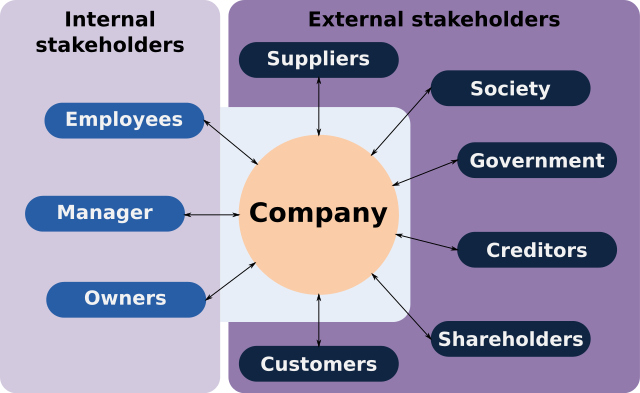
A graphic from Wikipedia showing typical internal and external stakeholders.
At its root, stakeholder capitalism represents a rejection – and usually an explicit one – of shareholder wealth maximization as the sole objective and duty of a corporation’s management. Instead, managers are empowered and encouraged to pursue a variety of agendas that do not promote and are usually inimical to maximizing value to shareholders. These agendas are usually broadly social in nature intended to benefit various non-shareholder groups, some of which may be very narrow (transsexuals) or others which may be all encompassing (all inhabitants of planet earth, human and non-human).
This system, such as it is, founders on two very fundamental problems: the Knowledge Problem and Agency problems.
The Knowledge Problem is that no single agent possesses the information required to achieve any goal – even if universally accepted. For example, even if reducing the risk of global temperature increases was broadly agreed upon as a goal, the information required to determine how to do so efficiently is vast as to be unknowable. What are the benefits of a reduction in global temperature by X degrees? The whole panic about global warming stems from its alleged impact on every aspect of life on earth – who can possibly understand anything so complex? And there are trade-offs: reducing temperature involves cost. The cost varies by the mix of measures adopted – the number of components of the mix is also vast, and evaluating costs is again beyond the capabilities of any human, no matter how smart, how informed, and how lavishly equipped with computational power. (Daron Acemoğlu, take heed).
[…]
Agency problems exist when due to information asymmetries or other considerations, agents may act in their own interests and to the detriment of the interests of their principals. In a simple example, the owner of a QuickieMart may not be able to monitor whether his late-shift employee is sufficiently diligent in preventing shoplifting, or exerts appropriate effort in cleaning the restrooms and so on. In the corporate world, the agency problem is one of incentives. The executives of a corporation with myriad shareholders may have considerable freedom to pursue their own interests using the shareholders’ money because any individual shareholder has little incentive to monitor and police the manager: other shareholders benefit from, and thus can free ride on, any individual’s efforts. So managers can, and often do, get away with extravagant waste of the resources owned by others placed in their control.
This agency problem is one of the costs of public corporations with diffuse ownership: this form of organization survives because the benefits of diversification (i.e., better allocation of risk) outweigh these costs. But agency costs exist, and increasing the scope of managerial discretion to, say, saving the world or achieving social justice inevitably increases these costs: with such increased scope, executives have more ways to waste shareholder wealth – and may even get rewarded for it through, say, glowing publicity and other non-pecuniary rewards (like ego gratification – “Look! I’m saving the world! Aren’t I wonderful?”)
H/T to Tim Worstall for the link.
May 14, 2023
The life of the publishing world, fifty years ago
I point out things that prove that the past is a foreign country often enough that I have a blog tag for that purpose. When I first entered the work force, the conditions Ken Whyte describes for employees and managers at a publishing company weren’t all that uncommon (although they were already edging toward the endangered species list):

Fifty years ago, when Richard Charkin […] began his career in the book trade, telephones were wired to desktops and editors (male) wrote their letters and memos in longhand, turning them over to women in the typing pool who knocked them out on carbon paper because the publishing world was slow to photocopiers.
Employees smoked at their desks and drank at lunch. Men wore suits and ties and hats; women long skirts. Living wages were paid and even mid-level jobs came with a car. It was not uncommon for people to spend their whole careers at a single company.
Charkin started at Pergamon Press, an Oxford-based scientific publisher. It held an annual Miss Pergamon contest, essentially a beauty pageant for female employees. The winner received a titled sash, cloak, crown, and the opportunity to greet VIP visitors at company events. Pergamon was considered a progressive company for its time. Needless to say, this was before the dawn of the HR department. Also before marketing and IT departments, but publishers did have guilds, members of which met to discuss business at the pub.
In the mid-1970s, Charkin moved from Pergamon to Oxford University Press, which had traditions of its own. For instance, fortnightly editorial conferences were held at 11 a.m. on Tuesdays (but not in summer when everyone was off on extended vacations). Editors attended in robes and sat around an enormous table. In front of them were inkwells filled with fresh ink.
Charkin worked out of OUP’s Ely House offices in Mayfair. Tea ladies pushed trolleys down the corridors once in the morning and again in the afternoon, dispensing drinks and biscuits. There were three dining rooms on the premises: “one in the basement for all staff, which provided hearty and generously subsidized fare, while on the second floor there was an officers’ dining room, reserved for editors and middle managers, where meals were prepared by a fine chef and the drinks were free. At the very top of the building was the publisher’s dining room, which was exclusively for the use of the head of the London office … and his guests. The food here was sourced from Jackson’s of Piccadilly and the wine list was excellent, with the cellar being overseen by a senior manager at OUP whose job involved spending at least a month in France every year researching and ordering directly from vignerons.”
Class distinctions were rigid enough that two sets of bike racks were required, one for editors, the other for printers. There were a lot of printers: OUP still manufactured its own books and made its own paper, that very thin but indestructible variety once common in Bibles.
You’ll be shocked to learn that Oxford University Press, in operation since 1478, was in deep financial trouble by the 1980s.
In Toronto, this sort of thing was common in the bigger, long-established firms like banks, insurance companies, and even the major grocery chains (the Dominion head office facilities were reportedly top-notch in their day). I imagine it was even more the case in places like New York and Chicago.
May 2, 2023
Si vis pacem, para bellum
CDR Salamander suggests that the “War Gods of the Copybook Headings” are not happy with us, and he’s probably right:

Relief at the entrance of the Cultural Center of the Armies (formerly the Serviceman’s Casino) of Madrid (Spain), showing the Latin phrase Si vis pacem, para bellum (If you want peace, prepare for war).
Photo by Luis Garcia (Zaqarbal) via Wikimedia Commons.
Mindsets are universal.
Yes, no one can see the future. Of course, it is easy to play “got-cha” in hindsight. Yes to all the excuses … but that isn’t the point.
Two things to keep in mind as you read the below:
- Our “experts” may lack broad expertise. Always question. Defer only when earned.
- We have a horrible record of predicting even the predictable for a whole host of reasons, most bureaucratic.
- At peace, assume you have leaders who can only imagine peace unless they actively demonstrate otherwise, that they will plan and act in line with their priors. When war comes, it will be up to others to fix things (as they say in the movies, “When they get in trouble, they send for the sons of bitches“.). The harder peacetime leaders are pressed by those who understand the constants of history, the less difficult the fix will be when war comes.
This is one of the virtue/vice dualities of democratic states. In peacetime, there is no political appetite for military spending and no political party will be eager to provide the opportunity to be accused of warmongering. An opposition party might briefly call attention to defects in the standing military, but only to embarrass the governing party, not because they would address the problem if they were in power. There may be widespread passive support for the military, but this isn’t represented at the ballot box because there are always far more urgent issues that drive how the voters allocate their support … and military spending is a lot of money put into things that don’t fix the roads, improve public health, address law and order concerns, or clean the environment.
Peacetime military establishments are huge bureaucracies at the best of times, and those who want to rise through the bureaucracy need to learn how use the same tools, schemes, and stratagems as in every other civil service organization. The longer a country has been at peace, the less capable the military administration will be of transitioning to a war footing. If you haven’t seen war in twenty years or more, then every officer up to the very top of the chain of command got there not for being a good soldier/sailor/airman but for being a good peacetime manager and administrator. This is totally normal, as is the massive disruption when a real war is imminent. If you’re lucky, some of those administrators-in-uniform can make the transition to being combat leaders quickly, but many of them will not be able or willing (it’s just human nature to resent and resist sudden change of long-standing practice).
Well meaning people can be wrong. Just because they are well meaning and have tenure-reputation-rank should not mean that everyone has to defer to them or their plans.
Good leaders with sound ideas and well developed plans will welcome hard questions and informed challenges.
Bad leaders with weak ideas and compromised plans will be defensive, flinty, and more often than not will resort to appeals to authority or credentialism. Those are your warning signs.
Sadly, highly isolated decision nodes — think the Transformationalists in the first half of the ’00s — don’t think they are wrong. They have filtered their information sources and filled out their staffs with either clones or the obsequious — often found in the same person.
They are the ones who have a blinkered focus on usually something far on the horizon that can’t be measured right now — but is very attractive to them for reasons of either a broader ignorance, ego, or monetary.
They don’t fully accept “risk” – they dismiss it.
In the area of national security — such a mindset and practice can create an existential crisis and it comes from hubris.
Smart people who are so convinced of their wisdom without humility will filter out any concerns, and won’t allow questions that might challenge their wisdom.
They may be right as they didn’t, mostly, get to where they were by being wrong — and they don’t consider they may not be and hedge accordingly.
April 12, 2023
QotD: Karen
self-propelled lifestyle accessorieskids while she gets exalted at hot yoga and the nail salon, now that school’s out. Give her a week without Starbucks, I said, locked in her house with Kayden, Brayden, Jayden, and Khaleesi, and she’ll demand we never mention the word “flu” again.In other words, I misunderstood the essence of Karen. Karen is — first, foremost, and always — a victim. I of all people should’ve known better, because I was surrounded by Karens all the time in my personal and professional life. I’ve mentioned this story before, but bear with a quick repeat: At one of my first teaching gigs, at the big directional tech that makes up a lot of “Flyover State”, the department’s women got it into their vapid little heads that they — women — were being systematically excluded from positions of power. The fact that the department chair was a woman, and in fact the whole department, emeritus through first year grad student, was something like 65% female should’ve been their first clue, but nevertheless, they persisted. They got together a blue-ribbon commission, as one does, and studied the shit out of the problem. The much-ballyhooed report revealed …
… that all the positions of authority in the department, every blessed one, was held by a female. At which point, without missing a single fucking beat, they started complaining that being forced to hold all these positions of authority was keeping them from making adequate career progress.
I shit you not.
That’s Karen, my friends.
Severian, “The Civil War That Wasn’t”, Rotten Chestnuts, 2020-09-09.
March 31, 2023
QotD: The education racket
Indeed, it’s not going too far to say that these types of institutions are designed to chase off anyone brighter, more honest, or more hardworking than the average member. If you haven’t had any experience with teachers or school boards lately (you lucky bastards), think back to your last encounter with Human Resources, or your neighborhood’s Homeowners’ Association. The only person who can stand to work for HR or be part of the HOA is … well, is the kind of person who works in HR or is part of the HOA — dull, vapid, lazily malicious busybodies. They’re as lazy as they are dumb, as dumb as they are malicious. The key to dealing with them, like the Sovietologist’s key to predicting the Politburo, is figuring out which of their lovely personality traits is likely to come to the fore in a given situation.
Severian, “How Dumb Are Liberals?”, Rotten Chestnuts, 2020-07-31.
March 20, 2023
McKinsey, in the backrooms, with a masterplan
Elizabeth Nickson suggests that the vast disruption of life in western societies, the transformation of governments from barely competent to actively tyrannical, and the economic undermining of middle class prosperity may all be linked to one management consulting firm:

The brutalism of government during the last three years was anomalous in western democracies. First of all, it was irrational, it contravened common sense, which almost everyone possesses, and it destroyed millions of household economies and small businesses. It impoverished and starved a billion people in the developing world. It killed the old, brutally, refusing them affection in their last days. It divided us and is still dividing us. The virus was engineered by the government and paid for by the people it was unleashed upon. And then the fiends forced injections upon anyone with a job and a family to feed, via relentless propaganda, where it too contravened basic reason (acquired immunity, tiny effect on people under 70), and then the shot started to kill. And the deaths were ignored, records hidden, and the press was quiescent.
Who did this? This wasn’t normal government behavior. Government is usually just incompetent. At the very least it pretends compassion, is generally well-meaning, its check the voting booth. But now, it’s full-on Satanic. And the voting booth is essentially gone, corrupted by cartels, the CCP, the international left, the profiting UniParty.
But this niggled at me. Who drew up the plan, instituted it in every country, bullied every citizenry, devised the advertising, instituted the protocols? What operation has that level of power, of discipline?
Only one answer: McKinsey. McKinsey innovated and executed the whole damned thing. Mr Google is quite clear. In France, in Canada, in the U.S., in Australia and New Zealand. The cruelty, the ruthless crushing of millions, it was all them. In Canada alone they made $100 million “transitioning” government’s duty of care into a brutal suppression of anyone without elite status.
McKinsey is the international consultancy that lands everywhere that owners want to maximize their income. It is profoundly efficient. It privileges the predator class and institutes a brutal Darwinian system for everyone else.
“We don’t do policy,” said Richard Elder, DC Mckinsey chief. “We do execution.” Sure, buddy, you aren’t at the meeting where they tabletop ICE budgets, game the Chicago Health bureaucracy by Kaiser or how to sell more opioids to teens?
Trudeau had to have taken McKinsey advice when he set planeloads of anonymous black Kevlar-clad mercenaries on Canadian truckers and their supporters. He simply doesn’t have the nerve to do it alone. That action was unprecedented in Canadian history. Even the poodle press thinks McKinsey runs Canada. It has contracts across ministries, its former CEO, Dominic Barton, is Trudeau’s ambassador to China, and he is likely guiding some of the election theft that has been taking place under Trudeau. Whether McKinsey games immigrant ballot harvesting remains to be seen, but it bears its fingerprint.
January 16, 2023
The music industry fails to capitalize on the vinyl revival
It’s kind of hard to believe, but the companies that control the pressing of music into vinyl appear to have no clue about the business they’re in:

“Framed Vinyl Album Art: America ‘Homecoming’; Nick Gilder (Studio Copy of Singles From ‘City Lights’ Chosen for AOR); Climax Blues Band ‘FM Live’)” by JoeInSouthernCA is licensed under CC BY-ND 2.0


I’d heard so many grand claims for the vinyl resurgence, but the reality was tremendously disappointing. And I was a late adopter — the revival had been going on for a decade, but record labels still didn’t have their act together.
In my case, I ended up buying vinyl albums, but mostly used ones. I simply couldn’t find new pressings of the records I wanted. This was fine for me, but lousy for musicians and labels — who make no money on the sale of a secondhand vinyl album.
I have some experience in these matters — in my alternative career I worked with CEOs chasing after fast growth product categories. I know how they handle these situations. But, really, it’s no mystery. The strategies you use in this kind of business are very straightforward:
- You add manufacturing capacity aggressively — to make sure you have enough product to fuel growth.
- You bring down costs by getting scale advantages. But this only happens because unit costs drop as volume increases. So the single biggest goal is to grow sales as hard and fast as possible.
- You constantly reduce prices to keep demand building. In some cases, you even set prices below your costs to accelerate growth rates. When I originally saw companies do this I was skeptical — how can you make profits if you sell below your costs? But I soon learned that you eventually got a huge payback.
- You keep expanding the product line, so that you constantly have something new and exciting to sell to every potential buyer.
- You invest in R&D so that you eventually have a next generation technology to keep the growth going over the long haul.
None of this is easy to do, but it isn’t impossible. It just takes investment, focus, management commitment, and hard work. And later you reap the benefits. You turn a small business into a huge one, and enjoy a big payday.
The record labels could have done that with vinyl. It was taking off — unit sales doubled in just 5 years. And these sales were insanely profitable, because much of the demand was for old music. So labels didn’t even have to pay to sign artists, and cover the costs of recording sessions. The music was already there, with the fixed costs amortized long ago.
They just had to press the bloody album and ship it to the store. How hard is that?
But what did the music industry do?
- They hate running factories — which is hard work. So they tried to outsource manufacturing instead of building it themselves. Chronic shortages resulted.
- They refuse to spend money on R&D, so they stayed with the same vinyl technology from the 1950s. In other words, the record business became the only entertainment industry in the world with no plan for technological innovation. In the year 2023, even bowling alleys, bordellos, and bookies are more tech savvy than the major record labels.
- They want easy money, so they kept prices extremely high. That was bizarre because their R&D and catalog acquisition costs were essentially zero, and they could have priced vinyl aggressively. Instead they treated vinyl as a luxury product, even as they dreamed of it also becoming a mass market option. But you can’t do both without a careful market segmentation strategy — which the labels never even started thinking about.
- They love hype, so they focused on high visibility vinyl reissues, which look good in press releases, but couldn’t be bothered to make back catalog albums available. After a decade of the vinyl revival, they still hadn’t taken even basic steps in offering a wide product line.
This is a lazy strategy — and the exact opposite of what they should have done. And the results are, of course, predictable.
January 14, 2023
More on the Barnes & Noble turnaround
In the latest SHuSH newsletter, Ken Whyte looks at the Barnes & Noble recovery story (discussed a couple of weeks back):

“Barnes & Noble Book Store” by JeepersMedia is licensed under CC BY 2.0 
 .
.
Back in 2018, the bookselling chain was losing $18 million a year. It had just fired 1,800 full-time employees. About 150 stores had been closed, leaving the company with 600. It had lost its fourth CEO in five years, this one to a sexual-harassment charge. The firm’s big digital initiative, the Nook e-reader, was a flop. The share price was down 80 percent.
Not only was the business failing: it was demoralized. As the writer Ted Gioia noted in a recent newsletter, B&N had lost faith in the public’s willingness to buy books from anyone but Amazon. Its leadership “shifted a huge portion of its floorspace to peddling toys, greeting cards, calendars, and various tchotchkes”. It doubled down on in-store cafes and even tried launching freestanding Barnes & Noble restaurants.
Just when it seemed B&N was certain to follow the path of its former competitor, the Borders chain, which closed in 2011, it was purchased for $638 million (US) by Elliott Advisors, a hedge fund.
SHuSH has been skeptical about the record of hedge funds in the cultural space. We are also skeptical of hedge funds in the retail space where they have a well-established record of buying chains, slashing costs, and driving them into the ground: Sears, Toys R Us, Payless Shoes, Radio Shack, Aeropostale, Sports Authority, etc.
Elliott Advisors is an exception.
The UK based-firm has a demonstrated commitment to bookselling (at least in the medium term — more on this later). It bought the Waterstones chain in 2018. Waterstones and its 283 stores had been rescued from near-bankruptcy in 2011 by lifelong bookseller James Daunt and a Russian backer. Elliott kept Daunt at the helm and a year later bought Barnes & Noble and added this second chain to his responsibilities.
Daunt acknowledged that Barnes & Noble was in rough shape when acquired by Elliott. Its stores were “crucifyingly boring”. But he was confident the chain could be turned around. There was no template or magic ingredient, he said. It was a simple matter of “running really nice bookshops”. To that end, he gives his stores unusual autonomy to develop their own personalities and tailor their stock to the interests of their communities.
Barnes & Noble stores have since dropped most of their crap: they no longer look like big-box flea markets. They’ve quit accepting payments from the major publishers to put their books on display, a practice that brought B&N revenue but left publishers in charge of what customers saw when they walked into stores. Local managers now decide how their books are presented based on what they think will appeal to their customers.
The company used the COVID lockdown to freshen up its dowdy stores. Managers were instructed to take every single book off the shelves and “weed out the rubbish”. Walls were painted, aged carpet replaced, furnishings upgraded. The result is a much improved browsing experience. Readers like to browse.
There were hard decisions, too. Daunt cut the B&N head office staff in half and shed about 5,000 of 30,000 employees.
All in all, it worked. Last spring, The New York Times reported that sales were up and costs were down at Barnes & Noble and that “the same people who for decades saw the superchain as a supervillain are celebrating its success. In the past, the book-selling empire, with 600 outposts across all 50 states, was seen by many readers, writers and book lovers as strong-arming publishers and gobbling up independent stores in its quest for market share … Today, virtually the entire publishing industry is rooting for Barnes & Noble — including most independent booksellers. Its unique role in the book ecosystem, where it helps readers discover new titles and publishers stay invested in physical stores, makes it an essential anchor in a world upended by online sales and a much larger player: Amazon.”
There are not a lot of reliable financial numbers available on Barnes & Noble because it is no longer a public company, but it reports that its 2021 sales in were up 3 percent over pre-pandemic times. Most importantly, sales of books were up 14 percent.
December 30, 2022
Barnes & Noble used to be like an even more boring Indigo … but they’ve been turned around
Back when my job required more travel, one of the things I used to look forward to was visiting US bookstores, as they always had a wider and more interesting stock than our staid Canadian equivalents. Over time, the interesting local bookstores got harder and harder to find as the big box stores like Borders and Barnes & Noble took over much of their customer base. Of the two, I much preferred going into a Borders store, as they had better stock than B&N and the staff seemed friendlier and (generally) more helpful to clueless foreigners like me. Borders went under around the same time my business travels to the US tapered off and it looked like it was only a matter of time for B&N to follow it into bankruptcy. Even if it struggled on, surely the pandemic killed off what Amazon left behind? Ted Gioia says not so fast:
“Barnes & Noble Book Store” by JeepersMedia is licensed under CC BY 2.0 .
But Barnes & Noble is flourishing. After a long decline, the company is profitable and growing again — and last week announced plans to open 30 new stores. In some instances, they are taking over locations where Amazon tried (and failed) to operate bookstores.
Amazon seems invincible. So the idea that Barnes & Noble can succeed where its much larger competitor failed is hard to believe. But the turnaround at B&N is real. In many instances they have already re-opened in locations where they previously shut down.
Barnes & Noble tried exactly the same sort of “re-imagining” of their stores that Canada’s Indigo chain is currently floundering with: cutting back on the floorspace devoted to books in favour of throw cushions, candles, decorations, bath salts, scarfs and towels. It worked just as badly for B&N as it is working for Indigo: it chases out the primary customer base (book-buyers) in favour of bored people looking to waste away an hour or two just browsing tchotchkes. (And if you can find an Indigo staff member to ask about a particular book, they almost always assure you that you can find it on their website, which I’m sure helps bring more people into the store …) In desperation, B&N looked to expand into a very different market:
… in a bizarre strategic move, the company decided to launch freestanding restaurants under the name Barnes & Noble Kitchen — no books, just meals. But this was another disaster.
The company chairman Leonard Riggio eventually admitted, in September 2018, that running a restaurant is “a lot harder than you think it is … The bottom line is awful.”
Given the incredibly short and profitless life of most start-up restaurants, that really does qualify as a “No shit, Sherlock” moment. So how did Barnes & Noble turn things around?
It’s amazing how much difference a new boss can make.
I’ve seen that firsthand so many times. I now have a rule of thumb: “There is no substitute for good decisions at the top — and no remedy for stupid ones.”
It’s really that simple. When the CEO makes foolish blunders, all the wisdom and hard work of everyone else in the company is insufficient to compensate. You only fix these problems by starting at the top.
In the case of Barnes & Noble, the new boss was named James Daunt. And he had already turned around Waterstones, a struggling book retailing chain in Britain.
Bringing in fresh blood can be a life-saver for a business, but we also have that expression about deck chairs on the Titanic in common business parlance, so just being “new” isn’t enough … new leaders must also bring new approaches and fresh ideas:
But the most amazing thing Daunt did at Waterstones was this: He refused to take any promotional money from publishers.
This seemed stark raving mad. But Daunt had a reason. Publishers give you promotional money in exchange for purchase commitments and prominent placement — but once you take the cash, you’ve made your deal with the devil. You now must put stacks of the promoted books in the most visible parts of the store, and sell them like they’re the holy script of some new cure-all creed.
Those promoted books are the first things you see when you walk by the window. They welcome you when you step inside the front door. They wink at you again next to the checkout counter.
Leaked emails show ridiculous deals. Publishers give discounts and thousands of dollars in marketing support, but the store must buy a boatload of copies — even if the book sucks and demand is weak — and push them as aggressively as possible.
Publishers do this in order to force-feed a book on to the bestseller list, using the brute force of marketing money to drive sales. If you flog that bad boy ruthlessly enough, it might compensate for the inferiority of the book itself. Booksellers, for their part, sweep up the promo cash, and maybe even get a discount that allows them to under-price Amazon.
Everybody wins. Except maybe the reader.
Daunt refused to play this game. He wanted to put the best books in the window. He wanted to display the most exciting books by the front door. Even more amazing, he let the people working in the stores make these decisions.
This is James Daunt’s super power: He loves books.
“Staff are now in control of their own shops”, he explained. “Hopefully they’re enjoying their work more. They’re creating something very different in each store.”
This crazy strategy proved so successful at Waterstones, that returns fell almost to zero — 97% of the books placed on the shelves were purchased by customers. That’s an amazing figure in the book business.
On the basis of this success, Daunt was put in charge of Barnes & Noble in August 2019. But could he really bring that dinosaur, on the brink of extinction, back to life?
December 8, 2022
Meta (the artist formerly known as Facebook) moves to clamp down on political discussions in the workplace
Tom Knighton on an uncharacteristic corporate move by the artist formerly known as Facebook:

My favourite reaction to Facebook rebranding as “Meta”.
It seems there are certain words employees aren’t really supposed to bring up in the workplace.
Meta (formerly Facebook) has reportedly told its employees not to discuss sensitive issues like abortion, gun control, pending legislation and vaccine efficacy at workplace.
According to a report in Fortune, citing a leaked internal memo, Meta has banned employees from discussing “very disruptive” topics, including abortion, gun rights, and vaccines as part of new “community engagement expectations”.
“As Mark mentioned recently, we need to make a number of cultural shifts to help us deliver against our priorities,” read the company memo.
“We’re doing this to ensure that internal discussions remain respectful, productive, and allow us to focus. This comes with the trade-off that we’ll no longer allow for every type of expression at work, but we think this is the right thing to do for the long-term health of our internal community,” it added.
Unfortunately for Meta, employees hammered them on the fact that they could talk about Black Lives Matter, immigration, and trans rights.
Now, they’re not really wrong to call out the hypocrisy, but this sounds like just a first move, and it’s a step in the right direction.
What would have been a better move is simply prohibiting discussing politics with your coworkers unless it directly pertains to your job. For example, if you are responsible for content moderation and a new bill will impact how you conduct that moderation, that’s one thing.
But topics ranging from Black Lives Matter to gun control are all contentious issues, and while Meta might have allowed that discussion in the past, they probably won’t indefinitely.
This is interesting to me, in part because we’ve seen the woke in the technology sector essentially bully employers into following along with the left’s agenda. Yet when they tried that with Netflix, the streaming giant basically told them to suck it up.
That was in May, but it may have triggered companies to realize that they didn’t have to play the woke game.
Last week, in the weekly wrap-up, I included this story about how Disney’s returning CEO Bob Iger is trying to have the company step back from the political ledge. Iger is far from a conservative, mind you, but he’s come to realize that his personal political agenda isn’t going to sell.
Granted, he started them along that path, but he’s recognized it’s not a great road to go down.
Now, we have Meta that may be venturing on a similar path to Netflix, setting the stage for what’s appropriate and what isn’t.
December 4, 2022
QotD: In praise of mediocrity
Mediocrity is not a problem in itself; it is inevitable. Indeed the world needs many mediocrities, that is to say mediocrities who know themselves, and are perfectly content, to be such (complacency is as much an underestimated quality as rebelliousness is an overestimated one). The problem with mediocrity begins when it is allied to overweening ambition, as it seems so often to be the case nowadays.
Ambition is likewise a quality that is excellent when it attaches to something worthwhile in itself, but which is dreadful when it does not. And the rapid and phenomenal spread of education has increased the spread of ambition with it, much of it inevitably of the apparatchik type, that is to say the determination to climb some bureaucratic career ladder detached from any purpose except survival and, if possible, self-aggrandizement. To climb such a ladder you have to be both ruthless and submissive at the same time. You have to be egotistically prepared to stab people in the back in the scramble for advancement, while at the same time being prepared to suppress your own personality by uttering other people’s clichés at the expense of your own thoughts. Unpreparedness to do this, either through lack of training or moral scruple, unfits you for a career in the organization, any organization. You have to learn to lie with clichés, and do so with a straight face.
Theodore Dalrymple, “In Defense of Mediocrity”, Taki’s Magazine, 2018-02-17.
November 26, 2022
Indigo vastly prefers selling pillows, candles, and tchotchkes of all kinds rather than – ugh! – books
In the latest SHuSH newsletter, Ken Whyte explains why it’s becoming harder and harder to find actual books in Canada’s biggest bookstore chain … because they no longer want to be a bookstore chain:
“Indigo Books and Music” by Open Grid Scheduler / Grid Engine is licensed under CC0 1.0
We need to talk about Indigo. As you know, it’s Canada’s biggest bookstore chain, with 88 superstores and 85 small-format stores. It sells well over half the books that are bought in stores in Canada, with Walmart, Costco, and independent bookstores accounting for most of the rest.
One problem with Indigo is that it’s failing. The other problem is that it’s abandoning bookselling. Yes, that sounds like a Woody Allen joke, but it’s not funny from a publishing perspective. We depend on Indigo.
The company’s finances have been ugly for some time. It lost $37 million in 2019, $185 million in 2020, and $57 million in 2021. Things looked somewhat better in 2022 with a $3 million profit, but the first two quarters of 2023 are now in the books (it has a March 28 year end) and Indigo has already dropped $41.3 million.
[…]
Indigo hasn’t come right out and said we’re through with books. It can’t, given that Heather [Reisman] has spent the last twenty-five years building herself up as the queen of reading in Canada. Also, the Indigo brand is still associated with books in most people’s minds and that won’t change overnight no matter how many cheeseboards it stocks. So Heather talks about a gradual, natural transition: “We built a wonderful connection with our customers in the book business. Then, organically, certain products became less relevant and others were opportunities.”
To be clear, books are irrelevant; general merchandise is the opportunity. Heather recently appointed as CEO a guy named Peter Ruis who has no experience in books. He comes from fashion retail, most recently the Anthropologie chain, which sells clothing, shoes, accessories, home furnishings, furniture, and beauty products. Anthropologie was hot in 2008, and it seems to be where Indigo wants to go today.
Fair enough. You own a company, you can take it in any direction you want, so long as your shareholders will follow. I don’t blame Heather for having second thoughts about the book business. (I have them every week. It’s a tough business.) But where does that leave readers, writers, agents, publishers, and everyone else who remains committed to books?
You’ll recall that Indigo and Chapters, between them, decimated the independent bookselling sector in Canada in the nineties. They are the principal reason Canada has so few independent bookstores today. You could probably fit the combined stock of all our independents into a handful of Heather’s stores.
The federal government let Heather’s Indigo buy Larry Stevenson’s Chapters in 2001, which gave her a ridiculously large share of the market. That shouldn’t have happened.
At the same time, with the help of some lobbying by Heather, the federal government made it clear that the US chains, Borders and Barnes & Noble, weren’t welcome up here. The argument was that bookselling was a crucial part of our cultural sector and needed to be protected from foreign domination by the Canadian government.
In that spirit, Indigo also asked the federal government to prevent Amazon from opening warehouses in Canada. That request was denied in 2010, which is about when Indigo began its transition out of books.
One can see how Heather might feel betrayed by the federal government. Instead of protecting bookselling, it swung the door wide open for Amazon. You said I wouldn’t have to compete!


