
Have you noticed how programs and apps and websites have taken to “improving” by taking away functions you liked and used every day?
Now, everybody thinks they know what you want better than you do. With the extra added side benefit of “molding” your actions to conform to what they think is preferable.
Again, Jobs was very, very good at actually determining what people really wanted, versus what they held onto simply because it was familiar. He killed the floppy disk drive. He veered away from power-on buttons. He got lots of changes through that seemed huge at the time, but in hindsight are natural.
And because of his precedent, in addition to (at least) fifty-plus years of marketing “wisdom” that treats customers as mindless sheep, everybody now treats you, the user, as a “moist robot” who does not think, but merely needs the proper stimulus to behave the way they want you to.
Steve Jobs was the outlyingest outlier there is: He was a jerk, but he actually was a genius, and he actually did want to change the world, and he actually was very good at figuring out what people would want before they even knew they wanted it.
The foundation on which the Cult of Jobs was built was, wonder of wonders, actually pretty solid.
I would bet that not one single emulator of his has the same solid basis on which to stand. They all learned how to imitate him, to give the impression of integrity as it is currently misunderstood, thanks in part to Jobs’s antics. But I would be surprised if any copied his substance. Because genius cannot be faked. Only the appearance of it can.
D. Jason Fleming, “The Steve Jobs Myth”, According to Hoyt, 2016-09-12.
June 8, 2018
QotD: The cult of Steve Jobs
June 6, 2018
June 3, 2018
Conrad von Hötzendorf – A Military Genius? I OUT OF THE TRENCHES
The Great War
Published on 2 Jun 2018Chair of Wisdom Time!
May 15, 2018
Evolution of French Infantry During World War 1 I THE GREAT WAR Special
The Great War
Published on 14 May 2018The French soldier in 1914 was already very different from the one in 1918 if you looked at his uniform or equipment. Also the combat tactics evolved considerably in four years of war. The Battle of Verdun, the Nivelle Offensive or the Battle of La Malmaison were important steps during that evolution in which the Poilu became a modern French soldier.
May 10, 2018
QotD: Langue de bois
The attendees [of a medical leadership conference] would learn about something called “lean management,” one feebly-attempted definition of which is as follows:
If someone tells you that “lean management is this” and not something else, if someone puts it in a box and ties a bow around it and presents it in a neat package with four walls around it, then that someone knows not of what they speak. Why? Because it is in motion and not a framed picture hanging on the wall. It is a melody, a rhythm, and not a single note.
This is the mysticism of apparatchiks, the romanticism of bureaucrats, the poetry of clerks. From my limited observations of management in public hospitals and other parts of the public health care system, it seeks to be not lean, in the commonly used sense of the word, but fat, indeed as fat as possible; nor are large private institutions very much different.
It seems, then, that we have entered, gradually and without any central direction or decree, a golden age of langue de bois or even of Newspeak. Langue de bois is the pompous, vague, and abstract words that have some kind of connotation but no real denotation used by those who have to hide their real motives and activities by a smokescreen of scientific- or benevolent-sounding verbiage. Newspeak is the language in Nineteen Eighty-Four whose object is to limit human minds to a few simple politically permissible thoughts, excluding all others, and making doublethink — the frictionless assent to incompatible propositions — part of everyday mentation.
Langue de bois and Newspeak are no longer languages into which normal thought must be translated; rather they have become the languages in which thought itself, or rather cerebral activity, takes place, at least in the upper echelons of the bureaucracy that rules us. If you ask someone who speaks either of them to translate what he has said or written into normal language, it is more than likely he will be unable to do so: His translation will be indistinguishable from the words translated. It is therefore clear that, where culture is concerned, the Soviet Union scored a decisive and probably irreversible victory in the Cold War.
Theodore Dalrymple, “Life de Bois”, Taki’s Magazine, 2016-09-10.
April 7, 2018
The Danelaw – Alfred vs. Guthrum – Extra History – #1
Extra Credits
Published on 5 Apr 2018The Vikings moved from Scandinavia to the coasts of Britain, intent on establishing a new kingdom by any blood necessary. What they probably didn’t expect was that one of their own leaders, Guthrum, and the local king, Alfred, would end up cooperating on the creation of a kingdom for the Danes.
Sponsored by Total War Saga: Thrones of Britannia! http://store.steampowered.com/app/712100/Total_War_Saga_Thrones_of_Britannia/
April 1, 2018
Genghis Khan – Lies – Extra History – #7
Extra Credits
Published on 31 Mar 2018How DO you pronounce Genghis Khan’s name? What cool stories did we have to leave out of the main animated series? And how does Walpole fit into all this? It’s time for Lies, featuring Jac Kjellberg (writer) and James Portnow!
March 26, 2018
Genghis Khan – The Final Conquering Years – Extra History – #6
Extra Credits
Published on 24 Mar 2018Genghis Khan wanted to establish a long-lasting legacy of conquering and growth for the Mongols, but at what cost? Even his own sons fought each other for the throne. Would peace truly last in the lands he had conquered?
March 18, 2018
Genghis Khan – Beginnings of the Great Mongol Nation – Extra History – #5
Extra Credits
Published on 17 Mar 2018The man now known as Genghis Khan, leader of all Mongols, was ready to show the world what he was made of. He acted in fairness towards his own people and happily began integrating Chinese citizens and their culture, but showed no mercy to those who opposed him.
King George V in World War 1 I WHO DID WHAT IN WW1?
The Great War
Published on 17 Mar 2018He was monarch over the largest empire the world has ever seen. When the war came he saw his duty as the face of determination for his people: King George V.
March 12, 2018
Genghis Khan – Khan of All Mongols – Extra History – #4
Extra Credits
Published on 10 Mar 2018Temüjin had a plan: a set of strategies to keep amassing wealth and followers for himself while keeping unity between all the disparate Mongol tribes he was collecting. But Jamukha and Ong Khan had other plans…
And the next premier of Ontario is likely to be … Doug Ford?
Saturday’s Ontario Progressive Conservative leadership contest went down to the wire … and beyond, as voting glitches pushed the announcement of a winner beyond the time the party had rented the facility in Markham, so attendees had to go elsewhere to wait for the final result. In a disturbingly similar way to the last US presidential election, Christine Elliot won the popular vote, but the result hinged on the number of constituencies won, which went to Ford. Several of my (Liberal or NDP) friends on Facebook, who’d announced they’d joined the PCs explicitly to vote against Ford, were aghast at the result.
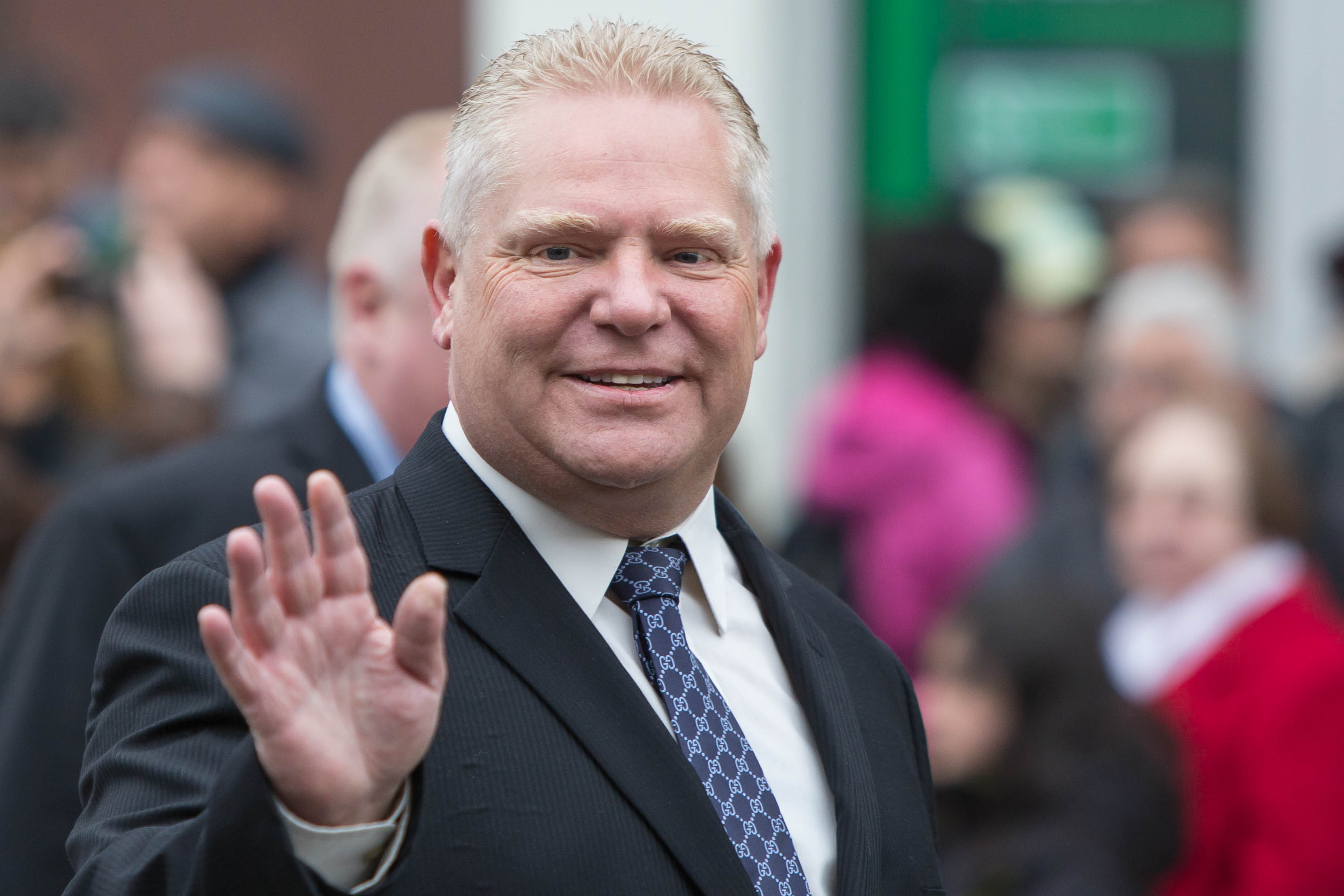
New Ontario Progressive Conservative leader Doug Ford at the 2014 Good Friday procession in East York.
Photo via Wikimedia.
In the National Post, Chris Selley reports on the three-ring circus:
In the end, maybe caucus had it right. If more than anything else Ontario’s Progressive Conservatives wanted to win on June 7 then maybe they should have stuck with interim leader Vic Fedeli. If the ultra-folksy MPP for Nipissing wasn’t the most compelling imaginable premier-in-waiting, he would certainly have cut a less divisive figure than Doug Ford, who was announced as the party’s new leader late Saturday night in a small room at a Markham conference centre.
“To the party members I say thank you. To the people of Ontario I say relief is on its way,” Ford told reporters and campaign workers. “And to Kathleen Wynne, I say your days as premier are numbered.”
That got a massive cheer, of course, but this is an outcome that many in the party consider a worst-case scenario. An Angus Reid poll released this week asked “soft” Tory voters whether each candidate would make them more or less likely to support the party: Ford’s net score (more likely minus less likely) was minus 27 per cent; Christine Elliott, who finished a very narrow second Saturday — her third failed shot at the position — was at plus 20.
Sticking with Fedeli would also have spared the party the hideous embarrassment of Saturday’s botched convention. Vote-counting dragged on for hours thanks to a chunk of ballots that had been allocated to the wrong ridings. A packed crowd of partisans was left in the dark for three hours, then told to hang tight for another 30 minutes, and then sent away into the night with no result. In lieu of a cascade of balloons, there was booing and hollering. Various Ford supporters, citing ostensibly conclusive media reports earlier in the day that Ford had won, alleged party elites were trying to steal it.
These were not the ideal circumstances in which to build unity, which was the stated purpose of the event. “You’ve been through a very tough couple of months — perhaps the toughest times in the history of the Progressive Conservative Party of Ontario,” Alberta United Conservative Party leader Jason Kenney told the crowd. “You’ve gone through weeks of anxiety and adversity. But I am certain that you will overcome this time of trial, and that this afternoon, with the election of your leader, you will emerge stronger, united and victorious in the election.”
“This afternoon,” he said. We were so young then.
CORRECTED: 2018 Ontario PC leadership electoral point flow. #onpcldr pic.twitter.com/0w89PK9Er2
— Paul Fairie (@paulisci) March 11, 2018
The flow of votes from Allen to Ford was expected, but what I didn’t expect was the proportion of Mulroney votes that flowed to Ford instead of Elliot (I’d expected roughly 100% to Elliot, but a significant number went to Ford instead).
Perhaps the most surprising thing about the leadership campaign was how well Ford managed to stick to his talking points and not be baited into the kind of media spectacle his late brother seemed to specialize in. A tougher test awaits in the June provincial election, however. The Liberals and NDP have been gifted a full warehouse of attack ads, based on the Ford brothers’ chaotic and at times incoherent term in office in Toronto, but there may be a limit to the overall usefulness of this arsenal: rather like the US media attacking Trump during the last US election, we’ve probably heard it all before.
The circus may not be over yet, however, as reports on Sunday indicated that Christine Elliot is demanding an investigation into the election.
March 11, 2018
Soviet Leaders in 7 Minutes (History)
Austin Olney
Published on 19 Apr 2016Learn about the leaders of the Soviet Union.
Vladimir Lenin
1917-1922
Joseph Stalin
1922- 1953
Georgy Malenkov
1953-1955
Nikita Khrushchev
1953 – 1964
Leonid Brezhnev
1964 – 1982
Yuri Andropov
1982 – 1984
Konstantin Chernenko
1984 – 1985
Mikhail Gorbachev
1985 – 1991Music – Goldeneye 64 Menu
March 10, 2018
Jacob Rees-Mogg versus the Tory establishment
In the Continental Telegraph, Hector Drummond describes the rise of Jeremy Corbyn despite the bitter resistance of the Labour party establishment and says that the mistake Labour made was allowing Corbyn on the ballot in the first place — the party rank and file were far more ideologically “left” than the MPs and party officials. “When Corbyn was elected leader, it looked like Labour had shot itself through the foot. It now looks like what actually happened was that New Labour shot itself through the heart.”
On the other side, the closest equivalent threat to the Tory party establishment appears to be Jacob Rees-Mogg:
It’s clear that the wet Tory establishment is not keen on Jacob Rees-Mogg. On the surface that appears to be because he holds robust views that are at odds with theirs: he’s an actual Conservative, and they are, of course, anything but. But I wonder if there’s a deeper fear there as well: do they worry that if Rees-Mogg becomes leader then the party will slip out of their grasp in the way that Labour was taken over by hard-left, Momentum commies?
[…]
So I suspect the Tory establishment think that at all costs Rees-Mogg must be kept off a leadership ballot, because there’s a good chance he would win: he constantly tops the polls among party members for preferred leader. You see how the thinking would go after that. He’ll appoint a dry Cabinet. The likes of Gove and Johnson would be given a freer rein. Maybe even John Redwood would come into cabinet. All the disgruntled right-wingers who’ve quit the party in recent decades would come flocking back, including all the racists. We’d have a proper Brexit. The new members would get involved in choosing more right-wing candidates in local constituencies, which the central office would now be okay with. Some centrist MPs and councillors would quit the party, and The Guardian and the BBC will big up their huffy resignation letters. Anna Soubry, having left the party, will do wall-to-wall TV interviews telling the BBC and CNN how bad the Tories are under Rees-Mogg. And so the Tories would lose voters from the middle as they come to be seen as another bunch of UKIP-style golf-club bores, and Jeremy Corbyn will win the election (which the Tory establishment will think is a horrible outcome, but not quite as horrible as Rees-Mogg winning the election).
However, such fears are a bit overblown. True, Anna Soubry probably would quit, but that’s a good thing. Disgruntled right-wingers may come back into the fold, but that’s a good thing as long for the Tories (as long as overt racists are kicked out) – the Tories need those people back voting for them, and working for them.
But I can’t see Rees-Mogg upturning the Conservative establishment. Maggie Thatcher couldn’t do it, she remained a outlier for her entire career despite being PM for years, so I doubt Rees-Mogg could either (although I hope he can). And although there’s a lot of energy on the right at the moment, there’s nothing like Momentum, with its quasi-religious fervour, and its Stalinist-style fanaticism. Plus the wider establishment, like the BBC, the civil service and the Universities are virulently anti-right, and they have a vice-like grip on power, and they’ll harry the Conservatives under Rees-Mogg. So the party would go right to some degree, but not to any great extent. And eventually the squishy MPs will kill off Rees-Mogg once he makes a mistake.
But it should be good while it lasts, as long the Establishment fails to prevent him getting onto the leadership ballot paper.
March 5, 2018
Genghis Khan – The Debut of Temüjin Khan – Extra History – #3
Extra Credits
Published on 3 Mar 2018Jamukha and Temüjin were officially fighting for control of the Mongolian steppes, appointing themselves the titles of “khan.” But each man practiced wildly different strategies to gain prestige — Jamukha showed no mercy, but Temüjin took a more egalitarian route.


