
Extra Credits
Published on 24 Feb 2018When Temüjin needed help to find his kidnapped wife, Börte, his blood brother and friend Jamukha came to his aid, and the two eventually combined their camps and families. But peace would not last long…
February 26, 2018
Genghis Khan – The Rivalry of Blood Brothers – Extra History – #2
Comments Off on Genghis Khan – The Rivalry of Blood Brothers – Extra History – #2
January 30, 2018
DicKtionary – A is for Air Force – Curtis LeMay
TimeGhost
Published on 17 Jan 2018A is for Air Force, you know that of course
And we turn to the states to look at the dates
When the man in command, that some couldn’t stand
Is our hero today, General Curtis LeMay.Join us on Patreon: https://www.patreon.com/TimeGhostHistory
Like TimeGhost on Facebook: https://www.facebook.com/TimeGhostHistory/
Written and Hosted by: Indy Neidell
Based on a concept by Astrid Deinhard and Indy Neidell
Produced by: Spartacus Olsson and Astrid Deinhard
Executive Producers: Bodo Rittenauer, Astrid Deinhard, Indy Neidell, Spartacus Olsson
Camera and Edit by: Spartacus Olsson
Comments Off on DicKtionary – A is for Air Force – Curtis LeMay
January 21, 2018
Sun Tzu – The Art of War l HISTORY OF CHINA
IT’S HISTORY
Published on 8 Aug 2015Sun Tzu’s The Art of War is a book on military strategies written around 500 BC, between the collapse of the Zhou dynasty and the rise of the first emperor of imperial China. Today Tzu’s guidelines are still as applicable as ever. They are still being read by military commanders, politicians and businesspeople all over the world. Also known as “Master Sun’s Military Methods”, the book explains basics like the “Strategy of Attack”, “Moving the Army” and even “Employing Spies” in 13 short chapters, restricting itself to general principles rather than detailed instructions of strategy and tactics. Learn all about this timeless and influential military masterpiece on IT’S HISTORY.
Comments Off on Sun Tzu – The Art of War l HISTORY OF CHINA
January 8, 2018
Mark Steyn reviews Darkest Hour
The latest screen depiction of Winston Churchill gets the once-over from Mark Steyn:
Churchill tends to the Churchillian, which is to say the epic. Darkest Hour, by contrast, is very finely focused. Joe Wright, director, and Edward McCarten, writer, confine their two dark hours of screen time to a couple of critical weeks in May 1940, when Hitler’s invasion of Norway precipitated Neville Chamberlain’s retreat from Downing Street. Aside from some rather elaborately choreographed overhead shots and a lush grandiose score, Darkest Hour is filmed claustrophobically, too – in poky sitting rooms, Downing Street basements, attics, Westminster ante-rooms, and chilly lavatories; the lighting is crepuscular. The fate of the world is being determined, but we never glimpse the far horizons, only the dingy backrooms.
What happened that month was a showdown between the two principal contenders for the Prime Ministership, Mr Churchill and Lord Halifax. Stephen Dillane is excellent as Halifax, the vulpine cadaver looking down (in every sense) from the Commons gallery at Churchill’s turns at the dispatch box. Unfortunately, aside from skillful deployments of his inscrutable yet condescending eyebrows, he gets somewhat short shrift on screen, so as a Churchill vs Halifax cage match it never quite comes off – presumably because the third Viscount Halifax is entirely unknown in Hollywood. (“Third Viscount Halifax? Hey, let’s see what the first two gross before we commit to that…”)
This is a pity, because the two men were on opposite ends of the seesaw, and, capacious as Churchill’s own bottom is, most of the other players – the King, Chamberlain, the parliamentary party, defeatist generals, Dominion prime ministers around the globe – were inclined to park their own butts down Halifax’s end. On May 10th, the day Winston became PM, the Germans invaded Belgium, France and the Netherlands. Ten days later, Hitler’s army reached the Channel, and was within reach of throttling the 300,000-strong British Expeditionary Force at Dunkirk, and seizing the entire French fleet. In that dreadful month of May, Churchill wanted to fight on; Halifax preferred to use Mussolini’s “good offices” to sue for a “peace” that would leave Britain and its empire more or less “intact” – save for East Africa, Suez, Malta, Gibraltar and sundry other places that would have to be addressed, per the Italian ambassador in London, “as part of a general European settlement”.
In other words, we are at the great hinge moment of the twentieth century: Had Halifax prevailed, there would have been a neutered Berlin-friendly British Empire directly bordering America on the 49th parallel and all but directly the Soviet Union in Central Asia. There would have been no potential allies for Moscow in the event of war with Germany, thus incentivizing a successful conclusion in late 1940 to Molotov’s talks in Berlin to join the Axis; and no allies whatsoever for Washington, assuming Japan still felt the need to bomb Pearl Harbor the following year. Instead, Churchill prevailed – and Britain and its lion cubs fought on, playing for time until first the Soviets and then the Americans joined the war against Germany, Italy and Japan. That year in which the moth-eaten Britiish lion and its distant cubs stood alone is, more than any other single factor, the reason why the world as ordered these last seventy years exists at all.
[…]
As with Christopher Nolan’s Dunkirk, one’s admiration for the film is tempered by a terrible profound sadness – for a people who “won the war, and lost their country anyway”. To anyone old enough to remember an England where one could “walk into any pub in the country and ask with perfect confidence if the major had been in”, the sense of loss can bring tears to the eye. Unlike Iron-Man 5 and Spider-Man 12 and Cardboard-Man 19 and Franchise-Man 37, this is the story of an actual, real-life superhero: You leave the theater with the cheers of the House ringing in your ears …and return to a world where quoting Churchill in his own land can get you arrested.
Comments Off on Mark Steyn reviews Darkest Hour
January 5, 2018
Machinations In The British High Command I THE GREAT WAR Week 180
The Great War
Published on 4 Jan 20181918 starts with machinations in the British High Command since Prime Minister Lloyd George is holding back troops and generally would like to replace Sir Douglas Haig as commander.
Comments Off on Machinations In The British High Command I THE GREAT WAR Week 180
December 10, 2017
Father Victory – Georges Clemenceau I WHO DID WHAT IN World War 1?
The Great War
Published on 9 Dec 2017Today we look at the life of Georges Clemenceau, otherwise known as the Tiger or Father Victory. Before he went on to become French Prime Minister (twice) and played an important role in the later stage of the First World War, Clemenceau studied medicine, fought in the Franco-Prussian war, travelled to various destinations across the globe and founded two newspapers.
Comments Off on Father Victory – Georges Clemenceau I WHO DID WHAT IN World War 1?
December 4, 2017
Otto von Bismarck – Lies – Extra History
Extra Credits
Published on 2 Dec 2017We’ve wrapped up our series on Otto von Bismarck, but we’ve only touched on the first half of his life! Maybe someday we’ll get to come back. Until then, James answers questions and discusses errors in this episode of Lies!
Comments Off on Otto von Bismarck – Lies – Extra History
December 3, 2017
Command and microcontrol
Ted Campbell relays some thoughts from a recent British criticism of how military operations are now capable — and therefore very frequently are — micromanaged by higher authority:
There is a very useful and, I hope, thought provoking article (written under a nom de plume by a serving British officer) published in the Wavell Room website.* It is entitled “Mission Command; The Fall of the Strategic Corporal; the Rise of the Tactical Minister,” and in it the author laments the fact ~ and it is a fact in Canada, too, I assert ~ that “British Mission Command and performance has regressed, largely as a result of our headquarters incorporating American military information technology as well as replicating American headquarters structures and manning. During recent counterinsurgency operations we have employed increased quantities of manpower, technology and process to try and make sense of the exponentially increasing volumes of information piped into an increasingly static headquarters. These bloated headquarters have bred a culture of over planning and control. The information technology revolution has allowed Ministers and UK based senior officers to directly reach down to the tactical level in distant operational theatres.” As a British general said in a recent speech titled “‘In command and out of control’ [the] creep at the National Level to from Mission Command to Mission Control. Prolonged campaigning in Iraq and Afghanistan has created an expanded bureaucracy with a function of identifying and mitigating risk that has not receded. The advent of ‘lawfare’ and a hysterical media has reduced our Civil Service’s threshold for presentational and reputational risk. This has led to an ever increasing legal and policy oversight and scrutiny of operations. The lack of domestic appetite for wars of choice rather than of national survival has led to a dramatically reduced appetite for risk to life on operations.” I am 99.99% certain that several serving Canadian generals and senior officers (post ship/regiment-battalion and squadron command level) could have and wish they had written the same words.
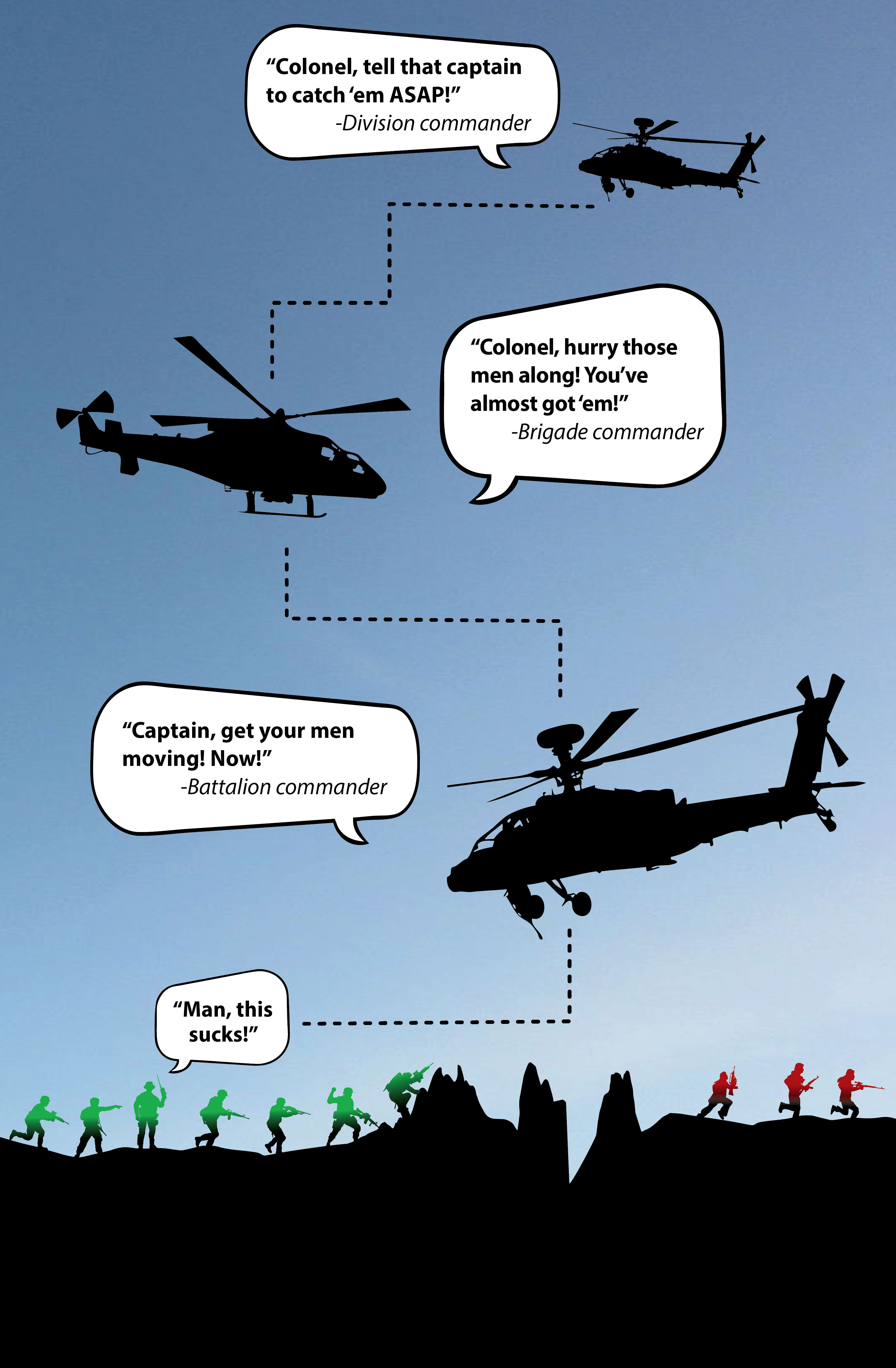
First, the very term “Mission Command” is rubbish. I know there is a whole body of literature about it, but it’s still rubbish ~ just well very documented rubbish. There is, very simply, command which is supported by control. The notion of “Mission Command” came about in the USA when it became clear that too many US senior officers were unable to exercise effective combat command because they were “nervous nellies” (or overzealous careerist) who would not or could not trust their subordinates to get on with the job. The image of a helicopter belonging to the division commander hovering over a helicopter belonging to the brigade commander hovering over the battalion commander’s helicopter that is hovering over the company of men on the ground comes to mind. Then a few other US military leaders decided that a new “concept” and a few PowerPoint presentations featuring gothic lettering and pictures of German generals would put things right … instead things went from bad to worse, but not just in the US military.
[Click to see full-size image]
Second, command and control (C2) is, actually, a quite simple thing to understand … it is the whole process by which a commander receives and analyzes his (or her) orders, does his (or her ~ always presumed from here on in) reconnaissance, makes his appreciation (estimate) of the situation and his plan and then issues the orders that commit his troops to battle. There it is in under 40 words … that’s not too hard to grasp, is it? But it can be bloody hard to do!
Comments Off on Command and microcontrol
November 21, 2017
Otto von Bismarck – VI: Germany! – Extra History
Extra Credits
Published on 18 Nov 2017You would think that capturing the Emperor of France would end the war, but… no. Who could Bismarck negotiate with? Eventually he forced an interim government to cave to his demands, and at the same time convinced the rest of the German states to unite with Prussia.
Comments Off on Otto von Bismarck – VI: Germany! – Extra History
November 14, 2017
The Last Hussar – August von Mackensen I WHO DID WHAT IN WW1?
The Great War
Published on 13 Nov 2017August von Mackensen was one of the most prolific generals of World War 1. He served with distinction on the Eastern theatres. The Gorlice-Tarnow Offensive, the conquest of Serbia and Romania were all possible thanks to him. He was raised with the belief in Prussian glory and held onto this belief even after the war ended.
Comments Off on The Last Hussar – August von Mackensen I WHO DID WHAT IN WW1?
November 13, 2017
Otto von Bismarck – V: Prussia Ascendant – Extra History
Extra Credits
Published on 11 Nov 2017The northern German states now looked to Prussia for leadership, but that power brought increased attention from their enemies. Bismarck engineered a war with France by striking at Napoleon III’s pride and wound up winning a runaway victory to secure Prussia’s diplomatic power.
Comments Off on Otto von Bismarck – V: Prussia Ascendant – Extra History
November 6, 2017
Otto von Bismarck – IV: The Iron Chancellor – Extra History
Extra Credits
Published on 4 Nov 2017Bismarck turned up the heat on his long-term plan to unite the German Confederation under Prussian leadership. He allied with Austria to seize a piece of disputed land, then maneuvered them into a war that he decisively won. Even an assassination attempt could not stop him.
Comments Off on Otto von Bismarck – IV: The Iron Chancellor – Extra History
October 30, 2017
Otto von Bismarck – III: Iron and Blood – Extra History
Extra Credits
Published on 28 Oct 2017Bismarck was just starting to get the hang of diplomacy when the throne of Prussia passed to a new Frederick Wilhelm who promptly sent him away to Russia. But then Bismarck got tapped to serve as the Head of Government and began pushing for his great project: the unification of Germany.
Comments Off on Otto von Bismarck – III: Iron and Blood – Extra History
October 22, 2017
Otto von Bismarck – II: A Man of Great Ideas – Extra History
Extra Credits
Published on 21 Oct 20171848. Revolution swept Europe as the working class rose up to claim their freedoms from an oppressive ruling class. But as a member of that ruling class, Bismarck had some resistance to this movement. He channeled his wild energy into productive avenues, gradually becoming the man of realpolitik that we know today.
Comments Off on Otto von Bismarck – II: A Man of Great Ideas – Extra History
October 16, 2017
Otto von Bismarck – I: The Wildman Bismarck – Extra History
Extra Credits
Published on 13 Oct 2017Otto von Bismarck became the greatest statesman of a generation, but he began as an intransigent and irresponsible youth. He coasted through college, got himself thrown out of an early political appointment, and caused havoc with his divisive opinions during a meeting of parliament.
Comments Off on Otto von Bismarck – I: The Wildman Bismarck – Extra History


