
Excess? The German Army of WW II somehow managed to fight off for six years – that, or beat the ever loving crap out of – nearly the whole world with under three percent commissioned officers. Roman legions, perhaps the most formidable fighting machines of human history, got by with six to eight. Six to eight percent? Not on your life; six to eight, period, six military tribunes, a legate, and – arguably – the praefectus castrorum, who was more in the line of a late entry officer, as per the British system. Think about that one, one officer per every eight hundred men. And it was plenty.
What have we got? As of 2013 we had over eleven percent commissioned in the Marine Corps, seventeen percent in the Navy, almost nineteen percent in the Army, and nearly twenty percent of strength being commissioned officers in the Air Force.
The problems with having this many officers are multifold. I can only cover some of the more important ones.
This high a percentage of officers almost certainly means that there are people running around with bars and leaves and even eagles and perhaps stars who probably should have been non-coms. They may have the education and intelligence to be officers, but as a matter of attitude, outlooks, values, and approaches to things, they’d have been happier if they’d been wearing multiple stripes. I used to see a lot of this among lieutenants who decided to go Special Forces. In almost every case I have seen, these were guys who really wanted to be squad leaders which, in SF, they could be. The effect of commissioning so high a percentage of people has tended to be having an NCO corps weaker than it should have been and weaker than it needs to be. This tends to exacerbate another problem, officers will tend to micromanage if they’re allowed to. They will be allowed to, if there is a common perception that the NCO corps needs to be micromanaged, which, because some numbers actually do need to be micromanaged, casts them all in a questionable light in some circles. There’s another reason, one having little or nothing whatsoever to do with NCOs, for that kind of micro-management.
Tom Kratman, “There Are No Bad Regiments…”, Everyjoe.com, 2015-10-12.
October 8, 2017
QotD: Excess officers
October 5, 2017
The greatest general you’ve probably never heard of
I missed this article when it was posted in September: Iskander Rehman discusses the life and times of Byzantium’s greatest general, Belisarius:
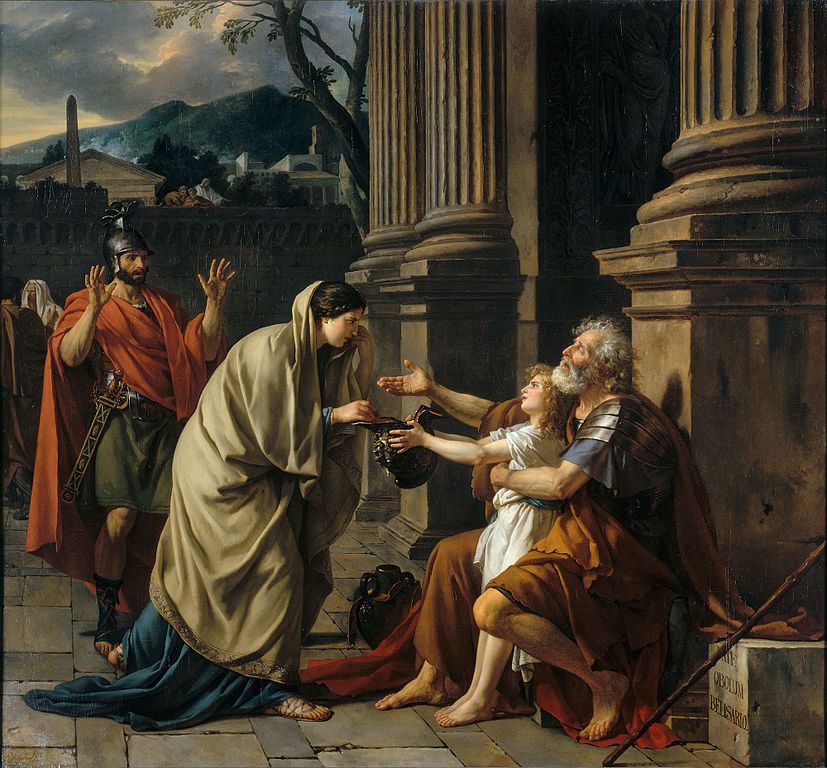
Belisarius begging for alms. Painting by Jacques-Louis David, 1781.
(Via Wikimedia)
In 1780, the great neoclassical painter Jacques-Louis David completed one of his finest works. Entitled “Belisarius Begging for Alms,” the oil painting depicts an aging warrior, blinded with a hand outstretched, seated at the base of a colossal Roman monument. His feet are bare, his beard unkempt, and his armor draped in coarse rags, dull in sheen. A slender walking cane rests to his side, propped against a stone slab bearing the name of a famous former general — Belisario, or Belisarius. A beautiful woman, her face etched in concern, drops a few coins into an upturned helmet, and whispers words of consolation. Her husband, a man in the vigor of youth and full military regalia, is in shock, his arms raised and his mouth open. He has just realized that the stricken veteran is his former commander, the legendary Belisarius himself.
Although his name is not as well known as it once was, Belisarius has long been considered one of history’s finest tacticians. Under the orders of the Byzantine emperor Justinian I, the sixth century general reclaimed vast tracts of Western Roman territory, from northern Africa to the Italian peninsula. Frequently outnumbered and leading an eclectic grouping of warriors composed of romaioi (Eastern Romans), foederati (Barbarian allies), and ethnikoi (specialist ethnic troops), the Thracian commander greatly expanded the footprint of the Byzantine empire at a time when many thought that Rome’s ancestral lands had been irredeemably lost. The fact that many of these conquests, as we shall see, only proved fleeting, has, if anything, only burnished his myth, transmogrifying the soldier into something of a crepuscular icon — Western Europe’s last great Roman protector before the advent of the so-called Dark Ages.
For Liddell Hart, Belisarius was also the consummate practitioner of the so-called “indirect approach” and the “master of the art of converting his weakness into strength; and the opponent’s strength into a weakness.” T.E. Lawrence, an avid reader of the ancient military classics, considered “the Thracian genius” to be one of “three really first-class Roman generals in history” (the other two being Scipio Africanus and Julius Caesar) and encouraged his friend, Robert Graves, to write the novel Count Belisarius. This piece of historically informed fiction retraces Belisarius’s military campaigns and was much admired by Winston Churchill, who is said to have often turned to it for guidance during the fraught early years of World War II.
Who was the man behind the myth? And why do the tales of Belisarius’s life and military exploits continue to resonate, firing the imaginations of great men from David to Churchill and Lawrence of Arabia? What insights can be gleaned, not only from his campaigns, but from the Eastern Roman Empire’s strategic literature more broadly?
October 3, 2017
Jagmeet Singh wins the federal NDP leadership race
The NDP have finally selected a leader who may be able to recapture some of the “lightning in a bottle” phenomenon of the late Jack Layton’s time as party leader (and bring back some former NDP voters who plumped for Justin last time around). Jay Currie is enthusiastic about the new guy:

Federal NDP leader Jagmeet Singh taking part in a Pride Parade in June 2017 (during the leadership campaign).
Photo via Wikimedia.
… I was cheered to see the rollover victory of Jagmeet Singh for the NDP leadership. Singh seems to be from the pragmatic end of the NDP and will be relatively immune from identitarian and intersectional attack simply because he’s brown and wears brilliant turbans. He’s intelligent, well spoken and has a bit of charisma. And he is just going to kill Justin Trudeau in places Trudeau needs to win.
It is simplistic to say that the Sikh community in Canada will universally support one of its own, there will certainly be a temptation to defect from Trudeau to Singh. While that might have some effect in Tory ridings, it will be felt most strongly in seats which have traditionally swung from Liberal to New Democrat and back again.
I am not sure, however, that Singh’s ethnicity is his biggest threat to Trudeau. By 2019 the emptiness of much of the Liberal’s program will be apparent to all. The broken promises, the tepid policy initiatives and, above all, the fiscal incompetence on the revenue side and on expenditures will be pretty apparent. For small business owners and consumers with half a clue, the combination of the lunatic small business tax measures and the expensive, but pointless, carbon tax will pour votes into the Conservative column. But with Canada’s first past the post system, that may not be enough.
Singh’s real threat to Trudeau is in marginal seats where the Libs beat the Conservatives by a few thousand votes in the last election because a) people had had enough of Harper, b) Justin seemed bright and shiny. People who would have voted NDP in the past were so eager to get rid of Harper they voted for Trudeau. Mulclair simply lacked the appeal to keep the faithful in the pews. At a guess, the rank and file NDP voters, as well as the multi-culti virtue signallers, will be much more inclined to give Singh a go. Which means he has the capacity to bleed off Liberal voters in significant numbers.
September 24, 2017
Why Was Haig Still in Command? I OUT OF THE TRENCHES
The Great War
Published on 23 Sep 2017
Ask your questions here: http://outofthetrenches.thegreatwar.tvIn this week’s OOTT episode we talk about Douglas Haig, the trenches on the British Islands and silencers.
September 14, 2017
The art of leadership and other secrets
In Taki’s Magazine, Steve Sailer remembers the late Jerry Pournelle, including a helpful leadership tip he once shared:
I didn’t meet Jerry until 1999, but I’d known his son Alex in high school. The Pournelle family asked me to go with them to Kansas City in August 1976 to the science-fiction convention at which Heinlein, the central American sci-fi writer of the 20th century, received his lifetime achievement award. (But I had to be at college that week.)
But Jerry, one of the great Southern California Cold Warriors, had a remarkable number of careers, starting as a teenage artillery officer during the Korean War, which deafened him in one ear. (At the lunch table, he’d choose his seat carefully to position his one remaining good ear next to his guest.)
He once recalled a question from the Army Officer Candidate School test:
Q. You are in charge of a detail of 11 men and a sergeant. There is a 25-foot flagpole lying on the sandy, brush-covered ground. You are to erect the pole. What is your first order?
The right answer is:
A. “Sergeant, erect that flagpole.”?
In other words, if the sergeant knows how to do it, then there’s no need for you to risk your dignity as an officer and a gentleman by issuing some potentially ludicrous order about how to erect the flagpole. And if the sergeant doesn’t know either, well, he’ll probably order a corporal to do it, and so forth down the chain of command. But by the time the problem comes back up to you, it will be well established that nobody else has any more idea than you do.
He also quotes Dave Barry’s breakdown of Pournelle’s monthly columns for Byte magazine:
In 1977 Jerry paid $12,000 to have a state-of-the-art personal computer assembled for him, supposedly to boost his productivity. By 1980 that led to his long-running “Chaos Manor” column in Byte magazine in which he would document his troubles on the bleeding edge of PC technology. As fellow word-processing aficionado Dave Barry explained jealously, Jerry got paid to mess around with his computers when he should be writing:
Every month, his column has basically the same plot, which is:
1. Jerry tries to make some seemingly simple change to one of his computers, such as connect it to a new printer.
2. Everything goes hideously wrong…. Sometimes there are massive power outages all over the West Coast. Poor Jerry spends days trying to get everything straightened out.
3. Finally…Jerry gets his computer working again approximately the way it used to, and he writes several thousand words about it for ‘Byte.’
I swear it’s virtually the same plot, month after month, and yet it’s a popular column in a magazine that appeals primarily to knowledgeable computer people.
I like to imagine Steve Jobs circulating “Chaos Manor” columns to his executives with scribbled annotations suggesting that some people would pay good money to not have to go through all this.
September 8, 2017
Grant Vs Lee Who Was The Better General?
Published on 17 Aug 2016
Today I break down the book: Grant And Lee: A Study In Personality And Generalship By J.F.C Fuller
Here’s a quick break down of the two personalities
Grant: common sense, logical, simple plans with incredible precise execution, the ability to bring a whole lot of moving pieces into focus, and finally the ability to think clearly under stress.
Lee: The ability to motivate his men to an incredible degree, an extremely kind man, very good at doling out troops to his commanders when in a defensive situation.This video goes into more detail on all of this, I hope you enjoyed!
August 25, 2017
Great Northern War – I: When Sweden Ruled the World – Extra History
Published on 19 Aug 2017
A young boy king had inherited the crown of the Swedish Empire, and his neighbors saw an opportunity to attack. To their surprise, young Charles XII of Sweden turned out to be a fearsome opponent who quickly repelled their assaults – and then sought revenge.
July 7, 2017
Turmoil In The Reichstag – The Kerensky Offensive I THE GREAT WAR Week 154
Published on 6 Jul 2017
WW1 Flying Event with Indy & the Crew: http://bit.ly/TGWStowMaries
The German home front is shaken by a political scandal this week 100 years ago. A member of the Center party reveals that the German unrestricted submarine warfare is not achieving what the German high command had hoped for. Paul von Hindenburg and Erich Ludendorff, who pretty much run Germany as a military dictatorship by now, also dispose of chancellor Theobald von Bethmann Hollweg. Hollweg was actually secretly involved in peace negotiations but that chance is gone with him too. Russia unleashes their Kerensky Offensive on the Eastern Front and puts further pressure on the Central Powers.
June 20, 2017
Hero or Burden? – King Constantine I of Greece I WHO DID WHAT IN WW1?
Published on 19 Jun 2017
King Constantine I of Greece embodies the complex history of modern Greece in the early 20th century. By some he was and still is perceived as a hero who united the country. Others perceive him as a burden who only brought problems to Greece.
Why Arabs Lose Wars
Published on 5 Jan 2015
Read from source: De Atkine, N. (1999, December 1). Why Arabs Lose Wars. Retrieved January 5, 2016, from http://www.meforum.org/441/why-arabs-lose-wars
In the modern era of warfare, Arabic-speaking countries have been generally ineffective. Egyptian special forces fared poorly against Yemeni tribes and irregular forces. The Iraqi army has collapsed several times; The Iran Iraq War, Operation Desert Storm, Operation Iraqi Freedom, and against the Islamic State. And the Arabs have done poorly in nearly all military confrontations with Israel. Many Middle Eastern states have not adapted to the modern battlefield.
June 15, 2017
Why is Rommel so complicated? – Erwin Rommel vs. Desert Fox
Published on 17 May 2017
This video takes a look at why Erwin Rommel often called the “Desert Fox” is so complicated due to the various interest groups and his complex situation in World War 2.
June 13, 2017
Top 10 Stupid Moves of World War 1 – Mid 1915/1916 I THE GREAT WAR Ranking
Published on 12 Jun 2017
Generals of WW1 did a lot of stupid things, so many in fact that we made a second top 10 list to appeal to your inner armchair general.
June 6, 2017
QotD: Comparing general staff “systems”
Throughout the 20th century and into the 21st there have been, largely, two staff systems:
- The continental system ~ which is used by most European armies and also used by the American and many, many Asian armies;
- The imperial, or British staff system which was used by the Canadian Army throughout most of the 20th century.
The two are fundamentally different.
The continental system is based on the great and impressive German General Staff system which grew up in the 19th century based on lessons learned in the Napoleonic Wars and then relearned in inter alia the Franco-Prussian Wars. The imperial system came later and reflected British thinking about what the Germans had formalized.
The best way to see the difference is to look at how the commanders and staff relate. In a French or German battalion ~ at least this was the case a few years ago ~ a company (100 to 150 soldiers) is commanded by a captain; there are only two or three officers in the company. The battalion, three, for or five companies, is commander by a lieutenant colonel, and there is a major deputy commander. The battalion staff consists of:
- S1 – personnel officer – a captain
- S2 – intelligence officer – a captain, sometimes a major
- S3 – operations officer – a major
- S4 – logistics officer – a major
- S5 – plans officer – a captain, often a major
For the German captain, company commander, looking “up the chain,” all he sees is higher ranks and he will never be blamed for being unsure if the commanding officer or the operations officer is the real “boss.” Ditto for French and American officers whose command-staff relationships are very, very similar. One of the great strengths of the German General Staff system was it “coherence.” The staff, at every level, was part of a single, coherent whole that stretched top to bottom from Berlin to the smallest battalion in the field. It is part of what made the German General Staff so famous and so feared by enemy armies. But the British, especially in 1914-18, saw a flaw in the continental system. The soldiers and commanders in the battalions and brigades in the trenches saw the general staff as being too remote, and even comfortable ~ removed from the horrors of combat and, consequently, many felt, making poor staff decisions. The system of the staff out-ranking subordinate commanders extends all the way to the top of the US Army and most European armies. Higher rank staff officers tend to build bigger and bigger HQs, too.
The British adapted the imperial system so that is was always crystal clear that commanders, from company up, always outranked and “out-appointed” the staff. Consider a British or Canadian battalion, also with, say, five companies. Like the US or European battalion the commanding officer is a lieutenant colonel, but each company commander is a major and the staff are:
- Adjutant (S1/personnel) – a captain
- Intelligence officer (S2) – a lieutenant, maybe a captain
- Operations officer (S3 and S5) – a captain, but, after about 1944 usually a major by “misemploying” the HQ Company commander
- Quartermaster (s4) – a captain
So a British or Australian or Canadian or Indian major, company commander, looking “up the chain” saw that there was no one between him (or her) and the CO except officers of equal or lower rank. The same applied, top to bottom: Field Marshal Montgomery’s (famously able) chief of staff was a major general … but you can be 100% certain that when Major-General Sir Francis Wilfred “Freddie” de Guingand, a two star level officer, phoned General (four stars) Henry Duncan Graham “Harry” Crerar, commander of the 1st Canadian Army in 1944/45 was wakened up and took the call because Monty’s chief-of-staff only dealt with important people and important matters. Rank didn’t really matter: de Guingand didn’t need any more stars ~ his appointment and ability both spoke (loudly) for themselves.
One result was that imperial (Commonwealth) armies tended to have smaller and lower ranked HQs, top to bottom.
There is no empirical proof that the continental staff system is better than the imperial one. The German General Staff was, indeed, superb, but that didn’t help, in 1944/45 when the German divisions and regiments and battalions were being defeated in detail on the front lines. Ditto in Korea and Vietnam: large numbers of excellent staff officers and superior communications systems didn’t help (and may have hindered) when the (first French and then) American brigades and battalions were being beaten in the jungles and rice paddies. The British, too, were defeated in battle ~ Dunkirk, Hong Kong, Singapore ~ but there is no evidence that bad operational staff work was to blame.
Ted Campbell, “The foundation (2)”, Ted Campbell’s Point of View, 2017-02-21.
June 4, 2017
Emperor Claudius
Victor Davis Hanson outlines the career of the fourth Roman Emperor and makes an unusual comparison:
The Roman Emperor Claudius, who reigned from 41 to 54 AD, was never supposed to be emperor. He came to office at age 50, an old man in Roman times. Claudius succeeded the charismatic, youthful heartthrob Caligula — son of the beloved Germanicus and the “little boot” who turned out to be a narcissist monster before being assassinated in office.
Claudius was an unusual emperor, the first to be born outside Italy, in Roman Gaul. Under the Augustan Principate, new Caesars — who claimed direct lineage from the “divine” Augustus — were usually rubber-stamped by the toadyish Senate. However, the outsider Claudius (who had no political training and was prevented by his uncle Tiberius from entering the cursus honorum), was brought into power by the Roman Praetorian Guard, who wanted a change from the status quo apparat of the Augustan dynasty.
The Roman aristocracy — most claiming some sort of descent from Julius Caesar and his grandnephew Octavian (Caesar Augustus) — had long written Claudius off as a hopeless dolt. Claudius limped, the result of a childhood disease or genetic impairment. His mother Antonia, ashamed of his habits and appearance, called the youthful Claudius “a monster of man.” He was likely almost deaf and purportedly stuttered.
That lifelong disparagement of his appearance and mannerisms probably saved Claudius’s life in the dynastic struggles during the last years of the Emperor Augustus and the subsequent reigns of the emperors Tiberius and Caligula.
The stereotyped impression of Claudius was that of a simpleton not to be taken seriously — and so no one did. Claudius himself claimed that he feigned acting differently in part so that he would not be targeted by enemies before he assumed power, and to unnerve them afterwards.
Contemporary critics laughed at his apparent lack of eloquence and rhetorical mastery, leading some scholars to conjecture that he may have suffered from Tourette syndrome or a form of autism. The court biographer Suetonius wrote that Claudius “was now careful and shrewd, sometimes hasty and inconsiderate, occasionally silly and like a crazy man.”
Sound familiar?
May 21, 2017
The Hero Of Tannenberg – Paul von Hindenburg I WHO DID WHAT IN WW1?
Published on 20 May 2017
Paul von Hindenburg’s military career was already over when World War 1 broke out. He fought in legendary German battles like Königgrätz [and] Sedan and now was retired. But he returned in 1914 and became a living legend after the victory over the Russians at Tannenberg 1914. During the war he and Erich Ludendorff turned Germany in a de facto military dictatorship to steer the entire country through this total war. But Germany still lost and Hindenburg was also responsible for setting up the Dolchstoßlegende – the myth of the stab in the back of the undefeated German Army.


