
The History Guy: History Deserves to Be Remembered
Published on 2 May 2018In the early days of the Canadian confederation, one of the greatest officers of the British Victorian Army takes 1000 soldiers on an impossible march through the wilderness that helps to define modern Canada.
All events are described for educational purposes and are presented in historical context.
Patreon: https://www.patreon.com/TheHistoryGuy
The History Guy: History Deserves to be Remembered is the place to find short snippets of forgotten history from five to fifteen minutes long. If you like history too, this is the channel for you.
August 26, 2018
The Wolseley Expedition and the making of Canada
Comments Off on The Wolseley Expedition and the making of Canada
August 25, 2018
Why was Italy so Ineffective in WWII? | Animated History
The Armchair Historian
Published on 27 Jul 2018Potential History’s Video: https://youtu.be/QB2GINNs3Aw
Our Patreon: https://www.patreon.com/armchairhistory
Our Twitter: https://twitter.com/ArmchairHist
Sources:
The Rise and Fall of the Third Reich, William L. Shirer
Fascist Italy’s Military Struggles from Africa and Western Europe to the Mediterranean and Soviet Union 1935-45, Frank Joseph
Hitler’s Italian Allies: Royal Armed Forces, Fascist Regime, and the War of 1940-1943, MacGregor Knox
Comments Off on Why was Italy so Ineffective in WWII? | Animated History
August 21, 2018
Creating An American Army – John J. Pershing I WHO DID WHAT IN WW1?
The Great War
Published on 20 Aug 2018Check Out Desert Operations: https://desertoperations.gamigo.com/
John Pershing already had a long career in in the US forces when World War 1 broke out. When 1917 came around he was tasked with the monumental challenge of creating and expanding the American Expeditionary Forces and send them over to Europe.
Comments Off on Creating An American Army – John J. Pershing I WHO DID WHAT IN WW1?
August 8, 2018
Doing military intelligence … backwards
Ted Campbell on what he sees as a big problem with western military command structures and particularly the way military intelligence is being over-centralized away from the fighting troops and pushed high up the chain of command:
Intelligence is vital in modern combat operations … just as it was when Alexander set about conquering the known world. But, as Alexander knew, real intelligence is gathered by the troops in direct contact with the enemy and is augmented by e.g. spies who read the enemies mail (our modern, very effective SigInt services, for example, and drones and so on). There is a now well established ~ and I think wrong headed ~ system which aims to collect ALL intelligence at the highest possible level and then disseminate it down … that’s exactly backwards! Combat intelligence is gathered, in the main, by troops in contact with the enemy, by privates and troopers and corporals and then it is passed up the chain to be collated with reports from other troops in contact and then a refined picture is passed back down … where it is promptly corrected by the troops in contact. Intelligence staffs in HQs almost never know much of anything of real utility but they have convinced commanders that if there can only be more and more highly ranked intelligence officers with more clerks and more drones and more computers and so on, that they will, somehow, get ahead of the enemy. It’s a siren song that has, already, run more than one combat commander up on to the rocks of operational failure. The only people who have a good feel for what the enemy is up to are the people who have them in their sights. Don’t get me wrong: I am a HUGE fan of SigInt and drones and UWB radio devices that can see through walls and so on … I want the micro drones and the cyber bugs to be in the hands of the corporals in the rifle sections who are making their way house-to-house and floor-by-floor.
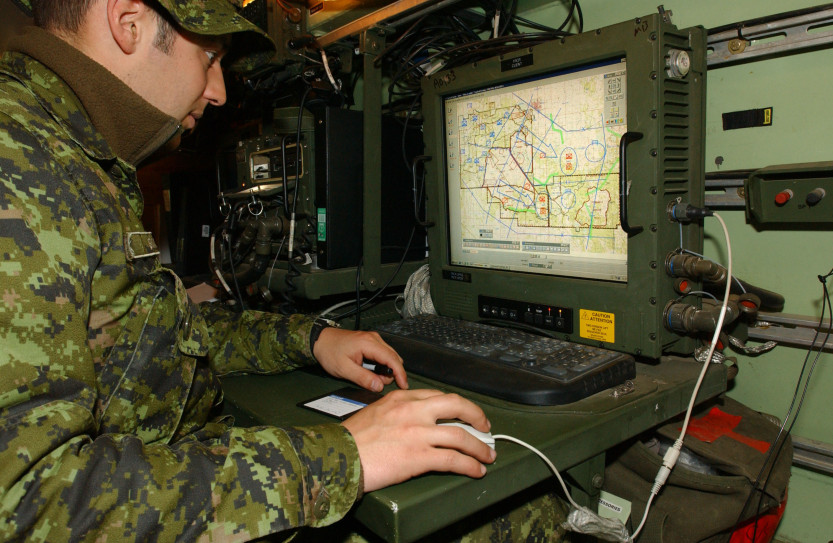
But the bigger threat, by far, is a brigade command post that looks like this …
… than like this:
April 18, 2003, Wainwright, Alberta
Captain Jeremy Small, the Signals Officer with the First Battalion of the Royal Canadian Regiment (1 RCR)(Petawawa, Ontario), works on the Athene Tactical System (ATS) in the Command Post (CP). The ATS is a new battlefield information system being tested by 2 Canadian Mechanized Brigade Group (2CMBG) Headquarters and the 1 RCR. The digital information can be shared in a more timely fashion than the old method, which needed to be drawn by hand. The 1 RCR are part of the is part of the approximately 4,600 Canadian Forces members who are participating in the first major army training exercise of the 21st Century, from April 7 to May 2, 2003 in Wainwright, Alta. After two years of planning, co-operation, strategic resource management, and with assistance from the Air Force, the Army has created Exercise RESOLUTE WARRIOR. Fourteen combat and support units are training together in a multi-element combat environment in preparation for potential and upcoming high readiness tasks at home and abroad. This exercise is the confirmation of the skills and cohesion of the units involved and will be similar to an actual deployment.
Photo: MCpl Paul MacGregor, Canadian Forces Combat CameraThe urban battle of the future, like those of the past will be fought by rifle sections of eight to 12 soldiers, directed by platoon commanders (young, 20-something, lieutenants) overseen and supports by company and battalion commanders. The lessons that my Regiment learned at Ortona, during the Christmas season of 1943, (and which were drummed into my head by ‘old sweats‘ 20 years later) will still apply. Generals and brigadiers and colonels may plan and guide the battle but it will be fought by captains and corporals and privates … hand-to-hand, house-by-house, street-by-street … whether it is a small city or a giant metropolis. Yes, that young soldier would love to have a little drone to see around the corner before he throws the grenade and he might even be interested in knowing that SigInt says that enemy is running low on ammo and food, but at the moment he, like all combat soldiers, must trust, mainly, in his own judgment of the situation as he, and only he, can see it.
But while the privates and corporals are fighting the battle and gathering the real intelligence about the enemy, the legal officer will be wanting to know exactly what (s)he (the rifle section commander) sees and (s)he, the legal officer, will want to advise the brigade commander (who commands 6,500 soldiers) to interfere directly with the the command decisions of the most junior leaders (section (10 soldiers) and platoon (35 soldiers) commanders) and with the control decisions being made by company (125 soldiers) and battalion (900 soldiers) commanders. Good brigade commanders will resist that pressure and they will, equally, close their ears to the urgent warnings of the Public Affairs officer who will say something like “if this goes wrong the Minister will be embarrassed and that will cost you your next star.”

Comments Off on Doing military intelligence … backwards
August 3, 2018
Four Years of War I THE GREAT WAR Week 210
The Great War
Published on 2 Aug 2018As the war turns 4 years old, there is still no end in sight. From the Western Front to the Caucasus and the Middle East; in every theater the war is still raging on.
Comments Off on Four Years of War I THE GREAT WAR Week 210
July 27, 2018
Ludendorff’s Last Swing I THE GREAT WAR Week 209
The Great War
Published on 26 Jul 2018All of Germany’s recent offensives have been building up to Operation Hagen: An offensive in Flanders that was to divide the Allies and drive the British off the continent. But this week German High Command realizes that they don’t have the manpower left to even start the offensive.
Comments Off on Ludendorff’s Last Swing I THE GREAT WAR Week 209
July 24, 2018
The Amazing Life of Ulysses S. Grant
PragerU
Published on 2 Jul 2018No American led a more eventful life than Ulysses S. Grant, the 18th President of the United States and the Union Army’s most celebrated general. Garry Adelman, director of history and education at the Civil War Trust, tells Grant’s amazing story in this inspiring video.
Donate today to PragerU! http://l.prageru.com/2eB2p0hThis video was made in partnership with the American Battlefield Trust. Learn more about the Civil War and America’s Battlefields at: https://goo.gl/mmJMPk
Comments Off on The Amazing Life of Ulysses S. Grant
July 17, 2018
Australian General John Monash I WHO DID WHAT IN WW1
The Great War
Published on 16 Jul 2018John Monash was one of the most capable commanders of World War 1 but his rise to fame didn’t come unopposed.
Comments Off on Australian General John Monash I WHO DID WHAT IN WW1
July 15, 2018
Alcibiades, the Athenian Byron
Not for poetry, but for the Byronian swathe he cut through a large portion of Classical Greece:
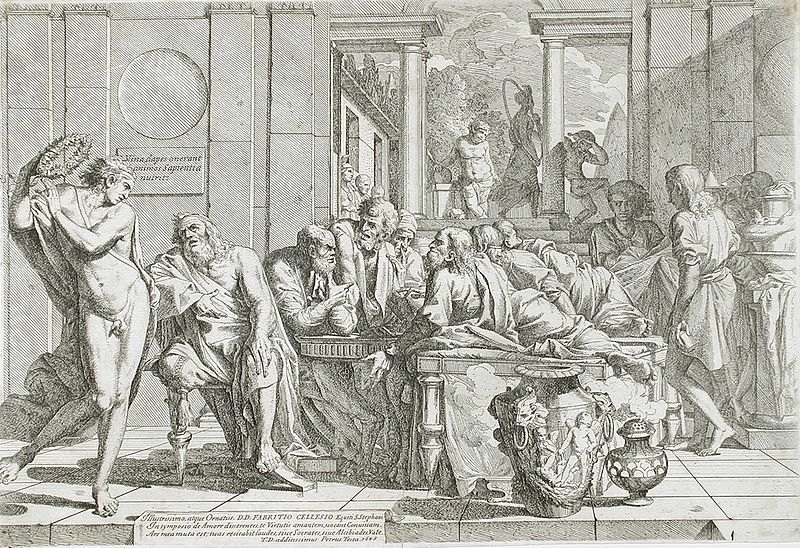
“Drunken Alcibiades interrupting the Symposium”, an engraving from 1648 by Pietro Testa (1611-1650)
Via Wikimedia Commons.
Of all personality traits, charisma is the hardest to appreciate at second hand. We read Cicero’s letters and can instantly tell that he was vain, insecure and ferociously clever; we read scraps of Samuel Johnson’s conversation in Boswell’s biography and know at once that he was magnificent, lovable and desperately unhappy. But as to what it was like to have Lord Byron turn the full force of his attention onto you – well, we have no conceivable way of knowing. We just have to trust his contemporaries that it felt like ‘the opening of the gate of heaven’.
This causes problems for a biographer of Alcibiades. On the face of it, the man was utterly insufferable. Born in around 450 BC into one of the oldest and richest families of ancient Athens, Alcibiades was the only Old Etonian (as it were) to play a leading role in the late-fifth-century radical democracy. The account of his childhood in Plutarch’s Life of Alcibiades suggests a bad case of antisocial personality disorder: biting during wrestling, mutilating dogs, punching his future father-in-law in the face for a dare. His later political career makes Boris Johnson seem like a man of firm and unbending principle. Exiled from Athens in 415 BC over some particularly odious Bullingdon Club antics, Alcibiades promptly sold his services to Sparta (where he seduced the king’s wife) before double-crossing both sides and wheedling his way into the court of a Persian satrap.
But Alcibiades, like Byron, clearly had that indefinable something. One catches a glimpse of it in the unforgettable last scene of Plato’s Symposium, when he crashes into the room, blind drunk, flirting with everything on legs, shouting about his love for Socrates. Thucydides captures it in his report of Alcibiades’s speech whipping up the Athenian assembly to vote for the disastrous Sicilian expedition of 415 BC – an extraordinary stew of egotistic bragging (about how successful his racehorses are), mendacious demagoguery and brilliantly acute strategic thinking. The unwashed Athenian masses, not usually prone to atavistic toff-grovelling, absolutely adored him: when Alcibiades finally returned to Athens in 407 BC after eight years of exile, sailing coolly into Piraeus on a ship with purple sails, they welcomed him back with paroxysms of joy.
Behind the Peloponnese-sized ego, Alcibiades was a general of spectacular genius – when he could be bothered. In 410 BC, shortly after his controversial reinstatement as admiral of the Athenian navy (on the back of a bogus promise of Persian support), he wiped out the entire Spartan fleet at the Battle of Cyzicus; two years later, through sheer chutzpah, he captured the city of Selymbria near Byzantium with only fifty soldiers, and without striking a blow. When things went wrong – as in 406 BC, after a disastrous campaigning season in the eastern Aegean – he showed an infuriating ability to wriggle out of trouble. His final years (406–404 BC) were spent once again in exile from Athens, holed up in a private castle on the Gallipoli peninsula. The circumstances of his death are still shrouded in mystery. One story tells that he died in the remote mountains of central Turkey at the hands of the brothers of a Phrygian noblewoman whom he had decided to seduce. This is, I fear, all too believable.
This is the introduction to a review by Peter Thonemann of a new biography of Alcibiades by David Stuttard in the Literary Review for July, 2018. H/T to Never Yet Melted for the link.
Comments Off on Alcibiades, the Athenian Byron
July 7, 2018
History Buffs: Gettysburg
History Buffs
Published on 19 Feb 2018
Comments Off on History Buffs: Gettysburg
June 30, 2018
Crown Prince Wilhelm – Front Line Visits – Trench Entertainment I OUT OF THE TRENCHES
The Great War
Published on 30 Jun 2018Chair of Wisdom Time!
Comments Off on Crown Prince Wilhelm – Front Line Visits – Trench Entertainment I OUT OF THE TRENCHES
June 16, 2018
QotD: Term limits
The last person to trust with power is someone who is dying to have it. The best person to wield power is someone who is reluctant to do so, but who will do it for a while as a civic duty. That is why term limits should make it impossible to have a whole career in politics.
Thomas Sowell, “A Few Assorted Thoughts About Sex, Lies And Human Race”, Sun Sentinel, 1998-11-28.
Comments Off on QotD: Term limits
June 15, 2018
QotD: Churchill on Montgomery
There was a brief firestorm in Britain when a photograph appeared in the press of Montgomery and Gen. Wilhelm Ritter von Thoma, the commander of the Afrika Korps and the highest-ranking German captured at Alamein. After his capture Thoma was brought to the Eighth Army command post, where Montgomery accorded him the respect of one honorable professional soldier to another. The two dined that night, and the photograph of the two generals led Brendan Bracken to send Churchill a memo criticizing Montgomery’s naïveté and noting that it created a bad impression with the public. Churchill merely commented: “I sympathize with Gen. von Thoma. Defeated, humiliated, in captivity, and,” after pausing for effect, “dinner with General Montgomery.”
Carlo d’Este, Warlord: A life of Winston Churchill at war, 1874-1945, 2008.
Comments Off on QotD: Churchill on Montgomery
June 9, 2018
D-Day – IV: The Atlantic Wall – Extra History
Extra Credits
Published on 29 Jun 2017The Germans had established a secure barrier against the Allied invasion of France – or so they believed, until the D-Day landings in Normandy caught them by surprise and the Atlantic Wall quickly fell apart.
Comments Off on D-Day – IV: The Atlantic Wall – Extra History
June 8, 2018
The Battle of Belleau Wood Begins I THE GREAT WAR Week 202
The Great War
Published on 7 Jun 2018The German Army is still threatening Paris and the situation for the Allies looks dire. Reluctantly, General Pershing agrees to put some of the American troops into action at Belleau Wood and Château-Thierry.
Comments Off on The Battle of Belleau Wood Begins I THE GREAT WAR Week 202


