
HardThrasher
Published 30 Aug 2024Please consider donations of any size to the Burma Star Memorial Fund who aim to ensure remembrance of those who fought with, in and against 14th Army 1941–1945 – https://burmastarmemorial.org/
(more…)
August 31, 2024
Forgotten War Ep2 – You Walk, You Walk Or You Die Mate
Comments Off on Forgotten War Ep2 – You Walk, You Walk Or You Die Mate
August 28, 2024
H.R. McMaster dishes on Trump’s first term in office
In Reason, Liz Wolfe covers some of the head-scratchers former National Security Advisor H.R. McMaster revealed about working for Donald Trump:
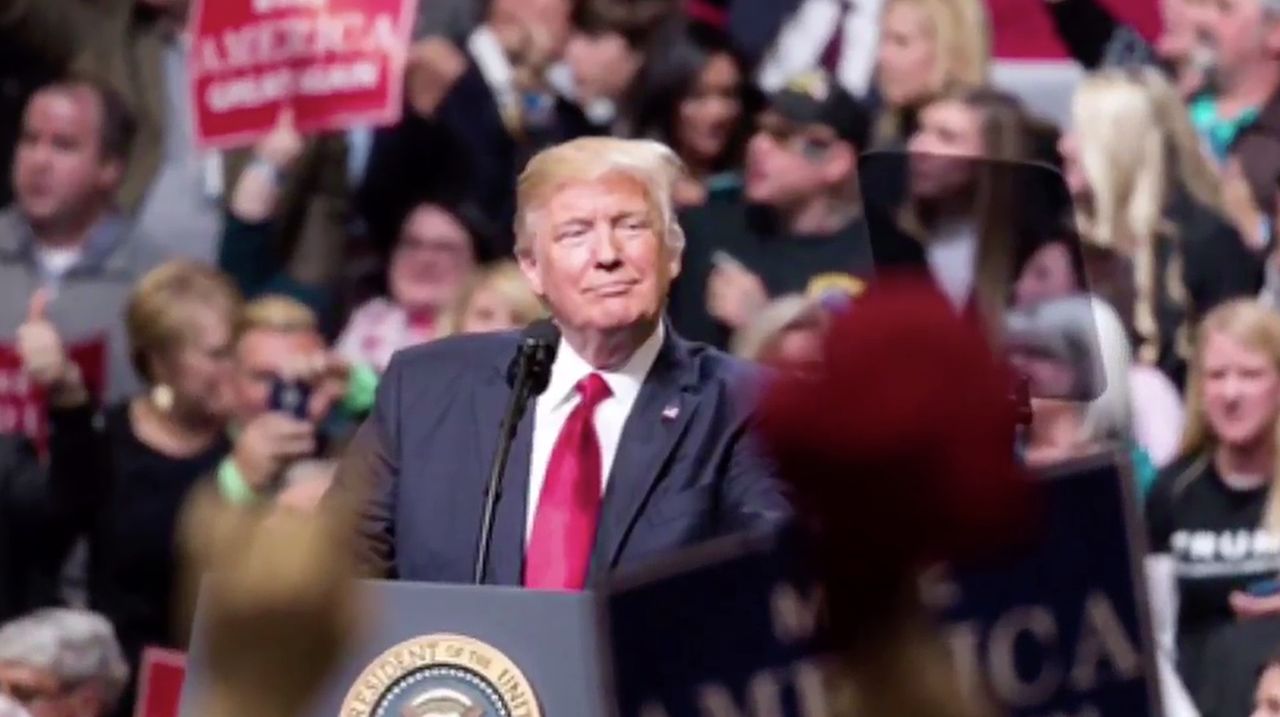
Donald Trump addresses a rally in Nashville, TN in March 2017.
Photo released by the Office of the President of the United States via Wikimedia Commons.
What might a second Trump White House be like? In his new book, At War with Ourselves: My Tour of Duty in the Trump White House, Lt. Gen. H.R. McMaster, who served as national security adviser to Donald Trump (for one year), characterizes Oval Office meetings as “exercises in competitive sycophancy” where advisers would greet him with lines like “your instincts are always right” or “no one has ever been treated so badly by the press”.
Trump, meanwhile, would come up with crazy concepts, and float them: “Why don’t we just bomb the drugs?” (Also: “Why don’t we take out the whole North Korean Army during one of their parades?”)
This is one man’s account, of course. McMaster’s word should not be taken as gospel, and some of his frustration might stem from his dismissal, or his foreign-policy prescriptions being at times ignored by his boss. But it’s a somewhat revealing look behind the curtain at policy-setting in a White House helmed by an especially mercurial commander in chief, who “enjoyed and contributed to interpersonal drama in the White House and across the administration”.
It also shows how quickly Trump fantasies have percolated through the Republican Party, namely the “let’s just bomb Mexico to get rid of the cartels” line, which Trump has been toying with since roughly 2019 (or possibly more like 2017, after he chatted with Rodrigo Duterte, former president of the Philippines, who had promised to kill 100,000 drug traffickers during his first six months as president). A few years prior, in 2015, he had suggested that Mexico was sending rapist and drug-traffickers across the southern border, and that we’d need to build a wall between the two countries, but it wasn’t until nine American citizens were killed in Mexico that Trump trotted out the idea of declaring cartels foreign terrorist organizations and using military might to eradicate them.
Trump’s line from 2019 has now become standard fare, notes The Economist: The Republican primary debates included lots of tough talk on Mexico, specifically on the bombing front, with Florida Gov. Ron DeSantis claiming he’d send special forces down there on Day One. Right-wing think tanks have embraced the messaging, with articles headlined “It’s Time to Wage War on Transnational Drug Cartels”. Taking cues from other members of her party, Georgia Rep. Marjorie Taylor Greene asked why “we’re fighting a war in Ukraine, and we’re not bombing the Mexican cartels”. Whether it’s economic protectionism (10 percent across-the-board tariffs, with 60 percent tariffs imposed on Chinese imports) or Mexico-bombing, Trump has near-magical abilities to get other members of his party to accept something previously regarded as absurd.
Comments Off on H.R. McMaster dishes on Trump’s first term in office
August 24, 2024
Operation Downfall – the planned invasion of Japan in 1946
Wes O’Donnell talks about the thankfully never-launched invasion of the Japanese home islands at the end of the Second World War:
History often hinges on the narrowest of margins.
Entire nations can rise or fall based on decisions made under the pressures of the moment.
But what if those decisions had gone the other way?
What if Archduke Franz Ferdinand had survived the assassination attempt in 1914?
What if John F. Kennedy had lived to complete a second term?
And most intriguingly, what if the United States had not dropped atomic bombs on Hiroshima and Nagasaki in August 1945?
The world would have witnessed Operation Downfall, the Allied invasion of Japan — an operation that, by all accounts, would have been the bloodiest amphibious assault in human history.
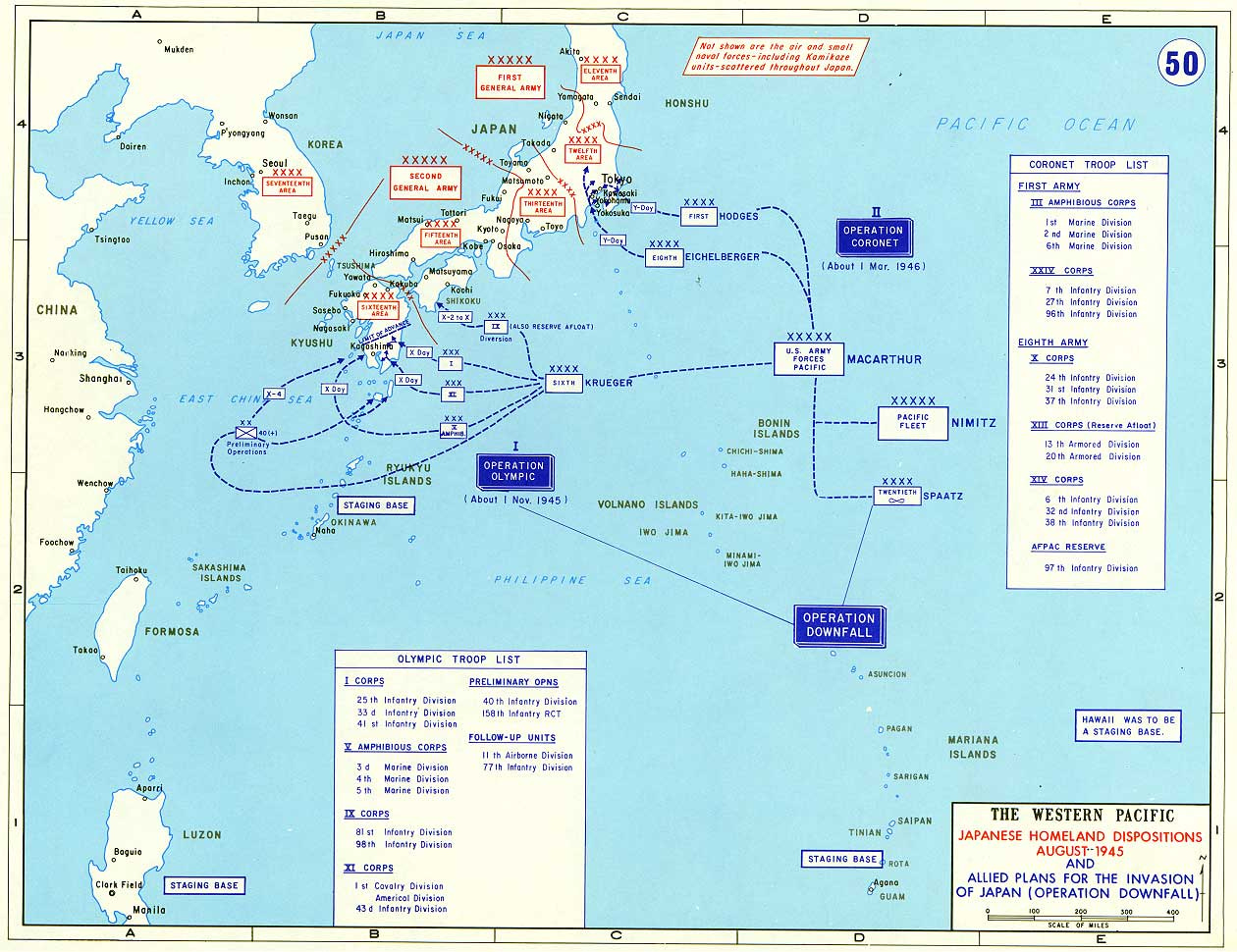
Operation Downfall was the codename for the proposed Allied plan for the invasion of Japan near the end of World War II.
The planned operation was abandoned when Japan surrendered following the atomic bombings of Hiroshima and Nagasaki and the Soviet declaration of war.
The operation had two parts: Operations Olympic and Coronet.
Set to begin in November 1945, Operation Olympic was intended to capture the southern third of the southernmost main Japanese island, Kyūshū, with the recently captured island of Okinawa to be used as a staging area.
Later, in the spring of 1946, Operation Coronet was the planned invasion of the Kantō Plain, near Tokyo, on the Japanese island of Honshu.
Airbases on Kyūshū captured in Operation Olympic would allow land-based air support for Operation Coronet.
The most troubling aspect of Downfall may have been the logistical problems facing military planners.
By 1945, there simply were not enough shipping, service troops, or engineers present to shorten the turnaround time for ships, connect the scattered installations across the Pacific, or build facilities like air bases, ports, and troop housing.
By this point in the war, the War Department had several military leaders that the government trusted to execute a quick end to hostilities.
Unlike the heavy political influence found in today’s wars, these men were given almost total freedom to plan large-scale military operations – Truman’s decision to drop the atomic bombs notwithstanding.
Six men of destiny
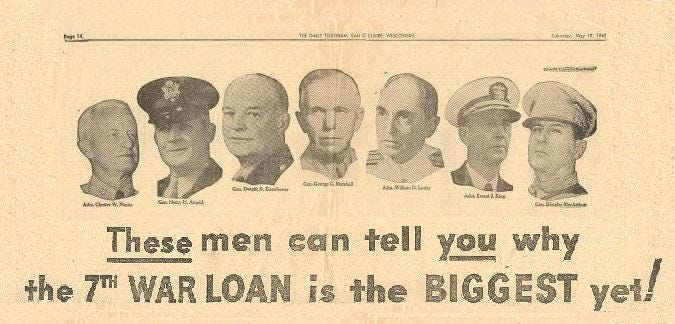
Responsibility for planning Operation Downfall fell to some of the most prominent American military leaders of the 20th century: Fleet Admiral Chester Nimitz, General of the Army Douglas MacArthur, and the Joint Chiefs of Staff — Fleet Admirals Ernest King and William D. Leahy, along with Generals of the Army George Marshall and Hap Arnold, who commanded the U.S. Army Air Forces.
These six men, raised in the relatively stable and predictable world of late 19th-century small-town America, carried with them the values instilled by that era.
Arnold and MacArthur were West Point graduates; King, Leahy, and Nimitz came out of the Naval Academy; while Marshall honed his discipline at the Virginia Military Institute, a school renowned for its toughness, even more so than the service academies.
For these leaders, the concepts of duty, honor, and country were more than just words — they were guiding principles.
They approached their roles without a trace of cynicism, supremely confident in their ability and, crucially, their God-given right to steer the course of history, especially in the chaos of war.
Comments Off on Operation Downfall – the planned invasion of Japan in 1946
August 17, 2024
Forgotten War Ep1 – Witness the Rising Sun
HardThrasher
Published Aug 14, 2024In January 1942 the Japanese Army poured over the border with Burma, and pushed back the Indian and British Armies to the border with Burma. Today we look at how that disaster came about, why and the first phase of the campaign
(more…)
Comments Off on Forgotten War Ep1 – Witness the Rising Sun
July 24, 2024
QotD: The “strategic defensive” approach to the attrition battles of WW1
Well, perhaps you say, that is a bit simplistic; what if we go on a strategic defensive – adopting a strategy of attrition? Note we are fairly far now from the idea that the easy solution to trench warfare was “don’t attack”, but this is the first time we reach what appears on its face to be a workable strategy: accept that this is a pure war of attrition and thus attempt to win the attrition.
And here is where I, the frustrated historian, let out the primal cry: “They did that! Those ‘idiot’ generals you were bashing on a moment ago did exactly this thing, they did it in 1916 and it didn’t work.”
As Robert Doughty (op. cit.) notes quite effectively, after the desperate search in 1915 for ways either around the trench stalemate or through it (either way trying to restore a war of maneuver), Joseph Joffre, French chief of the army staff, settled on a strategic plan coordinating British, Italian, French and Russian actions designed around a strategy of “rupture” by which what was meant was that if all of the allies focused on attrition in each of their various theaters, eventually one theater would break for lack of resources (that’s the rupture). He was pretty damn explicit about this, writing about the war as a “struggle of attrition” in May, 1915 and setting a plan of action in December of 1915 to “do everything they can to attrit the adversary”.
Joffre’s plan did not go perfectly (the German offensive at Verdun upset the time-tables) but it did, in fact mean lower French losses in 1916 than in 1915 or 1914 and more severe German losses. Meanwhile, the German commander, Erich von Falkenhayn would at least subsequently claim to have been trying to do the same thing: achieve favorable casualty ratios in a war of attrition, with his set piece being the Battle of Verdun, designed to draw the French into bloody and useless repeated counter-attacks on ground that favored the Germans (there remains a lot of argument and uncertainty as to if that attritional strategy was the original plan, or merely Falkenhayn’s excuse for the failure to achieve meaningful strategic objectives at Verdun). In the end, the Verdun strategy, if that was the strategy, failed because while the Germans could get their favorable ratio on the attack, it slipped away from them in the inevitable French counter-attacks.
But as Clausewitz reminds us (drink!) will – both political and popular – is a factor in war too (indeed, it is one of the factors as part of the Clausewitzian trinity!). Both Joffre and Falkenhayn had to an extent seen that the war was going to run until one side ran out of soldiers and material and aimed to win that long, gruelling war; for which they were both promptly fired! The solution to the war which said that all one needed to do was sacrifice a few more million soldiers and wait 2, or perhaps 3 or maybe even 4 more years for the enemy to run out first was unacceptable to either the political leaders or the public. 1917 came around and both sides entrusted the war to generals who claimed to be able to produce victories faster than that: to Robert Nivelle and Erich Ludendorff, with their plans of bold offensives.
And to be clear, from a pure perspective of “how do we win the war” that political calculation is not entirely wrong. Going to the public, asking them to send their sons to fight, to endure more rationing, more shortages, more long casualty lists with the explanation that you had no plans to win the war beyond running Germany out of sons slightly faster than you ran France out of sons would have led to the collapse of public morale (and subsequent defeat). Telling your army that would hardly be good for their morale either (the French army would mutiny in 1917 in any event). Remember that in each battle, casualties were high on both sides so there was no avoiding that adopting an attrition strategy towards the enemy meant also accepting that same attrition on your own troops.
And, as we’ve discussed endlessly, morale matters in war! “Wait for the British blockade to win the war by starving millions of central Europeans to death” was probably, in a cold calculus, the best strategy (after the true winning strategy of “don’t have a World War I”), but it was also, from a political perspective, an unworkable one. And a strategy which is the best except for being politically unworkable is not the best because generals must operate in the real world, not in a war game where they may cheerfully disregard questions of will. In short, both sides attempted a strategy of pure attrition on the Western Front and in both cases, the strategy exhausted political will years before it could have borne fruit.
And so none of these easy solutions work; in most cases (except for “recruit a lost Greek demi-god”) they were actually tried and failed either due to the dynamics (or perhaps, more truthfully, the statics) of trench warfare or because they proved impossible implement from a morale-and-politics perspective, violating the fundamental human need to see an end to the war that didn’t involve getting nearly everyone killed first.
Bret Devereaux, “Collections: No Man’s Land, Part I: The Trench Stalemate”, A Collection of Unmitigated Pedantry, 2021-09-17.
Comments Off on QotD: The “strategic defensive” approach to the attrition battles of WW1
July 22, 2024
“Lovable loser” is not a good look for a political leader, even a British one
In The Critic, Andy Mayer points out that former British PM Rishi Sunak does not deserve the post facto praise he’s been getting from the media and should not be “rehabilitated” by them:
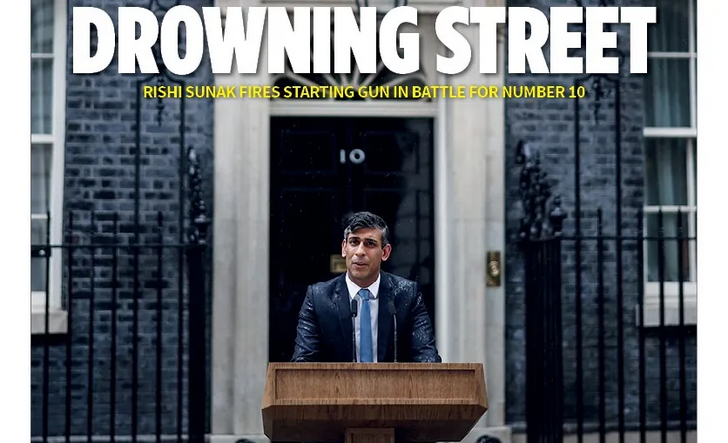
Rishi Sunak was a “wet” even before his farcical aquatic ceremony to kick off the 2024 general election.
We love a loser in Britain. From Eddie the Eagle to Gareth Southgate, our default reaction to a lack of success is warm appreciation. Parliament in that regard could not have been kinder to Rishi Sunak on his return as Leader of the Opposition. Never mind that the Conservative Party now looks more like the garrison of Rourke’s Drift than a campaign army. Never mind that the majority lies speared in the dust from their July 4th Isandlwana. Never mind that on the horizon General Farage is stirring the nativists for a future Bore War. The Lord Chelmsford of Prime Ministers marches on.
Less allegorically, Sunak, having made a couple of good speeches, is as one commentator put it “precisely the leader the Conservative Party needs right now”. On a personal level he is clearly a lovely guy, smart, capable, talented and has a very bright Clegg-like future ahead of him, whether in the valley or teaming up with Tony Blair to hawk AI to dictators. He is being feted by all the usual suspects who regard Parliament as a jolly club for centrist dads. Little thought however has been put into how this comes across to the poor bloody Tory infantry still pulling the bodies out of the metaphorical Buffalo River, wondering whether the inexperienced lieutenants rowing in the redoubts have what it takes to hold the line.
So let us be blunt, as a leader Sunak was hopeless. He had no coherent ideology or vision. He treated consensus building as an end in itself rather than as a means to an end. Even then he was better at building coalitions against rather than for him and was advised by people who used polls to tell them what to think, rather than as tools to move the public their way. He was neither a campaigner nor a political strategist.
As a result, he demonstrated cataclysmic judgement on the timing of the election. Whether this was through arrogance, naivety, or ignorance, he amplified the losses. He did so in the teeth of ample public commentary praising an assumed wise decision to delay until winter. Catching his own side by surprise, benefitting only morally vacuous apparatchiks boosting their betting accounts, and a far better prepared Opposition.
In office he was addicted to fad policies like generational bans, the Rwanda scheme, and the triple lock. He ducked hard choices on growth like building homes and cutting red tape, both things his deeply buried Thatcherite instincts should have told him were fights worth having. He was useless at implementation. Note, for example, the failure of his own borders policy or thinking through how to reform Ed Miliband’s ideological Net Zero architecture into something pragmatic.
He was right about one big thing — the importance of fiscal prudence and sound money. But he was also the Chancellor who undermined that prudence with wasteful lockdown splurges that destroyed growth and pushed the national debt over 100 per cent. He loved the sugar rush of popularity that came with being a spender in a crisis, but afterwards reformed nothing, preferring instead to raise taxes, generally by copying Labour’s madder talking points. For example, putting up corporation (company profits) tax to 25 per cent, freezing personal allowances, and hitting the North Sea with a 75 per cent “temporary” windfall tax, that has already outlasted the short period of high prices that inspired it. The latter has mortally wounded domestic investment, ripe for the Labour administration to finish it off. An error made despite his predecessor Osborne making exactly the same mistake with the same disastrous consequences only a few years earlier.
Comments Off on “Lovable loser” is not a good look for a political leader, even a British one
July 11, 2024
QotD: Armchair generals
Robert E. Lee, quoted at American Digest, 2005-08.
Comments Off on QotD: Armchair generals
July 1, 2024
Fifty ways to leave your leader
Okay, I exaggerate in the headline … Mitch Heimpel only offers a list of eight factors that matter when it’s time for a political party to take their leader out behind the barn, so to speak:

Caucus revolts have gotten more common in Canadian politics of late.
They’ve always been commonplace in Westminster politics. In recent years, they’ve dethroned three prime ministers in the U.K. They’re almost as common as general elections for removing prime ministers in Australia. They’re a sign of a healthy parliamentary system … sort of. Our system runs on confidence. Prime ministers are supposed to be responsive to pressure from the backbench.
Canada has been something of an exception to this, and not always to our national benefit. Though less so lately. We’ve seen sitting governments in revolt (Jason Kenney in Alberta, 2022) We’ve also seen opposition leaders taken out by frustrated caucus (Erin O’Toole federally in 2022, Patrick Brown as Ontario Progressive Conservative leader, 2018.) The Chrétien-Martin feud was more of a civil war than a revolt.
Still, despite the examples above, these events remain relatively rare in Canada, compared to many of our Westminster peers, because of how centralized power has become in leaders’ offices (especially in the PMO). Our normal, as described in Jeffrey Simpson’s The Friendly Dictatorship, is how our system evolved, not how it was meant to be.
Now, since there are signs (see here and here and here) that at least some Liberals are musing about taking a shot at Prime Minister Justin Trudeau, it’s perhaps a good time to set some ground rules for caucus revolts. This is what we’ve learned not just from recent Canadian experience, but also from what our British and Australian cousins have learned over the years.
[…]
If things are going so badly that the caucus wants to revolt, you probably do need to make changes. Showing you’re listening, demonstrating accountability at the senior levels and demonstrating change can take the wind out of a caucus revolt before it gets out of hand.
The above are general rules — exceptions can obviously apply. And as noted at the beginning, Canada doesn’t have much experience with these situations. That’s why Australia and the U.K. are so instructive. But things do seem to be changing in Canada, and certainly, things seem to be changing in the Liberal caucus. The above rules are offered free of charge to mutineers and loyalists alike. Good luck!
Comments Off on Fifty ways to leave your leader
June 26, 2024
Why the Allies Lost The Battle of France
Real Time History
Published Mar 1, 2024In May 1940, Nazi Germany attacks in the West. The Allied armies of France, Britain, Belgium, and the Netherlands have more men, guns, and tanks than the Germans do – and the French army is considered the best in the world. But in just six weeks, German forces shock the world and smash the Allies. So how did Germany win so convincingly, so fast?
(more…)
Comments Off on Why the Allies Lost The Battle of France
May 23, 2024
Where does a former general go to get his reputation back?
The National Post reports on a former Canadian senior officer launching a lawsuit in an attempt to clear his reputation after an abortive court martial brought his career to an end:
Lt.-Gen. Steven Whelan, a three-star general who was accused of sexual misconduct in what he claims was a politically motivated prosecution that was then abandoned before he was able to defend himself, is looking for his day in court.
“I didn’t get a chance to tell my side of the story,” he told me.
Whelan’s lawyer, Phillip Millar of Millars Lawyers, has just filed a bruising statement of claim with the Federal Court in Ottawa, naming a who’s who of Canada’s military establishment as defendants; a litany that makes allegations of abuse of office, negligent investigation, malicious prosecution and involvement in media leaks that destroyed Whelan’s reputation and career.
Defendants named in the lawsuit include His Majesty the King in Right of Canada (the Crown) and top brass in the Department of National Defence (DND) and Canadian Armed Forces (CAF): Jody Thomas, former deputy minister of National Defence and former national security advisor to the Prime Minister; General Wayne Eyre, chief of the defence staff; Lt.-Gen. Frances Allen, vice chief of the defence staff; and Lt.-Gen. Jennie Carignan, CAF’s chief of professional conduct and culture.
The allegations stretch all the way to the Prime Minister’s Office.
Last September, Whelan faced a court martial, accused of sexual misconduct purported to have taken place more than a decade ago.
At the trial’s outset, military prosecutors dropped the more serious allegation of improperly communicating with a female subordinate (flirting, in colloquial terms). A week later — following the testimony of the complainant and minutes before Whelan’s lawyers could cross-examine her or hear from other witnesses — prosecutors dropped the remaining charge accusing Whelan of doctoring the same subordinate’s performance evaluation in 2011, allegedly fearing she would disclose their friendly but not physical relationship to others. The court martial came to an abrupt end. Notwithstanding the technical win for Whelan, the allegations effectively sidelined the three-star general.
Casual observers, seeing just how many Canadian generals’ and admirals’ careers have run aground in scandal of one sort or another, might draw conclusions about the quality of the leadership and the deep culture of the Canadian Armed Forces at both military and political levels.
Comments Off on Where does a former general go to get his reputation back?
April 18, 2024
On The Line with General Wayne Eyre, commander of the Canadian Armed Forces
The Line
Published Apr 16, 2024General Wayne Eyre served for decades in the Canadian Army, including as its commander, before being promoted to Chief of the Defence Staff in 2021. During his time as Canada’s top soldier, he has overseen not only a series of challenges inside the Canadian military, but also a rapid deterioration in the geopolitical environment. The world is a more dangerous place, and Gen. Eyre has been unusually outspoken in noting that Canada needs to do more to be ready for what’s coming.
In this conversation with The Line‘s Matt Gurney, the general provides his take on the state of the world today, shares his thoughts on the recently announced Defence Policy Update, and talks about why he is encouraged by some of what he is already seeing change with Canada’s military readiness.
On The Line is The Line‘s newest podcast, featuring longer interviews by either Jen or Matt with someone who is currently in the news or able to speak to something topical (or, sometimes, simply fun and interesting). We are still getting it up to speed, but Line listeners and viewers can expect an episode weekly by next month, at the latest.
To never miss an episode of either On The Line or The Line Podcast, sign up today to follow us on YouTube, on the streaming app of your choice and, of course, at ReadtheLine.ca, home of The Line. Like and subscribe!
Please note: This interview was recorded on Friday, before the Iranian attack on Israel.
Comments Off on On The Line with General Wayne Eyre, commander of the Canadian Armed Forces
April 14, 2024
QotD: Imperium in the Roman Republic
That power was represented visually around the person of magistrates with imperium through the lictors (Latin: lictores), attendants who follows magistrates with imperium, mostly to add dignity to the office but who also could act as the magistrate’s “muscle” if necessary. The lictors carried the fasces, a set of sticks bundled together in a rod; often in modern depictions the bundle is thick and short but in ancient artwork it is long and thin, the ancient equivalent of a policeman’s less-lethal billy club. That, notionally non-lethal but still violent, configuration represented the imperium-bearing magistrate’s civil power within the pomerium (recall, this is the sacred boundary of the city). When passing beyond the pomerium, an axe was inserted into the bundle, turning the non-lethal crowd-control device into a lethal weapon, reflective of the greater power of the imperium-bearing magistrate to act with unilateral military violence outside of Rome (though to be clear the consul couldn’t just murder you because you were on your farm; this is symbolism). The consuls were each assigned 12 lictors, while praetors got six. Pro-magistrates [proconsuls and propraetors] had one fewer lictor than their magistrate versions to reflect that, while they wielded imperium, it was of an inferior sort to the actual magistrate of the year.
What is notable about the Roman concept of imperium is that it is a single, unitary thing: multiple magistrates can have imperium, you can have greater or lesser forms of imperium, but you cannot break apart the component elements of imperium.1 This is a real difference from the polis, where the standard structure was to take the three components of royal power (religious, judicial and military) and split them up between different magistrates or boards in order to avoid any one figure being too powerful. For the Romans, the royal authority over judicial and military matters were unavoidably linked because they were the same thing, imperium, and so could not be separated. That in turn leads to Polybius’ awe at the power wielded by Roman magistrates, particularly the consuls (Polyb. 6.12); a polis wouldn’t generally focus so much power into a single set of hands constitutionally (keeping in mind that tyrants are extra-constitutional figures).
So what does imperium empower a magistrate to do? All magistrates have potestas, the power to act on behalf of the community within their sphere of influence. Imperium is the subset of magisterial potestas which covers the provision of violence for the community and it comes in two forms: the power to raise and lead armies and the power to organize and oversee courts. Now we normally think of these powers as cut by that domi et militiae (“at home and on military service”) distinction we discussed earlier in the series: at home imperium is the power to organize courts (which are generally jury courts, though for some matters magistrates might make a summary judgement) and abroad the power to organize armies. But as we’ll see when we get to the role of magistrates and pro-magistrates in the provinces, the power of legal judgement conferred by imperium is, if anything, more intense outside of Rome. That said it is absolutely the case that imperium is restrained within the pomerium and far less restrained outside of it.
There were limits on the ability of a magistrate with imperium to deploy violence within the pomerium against citizens. The Lex Valeria, dating to the very beginning of the res publica stipulated that in the case of certain punishments (death or flogging), the victim had the right of provocatio to call upon the judgement of the Roman people, through either an assembly or a jury trial. That limit to the consul’s ability to use violence was reinforced by the leges Porciae (passed in the 190s and 180s), which protected civilian citizens from summary violence from magistrates, even when outside of Rome. That said, on campaign – that is, militae rather than domi – these laws did not exempt citizen soldiers from beating or even execution as a part of military discipline and indeed Roman military discipline struck Polybius – himself an experienced Greek military man – as harsh (Polyb. 6.35-39).
In practice then, the ability of a magistrate to utilize imperium within Rome was hemmed in by the laws, whereas when out in the provinces on campaign it was far less limited. A second power, coercitio or “coercion” – the power of a higher magistrate to use minor punishments or force to protect public order – is sometimes presented as a distinct power of the magistrates, but I tend to agree with Lintott (op. cit., 97-8) that this rather overrates the importance of the coercive powers of magistrates within the pomerium; in any case, the day-to-day maintenance of public order generally fell to minor magistrates.
While imperium was a “complete package” as it were, the Romans clearly understood certain figures as having an imperium that outranked others, thus dictators could order consuls, who could order praetors, the hierarchy neatly visualized by the number of lictors each had. This could create problems, of course, when Rome’s informal systems of hierarchy conflicted with this formal system, for instance at the Battle of Arausio, the proconsul Quintus Servilius Caepio refused to take orders from the consul, Gnaeus Mallius Maximus, because the latter was his social inferior (being a novus homo, a “new man” from a family that hadn’t yet been in the Senate and thus not a member of the nobiles), despite the fact that by law the imperium of a sitting consul outranked that of a pro-consul. The result of that bit of insubordination was a military catastrophe that got both commanders later charged and exiled.
Finally, a vocabulary note: it would be reasonable to assume that the Latin word for a person with imperium would be imperator2 because that’s the standard way Latin words form. And I will say, from the perspective of a person who has to decide at the beginning of each thing I write what circumlocution I am going to use to describe “magistrate or pro-magistrate with imperium“, it would be remarkably fortunate if imperator meant that, but it doesn’t. Instead, imperator in Latin ends up swallowed by its idiomatic meaning of “victorious general”, as it was normal in the republic for armies to proclaim their general as imperator after a major victory (which set the general up to request a triumph from the Senate). In the imperial period, this leads to the emperors monopolizing the term, as all of the armies of Rome operated under their imperium and thus all victory accolades belonged to the emperor. That in turn leads to imperator becoming part of the imperial title, from where it gives us our word “emperor”.
That said, the circumlocution I am going to use here, because this isn’t a formal genre and I can, is “imperium-haver”. I desperately wish I could use that in peer reviewed articles, but I fear no editor would let me (while Reviewer 2 will predictably object to “general”, “commander” or “governor” for all being modern coinages).3
Bret Devereaux, “Collections: How to Roman Republic 101, Part IIIb: Imperium”, A Collection of Unmitigated Pedantry, 2023-08-18.
1. I should note here that Drogula (in Commanders and Command (2015)) understands imperium a bit differently than this more traditional version I am presenting (in line with Lintott’s understanding). He contends that imperium was an entirely military power which was not necessary for judicial functions and was not only indivisible but also, at least early on, did not come in different degrees. In practice, I’m not sure the Romans were ever so precise with their concepts as Drogula wants them to be.
2. Pronunication note because this bothers me when I hear this word in popular media: it is not imPERator, but impeRAtor, because that “a” is long by nature, and thus keeps the stress.
3. And yes, really, I have had reviewers object to “general” or “commander” to mean “the magistrate or pro-magistrate with imperium in the province”. There is no pleasing Reviewer 2.
Comments Off on QotD: Imperium in the Roman Republic
March 23, 2024
Ireland’s Varadkar heads for the showers
In Spiked, Brendan O’Neill discusses the “shocking” — but not actually shocking — resignation of Ireland’s Taoiseach (prime minister):
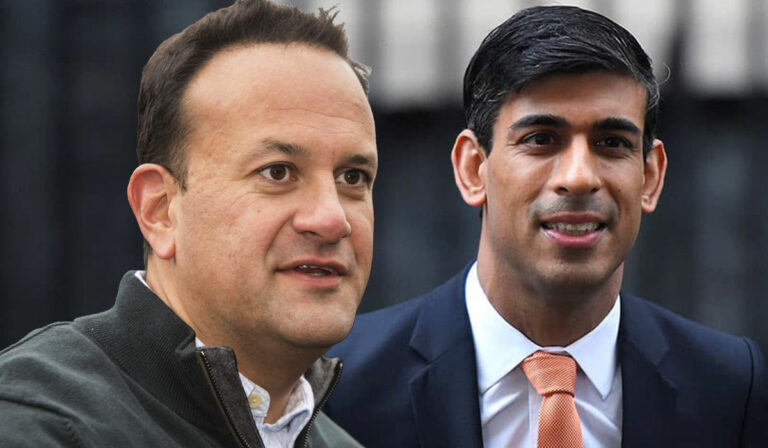
Leo Varadkar and Rishi Sunak
Composite image from extra.ie
“I am no longer best man to be Irish PM”, said a BBC headline this week, summarising Leo Varadkar’s resignation speech. The truth, Leo, is that you were never the best man to be Irish PM. He was never elected by the people to be taoiseach, instead securing that seat of power by appointment and backroom dealing. And once there, once he’d been gifted the highest office in the land by his allies in Dublin 4, he wielded government not for the people, but against them. He bent Ireland to what was essentially a vast real-time experiment in social re-engineering and thought control.
An unelected ruler using his power and clout to correct the country and improve the people? There’s a word for that. And it isn’t “democracy”.
Varadkar announced his resignation on Wednesday. In an emotional speech he said he was stepping down as leader of Fine Gael immediately and will step down as taoiseach once his successor has been chosen. His “shock departure” followed the people’s crushing defeat of the twin referendum he put forward. Overwhelming majorities rejected his proposals to alter the Irish constitution to update its definition of “family” and to fix what Varadkar damned as its “very sexist” reference to a woman’s “duties” in the home. No thanks, said the electorate, in the biggest ever referendum loss by an Irish government.
Even the fact that Varadkar’s stepping down is widely seen as a “shock move” speaks to the haughtiness, the outright unworldliness, of his political kind. To many of us it makes perfect sense that a PM would bugger off after suffering a historically unprecedented bloody nose from voters. But it seems the Varadkar clique thought they could ride it out. “No biggie” was their view. Until his “shock departure” on Wednesday, reports the Guardian, “the political fallout from the [referendum] debacle had widely been expected to be limited”.
Who expected that? I’m sure those voters who gleefully seized the opportunity of the referendum to give the middle finger to Varadkar and the rest of the establishment didn’t expect the impact of their discontent to be “limited”. It is a testament to the arrogance of technocracy, to the chasm that has emerged between Ireland’s rulers and Ireland’s ruled, that the Dublin establishment thought it could shrug off the largest drubbing it has ever received from voters.
In the end, tellingly, it seems it was disgruntlement from within his own party ranks, rather than the disgruntlement of the oiks, that convinced Varadkar to go. He was facing “increasing discontent within Fine Gael”, with some party bigwigs worried he’s an “electoral liability”. Everything you need to know about the man is contained in the fact that he essentially shrugged when the masses rose up against him but bolted when his fellow clerisy members criticised him. To the technocrat, the disapproval of their dinner-party circle carries far more weight than the discontent of ordinary people.
If Varadkar was edged out by the tut-tutting of movers and shakers, it would be a fitting end to a career that always owed more to the intrigue of political insiders than to the enthusiasm of the electorate. It is an unremarked upon truth that Varadkar was never installed into power by the people. He first became taoiseach in 2017 when then taoiseach Enda Kenny resigned as leader of Fine Gael. Varadkar was elected new party leader and became taoiseach on the back of it. So he became PM of Ireland on the back of the deliberations of 25,000 party members, not the ballots of the people.
Actually, even members of Fine Gael weren’t especially enthused by him. Varadkar’s opponent in the 2017 leadership contest – Simon Coveney – won almost twice as many votes from party members: 7,051 to Varadkar’s 3,772. But Varadkar won more votes from members of the parliamentary party – 51 to Coveney’s 22 – which meant Fine Gael’s weighted electoral college ruled in his favour rather than Coveney’s. From the get-go, Varadkar’s rule of Ireland was more an accomplishment of elite patronage than democratic keenness.
March 7, 2024
QotD: Helmuth von Moltke’s Kabinettskriege of 1870
From an operational perspective, this sequence of events was (and is) considered a masterclass, and a major reason why Moltke has become revered as one of history’s truly great talents (he is on this writer’s Mount Rushmore alongside Hannibal, Napoleon, and Manstein). The Prussians had executed their platonic ideal of warfare — the encirclement of the main enemy body — not once, but twice in a matter of weeks. In the conventional narrative, these great encirclements became the archetype of the German kesselschlacht, or encirclement battle, which became the ultimate goal of all operations. In a certain sense, the German military establishment spent the next half-century dreaming of ways to replicate its victory at Sedan.
This story is true, to a certain extent. My objective here is not to “bust myths” about blitzkrieg or any such trite thing. However, not everyone in the German military establishment looked at the Franco-Prussian War as an ideal. Many were terrified by what happened after Sedan.
By all rights, Moltke’s masterpiece at Sedan should have ended the war. The French had lost both of their trained field armies and their head of state, and ought to have given in to Prussia’s demand (namely, the annexation of the Alsace-Lorraine region).
Instead, Napoleon III’s government was overthrown and a National Government was declared in Paris, which promptly declared what amounted to a total war. The new government abandoned Paris, declared a Levee en Masse — a callback to the wars of the French Revolution in which all men aged 21 to 40 were to be called to arms. Regional governments ordered the destruction of bridges, roads, railways, and telegraphs to deny their use to the Prussians.
Instead of bringing France to its knees, the Prussians found a rapidly mobilizing nation which was determined to fight to the death. The mobilization prowess of the emergency French government was astonishing: by February, 1871, they had raised and armed more than 900,000 men.
Fortunately for the Prussians, this never became a genuine military emergency. The newly raised French units suffered from poor equipment and poor training (particularly because most of France’s trained officers had been captured in the opening campaign). The new mass French armies had poor combat effectiveness, and Moltke managed to coordinate the capture of Paris alongside a campaign which saw Prussian forces marching all over France to run down and destroy the elements of the new French Army.
Big Serge, “The End of Cabinet War”, Big Serge Thought, 2023-11-30.
Comments Off on QotD: Helmuth von Moltke’s Kabinettskriege of 1870
February 28, 2024
Why Germany Lost the First World War
The Great War
Published Nov 10, 2023Germany’s defeat in the First World War has been blamed on all kinds of factors or has even been denied outright as part of the “stab in the back” myth. But why did Germany actually lose?
(more…)
Comments Off on Why Germany Lost the First World War


