Quotulatiousness

May 9, 2026

Like the Roman. The Life of Enoch Powell, by Simon Heffer

Filed under: Books, Britain, History, Media, Politics — Tags: , , , , , — Nicholas @ 05:00

I think it’s fair to say that Enoch Powell is having a moment, nearly sixty years after he shocked the establishment with his 1968 “Rivers of Blood” speech. He became a pariah even in his own party, and his political career never recovered … but his warnings have more than been fulfilled over the intervening decades. In The Critic, Jeremy Black reviews the recently reprinted 1998 biography of Enoch Powell by Simon Heffer:

Enoch Powell in a 1987 portrait by Allan Warren.
Wikimedia Commons.

The new imprint of this important biography provides an opportunity to reread one of the most skilful works on British political history published over the last half century. As with Heffer’s other books, it is also very well written — although might I offer a plea for leaving aside sentences such as “He still saw no reason to lay off Heath”?

Before turning to the substance, it is worth considering the Foreword. Written this January, it underlines Powell’s significance to many issues, notably: “His deep scepticism about the confluence of America’s interest with those of Britain”. I am, however, dubious about the proposition that “Powell was, quite simply, one of the foremost Conservative thinkers in living memory, possibly the greatest since Burke”. Leaving aside the question of whether Burke can be described as Conservative or even, prior to the 1790s, as conservative, and, separately, the implicit dig at claims for Disraeli whom Heffer is on the record as describing as a Charlatan, I myself would make the case for Salisbury, while agreeing that Macmillan, Hailsham and MacLeod did not measure up to Powell. He returned the damage done him by Macmillan with “bilious” reviews of his Memoirs.

While I am sceptical of the claim that Powell was a great Conservative thinker in the cosmic sense, he was an impressive critic of many of the shibboleths of establishment Conservatism from the 1960s to the 1980s, including on immigration, the nuclear deterrent, the Common Market, the American alliance, Northern Ireland, and economic policy.

A significant aspect of the intellectual character of Powell was the return of this one-time atheist to the Church in the late 1940s, the subject of the “Interlude” “Powell and God” in the book. There is, as Salisbury and Cowling among others underlined, a significant link between Conservatism and the Church of England, and Powell, like Thatcher, can be profitably discussed in these terms, with Thatcher far less convincing.

The discussion of Powell’s elision from public debate is also interesting. Published by Weidenfeld and Nicolson in 1998, the biography was kept on print-on-demand until cancelled in the aftermath of the Black Lives Matter movement. Heffer compares the treatment of Powell to that of Orwell in facing difficulties in publishing Animal Farm and Nineteen Eighty-Four. For several years, Heffer found it impossible to persuade a publisher to republish the book and suggests that this was due to a craven fear of public opinion “real or perceived”, one about which Orwell had warned not least when referring to “intellectual cowardice”. The publisher he has found, it has to be said, is another instance of the very valuable work being done by non-metropolitan concerns.

May 7, 2026

Pay no attention to the Laurentian Elite behind the curtain!

Canada before Confederation was largely run by the Family Compact, an informal oligarchy of wealthy and influential families who had a virtual monopoly on social advancement, political appointments, and the justice system. As kids we were all told in school that this all withered away and now we live in a wonderfully meritocratic society (that’s also a genocidal racist, sexist, homophobic, transphobic dystopia, but those are later lessons after the land acknowledgements). They didn’t fade away, of course, and the behind-the-scenes power brokers are still there, still wielding informal but widespread control over the government and the economy. We just call them the Laurentian Elite, so that’s totally different than the bad old Family Compact, eh?

The Laurentians very effectively keep themselves out of the public eye. Most Canadians don’t even know this class exists. So, they are in that sense a shadowy cabal.

Of course Canadians want prosperity and whatever. Everyone does. Of course they think this is the purpose of the government. Of course the government’s messaging is largely around economics.

The government’s actual activities, however, are immensely economically destructive. This is because of their religious fanaticism. Canadians believe in “peace, order, and good government”. The Laurentians believe in multiculturalism, mass immigration, gender woo, and climate change. They just lie about these things being good for the economy. It’s now obvious that they are very bad for the economy, and yet, they continue, so.

The gimmigration restrictions are a joke. The government is continuing to hand out PRs and passports like Halloween candy, and turd worlders are continuing to grab them like the black kids who think the whole basket is all just for them. It is allowing TFWs to flood the asylum system, which it uses as a back door to keep them in the country. The numbers they publish are a bullshit accounting game, but even if they’re to be believed, letting in hundreds of thousands of new PRs every year isn’t a reduction from anything but the truly insane spike in 2022-24.

The housing market is fucked, yes, but I’m skeptical this is because immigration has been “reduced”. It’s more likely that a decade of zero economic growth, rapid inflation, even more rapid asset inflation, shit jobs, and high taxes means that no one can afford the overpriced housing, so no one buys it. The shoebox condos they threw up all over Toronto are a contributing factor: no one wants to spend $500,000 on a 500 square foot condo, so no one does. Investors can’t afford to sell for less, so they sit on them. Developers look at tens of thousands of units of unsold inventory, and refuse to start new projects. Whole system is seized up because of many years of malinvestment, not because the government has meaningfully reduced the invasion.

You say that Canadians will go back to Laurentian rule once the excesses are curbed. That presumes Laurentian rule slackened for even a moment, and that the Laurentians have any intention of curbing their excesses. Neither of these are true. They are doubling down on everything. Destroying Canada — as one element in the destruction of Western civilization — is a religious imperative for them. Nor was their power ever threatened, because it is propped up by brainwashed parasitic client groups — boomers, women, immigrants — that now comprise the bulk of the country.

The “pivot” was about two weeks of campaign rhetoric, during which a fast-talking globalist banker gave the boomers a reach-around about “British and French heritage”, which dazzled the affection-starved senile coots because it was the first time they’d heard something nice about themselves in a generation. Since then there’s been no rollback in DEI. No rollback in gender woo. No rollback in net zero. No rollback in Internet censorship. To the contrary, it has been full steam ahead on every single one of their hateful programs.

No revolution? You’re probably right, although the Freedom Convoy suggests that there are possibilities. Nevertheless the most likely scenario is that Canada devolves into Argentina Del Norte, its bones picked by vultures posing as patriots, kept in power by the most mind-raped boomers on planet Earth.

I do not think this is a good thing, obviously. I love my country very much. I suppose the reason for my vehemence on this matter is that I do not see any future for Canada with the Laurentians remaining in charge. We cannot work with them. They aren’t going to change. They aren’t going to slow down. They need to be removed, prosecuted for high treason, their assets seized, their oligopolies nationalized, and many of them sent to the gallows. Absent this, Canada is doomed.

May 5, 2026

Restore Britain’s proposal for illegal migrant detention centres

Filed under: Britain, Media, Politics — Tags: , , , , — Nicholas @ 03:00

On the Restore Britain Substack, the party lays out its proposal for locating detention centres for illegal migrants, in response to Nigel Farage’s vindictive desire to punish voters in constituencies that “voted the wrong way”:

Reform want to vindictively target Brits in potential Green constituencies to make a point and house illegals next to them — that is their choice. But I don’t believe that we have time for this petty nonsense.

A Restore Britain Government will not abandon residents of those constituencies who have a Green MP elected on 25% of the vote. That is not fair, and more importantly — it is not efficient.

Restore Britain will focus on solving the problem, in the most ruthlessly efficient manner possible. Objective number one is quite clear — remove the illegal migrant population.

That is not going to be completed through vengeful gimmicks.

We won’t punish hardworking British men and women because their neighbours voted Green.

We need a serious, systematic approach utilising the current state apparatus at first in order to rapidly scale our removal capabilities — our deportation paper goes into great detail about how to achieve this.

This an incredibly complicated task. Removing two million plus illegal migrants will not be done overnight. It will not be done through deliberately choosing less efficient options to take revenge on constituencies who did not vote for us. We don’t have time for this petty nonsense.

It is a mammoth challenge — it would be one of the biggest state policy implementations ever.

We would construct detention facilities where they are most efficient, most secure, and most practical to operate — not based on shitty political point-scoring, but on what actually works and on what actually will remove these illegals on a timescale the British people expect.

Because the aim is clear.

To detain, process and remove those who have entered this country illegally, and to do so at scale. Millions will go.

May 1, 2026

Spain joins the awkward squad

Filed under: Europe, Government, Media, Politics, Russia — Tags: , , , , , , — Nicholas @ 03:00

At The Conservative Woman, Bepi Pezzulli outlines a few ways that the Spanish government is moving in quite different directions than their NATO allies and fellow EU members:

Torre del Oro (Tower of Gold) – Calle Almirante Lobo, Seville – Spanish flag” by ell brown is licensed under CC BY-SA 2.0 .

Spain’s Prime Minister Pedro Sánchez wants the privileges of alliance without the duties of one. Madrid remains in Nato, hosts critical American military infrastructure, and speaks the language of Atlantic solidarity – but only when convenient. On the central strategic questions of the age – Russia, Israel, and the wider Western posture in the Mediterranean – it increasingly behaves like a spoiler. What is troubling is that Spain is not merely posturing: it is rewriting its entire conception of statecraft, treating alliance as a shield, hostility as leverage, and strategic ambiguity as a governing doctrine.

When Washington needed alignment, Sánchez offered obstruction. When Israel faced existential war, Madrid offered moral lectures. When the West sought energy discipline against Moscow, Spain found room for Russian gas. All while preserving the old imperial obsession with Gibraltar and extracting advantages from London over the Rock.

Spain has discovered the pleasures of consequence-free hostility. That needs to end.

Anti-Americanism with diplomatic immunity

Sánchez has carefully cultivated the old European left’s anti-American reflexes: Nato when subsidised, moral neutrality when sacrifice is required. His government publicly resisted support for American military operations linked to Iran escalation and signalled clear reluctance to facilitate use of Spanish bases such as Rota and Morón for operations that might implicate Madrid politically. The message was unmistakable: American security guarantees are welcome but strategic co-operation is negotiable. The rhetoric matched the policy. “No to war” was not merely a slogan for domestic consumption. Sánchez is deliberately positioning Spain as the righteous dissenter against Washington’s harder strategic line.

At the same time, Spain maintained substantial imports of Russian gas well into the European sanctions era. While pipeline politics consumed Brussels, Madrid benefited from a convenient moral distinction: condemning Moscow loudly while continuing commercial accommodation where useful. The formal sanctions architecture left open some loopholes, and Spain was happy to live inside them.

An ally that profits from ambiguity while others bear the strategic burden is not an ally in the full sense. As US War Secretary Pete Hegseth noted, “An alliance cannot be ironclad if in reality or perception it is seen as one-sided”.

From criticism of Israel to open diplomatic hostility

On Israel, Sánchez has moved beyond criticism into active diplomatic confrontation. Recognition of Palestine was presented as humanitarian principle. In practice, it rewarded maximalism at the worst possible moment. Madrid helped transform October 7 from a terrorist massacre demanding strategic clarity into another European seminar on Israeli restraint. Spain became one of the loudest governmental amplifiers of the anti-Zionist campaign in Western Europe. Ministers normalised rhetoric that blurred the distinction between criticism of Israeli policy and systematic delegitimisation of the Jewish state itself. Arms restrictions followed. Then diplomatic actions. Symbolism became policy.

Gibraltar: Madrid’s imperial nostalgia

Spain’s sanctimony would be easier to tolerate if it were not paired with its own colonial fixation. For decades, Madrid has pursued sovereignty claims over Gibraltar with theological persistence. Brexit offered a fresh opening. With Brussels behind it, Spain extracted a remarkably favourable negotiating posture over the future relationship of the Rock with both the European Union and the United Kingdom. London, in the hands of the most Europhile government in recent history, conceded far more than many British voters imagined when they heard the word “sovereignty”. Spain never abandoned the long game. It simply learned to play it through institutions until a weaker opponent appeared. Madrid insists Gibraltar is unfinished history. Fair enough: is it not time then to conclude the same about Ceuta and Melilla?

April 24, 2026

Britain’s Green Party … not your weird cousin’s old Green Party

The Green Party have been more of a punchline than a party for decades in British politics, but the Green Party of today shares only a name with its earlier incarnations (the old UK party is now split into three separate Green Parties for England and Wales, Scotland, and Northern Ireland). Now, it’s become a significant threat to the Labour Party thanks to its unlikely fusion of socialist and green policies with strong support from Britain’s growing Muslim community:

The Green Party is a growing force in British politics. In February, they gained the Parliamentary constituency of Gorton and Denton in a by-election — a supposedly “safe” seat for the Labour Party. Local elections in May see them set to make big gains — perhaps sweeping to power in several town halls in London, perhaps including Camden, where Sir Keir Starmer is one of the local MPs. Opinion polls often show them roughly level with Labour and the Conservatives.

This is quite a change from previous decades when they were indulged as eccentrics on the political fringe. The Green Party (or the Ecology Party, as it was earlier named) were the sandal-wearing, muesli-munching environmentalists who wanted to go back to nature. They opposed economic growth — but their supporters tended to be affluent enough that they could afford to do so. Its leader was the aristocrat Sir Jonathon Porritt.

They were the breed George Orwell was thinking of when he wrote: “One sometimes gets the impression that the mere words ‘Socialism’ and ‘Communism’ draw towards them with magnetic force every fruit-juice drinker, nudist, sandal-wearer, sex-maniac, Quaker, ‘Nature Cure’ quack, pacifist, and feminist in England”.

Great fun. But there was a darker side to the quackery then and now. A totalitarian mentality which, as Orwell also vividly described, proves horrific when it prevails.

Increasingly, the Green Party has shifted its focus away from the environment. In the few towns and cities where it has gained power locally, such as in Bristol and Brighton, it has proved ineffective at practical work in this respect. Typical behaviour would be to pass a motion declaring a “climate emergency” but then perform lamentably when it comes to recycling or tree planting or any of the relevant matters they have the power to deal with.

There was always a distortion in its supposed concern for sustainability in that it was really an excuse to denounce capitalism. The Property and Environment Research Center, a US think tank which champions free-market environmentalism, has shown a more enlightened approach. Their work has included a comparison of privately-owned and state-owned forests. Another applies property rights to marine assets. But the role of property rights as a means of good stewardship of our planet is dismissed by the Green Party out of hand.

In any case, much of the campaigning by the Green Party now is on non-green issues. Its leadership talks a lot about foreign policy and a broader economic pitch focusing on class war rhetoric and an extreme programme of state control. Taxing the rich is always seen as the panacea, despite the reality that many entrepreneurs are already fleeing the United Kingdom due to its hostile fiscal environment.

Its Manifesto for the last election two years ago proposed a Wealth Tax, a pensions tax, and a big increase in Capital Gains Tax. A £90 billion carbon tax would have closed down much of British industry, which was probably the idea.

April 21, 2026

Hungary in the news

Filed under: Europe, Media, Politics — Tags: , , , , — Nicholas @ 03:00

Theodore Dalrymple considers the recent change in government as Victor Orbán was replaced by Péter Magyar, who had been an Orbán supporter until the last few years:

Hungarian Prime Minister-elect Péter Magyar, on 15 March 2026 during a national day demonstration at Heroes’ Square in Budapest. Magyar is wearing a traditional bocskai jacket and a national cockade.
Photo by Norbert Banhalmi and released under CC BY-SA 4.0 via Wikimedia Commons.

It is perfectly normal and healthy that in an electoral democracy a government should be voted out of office after 16 years in power. One of the complaints often heard in such democracies is that “they are all the same”, they being members of the political class of whatever political party.

But there is benefit in a change of government personnel irrespective of all else, for those who remain too long in power come to think of that power as their right, and the citizenry as their servants rather than of themselves as servants of the citizenry.

The recent removal from power by election of Viktor Orbán in Hungary after so long as prime minister (and his full acceptance of the defeat, despite accusations that he was like an authoritarian dictator) was perfectly normal. He had been replaced by a man who is no fire-eating radical, Péter Magyar, a young man who was, until comparatively recently, a supporter of the leader he has replaced.

The electorate, according to polls, was concerned about the state of the economy and the level of corruption in the country. Governments that come into power promising to eradicate corruption often reveal themselves to be no different in this respect from the last: the fruits of corruption are distributed to different people, that is all.

The new prime minister differs greatly from the old in two attitudes: firstly, to the war in Ukraine and secondly to the European Union. Unlike Mr. Orbán, he is no friend of Vladimir Putin’s; and unlike Mr. Orbán, he is more likely to do the Union’s bidding in order to gain access to the latter’s funds. One important question is whether he will be forced to change Hungary’s attitude to mass immigration, opposition to which was a source not only of Mr. Orbán’s conflict with the Union, but of his long domestic popularity.

His policy was regarded as xenophobic, but this was an unjustified slur. Xenophobia is a hatred or fear of foreigners as such, ex officio, and on my visits to Hungary I found none of this. I met, for example, a Kurdish physiotherapist well integrated into Hungary, and a Moroccan academic likewise, who did not complain of personal antagonism to them. Other foreign residents whom I met did not complain of it either. A desire to protect a small country from the effects of mass immigration that have been seen in Sweden (a country of similar size of population), for example, is not xenophobia: it might on the contrary be regarded as both prudent and as a manifestation of love of one’s country. It is part of the malign legacy of Hitler and the Nazis that love of one’s country is now felt by many European intellectuals to be inherently vicious and aggressive. But love of one’s country is not the same as hatred of everyone else’s, though it is true that patriotism can sometimes degenerate into such hatred.

The European Union’s attitude to mass immigration is contradictory. It regards ethnic and cultural diversity as good in themselves, as if what existed before was lacking some important ingredient that such diversity will automatically bring.

April 17, 2026

Hungary in the news

Filed under: Europe, Media, Politics — Tags: , , , , — Nicholas @ 05:00

The way the mainstream media reacted to the recent Hungarian election results, you’d think it was the 2020s equivalent to the fall of the Iron Curtain. Outgoing leader Viktor Orbán has been portrayed as Hungary’s Trump when he hasn’t been discussed as Hungary’s Mussolini. His successor, Péter Magyar is largely unknown outside Hungary where he had been a member of Orbán’s Fidesz party before leaving to join his current party, Tisza. In The Critic, Ben Sixsmith provides some useful background on the state of politics in Hungary today:

Hungarian Prime Minister-elect Péter Magyar, on 15 March 2026 during a national day demonstration at Heroes’ Square in Budapest. Magyar is wearing a traditional bocskai jacket and a national cockade.
Photo by Norbert Banhalmi and released under CC BY-SA 4.0 via Wikimedia Commons.

Tisza — the name being a portmanteau of the Hungarian words tisztelet (respect) and szabadság (freedom), and a reference to the nation’s second largest river — was founded in 2020 and registered in 2022. It was a very marginal conservative party with policies like “raise the minimum pension” and “stop migration”.

In the 2022 parliamentary elections, the party fielded no candidates at all.

Tisza became a major force in Hungarian elections when Péter Magyar joined the party. Magyar, who has a legal background, had been a member of Viktor Orbán’s party Fidesz. More significantly, he had been married to the Hungarian Minister of Justice, Judit Varga, from 2006 to 2023.

In 2024, Varga resigned, along with Hungarian president Katalin Novák, after both were exposed as having signed a pardon for a convicted paedophile who had been a director of a state-run children’s home. Magyar resigned from Fidesz, accusing Orbán of “hiding behind women’s skirts”.

“For a long time I believed in an idea, a national, sovereign, civic Hungary,” wrote Magyar in a much-quoted statement, “But in recent years, I have slowly and finally realized that all of this is really just a political product.”

Magyar became a ferocious critic of alleged government corruption. His ex-wife responded to his anti-Orbán activities by accusing him of domestic abuse. Magyar denied this. Undaunted, he led various anti-government demonstrations, which attracted tens of thousands of Hungarians. He was also chosen to lead Tisza.

Magyar has profited from good timing. He is also a photogenic man who has performed well on social media. His politics are more mysterious. He has called himself a “critical pro-European and a conservative liberal”.

He is not the sort of liberal that anti-Orbán Westerners might want him to be. While he has said that he will “move away from the current, uncritically friendly approach towards Russia”, he has also said that it will take time to stop buying Russian fuel, and he has criticised the Ukrainian approach to Hungarian minorities. He has sometimes tried to outflank Orbán on sovereignty, saying that Fidesz have brought in too many guest workers, and even questionably saying that migrants have been stealing ducks from Hungarian ponds. Still, it remains to be seen if the pro-EU Magyar will maintain his more right-wing opinions or be swept along by European orthodoxy — not least when he has emphasised the importance of unlocking EU funds.

At The Sceptic, James Alexander says that the situation is more complicated than a split between Orbán and what he terms “the Roral Response”:

President Donald Trump and Hungarian Prime Minister Viktor Orban pose for a photo in the Oval Office, Friday, November 7, 2025.
Official White House photo by Daniel Torok via Wikimedia Commons.

What is the Orbán-Roral Divide? It is the Manichaean yin-yang binary of the simplistic political imagination, which supposes that, on one side, we have Orbán, Putin, Trump etc., and that, on the other side, we have von der Leyen, Merz, Starmer, Carney, Zelensky and of course the man after whom I name the category: Rory Stewart.

It has some truth in it, but it is bewildering when we see the binary exalted as if it is the only truth of politics. The downfall of Orbán illustrates this almost perfectly.

The subject today is Orbán Developments. And the Roral Response.

News.

As you all know, Orbán, after 16 years of power, fell in the recent election.

  • Viktor Orbán = Fidezs = 37.8% = 55 seats
  • Peter Magyar = Tisza = 53.6% = 138 seats

“Who loses and who wins, who’s in, who’s out,” quoth King Lear.

Orbán lost.

Now, I like Orbán, symbolically. I don’t know about actually: never studied him. I read one of his speeches once, and it read as more intelligent than any equivalent political speech. I have one thing in common with him, which is that he was present at the funeral of Norman Stone. Anyhow, like him or loathe him, we have to be philosophical. And we have to respect him, even if he is an Oxford man.

  • Oxford: Obsessed with power. Corrupt. Cecil Rhodes, Lord Milner, Tony Blair, David Cameron, Boris Johnson, Dominic Cummings, Viktor Orbán etc.
  • Cambridge: Lord Acton: “Power corrupts and absolute power corrupts absolutely.”

So let us look at what people say. The amusing thing is that people immediately editorialise. Twitter, X, Whatyouwill.com, turns everyone into William Rees-Mogg. Look at all these Editors.

Here is Ferenc Horcher, a very important Hungarian scholar:

    Time to face reality: the Hungarian electorate ousted the ruling power. The electoral system Fidesz introduced gave its opponent a two-thirds majority. Orbán established a one-man rule, tailored the campaign to himself, he is responsible for the defeat, he has to resign.

That’s grim talk from a conservative. So here on the jolly side is Sam Moyn, a very important Yale Law School professor:

    Yay for Hungary. What if the answer to illiberalism is democracy?

Ho hum. I sigh a bit over the innocence of making a contrast between illiberalism and democracy, as if liberalism = democracy.

(more…)

April 15, 2026

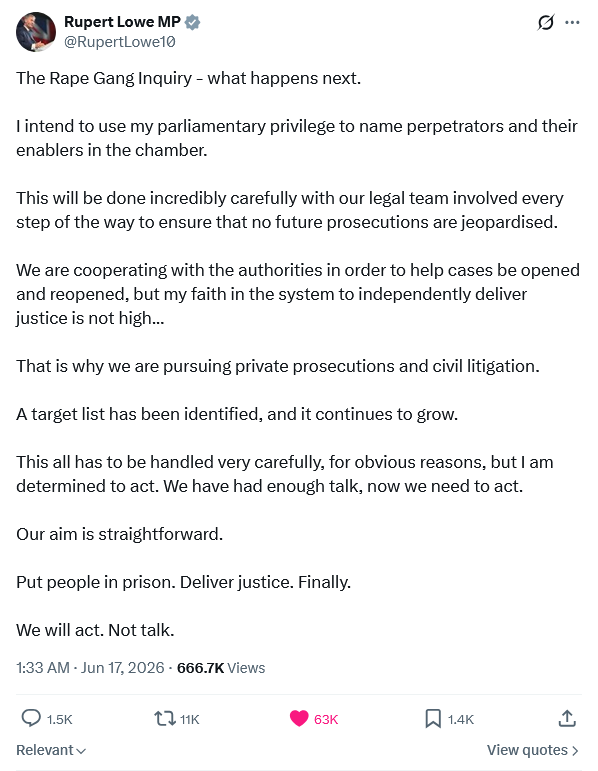
Do “combat-trained Islamists in Britain … now outnumber the British Army”?

Filed under: Britain, Government, Middle East, Military, Politics — Tags: , , , — Nicholas @ 05:00

In The Conservative Woman, Julian Mann asks Conservative party leader Kemi Badenoch if Britain’s immigration policies have imported enough “combat-trained Islamist” to outnumber the ever-decreasing number of soldiers in the British army:

You won’t find anyone less military-minded than me but Conservative leader Kemi Badenoch’s speech to the London Defence Conference last week prompted me to put these questions to her on X:

“How many combat-trained Islamists do you estimate there to be in Britain? Would they now outnumber the British Army and, if so, by how many?”

I very much doubt that I will get an answer. She is a busy woman and she might be reluctant to comment for fear of being drawn into an anti-Muslim conspiracy theory. She should note that the question is about Islamists, not about integrated and peaceable British Muslims.

It was this part of her speech, highlighted by historian Niall Ferguson on X, that provoked the questions:

    General Sir Richard Barrons, co-author of the Government’s Strategic Defence Review, stripped away the pretence when he said: “Today’s army, frankly, could do one very small thing. It could seize a small market town on a good day”.

Ms Badenoch also said: “Between 1989 and 2022, defence spending fell in every year. One of the authors of the Strategic Defence Review has since said: ‘The UK is trapped in a conspiracy of stupidity because politicians won’t make the case for cutting spending to fund defence’. And he’s not the only one who thinks that. In Washington, US administrations have felt for years that, while America subsidised the defence of Europe, we built welfare systems instead. On this point, they are right. Before the Second World War, one in every £7 the British government spent went on health and welfare. By last year, it had soared to one in every £3. We have grown fat on welfare, prioritising benefits over bullets.”

According to the House of Lords Library: “As at 1 April 2025, there were 181,890 people in the UK armed forces, a 1 per cent decrease compared with the previous year. This total includes:

  • all full-time service personnel (known as the UK regular forces) and Gurkhas, who comprise 77.7 per cent of the total number of personnel
  • volunteer reserves (17.5 per cent of the total personnel)
  • other personnel, including the serving regular reserve, sponsored reserve and military provost guard service (4.8 per cent of the total personnel)

“The total size of the full-time UK armed forces, comprising the UK regular forces, Gurkhas and full-time reserve service, was around 147,000. Of these, 82,000 were Army personnel, 33,000 were members of the Royal Navy or Royal Marines, and 32,000 belonged to the Royal Air Force.”

So if there were 100,000 combat-trained Islamists in Britain, they would outnumber the British Army by about 20,000. I realise that there are various levels of combat training. It is possible that British Army personnel are better trained than any Islamist forces they might face on British soil. But would they be better motivated, given the way they are being treated by the Government? Why has the Government apparently failed to reckon with the appalling impact on morale and recruitment from the lawfare it is allowing against special forces and Northern Ireland veterans?

Update, 16 April: Welcome, Instapundit readers! Have a look around at some of my other posts you may find of interest. I send out a daily summary of posts here through my Substackhttps://substack.com/@nicholasrusson that you can subscribe to if you’d like to be informed of new posts in the future.

April 14, 2026

Britain’s Green Party stakes out bold new immigration policies

Filed under: Britain, Government, Media, Politics — Tags: , , — Nicholas @ 03:00

With the ongoing shake-up in British politics — long-established “mainstream” parties losing support across the board — once-fringe parties are becoming electorally viable at least in the short term. On Substack Notes, Donna-Louise Flowers talks about the Green Party’s amazingly generous plans for immigrants to Britain should they be elected:

Someone on X just called me a scaremonger. 🙄

For quoting the Green Party’s own published immigration policy.

I’m a former Detective Constable. Serious sexual violence. CSE. I didn’t scaremonger for a living.

So let me be VERY clear about what the Green Party are actually proposing. In their own words. From their own published, member-voted policy document.

Every illegal arrival gets an automatic visa. No questions. No country of origin checks. Free legal advice to regularise their status. No penalty for being here unlawfully.

Guaranteed accommodation. Families get a house or flat with exclusive use. Free Universal Basic Income. No work required. Full NHS access from the moment they arrive — and their policy explicitly states these rights remain even if their asylum case is rejected.

And then — and I need you to read this carefully — they want to give every visa resident the right to vote in all elections and referendums.

All of this while our welfare bill has just exceeded our income tax revenue for the first time in British history.

All of this while we have a shortage of 6.5 million homes.

All of this while foreign nationals account for up to a quarter of all rape convictions in England and Wales. Up to 34% of sexual assault on a female convictions. Ministry of Justice data. Freedom of Information. Not opinion.

Not scaremongering.

Facts.

I’ve written a full thread on X breaking down every single point with sources. Link below.

Read it. Share it. Because this is what 18% of the country is apparently voting for.

x.com/nolongerthefuzz/s…

March 30, 2026

Net Zero or mass immigration, pick one (or better, pick neither)

Lorenzo Warby points out the blindingly obvious (to anyone with common sense) fact that the top two pet projects of western transnationalist elites — Net Zero and mass third-world immigration — are in direct conflict with one another. But rather than choosing one form of societal suicide over the other, the healthy alternative is to absolutely reject both:

Culturally more homogeneous democracies are happier than more culturally diverse democracies. Also, in the Anglophone countries, where the centre-right won the most recent national election, happiness went up slightly. Where the centre-left won the most recent national election, happiness went down noticeably.

Australia is the latest developed democracy to experience conventional centre-right politics being threatened by a national populist surge. Just as country-club Republicans were Trumped, Gaullists were Le Penned, Forza Italia was Melonied, and the Tories are being Faraged, so the Liberal-National Party Coalition in Australia is getting Hansoned.

What Australia has in common with the pattern in the UK, and the rise of AfD (Alternative for Deutschland) in Germany, is the combination of Net Zero (or equivalent) with mass immigration leading to a national populist surge.

National populism well predates Net Zero. It does not predate the adoption of policies of elite display and elite benefit, particularly regarding immigration. The combination of Net Zero with mass immigration is, however, particularly conducive to surges electoral support for national populism, as we can see in the UK, Germany and now Australia.

It is not hard to see why. Mass prosperity rests on cheap energy: that is much more important than, for instance, free trade. The Industrial Revolution is really the Mass Access To Cheap Energy Revolution. It is that access that is above all else responsible for The Great Enrichment.

As economic historian Jack Goldstone notes:

    by 1850 the average English person has at his or her disposal more than ten times the amount of moveable, deployable fuel energy per person used by the rest of the world’s population.

Net Zero means raising the price of energy, thereby narrowing access to it, and, in particular, narrowing the range of economic activity that is commercially sustainable. Even without increasing the population, that will increase contestation over resources.

Add mass immigration to the mix, and that contestation becomes much worse. All the experienced costs of mass immigration — higher rents and house prices; increased congestion; downward pressure on wages and increased fiscal stress (if importing significant numbers of low-capital/skill immigrants); downward pressure on social trust and corrosive effects on the norms and rules that underpin institutions (if importing lots of people from very different cultures); increased crime (if importing significant numbers of people from higher crime cultures) — are then magnified.

Canada’s immigration fraud system

Filed under: Cancon, Government — Tags: , , , — Nicholas @ 03:00

As Alexander Brown points out, “the purpose of a system is what it does”, and Canada’s immigration system produces vast amounts of fraudulent immigrants with only token attempts to detect and punish it. So Canada actually has an Immigration Fraud System, because that is what it does:

Let’s be clear about immigration fraud.

It started at the top. It was on purpose. And it’s still happening on purpose.

After a week of damning reports, and even a craven disregard for a return to decency, it has become abundantly clear that the government’s much-touted “reforms” are more about managing political perception than fixing a broken system. Behind the rhetoric lies a reality of widespread fraud, a continued lack of oversight, and an immigration department which has lost even greater control of its own bastardized mandate.

One of the most glaring failures has been the confirmed explosion of fraud within the international student program. Earlier this week, a scathing report from the Auditor General revealed that the IRCC failed to investigate the vast majority of cases flagged for potential fraud or non-compliance. Out of 153,000 cases identified in 2023 and 2024, only about 4,000 investigations were actually launched — a measly 2.6%. Even more troubling, 40% of these investigations were simply dropped because the students didn’t bother to respond to emails.

Speak to industry insiders and they’ll tell you that a “pay-to-play” market ran rampant between the years of 2021-2024, almost entirely on the basis of an understanding that fraudulent letters of acceptance, through equally dodgy institutions, would not be investigated through official immigration channels.

Let us not forget, even Ontario Premier Doug Ford touted this unvetted explosion — the worst policy decision in our nation’s history — as a success story. And yes, his office assisted in building for Conestoga, the worst offender of all the nation’s illegitimate institutions.

This culture of non-enforcement extends to the asylum system, which has seen a massive surge in claims. Since 2015, the backlog of refugee claimants has grown by a staggering 2,900%. While the government speaks of protecting the “vulnerable,” critics (read: normal people with morals and scruples) point out that the system is being exploited by those using it as a legal strategy to stall their removal from Canada. International students have spammed asylum claims after striking out in the labour force, making the trend so obvious that even then-immigration minister Marc Miller admitted it “[didn’t] smell good.”

Record levels of asylum fraud, in the six figures, is no mere matter of paperwork. The programme has become the safe haven for serial extortionists, varying degrees of triggermen from the Indian subcontinent, and those who have exploited a key loophole in the Safe Third Country Agreement: Canadian judges no longer care to enforce the law.

March 28, 2026

Noelia Castillo Ramos, RIP

Filed under: Europe, Health, Law, Media, Politics — Tags: , , , , , , — Nicholas @ 04:00

Celina provides the background information you certainly won’t get from skimming the mainstream media’s coverage of the death of twenty-five year old Noelia Castillo Ramos:

This is how broken the West has become. On Thursday, March 26, 2026, in a clinically sterile room within an assisted living facility in Barcelona, Spain, the government executed a twenty five year old paralysed rape victim. Her name was Noelia Castillo Ramos.1 Noelia did not die of a terminal illness, nor did she pass away from natural causes. Rather, she was administered a lethal injection by the Spanish state that had dismantled her family, forced her into a hostile and horribly dangerous environment, ignored her horrific violation, and ultimately deemed her broken existence too inconvenient to maintain.2

A still from Noelia Castillo’s Antena 3 interview on March 24.

While Noelia Castillo’s heart was stopped by a cocktail of state-sponsored chemicals, the unvetted migrant men who gang-raped her, shattered her mind, and drove her to fling herself from a fifth-floor window continue to walk the streets of Europe, entirely shielded from justice. They faced zero consequences. She faced the death penalty.

These were the last words that her grandmother said to Noelia: “I love you, my girl; someday we will be together again”.

The fate of Noelia Castillo stands as a single almost perfect, undeniable illustration of everything that is broken, evil, and actively suicidal about modern Western society under progressive, woke, open-border, and secular-left governance. Progressive Europe has functionally and legally decided that native European women and girls are a disposable commodity, just collateral damage in the grand suicidal project of multiculturalism.


  1. https://en.wikipedia.org/wiki/Case_of_Noelia_Castillo
  2. https://www.v2radio.co.uk/news/v2-radio-world-news/gang-rape-victim-25-to-be-euthanised-after-fathers-legal-challenge-fails/

March 24, 2026

“Matt Goodwin’s Suicide of a Nation is a very bad book”

Filed under: Books, Britain, Media, Politics — Tags: , , , , , — Nicholas @ 04:00

In The Critic, Ben Sexsmith reviews a new book by Matt Goodwin, Suicide of a Nation: Immigration, Islam, Identity:

Here is an exceptionally easy argument to make:

  1. Mass migration is ensuring that the historical majority in Britain is becoming a minority.
  2. This is the result of policies that have been pursued regardless of popular opinion.
  3. This has had many kinds of destructive consequences.

The first claim is so obviously true that one might as well deny the greenness of the grass. The second is proven by decades of broken promises (see Anthony Bowles’s article “Immigration and Consent” for more). The third requires argumentation, but I think that it is clear if one considers hideous incidences of terrorism, grooming gangs and violent censoriousness, as well as broader trends of economic dependency and electoral sectarianism.

Again, this is not a difficult argument to make. So why is it made so badly?

Matt Goodwin’s Suicide of a Nation is a very bad book. It reads like the book of a political operator extending his CV. The left-wing commentator Andy Twelves caused a stir on social media by pointing out various factual mistakes and what appear to be non-existent quotes. Twelves speculates that these “quotes” are the result of AI hallucinations, which is plausible, if not proven, in the light of the fact that two of Mr Goodwin’s sparse footnotes contain source information from ChatGPT.

Inasmuch as Suicide of a Nation makes a form of the argument sketched out the beginning of this article, there is truth to it. But it contains a fundamental problem — it assumes that this argument is so true that there is no requirement to make it well.

“Slop” is an overused term but it feels painfully appropriate for a book that is spoon fed to its audience. Goodwin, who had a long academic career before becoming a successful commentator, is not a man who lacks intelligence. But he writes as if he thinks his audience lacks it. “I did not write this book for the ruling class”, writes Goodwin, “I wrote it for the forgotten majority”. Alas, he seems to think that the average member of the “forgotten majority” has the reading level of a dimwitted 12-year-old. As well as being stylistically simple, the book is full of annoying paternal asides. “In the pages ahead I shall walk you through what is happening to the country …” “In the next chapter we will begin our journey …” Thank you, Mr Goodwin. Can we stop for ice cream?

The book is terribly derivative, with a title that reflects Pat Buchanan’s Suicide of a Superpower and a subtitle — “Immigration, Islam, Identity” — that all but repeats that of Douglas Murray’s The Strange Death of Europe — “Immigration, Identity, Islam”. It is written in the humourless and colourless rhetorical style of AI. I’m not saying it was AI-generated. (Indeed, a brief assessment using AI checkers suggests that it was not.) I’m just saying that it might as well have been.

March 23, 2026

Reject multiculturalism as you would reject fake meat

Filed under: Food, Government, Media, Politics — Tags: , , , , — Nicholas @ 05:00

Spaceman Spiff looks at the technocratic dream that we’d all give up on eating meat and instead switch to lab-grown, VC-funded, and Bill-Gates-approved fake meat. It failed utterly, of course, because despite all of the arguments the corporations and the astroturf activists could marshal, nobody wanted it. Vegetarians wouldn’t switch to eating something vaguely kinda-sorta meat-ish, and meat eaters were happy continuing their carnivorous habits. It had no real market, so it was a dud product.

Our technocratic elites have been pushing multiculturalism for even longer than they were pushing fake meat, but just as with fake meat, the more people encounter it, the less willing they are to accept it:

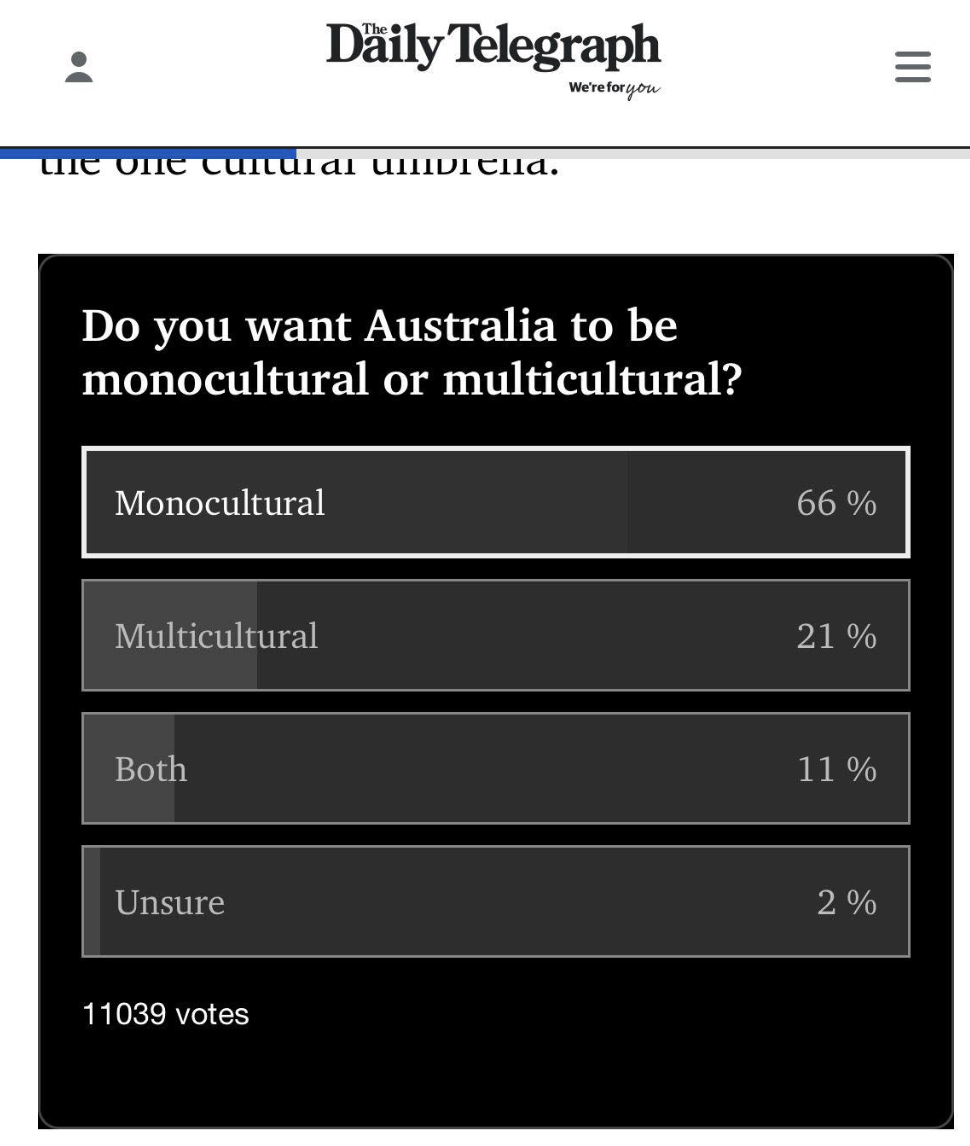
Multiculturalism is the belief many distinct cultures can live together and flourish rather than devolve into conflict.

This is false. It has never worked anywhere.

The world itself is multicultural. The solution that emerged to manage different groups was national borders. Each culture could segregate and live apart from others because they could not successfully live together.

As the failures of multiculturalism become impossible to hide, social engineers reach for ideas to make it work. The latest is civic nationalism. The fake meat of the social governance world.

For all human history we have relied upon the real thing, but now today’s social engineers believe they have discovered a superior recipe, one that avoids the hassle and expense of tradition.

Anyone can become someone like you as long as they conform to an arbitrary list of beliefs, behaviours, laws and customs. We can ignore ethnicity, heritage and history. We can manufacture instant populations with passports and certificates just as we can create synthetic meat by combining the ingredients ourselves.

Like fake meat it looks workable on paper. Not only that, it is presented as self-evidently reasonable. Why has nobody thought of this before? How convenient governments and corporations can import a new workforce and they magically become British, American or Chinese because they “share values” and observe laws.

America was the first to experiment, a necessity after the introduction of non-European immigration in the 1960s. Needless to say they didn’t need it before that.

The country found itself importing people with no historical connection to the American population through heritage or history. Far fewer of them married into the family than previous waves of immigrants from European nations. While importing the world America was becoming the world with its racial, ethnic and cultural tensions.

They convinced themselves they had always been a nation of immigrants and conveniently forgot how long it took even the Irish to assimilate into America despite their ostensible similarity to the founding stock.

Strenuous efforts to make this seem normal, despite its novelty, included the energetic emphasis on shared values or adopted customs since the newcomers were often strikingly different.

Civic nationalism seems to be based on the same faulty reasoning as synthetic meat. We can circumvent the traditional approach using innovation. Why live through centuries of strife for a nation to emerge when you can just hand out certificates and make everyone instantly like you because they claim to respect the law and promise to adopt new customs?

Initially this can seem to work. If a small number of skilled immigrants come they are typically absorbed. Most cultures can do this if the numbers are modest and especially if the newcomers intermarry, or their children do.

Even more so, in traditional societies, including our own until recently, the pressure to adapt was almost universal; no translators, no welfare, no slack whatsoever.

Large numbers of immigrants over short time scales retard the process of assimilation, and generous welfare programmes can derail it completely.

America is also big unlike European nations, so it has taken a while for the full effects to be felt.

Despite the endless hype, people reveal their preferences in their behaviour. They can move. Pro-immigrationists have complained about white flight for decades, one very obvious example of the failure of civic nationalism.

Image from Spaceman Spiff

Just like those inconveniently full supermarket shelves with their synthetic products no one will buy, people run from diversity when they can.

Civic nationalists, like climate zealots, resort to repeating their tired lines about their great intent, how amazing it is all meant to be if people would just get into the spirit of things.

But it is all fantasy. Literal fictions that exist only inside the heads of those who imagine utopia. Real life has its own ideas.

Update: Added missing URL.

Update the second, 24 March: Welcome, Instapundit readers! Have a look around at some of my other posts you may find of interest. I send out a daily summary of posts here through my Substackhttps://substack.com/@nicholasrusson that you can subscribe to if you’d like to be informed of new posts in the future.

March 11, 2026

The Supreme Court of Canada in Santa Claus mode (even if they no longer use those robes)

Filed under: Cancon, Government, Politics — Tags: , , , , , , , — Nicholas @ 05:00

In a pretty conclusive 8-1 decision, the Supreme Court of Canada seems to have overturned not only the Quebec childcare entitlement at issue in this case, but the notion of citizenship in a much wider sense:

The SCC recently abandoned their traditional red robes for black robes more similar to those of the US Supreme Court. This is a case where the older robes would be more appropriate for other reasons.

On Friday, the Supreme Court of Canada delivered its latest stupefying ruling. According to an 8–1 majority in the case of Quebec (Attorney General) v. Kanyinda, the Charter requires the Quebec government to extend subsidized daycare benefits to refugee claimants — asylum seekers who have not yet proven the legitimacy of their claim to refugee status. Founded on a prevalent but contentious reading of constitutional equality rights, the court’s reasoning has far-reaching potential to destabilize parts of the nation’s immigration and social welfare systems.

Until last week, Quebec law granted daycare subsidies to certain categories of parents, including Canadian citizens, permanent residents, and those with approved refugee status. When Bijou Cibuabua Kanyinda, the plaintiff in this case, arrived in the province and sought asylum in 2018, she fell into none of those categories. Aided by cause lawyers, and a coterie of social justice interveners (third party interest groups who submit arguments to the court), Kanyinda argued that the exclusion of refugee claimants from this welfare scheme amounted to unconstitutional discrimination.

Remarkably, the majority of the Supreme Court not only agreed with Kanyinda that the Quebec daycare scheme violated Section 15(1) of the Charter — which provides for “the right to the equal protection and benefit of the law without discrimination” — but bypassed the Quebec legislature by “reading in” a remedy directly into the law. In other words, the court rewrote the statute to immediately grant subsidies to “all parents residing in Quebec who are refugee claimants”.

More troubling than the outcome itself, however, will be the judicial reasoning that rationalized it. Writing for the majority, Justice Andromache Karakatsanis held that the Quebec scheme created a distinction “on the basis of sex”, a proscribed ground of discrimination under Section 15. But rather than fostering a distinction between men and women, Justice Karakatsanis asserted that the scheme discriminated between “men and women refugee claimants” — even though neither group was eligible for benefits at all. Because Quebec’s exclusion of refugee claimants worsened the economic disadvantage of the female claimants, she concluded, it constituted discrimination that violated Section 15.

The court’s reasoning is convoluted, to be sure. Readers may be forgiven for struggling to understand how a ruling that extends benefits to “refugee claimants” can follow from a supposed distinction on the basis of “sex”. In fact, the judgment exposes the incoherence into which the Supreme Court’s equality rights jurisprudence has fallen.

« Newer PostsOlder Posts »

Powered by WordPress