Are there any photos of Canadian PM Justin Trudeau where he isn’t in blackface? I’m struggling to remember the last time I saw one. There he was again yesterday, this wokest of world leaders, this darling of centrist Twitter, covered in black facepaint and sticking his tongue out. You know, like those dark-skinned foreigners do. The pic is from an Arabian Nights fancy-dress party – man, the bourgeoisie are weird – that Trudeau attended in 2001, when he was 29. Twenty-nine. If you’re on the cusp of 30, at the dawn of this new millennium, and you still don’t know it’s wrong to don blackface, there’s something wrong with you.
This is only the latest in a long line of Trudeau blackface scandals, of course. The man appears to have spent a significant chunk of his younger years blacked up. There are three blackface incidents that we know of. There could be more. As one headline put it: “Trudeau says he can’t recall how many times he wore blackface make-up.” Imagine blacking up so often you can’t remember all the times you did it. Trudeau’s defenders say it was youthful daftness. Really? I don’t know a single person who has ever blacked up. I know people who have done daft things, of course. But not that.
Trudeau’s penchant for blackface is very odd. He puts it down to the fact that he has always been “more enthusiastic about costumes than is sometimes appropriate“. Riiight. It is mostly a matter for Mr Trudeau and his conscience, of course, as to why he was black-painting his face – and, in one incident, his tongue too – well into his twenties. But it’s a matter for all of us who inhabit the online world as to why Trudeau has never been cancelled, or even seriously threatened with cancellation, for doing something that would be ferociously denounced as racist if anyone else on earth had done it.
Brendan O’Neill, “The never-ending ridiculousness of Justin Trudeau”, Spiked, 2021-09-21.
December 31, 2021
QotD: Justin Trudeau … “virtue-signalling made flesh”
December 17, 2021
Those Olympic rings are more than just tarnished
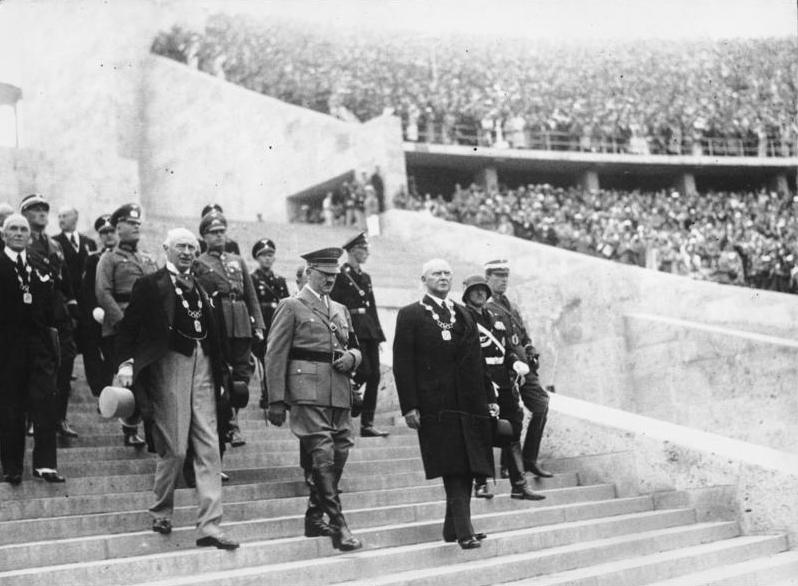
In First Things, George Weigel notes the, ah, Olympian disdain for mere morality and human decency is far from a new thing as the IOC prepares for the Beijing games in 2022:

Google translation of the original German caption: “Before the ceremonial opening of the XI Olympic Games. Together with the members of the International and National Olympic Committee, the Führer and Reich Chancellor enters the stadium through the marathon gate. On the left of Adolf Hitler [Henry] Graf Baillet-Latour, on the right His Excellency [Theodor] Lewald.”
German Federal Archives (Accession number Bild 183-G00372) via Wikimedia Commons.
In July 2016, as we were sitting on the fantail of the Swiss sidewheeler Rhone while she chugged across Lake Geneva, my host pointed out the city of Lausanne, where a massive, glass-bedecked curvilinear building was shimmering in the summer sun. “Isn’t that the headquarters of the International Olympic Committee?” I asked. When my friend replied in the affirmative, I said, “I thought I smelled it.”
That rank odor — the stench of greed overpowering the solidarity the Olympics claim to represent — has intensified recently.
Even the casual student of modern Olympic history knows about the August 1936 Berlin Games, at which America’s Jesse Owens, a black man, took four gold medals and trashed Hitler’s Aryan supremacy myth. Fewer may be aware that, in February that year, the Olympic Winter Games were held in the Bavarian town of Garmisch-Partenkirchen. How, we ask today, could two Olympics be held in the Third Reich? How could people not know?
There was some controversy about holding the summer and winter Olympics under Nazi auspices. But in 1936, the German situation was not as comprehensively ghastly as it would become in later years. Yes, the Dachau concentration camp for political prisoners had opened in March 1933, and the Nuremberg Laws banning Jews from German citizenship and prohibiting marriage between Jews and “Aryans” had been enacted in 1935. The horrors of the Kristallnacht pogrom in November 1938 were two years in the future, however, and the satanic Wannsee Conference to plan the “Final Solution” to the “Jewish Question” would come six years later. Clear-minded people ought to have discerned some of the implications of the Nuremberg Laws. But the industrialized mass slaughter of millions, simply because they were children of Abraham, was beyond the imagination of virtually everyone.
So Hitler and his thugs temporarily behaved themselves (sort of) in the run-up to the Garmisch-Partenkirchen and Berlin Olympics. And the International Olympic Committee could salve whatever conscience it had in those days and proceed with the games.
The IOC has no excuses today, two months before the XXIV Olympic Winter Games open in Beijing. Because today, everyone knows.
November 23, 2021
QotD: Generation X and the 1990s
When I retired, a retro 1990s fad was just gearing up on campus. It was an Uncanny Valley kind of experience. There they were, dressing like day-glo lumberjacks and listening to knockoff BritPop, but still plodding around campus with that peculiarly late-Millennial affect. You know the one — half secret policeman, half cringing mouse. Unpleasant, but it got me thinking about my own college years back at the dawn of the Clinton Era. We really screwed the pooch, didn’t we?
I’m referring, of course, to Gen X’s patented brand of “irony”. We’ve talked about this before, but here’s a quick recap: Every middle-class kid born after about 1965 was raised to believe that Authenticity was the thing, the only thing. Just do what you feel. Question authority. Don’t listen to The Man!
The problem, of course, is that we were told this by The Man.
It had a weird, telescoping effect. On campus, you were surrounded by people who actually were hippies, plus a whole bunch of wild-eyed fanatics who were sure they would’ve made truly excellent hippies if they hadn’t been in elementary school at the time, plus a bunch of kids — these would be your classmates — who thought of “Woodstock” as a brand name, a kind of backpacking-through-Europe, taking-a-year-off-to-find-myself experience that everyone has as a matter of course before settling down to the serious business of making partner at the law firm.
In short: Our parents were stuck in adolescence, and, being adolescents ourselves, we didn’t understand that “Rebellion” wasn’t something the hippies invented. We wanted to experience sex, drugs, and rock’n’roll, too, but since the Baby Boomers treated those as their exclusive property instead of what they actually are — i.e. the natural impulses of teenagers in all times and places — we had to be all, like, you know, whatever about it. […]
That was the 1990s. Faced with a paradox that everything your parents say, do, and believe is lame — according to your parents! — the only safe way is to make sure nobody can figure out exactly what your attitude is at any given instant. You might end up working 90 hour weeks at the office to pay the nut on the McMansion and the Volvo the same way they did, but at least you’d be, you know, ironic about it. The ketman of the suburbs.
See what happens when you listen to your elders, kids?
Severian, “The Virtue of Hypocrisy”, Rotten Chestnuts, 2019-01-19.
November 22, 2021
QotD: Canadian values
During recent decades, our politicians have told us a sweet bedtime story about Canada being an exceptionally compassionate country, a world leader in multiculturalism and wonderfully generous to the poor countries. All of this expresses something called “Canadian values”. All lies.
Robert Fulford, quoted in “Canada takes a new look at ‘fable’ of its image”, New York Times, 2005-05-25. (Link updated thanks to MILNEWS.ca in the comments.)
October 29, 2021
The “third wave of anti-racist activism”
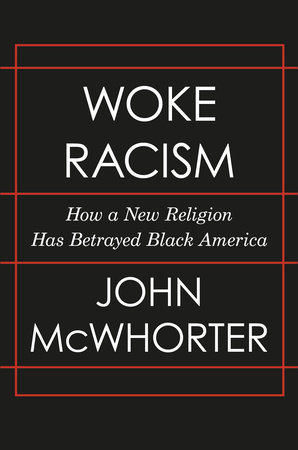
In Quillette, Jared Marcel Pollen reviews John McWhorter’s new book Woke Racism: How a New Religion Has Betrayed Black America:
McWhorter identifies three waves of anti-racist activism in the United States, the first of which was the fight against slavery and legalized segregation. The second was the struggle against racist attitudes, which sought to instill the idea that racial prejudice was a moral defect. The current strain of anti-racist activism constitutes a “third wave”, and like any movement in an advanced stage, it is characteristically decadent. The Elect’s ideology, like so much contemporary social justice, is a grotesque contest of elite moral exhibitionism, inordinately preoccupied with policing speech and regulating behavior. It is fundamentally performative and, above all, pretentious, in both the etymological sense of the word (to pretend) and in its common usage (attempting to impress).
This approach to battling racism tends to appeal to well-educated white people afflicted by a guilty conscience. The only remedy for them — the load-bearing pillar of white America’s new moral responsibility — is a declaration of one’s own “privilege”. This, McWhorter assures us, is not progress or even compassion, it is a form of self-help. “The issue,” he writes, “is not whether I or anyone else thinks white privilege is real, but what we consider the proper response to it.” [Italics in original.] Privilege is indeed real, and making oneself aware of it is morally important, but when employed as a cudgel, it becomes a monstrous prop.
Encouraging black people to see themselves as perpetual victims, while assigning to white people the task of becoming enlightened enough to recognize their own inherent and irredeemable racism creates a culture of soft-bigotry, furnished by polite lies and low expectations. “White people calling themselves our saviors,” McWhorter writes, “make black people look like the dumbest, weakest, most self-indulgent human beings in the history of our species, and teach black people to revel in that status and cherish it as making us special.”
This endless condescension is writ large in DiAngelo’s work, and we can see it in the training seminars now required by many companies, in which things like “logic” and “punctuality” are ascribed to “Whiteness”. Do the people running these seminars really believe that black people can’t be rational and on time? Do they think that science and math are things that only white kids are good at? And, McWhorter asks, if black students perform poorly on standardized tests, is it fair to assume that the test is racist, and should therefore be discontinued, as the Elect now propose? Would it not be better to ensure that those students have access to resources and tutoring? Far from helping anyone, these distortions of essence and aptitude actually hurt the advancement of what is now commonly referred to as “racial equity”.
The goal of third wave anti-racism is ostensibly concerned with “dismantling” racist “structures”, but it is actually an attempt to narrow the discourse and limit the range of honest thought in pursuit of a phony consensus. This is achieved through a ruthless evangelism, which McWhorter manages to condense as follows:
Battling power relations and their discriminatory effects must be the central focus of all human endeavor, be it intellectual, moral, civic, or artistic. Those who resist this focus, or even evidence insufficient adherence to it, must be sharply condemned, deprived of influence, and ostracized.
For support, McWhorter offers a spate of scandals and PR nightmares that would signal, to an alien observer, a kind of collective insanity or Salem-esque panic. One of the salient and most stupefying examples is the case of Alison Roman, a (now-former) food critic at the New York Times. Roman ran into trouble when she criticized two of her contemporaries — model and food writer Chrissy Teigen, and life coach Marie Kondo — for their hypocritical commercialism. Despite coming from different ethnic backgrounds and cultural milieux (Teigen is half-white and half-Thai and was born in America; Kondo was born and raised in Japan), both are assimilable as “people of color” according to the progressive Weltanschauung, so Roman’s criticism placed her under suspicion. What reason could a white New York Times journalist have for criticizing two non-white celebrities, other than sublimated bigotry?
A few days later, singer Lana Del Rey responded to criticisms of her music’s use of sexual themes by pointing out that plenty of other artists, including Nicki Minaj and Beyoncé, also sing about sex. Del Rey was immediately attacked by social media mobs, who denounced her in an endorphin-rush of self-righteousness. These two cases make the Elect’s devotion to rooting out racial bias seem like a protean neurosis, which sees racism even when it isn’t there.
October 12, 2021
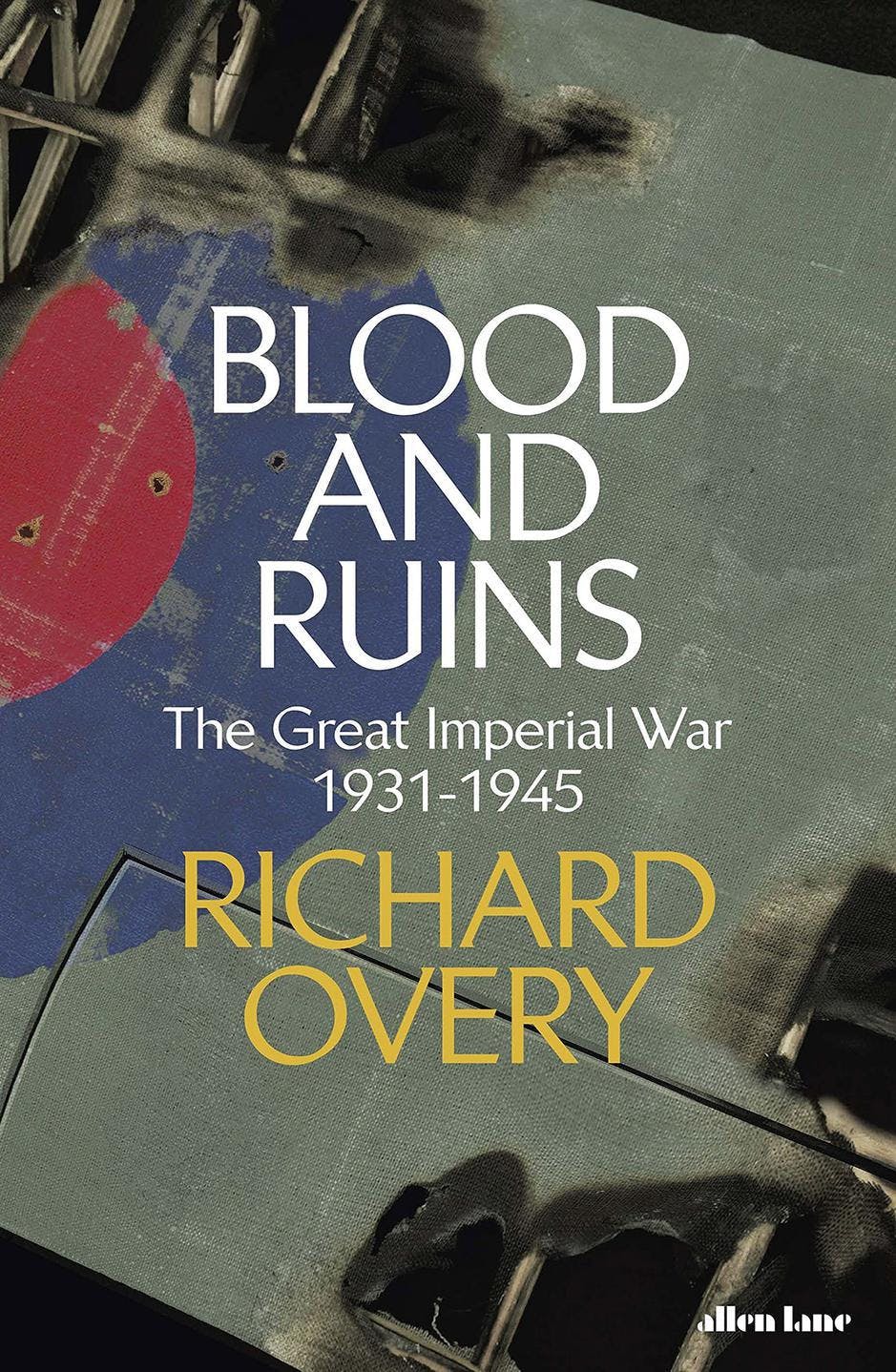
Richard Overy looks at the “Great Imperial War” of 1931-1945
I missed Rana Mitter‘s review of Richard Overy’s latest book when it was published in The Critic last week:
Imagine there’s no Hitler. It’s not that easy, even if you try, at least if you’re a westerner thinking about the Second World War. But for millions of Asians, those years of conflict had little to do with the horrors of Nazi invasion and genocide, and it is their experience that frames Richard Overy’s account of a seemingly familiar conflict. For most non-Europeans, the war was not a struggle for democracy, but a conflict between empires, and in this book, that imperial struggle begins not with the invasion of Poland by Germany in 1939 but the occupation of Manchuria by the Japanese in 1931.
Blood and Ruins is really two books in one. The first is perhaps the single most comprehensive account of the Second World War yet to appear in one volume. You might think that by reading extensively, you could construct a book like this one. You could not — unless you have Overy’s control over a staggering range of World War II scholarship, much of it drawn from his own decades of research on the economics of total warfare, the development of technology, from radar to aerial bombing, and the idea of the “emotional geography” of war, encompassing morale, hope, and despair. Then you’d need to go back and cover all those categories for each of the major Allied and Axis belligerents: Britain, the US, Japan, Germany, France, Italy and China among them.
The second book is an argument about what kind of conflict the Second World War really was. Overy is clear: on a global as opposed to European scale, it was not (just) a war about democracy, but about empires and their fate, although “the starting point in explaining the pursuit of territorial empire is, paradoxically, the nation.”
Overy points out what is generally lost to view when the European war is placed at the centre of the historiography: both Britain and France were undertaking an “awkward double standard” in their defence of democratic values, as their Asian and African possessions “rested on a denial of those liberties and the repression of any protest against the undemocratic nature of colonial rule”. While this argument has been made before (not least by figures such as Nehru and Gandhi in India at the time), Overy does something unusual and revealing: he compares the western empires with Japan’s justification for its own imperial project in the early twentieth century.
The book is scrupulously careful not to endorse or excuse the worldview of Tokyo’s imperialists, and gives full weight to the voices of the Chinese nationalists and communists who were bitterly opposed to Japan’s expansion on the Asian mainland. Still, the comparison of Japan’s pre-war and wartime empire to those of the western powers provides an important and original broadening of a contemporary debate.
There is ongoing public British (and to some extent French) argument about whether empire was a “good” or “bad” thing. Yet neither attackers nor defenders of the British empire tend to analyse it alongside the Japanese equivalent that lasted nearly half a century. Britain committed colonial massacres (Amritsar) and deadly repression (Mau Mau). So did Japan (the rape of Nanjing, invasion of Manchuria).
Britain’s empire also created an aspirational middle class full of cosmopolitan nationalists, and drew on ideas of loyalty to recruit its subjects to fight in world wars. All these things are also true of Japan, which like Britain was a multi-party democracy for much of its period as an overseas empire (between 1898 and 1932), and whose capital city was an intellectual hub for political activists from across Asia.
As a colony of Japan between 1895-1945, Taiwan developed a middle class that was Japanese-speaking and keen to draw on new economic opportunities brought by empire: Lee Teng-hui, the first democratically elected president of the Republic of China on Taiwan, always thought of Japanese as his mother tongue. Park Chung-hee, the American-sponsored dictator of Cold War South Korea, learned his political craft as an army officer in the Japanese Manchukuo Army that occupied Manchuria.
October 6, 2021
Jonathan Kay explains why Justin Trudeau’s no-show got a lot of Canadians mad
Linked from Small Dead Animals, Jonathan Kay took to the twits to summarize why this particular Justin Trudeau flake-out seems to have impacted his reputation so much more than all the other flake-outs he’s pulled over the years (screencapped for those who find Threadreader links objectionable):
September 30, 2021
“The nicer the Canadian, the worse the hypocrisy gets”
In The Line a Canadian veteran of Afghanistan (writing as “Tommy Conway”) explains why Canada’s “nice guy” illusions have made us weaker and unable to succeed at so many of our endeavours:

Canadian Army LAV III convoy near Khadan, Afghanistan, 2010-01-25.
Photo by Staff Sgt. Christine Jones via Wikimedia Commons.
We do not merely have an institutional problem, but a spiritual one. The peoples of the Western democracies have lost their sense of shame. Canadians, in particular, have lost our collective self-respect. We have become “nice guys”, the sort of people who expect to be praised because we can do no harm. We have ceased to be a citizenry that values honour — the kind of people who are capable of doing hard things, and willing to spend a lot of effort doing the right ones.
During the Afghan war, many NATO soldiers lived in very harsh conditions “outside the wire”. In forward patrol bases or on extended missions, water was at a premium, so washing socks was a weekly treat. But for others, Afghanistan meant a lot of time generating PowerPoint decks in bloated headquarters. Go past the walls in Kabul which separated the safe NATO bases from the bustling city, and one could find cafes staffed by friendly Nepalese baristas, air-conditioned gyms, and plentiful cold drinks.
Absurdly, in the American compound at the same Kabul International Airport where desperate evacuees tramped through trenches of human waste and barbed wire to escape the country as the Taliban advanced, the U.S. Air Force maintained a pleasant compound with green grass. Kandahar International Airport was well-known for a much-frequented strip of fast-food outlets, including a Tim Hortons.
These amenities warped the perspective of those with regular access to them. Canadian Army lore is full of tales of confrontations between bedraggled, unshaven troops coming in from patrol being denied access to an iced capp for improper dress. I’ve rarely been so embarrassed as the time I took tea from an Afghan father of three, smiling in the sweltering heat of an Afghan summer, only to return to my relatively comfortable quarters behind safe walls to hear people bitch and moan about the fridge being out of their favourite pop.
It wasn’t just individual troops who lost perspective. Senior leaders made a big deal about receiving two beers on Canada Day, and put extensive measures in place to conceal the festivities from Afghan staff because the presence of alcohol might offend cultural sensibilities. I am not a cultural expert, but I imagine the locals were offended about the well-watered, visibly overfed, air-conditioned people in less than a kilometer from the poverty of the population they were supposed to be protecting. Some of the old-timers, who had served with the Communist army, stated categorically that they liked the Russians more because they shared their vodka — and their hardships.
We barely had perspective then, and we sure as hell don’t now.
Predictably, the further from the theatre of operations, the more that perspective was distorted. Somehow, the Canadian public grew “war-weary” over Afghanistan, though it’s difficult to understand what tired them. Between 1939-45, this country sustained a full field army, despite drawing from a population a third of today’s size. Canadians withstood rationing as tens of thousands of their countrymen died overseas, and came out of the war optimistic about the future.
[…]
Compare that to what we suffered in Afghanistan; we sustained a strong battalion group, and maintained a few bloated headquarters — all of this proved to be too much to keep up. Canada slid into a training mission in 2011 and then gave up completely in 2014. During the fighting, the vast majority of the population felt no impact whatsoever. As Tom Nichols paraphrased a U.S. officer in Iraq, “We’re at war, America’s at the mall.” Canada was there with them, complaining about the lines in the food court.
September 21, 2021
QotD: Canadian international virtue signalling is not a new thing
[I]n January, after the tsunami hit, [Canadian prime minister Paul Martin] flew into Sri Lanka to pledge millions and millions and millions in aid. Not like that heartless George W. Bush back at the ranch in Texas. Why, Prime Minister Martin walked along the ravaged coast of Kalumnai and was, reported Canada’s CTV network, “visibly shaken.” President Bush might well have been shaken, but he wasn’t visible, and in the international compassion league, that’s what counts. So Martin boldly committed Canada to giving $425 million to tsunami relief. “Mr. Paul Martin Has Set A Great Example For The Rest Of The World Leaders!” raved the LankaWeb news service.
You know how much of that $425 million has been spent so far? Fifty thousand dollars — Canadian. That’s about 40 grand in U.S. dollars. The rest isn’t tied up in [Sri Lankan] bureaucracy, it’s back in Ottawa. But, unlike horrible “unilateralist” America, Canada enjoys a reputation as the perfect global citizen, renowned for its commitment to the U.N. and multilateralism. And on the beaches of Sri Lanka, that and a buck’ll get you a strawberry daiquiri. Canada’s contribution to tsunami relief is objectively useless and rhetorically fraudulent.
Mark Steyn, “Bolton’s sin is telling truth about system”, Chicago Sun-Times, 2005-05-15.
September 20, 2021
QotD: English jingoism
In England all the boasting and flag-wagging, the “Rule Britannia” stuff, is done by small minorities. The patriotism of the common people is not vocal or even conscious. They do not retain among their historical memories the name of a single military victory. English literature, like other literatures, is full of battle-poems, but it is worth noticing that the ones that have won for themselves a kind of popularity are always a tale of disasters and retreats. There is no popular poem about Trafalgar or Waterloo, for instance. Sir John Moore’s army at Corunna, fighting a desperate rear-guard action before escaping overseas (just like Dunkirk!) has more appeal than a brilliant victory. The most stirring battle-poem in English is about a brigade of cavalry which charged in the wrong direction. And of the last war, the four names which have really engraved themselves on the popular memory are Mons, Ypres, Gallipoli and Passchendaele, every time a disaster. The names of the great battles that finally broke the German armies are simply unknown to the general public.
The reason why the English anti-militarism disgusts foreign observers is that it ignores the existence of the British Empire. It looks like sheer hypocrisy. After all, the English have absorbed a quarter of the earth and held on to it by means of a huge navy. How dare they then turn round and say that war is wicked?
It is quite true that the English are hypocritical about their Empire. In the working class this hypocrisy takes the form of not knowing that the Empire exists. But their dislike of standing armies is a perfectly sound instinct. A navy employs comparatively few people, and it is an external weapon which cannot affect home politics directly. Military dictatorships exist everywhere, but there is no such thing as a naval dictatorship. What English people of nearly all classes loathe from the bottom of their hearts is the swaggering officer type, the jingle of spurs and the crash of boots. Decades before Hitler was ever heard of, the word “Prussian” had much the same significance in England as “Nazi” has to-day. So deep does this feeling go that for a hundred years past the officers of the British Army, in peace-time, have always worn civilian clothes when off duty.
George Orwell, “The Lion And The Unicorn: Socialism and the English Genius”, 1941-02-19.
September 3, 2021
“Watching our feminist prime minister uncomfortably defend and explain away decidedly unfeminist behaviour has become an evergreen moment for our nation”
The NP Platformed newsletter is in the hands of Kathryn Marshall while Colby Cosh is on vacation, and she offers yet another golden moment of hypocrisy on the part of Justin Trudeau:
Standing in the fenced-in corner of a backyard during a press conference this Tuesday, Justin Trudeau was cornered in more ways than one.
Faced with questions from the media as to why he was allowing an incumbent Liberal candidate who had been repeatedly accused of sexual harassment to run for his party, an exasperated Trudeau was once again faced with his hypocrisy when it comes to his feminist credentials.
Only the day before, Trudeau was touting the Liberals “zero-tolerance” policy for sexual harassment. Of course, that was in the context of a Conservative candidate who had been accused of sexual misconduct. Notably, that candidate was very swiftly given the boot by leader Erin O’Toole, which was the correct response.
Now Trudeau finds himself in the exact same position that the Conservative leader was in. Following a CBC report, it has come to light that one of the Liberal candidates, two-term MP Raj Saini, has been the subject of numerous sexual harassment allegations from a number of staff going all the way back to 2015. I have no idea if these allegations are true, but they are deeply disturbing and should be taken seriously. As reported by the CBC, there are seven different sources who “described four different cases where Saini allegedly made unwanted sexual advances or inappropriate comments.” One of the allegations involves a former staff member who filed a human rights complaint with the Canadian Human Rights Commission and tried to end her own life.
It should be a ludicrously easy call for Trudeau. The Liberal party has a zero-tolerance policy for sexual harassment, right? Obviously, Saini needs to go and an individual who is facing allegations of this nature is in no position to be running for public office, period.
Except for one small hiccup. The allegations have come to public light after the candidate cut-off date for the election, which was Monday. So if Trudeau gets rid of Saini, it means they can’t replace him with someone else, and the result is no Liberal candidate on the ballot in a safe Liberal seat. Call me cynical, but if I had to guess, I would say this likely has something to do with the fact that overnight, the Liberal’s “zero-tolerance” policy appears to have evaporated into thin air.
Anti-Slavery Patrols – The West Africa Squadron
Drachinifel
Published 1 Dec 2018Title says it all really, we look at something that was definitely worth doing, which really should have been done much sooner.
August 28, 2021
August 27, 2021
Updating Rahm Emanuel’s notion about not “wasting” a crisis — don’t let a crisis end
In City Journal, John Tierney considers how political leaders and public health officials across the western world are going Rahm Emanual one better by continuously extending the Wuhan Coronavirus crisis:
Throughout the pandemic, American political and public-health leaders have been following Rahm Emanuel’s classic dictum for power-seeking officials: “You never want a serious crisis to go to waste.” Now they’ve adopted a corollary: you never want a crisis to end.
So they are prolonging the national misery instead of easing it, which could be done with a few simple strategies. Explain to the public that the virus will never disappear but is no longer a mortal threat to the vast majority of Americans. Encourage the minority still at risk to get vaccinated by honestly discussing who is in jeopardy and what scientists have learned about infections. Promote treatments proven to prevent infection and speed recovery while avoiding unproven treatments and mandates that cause collateral damage and generate mistrust. Above all, make it clear to Americans that we finally have reason to celebrate: what once seemed an unprecedented danger is now just one of many pathogens that we know how to live with.
But the nation’s crisismongers aren’t about to relinquish their hold over the public, so they’ve set new goals that are as unachievable as they are unnecessary and harmful. Making vaccines available to every American adult is no longer sufficient; now the crisis cannot end until the entire population has been vaccinated. Instead of focusing efforts on vaccinating the vulnerable, officials obsess on compelling universal obedience, even if that means squandering vaccines on people who already have acquired natural immunity or are at minimal risk of serious illness.
The same progressives who regularly denounce “systemic racism” and “Western imperialism” are now enforcing policies that disproportionately punish minorities and the poor, both in the United States (the majority of black teenagers and young adults in New York have been banished from much of public life by the city’s new vaccine-passport policy) and in the rest of the world. The hypocrisy was deftly captured in a tweet by Martin Kulldorff, the Harvard epidemiologist: “If you favor university vaccine mandates for low-risk American and European students, when there is not enough vaccine for older high-risk people in Asia, Africa and Latin America, please remove your #BLM tags from your Twitter/Facebook profiles.”
Children are being sentenced to another round of unnecessary mask mandates and probably more school closures based on evidence-free warnings from Anthony Fauci and others that the Delta variant will be more deadly to them than the original virus. While the variant is more infectious, the evidence does not show it to be any more lethal. In fact, the current mortality rate among American children with Covid is lower than it was last year — and last year many more children died of the flu than of Covid. One of the most thorough studies, in England, shows that the survival rate for those under 18 with Covid is 99.995 percent. But instead of emphasizing these reassuring statistics, public-health officials like Jerome Adams, the former surgeon general, keep looking for new ways to scare parents and children.
QotD: Music corporations, musicians, and hypocrisy
“A good song should make you wanna tap your feet and get with your girl. A great song should destroy cops and set fire to the suburbs. I’m only interested in writing great songs.”
So says Tom Morello, guitarist for the Los Angeles-based band Rage Against the Machine. He and his bandmates are not simply against cops and the suburbs, of course. They also stand for the Zapatistas and the Shining Path, for freeing Mumia Abu-Jamal and Leonard Peltier, for giving California back to Mexico, and for destroying stores where rich people like themselves shop.
That’s pretty strong stuff coming from work-for-hire employees of one of the great cogs in the global capitalist machine, the megaconglomerate Sony, which wholly owns and distributes Rage’s music and even is a co-owner of the group’s publishing. Since 1992, Rage has sold nearly 7 million records, and it’s safe to say that nobody has benefitted more from that commerce than the band’s unabashedly capitalist paymaster.
Brian Doherty, “Rage On: The strange politics of millionaire rock stars”, Reason, 2000-10.