Quotulatiousness

July 8, 2020

H.G. Wells, fortunately for his reputation, is mostly remembered for his science fiction writings

Filed under: Books, Britain, History, Politics, WW2 — Tags: , , , , , , — Nicholas @ 03:00

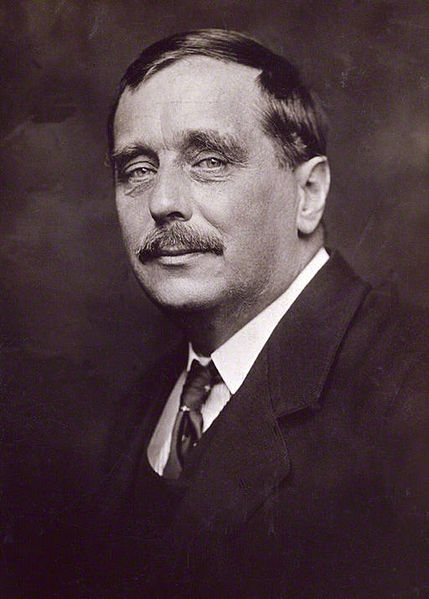
I was well into my twenties before I found out that H.G. Wells the science fiction writer was only a small slice of his career. I picked up a one-volume edition of his Outline of History, but it didn’t seem to have the same interest for me that The War of the Worlds or The Time Machine had done (and honestly, it was Jeff Wayne’s musical interpretation of War of the Worlds that pushed me to read any of his writing). His analysis of the events of his day fell well short of his reputation, as George Orwell pointed out:

In March or April, say the wiseacres, there is to be a stupendous knockout blow at Britain … What Hitler has to do it with, I cannot imagine. His ebbing and dispersed military resources are now probably not so very much greater than the Italians’ before they were put to the test in Greece and Africa.

    The German air power has been largely spent. It is behind the times and its first-rate men are mostly dead or disheartened or worn out.

    In 1914 the Hohenzollern army was the best in the world. Behind that screaming little defective in Berlin there is nothing of the sort … Yet our military “experts” discuss the waiting phantom. In their imaginations it is perfect in its equipment and invincible in its discipline. Sometimes it is to strike a decisive “blow” through Spain and North Africa and on, or march through the Balkans, march from the Danube to Ankara, to Persia, to India, or “crush Russia”, or “pour” over the Brenner into Italy. The weeks pass and the phantom does none of these things — for one excellent reason. It does not exist to that extent. Most of such inadequate guns and munitions as it possessed must have been taken away form it and fooled away in Hitler’s silly feints to invade Britain. And its raw jerry-built discipline is wilting under the creeping realisation that the Blitzkrieg is spent, and the war is coming home to roost.

These quotations are not taken from The Cavalry Quarterly but from a series of newspaper articles by Mr. H. G. Wells, written at the beginning of this year and now reprinted in a book entitled Guide to the New World. Since they were written, the German Army has overrun the Balkans and reconquered Cyrenaica, it can march through Turkey or Spain at such time as may suit it, and it has undertaken the invasion of Russia. How that campaign will turn out I do not know, but it is worth noticing that the German general staff, whose opinion is probably worth something, would not have begun it if they had not felt fairly certain of finishing it within three months. So much for the idea that the German Army is a bogey, its equipment inadequate, its morale breaking down, etc. etc.

What has Wells to set against the “screaming little defective in Berlin”? The usual rigmarole about a World State, plus the Sankey Declaration, which is an attempted definition of fundamental human rights, of anti-totalitarian tendency. Except that he is now especially concerned with federal world control of air power, it is the same gospel as he has been preaching almost without interruption for the past forty years, always with an air of angry surprise at the human beings who can fail to grasp anything so obvious.

[…]

Mr. Wells, like Dickens, belongs to the non-military middle class. The thunder of guns, the jingle of spurs, the catch in the throat when the old flag goes by, leave him manifestly cold. He has an invincible hatred of the fighting, hunting, swashbuckling side of life, symbolised in all his early books by a violent propaganda against horses. The principal villain of his Outline of History is the military adventurer, Napoleon. If one looks through nearly any book that he has written in the last forty years one finds the same idea constantly recurring: the supposed antithesis between the man of science who is working towards a planned World State and the reactionary who is trying to restore a disorderly past. In novels, Utopias, essays, films, pamphlets, the antithesis crops up, always more or less the same. On the one side science, order, progress, internationalism, aeroplanes, steel, concrete, hygiene: on the other side war, nationalism, religion, monarchy, peasants, Greek professors, poets, horses. History as he sees it is a series of victories won by the scientific man over the romantic man.

In addition to being a surprisingly consistent one-note proponent of the same solution to every problem, he was, as Michael Coren relates, a nasty piece of work in his personal life:

There’s an anecdote concerning H.G. Wells that rather exemplifies his character. A London theatre in the 1920s. Wells was approached by a nervous, eager young fan. “Mr. Wells, you probably don’t remember me”, he said, holding out his hand. “Yes, I bloody do!” replied Wells, and rudely turned his back. Personality aside, Wells also embraced anti-Semitism, racism, and social engineering, and in this atmosphere of outrage and iconoclasm it’s surprising that he hasn’t been more targeted for symbolic removal. Then again, perhaps not. Because while the undoubtedly gifted author said and believed some dreadful things he was also a man of the left. And when it comes to cancel culture, socialism is the ultimate prophylactic.

George Bernard Shaw said of his nastiness and his ugly views, “Multiply the total by ten; square the result. Raise it again to the millionth power and square it again; and you will still fall short of the truth about Wells — yet the worse he behaved the more he was indulged; and the more he was indulged the worse he behaved.”

In fact, for much of the 20th-century eugenics was a creature of the left as much if not more than the right. Shaw himself, Sydney and Beatrice Webb and many other left-wing intellectuals were convinced that for the lives of the majority to improve there had to be a harsh control of the minority.

Wells argued that the existing social and economic structure would collapse and a new order would emerge, led by “people throughout the world whose minds were adapted to the demands of the big-scale conditions of the new time … a naturally and informally organized educated class, an unprecedented sort of people.” The “base,” the class at the bottom of the scale, “people who had given evidence of a strong anti-social disposition,” would be in trouble. “This thing, this euthanasia of the weak and the sensual, is possible. I have little or no doubt that in the future it will be planned and achieved.” He wrote of, “boys and girls and youth and maidens, full of zest and new life, full of an abundant joyful receptivity … helpers behind us in the struggle.” Then chillingly, “And for the rest, these swarms of black and brown and dingy white and yellow people who do not come into the needs of efficiency … I take it they will have to go.”

June 27, 2020

Andrew Sullivan on revolution in the current year

Filed under: History, Politics, USA — Tags: , , , , , , — Nicholas @ 05:00

The people involved in the protests — some of them would-be revolutionaries — may not know about prior revolutionary movements, and if they succeed then they’ll ensure that nobody will be able to remember what life was like before their longed-for Year Zero moment:

A building burning in Minneapolis following the death of George Floyd.
Photo by Hungryogrephotos via Wikipedia.

Revolutions also encourage individuals to take matters in their own hands. The distinguished liberal philosopher Michael Walzer recently noted how mutual social policing has a long and not-so-lovely history — particularly in post–Reformation Europe, in what he has called “the revolution of the saints.” “The ‘saints’ were very strong on the work of neighborhood committees. In Calvin’s Geneva, law and order were maintained through ‘mutual surveillance.’ Church members (ideally all Genevans were church members) ‘watched, investigated, and chastised’ each other.” Imagine what these Puritans could have done with cell phones and Twitter histories.

Revolutionaries also create new forms of language to dismantle the existing order. Under Mao, “linguistic engineering” was integral to identifying counterrevolutionaries, and so it is today. The use of the term “white supremacy” to mean not the KKK or the antebellum South but American society as a whole in the 21st century has become routine on the left, as if it were now beyond dispute. The word “women,” J.K. Rowling had the temerity to point out, is now being replaced by “people who menstruate.” The word “oppression” now includes not only being herded into Uighur reeducation camps but also feeling awkward as a sophomore in an Ivy League school. The word “racist,” which was widely understood quite recently to be prejudicial treatment of an individual based on the color of their skin, now requires no intent to be racist in the former sense, just acquiescence in something called “structural racism,” which can mean any difference in outcomes among racial groupings. Being color-blind is therefore now being racist.

And there is no escaping this. The woke shift their language all the time, so that words that were one day fine are now utterly reprehensible. You can’t keep up — which is the point. (A good resource for understanding this new constantly changing language of ideology is Translations From the Wokish.) The result is an exercise of cultural power through linguistic distortion.

So, yes, this is an Orwellian moment. It’s not a moment of reform but of a revolutionary break, sustained in part by much of the liberal Establishment. Even good and important causes, like exposing and stopping police brutality, can morph very easily from an exercise in overdue reform into a revolutionary spasm. There has been much good done by the demonstrations forcing us all to understand better how our fellow citizens are mistreated by the agents of the state or worn down by the residue of past and present inequality. But the zeal and certainty of its more revolutionary features threaten to undo a great deal of that goodwill.

The movement’s destruction of even abolitionist statues, its vandalism of monuments to even George Washington, its crude demonization of figures like Jefferson, its coerced public confessions, its pitiless wreckage of people’s lives and livelihoods, its crude ideological Manichaeanism, its struggle sessions and mandated anti-racism courses, its purging of cultural institutions of dissidents, its abandonment of objective tests in higher education (replacing them with quotas and a commitment to ideology), and its desire to upend a country’s sustained meaning and practices are deeply reminiscent of some very ugly predecessors.

But the erasure of the past means a tyranny of the present. In the words of Orwell, a truly successful ideological revolution means that “every record has been destroyed or falsified, every book rewritten, every picture has been repainted, every statue and street building has been renamed, every date has been altered. And the process is continuing day by day and minute by minute. History has stopped. Nothing exists except an endless present in which the Party is always right.” We are not there yet. But unless we recognize the illiberal malignancy of some of what we face, and stand up to it with courage and candor, we soon will be.

March 14, 2020

“The people who write such things are thinking with their epidermis and genitalia, which is to say they’re not thinking at all”

In Quillette, Matt Johnson remembers the great anti-identitarian writer and speaker, Christopher Hitchens:

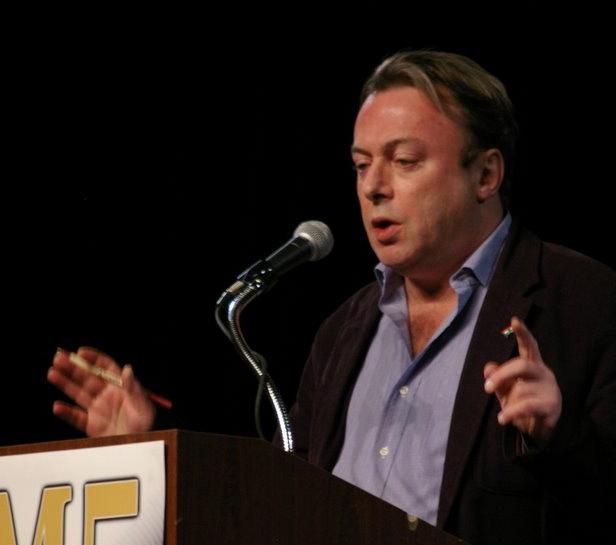
Christopher Hitchens speaking at The Amaz!ng Meeting held at the Riviera Hotel, Las Vegas, Nevada on 20 January 2007.
Photo detail by ensceptico via Wikimedia Commons.

Hitchens thought fearlessly. As Martin Amis put it, he liked “the battle, the argument, the smell of cordite.” This is why he told the publisher of God is Not Great: How Religion Poisons Everything to organize a book tour that ran through the pulpits of the American South instead of remaining confined to the coasts. It’s why he relished every opportunity to lambaste Bill and Hillary Clinton in front of liberal audiences. It’s why he went after Mother Teresa and Princess Diana. He was an inveterate iconoclast — if there was a bloated reputation to puncture or a cherished dogma to deflate, he saw it as a duty and a pleasure to do so.

It’s no surprise that this oppositional inclination, coupled with blistering rhetorical ability, made Hitchens a deadly debater. After his death in December 2011, countless tributes and articles about Hitchens emphasized what a force he was in the studio and on the debate stage — his erudition and wit, his fluency, his seemingly superhuman memory. Hitchens is unforgettable for all these reasons, but people don’t miss him because he could turn a phrase or win an argument on CNN — they miss him because he thought for himself and refused to apologize for it. He didn’t want to write and speak as the representative of a community: “My own opinion is enough for me,” he told the audience at a debate on free speech in 2007, “and I claim the right to have it defended against any consensus, any majority.”

“Unpopular ideas can be silenced, and inconvenient facts kept dark, without the need for any official ban,” Orwell wrote in his original introduction to Animal Farm (which was, ironically, suppressed). He continued: “Anyone who challenges the prevailing orthodoxy finds himself silenced with surprising effectiveness.” While there was far more official censorship in Orwell’s time, we’re living through an era of pervasive self-censorship, and as Packer explains, this type of silencing is “more insidious than the state-imposed kind, because it’s a surer way of killing the impulse to think, which requires an unfettered mind.”

[…]

Hitchens detested tribal and parochial feelings of any kind, which is why he was dismayed when he witnessed the emergence of identity as a catalyst for political mobilization in the late 1960s and early 1970s. In his memoir, Hitch-22, Hitchens attacked radicals who thought it was “enough to be a member of a sex or gender, or epidermal subdivision, or even erotic ‘preference,’ to qualify as a revolutionary.” When Hitchens first heard the expression “the personal is political,” he knew “as one does from the utterance of any sinister bullshit that it was — cliché is arguably forgivable here — very bad news.” As he put it in a 2008 article:

    People who think with their epidermis or their genitalia or their clan are the problem to begin with. One does not banish this specter by invoking it. If I would not vote against someone on the grounds of ‘race’ or ‘gender’ alone, then by the exact same token I would not cast a vote in his or her favor for the identical reason.

It’s easy to imagine what Hitchens would have thought about a recent New York Times headline that declared “The Next President Should Not Be a Man” or a prominent writer and activist who announced that she “will not support white male candidates in the Dem primary.” The people who write such things are thinking with their epidermis and genitalia, which is to say they’re not thinking at all. You don’t have to bother defending candidates’ principles and positions when gender and race are the only relevant variables.

February 19, 2020

Christopher Hitchens – Why Orwell Matters

Filed under: Books, Britain, History, Liberty, Politics — Tags: , , , , — Nicholas @ 04:00

TheHitchensArchive
Published 24 Apr 2013

October 21, 2002. Christopher Hitchens giving a speech based on his book about George Orwell at The Commonwealth Club.

January 17, 2020

Labour’s underlying problem

Filed under: Britain, History, Politics — Tags: , , , — Nicholas @ 05:00

In UnHerd, James Bloodworth explains why the Labour Party will have to change to get back into power in Britain:

Jeremy Corbyn speaking at a Rally in Hayfield, Peak District, UK on 25th July 2018.
Photo by Sophie Brown via Wikimedia Commons.

George Orwell was famously contemptuous of much of the left intelligentsia. “England is perhaps the only great country where intellectuals are ashamed of their own nationality,” he wrote in his 1941 essay “England, Your England“. “In left-wing circles it is always felt that there is something slightly disgraceful in being an Englishman and that it is a duty to snigger at every English institution.”

Plus ça change, plus c’est la même chose.

There has always been a healthy suspicion of jingoism and flag-waving on the Left. However it wasn’t this that Orwell was referring to. Few wrote more damning screeds about the British empire than the former colonial policeman, who was always willing to give the “blimps” who ran Britain a good kicking. Rather, Orwell was referring to a more generalised contempt many on the Left felt towards Britain and — by extension — their fellow countrymen.

Socialism to Orwell meant bread and butter issues of higher wages and more freedom — freedom itself depending to a large extent on how much money one has. Yet the movement attracted its fair share of cranks. It was this penumbra of crankishness that prevented socialism from developing a mass following. A major hallmark of it was its anti-Britishness.

Jeremy Corbyn has been compared plenty of times over the past five years to the “vegetarian, fruit-juice drinking, Nature Cure quack, pacifist” oddballs Orwell wrote about in The Road to Wigan Pier. In Orwell’s time these types seemed to gravitate towards the socialist movement “like bluebottles to a dead cat”, as he put it. Since Corbyn became leader in 2015 something similar has occurred: the Labour Party has been flooded with conspiracy theorists, antisemites and various other subliterate fools. Uniting almost all of them is a profound contempt for Britain and in particular British foreign policy.

This is arguably a major reason Labour lost the recent election. “Such was the demonisation of Jeremy Corbyn,” wrote the Labour MP Liam Byrne, “that hundreds of voters I met thought Labour’s leader was a ­communist terrorist sympathiser who wouldn’t push the nuclear button or sing the national anthem.”

This isn’t so much the “demonisation of Jeremy Corbyn” as an accurate summation of the Labour leader’s views. Seumas Milne and Andrew Murray, two of Corbyn’s first appointments as advisers, are communists. Corbyn called members of Hamas and Hezbollah “honoured friends”. He fraternised with the IRA and argued for the abolition of Nato. He has obfuscated shamefully over acts of aggression directed against Britain, such as during the Skripal poisoning in Salisbury. It is not demonising someone to accurately list the things they have said and done.

December 23, 2019

QotD: British meals – puddings

Filed under: Britain, Food, History, Quotations, WW2 — Tags: , , — Nicholas @ 01:00

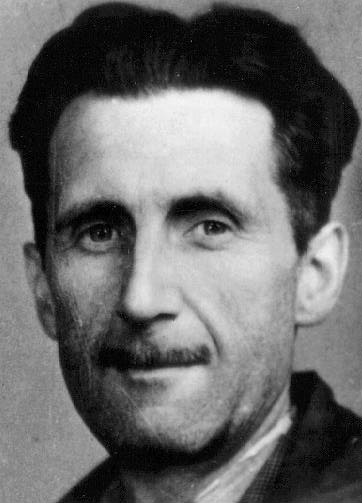
Orwell’s press card portrait, 1943

Suet crust, which appears in innumerable combinations, and enters into savoury dishes as well as sweet ones, is simply ordinary pastry crust chopped beef suet substituted for the butter or lard. It can be baked, but more often is boiled in a cloth or steamed in a basin covered with a cloth. Far and away the best of all suet puddings is plum pudding, which is an extremely rich, elaborate and expensive dish, and is eaten by everyone in Britain at Christmas time, though not often at other times of the year. In simpler kinds of pudding the suet crust is sweetened with sugar and stuck full of figs, dates, currents or raisins, or it is flavoured with ginger or orange marmalade, or it is used as a casing for stewed apples or gooseberries, or it is rolled round successive layers of jam into a cylindrical shape which is called roly-poly pudding, or it is eaten in plain slices with treacle poured over it. One of the best forms of suet pudding is the boiled apple dumpling. The core is removed from a large apple, the cavity is filled up with brown sugar, and the apple is covered all over with a thin layer of suet crust, tied tightly into a cloth, and boiled.

British pastry is not outstandingly good, but there are certain fillings for pies and tarts which are excellent, and which are hardly to be found in other countries. Treacle tart is a delicious dish, and the large or small mince pies which are eaten especially at Christmas, but else fairly frequently at other times, are almost equally good. The mince-meat with which they are filled is a mixture of various kinds of dried fruits, chopped fine, mixed up with sugar and raw beef suet, and flavoured with brandy. Other favourite fillings are jams of various kinds, lemon curd – a preparation of lemon juice, yolk of egg and sugar – and stewed apples flavoured with lemon juice or cloves. An apple pie is often given an exceptionally fine flavour by including one quince among about half a dozen apples.

The other main category of puddings – milk puddings – is the kind of thing that one would prefer to pass over in silence, but it must be mentioned, since these dishes are, unfortunately, characteristic of Britain. They are preparations of rice, semolina, barley, sago or even macaroni, mixed with milk and sugar and baked in the oven. The one made with barley is somewhat less bad then the others: the one made with macaroni is intolerable to any civilised palate. As all of these puddings are easy to make, they tend to be a stand-by in cheap hotels, restaurants and apartment houses, and they are one of the chief reasons why British cookery has a bad name among foreign visitors.

There are, of course, XXX countless other sweet dishes, including the whole range of jellies, blancmanges, custards, soufflés, ice puddings, meringues and what-nots, which are much the same in all European counties. A few oddments which do not fit into any of the above categories are pancakes – British pancakes are thinner than those of most countries, and are always eaten with lemon juice, – batter pudding, which is made of much the same ingredients as Yorkshire pudding, but is steamed instead of being baked and is eaten with treacle, and baked apples. The apples are cored but not peeled, filled up with butter and sugar, and cooked in the oven: it is important that they should be served in the dish in which they are cooked With cooked fruit of any kind British people always eat cream, if they can get it. In the West of England a particularly delicious kind of clotted cream is made by slowly simmering large pens of milk and skimming off the cream as it comes to the surface.

George Orwell, “British Cookery”, 1946. (Originally commissioned by the British Council, but refused by them and later published in abbreviated form.)

December 10, 2019

QotD: British breakfast – “Not a snack but a serious meal”

Filed under: Britain, Food, History, Quotations, WW2 — Tags: , , , , — Nicholas @ 01:00

First of all, then, breakfast. Ideally for nearly all British people, and in practice for most of them even now, this is not a snack but a serious meal. The hour at which people have their breakfast is of course governed by the time at which they go to work, but if they were free to choose, most people would like to have breakfast at nine o’clock. In principle the meal consists of three courses, one of which is a meat course. Traditionally it starts with porridge, which is made of coarse oatmeal, sodden and then boiled into a spongy mess: it is eaten always hot, with cold milk (better still, cream) poured over it, and sugar. Breakfast cereals, which are ready-cooked preparations of wheat or rice, taken cold with milk and sugar, are often eaten instead of porridge. After this comes either fish, usually salt fish, or meat in some form, or eggs in some form. The best and most characteristically British form of salt fish is the kipper, which is a herring split open and cured in wood-smoke until it is deep brown colour. Kippers are either grilled or fried. The usual breakfast meat dishes are either fried bacon, with or without fried eggs, grilled kidneys, fried pork sausages, or cold ham. British people favour a lean, mild type of bacon or ham, cured with sugar and nitre rather than with salt. At normal time it is not unusual to eat grilled beef steaks or mutton chops at breakfast, and there are still old-fashioned people who like to start the day with cold roast beef. In some parts of the country, for instance in East Anglia, it is usual to eat cheese at breakfast.

After the meat course comes bread, or more often toast, with butter and orange marmalade. It must be orange marmalade, though honey is a possible substitute. Other kinds of jam are seldom eaten at breakfast, and marmalade does not often appear at other times of [the] day. For the great bulk of British people, the invariable breakfast drink is tea. Coffee in Britain is almost always nasty, either in restaurants or in private houses; the majority of people, though they drink it fairly freely, are uninterested in it and do not know good coffee from bad. Of tea, on the other hand, they are extremely critical, and everyone has his favourite brand and his pet theory as to how it should be made. Tea is always drunk with milk, and it is usual to brew it very strong, about one spoonful of dry tea leaves being allowed for each cup. Most people prefer Indian to Chinese tea, and they like to put sugar in it. Here, however, one comes upon a class distinction, or more exactly a cultural distinction. Virtually all British working-people put sugar in their tea, and indeed will not drink tea without it. Unsweetened tea is an upper-class or middle-class habit, and even in those classes it tends to be associated with a Europeanised palate. If one made a list of the people in Britain who prefer wine to beer, one would probably find that it included most of the people who prefer tea without sugar.

After this solid breakfast – and even now, in a time of rationing, it is usual to eat a fairly large bulk of food, chiefly bread, at breakfast – it is natural that the midday meal should be somewhat lighter than it is in many other countries.

George Orwell, “British Cookery”, 1946. (Originally commissioned by the British Council, but refused by them and later published in abbreviated form.)

December 7, 2019

QotD: A “democratic” army

Filed under: Britain, Europe, France, Quotations — Tags: , , , , , , — Nicholas @ 01:00

Orwell’s press card portrait, 1943

It is probable that the nature of modern war has made “democratic army” a contradiction in terms. The French army, for instance, based on universal service, is hardly more democratic than the British. It is just as much dominated by the professional officer and the long-service N.C.O., and the French officer is probably rather more “Prussian” in outlook than his British equivalent. The Spanish Government militias during the first six months of war — the first year, in Catalonia — were a genuinely democratic army, but they were also a very primitive type of army, capable only of defensive actions. In that particular case a defensive strategy, coupled with propaganda, would probably have had a better chance of victory than the methods casually adopted. But if you want military efficiency in the ordinary sense, there is no escaping from the professional soldier, and so long as the professional soldier is in control he will see to it that the army is not democratised. And what is true within the armed forces is true of the nation as a whole; every increase in the strength of the military machine means more power for the forces of reaction. It is possible that some of our more Left-wing jingoes are acting with their eyes open. If they are, they must be aware that the News-Chronicle version of “defence of democracy” leads directly away from democracy, even in the narrow nineteenth-century sense of political liberty, independence of the trade unions and freedom of speech and the press.

George Orwell, “Democracy in the British Army”, Left, 1939-09.

November 13, 2019

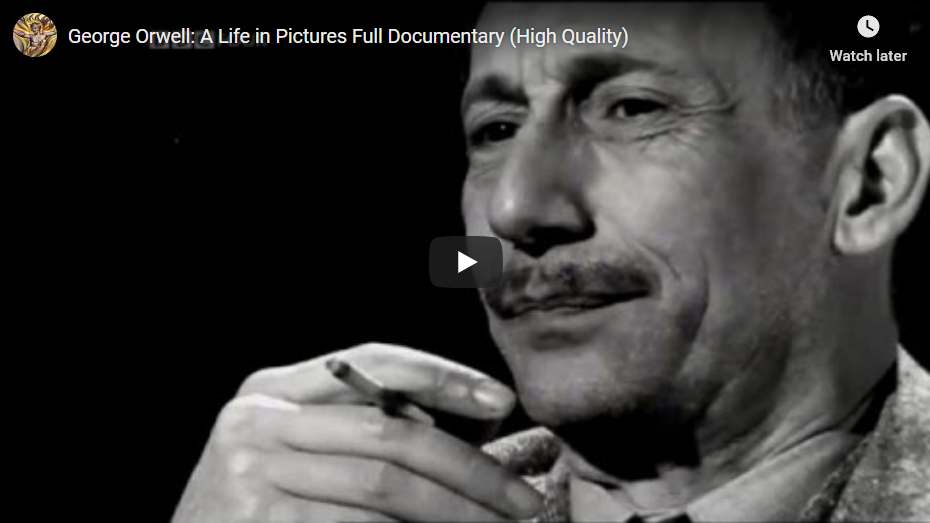
George Orwell: A Life in Pictures

Filed under: Books, Britain, History, Politics — Tags: , , , , — Nicholas @ 09:45

Albion Noise
Published 27 Dec 2015

George Orwell: A Life in Pictures is a 2003 BBC Television docudrama telling the life story of the British author George Orwell. Chris Langham plays the part of Orwell. No surviving sound recordings or video of the real George Orwell have been found.

Awards:
International Emmy 2004 for Best Arts Programme
Grierson Award 2004 for Best Documentary on the Arts

November 9, 2019

QotD: British Cookery

Filed under: Britain, Food, Health, Quotations, WW2 — Tags: , , — Nicholas @ 01:00

When Voltaire made his often-quoted statement that the country of Britain has “a hundred religions and only one sauce”, he was saying something which was untrue and which is equally untrue today, but which might still be echoed in good faith by a foreign visitor who made only a brief stay and drew his impressions from hotels and restaurants. For the first thing to be noticed about British cookery is that it is best studied in private houses, and more particularly in the homes of the middle-class and working-class masses who have not become Europeanised in their tastes. Cheap restaurants in Britain are almost invariably bad, while in expensive restaurants the cookery is almost always French, or imitation French. In the kind of food eaten, and even in the hours at which meals are taken and the names by which they are called, there is a definite cultural division between the upper-class minority and the big mass who have preserved the habits of their ancestors.

Generalising further, one may say that the characteristic British diet is a simple, rather heavy, perhaps slightly barbarous diet, drawing much of its virtue from the excellence of the local materials, and with its main emphasis on sugar and animal fats. It is the diet of a wet northern country where butter is plentiful and vegetable oils are scarce, where hot drinks are acceptable at most hours of the day, and where all the spices and some of the stronger-tasting herbs are exotic products. Garlic, for instance, is unknown in British cookery proper: on the other hand mint, which is completely neglected in some European countries, figures largely. In general, British people prefer sweet things to spicy things, and they combine sugar with meat in a way that is seldom seen elsewhere.

Finally, it must be remembered that in talking about “British cookery” one is referring to the characteristic native diet of the British Isles and not necessarily to the food that the average British citizen eats at this moment. Quite apart from the economic difference between the various blocks of the population, there is the stringent food rationing which has now been in operation for six years. In talking of British cookery, therefore, one is talking of the past or the future – of dishes that the British people now see somewhat rarely, but which they would gladly eat if they had the chance, and which they did eat fairly frequently up to 1939.

George Orwell, “British Cookery”, 1946. (Originally commissioned by the British Council, but refused by them and later published in abbreviated form.)

November 7, 2019

Replacing “dead, white male” writers with contemporary First Nations writers

Filed under: Books, Cancon, Education, Politics — Tags: , , , — Nicholas @ 03:00

Barbara Kay, as you would expect is not a fan of this move by this school board in the Windsor area:

Some years ago, the late, great writer George Jonas asked me about my intellectual influences. Who did I remember as especially formative? Oh, George Orwell, of course. I read Animal Farm in my mid-teens, 1984 a little later, and most of his other writings over the course of my salad years. It would be hard to overstate his effect on my understanding of concepts like “freedom,” “power” and “decency.”

Since Orwell has never been “owned” by the right or the left, both admiring his prose as a model for clarity and coherence, he is the one English-language writer I would consider indispensable for any high school literature curriculum.

Up to now, most educators have concurred. But the Windsor, Ont.-area Greater Essex County District School Board has announced that, in accordance with the spirit of the Truth and Reconciliation Commission (TRC), Orwell and other canon favourites in the Grade 11 literature curriculum, including Shakespeare, will be set aside in favour of a course wholly devoted to Indigenous writing. Eight of the district’s 15 schools have already replaced former standards with such books as Indian Horse, In This Together and Seven Fallen Feathers under the rubric of Understanding Contemporary First Nations, Métis and Inuit Voices.

“This decision wasn’t made lightly,” said Tina DeCastro, a teacher consultant with the school board’s Indigenous Education Team. The decision arose from a motion passed by the school board’s trustees as a response to TRC calls for action. Eastern Cherokee Sandra Muse Isaacs, Professor of Indigenous Literature at the University of Windsor, defends the radical change as necessary on the grounds that Indigenous stories have been ignored in the past. “Our stories predate Canada. It’s as simple as that.”

Is it really that simple?

I don’t think there is a sentient Canadian today who isn’t aware that Indigenous voices have been neglected in the past, and who would not wholeheartedly support the addition of Indigenous writing to contemporary literature curricula. But an entire year devoted to Indigenous literature that supplants revered works by great writers from the civilization that produced Canada as a nation-state, in order to redress the offence of historical inattention to Indigenous people, is to rob the majority of Canadian students of their cultural patrimony.

November 6, 2019

QotD: “Fake news” is nothing new

Filed under: Books, History, Media, Politics, Quotations — Tags: , , , , , — Nicholas @ 01:00

… the basic ideas of “alternative facts” and “fake news” — our updated, revved-up forms of disinformation — were not foreign to Orwell. Working at the BBC as a news producer — a fancy term for war propagandist — he heard some of the Axis powers’ propaganda as well as that of his own side (even if he kept his own hands fairly clean). He justifiably feared that the very concept of objective truth was fading from the modern world. Winston Smith’s job at the Ministry of Truth is to rewrite or “rectify” history, so that it follows the current party line, whatever it may be at that moment.

Orwell himself saw all this happen when he read Catalan newspapers as well as British ones during the Spanish Civil War, several years before joining the BBC. Condemning press distortions, above all how several English newspapers reported the war, he wrote: “I saw great battles where there had been no fighting and complete silence where hundreds of men had been killed … I saw, in fact, history being written not in terms of what happened but what ought to have happened according to various ‘party lines.'” Given the gridlock in American politics, and the never-ending verbal warfare between news outlets on the Right such as Fox News and on the Left such as MSNBC, Orwell appears all too accurate in his “predictions.”

One of the features of the world of Oceania reflecting Orwell’s prescience is its official language, Newspeak, an argot resembling a kind of Morse code that satirizes advertising norms, political jargon, and government bureaucratese. The purpose of Newspeak is to limit thought, on the view that “you can’t think what you lack the words for.” Ultimately, this impoverished language seeks to narrow and control human thought. (Does Twitter represent a step in that direction?) Purged of all nuance and subtlety, denuded of variety, and reduced to a few hundred simple words, Newspeak ultimately promises to render all independent thought (or “thoughtcrime”) impossible. If it cannot be expressed in language, it cannot be thought. And anything can fill the vacuum, such as 2 + 2 = 5. That is the equation — a perfect example of “doublethink” — which O’Brien indoctrinates Winston to accept in Room 101 and which marks the final step of the latter’s brainwashing. As the Party defines it, “doublethink” consists in holding “two contradictory beliefs in one’s mind simultaneously, and accepting both of them.” In 2018, Trump’s lead lawyer, former New York mayor Rudy Giuliani, declared in a TV interview: “Truth isn’t truth.” A few months later, a talking head defended a critical news report on the grounds that, just because it is “not accurate doesn’t mean it’s not true.”

It testifies both to the brilliance of Orwell’s vision and to the bane of our times that Nineteen Eighty-Four retains so much relevance.

John Rodden and John Rossi, “George Orwell Warned Us, But Was Anyone Listening?”, The American Conservative, 2019-10-02.

October 30, 2019

QotD: Trotskyism

Filed under: Europe, History, Politics, Quotations — Tags: , , , , — Nicholas @ 01:00


[The word “Trotskyist”] is used so loosely as to include Anarchists, democratic Socialists and even Liberals. I use it here to mean a doctrinaire Marxist whose main motive is hostility to the Stalin regime. Trotskyism can be better studied in obscure pamphlets or in papers like the Socialist Appeal than in the works of Trotsky himself, who was by no means a man of one idea. Although in some places, for instance in the United States, Trotskyism is able to attract a fairly large number of adherents and develop into an organised movement with a petty fuehrer of its own, its inspiration is essentially negative. The Trotskyist is against Stalin just as the Communist is for him, and, like the majority of Communists, he wants not so much to alter the external world as to feel that the battle for prestige is going in his own favour. In each case there is the same obsessive fixation on a single subject, the same inability to form a genuinely rational opinion based on probabilities. The fact that Trotskyists are everywhere a persecuted minority, and that the accusation usually made against them, i.e. of collaborating with the Fascists, is obviously false, creates an impression that Trotskyism is intellectually and morally superior to Communism; but it is doubtful whether there is much difference. The most typical Trotskyists, in any case, are ex-Communists, and no one arrives at Trotskyism except via one of the left-wing movements. No Communist, unless tethered to his party by years of habit, is secure against a sudden lapse into Trotskyism. The opposite process does not seem to happen equally often, though there is no clear reason why it should not.

George Orwell, “Notes on Nationalism”, Polemic, 1945-05.

October 20, 2019

QotD: Why Orwell wrote Nineteen Eighty-Four

Filed under: Britain, History, Politics, Quotations — Tags: , , , , — Nicholas @ 01:00


Many thanks for your letter. You ask whether totalitarianism, leader-worship etc. are really on the up-grade and instance the fact that they are not apparently growing in this country and the USA.

I must say I believe, or fear, that taking the world as a whole these things are on the increase. Hitler, no doubt, will soon disappear, but only at the expense of strengthening (a) Stalin, (b) the Anglo-American millionaires and (c) all sorts of petty führers of the type of de Gaulle. All the national movements everywhere, even those that originate in resistance to German domination, seem to take non-democratic forms, to group themselves round some superhuman führer (Hitler, Stalin, Salazar, Franco, Gandhi, De Valera are all varying examples) and to adopt the theory that the end justifies the means. Everywhere the world movement seems to be in the direction of centralised economies which can be made to “work” in an economic sense but which are not democratically organised and which tend to establish a caste system. With this go the horrors of emotional nationalism and a tendency to disbelieve in the existence of objective truth because all the facts have to fit in with the words and prophecies of some infallible führer. Already history has in a sense ceased to exist, ie. there is no such thing as a history of our own times which could be universally accepted, and the exact sciences are endangered as soon as military necessity ceases to keep people up to the mark. Hitler can say that the Jews started the war, and if he survives that will become official history. He can’t say that two and two are five, because for the purposes of, say, ballistics they have to make four. But if the sort of world that I am afraid of arrives, a world of two or three great superstates which are unable to conquer one another, two and two could become five if the führer wished it. That, so far as I can see, is the direction in which we are actually moving, though, of course, the process is reversible.

As to the comparative immunity of Britain and the USA. Whatever the pacifists etc. may say, we have not gone totalitarian yet and this is a very hopeful symptom. I believe very deeply, as I explained in my book The Lion and the Unicorn, in the English people and in their capacity to centralise their economy without destroying freedom in doing so. But one must remember that Britain and the USA haven’t been really tried, they haven’t known defeat or severe suffering, and there are some bad symptoms to balance the good ones. To begin with there is the general indifference to the decay of democracy. Do you realise, for instance, that no one in England under 26 now has a vote and that so far as one can see the great mass of people of that age don’t give a damn for this? Secondly there is the fact that the intellectuals are more totalitarian in outlook than the common people. On the whole the English intelligentsia have opposed Hitler, but only at the price of accepting Stalin. Most of them are perfectly ready for dictatorial methods, secret police, systematic falsification of history etc. so long as they feel that it is on “our” side. Indeed the statement that we haven’t a Fascist movement in England largely means that the young, at this moment, look for their führer elsewhere. One can’t be sure that that won’t change, nor can one be sure that the common people won’t think ten years hence as the intellectuals do now. I hope they won’t, I even trust they won’t, but if so it will be at the cost of a struggle. If one simply proclaims that all is for the best and doesn’t point to the sinister symptoms, one is merely helping to bring totalitarianism nearer.

You also ask, if I think the world tendency is towards Fascism, why do I support the war. It is a choice of evils — I fancy nearly every war is that. I know enough of British imperialism not to like it, but I would support it against Nazism or Japanese imperialism, as the lesser evil. Similarly I would support the USSR against Germany because I think the USSR cannot altogether escape its past and retains enough of the original ideas of the Revolution to make it a more hopeful phenomenon than Nazi Germany. I think, and have thought ever since the war began, in 1936 or thereabouts, that our cause is the better, but we have to keep on making it the better, which involves constant criticism.

George Orwell, responding to a letter from Noel Willmett, 1944-05-18.

October 6, 2019

The cultural influence of George Orwell

Filed under: Books, Britain, History — Tags: , , , , — Nicholas @ 03:00

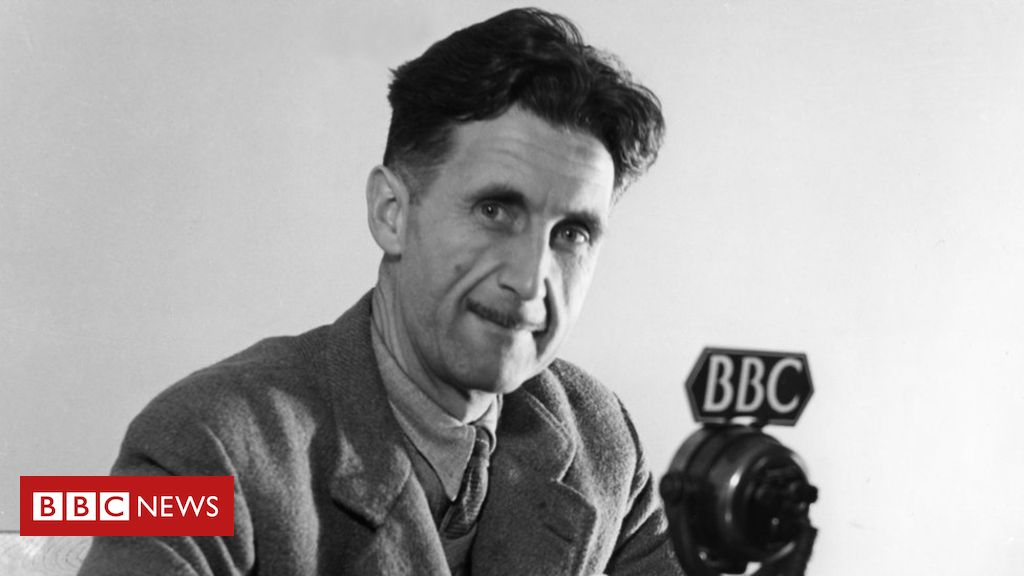
George Orwell, the chosen pen name of Eric Blair, is one of the best known writers of the 20th century and even people who have never read any of his writings are aware of his influence. John Rodden and John Rossi outline the immediate post-war period that saw Orwell publish his final and best-known work:

Seven decades ago on June 8, George Orwell’s Nineteen Eighty-Four exploded on the cultural front—fittingly enough, just two months before the Soviet Union’s first successful atomic test that August, which broke America’s nuclear monopoly. Orwell’s warning was urgent — and timely. Almost overnight, in the wake of the surrender of Germany and Japan that ended World War II in 1945, a new war—the so-called Cold War — had emerged. (Orwell is often credited with coining the term.)

The Cold War pitted the capitalist West against the communist East, above all the United States against the USSR (and soon China). Just three weeks before the publication of Nineteen Eighty-Four, the Soviet Union lifted the Berlin Blockade, thereby avoiding a potentially deadly showdown with the West that might have triggered World War III. Two weeks later, on May 23, the Federal Republic of Germany (West Germany) was officially established, effectively ending prospects in the near future of German reunification. On the very day of Nineteen Eighty-Four‘s publication, June 8, fears swept through liberal America of a growing Red Scare when a leaked document named numerous celebrities as Communist Party members (e.g., Helen Keller, Dorothy Parker, Fredric March, Danny Kaye, Edward G. Robinson). That same month, the communist armies of Mao Zedong captured Shanghai, and less than six months later on October 1, declared victory in the civil war against the American-backed Nationalists and the founding of the People’s Republic of China.

What educated person is not at least vaguely familiar with the language and vision of Orwell’s novel — even if he or she does not recognize the source? Indeed the very ignorance of the source represents an inadvertent tribute to the power of Orwell’s language and vision. Like Shakespeare’s poetry (“All the world’s a stage,” “To be or not to be,” “This above all: to thine own self be true”), so deeply have some of Orwell’s locutions become lodged in the cultural lexicon and political imagination that most people no longer recognize their author, let alone the source.

Today, as in the case of Shakespeare, hundreds of millions of people mouth Orwell’s coinages and catchphrases, such as “Big Brother” and “doublethink” — including his name as proper adjective, “Orwellian” (i.e., nightmarish, oppressive). And that’s just in English. Tens of millions more recognize and repeat them in foreign translations, as I [Rodden] discovered in our travels and teaching in the communist East Germany as well as in Asia. Rudimentary acquaintance with such locutions is regarded as a sine qua non of cultural literacy in English — even today, when prolefeed (mindless chatter) floods the print columns and dominates the airwaves.

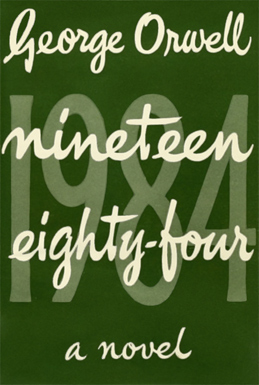
Nineteen Eighty-Four represents Orwell’s Orwellian vision — in the form of a fictional anti-utopia (or “dystopia”) — of what a nightmarish, oppressive future might hold. It projects a world 35 years away — half the biblical lifespan of three score and ten. Having completed his novel by the end of 1948, Orwell flipped the last two digits to underscore his anti-utopian theme of a world turned upside down and inside out. Or so many scholars have reasonably claimed. The date resultant from the flipped digits also gave the novel its immediacy. Previous anti-utopias, such as Aldous Huxley’s Brave New World (1932), had cast their ominous scenarios far into the future, which lessened their dramatic impact and tended to render them entertaining thought experiments. (Huxley’s action is set in the 26th century.) By contrast, Orwell’s dire future is too close for comfort — and depicts the planet in the immediate aftermath of a global nuclear war that has nearly annihilated the human species. His vision thus projects a world in which middle-aged readers in 1949 might find themselves in old age — and certainly their children and grandchildren were likely to witness it. (If he had lived, Orwell himself would have still been just 80 years old on April 4, 1984, when the story opens.)

« Newer PostsOlder Posts »

Powered by WordPress