
World War Two and Spartacus Olsson
Published 11 Jul 2026On September 30, 1938, Neville Chamberlain returned from Munich promising “peace for our time”. Adolf Hitler returned to Berlin with the Sudetenland.
In this episode of “Death of Democracy”, Spartacus Olsson reports from Berlin as Nazi Germany escalates on two fronts: terror against Jewish citizens at home, and diplomatic blackmail against Czechoslovakia abroad.
While the Evian Conference fails to open the world’s doors to Jewish refugees, the Nazi regime tightens the trap with identity cards, forced names, professional bans, the opening of Mauthausen, and Eichmann’s machinery of forced emigration in Vienna.
At the same time, Hitler manufactures the Sudeten Crisis, threatens war, breaks Czechoslovakia’s defenses through the Munich Agreement, and convinces much of Europe that surrendering another country’s territory is the price of peace.
This is Germany in Q3 1938: the lie that Hitler would not start another war — and the world’s decision to believe him.
July 12, 2026
How WW2 Really Started: Appeasement! – Death of Democracy 23 – Q3 1938
July 5, 2026
How Hitler Targeted Czechoslovakia – Death of Democracy 22 – Q2 1938
World War Two
Published 4 Jul 2026Spring 1938: Hitler has taken Austria. Now he turns toward Czechoslovakia — and at home, Nazi Germany’s terror against Jews and other targeted minorities accelerates.
In this episode of Death of Democracy, Spartacus Olsson reports from Berlin at the end of Q2 1938, as the Nazi regime fuses foreign-policy intimidation with domestic repression.
After the Anschluss, Hitler pressures Czechoslovakia over the Sudetenland, but the May Crisis exposes that Germany may not yet be ready for war. Humiliated, Hitler secretly issues a revised Case Green directive: Czechoslovakia is to be smashed by military action.
At the same time, persecution inside the Reich escalates. Jews are forced to register assets. The Nuremberg Laws are extended to annexed Austria. The Great Synagogue in Munich is demolished. Berlin sees orchestrated anti-Jewish street violence. And during “Operation Work-Shy Reich“, thousands of so-called “asocials” are sent to concentration camps — including the first mass arrest of Jews since Hitler’s seizure of power.
This is the quarter when the road from Anschluss to Munich becomes clearer: diplomatic extortion abroad, racial terror at home, and a world still hoping that concessions might preserve peace.
In this episode:
– The April 1938 Anschluss plebiscite
– Jewish asset registration and Aryanization
– The extension of the Nuremberg Laws to Austria
– The Sudeten May Crisis
– Hitler’s Case Green directive against Czechoslovakia
– The demolition of Munich’s Great Synagogue
– Anti-Jewish violence in Berlin
– Operation Work-Shy Reich
– Flossenbürg and the expansion of concentration-camp labor
– The world’s hesitant response to Nazi escalation
June 21, 2026
How To Make War Inevitable – Death of Democracy 20 – Q4 1937
World War Two and Spartacus Olsson
Published 20 Jun 2026By late 1937, Nazi Germany’s rearmament economy had trapped itself. Autarky was failing. Hjalmar Schacht was pushed aside. Göring’s Four-Year Plan dominated economic policy. And at the secret Hossbach meeting of November 5, Hitler turned economic impossibility into an argument for territorial conquest.
This episode covers Q4 1937: the Hossbach Memorandum, Schacht’s resignation, the Anti-Comintern alignment, Lord Halifax’s visit, Himmler’s police-state consolidation, the December “Preventive Crime Fighting” decree, and the antisemitic propaganda exhibition Der Ewige Jude.
The argument is not that war was metaphysically inevitable. It is that the Nazi regime built an ideological, economic, and police-state machine that made war look increasingly necessary to its own leadership. This is a historical analysis of Nazi dictatorship, antisemitic propaganda, and war planning. It condemns Nazism and uses extremist material only for educational and documentary context.
Chapters:
0:00 Q4 1937 Intro
0:53 The world at the end of 1937
1:36 Germany’s quarter of acceleration
3:30 Himmler Tightens Police Power
6:26 Der Ewige Jude and dehumanization
8:30 Hossbach: autarky fails
11:16 Halifax and diplomatic confidence
13:03 Mood inside Germany
15:09 Mein Kampf has become policy
17:16 Conclusion: the politics of beasts
May 13, 2026
The Korean War Week 99: The War’s Most Humiliating Crisis – May 12, 1952
The Korean War by Indy Neidell
Published 12 May 2026The world turns it’s eyes to the UN POW camp at Koje-Do island when the Communist POWs in one of the compounds kidnap the Camp Commandant, an American General no less, and issue demands that they say must be met before his release. Can this be settled diplomatically, or is the army going in in force?
00:00 Intro
00:54 General Dodd Kidnapped
04:09 Koje-Do Phase Two
07:04 Dodd on Trial
13:18 The POWs Demands
18:30 Summary
19:03 Conclusion
19:54 Call to Action
May 6, 2026
The Korean War Week 98: No Peace at Panmunjom – May 5, 1952
The Korean War by Indy Neidell
Published 5 May 2026At the end of last week the UN presented a peace package proposal to the Communists at the peace talks, but that package has been rejected. The only issue still left to clear up is that of POW repatriation, but that seems insurmountable, at least for the time being. In the field, there are ambushes, skirmishes, and night patrols, but still no larger scale actions, and the temperature at Koje-Do POW camp continues to rise and rise, perhaps nearing a boiling point.
00:00 Intro
01:34 Recap
02:09 The Package Rejected
03:58 Night Patrols
08:32 The Fighting
14:13 Koje-Do
15:58 Summary
16:15 Conclusion
May 1, 2026
Spain joins the awkward squad
At The Conservative Woman, Bepi Pezzulli outlines a few ways that the Spanish government is moving in quite different directions than their NATO allies and fellow EU members:
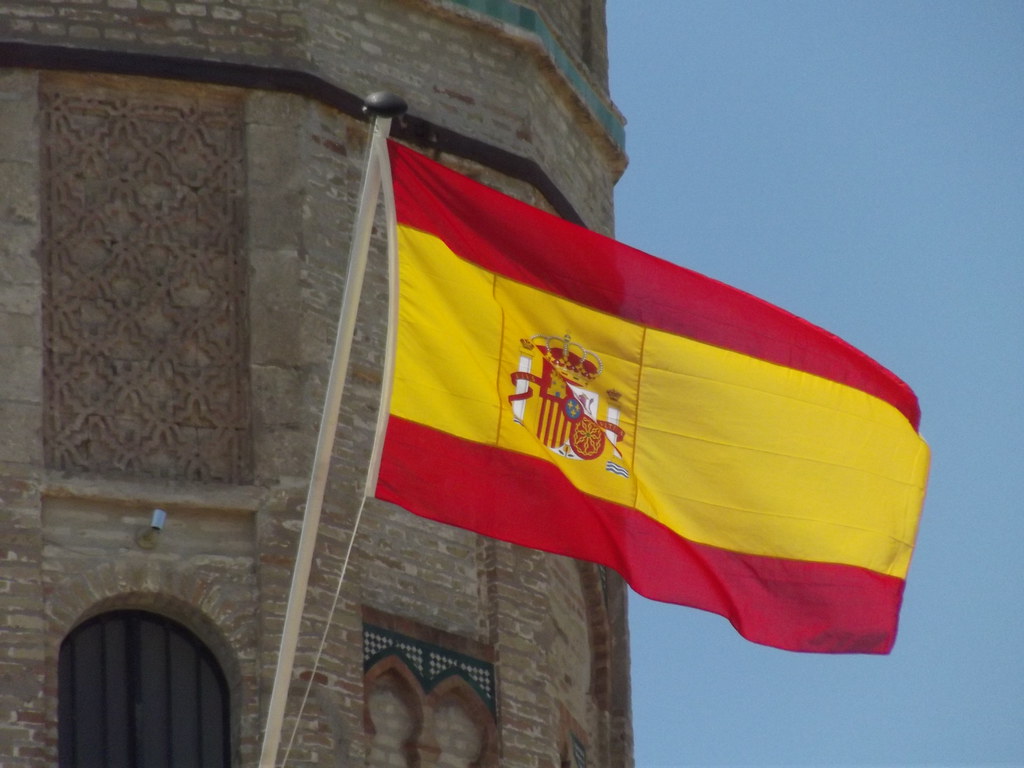
Torre del Oro (Tower of Gold) – Calle Almirante Lobo, Seville – Spanish flag” by ell brown is licensed under CC BY-SA 2.0 

 .
.
Spain’s Prime Minister Pedro Sánchez wants the privileges of alliance without the duties of one. Madrid remains in Nato, hosts critical American military infrastructure, and speaks the language of Atlantic solidarity – but only when convenient. On the central strategic questions of the age – Russia, Israel, and the wider Western posture in the Mediterranean – it increasingly behaves like a spoiler. What is troubling is that Spain is not merely posturing: it is rewriting its entire conception of statecraft, treating alliance as a shield, hostility as leverage, and strategic ambiguity as a governing doctrine.
When Washington needed alignment, Sánchez offered obstruction. When Israel faced existential war, Madrid offered moral lectures. When the West sought energy discipline against Moscow, Spain found room for Russian gas. All while preserving the old imperial obsession with Gibraltar and extracting advantages from London over the Rock.
Spain has discovered the pleasures of consequence-free hostility. That needs to end.
Anti-Americanism with diplomatic immunity
Sánchez has carefully cultivated the old European left’s anti-American reflexes: Nato when subsidised, moral neutrality when sacrifice is required. His government publicly resisted support for American military operations linked to Iran escalation and signalled clear reluctance to facilitate use of Spanish bases such as Rota and Morón for operations that might implicate Madrid politically. The message was unmistakable: American security guarantees are welcome but strategic co-operation is negotiable. The rhetoric matched the policy. “No to war” was not merely a slogan for domestic consumption. Sánchez is deliberately positioning Spain as the righteous dissenter against Washington’s harder strategic line.
At the same time, Spain maintained substantial imports of Russian gas well into the European sanctions era. While pipeline politics consumed Brussels, Madrid benefited from a convenient moral distinction: condemning Moscow loudly while continuing commercial accommodation where useful. The formal sanctions architecture left open some loopholes, and Spain was happy to live inside them.
An ally that profits from ambiguity while others bear the strategic burden is not an ally in the full sense. As US War Secretary Pete Hegseth noted, “An alliance cannot be ironclad if in reality or perception it is seen as one-sided”.
From criticism of Israel to open diplomatic hostility
On Israel, Sánchez has moved beyond criticism into active diplomatic confrontation. Recognition of Palestine was presented as humanitarian principle. In practice, it rewarded maximalism at the worst possible moment. Madrid helped transform October 7 from a terrorist massacre demanding strategic clarity into another European seminar on Israeli restraint. Spain became one of the loudest governmental amplifiers of the anti-Zionist campaign in Western Europe. Ministers normalised rhetoric that blurred the distinction between criticism of Israeli policy and systematic delegitimisation of the Jewish state itself. Arms restrictions followed. Then diplomatic actions. Symbolism became policy.
Gibraltar: Madrid’s imperial nostalgia
Spain’s sanctimony would be easier to tolerate if it were not paired with its own colonial fixation. For decades, Madrid has pursued sovereignty claims over Gibraltar with theological persistence. Brexit offered a fresh opening. With Brussels behind it, Spain extracted a remarkably favourable negotiating posture over the future relationship of the Rock with both the European Union and the United Kingdom. London, in the hands of the most Europhile government in recent history, conceded far more than many British voters imagined when they heard the word “sovereignty”. Spain never abandoned the long game. It simply learned to play it through institutions until a weaker opponent appeared. Madrid insists Gibraltar is unfinished history. Fair enough: is it not time then to conclude the same about Ceuta and Melilla?
April 29, 2026
The Korean War Week 97: A Peace Proposal Package – April 28, 1952
The Korean War by Indy Neidell
Published 28 Apr 2026There is what should be major news this week as the UN gives the Communists a peace proposal package at long last that addresses the remaining three issues to solve. It does not seem that it will be accepted by the Communist side, though, with the only sticking point being the issue of POW repatriation. There’s also still more unrest and protest at Koje-Do POW camp. And it looks like we’ll be getting a new UN forces commander, since Matt Ridgway will soon head to Europe to take over NATO command there.
00:00 Intro
00:24 Recap
00:56 Truman and Ike
02:34 April 28th
07:14 POW Rations
10:37 Notes
11:05 Summary
11:20 Conclusion
April 25, 2026
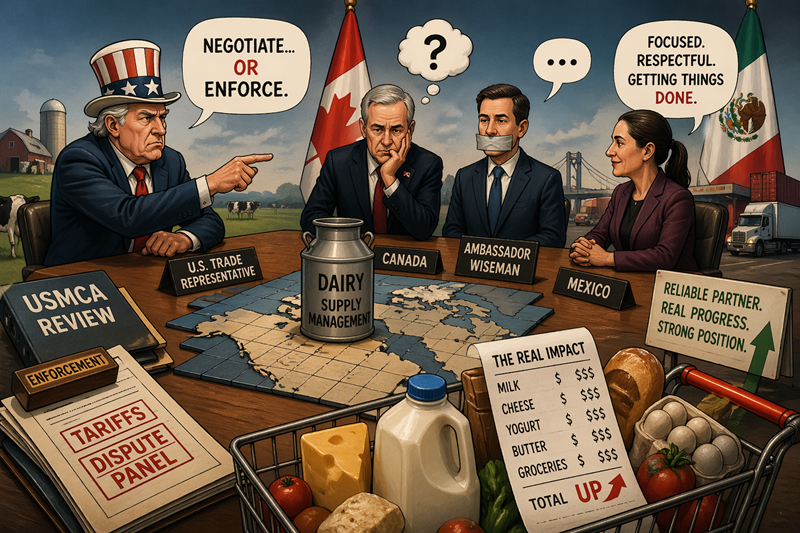
“… as the review of USMCA approaches. Dairy is once again at the center of the storm”
Dr. Sylvain Charlebois on the strong hints the US government has been dropping that Canada’s stance on our restrictive dairy cartel — euphemistically referred to as “supply management” — is going to be a key negotiating point in the upcoming USMCA trade negotiations:
The warning came quietly, but it was unmistakable. According to a Reuters report carried by The Western Producer, U.S. Trade Representative Jamieson Greer made it clear: Canada’s dairy dispute will be resolved one of two ways, through negotiation or through enforcement.
That is not diplomatic nuance. That is a choice.
And it comes at a delicate moment, as the review of USMCA approaches. Dairy is once again at the center of the storm. It always is. Canada’s supply management system, long defended domestically, continues to frustrate U.S. officials over limited market access. As reported by Reuters, tensions remain high around how Canada administers its tariff-rate quotas.
None of this is new. What is new is the tone.
Recent commentary out of the United States, including sharp criticisms aimed at Mark Carney, reflects a growing impatience. Some of it is political theatre. But some of it signals something more consequential, a willingness to move from negotiation to enforcement if progress stalls.
In food trade, that shift matters.
Canada’s agri-food economy is deeply integrated with the United States. This is not a casual trading relationship. It is structural. Supply chains cross the border multiple times before products reach consumers. Roughly three-quarters of Canadian agri-food exports still head south. You do not casually antagonize the market that anchors your value chain.
The critique coming from voices like Brian Switzer, however undiplomatic, boils down to a familiar expectation. Canada should act like a predictable partner. Not subordinate, but steady. When that perception erodes, the consequences are rarely immediate. They emerge later, in tighter border controls, procurement shifts, or dispute panels.
And eventually, in prices.
April 22, 2026
The Korean War Week 96: Korean Marines Leapfrog the Han – April 21, 1952
The Korean War by Indy Neidell
Published 21 Apr 2026UN Command completes its screening of the 170,000 military and civilian POWs they hold to see how many of them would violently resist repatriation, and it turns out it’s most of them. The Communists are furious. This cannot be good for the armistice negotiations. We also take a look at the defense possibilities the Marines have in their new positions and which Chinese forces oppose them.
00:00 Intro
00:55 Recap
01:32 POW Screening
07:26 The Marines
08:56 The Chinese
13:37 Summary
13:53 Conclusion
April 15, 2026
The Korean War Week 95: TWO THIRDS of POWs Refuse Repatriation – April 14, 1952
The Korean War by Indy Neidell
Published 14 Apr 2026US Marines begin to make contact with their Communist Chinese adversaries in their new position in the west of Korea, but a more insidious issue is beginning to threaten the UN war effort: dwindling stockpiles of ammunition. In fact, two-thirds of the US army’s procurement budget is going exclusively to ammunition, but production lag — the time between paying for something and actually getting it — is putting Eighth Army operations at risk. Elsewhere, POW screening begins, with results that might throw a wrench into the painstakingly negotiated armistice terms back at Panmunjom.
00:00 Hook
00:59 Recap
01:51 POW Screening
05:49 Ammunition
10:46 Marine Operations
14:07 Summary
14:57 Conclusion
(more…)
April 10, 2026
Trump’s intemperate, irresponsible, unhinged rants … worked?
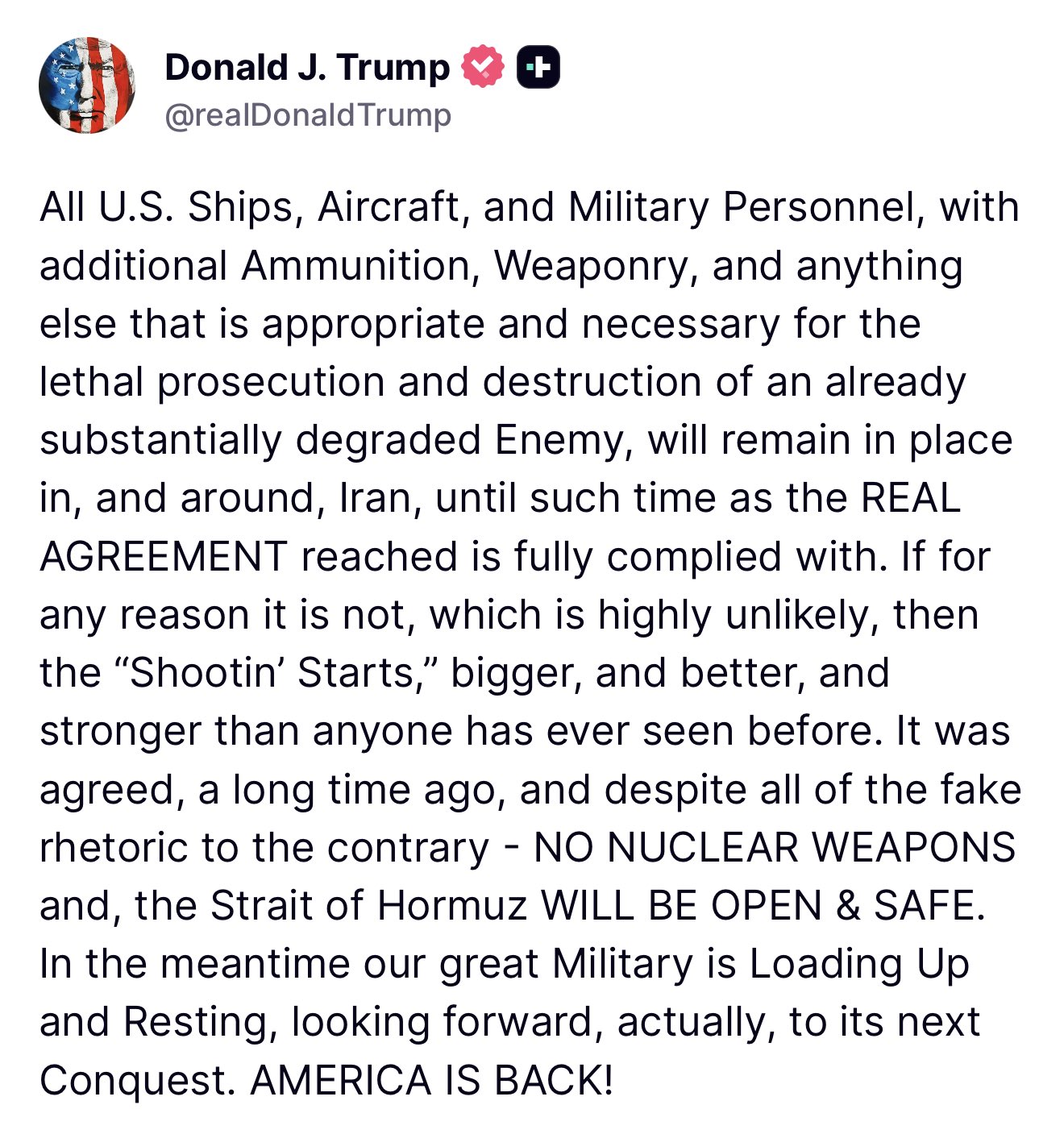
For all that Trump’s habitual form of social media post seem to frequently dance on the edge of incoherence — if not insanity — his track record is far better than his critics give him credit for. I thought his most recent blustering threats against the Iranian leadership would be counter-productive, but something approximating a ceasefire began just before his deadline. As Brendan O’Neill put it, this gives Iranian civilization a bit of a reprieve, but what about the West?
Imagine calling for the destruction of a civilisation. Imagine dreaming about violently scrubbing an ancient nation from the face of the Earth. Imagine flirting with the idea of obliterating a land with thousands of years of rich history. I am referring, of course, to the activist class and its annihilationist hatred for the Jewish State. For nearly three years, these people have beat the streets and swarmed the digital networks to agitate for the erasure of Israel, all the way “from the river to the sea“. President Trump’s juvenile bluster on Iran has nothing on their existential loathing for the Jewish homeland.
The frenzy of the past 48 hours, following Trump’s potty-mouthed and threatening social-media posts about Iran, has felt unhinged. The nukes are coming, influencers wailed. Trump must be “removed as president” in order to “prevent a catastrophe that our species will never recover from”, said the Guardian‘s Owen Jones. Within hours of this giddy apocalypticism, this huddled descent of the chattering classes into the pit of End Times prophesying, Trump had done what many of us expected he would: struck a kind of deal. The great detonation was not of a nuclear bomb but of the common sense of the cultural establishment. That’s the only thing that got vaporised yesterday.
Then there was the sheer cant. It was Trump’s ominous yelp that “A whole civilisation will die tonight” that got leftists and liberals frothing. It’s genocidal lunacy, they said. Let’s leave to one side that the target of his digital ire appeared to be the Islamic Republic, not Persia. “Forty-seven years of extortion, corruption and death will finally end”, he said. The more striking thing is the industrial-level gall of a cultural elite that is devoted to the dismantling of Israel, puffing itself up in fury over Trump’s hyperbole on Iran.
I agree that “A whole civilisation will die tonight” is a chilling thing to say. That’s why I’m so horrified by the frenzied anti-Zionism of our times. Our intellectual classes furiously deny Israel’s “right to exist”. Our activist classes openly call for Israel’s excision from the family of nations, by intifada (violence) if necessary. Our celebrity classes cheer the armies of anti-Semites (Hamas, Hezbollah) that were founded with the express intention of vaporising the Jewish nation. One minute the keffiyeh set is accusing the likes of Pete Hegseth of being in the grip of an anti-Iranian “bloodthirst”, the next it’s chanting for the death of the Jewish nation’s soldiers.
Future historians will marvel at the brass neck of an influencer class that took 24 hours off from calling for the destruction of Israel to bash Trump for posting about the destruction of Iran. I raise this not to be facetious but to draw attention to the moral disarray here on the home front that has been so spectacularly exposed by events in Iran. For it is undeniable now – we are surrounded by people who salivate over the violent disappearance of Israel but who fret over the withering of the Islamic Republic. They have taken sides – the side of the barbarous regime that dreams of “Death to America” over the side of the democratic state rebuilt by Jews in the aftermath of the Holocaust. I’m delighted the Persian civilisation is safe – now what about the West’s?
April 9, 2026
“Trump … scared us into doing the right thing”
Canada got into the incredibly bad habit of freeloading on national defence under Pierre Trudeau, and from 1968 onward, we’ve been leaning ever more heavily on US military power to fill in the gaps we’ve chosen not to invest in ourselves. At the same time, we’ve almost dislocated our arm in patting ourselves on the back for our “soft power” on the international diplomatic scene. The Americans, for reasons known only to themselves, rarely pushed back or called us out for our perpetual slacking … until Donald Trump came along. Now, as Matt Gurney regretfully points out, Trump seems to be the only accountability mechanism on the Canadian government:
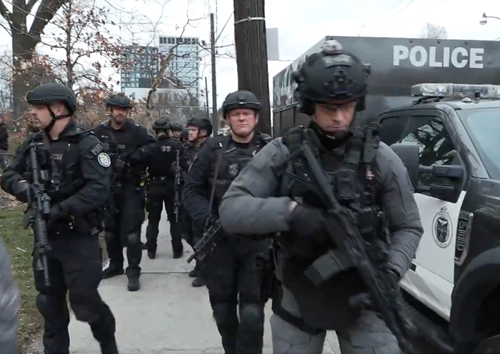
Coming soon to a Jewish daycare centre near you, sadly.
Image from The Line
Every well-functioning society needs effective accountability mechanisms. It needs something that can reliably deter bad guys from doing bad things, or at least catch them and stop them when they try. Hell, it also needs some sort of immune system that simply prevents the good ones from getting flaky and lazy, and to prune out the soft corruption that can easily settle in in comfortable and generally affluent societies.
“Accountability mechanism” is a broad term, but it has to be. It can be many things. It can be as basic as a strict moral or religious code, enforced by a priestly caste or even simple scolds. Or, ahem, a thriving press, with reporters and columnists poring over all the information they can find for examples of bad things that need fixing and then making a lot of noise about them. In democracies, effective opposition parties are a key part of this; so are government accountability officers, like auditors and ombudsmen. In a pinch, even just a healthy sense of personal honour and shame can work.
In a perfect world, you’ll have many or all of these, and they’ll be mutually reinforcing. Does Canada have any? Or, as I’m increasingly worried, have we basically outsourced this key democratic function entirely to the United States, and specifically, Donald Trump?
This bleak thought occurred to me after I watched, with equal parts horror and relief, a recent video put out by the Toronto Police Service. You can see it for yourself here, but, in short, it’s a promotional video for the new public order mission that is putting heavily armed and armoured officers onto the streets of Toronto to secure sites at risk of attack. The video has an intensely martial vibe; the deployment looks much more like a military operation than a police patrol. Though the video doesn’t say so directly, the intended purpose is clearly stopping the sustained attacks we’ve seen on Jewish religious, commercial and cultural sites in Toronto since Oct. 7, 2023.
[…]
There was also border security and fentanyl. I’m fully aware that the White House exaggerated both issues so they could use them against us. But I’m equally aware that Canada tends to ignore issues even slightly related to national security. A few tweets from Trump changed that. Some of our initial responses, like a czar and a pair of leased Blackhawks, were symbolic, clearly intended for Trump’s consumption. But Mark Carney has continued to ramp up our border security, and make a point of saying so. Again, we did this to avoid Trump’s wrath.
The biggest example, though, is clearly defence spending and rearming the Canadian military. Canada had long pledged to hit the NATO target, but never did; indeed, the former PM reportedly told our allies he had no plans to even try, as it wasn’t a domestic priority. But then Trump comes along and scares the crap out of us and, voilà, we’re hitting the target. Some of that is creative accounting, but not all of it.
Again, Trump did this. He scared us into doing the right thing.
April 8, 2026
The Korean War Week 94: Mines, Marines, and Mayhem – April 7, 1952
The Korean War by Indy Neidell
Published 7 Apr 2026In order to try and make some progress on the thorny issue of POW repatriation, the UN offers to screen all the POWs they hold to get an exact number of who refuses to be sent back. The Communists agree and the plans are put in motion. Plans in the field are finishing up, with the US 1st Marine Division having moved to new positions in the west, but they now have to deal with the unforeseen issue of thousands of landmines. They did not see that coming.
00:00 Intro
00:47 Recap
01:27 POW Issues
05:58 New Operations
07:18 Marine Defenses
10:53 Landmines
14:18 Summary
15:01 Conclusion
April 7, 2026
QotD: Advice for foreign leaders trying to deal with Donald Trump
If you want to understand Trump, you have to understand that he’s not a politician.
I do not say this as meaningless praise, just to say, oh, he’s not a corrupt scumbag. I say it with a very specific meaning.
To understand Trump, you must purge yourself of all expectations you have learned from watching politicians, include the assumptions you are not even aware you are making.
Trump is a completely different animal.
Trump is a businessman, and while there are many sorts of businessman, he is of a very specific type. He rose to wealth and prominence by doing two things very well:
1. Brand reputation building.
2. Negotiation.#1 forms the basis of how he deals with voters.
#2 forms the basis of how he deals with other power blocs within the US, and with other nations.
You see, the true love of Donald Trump’s life is bargaining. He is a business deal sperg. And he’s very, very good at it, because the actual process is his idea of fun, and winning at it is definition of pure satisfaction and joy.
He’s never made uncomfortable by the play of offer and counteroffer, or by butting heads and seeing who blinks first. That is, instead, his happy place. This means that not only is he totally at peace in the moment, he’s also practiced a lot.
When he called his book The Art of the Deal, it wasn’t just because he wants to think he’s good at this, it’s because this is the meaning of his life. The man finds meaning in haggling the way Musk finds meaning in building technologies, or the way I find meaning in explaining things to an audience.
So when Trump is dealing with others, from political office, he’s negotiating as if it were his money. Because that’s just how he ticks.
Now, the ground rule of global politics for the past 100+ years is that no matter who you are, you are allowed to rob American taxpayers and voters, so long as you pay American politicians for the privilege of doing so.
All of us, even democrat voters who don’t want to think about it, know what 10 percent for the big guy meant, and who the particular big guy was.
For all that time, global politics amounted to treating America as a giant cash pinata, and the deals had only two guardrails on them.
1. You must pay American politicians a large enough sum, in a subtle enough manner.
2. You can’t buy anything that your paid-off politicians won’t be able to hide their personal connection to.That’s it.
Everything else was on the table.
Trump isn’t like that. He can’t be bought.
Not because he’s some kind of saint, which he isn’t, nor because corrupt-politician money is loose change compared to Donald Trump money, which it is.
But because Trump can’t stand to deliberately lose a negotiation for a bribe, any more than Floyd Mayweather wants to throw a match to get paid off by bookies.
And this is how Trump became involved in politics in the first place. He was a standard New York City rich moderate democrat. Believed in the Postwar Dream, bought into the raceblind thing, was all in favor of exporting democracy, and taxed capitalism paying for a moderate amount of welfare state. But as he realized the political machines were selling out America, he got personally offended.
Not because he was principled and deeply cared about middle America. Perhaps a little because selling out America was hurting his real estate interests.
But mostly because bad business deals give Donald Trump the ick.
Trump seems like a loose cannon to a lot of people, because they don’t what he’ll do next. And they don’t know that because they don’t understand what motivates him.
Trump wants America to make better deals and stop being taken advantage of. And to make those better deals, he has to demonstrate to the people who are used to buying American politicians that the rules in play have changed.
So what’s the deal with Venezuela and Maduro?
Simple. If you ride the NYC subway enough, it’s pretty likely that eventually a bum will come up to you, whip out his dick, and piss on your shoes.
Why? Because he wants to feel powerful. Because his day isn’t going well, and so he wants to ruin yours. Because he’s crazy. Because who the fuck cares?
But most of all, because he can. Because NYC is run by out of touch commie liberals, and he knows that if he is arrested, he’ll be fed and let out in the morning, but if you punch him in the teeth, your life will be ruined.
So when things change, people need to be put on notice. The bums aren’t going to read a sign that says “this subway now functions under Tennessee rules”, and if they do read it, they aren’t going to believe it. They’ve heard it all before as a bluff.
You have to actually punch someone in mouth and knock some teeth out. And then have the Tennessee cops show up and say, so what, you shouldn’t have pissed on his shoes, dumbass.
It is beyond the shadow of a doubt that Maduro was offered plenty of gentle offramps which would have preserved his dignity, lifestyle, etc, if not his pride.
But he didn’t take them, because everything is a bluff … until it isn’t.
Maduro is a head on a spike. A signal that the ground truth of how to deal with America has changed.
A signal that both violence, and personal consequences, are no longer off the table.
Because the whole reason for the existence of governments is to wield organized violence instead of the disorganized kind.
Other nations will now be coming to the negotiating table with this example in mind.
America is tired of being your ATM.
Devon Eriksen, The social media site formerly known as Twitter, 2025-01-06.
Update, 8 April: Welcome, Instapundit readers! Have a look around at some of my other posts you may find of interest. I send out a daily summary of posts here through my Substack – https://substack.com/@nicholasrusson that you can subscribe to if you’d like to be informed of new posts in the future.
April 6, 2026
NATO without the United States?
At The Conservative Woman, Jonathan Riley considers the sudden existential crisis facing the NATO alliance with President Trump openly musing about pulling the United States out of their current commitment to joint European defence:
PRESIDENT Trump’s warning that the US could pull out of Nato should shock even the most complacent and anti-American elements on the political left. Mr Trump has raised the issue in private discussions with White House aides in recent days, and on Wednesday confirmed that he was “absolutely” reviewing membership.
I have underlined several times in these pages why this is so – the global reach and sheer size of US military power and the fact that the USA brings capabilities to Nato that no other country has, or is ever likely to have. With American backing, Nato has credibility in its deterrent posture – deterrence being built on capability and will to use those capabilities. Without the US, credibility remains only in the nuclear sphere because of the independent British and French arsenals, but not in the conventional sphere. An aggressor could well, therefore, be tempted to take actions that fell short of the use, or riposte, of weapons of mass destruction. A Russian incursion into a non-Nato state, for example, Bosnia and Herzegovina or Moldova; or even a limited incursion in the Baltic, either on land or at sea.
The President’s threat came as the latest in a sequence of angry responses to the failure of traditional allies to give their support, as he sees it, to the US/Israeli war on Iran. Not least was his disappointment with Starmer, first over his refusal to give the US use of Diego Garcia and RAF Fairford in Gloucestershire for strikes on Iran, second over Starmer’s reluctance to deploy the Royal Navy and then his refusal to take the lead on re-opening the Strait of Hormuz. France’s preference for diplomacy has irked him too. Austria, not a Nato member, has become the latest EU country to deny US military use of its airspace.
Whether or not this outburst was more than a mark of his frustration with unappreciative allies – more wake-up call than genuine warning – it still suggests an alarming failure on his part to understand what Nato is and is not; why a US pull-out would be a lose/lose situation for Europe and the US.
Nato is an alliance founded in the Treaty of 1949 and is about mutual defence. Article Five affirms that an attack on one member state is an attack on all and obliges all other states to come to the aid of whoever has been attacked. During the Cold War, there was no discussion about resources, or caveats, or vetoes – what mattered was survival. Once the Cold War was over, nations did have a choice about what they committed – and in the case of every European country, it was less.
The water was muddied by the Nato-led expeditions to Bosnia, Kosovo and Afghanistan. These were carried out using coalitions built on the Alliance and in some cases, simultaneously, coalitions built within the Alliance. For example, in Afghanistan, there were really two International Assistance Forces (ISAFs): one was a coalition of the willing confronting insurgency and terrorism; the other was a non-kinetic coalition based on the Bonn Agreement, concerned with nation-building. Some people and member states may therefore believe that Nato is a vehicle for Allies to climb aboard and support US (or French, or British) expeditionary operations. It is not.


