Quotulatiousness

July 30, 2022

Alexis de Tocqueville

Filed under: Books, France, History, Liberty, USA — Tags: , , — Nicholas @ 03:00

In The Critic, Paul Sagar reviews a new biography of Alexis de Tocqueville by Olivier Zunz:
Alexis de Tocqueville came perilously close to never existing at all. His parents, married in 1793, spent 10 of their first 18 months of matrimony in jail — arrested for the crime of being aristocrats during the height of the French revolutionary Terror. Tocqueville’s great-grandfather was guillotined in April 1794, after being forced to watch the beheadings of his daughter and grandchildren. His newlywed parents were in the queue, awaiting the same fate, but the fall of Robespierre in July meant they were spared.

Alexis, the third son of the family, would be born in 1805, and go on to write not one, but two, of the most influential works in the history of ideas. His two-volume Democracy in America (published in 1835 and 1840) has been hailed as, variously, the first work of political science, a founding text of sociological analysis, and a landmark in the history of political philosophy.

It remains a touchstone for those attempting to understand both democracy and the United States, as well as post-Revolutionary France (Tocqueville’s animating point of comparison). His later The Ancien Régime and the Revolution (1856) attempted to locate the long-term causes of the events of 1789, and inaugurated a school of French Revolution historiography that remains alive and influential to this day.

He also enjoyed a moderately successful career as a practising politician, directly involved in France’s tumultuous political upheavals from the 1830s to the early 1850s. Constitutionally frail, and wracked by tuberculosis for the final nine years of his life before dying at just 54, he nonetheless packed a lot in.

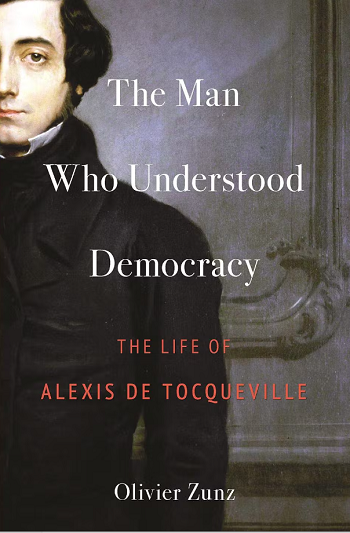
As a narrative biography, Olivier Zunz’s The Man Who Understood Democracy succeeds tremendously. The details of Tocqueville’s life — and the events he lived through — are rendered with engaging clarity. The detailed reconstruction of Tocqueville’s nine-month trip to America in 1831–32 is especially valuable, shedding a great deal of light on what Tocqueville saw and, crucially, who he spoke to and took his lead from. Zunz does not shy away from dissolving the myth to reveal the man. Sometimes treated as though he were a gimlet-eyed sage who saw through to the very soul of the fledgling United States, Zunz shows instead the extent to which Tocqueville tended to take too much at face value, especially regarding what he was told by less than impartial interlocutors, frequently failing to scratch below the surface on his whirlwind tour.

Thus, for example, he went on to write in Democracy in America that the liberty of the United States meant that secret societies were unknown there, entirely failing to recognise not only the extent of Masonic influence in local politics, but also how objections to Masonic influence were a core feature of contestation. A young man, dazzled by the hustle and bustle of the New World, he tended to see what he wanted to see — or what others hoped he would.


July 29, 2022

QotD: The US Civil War as a “revolt of the elites”

Filed under: Government, History, Politics, Quotations, USA — Tags: , , , , — Nicholas @ 01:00

They don’t teach it this way in college (for obvious reasons), but the Civil War was a revolt of the Elites. Put polemically, but not unfairly, The American People were offered four choices for President in 1860:

  1. tacitly pro-slavery;
  2. pro-slavery;
  3. fanatically pro-slavery; or
  4. fuck you.

These were embodied by John Bell, Stephen A. Douglas, John C. Breckinridge, and Abraham Lincoln, respectively, but the names on the tickets really didn’t matter, because it all boiled down to two options: Some flavor of politics as usual, or fuck you. And here’s the important part: The vast, vast majority of the country voted for politics as usual. “Fuck you” got 39.82% of the vote, which by my math means that 60% of a country that would soon be conducting the largest military mobilization yet seen in the history of warfare wanted things to keep going as they were.

In fact, it’s worse than that. As much as I hate to credit him with anything, Barack Obama was right — He truly was a Lincolnesque figure, in that Lincoln was vague to the point of incoherence about his origins, aims, and platform, too. A vote for Lincoln wasn’t a vote for disunion; it was a thumb in Dixie’s eye, no more. In other words, it was a vote to put the ball in the South’s court — an electoral-college version of the double dog dare. We voted for “none of the above,” pro-slavery people, now whatcha gonna do about it?

We know the answer — they haven’t yet forbidden us from teaching the fact that secession happened sorta-kinda-quasi democratically — but for obvious reasons they don’t teach that the secession conventions were all rigged in favor of the fire-eaters, and even then the motions barely passed. Which, again, means that “politics as usual” was nearly the default position of guys specifically summoned to discuss ending politics as usual. If you want to say that the Civil War was started by about twenty guys nobody’s ever heard of, with names like “Louis T. Wigfall” and “Laurence M. Keitt,” you won’t hear much argument from me.

Severian, “Misunderstanding the Civil War”, Rotten Chestnuts, 2019-05-29.

May 15, 2022

QotD: Parliament

Filed under: Britain, Government, Politics, Quotations — Tags: , , — Nicholas @ 01:00

What is the use of Parliament if it is not the place where true statements can be brought before the people? What is the use of sending Members to the House of Commons who say just the popular things of the moment, and merely endeavour to give satisfaction to the Government Whips by cheering loudly every Ministerial platitude, and by walking through the Lobbies oblivious of the criticisms they hear? People talk about our Parliamentary institutions and Parliamentary democracy; but if these are to survive, it will not be because the Constituencies return tame, docile, subservient Members, and try to stamp out every form of independent judgment.

Winston S. Churchill, speech around the time of the Munich crisis, 1938.

April 7, 2022

The EU only cares about democracy as long as the voters make the “correct” choice

Filed under: Europe, Government, Politics — Tags: , , , , — Nicholas @ 05:00

In Spiked, Tom Slater points out the most recent proof that the EU’s principled defence of democracy fades out quickly when the voters don’t vote the way they’re “supposed to”:

Remember the other day when the European Union was pretending to care about sovereignty and democracy? When Russia’s imperialist invasion of Ukraine had supposedly united European elites in their staunch, unflinching belief in a people’s right to determine their own destiny and shape their nation? You’ll be shocked to learn that they didn’t really mean it, at least if their reaction to the Hungarian election is anything to go by.

On Sunday, Viktor Orbán and his ruling Fidesz party won a landslide victory. Already the longest-serving EU leader, Orbán is now heading into a fourth consecutive term, with a two-thirds majority in parliament and an increased mandate. United for Hungary – an opposition coalition stretching from ex-communists to ex-fascists – defied the raised expectations of Euro elites and put in a dreadful showing, capped by gaffe-prone leader Péter Márki-Zay failing to win his own constituency race.

In the election, Orbán presented himself as a doughty defender of Hungarian national identity and interests against a meddlesome European Union and international set. Budapest and Brussels have been locked in a years-long battle over alleged “rule of law” breaches and LGBT rights. The EU is currently withholding €7 billion of coronavirus recovery funds from Hungary as part of a bitter legal standoff. In this, Márki-Zay was an all-too-willing foil, arguing that his government would be a “grand prize” for the EU.

In February, the European Court of Justice rejected a challenge by Hungary and Poland, upholding the legality of withholding funds from member states if they fail to adhere to “core values”. It sent a clear message to the Hungarian electorate in the run-up to the election: reject – or at least humble – this troublesome government or else. Now that Hungarians have politely refused to be pushed around, the European Commission has said it will press ahead with the formal mechanism that will deprive Hungary of the funds indefinitely.

Meanwhile, the European liberal media took a break from piously intoning about the defence of democracy in Ukraine to decry the election result in Hungary. Timothy Garton Ash even linked the ballot-box revolt to the barbarism in Bucha. “The Ukrainian horrors are clearly far worse than the Hungarian miseries, but the two are fatefully connected”, he wrote in the Guardian, accusing Orbán of being a Putin stooge. “Europe should now get tough on both the Russian enemy without and the Hungarian enemy within.” A Guardian editorial similarly called for swift EU action against this pesky central European state.

February 10, 2022

QotD: Classical Greek Polis governance

Filed under: Europe, Government, Greece, History, Quotations — Tags: , , , — Nicholas @ 01:00

Before we dive in, I want to give a brief primer on the basics of how nearly all Greek poleis – Athens, Sparta, Corinth, Thebes, Plataea, Tegea, whatever – are structured, because it’ll help in understanding Sparta. (Reminder: the polis, sometimes called a city-state, is the basic unit of Greek governance – these are all independent micro-states).

The standard ingredients of a Greek polis are an assembly of all adult citizen males (often called an ekklesia, meaning “assembly”), a smaller advisory committee (frequently called a boule), and then a set number of elected officials who carried out the laws of the other two (magistrates). I’ve given the common names for these components, but they often have different names in different poleis.

Those basic units don’t change from a democracy (like Athens) to an oligarchy (like Corinth) or even a tyranny (like Syracuse) – the type of government just reflects the division of power between them, and the method of selection. In a democracy, like Athens, the ekklesia will have most of the power, being able to overrule the boule or the magistrates. Often the members of the boule can come from a wide range of wealth classes or even be randomly selected.

In an oligarchy, power is generally focused in the magistrates – drawn from the upper-crust of society – and a smaller boule, with the ekklesia having much less power to restrain them. Alternately, the ekklesia may be restricted in size to only a wealthy subset of the citizenry. In a tyranny, a single person (the tyrant) is able to gain control of the system, through a mix of demagoguery, charisma and well-placed cronies. Even under a tyranny, the basic three-part system still exists, it is simply subverted and controlled by one person (much like how some modern dictatorships have all of the institutions of a democracy – courts, elections, etc – but all of the power is still in one set of hands and the elections are shams).

I want to note this up front because it is important to recognize that the existence of a popular assembly does not make a Greek polis a democracy, nor does the existence of a powerful magistrate make it a tyranny. As we’ll see, Sparta has an assembly, it is just laughably weak; it also has two very powerful magistrates, but their power is strongly checked. What matters is the division of power between these parts. I also wanted to start here because Sparta follows this basic model, but with some interesting variations. Knowing what the normal model looks like will make it easier to spot the variations that are unique to Sparta.

Bret Devereaux, “Collections: This. Isn’t. Sparta. Part V: Spartan Government”, A Collection of Unmitigated Pedantry, 2019-08-29.

January 7, 2022

Mark Steyn on the Potemkin Congress and the compliant media that enable the farce

Filed under: Media, Politics, USA — Tags: , , , , — Nicholas @ 03:00

With Mark doing a lot more screen time for GB News recently, he doesn’t have as much opportunity to set his thoughts down in written form, so this little paean to the Potemkin parliament at the heart of Washington DC is a rare treat:

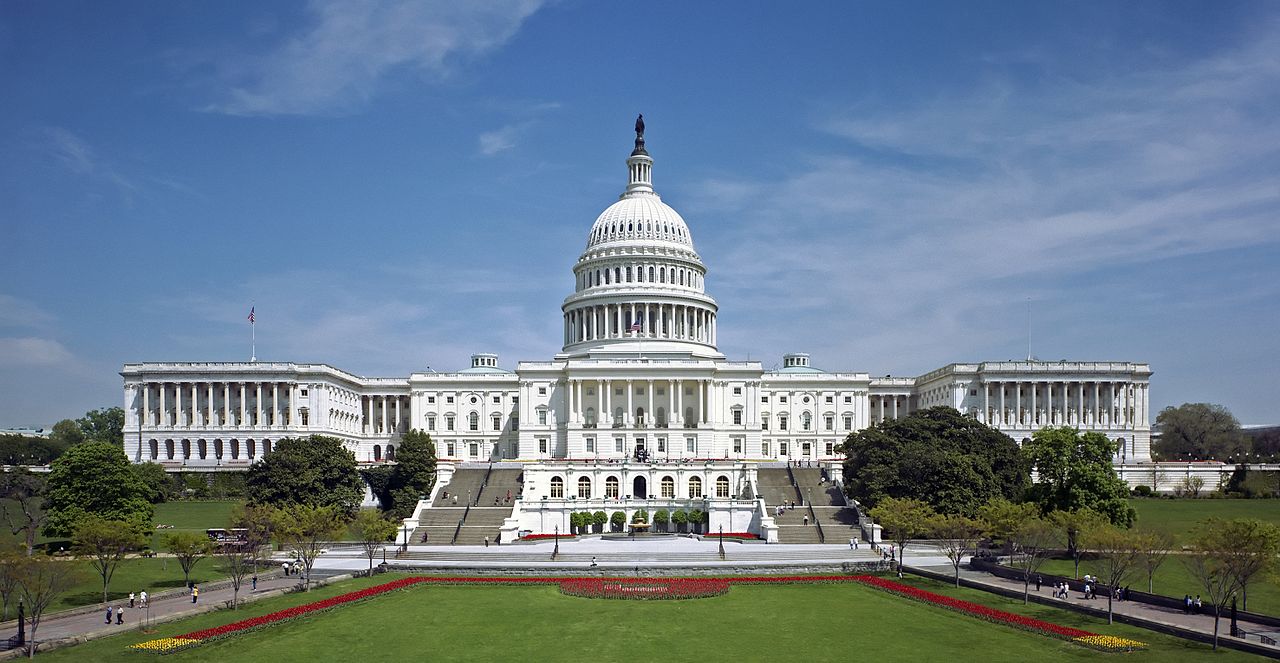
The western front of the United States Capitol. The Neoclassical style building is located in Washington, D.C., on top of Capitol Hill at the east end of the National Mall. The Capitol was designated a National Historic Landmark in 1960.
Photo via Wikimedia Commons.

As I said earlier, I find myself at odds with virtually the entire politico-media class in my reaction to the “storming” of the US Capitol … I was surprised that even politicians and pundits could utter all that eyewash about “the citadel of democracy” and “a light to the world” with a straight face. It’s a citadel of crap, and the lights went out long ago: ask anyone who needs that $600 “relief”.

I despise the United States Congress, and not merely for the weeks I had to spend there during the Clinton impeachment trial: My contempt pre-dates that circus. It dates to the moment I first realized, as a recent arrival to this land, that when Dick Durbin or some such is giving some overwrought speech on a burning issue he is speaking to an entirely empty chamber — because there are no debates, because most of these over-entouraged Emirs of Incumbistan are entirely incapable of debate: See, inter alia, Ed Markey.

But the fact that they might as well be orating in front of the bathroom mirror isn’t why I despise it. It’s that the American media go along with the racket, and there’s only the one pool camera with the fixed tight shot so that you can’t see the joint is deserted and the guy is talking to himself. The wanker press is so protective of its politicians that it’s happy to give the impression that a boob like Markey is Cromwell in the Long Parliament …

That leads easily to the next stage of decay — for why would a Potemkin parliament not degenerate further into a pseudo-legislature? The Covid “relief” bill is 5,593 pages. There is no such thing as a 5,593-page “law” — because no legislator could read it and grasp it. For purposes of comparison, the Government of India Act, which in 1935 was the longest piece of legislation ever drafted in British law and which provided for the government of what are now India, Pakistan and Burma, is 326 pages.

Oh, I’m sure paragons of republican virtue will object that no Indian or Burmese citizen-representatives were involved in that piece of imperial imposition. Well, no American citizen-representatives were involved in the Covid “relief” bill. The legislation was drafted not by legislators, nor by civil servants, nor even by staffers or interns. Instead, a zillion lobbyists wrote their particular carve-outs, and then it got stitched together by some clerk playing the role of Baron von Frankenstein. The “legislators” voted it into law unread, and indeed even unseen, as the Congressional photocopier proved unable to print it: It was a bill without corporeal form, but the yes-men yessed it into law anyway.

Whatever that is, it’s not a republic. As beacons to the world go, stick it where the beacon don’t shine … Whatever Sudan and Chad and Waziristan need, it’s not the US Congress.

November 12, 2021

More on the populist success of Hungary’s Victor Orbán

Filed under: Economics, Europe, History, Politics — Tags: , , , , — Nicholas @ 03:00

Last week, Scott Alexander looked at a couple of recent biographies of Hungarian politician Victor Orban (linked here). He got some quite interesting responses from his readers, including a long Twitter thread from Lyman Stone, which he’s converted into plain text for ease of reading:

I won’t make you read it all in tweet format. He continues:

1) Dictatorship and democracy. The arguments about Orban cheating in elections might be totally true. I dunno. But that’s sort of irrelevant. Neutral opinion polls nobody disputes show he would have gotten 2/3 under almost any system.

His crude poll share was about 60% before the 2010 election, but given the threshold effects, he’d likely have ended up at a supermajority under almost any system. And as @slatestarcodex [says], a lot of the initiatives that the EU most despises under Orban are initiatives that *everyone agrees* have supermajority public support among Hungarian voters.

Moreover, I agree with @slatestarcodex that if public opinion turned in Hungary, Orban would probably turn on a dime too. The dude loves power. But that should inform our read of what’s going on in Hungary. *Hungarians wanted* a right-nationalist authoritarian leader, *and so they voted for one*, and the electorate has *wanted* recurrent intensifications of that regime. So is it a dictatorship? Or is it a democracy?

This gets at the problem with “democracy” as a concept. Hungary is undeniably Democratic: there is widespread public support for the regime, which is selected by elections, the results of which are a decent approximation of trustworthy and neutral opinion polls. But I think it’s still possibly reasonable to call Orban a dictator. He wields enormous *personal* power, there are few checks on his power, and he uses power to create a *personal* clique of supporters to perpetuate that power and enfeeble the competition.

But this is the point: Democracy and dictatorship aren’t opposites. In fact, they are natural companions! So much so that before the 20th century, “democracy” was often used *literally as a synonym* for “authoritarian and demagogic rule”! Orban is a great example of why the word “democracy” came into ill repute in the past: because it was widely understood that “the people” (often pejoratively “the mob”) will often vote for a strongman to stomp his boot on the face of disliked others. That’s not so much a disagreement with @slatestarcodex as just a comment where I think the modern western liberal mindset obscures understanding the phenomenon of populist leadership.

2) Why admire Orban? Here I think @slatestarcodex misses some important stuff, perhaps because his biographies miss it. Yes, Orban was incompetent in the 90s. So were MOST immediate post-Soviet leaders! And while Orban may have been corrupt, you can compare the personal wealth of the Fidesz clique to the cliques that looted Russia or Ukraine and realize that Hungary got a better class of corrupt leaders than much of eastern Europe. Moreover, Hungary actually had competitive elections with changes of power and leaders who *respected* those results! Maybe they were dirty but, like, it happened! This wasn’t universally true!

So why might Hungarians admire a dissident-cum-parliamentarian who competed for their votes and when defeated responded democratically by adapting to try to win the next election? Because … duh?

But it’s not just that. The big factor that’s absent in all these culturalist accounts of Hungarian politics is … the economy. Hungary went from below-average unemployment rate for its region under Orban 1 to way above-average under the socialists to again below-average under Orban 2.

This is extremely important. A part of Orban’s appeal is that, whether by coincidence or art, he has managed to preside over periods where Hungary’s economic performance was better than a lot of its neighbors, and often fairly obviously so. That is, supporting irredentist nationalism in the form of Orban hasn’t imposed costs on Hungarians: they aren’t like facing sanctions or something or enduring deep economic hardship to stand by their dictator. He’s delivered (comparatively) good times!

So when you have a leader who 1) seems marginally-less-corrupt than regional peers, 2) delivers marginally-better-results than regional peers, and 3) adopts policies that are widely popular … that leader will be popular! Duh!

Update: Fixed broken link.

November 6, 2021

Choose your college roommates well

Filed under: Books, Europe, History, Politics — Tags: , , , , , — Nicholas @ 03:00

Scott Alexander on the unlikely rise of Victor Orbán:

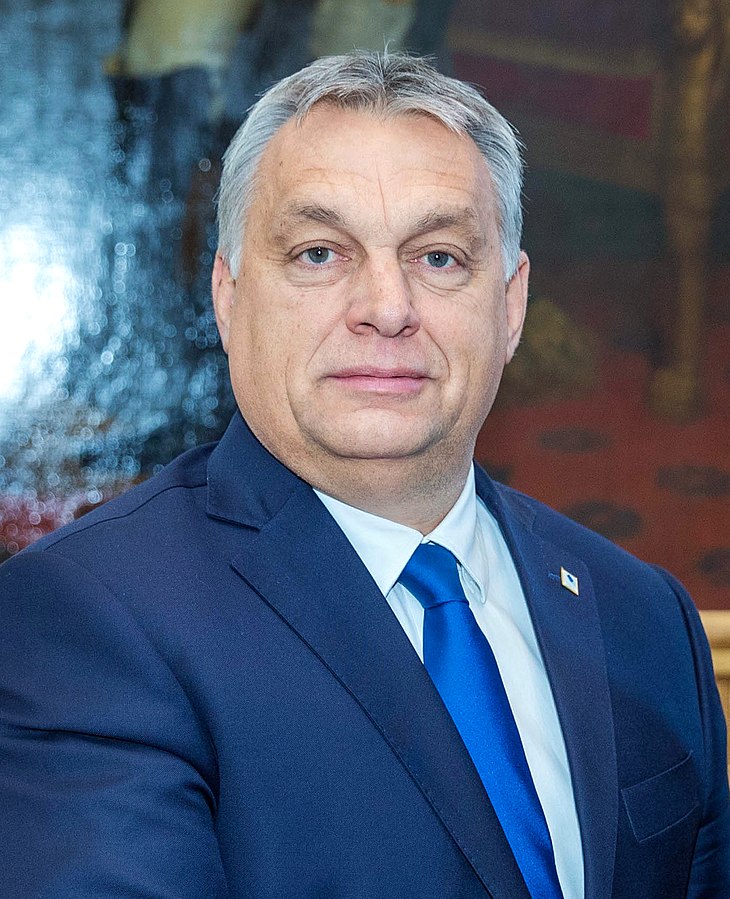
Viktor Orbán at the European People’s Party Summit in Brussels, December 2018.
Wikimedia Commons.

Some are born great. Some achieve greatness. And some are Victor Orbán’s college roommates.

Orbán: Europe’s New Strongman and Orbánland, my two sources for this installment of our Dictator Book Club, tell the story of a man who spent the last eleven years taking over Hungary and distributing it to guys he knew in college. Janos Ader, President of Hungary. Laszlo Kover, Speaker of the National Assembly. Joszef Szajer, drafter of the Hungarian constitution. All of them have something in common: they were Viktor Orbán’s college chums. Gabor Fodor, former Minister of Education, and Lajos Simicska, former media baron, were both literally his roommates. The rank order of how rich and powerful you are in today’s Hungary, and the rank order of how close you sat to Viktor Orbán in the cafeteria of Istvan Bibo College, are more similar than anyone has a right to expect.

Our story begins on March 30 1988, when young Viktor Orbán founded an extra-curricular society at his college called The Alliance Of Young Democrats (Hungarian abbreviation: FiDeSz). Thirty-seven students met in a college common room and agreed to start a youth organization. Orbán’s two roommates were there, along with a couple of other guys they knew. Orbán gave the pitch: the Soviet Union was crumbling. A potential post-Soviet Hungary would need fresh blood, new politicians who could navigate the democratic environment. They could get in on the ground floor.

It must have seemed kind of far-fetched. Orbán was a hick from the very furthest reaches of Hicksville, the “tiny, wretched village of Alcsutdoboz”. He grew up so poor that he would later describe “what an unforgettable experience it had been for him as a fifteen-year-old to use a bathroom for the first time, and to have warm water simply by turning on a tap”. He was neither exceptionally bright nor exceptionally charismatic.

Still, there was something about him. To call it “a competitive streak” would be an understatement. He loved fighting. The dirtier, the better. He had been kicked out of school after school for violent behavior as a child. As a teen, he’d gone into football, and despite having little natural talent he’d worked his way up to the semi-professional leagues through sheer practice and determination. During his mandatory military service, he’d beaten up one of his commanding officers. Throughout his life, people would keep underestimating how long, how dirty, and how intensely he was willing to fight for something he wanted. In the proverb “never mud-wrestle a pig, you’ll both get dirty but the pig will like it”, the pig is Viktor Orbán.

Those thirty-six college friends must have seen something in him. They gave him his loyalty, and he gave them their marching orders. The predicted Soviet collapse arrived faster than anybody expected, and after some really fast networking (“did you know I represent the youth, who are the future of this country?”) Orban got invited to give a speech at a big ceremony marking the successful revolution, and he knocked it out of the park.

He spoke about freedom, and democracy, and the popular will. He spoke against the older generation, and the need for a rupture with the crumbling traditions of the past. And also, he spoke against the Russian troops remaining in the country — the only speaker brave enough to say what everyone else was thinking. The voters liked what they heard: in Hungary’s first free election, he and several of his college friends were elected to Parliament on the Fidesz ticket.

Unfortunately, he wasn’t a very good liberal MP.

Separated from his pomp and platform, he was just a 27 year old kid without a lot of political experience. There was a glut of liberal democrats in Hungary — the country had just had a successful liberal democratic revolution — and Orbán and Fidesz couldn’t differentiate themselves from the rest of the market. Most liberal democrats wanted cosmopolitan intellectual types; Orbán — despite his herculean efforts to lose the accent and develop some class — was still just a hick from Hicksville. During the next election, Fidesz did embarrassingly badly.

So Viktor Orbán got everyone from his liberal democratic party together and asked — what if, instead of being liberal democrats, we were all far-right nationalists?

Wait, what?

October 26, 2021

The Constitution of Athens

Filed under: Europe, Government, Greece, History — Tags: , , , — Nicholas @ 09:50

Historia Civilis
Published 15 Dec 2017

Patreon | http://historiacivilis.com/patreon
Donate | http://historiacivilis.com/donate
Merch | http://historiacivilis.com/merch
Mailing List | http://historiacivilis.com/mailinglist
Twitter | http://historiacivilis.com/twitter
Website | http://historiacivilis.com

Sources:
The Athenian Constitution by Aristotle: http://amzn.to/2C1mHLv
Politics by Aristotle: http://amzn.to/2AB6KPV
Parallel Lives: The Life of Solon by Plutarch: http://amzn.to/2AT5Viv
The Constitution of the Athenians by Pseudo-Xenophon: http://amzn.to/2z9rE6l
The Rise of Athens by Anthony Everitt: http://amzn.to/2C2ryMu
The Athenian Democracy in the Age of Demosthenes by Mogens Herman Hansen: http://amzn.to/2AEAtYj
Persian Fire by Tom Holland: http://amzn.to/2AjLB8W

Music:
“Direct to Video,” by Chris Zabriskie
“It’s Always Too Late to Start Over,” by Chris Zabriskie
“Mario Bava Sleeps In a Little Later Than He Expected To,” by Chris Zabriskie
“Hallon,” by Christian Bjoerklund

We are a participant in the Amazon Services LLC Associates Program, an affiliate advertising program designed to provide a means for us to earn fees by linking to Amazon.com and affiliated sites.

October 19, 2021

Sarah Hoyt on getting #teamheadsonpikes to trend

Filed under: Government, Politics, USA — Tags: , , , , — Nicholas @ 03:00

In the latest Libertarian Enterprise, Sarah Hoyt considers the people who are still desperately hoping that if they just vote harder, the next election will fix everything:

Normalcy bias is YUGE in America. It is a testament to the founders’ vision that after a century of attempts to wrench us away from a constitutional republic, after a massive, in the open election steal, people are still counting on elections to right this mess.

They’re right and wrong.

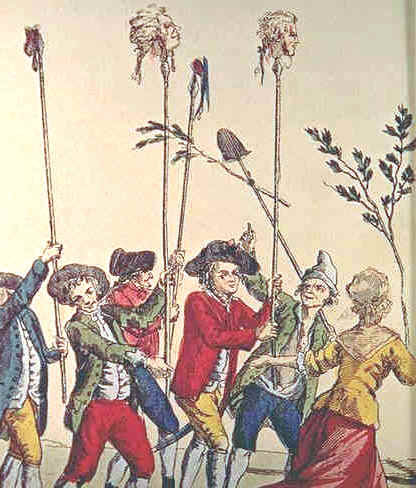
Look, I’m holding up my lighter with tears in my eyes, and whispering hopefully “Team heads on pikes”. Because I think a brief, brutal convulsion is our best hope to come back to ourselves as ourselves.

In the end we win, they lose, but the gradual road is in the end more costly. Perhaps the butcher’s bill will be hidden. You won’t see heads on pikes and bodies on overpasses. But the squid farms on Mars, the unborn babies, the uninvented conveniences, the–more costly. Because socialism kills, either fast or slow, and the longer we play footsy with it, the more lives will be lost. In that case, probably lives that don’t exist.

And frankly, though #teamheadsonpikes might not eventuate, I still see a brief and violent convulsion in our future. Understand “violent” here does not refer to the butcher’s bill. I mean, I wouldn’t want to be the Junta and their toadies, as I think there will be a few Romanian Christmas Gift events, but MOSTLY? MOSTLY there will be a lot of retirements, if we’re lucky a few prison sentences, almost for sure a lot of people taking themselves overseas for retirement (I’m hoping the Obama posse and their cronies are dumb enough to run to China. (Looks heavenward. Lord, if I’m a very good girl for the rest of my life …) our institutions will turn over so fast you’d think they were on wheels. They might retain the name but that will be the last resemblance. People will lose all faith in government (we’re mostly there) and this bizarre idea of scientific governance will be finally put to bed with a shovel. About 100 years after it should have been, but hey.

Why do I think that? Why do I expect an uprising at all? Americans are supine and taking it and reeeeeeeee.

Will someone PLEASE get me my eyes? The cats aren’t here, but the floor is covered in dust and paint chips. That can’t be good.

Two things: Normalcy bias. As I said, most people who aren’t political animals (Party like it’s 1776, yo) are still waiting for the elections to fix everything. Hell, I’ve seen people who are political animals waiting for it. And the left is lying to itself very hard and half believes their wins are legitimate. (AH!)

And: IF there is a rebellion and the news doesn’t report it, would you know about it?

Hell, the world has been in more or less open rebellion for 5 years, and our news sits on it, like it’s their favorite thumb. And most people don’t see it, except for things like Brexit, or Trump’s election. Ask them about German farmers driving their tractors to city hall and they’ll look at you like you’re nuts.

So now?

October 17, 2021

QotD: Like Justin Trudeau, too many western politicians admire China’s “basic dictatorship”

The Chinese model, such as it is, has a hypnotic appeal to many (too many) among our technocrats, bureaucrats and the political class. These are our betters, after all, and certainly the people who think they are smarter than everyone else, yet they are constantly constrained by the outmoded mechanisms of representative democracy, rule of law, and liberal state. How envious are they of the Chinese authorities (the Party and the government being largely the same, certainly the same for all practical purposes), which are not restrained by any considerations of accountability or public opinion. The Party can do whatever it wants – build a fast train network, carry out massive infrastructure projects, regulate emissions, direct economic resources, and so on – while the Western governments and administrations get bogged down in petty politics. The Chinese Communist Party is also a meritocracy of sorts, which promotes skill and talent (and of course loyalty, ideological reliability, and personal connections), while too many self-described smart people in our democracies are at the mercy of fickle voters. There is no stability and continuity, no long-term planning, no concern for the “national interest”; ah to be a mandarin instead!

Then there is the Chinese government’s ability to surveil and control their people – for their own good, of course. How many over here would love a Social Credit System, where they can reward and punish people according to government’s priorities, from environmentally-conscious behaviour to public health considerations. In democracies, the people rate their leaders; in China the leaders rate their people. Just imagine how much more effectively our governments and health authorities would be able to to deal with all of us during the current pandemic if they could “see” and “nudge” every individual at every moment and in every situation. The most dangerous virus to come from China recently is not COVID, it’s “socialism with Chinese characteristics” with its siren call of unrestrained power for large sections of our political and economic elites.

Arthur Chrenkoff, “World hearts commies”, The Daily Chrenk, 2021-07-01.

October 12, 2021

Richard Overy looks at the “Great Imperial War” of 1931-1945

Filed under: Asia, Books, Britain, China, France, History, India, Japan, Military, WW2 — Tags: , , , , , — Nicholas @ 05:00

I missed Rana Mitter‘s review of Richard Overy’s latest book when it was published in The Critic last week:

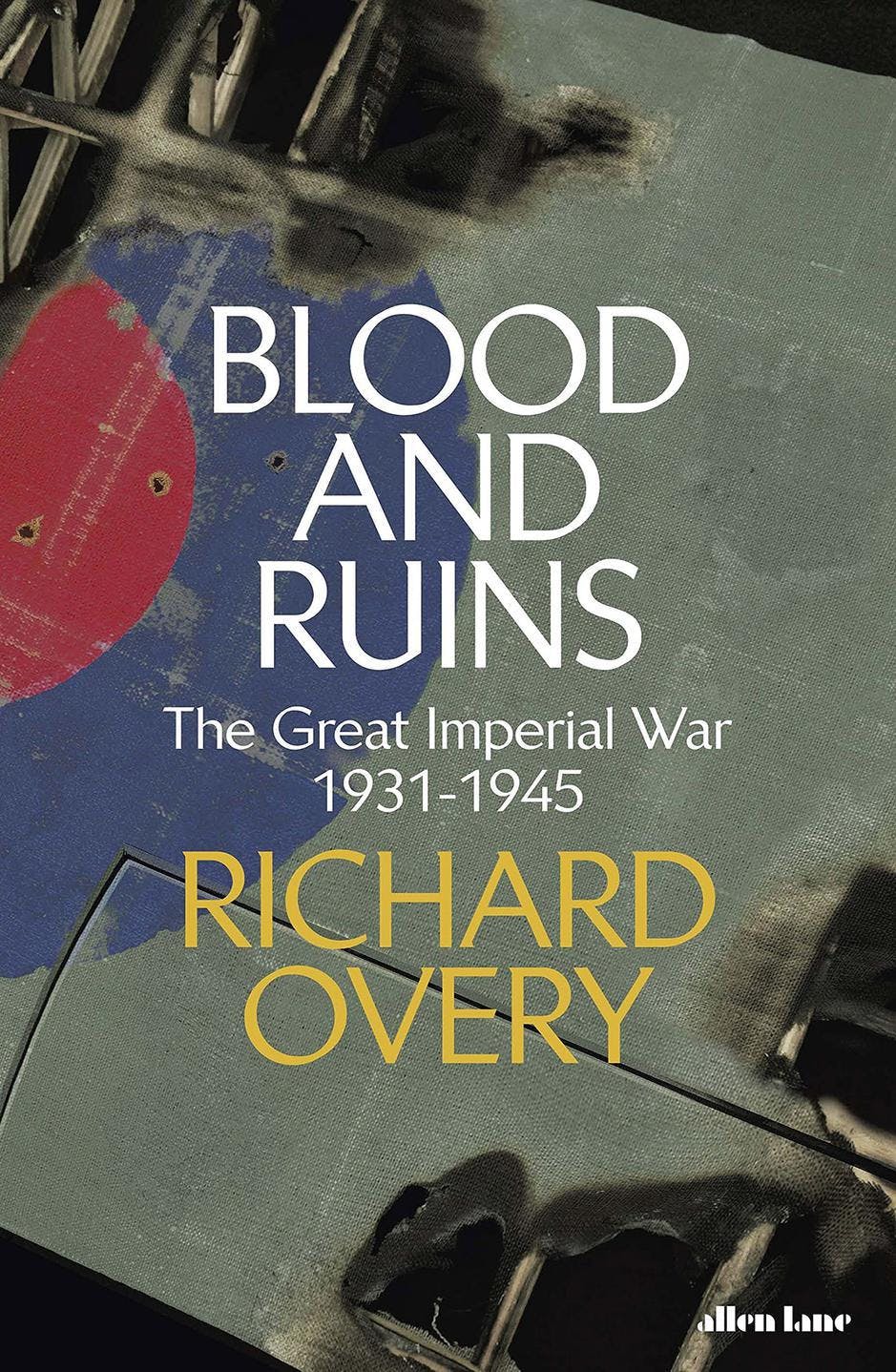
Imagine there’s no Hitler. It’s not that easy, even if you try, at least if you’re a westerner thinking about the Second World War. But for millions of Asians, those years of conflict had little to do with the horrors of Nazi invasion and genocide, and it is their experience that frames Richard Overy’s account of a seemingly familiar conflict. For most non-Europeans, the war was not a struggle for democracy, but a conflict between empires, and in this book, that imperial struggle begins not with the invasion of Poland by Germany in 1939 but the occupation of Manchuria by the Japanese in 1931.

Blood and Ruins is really two books in one. The first is perhaps the single most comprehensive account of the Second World War yet to appear in one volume. You might think that by reading extensively, you could construct a book like this one. You could not — unless you have Overy’s control over a staggering range of World War II scholarship, much of it drawn from his own decades of research on the economics of total warfare, the development of technology, from radar to aerial bombing, and the idea of the “emotional geography” of war, encompassing morale, hope, and despair. Then you’d need to go back and cover all those categories for each of the major Allied and Axis belligerents: Britain, the US, Japan, Germany, France, Italy and China among them.

The second book is an argument about what kind of conflict the Second World War really was. Overy is clear: on a global as opposed to European scale, it was not (just) a war about democracy, but about empires and their fate, although “the starting point in explaining the pursuit of territorial empire is, paradoxically, the nation.”

Overy points out what is generally lost to view when the European war is placed at the centre of the historiography: both Britain and France were undertaking an “awkward double standard” in their defence of democratic values, as their Asian and African possessions “rested on a denial of those liberties and the repression of any protest against the undemocratic nature of colonial rule”. While this argument has been made before (not least by figures such as Nehru and Gandhi in India at the time), Overy does something unusual and revealing: he compares the western empires with Japan’s justification for its own imperial project in the early twentieth century.

The book is scrupulously careful not to endorse or excuse the worldview of Tokyo’s imperialists, and gives full weight to the voices of the Chinese nationalists and communists who were bitterly opposed to Japan’s expansion on the Asian mainland. Still, the comparison of Japan’s pre-war and wartime empire to those of the western powers provides an important and original broadening of a contemporary debate.

There is ongoing public British (and to some extent French) argument about whether empire was a “good” or “bad” thing. Yet neither attackers nor defenders of the British empire tend to analyse it alongside the Japanese equivalent that lasted nearly half a century. Britain committed colonial massacres (Amritsar) and deadly repression (Mau Mau). So did Japan (the rape of Nanjing, invasion of Manchuria).

Britain’s empire also created an aspirational middle class full of cosmopolitan nationalists, and drew on ideas of loyalty to recruit its subjects to fight in world wars. All these things are also true of Japan, which like Britain was a multi-party democracy for much of its period as an overseas empire (between 1898 and 1932), and whose capital city was an intellectual hub for political activists from across Asia.

As a colony of Japan between 1895-1945, Taiwan developed a middle class that was Japanese-speaking and keen to draw on new economic opportunities brought by empire: Lee Teng-hui, the first democratically elected president of the Republic of China on Taiwan, always thought of Japanese as his mother tongue. Park Chung-hee, the American-sponsored dictator of Cold War South Korea, learned his political craft as an army officer in the Japanese Manchukuo Army that occupied Manchuria.

August 3, 2021

1848 – The Year of (Failed) Revolutions I GLORY & DEFEAT

Filed under: Europe, France, Germany, Government, History — Tags: , , , , — Nicholas @ 04:00

realtimehistory
Published 7 Jul 2021

Support Glory & Defeat: https://realtimehistory.net/gloryandd…

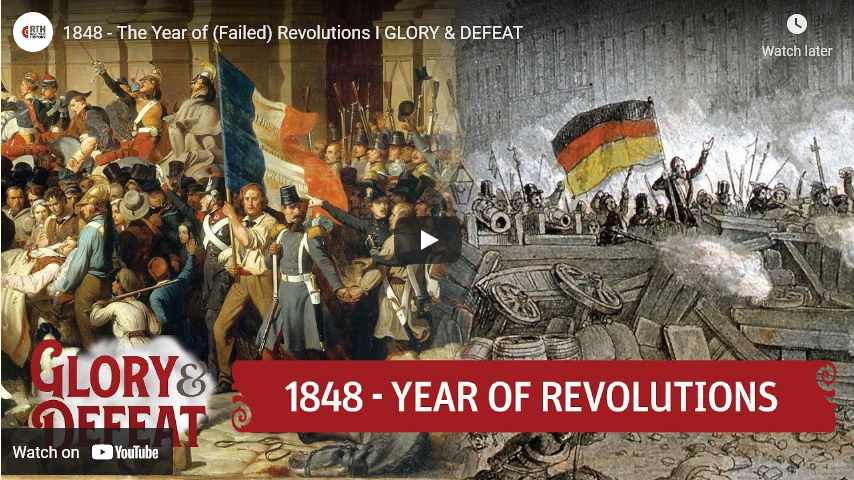
The year 1848 was pivotal in European history. All across the continent revolutionary movements erupted and demanded a new order. This would be no different in France and in the German states.

» OUR PODCAST
https://realtimehistory.net/podcast – interviews with historians and background info for the show.

» LITERATURE
Engehausen, Frank: Die Revolution von 1848/49. Paderborn, München 2007

Gall, Lothar (Hrsg.): 1848 – Aufbruch zur Freiheit: Ausstellungskatalog zum 150-jährigen Jubiläum der Revolution von 1848/49. Berlin 1998

Gouttman, Alain. La grande défaite de 1870-1871. Paris 2015

Siemann, Wolfram: Die deutsche Revolution von 1848/49. Suhrkamp, Frankfurt am Main 1985

Wollstein, Günter: “Scheitern eines Traumes”. In: Informationen zur politischen Bildung, Heft 265 (2010) o.S.

» SOURCES
Carrey, Émile: Recueil complet des actes du Gouvernement provisoire. Première partie n° 281. Paris 1884

Haupt, Hermann (Hrsg.): Quellen und Darstellungen zur Geschichte der Burschenschaft und der deutschen Einheitsbewegung, Band 1, Heidelberg 1910

N.N.: Die Staats-Verträge des Königsreichs Bayern von 1806 – 1858. Regensburg 1860

» OUR STORE
Website: https://realtimehistory.net

»CREDITS
Presented by: Jesse Alexander
Written by: Cathérine Pfauth, Prof. Dr. Tobias Arand, Jesse Alexander
Director: Toni Steller & Florian Wittig
Director of Photography: Toni Steller
Sound: Above Zero
Editing: Toni Steller
Motion Design: Philipp Appelt
Mixing, Mastering & Sound Design: http://above-zero.com
Maps: Battlefield Design https://www.battlefield-design.co.uk/
Research by: Cathérine Pfauth, Prof. Dr. Tobias Arand
Fact checking: Cathérine Pfauth, Prof. Dr. Tobias Arand

Channel Design: Battlefield Design

Contains licensed material by getty images
All rights reserved – Real Time History GmbH 2021

July 10, 2021

History-Makers: Aristophanes

Overly Sarcastic Productions
Published 9 Jul 2021

He told the Athenians they were a disaster and they gave him a prize. Aristophanes wrote in the new Theatrical genre of Comedy during the golden age of Athens, and used his plays to viciously satirize Athenian society. They create a fabulously clear portrait of ancient Athenian life, and they have the corollary benefit of being funny as hell.

SOURCES & Further Reading: The 11 plays of Aristophanes, with particular focus on Clouds and Women at the Thesmophoria, Britannica’s “Aristophanes”, Crash Course Theater #2 & 4.

Partial Tracklist: “Sneaky Snitch”, “Marty Gots A Plan” Kevin MacLeod (incompetech.com)
Licensed under Creative Commons: By Attribution 4.0 License
http://creativecommons.org/licenses/b…

Our content is intended for teenage audiences and up.

PATREON: https://www.Patreon.com/OSP

PODCAST: https://overlysarcasticpodcast.transi…

DISCORD: https://discord.gg/osp

MERCH LINKS: http://rdbl.co/osp

OUR WEBSITE: https://www.OverlySarcasticProductions.com
Find us on Twitter https://www.Twitter.com/OSPYouTube
Find us on Reddit https://www.Reddit.com/r/OSP/

From the comments:

Overly Sarcastic Productions
2 hours ago
While we’re here, one subject I cut for time is the relationship between “The Clouds” and the trial of Socrates.

It’s commonly assumed that Aristophanes’ satire played a part in Athens’ decision to charge and ultimately kill Socrates, but that interpretation doesn’t really hold up to scrutiny.

The Clouds was performed over 20 years before Socrates’ trial. If the play had that strong an effect on Athens, we can assume Socrates would have been charged far sooner. And Plato’s own writings paint Aristophanes rather favorably — if Plato blamed Aristophanes for the trial, he does not make that obvious.

There IS one snide line in Socrates’ Apology that seems to a modern reader like it’s referring to The Clouds, but really we can’t be sure. Aristophanes was not the only comic playwright in Athens, and certainly not the only person who disliked Socrates. Did The Clouds contribute to a negative public perception of Socrates? Sure, in part, at least when it was performed in 423. But it’s faaar more likely that Socrates’ trial and death in 399 owe more to his persistent habit of being a Colossal Pain In The Ass to whomever he was speaking with.

Reading The Apology makes it clear that nobody had the power to make Athens hate Socrates more than Socrates.
-B

April 2, 2021

Victory at any Cost? – Allied Censorship – WW2 Special

Filed under: Britain, History, Military, USA, WW2 — Tags: , , — Nicholas @ 04:00

World War Two
Published 1 Apr 2021

Censorship was not just a practice in totalitarian regimes. During World War Two, democratic liberties in Allied countries often clashed with propaganda and restrictions of the press.

Join us on Patreon: https://www.patreon.com/TimeGhostHistory
Or join The TimeGhost Army directly at: https://timeghost.tv

Follow WW2 day by day on Instagram @ww2_day_by_day – https://www.instagram.com/ww2_day_by_day
Between 2 Wars: https://www.youtube.com/playlist?list…
Source list: http://bit.ly/WW2sources

Hosted by: Spartacus Olsson
Written by: Joram Appel
Director: Astrid Deinhard
Producers: Astrid Deinhard and Spartacus Olsson
Executive Producers: Astrid Deinhard, Indy Neidell, Spartacus Olsson, Bodo Rittenauer
Creative Producer: Maria Kyhle
Post-Production Director: Wieke Kapteijns
Research by: Joram Appel
Edited by: Miki Cackowski
Sound design: Marek Kamiński
Map animations: Eastory (https://www.youtube.com/c/eastory​)

Colorizations by:
Adrien Fillon – https://www.instagram.com/adrien.colo…​

Sources:
Dutch National Archives
IWM D 20472
Bundesarchiv
from the Noun Project: Map by BaristaIcon, strategy by Fran Couto, weather by Yoyon Pujiyono, building by Made, Government by lathiif studio, documents by Geovani Almeid, Pen by Caesar Rizky Kurniawan
The True Cost of Petrol, courtesy of www.mirrorpix.com

Soundtracks from the Epidemic Sound:
Johannes Bornlof – “The Inspector 4”
Fabien Tell – “Last Point of Safe Return”
Johan Hynynen – “Dark Beginning”
Reynard Seidel – “Deflection”
Phoenix Tail – “At the Front”
Johannes Bornlof – “Deviation In Time”
Max Anson – “Maze Heist”
Wendel Scherer – “Out the Window”

Archive by Screenocean/Reuters https://www.screenocean.com​.

A TimeGhost chronological documentary produced by OnLion Entertainment GmbH.

From the comments:

World War Two
2 days ago
Censorship is a phenomenon of all ages. Those in power sometimes don’t want certain voices to be heard for a variety of reasons. While this episode is about political and military censorship, we ourselves are still dealing with another kind of censorship today. Economic, political and PR reasons to demonetize or age-restrict our videos are being conflated with “safety” and “harm” of “certain audiences”. We adamantly object to the restriction of fact-based history for the sake of business and public image. This is why it’s so important that we’re able to remain independent. We have full editorial control of our content, and we won’t surrender our mission to publish factual, unbiased and unsanitized documentaries. Our TimeGhost Army is the main reason why we have been able to remain independent and unwavering. Join the TGA at www.patreon.com/timeghosthistory or https://timeghost.tv

Cheers,
Joram

« Newer PostsOlder Posts »

Powered by WordPress