Quotulatiousness

November 5, 2019

The three ways human beings can organize themselves

Filed under: Government, History, Liberty, USA — Tags: , , , , — Nicholas @ 03:00

In the latest Libertarian Enterprise, L. Neil Smith relates the time he took a week-long seminar with Robert LeFevre:

I already considered myself a libertarian — of the Randian variety — when I first met Bob in 1972, at a seminar he delivered in Wichita, Kansas, sponsored by the Love Box Company and the local 7-up bottlers. I spent five magical 8-hour days in a motel basement meeting room, with about forty other people, listening to Bob’s moral, historical, and economic observations. Nearly half a century later, I can still remember large swatches of them, virtually verbatim. Bob reminded me of Frank Morgan in The Wizard of Oz. I didn’t agree with everything the Wzard of Libz said and thought (most notably, Bob was a Gandhian pacifist, while anyone who knows me or my work will tell you that, I, decidedly am not.)

But it was Bob’s unique view of history that won me over and changed my life. There are only three ways, he said, for human beings to organize themselves: (A), one guy tells everybody what to do; (B), everybody tells everybody else what to do; and (C) nobody tells anybody what to do. The last, he insisted, is the very definition of libertarianism.

Inevitably, Bob was an advocate of (C), and so was I, once he had rid me of the cob-webs in my head and the myth of “limited government”, which, he pointed out, somehow never manages to stay limited. Option (A), he suggested, was the way that the world had turned for ten thousand years or longer.

(B) is supposed to be the be-all and end-all of sociopolitical arrangements. It encompasses various forms of collectivism, including socialism, fascism, and the most dangerous of all, democracy, under which you are encouraged to believe that you’re free, but your neighbors can vote to control your life and impoverish you any time they want. As Robert A, Heinlein (a friend of Bob’s) put it, “‘Vox populi, vox dei‘ usually means ‘How the hell did we get into this mess?'”

The violent transition to (B) in 1776 accomplished two important things. It may yet prove to be a pathway to real liberty (no, I’m not holding my breath). In terms of what I’ve written here, it also pissed off all the right people. It schmussed humble pie in the face of the insane King George III and the rest of his inbred, slithery, pampered ilk. And when British General Corwallis surrendered his sword to George Washington, the band (where the hell did that come from?) played a little ditty called “The World Turned Upside-down.”

Most of history since then, according to Bob, has been a series of attempts — the War Between the States, public schooling, World War I, the Federal Reserve banks and the income tax, World War II, the United Nations, communism’s rise in Europe and Asia, the overpopulation and Global Warming hoaxes, the Silicon Valley commisars, the socioeconomic war on the Productive Class — by the pre-Revolutionary elites (who all seem to be related to each other) to regain the power they once wielded over the rest of the human race.

Aside from what I’ve written in The Libertarian Enterprise about the political significance of gun ownership, if you want to see who’s really on what side, take a look at the war on cattle and red meat. For centuries, the aristocrat class have hunted, and they have dined lavishly on animal protein, while trying to forbid the peasantry — us deplorables — the same rights and forcing them to subsist on boiled turnips. There’s a good reason for this: meat is mind. If you remembver nothing else of what I’ve said here, remember that: meat is mind. It contains certain components that let you build a strong and efficient nervous system (look up myelin), creating uppity peons, the last thing any right-minded upper cruster wants.

For decades, these creepy, perverted parasites have been sneaking up on us, falsely calling themselves “Progressives”, hoping to reverse the American Revolution and everything it has meant to humanity. Since socialism was invented in the early 19th century by Pierre-Joseph Proudhon, they’ve made more and more of what they regard as “progress”. By the beginning of the 21st century, they thought their victory was inevitable — until it was rudely snatched out of their blood-soaked hands by those uppity meat-eating peasants, eventually led by Donald J. Trump. The patricians and their surrogates are the swamp Trump wants to drain.
October 29, 2019

Parallels between the current Brexit mess and the 1906 general election

Filed under: Britain, Europe, History, Politics — Tags: , , , , , — Nicholas @ 09:10

Sean Gabb writes in the Libertarian Enterprise on the clusterfail in Parliament and an interesting historical parallel from the beginning of the 20th century:

… the Brexit debate that only began with the counting of the Referendum votes has been a valuable education. So far as it blurs the lines of accountability, membership of the European Union has been a useful entrenchment of our ruling class. It has also helped provide a mildly liberal and cosmopolitan gloss to a domestic project that has been anything but liberal. Its refusal to honour the Referendum has torn aside what remained of the democratic veil behind which power is exercised. These people are not our servants. They are a hostile elite. Their interests are not ours. They despise us. They fear us. They are determined not to give us even the shadow of what we were – perhaps unwisely – promised.

I have given a quotation from Chesterton. I am increasingly minded of parallels between his day and ours. In 1906, the Liberals won a large and unexpected majority in the House of Commons. They set about transforming the country on the lines they had been discussing since the end of their last majority government in 1885. In doing this, they faced a wall of resistance from the old ruling class. The Conservatives controlled the Law and education and most of the administration. They possessed the greatest mass of the national wealth. Above all, they dominated the House of Lords. They used their majority here to block the Liberal Government until such time as the people could be persuaded at the next election to bring back a Conservative Government.

Now, in that contest, I would have sided with the ruling class. I think England had a better future under the Conservatives than under the Liberals. I think most of the Liberal changes were bad. Moreover, the Conservative strategy showed some evidence of working. The Liberals lost a steady stream of by-elections — most notably Peckham in 1908. Then the Conservatives went too far. In 1909, the Liberals brought in a deliberately populist budget. The Conservatives broke more than two centuries of convention by voting this down in the Lords. This gave the Liberals their excuse. With the cry of “The People against the Peers,” they attacked the Conservatives in their most powerful stronghold. After two general elections in 1910, the Lords were stripped of their blocking veto. Of course, the Great War then changed everything. But it is reasonable to suppose that, had the Liberals won another election in 1915, most of the domestic changes that we blame on the War would have come about, if more slowly.

The lesson is that ruling classes often make strategic mistakes. Had the Conservatives before the Great War taken a more selective approach in their opposition, they might have won an election in 1911, and carried on with their own vision of the national future. As it is, they only lost the 1910 elections because the Liberals were able to rely on Labour and Irish support in the Commons. Because they overreached themselves, they eventually lost everything.

It may be the same now. Had our own ruling class pulled sad faces in 2016 and delivered a minimal Brexit — something like continued EEA membership and a Norwegian relationship — they might have put the issue to bed and continued riding us all to certain ruin. Instead, they went into a three-year filibuster, every so often drawing breath to suggest another referendum. The strategy appears to have failed. We may now have a more substantial Brexit than was intended. More to the point, the democratic veil has been torn aside. The continuing argument over Mr Johnson’s new Withdrawal Agreement is largely now unfinished business. The Agreement needs to be passed — but so we can go into a general election where the main issues will not be a new relationship with the European Union. These issues will be the nature and personnel of the country’s domestic government. I do not imagine that we shall become more “democratic.” But I can imagine that we shall find ourselves with a new ruling class that holds the mass of ordinary people in less vicious contempt.

October 20, 2019

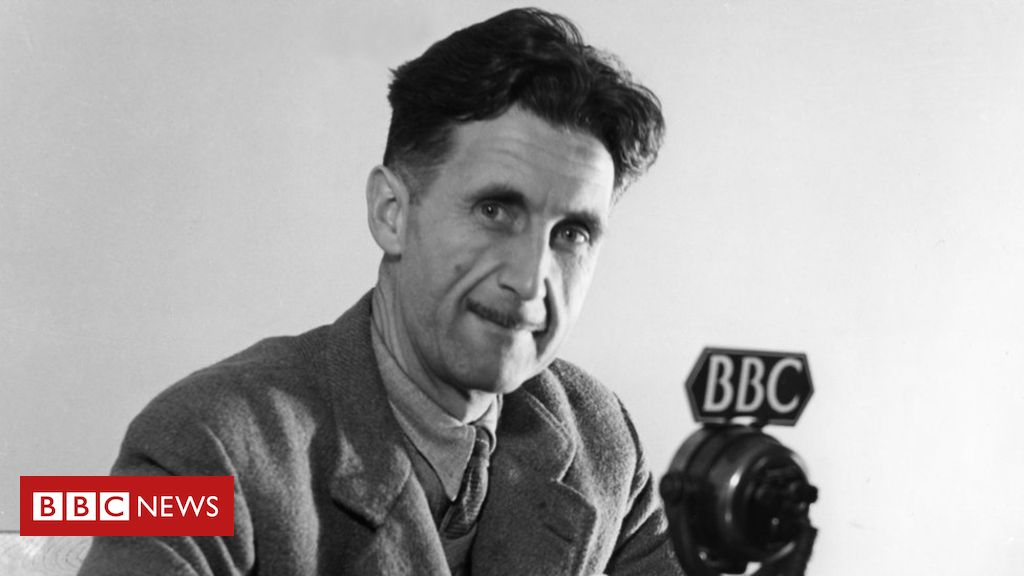
QotD: Why Orwell wrote Nineteen Eighty-Four

Filed under: Britain, History, Politics, Quotations — Tags: , , , , — Nicholas @ 01:00


Many thanks for your letter. You ask whether totalitarianism, leader-worship etc. are really on the up-grade and instance the fact that they are not apparently growing in this country and the USA.

I must say I believe, or fear, that taking the world as a whole these things are on the increase. Hitler, no doubt, will soon disappear, but only at the expense of strengthening (a) Stalin, (b) the Anglo-American millionaires and (c) all sorts of petty führers of the type of de Gaulle. All the national movements everywhere, even those that originate in resistance to German domination, seem to take non-democratic forms, to group themselves round some superhuman führer (Hitler, Stalin, Salazar, Franco, Gandhi, De Valera are all varying examples) and to adopt the theory that the end justifies the means. Everywhere the world movement seems to be in the direction of centralised economies which can be made to “work” in an economic sense but which are not democratically organised and which tend to establish a caste system. With this go the horrors of emotional nationalism and a tendency to disbelieve in the existence of objective truth because all the facts have to fit in with the words and prophecies of some infallible führer. Already history has in a sense ceased to exist, ie. there is no such thing as a history of our own times which could be universally accepted, and the exact sciences are endangered as soon as military necessity ceases to keep people up to the mark. Hitler can say that the Jews started the war, and if he survives that will become official history. He can’t say that two and two are five, because for the purposes of, say, ballistics they have to make four. But if the sort of world that I am afraid of arrives, a world of two or three great superstates which are unable to conquer one another, two and two could become five if the führer wished it. That, so far as I can see, is the direction in which we are actually moving, though, of course, the process is reversible.

As to the comparative immunity of Britain and the USA. Whatever the pacifists etc. may say, we have not gone totalitarian yet and this is a very hopeful symptom. I believe very deeply, as I explained in my book The Lion and the Unicorn, in the English people and in their capacity to centralise their economy without destroying freedom in doing so. But one must remember that Britain and the USA haven’t been really tried, they haven’t known defeat or severe suffering, and there are some bad symptoms to balance the good ones. To begin with there is the general indifference to the decay of democracy. Do you realise, for instance, that no one in England under 26 now has a vote and that so far as one can see the great mass of people of that age don’t give a damn for this? Secondly there is the fact that the intellectuals are more totalitarian in outlook than the common people. On the whole the English intelligentsia have opposed Hitler, but only at the price of accepting Stalin. Most of them are perfectly ready for dictatorial methods, secret police, systematic falsification of history etc. so long as they feel that it is on “our” side. Indeed the statement that we haven’t a Fascist movement in England largely means that the young, at this moment, look for their führer elsewhere. One can’t be sure that that won’t change, nor can one be sure that the common people won’t think ten years hence as the intellectuals do now. I hope they won’t, I even trust they won’t, but if so it will be at the cost of a struggle. If one simply proclaims that all is for the best and doesn’t point to the sinister symptoms, one is merely helping to bring totalitarianism nearer.

You also ask, if I think the world tendency is towards Fascism, why do I support the war. It is a choice of evils — I fancy nearly every war is that. I know enough of British imperialism not to like it, but I would support it against Nazism or Japanese imperialism, as the lesser evil. Similarly I would support the USSR against Germany because I think the USSR cannot altogether escape its past and retains enough of the original ideas of the Revolution to make it a more hopeful phenomenon than Nazi Germany. I think, and have thought ever since the war began, in 1936 or thereabouts, that our cause is the better, but we have to keep on making it the better, which involves constant criticism.

George Orwell, responding to a letter from Noel Willmett, 1944-05-18.

September 25, 2019

QotD: Big government is not human

Filed under: Bureaucracy, Government, Quotations — Tags: , , — Nicholas @ 01:00

An email from a correspondent, who is not in Guam, reminds me to remind gentle reader of a truth I take for self-evident, but perhaps others don’t. We personalize the State. I do myself, when I refer to it as Big Brother, Big Sister, Twisted Nanny, &c. But this is a conceit. As anyone caught in the jaws of Big Shark should realize, it doesn’t think like a human. It thinks more like a mechanism. Of course, when the mechanism has selected one’s own person for food — I am thinking here of the Revenue Department, but government agencies are all much the same — little can be done. One might beg for mercy, but the thing is not designed to dispense mercy. That is not its function. Its function is to absorb protein.

Guvmint agents themselves — the cells and their switches — are task-oriented. Each signed off his right to make humane judgements when he took the job.

We used to have reactionary courts, to restrain the creature. Now we have progressive courts, to urge it on.

Among the foibles of democracy, is the notion that “the peeple” are somehow in control. The people, however, consist of persons, with their quite various moral flaws, which tend to cancel each other. They elect politicians for show. This helps them put a human face on the enterprise, so they have someone to blame at the electoral intervals. It is true that a government with a majority and a will can alter the course of history: usually by putting more sharks in the tank. And that the policy wonks are, arguably, human. But they are cells themselves, within Leviathan.

We live, I say from time to time, in an age of “total war” and “total peace.” The one condition resembles the other: a command economy, focused on results. We have, as it were, totalitarianism with a human face. It is a kind of smiley face, painted on the tip of the missile.

David Warren, “Notes from the sheepfold”, Essays in Idleness, 2017-08-11.

September 24, 2019

QotD: Conditions for the rise of tyrants in the Greek city states

Filed under: Greece, History, Politics, Quotations, Religion — Tags: , , , , , — Nicholas @ 01:00

The central problem of almost every society before about 1950 has been how to reconcile the great majority to distributions of property in which they are at a disadvantage. Only a minority has even been able to enjoy secure access to abundant food and good clothing and clean water and healthcare and education. Whether actually enslaved or formally free sellers of labour, the majority have always had to look up to a minority of the rich who are often legally privileged. How to keep them quiet?

Force can only ever be part of the answer. The poor have always been the majority, and sometimes the great majority. Armies of mercenaries to protect the rich have not always been available, and they have never by themselves been sufficient to compel obedience on all occasions in every respect.

Force, therefore, has always been joined by religious terrors. In Egypt, the king was a god, and the privileged system of which he was the head was part of a divine order that the common people were enjoined never to challenge. In the other monarchies of the near east, the king might not actually be a god. But all the priests taught that he was part of a divinely ordained order that it was blasphemy to challenge.

In the Greek city states until about a century before the birth of Epicurus, securing the obedience of the poor had not been a serious problem. There had been some class conflict, even in Athens. But most land was occupied by smallholders, and excess population could be decanted into the colonies of Italy and the western Mediterranean. There were rich citizens, but they were usually placed under heavy obligations to contribute to the defence and ornament of their cities.

Then a combination of commercial progress and the disruptions of the war between Athens and Sparta created a steadily widening gulf between rich and poor. There was also a growing problem of how to maintain large but unknown numbers of slaves in peaceful subjection.

The result was a class war that destabilised every Greek state. The sort of democracy seen in Athens could survive in a society where citizens were broadly equal. Once a small class of rich and a much larger class of the poor had emerged, there was a continual tendency for democratic assemblies to be led by demagogues into policies of levelling that could be ended only by the rise of a tyrant, who would secure the wealth of the majority — but who could secure it only so long as the poor could be terrified into submission. Once they could not be terrified by the threat of overwhelming force, they would rise up and dispossess the rich, until a new tyrant could emerge to subdue them again.

Unlike in the monarchies of the near east, no settled order could be maintained in Greece by religious terrors. During the sixth and fifth centuries, the Greek mind had experienced the first enlightenment of which we have record. There had been a growth of philosophy and science that revealed a world governed by laws that could be uncovered and understood by the unaided reason.

Now, enlightenments are always dangerous to an established religion. And the Greek religion was unusually weak as a counterweight to reason. The Greeks had no conception of a single, omnipotent God the Creator. Instead, they had a pantheon of supernatural beings who had not created the world, but were subject to many of its limitations. These were frequently at war with each other, and so they could be set against each other by their human worshippers with timely sacrifices and other bribes. They did not watch continually over human actions, and beyond the occasional punishment and reward to the living, they had no means of compelling observance of any code of human conduct.

And so, when the intellectual disturbance of philosophy and science spilled over into demands for a reconstruction of society in which property would be equalised, there was no religious establishment with the authority to stand by the side of the rich.

Sean Gabb, “Epicurus: Father of the Englightenment”, speaking to the 6/20 Club in London, 2007-09-06.

September 23, 2019

QotD: Harry Truman’s second thoughts about the CIA

Filed under: Government, History, Quotations, USA — Tags: , , , — Nicholas @ 01:00

… it got out of hand. The fella … the one that was in the White House after me never paid any attention to it, and it got out of hand. Why, they’ve got an organization over there in Virginia now that is practically the equal of the Pentagon in many ways. And I think I’ve told you, one Pentagon is one too many.

Now, as nearly as I can make out, those fellows in the CIA don’t just report on wars and the like, they go out and make their own, and there’s nobody to keep track of what they’re up to. They spend billions of dollars on stirring up trouble so they’ll have something to report on. They’ve become … it’s become a government all of its own and all secret. They don’t have to account to anybody.

That’s a very dangerous thing in a democratic society, and it’s got to be put a stop to. The people have got a right to know what those birds are up to. And if I was back in the White House, people would know. You see, the way a free government works, there’s got to be a housecleaning every now and again, and I don’t care what branch of the government is involved. Somebody has to keep an eye on things.

And when you can’t do any housecleaning because everything that goes on is a damn secret, why, then we’re on our way to something the Founding Fathers didn’t have in mind. Secrecy and a free, democratic government don’t mix. And if what happened at the Bay of Pigs doesn’t prove that, I don’t know what does. You have got to keep an eye on the military at all times, and it doesn’t matter whether it’s the birds in the Pentagon or the birds in the CIA.

Harry S. Truman, quoted by Jeff Deist, “Truman Was Right About the CIA”, Mises Wire, 2017-03-08.

September 20, 2019

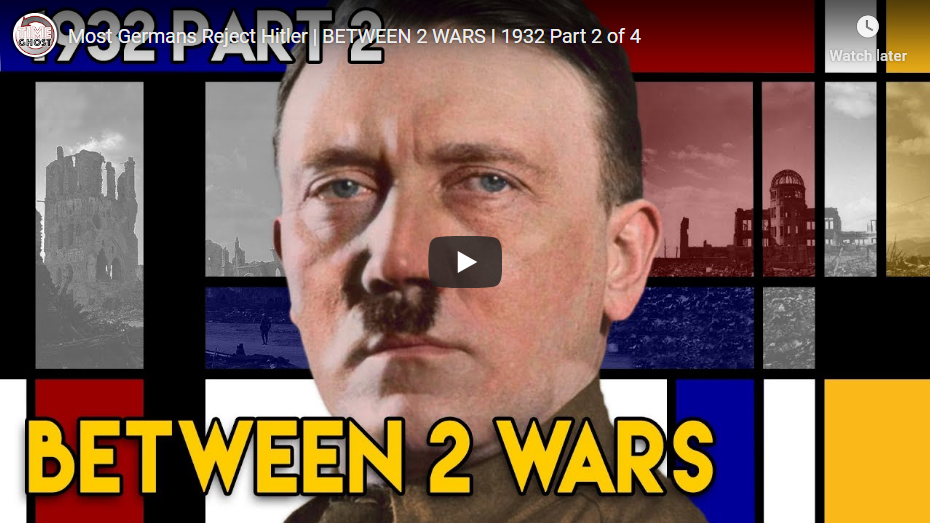
Most Germans Reject Hitler | BETWEEN 2 WARS I 1932 Part 2 of 4

Filed under: Germany, History — Tags: , , , , , — Nicholas @ 06:00

TimeGhost History
Published on 19 Sep 2019

After Chancellor Brüning has run Germany’s economy into the ground, the country is once again going to the polls. It’s a wild brawl between reason and madness, populism and stability, and democracy and tyranny focused on who will unite Germany if Germany even can be united again …

Join us on Patreon: https://www.patreon.com/TimeGhostHistory

Subscribe to our World War Two series: https://www.youtube.com/c/worldwartwo…

Hosted by: Indy Neidell
Written by: Spartacus Olsson
Directed by: Spartacus Olsson and Astrid Deinhard
Executive Producers: Bodo Rittenauer, Astrid Deinhard, Indy Neidell, Spartacus Olsson
Creative Producer: Joram Appel
Post-Production Director: Wieke Kapteijns
Research by: Spartacus Olsson
Edited by: Wieke Kapteijns
Sound design: Marek Kamiński

Sources: Icon german parliament: Gerald Wildmoser. Graphic German Reichstag: Liambaker98. Images: Bundesarchiv.

A TimeGhost chronological documentary produced by OnLion Entertainment GmbH.

From the comments:

TimeGhost History
3 hours ago
This year it will be 85 years ago that Germany elected the Nazis to power, or will it? Well … as most events in history it isn’t quite that simple. There is no majority for anything in Germany at this point. You see, in 1932 Germany is still a diverse, democratic state. But it’s been under attack for many years now by populist, partisan interests tearing it apart into fractious, sometimes destructive opposite forces. In essence, they can be grouped into three camps:

1. the mainstream centrist parties on the left and right that want a parliamentary, socially tolerant democracy.
2. the far left that wants to overthrow the parliamentary democracy and start a revolution to create an authoritarian, socially ultra-liberal, rule by the working class
3. the far right that wants to overthrow the parliamentary democracy to create a totalitarian, socially reactionary, rule by a strong man.

Now, that is the left to right landscape and as you shall see that is also how the election results play out in alliances. So try your best to get rid of your prejudices and preconceived notions — because for many of you things are not the way that you have been told. And if for no other reason than saving us the trouble of having to police these comments too much — please, please try to remember our rules. They are not there to quash freedom of speech — they are there so that we can keep the comment sections turned on. When we don’t police them it never takes long for videos like this to descend into a hatefest full of death threats and calls for mass murder. You might think that’s cool, but we don’t and we know that most of the world doesn’t so respect that — for the sake of democracy if nothing else.

September 19, 2019

QotD: Parliament and democracy

Filed under: Britain, Government, History, Politics, Quotations — Tags: , , , , — Nicholas @ 01:00

In legal theory, the members of the Commons are representatives and they have the role that was enunciated in the famous letter to the electors of Bristol by Edmund Burke. “I owe you my discretion; I don’t merely owe you my vote.” That was nearly 250 years ago when there was no democracy and politics was run by a handful of families like the Marquess of Rockingham to whom he was the paid lackey (and by the way the electors of Bristol threw him out). There is a very vague relationship between Parliament and democracy. We have had Parliament for 800 years. We’ve had democracy for less than a century. And the great issue was: how do you reconcile the previous tradition of representative in a non-democratic Parliament with the position of delegate in a democratic Parliament. And the way it was dealt with — this is what all the fuss, all the things that we are talking about: Erskine May, A V Dicey, they all appear at a particular moment of time. They appear in the middle of the 1880s because it’s the 1884 reform act that introduces something like democracy.

But you see we’ve never worked out the relationship between the fact that we’ve got two sovereigns. There is the legal sovereign which is the Crown in Parliament and there is the real, political sovereign which is the sovereign people behind them. But what we did, and this is why Bercow’s behaviour is so disastrous; it’s why Theresa May’s behaviour has been so catastrophic: what we developed thanks to Erskine May and the Parliamentary Handbook and endorsed by Dicey, we developed a whole series of devices. They were conventions that turned MPs from more or less representatives into more or less delegates. And what are these things? They’re party affiliation. They are manifestos. They’re standing on a ticket and they’re being whipped when they’re in the house. That is the thing that binds them to the popular vote. No MP; Dominic Grieve was not elected in a personal capacity. He was elected because he stood as a Tory on a Tory manifesto which promised Brexit. That man did not dissent at the time. His claims to dignity, his claims to acting honourably, are totally false.

There are other rules in Erskine May about the procedures of Commons business which gives the government the basic control of the parliamentary timetable. Otherwise what happens is the house just dissolves into a talking shop. Becuase MPs have refused to vote for any deal: they’re strong in the negative but they’re hopelessly weak in the positive. They can’t agree on anything. We developed a series of conventions in the 1880s that turn MPs into something like the representatives of the people and what has systematically happened in this Parliament: we have broken those conventions.

Theresa May’s loss of the election and her absurd notion that you can keep people with completely contradictory opinions on a main platform of government policy in the same party broke down the whipping system. Bercow broke down the government’s control of legislation. And you’re left with this chaotic mess.

David Starkey talking to Brendan O’Neill on the Brendan O’Neill Show, 2019-09-15. (Transcription from The Great Realignment)

September 7, 2019

Mark Steyn – “So the Remainer leaves, putting a question mark over whether the Leaver can remain”

Filed under: Britain, Government, Politics — Tags: , , , , , — Nicholas @ 03:00

Despite the lovely scenery outside his cabin window … I guess that should be “porthole” … Mark Steyn still finds time to comment on the circus at Westminster:

Greetings from the Mark Steyn Cruise, currently sailing the beautiful Inside Passage of Alaska. Across the continent and an ocean, Westminster continues to be roiled by Brexiteers and Remoaners locked, like the latter seasons of Dynasty, locked in ever more demented plot twists. Today Her Majesty’s Government suffered its first resignation since Boris Johnson took over as Prime Minister. The Minister for Universities and Science quit, and is leaving Parliament. His name is Jo Johnson. Any relation? Why, yes. He’s Boris’ brother. In the normal course of events, no normal person knows who the Minister for Universities is, or indeed that such a post exists, or, if aware of this grand office, what the chap who holds it does all day long: He ain’t a heavy, he’s his brother — that’s all. But the junior Johnson, a Remainer, has walked out on the senior Johnson, a Leaver, so it’s the biggest thing since Cain fired his Secretary of State for Sheep-Herding. Boris was his brother’s keeper, but he couldn’t keep him. So the Remainer leaves, putting a question mark over whether the Leaver can remain.

~All sides are throwing around media accusations of “constitutional outrage”, ever since Boris got the Queen to prorogue Parliament and was instantly ungraded from PM to Caudillo of the new dictatorship. I am more sympathetic to the charges against his opponents: Jeremy Corbyn, Leader of Her Majesty’s Loyal Opposition, has been claiming for months to want a general election. Indeed, there is no reason not to have one. On Tuesday the Prime Minister formally lost his majority, when some Tory nobody I’d never heard of crossed the floor and became a Liberal. So Boris and his team cannot govern. Indeed, even their minority is shrinking by the hour, as he removes the whip, expels and deselects those who vote against him on Brexit.

And yet Corbyn voted down Boris’ motion for a general election — because the Opposition Leader is determined to force the Government to enact not its own but the Opposition’s policy, by making Boris go to Brussels, grovel, and beg for another extension of Britain’s zombie membership in the European Union. To put it in American terms, the legislative branch wants to maintain the executive branch in power purely as its dead-eyed sock puppet. That is certainly a constitutional abomination, and, cautious as she is in such matters, I have no doubt the Queen regards it as such.

~Why is Corbyn doing this? Isn’t an Opposition Leader supposed to bring down the Prime Minister so he can force an election and replace the bloke? Yes, but Corbyn would lose that election, and Boris would likely win. The guff about the will of Parliament and the people’s representatives obscures the reality — that this situation exists because of the ever wider chasm between the people and their representatives, between a citizenry that voted to leave the European Union and the fanatically Remainer Liberal Democrats, openly Remainer Celtic nationalists, covertly Remainer Labour Opposition, and semi-Remainer Tory backbench all determined to subvert the will of the people. You can dress that up in all kinds of parliamentary flimflam, but, when politicians who’ve been bleating about a “people’s vote” for over a year refuse to let the people vote, you know these tribunes of the masses have gone rogue and left the masses far behind.

August 19, 2019

The Peterloo Massacre

Filed under: Britain, History, Liberty, Military, Politics — Tags: , , , — Nicholas @ 05:00

In Spiked on Friday, Brendan O’Neill marked the 200th anniversary of a brutal suppression of thousands of protestors demanding the right to vote in Britain:

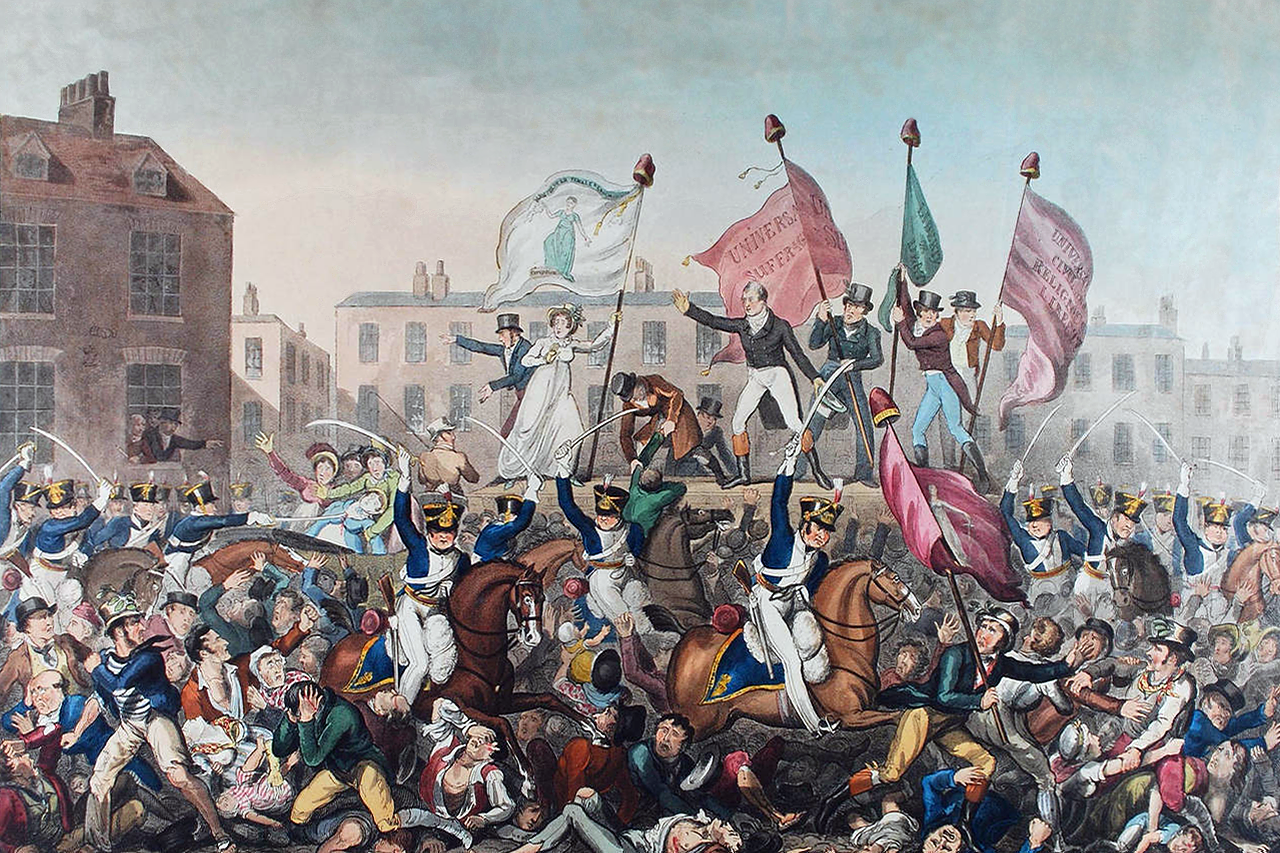
The Peterloo Massacre by Richard Carlile (1790-1843)
To Henry Hunt, Esq., as chairman of the meeting assembled in St. Peter’s Field, Manchester, sixteenth day of August, 1819, and to the female Reformers of Manchester and the adjacent towns who were exposed to and suffered from the wanton and fiendish attack made on them by that brutal armed force, the Manchester and Cheshire Yeomanry Cavalry, this plate is dedicated by their fellow labourer, Richard Carlile: a coloured engraving that depicts the Peterloo Massacre (military suppression of a demonstration in Manchester, England by cavalry charge on August 16, 1819 with loss of life) in Manchester, England.

All the poles from which banners are flying have Phrygian caps or liberty caps on top. Not all the details strictly accord with contemporary descriptions; the banner the woman is holding should read: Female Reformers of Roynton — “Let us die like men and not be sold like slaves”.
Manchester Library Services via Wikimedia Commons.

Today is the 200th anniversary of the Peterloo Massacre, when working people in Manchester were attacked and murdered by cavalry forces for daring to demand the right to vote. And what is our political class doing on this anniversary of such an important event in British political history? They are plotting, tirelessly, to overthrow something that millions of working-class people, and others, voted for: Brexit. They are doing what the Peterloo butchers did, only by political means and court cases rather than with bayonets and sabres. Our current political rulers may not physically attack the masses for having the temerity to use their democratic voices — not yet, anyway — but they view us with the exact same seething, elitist contempt as those who did attack the masses in St Peter’s Field on 16 August 1819.

Around 60,000 men, women and children gathered in St Peter’s Field in Manchester 200 years ago to demand parliamentary representation. They wanted that most basic and essential democratic right: the right to vote. The teeming industrial city of Manchester had no elected MPs in parliament. The old “rotten boroughs” system meant that often sparsely populated rural areas sent MPs to the Commons, involving much patronage and sometimes even the buying of votes by wealthy aspiring politicians, while newly industrialised cities full of the growing urban working classes had little to no political representation. Against a background of post-Napoleonic Wars economic depression and a fast-spreading radical desire for meaningful democratic change, the tens of thousands of marchers arrived in St Peter’s Field with a clear demand: let us vote, let us speak.

What happened next is well known. They were attacked by cavalry forces. Troops on horseback wielded sabres against the democratic crowd. They slashed and stabbed, killing 18 people. Around 500 were injured. The slaughter was given the name “Peterloo” as an ironic comparison to the Battle of Waterloo that took place four years earlier, in 1815. The bourgeoisie’s assault on the working-class democrats of Manchester had a deep impact on the radical psyche. New movements emerged in subsequent years, including the Chartists, the working-class movement for democratic representation. But it would be decades before the right to vote had been established across society. In 1867 some working-class men got the right to vote. In 1918, all men and some women got the right to vote. In 1928, finally all women got the vote. The General Election of 1929, 110 years after the march to St Peter’s Field, was the first election in which all adults had the right to vote.

The 200th anniversary of this bloody assault on working-class democrats ought to be a major occasion. It should be a reminder of the incredible, heroic sacrifices earlier generations made to secure people’s right to express themselves, to vote, and to see their votes be enacted. And yet while some in the political and media class will today pay lip service to the heroes of St Peter’s Field and express regret about the massacre of 18 of them, most of the elites will be too busy to do anything of the kind. Busy doing what? Trying to override and crush the votes of 17.4million people, which includes millions of working-class people and eight million women. It is a genuinely alarming and revealing moment: the 200th anniversary of the Peterloo Massacre arrives and the political set is engaged in an effective coup against the people; in a war against “No Deal Brexit” (which really just means a war against Brexit); in a concerted effort to force the ignorant public, as they see us, to vote for a second time and to give the “right” answer on this occasion.

July 16, 2019

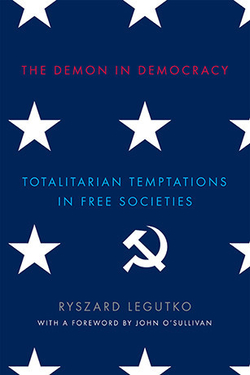
Totalitarian Temptations in Free Societies by Ryszard Legutko

Filed under: Books, Economics, Government, History, Politics — Tags: , , , , — Nicholas @ 05:00

Daniel Pipes reviews a recent translation (from Polish) by Teresa Adelson:

Legutko does not claim liberalism resembles communism in its monstrosity, much less that the two ideologies are identical; he fully acknowledges that the first is democratic and the second brutally tyrannical. After recognizing this contrast, however, he gets down to the more pungent topic of what the two have in common.

He first perceived those commonalities in the 1970s when visiting the West, where he saw how its liberals preferred communists to anti-communists; later, with the overthrow of the Soviet Bloc, he watched liberals warmly welcome communists, but not their anti-communist opponents. Why so?

Because, he argues, liberalism shares with communism a powerful faith in rational minds finding solutions which translates into a drive to improve the citizen, modernize him, and mold him into a superior being. Accordingly, both ideologies politicize, and thereby debase, every aspect of life, including sexuality, the family, religion, sports, entertainment, and the arts. (Here’s a mischievous but deadly serious question: which is the more awful art, the communist or the liberal, Stalin’s or the Venice Biennale’s?) [see below]

Both engage in social engineering to create a society whose members are “indistinguishable, in words, thoughts, and deeds ” from one another, aiming for a largely interchangeable population with no dissidents making trouble. Each sublimely assumes its specific vision constitutes the greatest hope for mankind and represents the end of history, the final stage of mankind’s evolution.

Trouble is, such grand schemes for improving mankind inevitably lead to severe disappointment; human beings, it turns out, are far more stubborn and less malleable then dreamers would like. When things go badly (say, food production for communists, unfettered immigration for liberals), two nasty consequences follow.

July 10, 2019

Liberals: “vote for us, you ignorant, uneducated conservative plebians!”

Filed under: Cancon, Education, Politics — Tags: , , , , , — Nicholas @ 03:00

Andrew Coyne sneaks in a literary quote from Chesterton on the eternal snobbery of the not-so-hidden class war in Canadian politics:

Democracy, in G. K. Chesterton’s careful definition, means government by the uneducated, “while aristocracy means government by the badly educated.”

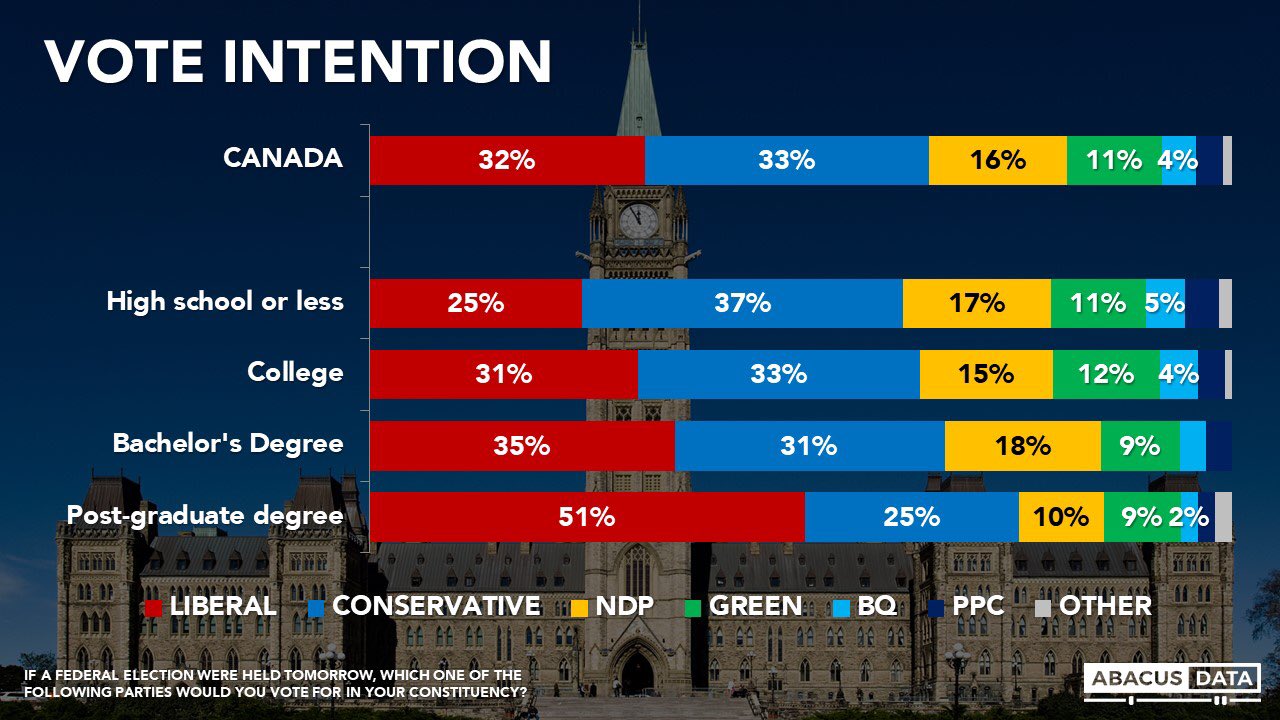
The enduring value of this distinction was suggested by the ruckus stirred up over the weekend by Amir Attaran, professor of law at University of Ottawa. Responding to a recent Abacus Data poll finding the Tories leading the Liberals by a wide margin among Canadians with a high school diploma or less, with the Liberals ahead among those with bachelor degrees or higher, the professor tweeted: “The party of the uneducated. Every poll says this.”

In the ensuing furor, Attaran tried to protest that he was just stating a fact, but the disdain in the tweet was clear enough to most. For their part, while some Tories quibbled with the data (just one poll, within the margin of error, misplaced correlation etc), most seemed less offended by the sentiment — every poll does show the less formal education a voter has, the more likely they are to support the Conservatives — than by the suggestion there was something shameful about it.

It was, in short, another skirmish in the continuing class war: class, now defined not by occupation or birth, as in Chesterton’s time, but by education. Conservatives, true to form, professed outrage at this arrogant display of Liberal elitism, while Liberal partisans protested that they were not snobs, it’s just that Conservatives are such ignorant boobs (I paraphrase).

The professor compounded matters by objecting, not only that he is not a Liberal, but that he is not an elite, since his parents were immigrants. And everyone did their best to be as exquisitely sensitive (“let us respect the inherent dignity of labour”) as they could while still being viciously hurtful (“not uneducated, just unintelligent”).

At the Post Millennial, Joshua Lieblein describes his initial reaction followed by sober second thoughts:

When I read the following condescending tweets from University of Ottawa professor Amir Attaran, my first thought was, “Well, somehow he wasn’t educated enough to predict this reaction. What did he expect?”

[…]

And then I realized that I wasn’t giving him enough credit. Professor Attaran knew exactly what to expect.

Professor Attaran wants you to read his unsolicited and deliberately insulting tweets. He wants you to talk about the tight links between the polling firm that provided him with his QUOTATION and the Liberal Party of Canada. He wants you to hurl all kinds of abuse at him.

Then, he and others will go through the pile of invective generated by this Sunday evening musing, pick out the most racist and inflammatory takes, and use them to justify the idea that facts are under assault, that minorities cannot speak out on issues of the day in Canada, that Conservatives don’t believe in freedom of speech, and that “right-wing mobs” exist and are being directed by CPC thought leaders.

It’s not like this is a new phenomenon, or something that’s new to Canada. Did you think all of Trudeau’s ridiculous behaviour was spontaneous? Sure, some of it is. The man is a certifiable moron. But we really should have guessed that we were being played for fools by the time he was doing shirtless photobombs of weddings.

May 21, 2019

The Brexit Party may be getting dirty foreign money! Call out the plod!

Filed under: Britain, Europe, Law, Politics — Tags: , , , , — Nicholas @ 05:00

In the Guardian, totally neutral and disinterested journalists report on former Labour PM Gordon Brown’s call to investigate where the Brexit Party is getting its funding from:

The Electoral Commission is under mounting pressure to launch an investigation into the funding of Nigel Farage’s Brexit party because of concerns that its donation structure could allow foreign interference in British democracy.

Before Thursday’s crucial European elections, Gordon Brown has written to the Electoral Commission calling on it to urgently examine whether the party has sufficient safeguards on its website to prevent the contribution of “dirty money”.

The former Labour prime minister will use a speech in Glasgow on Monday to say an investigation into the Brexit party’s finances is urgent and essential.

“Nigel Farage says this election is about democracy. Democracy is fatally undermined if unexplained, unreported and thus undeclared and perhaps under the counter and underhand campaign finance – from whom and from where we do not know – is being used to influence the very elections that are at the heart of our democratic system,” he will say, according to pre-released extracts.

As Tim Worstall points out:

It’s actually an entire 13 paragraphs later that we get to the meat of the matter:

    Only donations over £500 have to be declared under British law.

The Brexit Party is obeying every jot and tittle of electoral and fundraising law. This is the very system that the federast establishment set up itself. But, you know, the wrong people are succeeding under it so aspertions must be cast.

And guess what? The Electoral Commission isn’t going to get anything done by Thursday. Not even to be able to confirm that the law is being obeyed as it should be. But we’ve managed to get the propaganda out there that Nigel’s posse are bought by the Russians and that’s the point of it all anyway.

You might think me a little cynical here. But sadly I’m not. When I was working for Ukip the Times – Sam Coates it was – announced that we simply weren’t going to contest the next election. No reason given, no analysis performed, an apology of any prominence never was forthcoming. Just a bit of disinformation dropped into the public conversation there.

That’s how the federasts play and any governance system that has to play that way isn’t one we desire to be a part of, is it?

The Hell with the EU.

Of course, dirty anonymous foreign money sources can fund other groups too.

May 10, 2019

QotD: Defining freedom

Filed under: Liberty, Quotations — Tags: , , — Nicholas @ 01:00

Freedom is not a synonym for the right to vote in fair and open elections. Fair and open elections with a wide franchise might – might – be a useful instrument for promoting freedom. But contrary to much shallow thinking, the right to participate in such elections is not itself “freedom”. Freedom is the right to choose and act as you please, with this right bound only by the equal right of every other peaceful individual to do the same. (Or to quote Thomas Sowell, “Freedom … is the right of ordinary people to find elbow room for themselves and a refuge from the rampaging presumptions of their ‘betters’.” I would add that freedom requires also elbow room from the rampaging presumptions – and from the enviousness, ignorance, myopia, and even the good intentions – of one’s peers and, indeed, from those of everyone.)

In practice it is sometimes difficult to identify the detailed locations of the boundaries that best ensure equal freedom for everyone. This reality, however, neither renders the goal of equal freedom of choice and action for everyone less desirable nor makes this definition of freedom less serviceable.

Don Boudreaux, “Quotation of the Day…”, Café Hayek, 2017-04-23.

April 30, 2019

Japan’s monarchy

Filed under: History, Japan, Religion, WW2 — Tags: , , , , , — Nicholas @ 05:00

Colby Cosh looks at the astonishingly successful Japanese monarchy over the last few centuries of change:

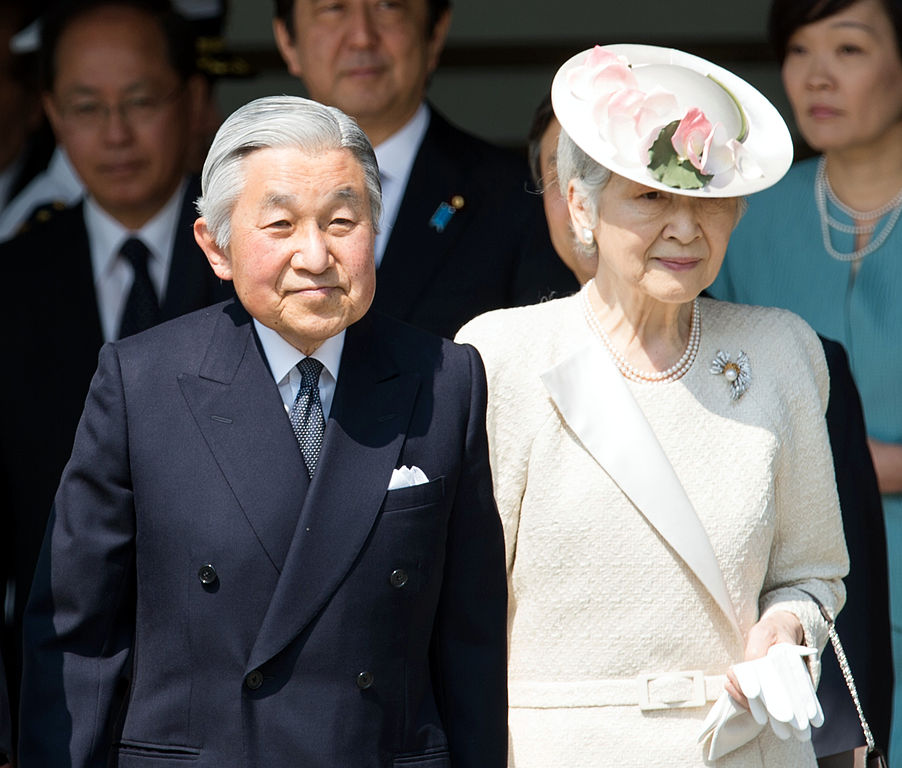
Emperor Akihito and Empress Michiko at the Tokyo Imperial Palace in Chiyoda Ward, Tōkyō Metropolis on April 24, 2014.
US State Department photo by William Ng, via Wikimedia Commons.

Most everybody knows how the office of the Japanese Emperor became “ceremonial” for the better part of 700 years, and how the archipelago was governed in isolation by what we call the shogunate. The first Westerners who established diplomatic relations with Japan in the 19th century did not think of the Emperor as analogous to Queen Victoria at all. For years they thought of the Mikado as primarily a religious functionary, a sort of pope performing funny, tedious rites in seclusion. (As anyone who has been watching Japanese news in the run-up to Golden Week knows, there is some truth to this.)

Even as reality dawned on those foreign barbarians, their presence in Japan led to social breakdown, civil war, and a sharp, sudden revival of the power of their monarchy — the Meiji Restoration. This is still an awe-inspiring event. Japan was confronted by a little-known and hated outer realm, and was able to adapt with inexplicable confidence. It did not descend into psychic and economic malaise, but almost immediately began to compete with obtrusive Western “powers.” After centuries in abeyance, their constitution somehow allowed them to conjure a enlightened despot of enormous ability, the Meiji Emperor, at the precise moment one was required.

This led in time to the war in the Pacific — and to a second miracle of the same kind. If matters had been left up to American public opinion in 1945, or to the allies of the United States, or even to the American executive branch, the Japanese monarchy would have been abolished and the Emperor given a humiliating trial and death. Such a procedure could have easily been justified then, and can be justified in retrospect now. U.S. foreign policy almost always, in practice, seems to follow the country’s republican instincts.

But while Japan was defeated, it had not been invaded. So Gen. Douglas MacArthur and a few foreign-policy brainiacs reached a magnificent, cynical modus vivendi: they would exploit and reshape the Japanese monarchy rather than smashing it. As a soldier, MacArthur, made Supreme Commander of occupied Japan, would have shot the Emperor with his own sidearm and never lost a minute’s sleep. But he and others somehow managed to overcome racial and political prejudices, and perform an act of American “nation-building” that was not a cruel joke.

« Newer PostsOlder Posts »

Powered by WordPress