Whatever else the European project was meant to be, it was never meant to be very democratic. Its deus ex machina, Jean Monnet, was quite clear abut this: the plebe was neither intelligent or informed enough to decide its own fate, at least as regards high politics. It would be dishonest to say that such thoughts never run through the heads of the more intelligent sector of the population in respect of the less intelligent; you have only to walk down the street to see that the voice of the people is hardly that of God. How many people, for example, know what the interest rate should be (assuming, that is, that there is a correct answer), or even what factors should be taken into account when assessing it? But few highly intelligent people would put their night thoughts into practice, and simply say, “We should rule because we are the most intelligent and know best.”
Theodore Dalrymple, “European Empire, Fractured”, Law & Liberty, 2020-11-10.
February 18, 2021
QotD: The “European Project”
January 24, 2021
QotD: The “returned ballot”
In Canada we used to have — still have, according to a friend who should know — the excellent institution of the “returned ballot.” It is my usual way of voting. I can write with some confidence that it has never won.
Here’s what you do. You go into the polling station, show your ID (in Canada voters must identify themselves). The officer crosses you off the voting list, and gives you a ballot. Then you say, “I wish to return this ballot.” He says, “Thank you, sir,” and takes out his returned ballot book. (It need be nothing special: a school exercise book will do.) He copies your name into that, along with your address. (It is the only way to get your preference recorded.) You thank him, then wander off through the boobs who came to vote for somebody.
One has oneself, in effect, just voted for “none of the above.” This is the theory.
In practice the officer, who may or may not speak English or French, but probably needed the money, looks puzzled and a little frightened. He has no idea what you are talking about. You dig in, to provide a patient lesson in elementary civics. He won’t have a book, but you have brought along a cahier with “Returned Ballots” written on the cover in large capitals with a felt pen, and some heraldry doodled above it. To be helpful, you have already written your name and address on the first line. He consults all the other polling staff then says, “Thank you, sir.”
When, later, you check the results, you will not find a single returned ballot mentioned. Perhaps you were counted among the spoilt ones.
Now if you had been counted, and had persuaded a plurality of your fellow citizens to do likewise in, say, the riding of Parkdale (about one-in-four would triumph in most Canadian ridings; one-in-six if the turnout were low enough), the election is annulled. A by-election must then be called, in which none of the previous candidates may stand.
David Warren, “Let’s be practical”, Essays in Idleness, 2018-09-15.
December 12, 2020
“Canada’s party system has long been an outlier that has baffled political scientists”
Ben Woodfinden emerges from a pre-winter hibernation to mull on how environmental issues intersect with regional and linguistic issues in a uniquely Canadian way that does not match how these issues play out in other countries:

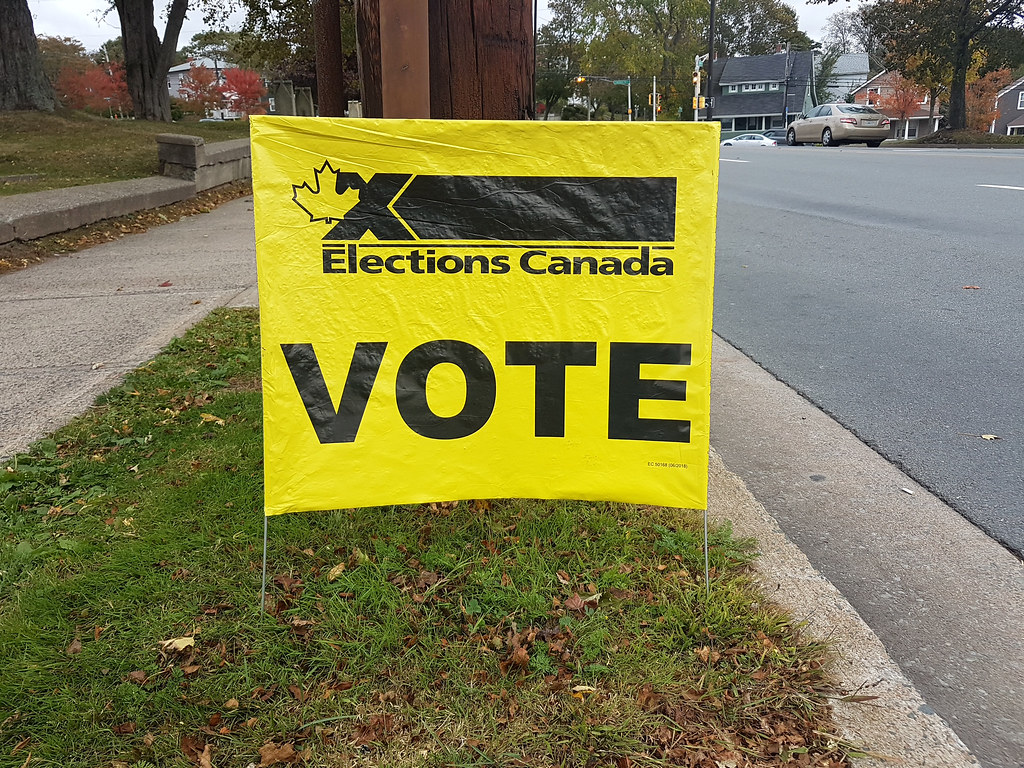
“2019 Canadian federal election – VOTE” by Indrid__Cold is licensed under CC BY-SA 2.0
… if you want to understand how democratic politics work, you have to begin with the premise that voters and electoral coalitions are made up of individuals with overlapping and complicated political identities, not just rationalistic voters who need to be convinced with some charts and data.
These identities and value divides coalesce and become the basis of the political cleavages around which competition in democratic regimes is built. There are many classic accounts of party system formation in political science, the one I think most plausible and still useful is the now classic account of cleavage politics posited by the political scientists Seymour Martin Lipset and Stein Rokkan.
This now classic account of the formation of party systems in Western Europe argues that long existing social conflicts and divides that existed prior to the gradually universal extension of voting across Western Europe helped to structure political competition. Specifically, industrialization and nation building generated four major cleavages that structured political conflict and party systems going forward: territorial cleavages defined by a centre-periphery divide, religious cleavages defined by a church versus state divide, an urban-rural cleavage, and a labour-capital cleavage.
Canada’s party system has long been an outlier that has baffled political scientists who study these things. If you’re looking for a good comprehensive overview of the history of the Canadian party system I’d recommend this recent book by Richard Johnston. Since the 1930’s Canada has defied what is perhaps the single most generalizable finding in comparative politics: Duverger’s Law. Canada also defies many of the expectations of the cleavage theory of party formation. But Canadian politics can still be broadly understood in terms of cleavages, albeit idiosyncratic Canadian cleavages (regional and linguistic cleavages especially).
I won’t bog you down with too much academic explanation. There is an enormous body of literature that builds on, tests, and modifies the cleavage thesis. Much of the talk in recent decades has been about an “unfreezing” of the traditional cleavages that have dominated party politics in western democracies, and the reorganizing of politics around new cleavages.
As traditional industrial, class, and religious cleavages have declined new cleavages have emerged and politics has been playing a catch up game. These new cleavages coalesce around educational, geographic, gendered, and age divides. This realignment, which has been in the making for decades has become the dominant political narrative since 2016, and as I’ve written in the newsletter recently these divides exist in Canada just as they do in Europe and America.
But the realignments these new cleavages produce often require singular events or defining figures to fully emerge. In the United Kingdom, the 2016 referendum produced a realignment because it scrambled the existing partisan and political arrangements so much that it gave rise to a hyper-polarized culture war around a remain/leave divide that people reoriented their own politics around this divide.
December 4, 2020
Canada used to have a “none of the above” option in federal elections … let’s bring it back
David Warren describes how the “returned ballot” functioned as a “none of the above” vote in Canadian federal elections:

“2019 Canadian federal election – VOTE” by Indrid__Cold is licensed under CC BY-SA 2.0
Back to the polling station, where the electoral officer is now passing me a ballot, with a hint on how to make an X on it. I am directed to a voting stall.
But I refuse to go there. Instead, I turn earnestly to the officer and say: “I am returning this ballot.”
Chances were, even decades ago, he would be thrown into confusion. So one would explain his job to him. He was supposed to have a book, entitled “Returned Ballots.” Into this he was supposed to transcribe one’s name and address. Getting into the book was one’s only way to avoid the secret ballot. But it was important to get in, to be recorded correctly, rather than as a “spoilt ballot,” as one is counted now if one’s ballot has no X.
After voting, I would check the result, and if not even one returned ballot had been recorded, I could doubt it was legitimate.
Now comes the good part. For returned ballots were supposed to be a separate category in the election tally. It was competing with all the other candidates. If it won a plurality — more returned ballots than the leading candidate — the election was to be formally thrown out, and a by-election called, in which none of the candidates for the thrown out one were allowed to run again. Too, voters could “theoretically” do this over and over, until at least one Party chose a candidate we could stomach.In theory, this was an excellent way for voters to “drain the swamp,” directly, by eliminating the political sleaze in successive groups. In practice — aheu — it was never used. The political sleaze nevertheless spotted the possibility, and had it taken off the books, at both Dominion and Provincial levels. What can I say? They are sleaze.
So the first thing we must do is campaign for the return of the returned ballot, up here; and for its institution in all the other Western nations. Then the second is to impartially, but massively, campaign for its use. It could be the greatest thing since the ancient Athenian ostracon.
August 29, 2020
“Last Sunday in Minsk was indeed a bizarre day”
Vladislav Davidzon reports on recent news from Belarus:

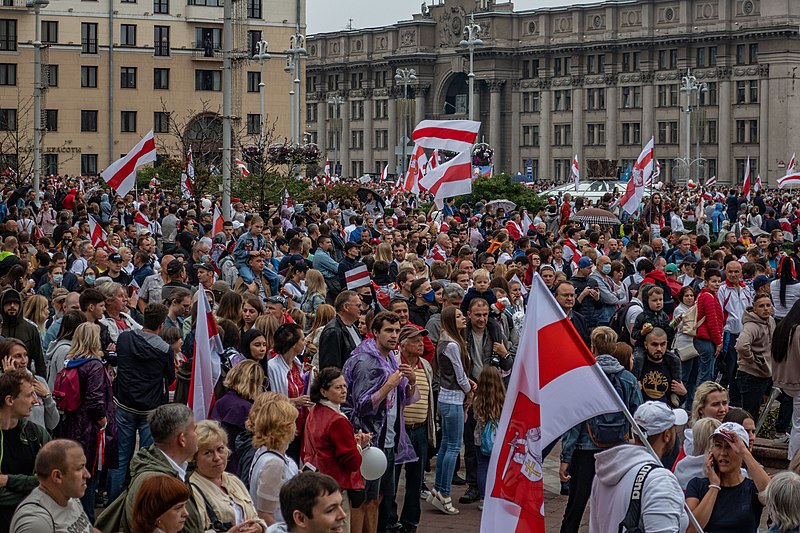
Protest in Minsk against Belarussian President Lukashenko, 23 August 2020.
Photo by Homoatrox via Wikimedia Commons.
“Where were you grandpa,” I dearly hope that my historically minded descendants will inquire of me one day, “when that maddened Belarusian president flew over the crowd of protestors in that helicopter with a machine gun in hand?” Last Sunday in Minsk was indeed a bizarre day. As the protestors of this most velvet of revolutions approached the presidential palace, Lukashenko panicked and ordered his personal military helicopter to fly over the crowd.
We are now into the third week of the political crisis that has wracked Belarus in the wake of the discredited presidential election of 9 August. Following the outcome of the fabricated election, Lukashenko has forfeited all political legitimacy after ruling the country as his own personal kingdom for the past 26 years. Yet, as the daily demonstrations taking place across every town and region demonstrate, Belarus is no longer governable under the old political agreement.
The entire capital of Minsk appears to be in revolt, if only passively. When I discreetly asked the cleaning lady at my hotel where I can go to make a call without being noticed, she replied with a knowing smile: “You can’t, they listen to everything.” The repressive apparatus on which Lukashenko has relied for decades clearly no longer functions. The protests are organised by encrypted telegram channels – many based in Poland and Lithuania – which the government is powerless to stop. NEXTA Live (the main telegram channel of the opposition, managed by an exiled 22-year-old Belarusian activist) has reported an extraordinary one billion views of its posts for the first three weeks of August.
So, it is understandable that the opposition demand that Lukashenko retire. He is 65 years old and will be celebrating his next birthday this coming Sunday (the day that protestors stage their weekly marches, routinely bringing 200,000 people into the streets of the capital). Those who run the opposition telegram channels have taken to referring to him as “a certain pensioner in Minsk”. Thus, “a certain pensioner in Minsk is meeting with the KGB and interior ministry generals today”. A “certain pensioner in Minsk is shaking his fist and threatening NATO”, and a “certain pensioner in Minsk has ordered a flight of Belarusian Mi-24 ‘Hind’ helicopters to intercept a formation of enemy flags bearing balloons on the Lithuanian border”.
August 26, 2020
For British liberals, it’s somehow different when it happens in another country
At Spiked, Brendan O’Neill emphasizes the hypocrisy of some of the people lionizing the Belarussian democrats who also spent the last few years demonizing the democratic process that led to Brexit:

Protest in Minsk against Belarussian President Lukashenko, 23 August 2020.
Photo by Homoatrox via Wikimedia Commons.
British liberals are cheering on the tens of thousands of brave Belarusians who have taken to the streets to demand the enactment of their democratic vote. Which is odd, to say the least, given that the last time British liberals themselves marched in the streets, often in their tens of thousands, it was to demand the crushing of a democratic vote. It was to call upon the state to refuse to enact the democratic wishes of 17.4 million people, the largest democratic bloc in the history of the UK. The hypocrisy is staggering: the British chattering classes celebrate democracy abroad and wage war on it at home.
Belarusians are fighting tooth and nail for their democratic rights. They are marching in the streets in vast numbers – in defiance of the government’s authoritarian clampdown on public gatherings – and workers are going on strike. They are furious with the rigged outcome of the election two weeks ago, which gave their authoritarian president, Alexander Lukashenko, who has been in power for 26 years, yet another term. Lukashenko’s regime claims he won more than 80 per cent of the vote in the election on 9 August while the opposition won around 10 per cent. No one believes this. And they are right not to believe it: Lukashenko has a history of anti-democratic, tyrannical behaviour.
The Belarusians rising up against Lukashenko and demanding the meaningful right to determine who governs their country are an inspiration to democrats everywhere. They are taking enormous risks. They are breaking illiberal laws by taking to the streets of Minsk. At least four people have been killed in the protests. Some demonstrators claim they were tortured by security forces after being arrested. It is testament to people’s yearning for democratic power, for a real say in the future of their country, that so many are flooding the streets of Belarus or downing their tools at work in order to force the regime to listen to their voices. This is democracy in action.
And yet, there is something nauseating in the British chattering classes’ attempt to cosy up to the Belarusian uprising for democracy. For these are the same people who spent the past four years trying to do in the UK what Lukashenko is currently doing in Belarus – that is, silence people’s democratic cry and write off their democratic votes. Lukashenko does it with batons and torture, while our far more polite elites tried to do it with court cases, parliamentary intrigue and a relentless campaign of Project Fear. But the motive was the same: to prevent the supposedly problematic little people from having their say and screwing up political life.
[…]
The British columnists and politicos celebrating the Belarusian uprising have to face up to this fact: they have nothing in common with these brave warriors for democracy. On the contrary, their marches over the past four years were singularly devoted to stopping democracy. Who can forget those huge “People’s Vote” gatherings in which armies of middle-class Remainers would gather in London to sneer at ordinary voters, plead with the government to ignore their votes, and demand that big constitutional questions be taken out of the hands of the dangerous, reckless “low-information” masses. Guess who probably feels similarly to this? Yes, Alexander Lukashenko.
August 16, 2020
This is a “hockey stick” graph you can believe
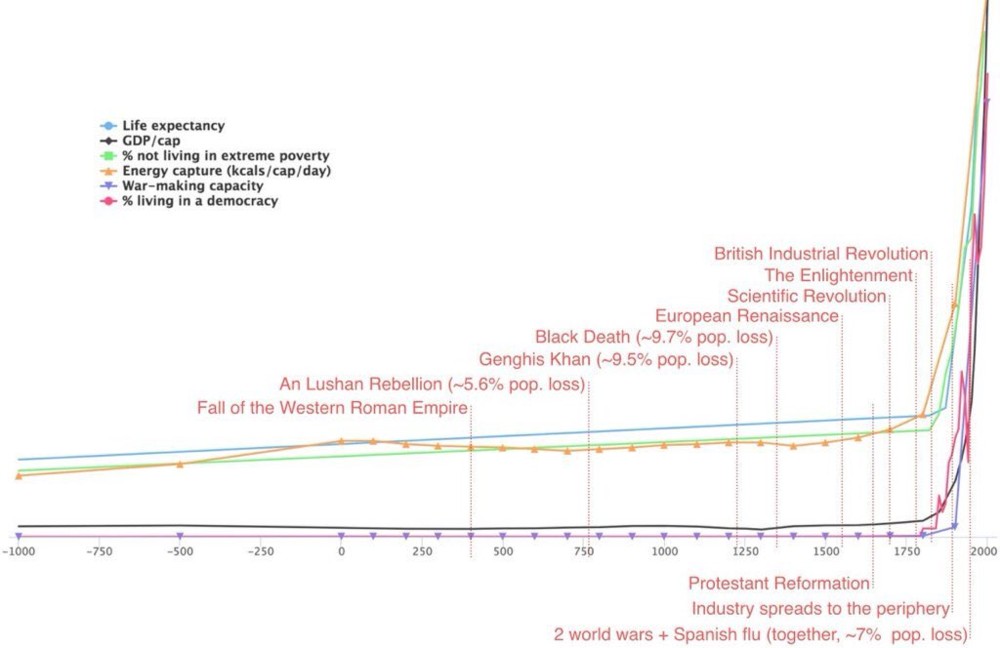
Brian Micklethwait says this graph, unlike the more famous (debunked) “hockey stick”, shows one of the most important moments in human history:
If that graph, or another like it, is not entirely familiar to you, then it damn well should be. It pinpoints the moment when our own species started seriously looking after its own creature comforts. This was, you might say, the moment when most of us stopped being treated no better than farm animals, and we began turning ourselves into each others’ pets.
Patrick Crozier and I will be speaking about this amazing moment in the history of the human animal in our next recorded conversation. That will, if the conversation happens as we hope and the recording works as we hope, find its way to here.
I’m not usually one for podcasts, in the same way that I’m not an audiobook user: I find I’m unable to do other things while listening to the spoken word, and it’s always far faster to read a text than to have it read to you. In this particular case, I might try to make an exception, and give up hope of doing anything else productive while I listen.
July 13, 2020
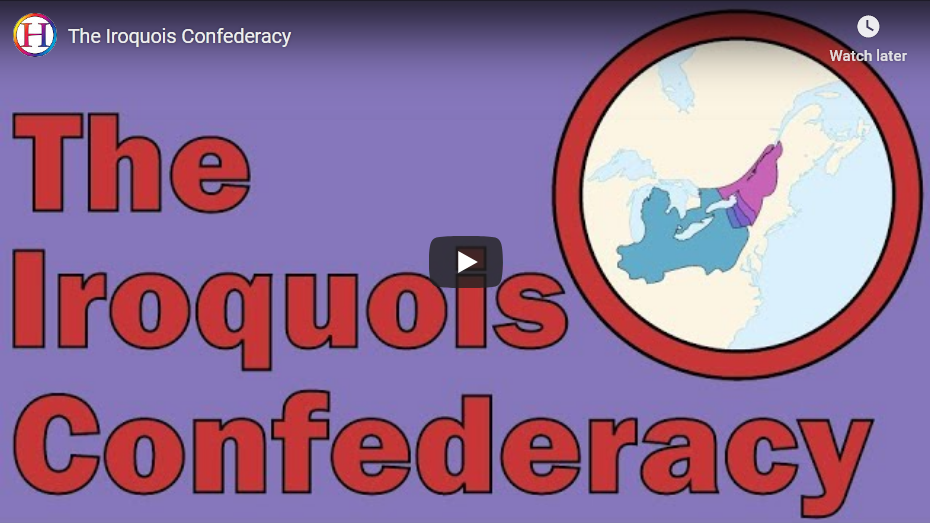
The Iroquois Confederacy
Historia Civilis
Published 20 Jun 2018Patreon | http://patreon.com/HistoriaCivilis
Donate | http://www.paypal.com/cgi-bin/webscr?…
Merch | http://teespring.com/stores/historiac…
Twitter | http://twitter.com/HistoriaCivilis
Website | http://historiacivilis.comSources:
“Discourse Delivered Before the New-York Historical Society: At Their Anniversary meeting, 6th December, 1811,” by DeWitt Clinton: https://amzn.to/2JJZ7eB
The Great Law and the Longhouse: A Political History of the Iroquois Confederacy, by William N. Fenton: https://amzn.to/2JKVTYo
League of the Hodenosaunee or Iroquois, by Lewis H. Morgan: https://amzn.to/2MzRfue
Forgotten Founders, by Bruce E. Johansen: https://amzn.to/2Mz8VGf
French-Iroquois Diplomatic and Military Relations 1609-1701, by Robert A. Goldstein: https://amzn.to/2JLjfxdMusic:
“Deluge,” by Cellophane Sam
“Hallon,” by Christian BjoerklundWe are a participant in the Amazon Services LLC Associates Program, an affiliate advertising program designed to provide a means for us to earn fees by linking to Amazon.com and affiliated sites.
July 9, 2020
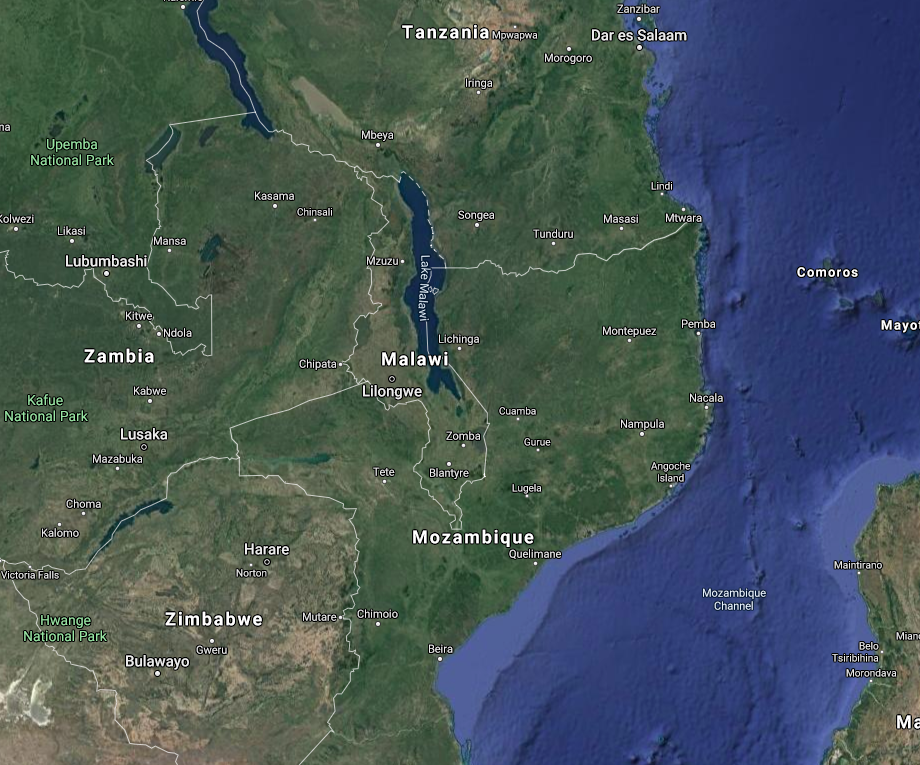
Austin Bay on how Malawi fixed a crooked election
At Strategy Page, Austin Bay recounts the efforts to overturn an election that was clearly fraudulent in the small land-locked African country of Malawi:
Since he retained the title of president, Mutharika believed he controlled the guns and the courts. The protests would fade.
He learned otherwise. Malawi’s military, the Malawi Defense Force (MDF) and the Malawi Police Service, watched the country carefully, keeping order but not taking sides. The opposition appealed to Malawi’s highest court, the Constitutional Court. MDF commanders made it clear their service, as protectors of the constitution, would protect the court’s justices and respect the court’s decision.
Ignoring intimidation and enticements (Mutharika offered splendid early retirement), in February 2020, the court annulled the 2019 results as tainted and ordered new elections in June 2020 — the Fresh Presidential Election.
MDF soldiers prepared to secure the FPE’s paper ballots. In a June briefing, an MDF general told motorists to “maintain a distance of at least one kilometer between them and vehicles” carrying ballots. Enter the security zone and get a warning, but “(overtly) following the vehicles can lead to loss of lives if one is not careful.” Beware political thugs — MDF weapons prevent ballot hijacking.
Voters need protection, too. On June 22, MDF soldiers in central Malawi detained 16 men local citizens identified as intruders seeking to disrupt the vote. When police officers questioned the 16, they admitted they worked for Mutharika’s governing Democratic Progressive Party.
On June 23, opposition leader Chakwera received 60% of the vote in the untainted do-over. Mutharika got 38%. An MDF contingent immediately began protecting Chakwera.
Voting irregularities occur in mature democracies. However, election fraud does severe harm to developing nations where the disenfranchised have little or no systemic recourse and free speech is risky. Hope and nascent civil participation give way to wrath and alienation, which produce violence and destruction, not stability and economic development.
In the six decades since decolonization, election rigging by sub-Saharan Africa elites has stunted economic and social progress in nations whose people deserve far better (see Ghana). Disregard of constitutional law and violent intimidation of opposition voters by the party in power inevitably accompany election theft. Burundi and Congo are examples.
May 25, 2020
QotD: Sociopaths and politicians
In the modern vernacular, the sociopath is someone who lacks empathy, remorse and an understanding of right and wrong. The sociopath sees no difference between the truth and a lie, only their utility. Additionally, they never think about the consequences of their actions. A sociopath sees no harm in telling people that his brain juice will prevent concussions. The veracity of his statements are meaningless. What matters is how well it moves product. People ending up with brain damage as a result is never considered.
The key thing about the modern sociopath is the ambivalence toward the truth. They think saying something is the same as doing something. What matters is if the words get the listener to do what the sociopath wants them to do. Standing in front of crowd, making false claims, is fine if it causes people to buy product. If the truth sells more product, then the truth is better. From the perspective of the modern sociopath, the difference is about the results, not the accuracy of the statements. The truth or a lie, whichever works.
Now replace “sociopath” with “politician” and “product” with “votes” and you have the modern managerial democracy. It’s not that our politicians lie. It’s that for them, a lie is indistinguishable from the truth. That’s why they seem so utterly shameless. Shame requires a sense of right and wrong, a knowledge that what you said or did is intrinsically wrong. For the people who rule over us, right and wrong only exist in the context of their own ambitions. Something is “right” if it benefits the person in the moment.
“The Z Man”, “Rule by Sociopath”, The Z Blog, 2018-02-21.
April 27, 2020
QotD: H.L. Mencken’s literary theory
As for me, my literary theory, like my politics, is based chiefly upon one main idea, to wit, the idea of freedom. I am, in brief, a libertarian of the most extreme variety, and know of no human right that is one-tenth as valuable as the simple right to utter what seems (at the moment) to be the truth. Take away this right, and none other is worth a hoot; nor, indeed, can any other long exist. Debauched by that notion, it follows necessarily that I can be only an indifferent citizen of a democratic state, for democracy is grounded upon the instinct of inferior men to herd themselves in large masses, and its principal manifestation is their bitter opposition to all free thought. In the United States, in fact, I am commonly regarded as a violent anti-patriot. But this is simply because most of the ideas upon which American patriotism bases itself seem to me to be obviously sentimental and nonsensical — that is, they have, for me at least, no intelligible relation to the visible facts. I do not object to patriotism when it is logically defensible. On the contrary, I respect it as a necessary corollary to the undeniable inequality of races and people. Its converse, internationalism, appears to me to be almost insane. What an internationalist says, stripping it of rhetoric, is simply that a lion is no more than a large rat.
H.L. Mencken, “Private Reflections”, The Smart Set, 1922-12.
March 21, 2020
QotD: The reason people don’t get a say in how the rulers carry on
… as we dissidents have been pointing out for decades now, practically no government action since the late 1950s has had The People’s approval. Had The People been consulted at any point between 1960 and now, America would still be a White Christian nation. Lots more White boys would still be alive, having never been sent to some irrelevant, unpronounceable place to die. Lots more Black folks would be alive, too, since abortion disproportionately affects Blacks and abortion was always a fringe lunacy — even a half-century of nonstop propaganda has barely pushed it into majority support. Gays would still be in the closet, since even after a propaganda barrage that makes the abortion thing look like a mere suggestion public tolerance of homosexuality polls even lower. The borders, of course, would be closed — they don’t allow those polls to be taken anymore, because “immigration restriction” polled at something like 75% just a few years ago and the lunacy of the political class in a “democracy” going hard against three-quarters of the entire population is too glaring even for this tv-and-iCrap-addled country to stomach.
The People keep giving the wrong answer, in other words, so The People will not be asked anything of importance. Same as it ever was.
The problem with democracy, though, isn’t that people are fools. People are fools, of course, but since that’s as universal as gravity, any human institution will be staffed entirely with fools. But … just as the general characteristic “great leader” doesn’t necessarily translate into any specific competence, so the general truth “people are fools” doesn’t mean everyone is a fool about everything. Since we all know at least one other human being, we all know a blithering idiot who’s remarkably shrewd about one little slice of life. Junkies, for example, are idiots — taking hard drugs is a remarkably stupid idea, as every addict I’ve ever met readily confessed. And yet, when it comes to getting their drug of choice these morons are endlessly inventive. Billy Bob up the holler has six teeth and a fourth grade education, but he can MacGyver up methamphetamine out of household products like a Chemistry PhD.
The problem with democracy is twofold. The first — that it’s the best technique ever devised for organizing self-righteousness — deserves a book in itself. The second, though, is covered by a single word: ultracrepidarianism. It means “the habit of giving opinions and advice on matters outside of one’s knowledge.” Peter Strzok, for example, was probably a perfectly competent FBI agent, when it came to doing the things the FBI actually hired him to do. But he decided that he was also some kind of political science expert, as well as a human love machine, and here we are. See also: our “elected” “representatives” What else would you call sending someone like Alexandria Ocasio-Cortez, whose areas of expertise are “mixing drinks” and “having big tits,” to Congress, where she’s expected to make decisions of war and peace? Ultracrepidarianism is a feature, not a bug, of democratic systems, which is why even the very best “representatives” fuck up everything they touch.
Combine required ultracrepidarianism with real shrewdness and you get Stephen A. Douglas.
Take those, add in religious fervor, and you get the suicide cult that is the Democratic Party.
And here we are.
Severian, “Impeachment Thoughts”, Rotten Chestnuts, 2019-12-19.
March 14, 2020
The still-secret “settlement” between the federal government and five hereditary chiefs of the Wet’suwet’en
Chris Selley points out some of the disturbing features of the as-yet-unrevealed agreement between Her Majesty’s Canadian government and five unelected First Nation chiefs that eventually got the railways running again:

“DSC02285” by Bengt 1955 is licensed under CC BY-NC 2.0
For starters, we still don’t know the details of the arrangement, struck earlier this month between Wet’suwet’en hereditary chiefs and federal and provincial government officials, that allowed for pipeline work to resume. Those details could well represent positive progress on establishing just what the Wet’suwet’en’s legal claim on their lands — affirmed by the Supreme Court in 1997 — really means. But did the government have any business negotiating with the chiefs in question in the first place?
Tait-Day doesn’t think so. The Office of the Hereditary Chiefs of the Wet’suwet’en, she told the committee, is “not accountable to the (Wet’suwet’en) nation.”
“By refusing to hear from elected councils, these governments have without merit prevented the most credible current governing voices from being heard,” she told the committee. “The Indian Act system must be reformed, but that does not invalidate the role of the elected councils. While imperfect, they continue to speak for the people until a better model is implemented.”
Even setting aside the exclusion of elected councils, the negotiations were of dubious legitimacy. They weren’t with the hereditary chiefs per se; rather, they were with the hereditary chiefs who oppose the pipeline. Not all do, and some support it — including Tait-Day, Gloria George and Darlene Glaim, founders of the Wet’suwet’en Matrilineal Coalition. For their apostasy, male chiefs simply stripped them of their titles. This is not in dispute: “We’ve stripped the names from three female hereditary chiefs for supporting the pipeline,” John Ridsdale, whose hereditary title is Chief Na’Moks, told APTN News in 2018. “A name is more important than money.”
Using the title of Chief Woos, Frank Alec has become the leading public face of the anti-pipeline hereditary chiefs. On his behalf, Canadians both Indigenous and non-Indigenous have shut down rail lines and blocked access to the B.C. legislature and marched in the streets. Until 2018, the title of Chief Woos belonged to Glaim. He took it from her precisely because she dared support the pipeline and the benefits that will flow from it to her people.
“By negotiating directly with (the Office of the Hereditary Chiefs of the Wet’suwet’en), Canada and British Columbia give legitimacy to a group of bullies and abusers of women,” Tait-Day told the committee. “We cannot be dictated to by a group of five guys.”
February 19, 2020
February 2, 2020
“The European Union is a 1970s solution to a 1940s problem”
Mark Steyn shares some thoughts on the now-diminished European Union from his 2006 book America Alone as the United Kingdom exits the European Union:
The construction of a pan-continental Eutopia was meant to ensure that Europe would never again succumb to militant nationalism of one form or another. Instead, the European Union’s governing class has become as obnoxiously post-nationalist as it was once nationalist: its post-nationalism has become merely the latest and most militant form of militant nationalism — which, aside from anything else, makes America, as the leading “nation state” in the traditional sense, the prime target of European ire.
It’s true that there are many European populations reluctant to go happily into the long Eurabian night. But, alas for them, modern Europe is constructed so as to insulate almost entirely the political class from populist pressures. As the computer types say, that’s not a bug, it’s a feature: the European Union is a 1970s solution to a 1940s problem, and one of the problems it was designed to solve is that fellows like Hitler and Mussolini were way too popular with the masses. Just as the House of Saud, Mubarak, and the other Arab autocracies sell themselves to the West as necessary brakes on the baser urges of their peoples, so the European leadership deludes itself on the same basis: why, without the EU, we’d be back to Auschwitz. Thus, on the eve of the 2005 referendum on the European “constitution,” the Dutch prime minister, Jan Peter Balkenende, warned his people where things would be headed if they were reactionary enough to vote no. “I’ve been in Auschwitz and Yad Vashem,” he said. “The images haunt me every day. It is supremely important for us to avoid such things in Europe.”
Golly. So the choice for voters on the Euro-ballot was apparently: yes to the European Constitution or yes to a new Holocaust. If there was a neither-of-the-above box, the EU’s rulers were keeping quiet about it. The notion that the Continent’s peoples are basically a bunch of genocidal wackos champing at the bit for a new bloodbath is one I’m not unsympathetic to. But it’s a curious rationale to pitch to one’s electorate: vote for us; we’re the straitjacket on your own worst instincts. In the end, the French and Dutch electorates voted no to the new constitution. One recalls the T-shirt slogan popular among American feminists: “What part of ‘No’ don’t you understand?” In the chancelleries of Europe, pretty much every part. At the time of the constitution referenda, the rotating European “presidency” was held by Luxembourg, a country slightly larger than your rec room. Jean-Claude Juncker, its rhetorically deranged prime minister and European “president,” staggered around like a collegiate date-rape defendant, insisting that all reasonable persons understand that “Non” really means “Oui.” As he put it before the big vote: “If it’s a yes, we will say ‘on we go,’ and if it’s a no we will say ‘we continue.'”
And if it’s a neither of the above, he will say “we move forward.” You get the idea. Confronted by the voice of the people, “President” Juncker covers his ears and says, “Nya, nya, nya, can’t hear you!”
Only in totalitarian dictatorships does the ballot come with a pre-ordained correct answer. Yet President Juncker distilled the great flaw at the heart of the EU constitution into one disarmingly straightforward expression of contempt for the will of the people. For his part, the architect of the constitution — the former French president Valery Giscard d’Estaing — was happy to pile on: why, even if the French and the Dutch had been boorish enough to want to vote no to the constitution, they would have been incapable of so doing, as the whole thing was designed to be way above their pretty little heads. “It is not possible for anyone to understand the full text,” declared M. Giscard. During his labors on the constitution, he’d told me he saw himself as “Europe’s Jefferson.” By referendum night he’d apparently become Europe’s Jefferson Airplane, boasting about the impenetrability of his hallucinogenic lyrics. The point is that his ingrate subjects had no need to read beyond the opening sentence: “We the people agree to leave it to you the people who know better than the people.”
After that, the rest doesn’t matter: you can’t do trickle-down nation-building. The British, who’ve written more constitutions for more real nations than anybody in history and therefore can’t plead the same ignorance as President Juncker, should be especially ashamed of going along with this farrago of a travesty of a charade.