
In England patriotism takes different forms in different classes, but it runs like a connecting thread through nearly all of them. Only the Europeanized intelligentsia are really immune to it. As a positive emotion it is stronger in the middle class than in the upper class – the cheap public schools, for instance, are more given to patriotic demonstrations than the expensive ones – but the number of definitely treacherous rich men, the Laval-Quisling type, is probably very small. In the working class patriotism is profound, but it is unconscious. The working man’s heart does not leap when he sees a Union Jack. But the famous “insularity” and “xenophobia” of the English is far stronger in the working class than in the bourgeoisie. In all countries the poor are more national than the rich, but the English working class are outstanding in their abhorrence of foreign habits. Even when they are obliged to live abroad for years they refuse either to accustom themselves to foreign food or to learn foreign languages. Nearly every Englishman of working-class origin considers it effeminate to pronounce a foreign word correctly. During the war of 1914-18 the English working class were in contact with foreigners to an extent that is rarely possible. The sole result was that they brought back a hatred of all Europeans, except the Germans, whose courage they admired. In four years on French soil they did not even acquire a liking for wine. The insularity of the English, their refusal to take foreigners seriously, is a folly that has to be paid for very heavily from time to time. But it plays its part in the English mystique, and the intellectuals who have tried to break it down have generally done more harm than good. At bottom it is the same quality in the English character that repels the tourist and keeps out the invader.
George Orwell, “The Lion And The Unicorn: Socialism and the English Genius”, 1941-02-19.
January 29, 2022
QotD: English patriotism
January 28, 2022
Spartan glossary
As part of a multi-post series at A Collection of Unmitigated Pedantry on explaining (and debunking) the modern day mythology of classic-era Sparta, Bret Devereaux compiled a useful glossary of terms that will be of use as I’ll be excerpting several sections of his series for today’s and several future QotD entries. I’ve added a few entries that seem necessary and expanded some others, but these are enclosed in square brackets “[ ]” to show they’re not directly from Bret’s original post.
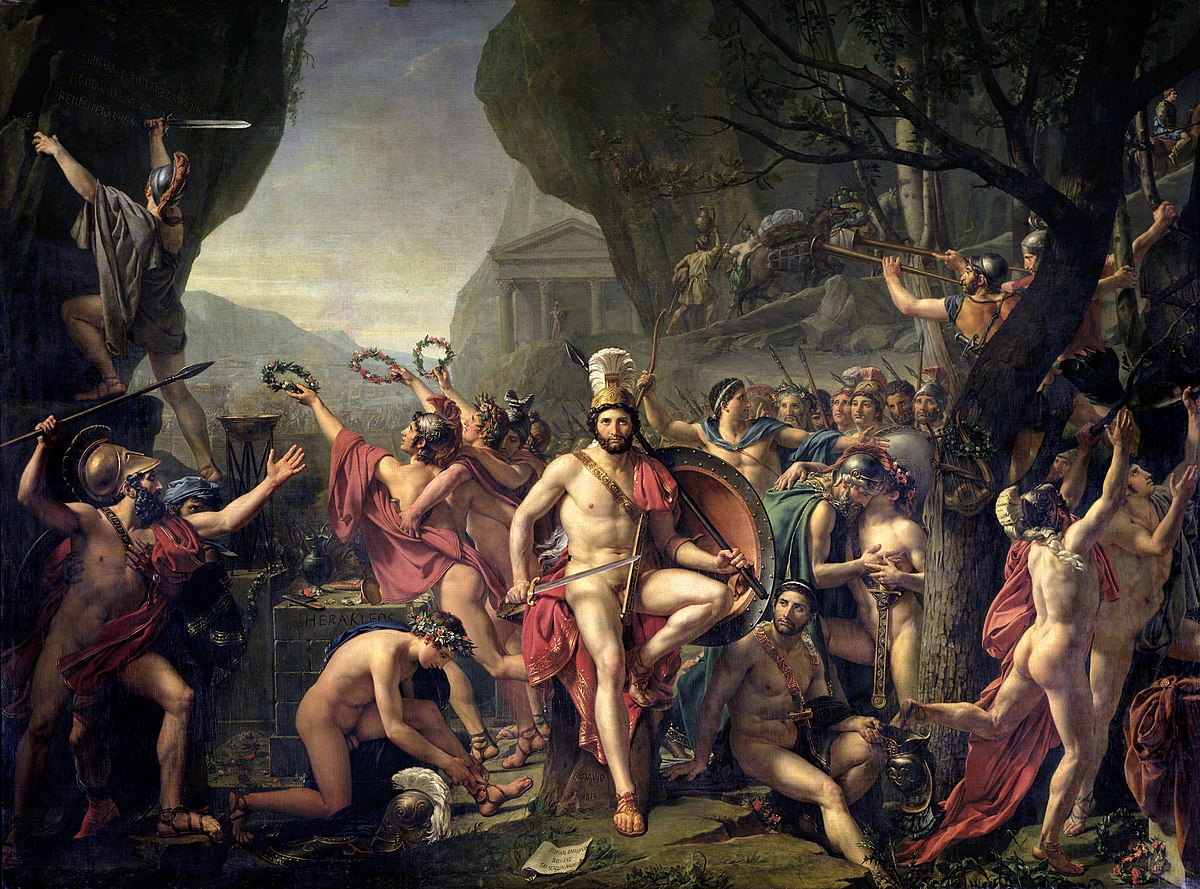
Leonidas at Thermopylae by Jacques-Louis David, 1814.
Wikimedia Commons.
Acclamation. A vote held by acclamation (sometimes called a “voice vote”) is a vote where, instead of getting an exact count of yes and no votes, the outcome is judged by the volume of people calling out yes or no. Obviously it would be very hard to tell who had really won a close vote. This is used in modern democracies only for very lopsided (typically unanimous) votes; in Classical Sparta, this was the only voting system, votes were never counted.
[Agoge. The Spartan education system for boys (ἀγωγή, pronounced ah-go-GAY). “Spartan boys were, at age seven, removed from their families and grouped into herds (agelai) under the supervision of a single adult male Spartan – except for the heirs to the two hereditary kings, who were exempt. Order was kept by allowing the older boys to beat and whip the younger boys (Xen. Lac. 2.2). The boys were intentionally underfed (Plut. Lyc. 17.4; Xen. Lac. 2.5-6). They were thus encouraged to steal in order to make up the difference, but severely beaten if caught (Plut. Lyc. 17.3-4; Xen. Lac. 2.6-9). … We are not told, but it seems unavoidable that in a system that intentionally under-feeds groups of boys to force them to steal, that the weakest and smallest boys will end up in a failure spiral where the lack of food leads to further weakness and further victimization at the hands of other boys. I should note that while ancient parenting and schooling was certainly more violent than what we do now – the Spartan system was recognized as abnormally violent towards these boys, even by the standards of the time.”]
Apella. The Apella was the popular assembly of Sparta, consisting of all adult male Spartiates over the age of thirty. The Apella was presided over by the Ephors and all votes were by acclamation. The Apella did not engage in debate, but could only vote “yes” or “no”. The Gerousia had the power to ignore the decisions of the Apella. [In most other Greek poleis the equivalent body would be called the ekklesia.]
Ephor. The Ephors were a board of five officials in Sparta, elected annually by the Apella (technically plus the two kings). The Ephors oversaw the two hereditary Spartan kings and could even bring a king up on charges before the Gerousia. In practice, the Ephors – not the kings – wielded the most political power in Sparta. The Ephors were also responsible for ritually declaring war on the helots every year. The institution as a whole is sometimes collectively referred to as the Ephorate.
Gerousia. The Gerousia – literally a council of old men (the members were “Gerontes” – literally “old men”) which consisted of thirty members, 28 elected (by acclamation in the Apella) plus the two hereditary kings. The elected members all had to be over the age of 60. Gerontes were elected for life. The Gerousia decided what motions could be voted on by the Apella and had the power to cancel any decision of the Apella. It also functioned as a court, with the power to try Spartiates and even the kings. In practice, with the Ephors, the Gerousia wielded the real political power in Sparta.
Helot. The subjugated slave class of Sparta, which made up the overwhelming majority of its residents, the Helots did the agricultural labor which kept the Spartan state running. Helots can be further subdivided into the Laconian helots (those living in Sparta proper) and the Messenian helots (the populace of Messenia which had been reduced to helotry after being conquered by Sparta in the 7th century B.C.). Helots often fought in Sparta’s armies, apparently as screening light-infantry forces (and also as camp followers and servants).
Homoioi. See: Spartiates.
Hoplite. Hoplites were Greek heavy infantry soldiers who fought with a heavy round shield (sometimes called a “hoplon” but more correctly an “aspis“) and a spear, typically in armor.
Hypomeiones. One of several sub-citizen underclasses in Sparta, the Hypomeiones (literally “the inferiors”) were former Spartiates who had fallen off the bottom of the Spartan social system, either through cowardice or (more likely) being unable to pay the contribution to the Syssitia. Though free, they had no role in government.
[Kings. Sparta had two royal lines and two kings at all times. The kings were drawn from the Agaids and the Eurypontid families. In theory, both kings had the same set of powers. The kings’ wealth was derived from lands allocated from territory taken from the perioikoi, and the eldest son of the current king in each line was the presumptive heir. On this basis, the kings were almost always the two wealthiest men in Sparta.]
[Kleroi (sing. kleros). The (theoretically) equal plots of land allocated to each Spartiate, worked on his behalf by Helots to generate the contributions to the individual Spartiate‘s Syssitia. Up to half of the production of the kleros had to be paid to the Spartiate by the Helots who worked that land. At some point, the kleroi became inheritable property, which facilitated the accumulation of wealth in fewer and fewer hands, contributing to the demographic collapse of the Spartiate class.]
Lycurgus. [The name of the (almost certainly) mythical founder figure of Sparta.] Lycurgus had been the younger brother of one of Sparta’s two kings, but had left Sparta to travel when his brother died, so that he would be no threat to his young nephew. After a time, the Spartans begged Lycurgus to come back and reorganize society, and Lycurgus – with the blessing of the Oracle at Delphi – radically remade Spartan society into the form it would have for the next 400 years. He did not merely change the government, but legislated every facet of life, from child-rearing to marriage, to the structure of households, the economic structure, everything. Once he had accomplished that, Lycurgus went back to Delphi, but before he left he made all the Spartans promise not to change his laws until he returned. Once the Oracle told him his laws were good, he committed suicide, so that he would never return to Sparta, thus preventing his laws from ever being over turned. So the Spartans never changed Lycurgus’ laws, which had been declared perfect by Apollo himself. Subsequently, the Spartans accorded Lycurgus divine honors, and within Sparta he was worshiped as a god.
Mothax. One of several sub-citizen underclasses in Sparta, the Mothakes were non-citizen men, generally thought to have been the children of Spartiate fathers and helot mothers, brought up alongside their full-citizen half-siblings. Mothakes fought in the Spartan army alongside spartiates, but had no role in government. A surprising number of innovative Spartan commanders – Gylippus and Lysander in particular – came from this class.
Neodamodes. One of several sub-citizen underclasses in Sparta, the Neodamodes were freed helots, granted disputed land on the border with Elis. Though they served in the Spartan army, the Neodamodes lacked any role in government. We might consider the helots who served in Brasidas’ army, the Brasideioi as a type of the Neodamodes (they did settle in the same place).
Peers: See: Spartiates.
Perioikoi (sing. Perioikos). The perioikoi (literally the “dwellers around”) were one of several sub-citizen underclasses in Sparta. The perioikoi were residents of communities which were subjected to the Spartan state, but not reduced to helotry. They lived in their own settlements under the control of the Spartan state, but with limited internal autonomy. The perioikoi seem to have included Sparta’s artisans, producing weapons, armor and tools; they were also made to fight in Sparta’s armies as hoplites.
Polis (pl. poleis). A complicated and effectively untranslatable term, polis most nearly means “community” and is often translated as “city-state”. However, there were poleis in Greece without cities (Sparta being one – a fact often concealed by translators rendering polis as city). Instead a polis consists of a body of citizens, their state, and the territory it controls (including smaller villages but not other subjugated poleis), usually but not always centered on a single urban center. Poleis are almost by definition independent and self-governing (that is, they have eleutheria and autonomia).
Skiritai. The Skiritai were one of several sub-citizen underclasses in Sparta. Dwellers in Skiritis, the mountains between Laconia and Arcadia, they were mostly rural people who were free, but subject to the Spartan state, similar to the perioikoi. The main difference between the two was that the Skiritai – perhaps because of their mountainous homes – served not as hoplites, but as an elite corps of light infantry in the Spartan army.
Spartiates, also called peers or homoioi. The citizen class at Sparta, the Spartiates were a closed ethnic aristocracy. Membership required both a Spartiate father and a Spartiate mother, as well as successful completion of the Agoge and membership in a Syssitia. Spartiate males over thirty were the only individuals in Sparta who could participate in government, although the political power of the average Spartiate was extremely limited.
Syssitia (sing. syssition). The Syssitia were the common mess-groups into which all adult Spartiates were divided. Each member of the Syssitia contributed a portion of the mess-group’s food; the contribution was a condition of citizenship. Spartiates who could not make the contribution lost citizenship and became Hypomeiones.
January 26, 2022
QotD: “Waltzing Matilda”
A gay Fusilier was marching down through Rochester
Bound for the war in the Low Country
And he cried as he tramped through the dear streets of Rochester
Who’ll be a sojer for Marlb’ro with me?
Who’ll be a sojer? Who’ll be a sojer?Who’ll be a sojer for Marlb’ro with me?
Marlborough being the Duke thereof: Winston Churchill’s forebear. “Cried as he tramped”? “Sang as he watched”? Don’t tell me that’s not a conscious evocation. Nonetheless, “Waltzing Matilda” is a splendid improvement on the original. If you’re a non-Australian who learned the song as a child, chances are you loved singing it long before you had a clue what the hell was going on. What’s a swagman? What’s a billabong? Why’s it under a coolibah tree? Who cares? It’s one of the most euphonious songs ever written, and the fact that the euphonies are all explicitly Australian and the words recur in no other well known song is all the more reason why “Matilda” should have been upgraded to official anthem status.
And yes, a “swagman” is a hobo, and this one steals a “jumbuck” (sheep), but he ends up drowning, which gives the song a surer moral resolution than most similar material. Yet in a sense that’s over-thinking it. It’s not about the literal meaning of the words, but rather the bigger picture that opens up when they’re set to the notes of that great rollicking melody: the big sky and empty horizon and blessed climate, all the possibilities of an island continent, a literally boundless liberation from the Victorian tenements and laborers’ cottages of cramped little England. Few of us would wish to be an actual swagman with a tucker bag, but the song is itself a kind of musical swagman with a psychological tucker bag, a rowdy vignette that captures the size of the land. One early version of it went “Rovin’ Australia, rovin’ Australia, who’ll come a-rovin’ Australia with me” – which is a lousy lyric, but accurately describes what the song does.
One sign of the song’s muscular quality is the number of variations. Of the rock’n’roll crowd’s monkeying around with it, I think I’ll stick with Bill Haley and the Comets’ goofy “Rockin’ Matilda”. The Pogues-Tom Waits approach – “And The Band Played Waltzing Matilda”, “Tom Traubert’s Blues” – seems to me to glum up the works unnecessarily. To use it for the story of a soldier who loses his legs at Gallipoli is unduly reductive: It’s too good a real marching song to be recast as an ironic marching song. I don’t know whether today’s diggers marched to “Matilda” in Afghanistan and Iraq and East Timor and wherever’s next but it’s one of the greatest marching songs ever, and today as a century ago it remains the great Australian contribution to the global songbook:
Waltzing Matilda
Waltzing Matilda
You’ll come a-waltzing Matilda with me
And his ghost may be heard as you pass by that billabongYou’ll come a-waltzing Matilda with me
Mark Steyn, adapted from A Song for the Season, 2008.
January 24, 2022
“Men and woman exist”, opens What Do Men Want?, “Occasionally, we even like each other”
Jarryd Bartle reviews What Do Men Want? by Nina Power:
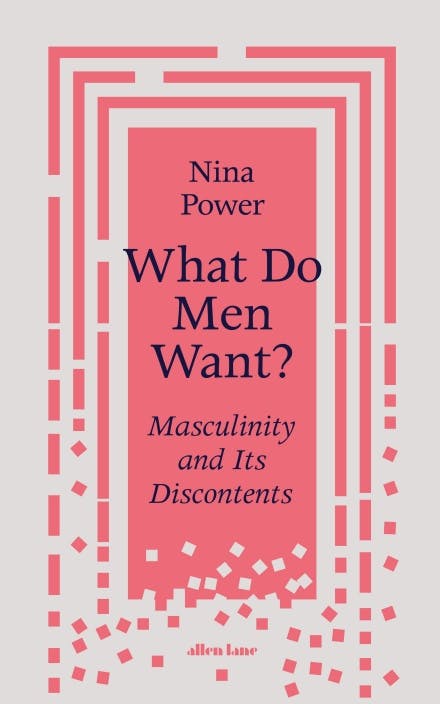
“Most men are, like most women, a mixture of good and bad, but they are not, as a rule, irredeemable,” Power notes.
Indeed, if there is ever to be a reconciliation between men and women, it may require considering the interests, needs and desires of good men, rather than a laser focus on the bad.
What then, do men want?
When Power asked her male friends this incredibly leading question, the responses ranged from “To be left alone” to “Pussy” to “Beer”. However, the real answer seems to be: something to do.
Power writes, “It is hard to imagine how the role [of men] today could be any more evacuated of meaning or status.”
The old-fashioned role of the Patriarch has been dead for at least one full generation now, and we haven’t really found an adequate replacement. The result is that men are adrift in a state of nihilism. In pop culture men seem to play the role of the “horny jester” to the self-serious goals of feminine social change. But men aren’t just interested in sex and frivolity; they also want a life of meaning.
The consequences of this listlessness are all too evident. Men are vastly overrepresented in statistics on suicide, unemployment, drug overdoses and crime.
Most men aren’t violent, but they are far more violent than women. Women are sometimes the target of this violence, but far more often men take out their pent-up aggression and sadism on other men. Often, we are told to blame these pathologies on “toxic masculinity” — that men need to be liberated from their preferences and to embrace the feminine ideals of tenderness, openness and sociability.
This solution sees sex difference as an irrelevancy, merely a reified founding myth of hegemonic masculinity, perfectly capable of tinkering. For Power, this approach is exceedingly cruel, failing to accept men as embodied creatures with a distinct way of experiencing the world:
To describe masculinity as “toxic” is to suggest that not only have men been poisoned, but that they are extending their poison to the rest of society.
This recent call to feminise men also didn’t occur in a vacuum.
There has been a significant decline in the needs for physical labour in Western countries since the turn of the century. Our increasingly service-oriented, tech-mediated economy requires very different temperaments, often drawing on the feminine virtues of empathic communication.
For Power, these broader structural changes have meant “certain kinds of behaviour come to be rewarded over others”.
Whilst we can’t turn back the clock, this re-evaluation of the role of men in society should be done in a manner which respects the dignity of men as different from woman.
January 21, 2022
QotD: Wrecking online civility is merely a byproduct
Turning people into hateful shitheads raging in echo chambers is just a side effect.
Tamara Keel, Twitter, 2021-10-19.
January 20, 2022
“The new music market is actually shrinking. All the growth in the market is coming from old songs”
As a certified (certifiable?) old pharte, I have to admit I pretty much stopped listening to “new” music on the radio the year my son was born, so I certainly listen to a lot of music from my younger years, but apparently even young people today are also more inclined to listen to music from before they were born:
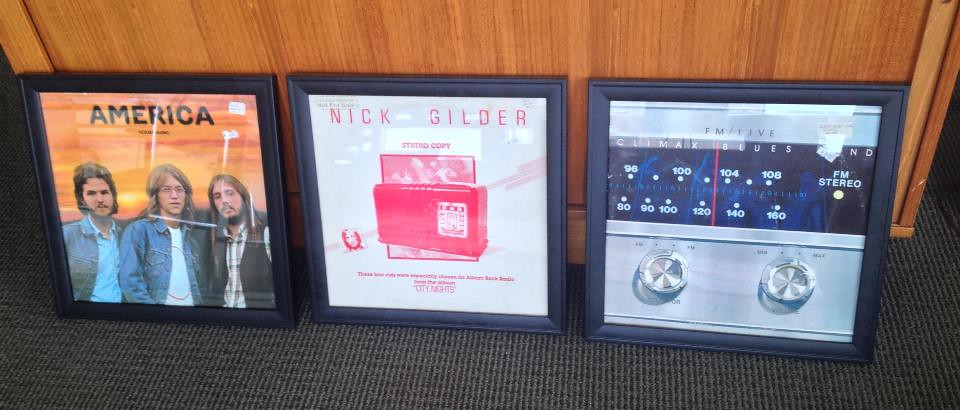
“Framed Vinyl Album Art: America ‘Homecoming’; Nick Gilder (Studio Copy of Singles From ‘City Lights’ Chosen for AOR); Climax Blues Band ‘FM Live’)” by JoeInSouthernCA is licensed under CC BY-ND 2.0


I had a hunch that old songs were taking over music streaming platforms — but even I was shocked when I saw the most recent numbers. According to MRC Data, old songs now represent 70% of the US music market.
Those who make a living from new music — especially that endangered species known as the working musician — have to look on these figures with fear and trembling.
But the news gets worse.
The new music market is actually shrinking. All the growth in the market is coming from old songs.
Just consider these facts: the 200 most popular tracks now account for less than 5% of total streams. It was twice that rate just three years ago. And the mix of songs actually purchased by consumers is even more tilted to older music — the current list of most downloaded tracks on iTunes is filled with the names of bands from the last century, such as Creedence Clearwater and The Police.
I saw it myself last week at a retail store, where the youngster at the cash register was singing along with Sting on “Message in a Bottle” (a hit from 1979) as it blasted on the radio. A few days earlier, I had a similar experience at a local diner, where the entire staff was under thirty but every song more than forty years old. I asked my server: “Why are you playing this old music?” She looked at me in surprise before answering: “Oh, I like these songs.”
The reasons are complex — more than just the appeal of old tunes — but the end result is unmistakable: Never before in history have new tracks attained hit status while generating so little cultural impact. In fact, the audience seems to be embracing en masse the hits of decades past. Success was always short-lived in the music business, but now it hardly makes a ripple on the attention spans of the mass market.
H/T to Althouse for the link.
“McLuhan came to be regarded by the Baby Boomer generation as a guru and prophet; a visionary who had discovered something profound, not merely about the media, but about life and the universe”
In Quillette, Graham Majin looks at the life and works of Marshall McLuhan:
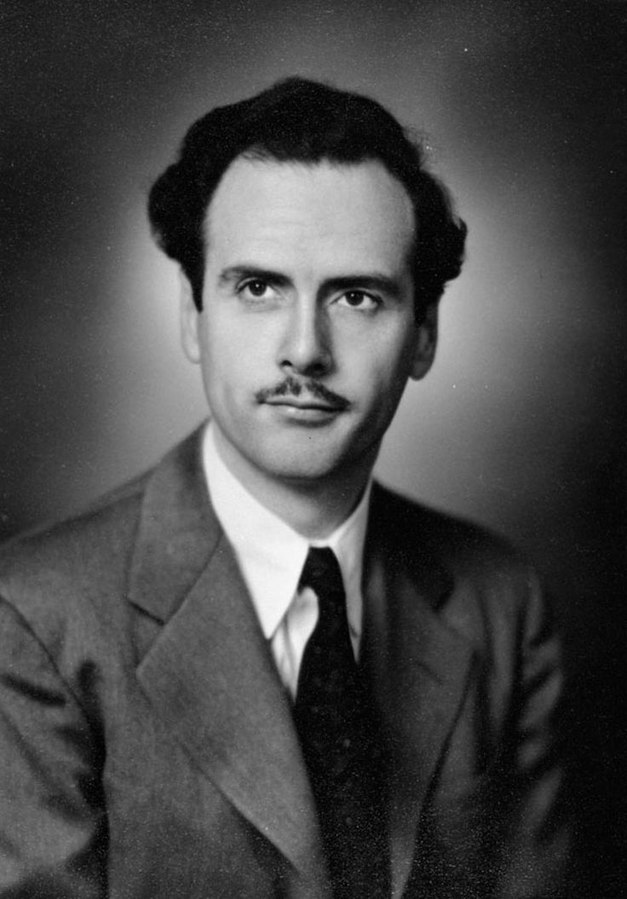
Marshall McLuhan, 1945.
Library and Archives Canada reference number PA-172791 via Wikimedia Commons.
The media ecosystem of the early 21st century is marked by a collapse of trust in journalism. How did we get here? As we look back, like a detective searching for clues, one moment stands out as significant; the publication on March 1st, 1962, of The Gutenberg Galaxy, written by a then-obscure Canadian academic named Marshall McLuhan. This book set in motion a line of falling dominoes, the consequences of which continue to affect us profoundly today.
McLuhan came to be regarded by the Baby Boomer generation as a guru and prophet; a visionary who had discovered something profound, not merely about the media, but about life and the universe. During the 1960s, he became a major celebrity, especially in the US. He featured on the cover of Newsweek magazine, was frequently interviewed on TV, and made a cameo appearance in Woody Allen’s 1977 movie Annie Hall. There was even a prog rock band named in his honor. The American media historian Aniko Bodroghkozy writes that “no other figure who was not of the movement itself received so much positive notice in the alternative newspapers that served dissident youth communities.” In 1965, the celebrity journalist Tom Wolfe asked breathlessly, “Suppose he is what he sounds like, the most important thinker since Newton, Darwin, Freud, Einstein, Pavlov?” Wolfe described McLuhan as an almost Christ-like figure:
A lot of McLuhanites have started speaking of him as a prophet. It is only partly his visions of the future. It is more his extraordinary attitude, his demeanor, his qualities of monomania, of mission. He doesn’t debate other scholars, much less TV executives. He is not competing for status; he is alone on a vast unseen terrain, the walker through walls, the X-ray eye.
Writing in 1967, John Quirk agreed that McLuhan was a “savant and prophet” and explained that, “McLuhanites hold that the new technologies will lend men the awareness and instruments necessary to solve contemporary problems and inaugurate a bright new era.” McLuhan was a master of the catchy one-liner and the original source of Timothy Leary’s famous counterculture catchphrase, “Turn on, tune in, drop out.”
McLuhan’s division of media into two types was certainly influential although that influence wasn’t particularly useful:
In The Gutenberg Galaxy, McLuhan observed that the decline of Catholicism, the rise of Protestantism, and the drift towards secularism all coincided with the development of printing. He hypothesized that the invention of printing had produced the European Enlightenment and Victorian liberal democracy. It was not what was printed, but printing itself that was responsible. McLuhan classified all media into two types: “hot” and “cool”. Printed books and newspapers, he suggested, were “hot” because they were bursting with information. Pre-Renaissance forms of communication, on the other hand, like the spoken Catholic Mass, were “cool”. This was because the Mass was spoken in Latin and hence contained little or no information that ordinary people could understand. Handwritten books were also categorized as “cool”.
Baby Boomers were quite receptive to McLuhan’s message, as it told them very much the sort of thing they wanted to hear:
He had produced a Boomer-friendly, sanitized version of his thesis in which magic and fantasy replaced religion. He also took care to flatter his Boomer audience by telling them that they were uniquely in tune with a deeper reality their parents could not see or understand. “We of the TV age,” he wrote, “are cool. The waltz was a hot, fast mechanical dance suited to the industrial time in its moods of pomp and circumstance. In contrast, the Twist is a cool, involved and chatty form of improvised gesture.”
McLuhan told the Boomers that they might appear irrational to their parents, but this was simply because the old generation was raised on obsolete “hot” media. As a result, he said, they had lost touch with their emotional side and become unnaturally rational and impartial: “Phonetic culture endows men with the means of repressing their feelings and emotions when engaged in action. To act without reacting, without involvement, is the peculiar advantage of Western literate man.”
McLuhan was a key influence on the Boomers, but his ideas failed when logically analyzed:
Trying to deconstruct McLuhan’s arguments reveals glaring absurdities. For example, it is self-defeating to claim that the content of a message is unimportant. On the contrary, all messages must convey information which corresponds with, or claims to correspond with, some state of affairs in the real world if they are to be useful. A news article without news, a weather forecast that does not mention the weather, or a traffic report lacking information about traffic might all be deliciously McLuhanesque, but they are not helpful. Even the Bible, revered by McLuhan, would be meaningless if it were merely a book of random words and blank pages. As Finklestein summarized, McLuhan’s argument is “absurd, when analyzed.”
McLuhan might well be the patron saint of fake news.
January 18, 2022
Decadence
In the latest Libertarian Enterprise, Sarah Hoyt considers the old Soviet put-down of all of western culture (especially the American one) … that it was decadent:
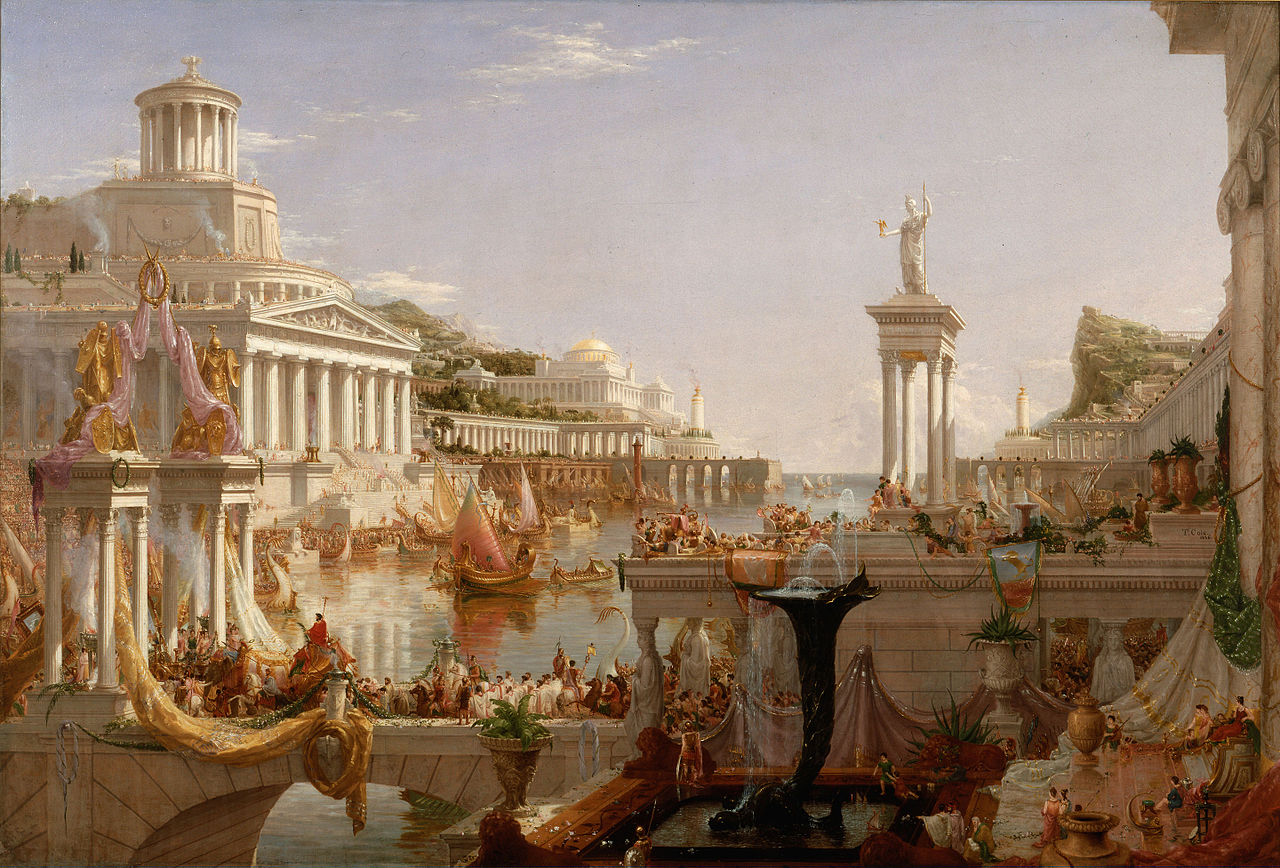
“The Consummation of Empire” from the painting series “The Course of Empire” by Thomas Cole (1801-1848).
New York HIstorical Society collection via Wikimedia Commons.
Yes, sure. I hear any number of you gnashing your teeth on that side of the screen: the soft living, the snowflakery in — mostly — our universities, the demands that everyone cater to them, people being completely terrified of a bad cold. Oh, yeah, rampant crime and bad sexual morals. We’re OBVIOUSLY decadent. How can I make fun of it?
Very easily.
For one your gnashing of teeth rhymes eerily with Romans gnashing of teeth for millennia, long before Rome was anywhere near ripe to fall, and in fact while Rome was the bad ass of the world. Second, it echoes even more eerily all of the Christian explanations of why Rome fell, which curiously also echoed the Christian beliefs in the loss of paradise.
“Decadence is sinfulness, and then comes the end and only G-d can save you” is the narrative there. Which is fine, in a spiritual sense, and completely bonkers insane when it applies to cultures and history. But it served the nascent theocracy that replaced Rome quite well. One of the things it served was to explain why life was now much, much harder. Because you know, abundance is what leads to decadence. Life is too soft, you don’t work hard enough and … bam! suddenly you’re in the middle of an orgy or worshiping a goat or something. Never you mind that the Romans pretty much did that all along, even when they were the badasses of the world. It’s really easy to shape the history of a fallen civilization so it suits the purposes of its successor.
Which brings us to the fact that Communism is a Christian heresy, complete with paradise — the supposed egalitarian and property-free pre-history (it’s also really easy to shape a period that left no account of itself that we can find) — until greed — and in one version PATRIARCHY and in another “whiteness” WTF that means — kicked us out of it. Now we must force the perfect human (Homo Sovieticus!) to emerge, so we can go back to living in caves in (sing it) perfect harmony. (Yeah.)
The complaints of decadence I heard as a young woman were mostly Soviet Agit Prop. Yes, yours were too. They ranged from incoherent to frigging insane. Some of it was a very old rhyming chorus: Americans were decadent because they were too rich. They had too many choices. They were too immoral. They never had enough, and would commit crimes to be richer. They ate too much, drove too much, slept in too comfortable a bed, and in general were DECADENT. Just like Rome before it fell. (If you realize the actual structure of Imperial Rome was closer to the Soviet Union’s, a plunder culture that could only survive by stealing, the whole thing will take your breath away with its chutzpah.
The fact that our (even though at the time it was your, as I was a foreigner at least in some ways) entertainment and art echoed these crazy accusations only made the whole thing stick, so even the right, American loving side (which anyway always has a vast side of puritanism in America. And speaking of puritans, let’s talk about what some of them did to … turkeys? If weird sexual kinks are a sign of decadence, we’ve never been non-decadent) bought into it. I mean Spartacus (the novel) portrait of the decadence of Rome was meant to echo how bad America was. What’s that I hear? The author was a communist? You. Don’t. Say. I think I sent my shocked face out to be mended, but I won’t be a sec while I retrieve it.
In a more personal sense, my own family told me Portugal too was decadent. Why, unlike mom, I didn’t have to walk beside the train line to pick up enough coal for the family to cook. We had butane bottles delivered, even if they were super expensive, so we often cooked on a petrol lamp in the patio, if the weather was fine.
Decadent and soft living, I tell you. Sure, the bathroom was outside, but it was a bathroom, with running water included. JUST like Rome before the fall. How much longer till we started screwing Nightingales’ Tongues, eating Bear Sausages and electing horses to congress (I think in America we’ve been doing that all along, too. Though I’d prefer if every now and then we elected the front half of the horse.)
January 15, 2022
QotD: “Jack Ketch as Eugenist”
The murder rate is very low in England, perhaps the lowest in the world. It is low because nearly all the potential ancestors of murderers were hanged or exiled in the Eighteenth Century. Why is it so high in the United States? Because most of the potential ancestors of murderers, in the late Eighteenth and early Nineteenth Centuries were not hanged. And why did they escape? For two plain reasons. First, the existing government was too weak to track them down and execute them, especially in the West. Second, the qualities of daring and enterprise that went with their murderousness were so valuable that it was socially profitable to overlook their homicides. In other words the job of occupying and organizing the vast domain of the new Republic was one that demanded the aid of men who, among other things, occasionally butchered their fellow men. The butchering had to be winked at in order to get their help. Thus the murder rate, on the frontier, rose to unprecedented heights, while the execution rate remained very low. Probably 100,000 men altogether were murdered in the territory west of the Ohio between 1776 and 1865; probably not 100 murderers were formally executed. When they were punished at all, it was by other murderers — and this left the strain unimpaired.
H.L. Mencken, “Miscellaneous Notes: Jack Ketch as Eugenist”, Prejudices: Fifth Series, 1926.
January 11, 2022
QotD: The decline of the “Blimp class” in the British empire
Thirty years ago the Blimp class was already losing its vitality. The middle-class families celebrated by Kipling, the prolific lowbrow families whose sons officered the army and navy and swarmed over all the waste places of the earth from the Yukon to the Irrawaddy, were dwindling before 1914. The thing that had killed them was the telegraph. In a narrowing world, more and more governed from Whitehall, there was every year less room for individual initiative. Men like Clive, Nelson, Nicholson, Gordon would find no place for themselves in the modern British Empire. By 1920 nearly every inch of the colonial empire was in the grip of Whitehall. Well-meaning, over-civilized men, in dark suits and black felt hats, with neatly rolled umbrellas crooked over the left forearm, were imposing their constipated view of life on Malaya and Nigeria, Mombasa and Mandalay. The one-time empire builders were reduced to the status of clerks, buried deeper and deeper under mounds of paper and red tape. In the early ‘twenties one could see, all over the Empire, the older officials, who had known more spacious days, writhing impotently under the changes that were happening. From that time onwards it has been next door to impossible to induce young men of spirit to take any part in imperial administration. And what was true of the official world was true also of the commercial. The great monopoly companies swallowed up hosts of petty traders. Instead of going out to trade adventurously in the Indies one went to an office stool in Bombay or Singapore. And life in Bombay or Singapore was actually duller and safer than life in London. Imperialist sentiment remained strong in the middle class, chiefly owing to family tradition, but the job of administering the Empire had ceased to appeal. Few able men went east of Suez if there was any way of avoiding it.
George Orwell, “The Lion And The Unicorn: Socialism and the English Genius”, 1941-02-19.
January 7, 2022
QotD: British intelligentsia and imperial decline
It should be noted that there is now no intelligentsia that is not in some sense “Left”. Perhaps the last right-wing intellectual was T.E. Lawrence. Since about 1930 everyone describable as an “intellectual” has lived in a state of chronic discontent with the existing order. Necessarily so, because society as it was constituted had no room for him. In an Empire that was simply stagnant, neither being developed nor falling to pieces, and in an England ruled by people whose chief asset was their stupidity, to be “clever” was to be suspect. If you had the kind of brain that could understand the poems of T.S. Eliot or the theories of Karl Marx, the higher-ups would see to it that you were kept out of any important job. The intellectuals could find a function for themselves only in the literary reviews and the left-wing political parties.
The mentality of the English left-wing intelligentsia can be studied in half a dozen weekly and monthly papers. The immediately striking thing about all these papers is their generally negative, querulous attitude, their complete lack at all times of any constructive suggestion. There is little in them except the irresponsible carping of people who have never been and never expect to be in a position of power. Another marked characteristic is the emotional shallowness of people who live in a world of ideas and have little contact with physical reality. Many intellectuals of the Left were flabbily pacifist up to 1935, shrieked for war against Germany in the years 1935-9, and then promptly cooled off when the war started. It is broadly though not precisely true that the people who were most “anti-Fascist” during the Spanish civil war are most defeatist now. And underlying this is the really important fact about so many of the English intelligentsia – their severance from the common culture of the country.
George Orwell, “The Lion And The Unicorn: Socialism and the English Genius”, 1941-02-19.
January 4, 2022
Jim Morrison’s surprisingly long cultural shadow
In City Journal, Ian Penman considers the paradox of Jim Morrison’s brief period of musical and cultural stardom yet seemingly endless echoes in popular culture:
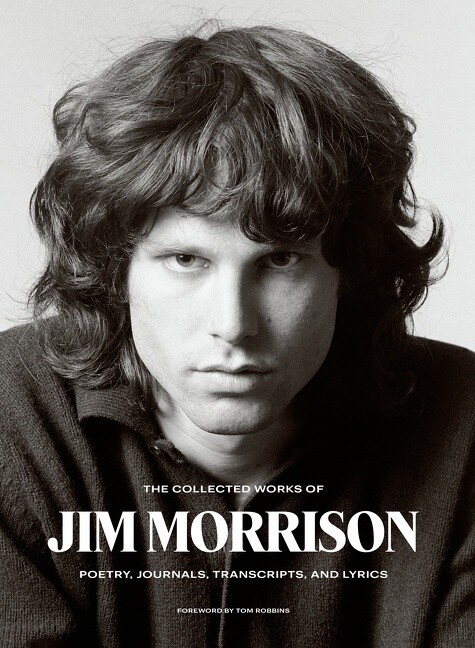
Jim Morrison’s bright spotlight time with The Doors lasted not quite five years: the band’s debut album arrived in January 1967, and L.A. Woman, the final work to feature the singer, was released the week of his death, aged 27, on July 3, 1971.
It’s now a half century since Morrison died in Paris in opaquely squalid circumstances, due to — take your pick — some mixture of alcohol, heroin, a small respiratory infection, and a general (not to say studied) carelessness. “When the music’s over / turn out the lights,” he sang in 1967, on The Doors’ second album, Strange Days. “Cancel my subscription / to the Resurrection.” Yet his revenant career as all-purpose Dionysian icon seems inexhaustible. From the posthumous album An American Prayer (1978) and The Doors’ soundtrack appearance on Francis Ford Coppola’s Apocalypse Now (1979), to the serial publication of various “lost” Morrison writings and the lamentable Oliver Stone biopic The Doors (1991), there’s no medium that Morrison’s shade hasn’t found a way to inhabit. More recently, hip L.A. chanteuse Lana del Rey sang: “Living like Jim Morrison / Heading for a fucked-up holiday.” And now we have a figuratively and literally heavy 600-page tome, like a chic designer sarcophagus, with Harper’s publication of The Collected Works of Jim Morrison. Not designed for casual riffling, it should really come with its own lectern or pulpit. It’s hard to know whom this kind of swanky item is aimed at, but it’s a palpable attempt (in the current lingo) to secure Morrison’s legacy: to fix him as more than just this crazy dude who had a few glorious hits and looked sensational in leather pants.
What accounts for such a thriving afterlife? Why is there still such a halo around Morrison’s shaggy head when a cursory examination might suggest a fatally date-stamped cultural figure? How does this Nietzsche-quoting white bluesman and would-be shaman fit into today’s culturally disputatious landscape? A memory is being conjured, but is everything as straightforward as it looks?
Born in December 1943, the young James Douglas Morrison was the son of a career Navy man who bequeathed his firstborn son a middle name honoring no less a figure than General Douglas MacArthur. Constantly on the move from base to base with his family, with no real hometown or settled circle of friends, young James turned to books and music to forge a sense of self-possession. Pursuing the then-prevalent ethos of pop existentialism (via Camus, Nietzsche, and Genet) allowed Morrison to view his own deracinated life as a Sisyphean trial. Unlike many such adolescents, however, Morrison seems actually to have read all the key texts — and a lot more besides. He was particularly taken with doomed poets, demonology, and Greek myth.
This was a cultural moment between the declamatory Beats and rock and roll proper, with European authors all the rage in cheap, widely available paperbacks. The shy, pudgy, bookish James slowly became charismatic Jim in waiting, splicing together a wild strain of Rimbaud and Baudelaire, American blues and Native American shamanism. Such borrowings are likely to be chided these days for over-easy appropriation of other cultures; but at the time, it may have had less to do with privilege than a tentative questing for something larger than the self — less to do with the cliché of rebelling against conformity than a way of locating something to worship in a time and place that was big on prosperity but had little sense of the sacred. Morrison found it in American blues and European literature, and what eventually appeared was his own kind of two-headed soul music: The Doors’ debut album made space for covers of both Howlin’ Wolf’s “Back Door Man” and Brecht/Weill’s “Alabama Song”. Morrison opened a door onto a threshold space that he would call his “bright midnight”: a sublime European Romanticism transplanted to a very American plain of cars, bars, deserts, and beaches — The Golden Bough on the Billboard chart.
The founding myth of Morrison’s short, intense life occurred when he was only a child. In 1947, the four-year-old Morrison was on a family road trip somewhere in the desert between Albuquerque and Santa Fe, and they passed the scene of a horrific traffic accident, involving a truckload of Indian workers. He claimed that he felt the spirit of one of the dead Indians enter him and take up residence as storm clouds unfurled overhead: “Indians scattered on dawn’s hi-way bleeding / Ghosts crowd the young child’s fragile egg-shell mind.” This scene contains all the elements that he would later obsessively return to in song, poetry, and film. A car in motion. Blood, sand, and death. Ghost whispers and gigantic skies. Here is a liminal scene more real than the polite society he’s being raised in. Nothing quite so full of life for these young inquiring eyes as this moment of messy extinction. A primal landscape, with the figure of the bewildered but awakened man-child set against it: enormous horizons outside, the child’s intently fascinated gaze within. “It was the first time I discovered death.”
December 29, 2021
QotD: The pervasive infantilization of the “elites”
We’ll get there, fear not. But the appeal of Harry Potter absolutely eludes me. I’m sure it’s a charming enough story, but … it’s kid stuff, and they’re not reading it with their kids, because they don’t have kids. And it’s really creepy, y’all, how seriously they take this kids’ stuff. As Vizzini pointed out yesterday, the very mature deep thinkers in the Totally Legit Joe regime are whiling away their hours behind the razor wire by choosing spirit animals for themselves, based on their favorite Harry Potter characters. And while that is absolutely the kind of thing those imbeciles should be doing, instead of attempting to govern, not a one of them is under age 40 (Jen Psaki, for instance, is 43 — and also, according to anonymous White House sources, a “wild cat”; make of that information what you will).
Part of it is just the infantilization of American culture, of course, but it’s strange and disturbing how the more educated, professional classes seem to be not just more infantile than the hoi polloi, but much more passionate about it, too. I know a senior ER doc at a big hospital, for instance, who is waaaaay into Star Wars. And I don’t mean Star Wars collectibles, though of course he has a bunch of those, and as silly as that is in itself (guilty as charged; let me show you my baseball cards sometime).
I mean the dude is just really, really, really into Star Wars. He’s got Star Wars shit all over his house … his huge, grossly expensive, “befitting a senior trauma surgeon whose wife is also a big league university administrator” house, in the toniest part of town, to which he routinely invites other big league people, including — for professional purposes — politicians and powerful apparatchiks. And let me hasten to add, he’s not House MD, whose abrasive “quirks” are tolerated because of his preternatural genius. This guy is, himself, a slick political operator; he’s got plenty of social savvy. But … he’s also got a scale model Millennium Falcon hanging from the roof in the dining room.
I’m sure there’s an explanation for how nobody but me seems to find this really, deeply, disturbingly fucking odd … but there it is.
Severian, “The One Pop Culture Thing”, Rotten Chestnuts, 2021-09-16.
December 17, 2021
QotD: The Kafkatrap that is known as “white feminism”
Many describe Franz Kafka’s disenchanted fables as tragic. And this is certainly true. But they are also farcical. To watch someone being relentlessly wrong can be grimly enjoyable — as long as you’re not the person in question.
The term white feminism, as it is commonly used today, is a classic example of the Kafka Trap. If you show too much interest in the lives of people of colour, you risk being accused of white saviourism — which is another way of saying you have a suspiciously condescending attitude to people of colour. But if you don’t show enough interest, you are insufficiently intersectional. You only care about the white, middle-class cisgendered women in your social circle.
White feminism is a classic example of the Kafka Trap because whatever you do is either too much or not enough. You are never right.
Tomiwa Owolade, “The problem with white saviours”, UnHerd.com, 2021-09-12.
December 13, 2021
QotD: Cultural undermining of the British “establishment” was effectively complete by 1970
[…]
It also made the middle class, especially the educated and well-off middle class, despise themselves and feel a sort of shame for their supposedly elitist prejudices, based upon injustice and undermined by their failure to defend the nation from its enemies in the era of appeasement. Thanks to this, in another paradox, they have often felt unable to defend things within Britain which they value and which help to keep them in existence, from the grammar schools to good manners. They are ashamed of being higher up the scale, though for most middle-class people this is more a matter of merit than birth, and nothing to be ashamed of at all.
[…]
Since the 1960s, when the Left began its conquest of the cultural battlements, it has always been surprised and annoyed by Tory election victories. The 1970 Tory triumph, though entirely predictable, took the cultural establishment by surprise. The 1979 Tory win, though even more predictable, infuriated them. They had won control of broadcasting, of the schools, of the universities, the church, the artistic, musical and architectural establishment? How was it possible that they could not also be the government? Their rage was enormous, and increased with each successive Labour defeat. It was an injustice. How could the people be so foolish? Now, instead of aristocratic snobs misgoverning the country, the establishment was portrayed as a sort of fascistic semi-dictatorship, hacking at the NHS and the welfare state, waging aggressive wars abroad and enriching itself while the poor lived in misery.
This series of falsehoods has now become a weapon ready and waiting for unscrupulous demagogues to harness, and perhaps use against the new “establishment” which has benefited so much from the satire boom and the alternative comedians. Once you have begun to use dishonest mockery as a weapon, you can never be entirely sure that it will not eventually be turned against you, by others who have learned that abuse and jeering pay much easier and swifter dividends than hard fact or serious argument. It could be that the civilized mirth of the sixties leads in a direct line to the crude hyena cackling of the mob. In any case, there is no sign of the humour industry taking the side of traditional morality, patriotism or civility. The best it can do is dignify itself with noisy and public collections for sentimental and prominent charity. Once you step beyond the fringe, you sooner or later find yourself in very wild country indeed.
Peter Hitchens, The Abolition of Britain, 1988.


