
Overly Sarcastic Productions
Published on 7 Aug 2017There’s a fascinating history from just northwest of American history that is too often ignored. But that’s a damn shame, because it’s a damn cool history, and I’m going to talk about it dammit!
No, I didn’t accidentally misspell the title of this video when I sleepily uploaded this after I woke up. That’s absurd.
EXTRA CREDITS: HIAWATHA: https://youtu.be/79RApCgwZFw
This video was produced with assistance from the Boston University Undergraduate Research Opportunities Program.
PATREON: http://www.patreon.com/OSP
February 12, 2019
History Summarized: Iroquois Native Americans
Comments Off on History Summarized: Iroquois Native Americans
January 2, 2019
QotD: The early United States
I’ve been reading Gordon Wood’s Empire of Liberty (2009), the best one-volume history of the very early American republic in the years between the enactment of the Constitution and the end of the War of 1812. In many ways, I notice, this story has the structure of an enormous joke. The American revolution was wrought by wealthy landowners, many of whom hoped to reproduce the hierarchical, agrarian lifestyle of the English countryside in the New World. These people became the early Federalists: they largely wanted to mimic the world of old Europe, only with themselves on top as rentiers, eschewing labour and trade alike.
But they had sown the wind. The commercial and intellectual forces they set in motion created a new, chaotic, competitive, egalitarian kind of society. And one way this manifested itself was as a media crisis. The Revolution overthrew all established authority, or tended to, and created the conditions for an unfamiliar kind of unregulated, rampant press — an ecosystem full of lies, partisanship, personal abuse, and scurrility.
Even those who made sneaky use of this new system, like Thomas Jefferson, left testimonies to their overall exhaustion and confusion as literate, curious people. You get the impression that being a reader in that time and place, with rumours of wars and tales of corruption zinging around, was hard work.
Colby Cosh, “In 2017, when the shooting stops, the media warfare begins”, National Post, 2017-02-02.
Comments Off on QotD: The early United States
December 5, 2018
QotD: Patriotism
Once upon a time, patriotism was a fairly simple thing. It was tribal identification writ large, an emotional attachment to a people and their land. In most of the world, where patriotism exists at all it’s still like this — tribal patriotism, blood-and-soil emotionalism.
A different kind of patriotism emerged from the American and French revolutions. While American patriotism sometimes taps into tribal emotion, it is not fundamentally of that kind. Far more American is the sentiment Benjamin Franklin expressed: “Where liberty dwells, there is my country”
Thus, most Americans love their country in a more conditional way — not as a thing in itself, but insofar as it embodies core ideas about liberty. It is in the same spirit that our Presidents and miltary officers and naturalizing citizens swear to defend, not the land or people of the United States but its Constitution — a political compact. This is adaptive in many ways; one of them is that tribal patriotism is difficult to nourish in a nation of immigrants.
In France, the ideology of the Revolution displaced tribal patriotism, just as it did in the U.S. But the French, roiled by political instability and war, have never settled on a political unifying idea or constitutional touchstone. Instead, French patriotism expresses a loyalty to French language and culture and history. It replaces tribalism not with idealism but with culturism.
America and France are a marked contrast with, say, Denmark. I chose Denmark at random from the class of civilized countries in which patriotism is still fundamentally tribal. You don’t become a Danish patriot by revering the constitution or culture of Denmark; you become one by being a Dane. Which partly means being a tribesman, connected to the Danish gene pool, and partly means identifying with stories of past Danish heroism.
It hasn’t been easy to find a fire-breathing Danish patriot for at least fifty years, though. One of the effects of the terrible convulsions of the 20th century has been to discredit tribal patriotism. Many people in Europe, not unreasonably, associate it with racism and Naziism and are suspicious of anything that smacks of immoderate patriotism.
Eric S. Raymond, “Patriotism And Its Pathologies”, Armed and Dangerous, 2008-07-09.
Comments Off on QotD: Patriotism
December 3, 2018
Eric Swalwell’s Kinsley gaffe
If you haven’t encountered it, a “Kinsley gaffe” is where a politician accidentally tells the truth (Wikipedia). Newly elected US member of the House of Representatives Eric Swalwell committed a classic Kinsley gaffe in an online discussion on social media, as Jeff Fullerton explains:
Democratic representative Eric Swalwell made a really provocative statement this week according to an article from Hot Air. Pretty much serving notice that: If we confiscate your guns and you fight back, we will nuke you.
Representative Swalwell sort of gives a disclaimer that he he was not actually advocating nuking Texas or some other disobedient red state or region — but merely trying to make a point in the fashion of the Borg from Star Trek; that resistance is futile and it is the lot of us all to be assimilated — against our will if necessary. The author of the article from Hot Air points out something that my friend and mentor Bruce the Historian pointed out long ago; that there are an awful lot weapons in the hands of private citizens capable of making it hell on earth for any federal troops deployed to disarm the population or engage in the collectivization of property and resources in a martial law scenario. Or forced relocation of people. That’s the real reason they want everyone disarmed. They know from experiences in Vietnam and the “Forever War” in the Middle East; that cracking down with overwhelming force has its limits and once they put off a nuke to burn a town in Texas they might have to burn every square mile of the nation to put an end to the uprising.
Talk about excessive force!
That they’d even talk at all about using a nuclear weapon to put down an internal insurrection proves beyond the shadow of doubt that power hungry politicians are a far deadlier existential threat to us all than any crazed mass shooter or terrorist could ever hope to be!
This congress creature bases his argument on a fallacy which is common assumption among the political class: that because the federal government is capable of mustering overwhelming force — the Second Amendment is obsolete anyway. He already contradicts himself for if we the people are impotent against the overwhelming fire and manpower of the Army and the bombs and missiles of the Air Force — then why are people like him so adamant about disarming the average Joe? I think I already answered that one. […]
There is also the issue of the military itself that the political class ought to take into consideration. It may be less monolithic than assumed. Many of them still believe in the validity of the Constitution and would side with the resistance while others among the loyalist factions would have problems of conscience when it comes to mass slaughter of fellow Americans. Still others might be fearful of the consequences of being held accountable for atrocities or even treason if they end up on the losing side of things. To attack and kill your own people who you swore to serve and protect is a grievous betrayal. It is treason of the highest order and the punishment for that is death. So if you choose such a course of action and loose the fight; you go down in historic infamy to be remembered like the Nazi war criminals who stood before the Nuremberg tribunals. And you will probably [be] shot or hanged in a public execution!
Comments Off on Eric Swalwell’s Kinsley gaffe
October 11, 2018
QotD: The radical, right wing US Supreme Court
We don’t have a “radical right-wing Supreme Court,” despite lots of mewing on the left to the contrary. Here are some things that would be at the top of the list for a radical right-wing Court: (1) ban abortion nationwide as a violation of the right to life protected by the due process clause; (2) rule that publicly-provided (but not funded) education is unconstitutional because it inherently involves viewpoint discrimination by the government, or at least require vouchers for those who object to the public school curriculum; (3) overrule an 1898 precedent and completely abolish birthright citizenship; (4) Use the First Amendment as a sword to require “fairness” in the left-dominated media. Not only is the Supreme Court not about to do any of things, I don’t think any of these things would even get one vote on the current Court. Moreover, merely bringing the scope of Congress’s constitutional back to where it was, say, in 1935, which was already much broader than the original meaning of the Commerce power, probably wouldn’t get more than one or two votes. What you are looking at right now is a conservative Court that will only affect society on the margins, not a “radical right-wing” Court.
David Bernstein, “WE DON’T HAVE A ‘RADICAL RIGHT-WING SUPREME COURT'”, Instapundit, 2018-10-09.
Comments Off on QotD: The radical, right wing US Supreme Court
September 2, 2018
Amtrak service and the “takings” clause
Back in August, Fred Frailey reluctantly came to the conclusion that at some point American freight railways are going to have to challenge in court Amtrak’s legislated ability to pre-empt freight traffic on their networks:

Amtrak’s
Eastbound Empire Builder crossing Two Medicine Trestle at East Glacier MT on 20 July 2011.
Photo by Steve Wilson via Wikimedia Commons.
We all know about “taking the Fifth.” It’s our right under the Fifth Amendment to the U.S. Constitution not to be compelled to testify against ourselves. In other words, a court cannot force us to admit to driving 60 mph in a 45-mph zone (or something worse). That amendment has another, less-well-known clause, which says government cannot take away our property without just compensation. Lawyers know this as the “Takings Clause.” The Fifth came to mind the other day as I rode Amtrak’s Empire Builder from Seattle to Chicago. I’ll get to my point, but first the experience.
[…]
All of this did terrible things to our schedule-keeping. By the third morning, as the train approached Devils Lake, N.D., we were more than eight hours late (the next day’s eastbound Builder was even later). But imagine what the Empire Builder does to BNSF’s freights every day. The Amtrak Improvement Act of 1973 reads: “Except in an emergency, intercity passenger trains operated by or on behalf of [Amtrak] shall be accorded preference over freight trains in the use of any given line of track, junction, or crossing.”
BNSF appears totally committed to obedience of this law but doing so devours the capacity of this route. It’s not just that freights give way; whizzing along at a 79 mph versus 55 or 60 for the freights, the Empire Builder eats capacity as if it were two or three freights, Six high-priority Z trains prowl the northern Transcon every day, and I don’t think a single one of them that I observed was moving as we went by. One Z train was sandwiched between two stopped manifest trains, all making way for our Builder.
Obviously, Amtrak pays BNSF for the right to run trains over the freight railroad. But whatever it pays is but a fraction of the cost in delays to its own trains incurred by BNSF. Were the northern Transcon double-tracked all the way, these delays would obviously be minimized. But at $3 million or more a mile, double tracking consumes capital like a dry sponge, and it’s not Amtrak’s capital, either.
So now to my point: Isn’t it fair to say that Amtrak, which the U.S. Supreme Court in 2015 decreed to be an arm of government, is confiscating the property (track capacity) of host railroads? And if it is, shouldn’t the freight railroads be fairly compensated for the delays to their freights caused by the loss of this capacity? Try as I might to say otherwise, I am forced to answer “yes” to both questions.
Comments Off on Amtrak service and the “takings” clause
July 5, 2018
The soon-to-be-announced target of the two-minute unceasing hate
At Reason, Jacob Sullum says Trump did well with his first Supreme Court pick, and the unwillingness of Trump’s opponents to acknowledge that shows how much blind partisanship has gripped the left:
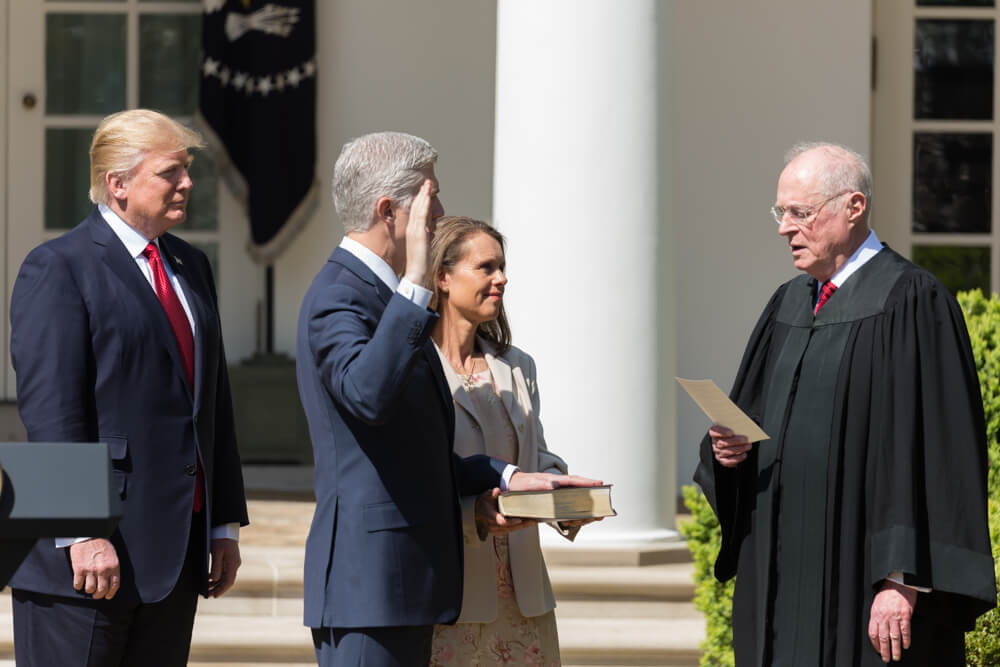
Anthony M. Kennedy, Associate Justice of the Supreme Court of the United States, swears in Supreme Court Justice Neil M. Gorsuch on Monday, April 10, 2017, in the Rose Garden of the White House in Washington, D.C. Also shown, Gorsuch’s wife Louise stands on stage holding a family Bible. Justice Gorsuch is the Supreme Court’s 113th justice.
White House photo via Wikimedia Commons.
“We have to STOP the next Trump nominee!” says a pop-up solicitation on People for the American Way’s website. Before you rush to “donate now,” you might want to consider the organization’s assessment of Trump’s last Supreme Court nominee.
“Far from being a fair-minded constitutionalist,” PFAW says, Neil Gorsuch “has proven to be a narrow-minded elitist who consistently votes in favor of corporations and the powerful.” The gap between that description and Gorsuch’s actual performance on the Court speaks volumes about the blind partisanship of Trump critics who care more about scoring political points than defending civil liberties.
PFAW is echoing the criticism of Democratic senators who worried, before Gorsuch was confirmed in April 2017, that he was not inclined to stand up for “the little guy.” Gorsuch’s record during a decade on the U.S. Court of Appeals for the 10th Circuit belied that claim, and his 15 months on the Supreme Court provide further evidence that he is not shy about defending the principles that protect politically disfavored individuals from the whims of the powerful.
In sharp contrast with the man who nominated him, Gorsuch worries about abuses of the government’s power to take people’s property “for public use.” In June 2017, when the Court declined to hear a case that raised the question of whether a state can impose limits on the “just compensation” it owes for takings under the Fifth Amendment, Gorsuch, joined by Clarence Thomas, urged his colleagues to address that issue at the “next opportunity.”
That pairing was notable because Gorsuch is on record as admiring Thomas’s passionate dissent from the widely condemned 2005 decision in which the Court approved the use of eminent domain to transfer property from one private owner to another in the name of economic development. Big businesses routinely use such arrangements to override the wishes of little people who get in the way of their plans.
Comments Off on The soon-to-be-announced target of the two-minute unceasing hate
June 2, 2018
YouTube Won’t Host Our Homemade Gun Video. So We Posted It on PornHub Instead.
ReasonTV
Published on 31 May 2018Reason has a new video out today explaining how to put together a homemade handgun using some very simple tools and parts you can buy online. But you won’t find it on our YouTube channel.
_____After the March for Our Lives rally, YouTube announced that it would no longer allow users to post videos that contain “instructions on manufacturing a firearm.”
Our video and its accompanying article are part of a package of stories in Reason‘s “Burn After Reading” issue. It includes a bunch of how-to’s, including how to bake pot brownies, how to use bitcoin anonymously, how to pick the lock on handcuffs, and how to hire an escort.
The whole issue is a celebration of free speech and our way of documenting how utterly futile of all kinds of prohibitions can be.
We made a video showing how easy it is to DIY a Glock because we wanted to show how the First Amendment reinforces the Second Amendment. If a bunch of journalists can build a handgun in their kitchen, we can assume it’ll be pretty hard to keep guns out of the hands of motivated criminals.
If YouTube prevents us from uploading the video, have they violated our First Amendment rights?
“YouTube of old days was this amazing thing that has become the digital library of Alexandria on the Internet,” says Karl Kasarda, the co-host of InRangeTV, a weekly YouTube show about guns. The show used to survive on ad revenue, until YouTube started de-monetizing certain forms of content. Once YouTube made it impossible for Kasarda to make money on its platform, he started posting his content to other places, including PornHub.
Last October Prager University, a conservative video production shop, sued YouTube, saying it had restricted the audience for content and alleging that the company was “unlawfully censoring its educational videos and discriminating against its right to freedom of speech.”
But here’s the thing: YouTube is a private platform. There is nothing in the First Amendment (or the Second) that requires them to host our gun video. Reason can turn down articles for any cause that we choose. We can do it because we don’t like the color of the author’s hair, or because we don’t like the font she used in her pitch email. We wouldn’t be violating a single constitutional right by doing so.
We wish YouTube would run our video. It’s awesome. But equally awesome is YouTube’s right — our right — not to run content we don’t like.
Karl Kasarda is correct that YouTube is the closest thing we have to the Library of Alexandria. It still doesn’t mean they have to carry our video.
YouTube is hardly the first to test this principle. In 1972, a teachers union president who was running for state legislature sued The Miami Herald, insisting it run an editorial he had written after he was attacked in its pages. The Supreme Court correctly ruled that ordering a newspaper to print an editorial violates the First Amendment. After all, a newspaper is “more than a passive receptacle.”
Prager University argued that YouTube isn’t entitled to the same editorial discretion as The Miami Herald because it advertises itself as a “platform for free expression” that’s “committed to fostering a community where everyone’s voice can be heard.” A federal judge, thankfully, dismissed the Prager lawsuit, rejecting the company’s argument that YouTube is comparable to a “government entity” and thus must be open-access. A slew of other judges have arrived at the same conclusion.
YouTube deserves the same editorial latitude those judges gave to The Miami Herald in the 1970s and that Reason enjoys today.
And that’s one of the things our new gun video is celebrating. If YouTube doesn’t want to post it to their site, its loss. We’ll just post it to another platform. That’s what the free and open internet is all about. So if you want to see our video, you can watch it here at Reason.com — or head over to PornHub and see how to make your very own unregistered firearm.
Links:
https://reason.com/archives/2018/05/31/how-to-legally-make-your-own-o
https://www.pornhub.com/view_video.php?viewkey=ph5b0460dc60380Edited by Todd Krainin. Narrated by Katherine Mangu-Ward. Written by Jim Epstein and Katherine Mangu-Ward. Cameras by Meredith Bragg.
Comments Off on YouTube Won’t Host Our Homemade Gun Video. So We Posted It on PornHub Instead.
April 14, 2018
Andrew Coyne asks “Why do we need a Senate?”
And the answer for anyone who’s lived through previous constitutional mud-wrestling is almost certainly going to be a variant of “We don’t, but to change it in any way means re-opening the entire constitution for revision and re-negotiation … thanks, but no thanks … we’ll put up with the Red Chamber of Irrelevance”:
More than two years after the Trudeau government introduced its system of “independent, merit-based” appointments to the Senate, transforming — so it was said — the Other Place from a house of patronage and partisanship to a house of virtue, the government’s “representative” in the Senate has given some thought to how it will all work.
In a 51-page discussion paper, Peter Harder offers his views on what role the Senate should play, as one of the last remaining appointed legislatures among the world’s democracies — and the most powerful, on paper — particularly in light of its changed circumstances. It makes for a fascinating, not to say hallucinatory read.
In Harder’s estimation, the past two-and-a-bit years have been something of a golden age of Senate legitimacy, a period in which it has rebuilt its credibility after what he plainly views as the dark age of partisanship that preceded it: a dark age that precisely coincides with the period of Conservative government.
The expense scandals, the epic confusion that followed the government’s half-considered reforms, the repeated episodes of brinksmanship as the newly envirtued Senate threatened to defeat this or that bill, these rate barely a mention, in Harder’s account, beside the Senate’s “robust bicameralism,” its “positive track record” and contributions that have been “effective, policy-oriented and always respectful of the role of the representative House of Commons.”
Ah yes. About that: if the Senate were so “always respectful” of their respective roles, it’s curious Harder should feel the need to spend 51 pages explaining what those roles are. But then, that is because it is so exquisitely complicated, so delicately subtle, requiring such a delicate balance.
Comments Off on Andrew Coyne asks “Why do we need a Senate?”
March 20, 2018
Free speech on the ropes
J.D. Tuccille says the right to freedom of speech isn’t dead, but it might not qualify for a new life insurance policy:
We have an environment in which the president of the United States is dismissive of the free speech rights of his opponents, prominent constitutional scholars sniff at free speech unless it’s used by the “right” people for their favored goals, and the country’s leading civil liberties organization is suffering an internal revolt by staffers who oppose “rigid” support for free speech protections.
Last October, President Trump said “It’s frankly disgusting the way the press is able to write whatever they want to write.” That came just hours after he tweeted, “With all of the Fake News coming out of NBC and the Networks, at what point is it appropriate to challenge their License? Bad for country!” And even before Trump took the oath of office, he’d huffed that protesters who burn American flags should face loss of citizenship or jail.
So if you’re an academic with expertise in constitutional law, and you have months to watch a populist politician who commands the power of the presidency fulminate about punishing those who criticize him, what do you do? If you’re Georgetown Law’s Louis Michael Seidman, you suggest that the president might be on to something.
In a forthcoming paper, Seidman’s main complaint is that free speech doesn’t inherently favor progressivism — it allows too much voice to people who disagree. “At its core, free speech law entrenches a social view at war with key progressive objectives,” writes Seidman.
Sure, “the speech right has instrumental utility in isolated cases,” he adds. But “significant upside potential”? Nah.
[…]
In its early days, the American Civil Liberties Union (ACLU) viewed free speech as a tool of social justice, suited to particular purposes under particular conditions,” wrote Weinrib, calling on the modern organization to rededicate itself to progressive political goals over civil libertarian advocacy.
The ACLU may be close to taking her advice. Last fall, about 200 of the organization’s staff members signed a letter objecting to the groups’ “rigid stance” on the First Amendment. The letter was characterized by former ACLU board member Michael Meyers as “a repudiation of free-speech principles.”
Huh. With a president who openly chafes at criticism and suggests media naysayers should be punished with the force of law, now seems like a perfect time for opponents to rally around unfettered debate and the First Amendment. Instead, lefty academics and activists are lining up to agree with Trump that a free press and individual rights to freedom of speech, belief, and association are indeed overrated overall.
Comments Off on Free speech on the ropes
March 1, 2018
South Africa to amend constitution to allow land expropriation without compensation
The South African parliament has voted overwhelmingly to change the nation’s constitution to allow the government to expropriate land without compensation:
The motion was brought by Julius Malema, leader of the radical Marxist opposition party the Economic Freedom Fighters, and passed overwhelmingly by 241 votes to 83 against. The only parties who did not support the motion were the Democratic Alliance, Freedom Front Plus, Cope and the African Christian Democratic Party.
It was amended but supported by the ruling African National Congress and new president Cyril Ramaphosa, who made land expropriation a key pillar of his policy platform after taking over from ousted PM Jacob Zuma earlier this month.
“The time for reconciliation is over. Now is the time for justice,” Malema was quoted by News24 as telling parliament. “We must ensure that we restore the dignity of our people without compensating the criminals who stole our land.”
According to Bloomberg, a 2017 government audit found white people owned 72 per cent of farmland in South Africa.
ANC deputy chief whip Dorries Eunice Dlakude said the party “recognises that the current policy instruments, including the willing-buyer willing-seller policy and other provisions of Section 25 of the Constitution may be hindering effective land reform”.
ANC rural affairs minister Gugile Nkwinti added: “The ANC unequivocally supports the principle of land expropriation without compensation. There is no doubt about it, land shall be expropriated without compensation.”
Thandeka Mbabama from the Democatic Alliance party, which opposed the motion, said there was a need to right the wrongs of the past but expropriation “cannot be part of the solution”.
“By arguing for expropriation without compensation, the ANC has been gifted the perfect scapegoat to explain away its own failure,” she said in a statement.
“Making this argument lets the ANC off the hook on the real impediments — corruption, bad policy and chronic underfunding. Expropriation without compensation would severely undermine the national economy, only hurting poor black people even further.”
Samizdata‘s Johnathan Pearce comments on the move:
The unfolding of South Africa’s history is a tragedy, and it is easy to see why there is an element of “score-settling” at work here. Apartheid, let it not be forgotten, was introduced in the late 1940s at the behest to some degree of the white trade union movement, keen to bolster its bargaining power. Even if you were a private entrepreneur who wanted to hire non-whites for certain jobs, for example, you couldn’t. (Minimum wage laws operated in ways that hurt, not helped, non-whites.) The system was as absurd and vile as the Jim Crow laws of the US, or other examples of serfdom and oppression down the ages. It had to go; for anyone who supports a free market economy, apartheid and its cousins are absurd as well as wrong.
But the solution of seizing white-owned land, regardless of the honesty or provenance of it, and giving it to people via a political carve-up, turns the injustices inherited from the old regime on their head, creating a new form of racism. Two wrongs do not make a right. And further, one suspects that the land seizures are an attempt to deflect attention from the failings of the existing regime. Compare and contrast how, for example, the “Asian tigers” threw off their old colonial masters and focused on getting seriously rich, not least by respecting property rights. And wherever one looks, there does seem a pretty tight correlation between respect for property rights – indeed their very existence – with prosperity and happiness more broadly. Hernando de Soto has made something of a career pushing the point that the world needs more property rights, spread among more people. (Check out this recent lecture by Niall Ferguson on the same sort of issue.)
Comments Off on South Africa to amend constitution to allow land expropriation without compensation
December 5, 2017
Happy Repeal Day!
Eighty-four years ago today, the US repealed Prohibition. Baltimore’s own H.L. Mencken was among the first to publicly celebrate the demise of the hated legislation:

Reason‘s Baylen Linnekin celebrates the federal anniversary, but points out that devolving powers to the various states hasn’t been quite a libertarian panacea:
[December 5th] will mark the 84th anniversary of the ratification of the Twenty-First Amendment, which repealed alcohol Prohibition. The repeal of Prohibition is worth celebrating, even if the amendment was (and remains) a deeply flawed vehicle.
The chief flaw with the Amendment is, as I wrote earlier this year, that it “simply shifted much of the power to prohibit and incessantly regulate alcohol from the federal government to the states.”
States have truly made the most of their teetotalitarian authority for decades, to the detriment of both alcohol producers and—much more so—consumers.
Much of the negative impacts of states’ approach to alcohol regulation can be tied to what’s known as the three-tier system, a Prohibition relic under which states generally prohibit direct alcohol sales from a brewer, vintner, or distiller to a consumer. The three-tier system mandates these alcohol producers first sell to a distributor or retailer — a mandatory middleman — who can then sell to actual drinkers.
Laws that require this approach create a host of problems, including, for one, that they drive up consumer costs dramatically and needlessly. States’ plenary control over alcohol has been controversial for decades, as this 1987 article in the Journal of Public Health Policy makes clear, noting that “the idea of a government monopoly of a consumer product seems odd and even bizarre[.]”
Great arguments in favor of scrapping the dreaded three-tier system are often countered by those who claim doing so will bring about the end of days, or worse.
Reposted from 2013:
ReasonTV
Published on 5 Dec 2012In honor of Repeal Day, which celebrates the end of America’s “noble experiment” in banning alcoholic beverages, Reason TV is happy to introduce you to George Cassiday, a man whose life and work should be taught to every schoolkid — and to every member of Congress hell-bent on legislating the nation’s morals.
From 1920 through 1930 — the thick of the Prohibition era — Cassiday supplied illegal liquor throughout the halls of Congress. Known as “The Man in the Green Hat,” Cassiday was the Capitol’s highest-profile bootlegger, with a client list that included senior members of the Republican and Democratic Parties. How instrumental was he to the D.C. power elite? He even had his own office in the House and Senate office buildings.
Cassiday gave up the liquor trade after his arrest in 1930, but gained notoriety by penning a series of front-page articles for The Washington Post about his days as Congress’ top bottle man.
Though he never named names, Cassiday’s stories detailed every aspect of his former business — and the depths of hypocrisy in Washington. By his own estimation, “four out of five senators and congressmen consume liquor either at their offices or their homes.” Appearing days before the 1930 mid-term elections, Cassiday’s revelations caused a national stir and helped sweep pro-Prohibitionist — and ostensibly tee-totaling — congressmen and senators out of power.
Today, with the rise of cocktail culture and prohibition-vogue in full swing, Cassiday’s life and legacy are being re-discovered. Through books such as Garrett Peck’s Prohibition in Washington, D.C.: How Dry We Weren’t to New Columbia Distillery’s Green Hat Gin, the remarkable story of George Cassiday — “The Man in the Green Hat” — is again being told.
Reason TV spoke with Cassiday’s son, Fred, author Garrett Peck, and New Columbia Distillery’s John Uselton to discuss George Cassiday and the end of Prohibition.
Comments Off on Happy Repeal Day!
November 21, 2017
Scaling back the Imperial Presidency
The US government was explicitly set up with clear separation of powers, to ensure that too many powers are not drawn together to create a potential tyranny. For over 100 years, the office of the President has been granted, or taken without challenge, more and more of the powers that the founders had intended to be kept separate. Many Democrats were horrified to discover just over a year ago that those powers could be inherited by a man they believed totally unfit for the job (and even some Republicans agreed). However, Donald Trump may be the first president in living memory to actually devolve power back to Congress:
Donald Trump did not campaign for president as the guy who would reverse the mostly unbroken, century-old trend of the executive power assuming more and more power in the face of an increasingly self-marginalizing Congress. If anything, the imperial presidency looked set to increase given Trump’s braggadocious personality and cavalier approach to constitutional restraints. “Nobody knows the system better than me,” he famously said during his worryingly authoritarian Republican National Convention speech, “which is why I alone can fix it.”
You wouldn’t know it from viewing policy through the prism of the president’s Twitter feed, which is filled with cajoling and insult toward the legislative branch, but Trump has on multiple occasions taken an executive-branch power-grab and kicked the issue back to Congress, where it belongs. As detailed here last month, the president has taken this approach on Iran sanctions, Obamacare subsidies, and the Deferred Action Against Childhood Arrivals program (DACA), at minimum. And notably, his one Supreme Court nominee, Neil Gorsuch, was most famous pre-appointment for rejecting the deference that courts have in recent decades given to executive-branch regulatory agencies interpreting the statutory language of legislators.
Are there any other examples? Sure — the 15 regulatory nullifications this year via the Congressional Review Act (14 more than all previous presidents combined) are definitionally power-transfers from the executive to legislative. And certainly, the sharp decreases in the enactment, proposal, and even page-count of regulations amount to the administration declining to exercise as much power as its predecessors.
Josh Blackman also looks at this unexpected phenomenon:
Our Constitution carefully separates the legislative, executive, and judicial powers into three separate branches of government: Congress enacts laws, which the president enforces and the courts review. However, when all of these powers are accumulated “in the same hands,” James Madison warned in Federalist No. 47, the government “may justly be pronounced the very definition of tyranny.” The rise of the administrative state over the last century has pushed us closer and closer to the brink. Today, Congress enacts vague laws, the executive branch aggrandizes unbounded discretion, and the courts defer to those dictates. For decades, presidents of both parties have celebrated this ongoing distortion of our constitutional order because it promotes their agenda. The Trump administration, however, is poised to disrupt this status quo.
In a series of significant speeches at the Federalist Society’s national convention, the president’s lawyers have begun to articulate a framework for restoring the separation of powers: First, Congress should cease delegating its legislative power to the executive branch; second, the executive branch will stop using informal “guidance documents” that deprive people of the due process of law without fair notice; and third, courts should stop rubber-stamping diktats that lack the force of law.
Executive power is often described as a one-way ratchet: Each president, Democrat or Republican, augments the authority his predecessor aggrandized. These three planks of the Trumpian Constitution — delegation, due process, and deference — are remarkable, because they do the exact opposite by ratcheting down the president’s authority. If Congress passes more precise statues, the president has less discretion. If federal agencies comply with the cumbersome regulatory process, the president has less latitude. If judges become more engaged and scrutinize federal regulations, the president receives less deference. Each of these actions would weaken the White House but strengthen the rule of law. To the extent that President Trump follows through with this platform, he can accomplish what few (myself included) thought possible: The inexorable creep of the administrative leviathan can be slowed down, if not forced into retreat.
Comments Off on Scaling back the Imperial Presidency
October 31, 2017
We may no longer refer to a last-place candidate as having “lost their deposit”
Colby Cosh on a recent court ruling in that hotbed of radical democracy, the Alberta Queen’s Bench, declaring candidate deposits for federal elections to be unconstitutional:
Deposits are a tradition in Canadian federal elections as old as the ballot itself, dating to 1874. But Queen’s Bench Justice Avril Inglis’s ruling suggests that their days are probably numbered. They were introduced for the purpose, stated at the time and very often re-stated since, of deterring frivolous candidates for office. Before the year 2000, you needed to hand over $1,000 to run in a federal election: you got half back automatically if you complied with the Ps and Qs of election law, and the other half if you got at least 15 per cent of the vote.
This practice ran into trouble when (literal) communists litigated against it, arguing that it impeded the Charter rights of the poor and humble to participate in elections. Parliament acknowledged this by making the full $1,000 refundable, so talking heads no longer speak of “forfeiting one’s deposit” on election night. But the government continued to take the view that the “frivolous” need to be discouraged from pursuing federal candidacies. This was not really a satisfying rectification of the Charter issue, as Kieran Szuchewycz, an Edmontonian with some legal experience, seems to have noticed.
The truth is that Szuchewycz (who, for all I know, could be the guy who mops my local 7-Eleven) ran circles around the Department of Justice lawyers who turned up to oppose him. Justice Inglis has ruled that the $1,000 deposit fails almost every point of the Oakes test for laws that impinge on Charter rights. She found that “preserving the legitimacy of the electoral process” is an important objective, but the connection between having a grand lying around and being a “serious” candidate is not clear.
Szuchewycz observed that nowhere in the literature defending election deposits is “seriousness” or “frivolousness” defined. Nobody can point to an example of any harm arising from the existence of even admittedly frivolous candidates, like the long-established Rhinos.
And, well, the deposit doesn’t seem to discourage the Rhinos, does it? If you are well-heeled but “frivolous” you can afford the deposit. If you are in earnest, but broke, it’s a problem. And there are other “seriousness” tests in election law, notably the requirement for candidates to gather nominating signatures from riding residents. So what’s the thousand bucks for specifically?
Update, 8 November: Elections Canada is respecting the Alberta Queen’s Bench decision and no longer requires candidates in federal elections to submit a deposit. H/T again to Colby Cosh.
Comments Off on We may no longer refer to a last-place candidate as having “lost their deposit”
August 26, 2017
QotD: The American Constitution
All things considered, this New Republic piece on Randy Barnett and the libertarian constitutional movement is really pretty good. But I thought this part was revealing:
Barnett believes the Constitution exists to secure inalienable property and contract rights for individuals. This may sound like a bland and inconsequential opinion, but if widely adopted by our courts and political systems it would prohibit or call into question basic governmental protections — minimum wages, food-safety regulations, child-labor laws — that most of us take for granted. For nearly a century now, a legal counterculture has insisted that the whole New Deal project was a big, unconstitutional error, and Barnett is a big part of that movement today.
If your entire program is called into question by the notion that individuals have property and contract rights, maybe the problem is with your program.
And to the extent that, as believed by many, the Supreme Court’s eventual accommodation to the New Deal was the product of duress in the form of FDR’s court-packing scheme, then isn’t that accommodation, in fact, illegitimate?
Glenn Reynolds, Instapundit, 2015-08-31.
Comments Off on QotD: The American Constitution


