Quotulatiousness

January 10, 2020

Pierre Poilievre’s bid for federal Conservative leader

Chris Selley on the varying reactions to the notion of Pierre Poilievre as Andrew Scheer’s replacement:

Glee is spreading among Liberal partisans at the thought of Pierre Poilievre succeeding Andrew Scheer as Conservative leader. The theory is he is so pugnacious, so obnoxious, so poisonously, sneeringly partisan as to be literally unelectable.

Conservative MP Pierre Poilievre at a Manning Centre event, 1 March 2014.
Manning Centre photo via Wikimedia Commons.

It is true that the man longtime Conservative cabinet minister John Baird nicknamed “Skippy,” in tribute to his enthusiastic Question Period performances, does not suffer from an excess of gravitas — though Poilievre’s reported support for his leadership bid from Baird and Jenni Byrne, a former senior adviser to Stephen Harper, lend him some within party ranks. His candidacy hasn’t made any measurable dent thus far in public opinion polls. And the opposition war rooms would certainly have fun unpacking his baggage.

Never mind Poilievre questioning the value-for-money proposition of compensating residential school victims (for which he apologized), or his use of the term “tar baby” in the House of Commons (for which he did not, and nor should he have, because it was a perfectly apt and inoffensive analogy in the context he used it), or the dreaded Green Light from the Campaign Life Coalition. Having been Harper’s parliamentary secretary, Liberals will blame him for every supposed atrocity of the Harper era.

All that said, the notion that people widely viewed as pugnacious, obnoxious and partisan-to-a-fault can’t win in Canadian politics is belied by reality. A quick glance around the federation brings Jason Kenney, Doug Ford and Justin Trudeau immediately to mind.

That’s not to say they won because of those character traits: Kenney’s and Ford’s leadership opponents would likely have fared just as well. Trudeau hoodwinked many with his Sunny Ways fraud, but he might well have won as the classic born-to-rule Liberal he turned out to be. If his government continues venting credibility at the rate it established late in its first mandate, the next Conservative leader could well become prime minister no matter who he is.

After recounting the dismal tale of Sheer’s “leadership”, Selley recounts a favourite story about Boris Johnson which contrasts strongly with the Milk Dud’s occupancy of the job.

Again, that degree of swagger and eloquence is far too much to ask of Canadian politicians. But it shouldn’t be too much to ask a party leader to have enough confidence in his party, his members, his movement and his ideas to arouse him to at least some degree of annoyance when they’re unfairly deprecated. If Conservative members aren’t excited by the prospect of a Poilievre leadership, they shouldn’t be half as mortified as Liberals think they should be.

December 30, 2019

The federal Conservative Party’s dilemma

Filed under: Cancon, Media, Politics — Tags: , , , , , — Nicholas @ 03:00

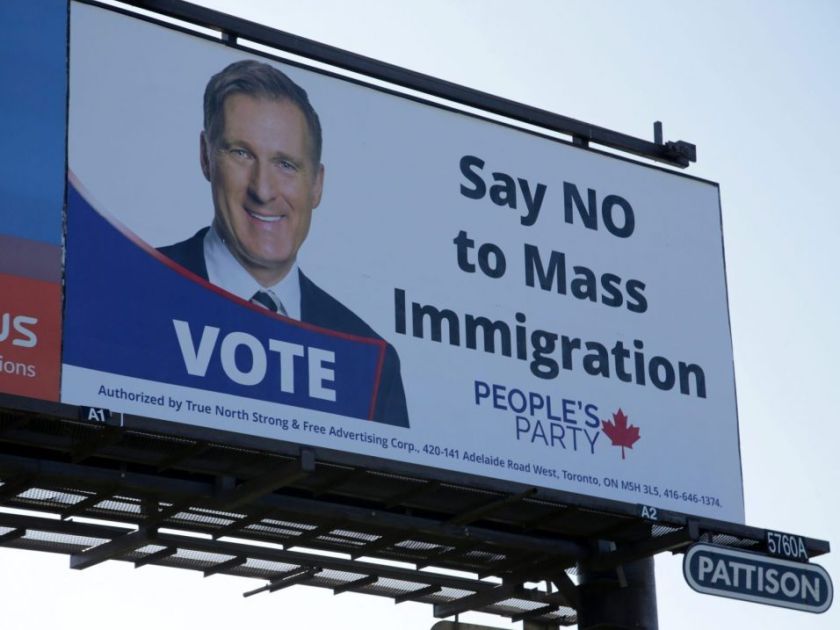
Canadians currently have two left-of-centre federal parties (three if we count the Greens), but only one party on the right (Maxime Bernier’s PPC), leaving the right-of-left-of-centre to the hapless, leaderless, useless, spineless, craven Conservative Party. “Conservative” in name only, of course, for those of you who don’t follow Canadian politics (and neither blame nor shame to you if you fall into that happy group). Bernier’s been labouring under an almost complete media blackout except where engineered drama can be used to demonize him or members of his party, so the roughly one-third of Canadian voters who would prefer an actual conservative alternative don’t really have anyone to vote for.

Jay Currie offers his analysis of the Conservative dilemma (but he’s also a known PPC sympathizer, so good Canadians must pay no attention to what he says):

Frank Graves and Michael Valpy ask the question, “What if the Conservatives had a ‘centrist’ leader?” like Rona Ambrose or Peter MacKay. To their credit Graves and Valpy recognize that while a centrist Conservative party would appeal to the media and various elites in Canada it would effectively maroon the 30% of Canadians who might loosely be described as “populist”.

A billboard in Toronto, showing Maxime Bernier and an official-looking PPC message.
Photo from The Province – https://theprovince.com/opinion/columnists/gunter-berniers-legitimate-position-on-immigration-taken-down-by-spineless-billboard-company/wcm/ecab071c-b57d-4d93-b78c-274de524434c

I think Graves and Valpy are right and I can’t wait for that exact outcome.

Scheer managed to hoodwink a lot of natural populists with a combination of Liberal-lite policies and some goofy socon gestures (I am not sure Pride Parade non-attendance really counts for much with the serious socons.)

Graves and Valpy maintain that this was enough to avoid “orphaning the party’s biggest lump, and he more or less cut off oxygen to Maxime Bernier’s People’s Party of Canada (PPC).” It might have been last election but if the CPC goes centrist with its next leader, the lump will be looking elsewhere.

I am fairly certain that the CPC will go for a centrist leader if only because there are really no populist candidates available to it. Pierre Poilievre might fill the bill but it is not obvious that the CPC will be willing to support an MP who is as “direct” as Poilievre.

Which will leave “the lump” looking for a home. Graves and Valpy give a rundown of the lump’s core issues,

    Like the United States, the United Kingdom and sizeable chunks of Western Europe, Canada has a significant portion of citizens — about 30 per cent — who are attracted to the current psychographic and demographic binge of ordered populism. They are profoundly economically pessimistic and mistrustful of science and the elites. They have no interest in climate change, they don’t really see an active role for public institutions and believe there are too many immigrants. Of those immigrants coming to Canada, they think that too many are not white.

Other than the dig about thinking “too many are not white”, that is a pretty good summary. (On the “not white” thing, I suspect it is more nuanced than that: more along the lines of the current Quebec government’s desire to preserve its culture in the face of immigration.)

December 18, 2019

Mark Steyn on what passes as “conservatism” these days

Filed under: Britain, Cancon, Media, Politics — Tags: , , , , — Nicholas @ 05:00

It’s certainly Conservative-In-Name-Only:

In 2000, when the Vermont Supreme Court mandated same-sex “civil unions”, American conservatives were outraged. By 2010, when the left had moved on to gay marriage, conservatives were supportive of civil unions but insisted marriage was an ancient institution between a man and a woman. Now, the left having won that one and moved on to transgenderism, conservatives profess to be a bit queasy about transitioning grade-schoolers.

So you can take it to the bank that by 2030 rock-ribbed Republicans will be on board with penises in the girls’ changing rooms, but determined to hold the line against whatever the left’s next cause du jour is: human cloning, the state appropriation of parenthood, voting rights for animals.

There really isn’t much point to conservatism that’s just leftism ten years late, is there? It’s like that ITV+1 satellite service they have in Britain that offers you the ITV schedule but an hour later, in case you were caught in traffic heading home. If you’re considering on which side to bestow your tribal loyalty, the left is right quicker; the right is left behind — but only for a few years until they throw in the towel. If you’re all headed to the same destination, why not ride first class on the TGV instead of the creaking, jerking stopping service? Justin Trudeau’s vapid modishness was perfectly distilled by his campaign catchphrase of four years ago: “Because it’s 2015.” But that beats waiting till 2025 to say “Because it’s 2015”.

While we’re on the subject of the northern Tories: Because the late unlamented Andrew Scheer finessed his views on same-sex nuptials as lethargically as did Barack Obama, he was flayed by the Canadian media as some fire-and-brimstone social conservative of televangical inflexibility. I wish. As I wrote the other day, he’s as unmoored from principle as Boris Johnson, but without the countervailing strengths of being able to stick it to the other guy and to pass himself off as a human being. He was particularly contemptible in the hours before my appearance at the House of Commons Justice Committee, as I may discuss in detail one of these days. Yet the never-learn Conservatives are minded to replace an entirely hollow man with someone just like him, only more so.

It is surely telling that the only issues on which the right has made any progress at all in moving the ball in its direction — Brexit in the UK; illegal immigration and a belated honesty about the rise of China in the US — had to be injected into public discourse by two outsiders, Nigel Farage and Donald Trump. And indeed in the teeth of opposition by the establishment’s catch-up conservatives.

Catch-up conservatism gives the game away: The right has lost the knack of persuasion, and increasingly doesn’t even bother to try.

December 15, 2019

Every time the “wrong” side wins an election…

Filed under: Britain, Media, Politics — Tags: , , , , , , — Nicholas @ 03:00

… we get all the media talking about how the winner needs to tack to the left:

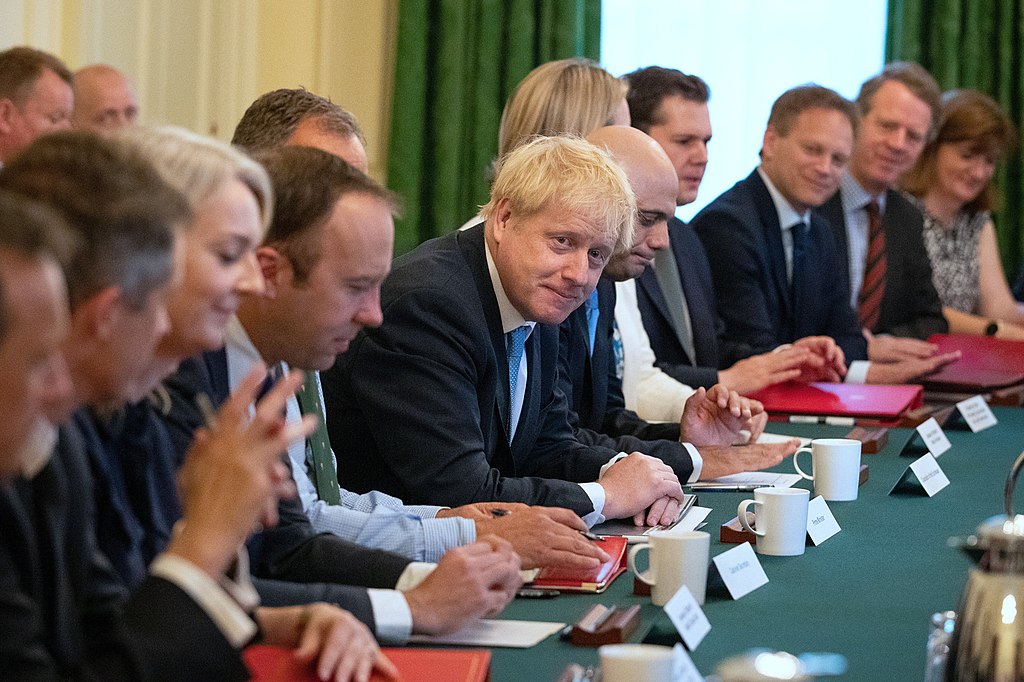
Prime Minister Boris Johnson at his first Cabinet meeting in Downing Street, 25 July 2019.
Official photograph via Wikimedia Commons.

Every single time. Whenever the left is slapped by voters like a bony Antifa moll at a street riot, “expert” analysts rush to the scene of democracy, cordon it off with police tape and announce through a bullhorn that there’s nothing to see here. Move along. They then propose that the winner is morally obliged to sideline the constituency that just elected him and heed the boutique preoccupations of the vanquished instead. Successful right-of-centre candidates must govern for All of Us. Successful leftists, on the other hand, are encouraged to give leftism to the enemy good and hard for the next few-to-several years. Possibly the first man to pull out his ‘horn following Boris Johnson’s emphatic victory is Philip Williams.

The sullen acceptance that Brexit will happen but will unleash crises that – alas – must be solved by a buffoon: check. Schools and hospitals: check. The problem of “an economy excised from Europe”: check. Williams’ piece is the Tate of tropes. But no: Johnson won’t faulter by being true to the shy nationalists who elected him but he might antagonise them by pivoting left to usher Hugh Grant’s coterie into a broader Boris marquee. Given his track record, that is very likely. Let’s not get carried away: Johnson did his Conservative duty regarding Brexit, nothing more. The question is whether or not he has the panache to hold on to his base while trying to expand it. The media will be a huge asset. They are certain to make daily sport of Johnson’s “gaffes,” eccentricities and less than squared away private life. This will endear him to everyman even more.

On the other hand, when the “correct” side wins an election, we’re assured that “elections have consequences”, the’ve been “keeping score”, and that the losers must strap in tight and hold on for dear life because we’re going further left than we ever were promised during the campaign.

Update: Related.

December 14, 2019

Livingstone announced Labour’s defeat was at least partially down to “the Jewish vote”

Barbara Kay on the British general election results:

Boris Johnson’s Conservatives racked up a stunning victory in the U.K. elections, with numbers so decisive — 365 of 650 seats — we will hear no more rumblings about a “second referendum” on Brexit. You can love Boris or hate him, or struggle with mixed feelings (as I confess I do), but he now has a mandate to get Brexit done.

But I have no mixed feelings about the Labour Party’s humiliating loss, at 203 seats their lowest ebb since pre-World War Two. If ever a party leader deserved a definitive smackdown, it was Jeremy Corbyn, and a victory lap is in order for democracy doing what it does best.

On seeing the results, I said to myself, “Yay!” The second thing I said to myself was, “Who will be the first to pull a Jacques Parizeau and how long will it take?” As it turned out, not long at all, and it was former London mayor Ken Livingstone who reprised Parizeau’s infamous “money and the ethnic vote” blame-shift after the Yes side’s narrow loss in the 1995 Quebec sovereignty referendum.

As soon as it was clear the U.K. Conservatives had crossed the threshold majority number of 326 seats, Livingstone announced Labour’s defeat was at least partially down to “the Jewish vote.” In fact, a Jewish population of 260,000 could not by itself have greatly influenced the result, but it is a mark of the anti-Semitic mindset to constantly exaggerate Jewish power.

Livingstone, who has called allegations of anti-Semitism within the Labour Party “lies and smears,” was himself suspended from Labour in 2016 over an assertion that Hitler supported Zionism. It was by no means Livingstone’s only egregiously insensitive remark. In April, he reportedly told the group Labour Against the Witchhunt that “It is not anti-Semitic to hate the Jews of Israel.”

Disappointed progressives, of course, are handling the Labour defeat with calm resignation, patience, and a spot of rioting.

Who will “Big Dairy” push as the next Conservative leader?

The Canadian supply management system is a classic case of concentrated benefits and diffused costs … all Canadians pay more for milk, cheese, and other dairy products, but the extra profits go to those who hold the quota allotment for production. During the last federal Conservative leadership race, the “temporary conservatives” were enough to push the Milk Dud over the top to defeat Maxime Bernier — because Bernier was outspoken in his opposition to the whole supply management cartel and threatened those guaranteed profits for the insiders. The Milk Dud has announced he’s stepping down, so who will Big Dairy choose to replace him?

Andrew Scheer, paid tool of Big Dairy, chugs some milk during a Press Gallery speech in 2017. I’ve called him the “Milk Dud” ever since.
Screencapture from a CTV video uploaded to YouTube.

To my mind the defining image of Andrew Scheer’s efforts to become prime minister of Canada, which officially came to an end Thursday, comes from the 2017 Press Gallery Dinner in Ottawa. “There’s some suggestion out there that I’m beholden to a certain group within the Conservative family,” he told the crowd, grinning. And then, dimples at maximum, he took a swig from a one-litre carton of Neilson two-per-cent milk.

It’s nice when politicians can poke fun at themselves. Most are really bad at it, betraying only their own ego. Scheer’s routine, by contrast, reportedly brought the house down. The problem is that, by all the evidence, Scheer was utterly beholden to the dairy industry. And absent the effects of alcohol, that’s not really very funny.

We knew at the time that, days before, Scheer had barely beaten Maxime Bernier in the party leadership contest with help from a few thousand votes from people whom Bernier not unreasonably called “fake Conservatives” — i.e., people who had purchased memberships for the sole purpose of voting for Scheer, for the sole purpose of maintaining supply management in the dairy industry (which Bernier opposes) intact.

We came to know later, thanks to a Dairy Farmers of Canada briefing book discovered by an aggrieved delegate to the 2018 party convention in Halifax, that the dairy lobby considered Scheer a “safety net.” Regardless of any vote by the party membership that might recommend freer markets in dairy, the book alleged, the farmers had Scheer’s commitment never to undermine supply management in an election platform.

Scheer denied any such deal existed, of course. But it seemed doubtful the dairy industry’s notoriously fearsome, professional and effective lobbyists could have been so misinformed.

It ought to have been a liability from the start: Here was the self-styled middle-class alternative to Justin Trudeau, the man who knows what it’s like to plan a family budget around the breakfast table, to scrimp and save, whose parents didn’t own a car, declaring his fealty to a cartel dedicated to inflating milk prices for the benefit of wealthy businesses. Har, har, har.

December 13, 2019

We won’t have the Milk Dud to kick around any more … eventually

Filed under: Cancon, Politics — Tags: , , — Nicholas @ 05:00

News of the moment in Canada is the sudden resignation of “Conservative” party leader Andrew “The Milk Dud” Scheer:

Andrew Scheer, paid tool of Big Dairy, chugs some milk during a Press Gallery speech in 2017. I’ve called him the “Milk Dud” ever since.
Screencapture from a CTV video uploaded to YouTube.

Andrew Scheer used money from the Conservative Party to pay costs of private schooling for his children, according to sources in contact with Global News. Some are suggesting this story might have ultimately let to Scheer’s resignation.

Scheer has since stepped down as leader of the Conservative Party, but he will not fully resign until the party has a replacement to fill the position.

According to some senior Conservative members, Scheer’s use of the Conservative Party of Canada funds was improper.

While in the House of Commons, Scheer said, “I just informed my colleagues in the Conservative caucus that I will be resigning as the leader of the Conservative Party of Canada and I will be asking the Conservative Party national council to immediately begin the process of organizing a leadership contest.”

“In order to chart the course ahead in the direction this party is heading, the party needs someone who can give 100 percent.”

Dustin van Vugt, the Executive Director of the Conservative Party of Canada wrote a statement saying, “All proper procedures were followed and signed off on by the appropriate people.”

Van Vugt talked about the party covering some of Scheer’s costs in the statement saying, “As is the normal practice for political parties, the Party offered to reimburse some of the costs associated with being a national leader and re-locating the family to Ottawa.”

Where, oh where will the “Conservatives” find a leader of Scheer’s “stature” to fill his dainty little shoes? Maybe Justin can spare one of his cast-offs…

December 2, 2019

Andrew Scheer’s Daisy connection

Filed under: Cancon, Politics — Tags: , , , — Nicholas @ 05:00

Jay Currie on the lingering stench of the spoiled Milk Dud’s campaign:

Andrew Scheer, paid tool of Big Dairy, chugs some milk during a Press Gallery speech in 2017. I’ve called him the “Milk Dud” ever since.
Screencapture from a CTV video uploaded to YouTube.

The sheer lack of ethics and paranoia hiring the Jackal demonstrates pretty much proves that Scheer is not fit to lead the CPC or to be Prime Minister. A fact which is dawning on the CPC itself as it struggles to figure out what to do with their present leader. Before Kinsellagate it was possible to say that Scheer was a decent, if uninspiring, leader. Now? It is indecent to hire a political mobster to beat up your opponents. Which leaves Scheer as merely uninspiring. I would be astonished if he survives a leadership review.

The revelation of Kinsella’s filth may sink Scheer but it burnishes Bernier’s reputation. Virtually all the accusations of “racism” levelled against the PPC and Max personally either were manufactured by Kinsella or occurred in a climate of hate created by the Jackal. I have never seen a credible accusation and now we have a pretty good idea why.

The PPC, even with Kinsella’s disinformation campaign, secured over 300,000 votes from a standing start a year before the election. If the CPC tears itself apart with a red/blue fight, a lot of thoughtful, conservative, people will give the PPC a second look. Conservative MPs looking for an alternative to the nastiness and vindictiveness of the Scheer people might well be tempted to join the PPC. Max had a lot of caucus support for his CPC leadership run. He was careful not to unfairly attack conservative positions, rather, during the campaign, he attacked CPC positions which were, in fact, Liberal-lite positions.

Political pundits, as they do after every election in which the Conservatives fail to win government, solemnly inform us that it was because the Conservatives failed to move towards the middle. The fact that only 30-35% of Canadians are even a bit right-leaning is trotted out to show how impossible it is for the Conservatives to win government unless they move left. I think this analysis is entirely incorrect. A solid, right of center party which had libertarian social views would hold that 30-35%. From there it is simply a matter of finding 3-5% in carefully targetted ridings. To do that a party would have to come up with policies which, while conservative, do not alienate middle-class voters, immigrant communities and women.

I don’t think there is a chance the CPC will manage that simply because they are too tied to establishment politics in Canada. Yeah multi-culti, boo climate change only echos the Liberal Party’s bland formula for success.

November 30, 2019

Toynbee’s warning

Filed under: History, Liberty, Politics — Tags: , , , , , — Nicholas @ 03:00

In the National Post, Barbara Kay wonders if conservative democracy can shore up the civilizational boundaries that liberal democracy has abandoned:

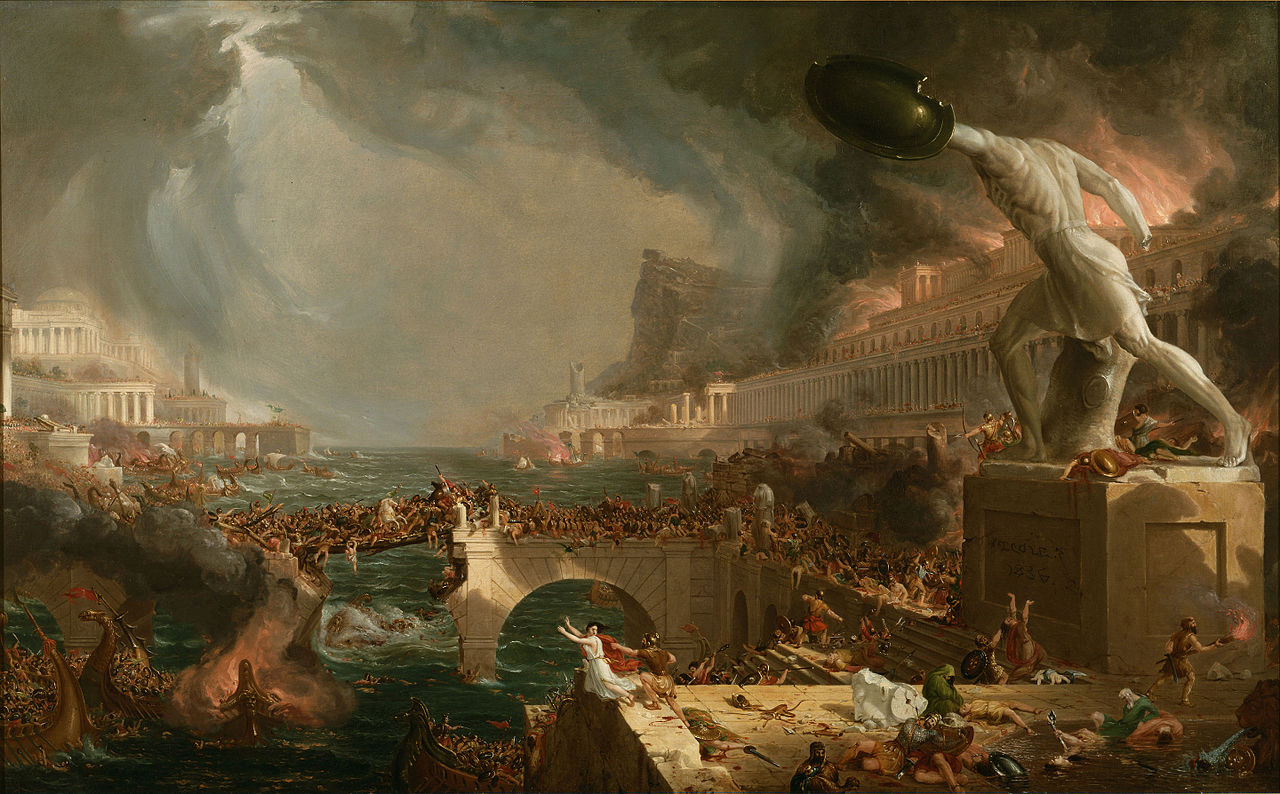
The Course of Empire – Destruction by Thomas Cole, 1836.
From the New York Historical Society collection via Wikimedia Commons.

The historian Arnold Toynbee warned that “civilizations die from suicide, not by murder.” He said they begin to disintegrate when they abandon moral law and yield to their impulses, which in turn brings about a state of passivity, a sense that there is no point in resisting incoming waves of foreigners driven by confidence and purpose.

Since Toynbee, other writers, notably James Burnham in his influential 1964 essay, “Suicide of the West: An essay on the Meaning and Destiny of Liberalism”, have picked up on the theme. In every case in which the word “suicide” features, the root cause comes down to the effects of a universalist liberal democracy over time. These observers are not trading in fear-mongering for its own sake. We must pay respectful attention to their warnings.

Liberal democracy is, broadly speaking, a political doctrine consecrated to the belief that reason, universally accessible and everywhere the same, can by itself create the conditions for enlightened progress in human affairs.

With social justice as the end and social transformation as the means, liberals are not perturbed by the erosion of Christianity, the traditional family and the cultural particularism such transformation requires. The instinct to jettison cultural babies in order to refresh our cultural bathwater is a feature, not a bug, of liberal democracy.

Conservatives, even those who don’t embrace social conservatism, view the crumbling of these building blocks of civilization with anxiety and fear. Their view is that reason alone, without spiritual ballast and deference to the traditions that created our civilization, can produce social instability and even violence. Nobody considered himself more reasonable than Vladimir Lenin. Nobody considers herself more reasonable than a minister of sport who conflates subjective gender identification with biological sex.

Conservatives’ fears are driving the nationalist/nativist counter-movement liberals view with disgust and anger. Conservatives find it difficult to get an unbiased hearing in the prevailing progressive zeitgeist. Liberals have been successful in linking nationalism with history’s most odious incarnations of racism and imperialism in the popular imagination, while ignoring the equally tragic history of internationalist movements, because Marxist utopianism casts a spell they find irresistible.

So in the matter of immigration, for example, liberals are not concerned by mass immigration from countries with different religious and cultural traditions, because they rely on the universal appeal of liberal principles to even out the initial wrinkles. Conservatives regard these different traditions as deeply entrenched and likely to be negatively transformative to our own culture. They are inclined to impose strictures that encourage integration into, along with recognition of, our own culture’s dominant status. Far from being racist, conservatives view this precaution as a hedge against the kind of inter-cultural tensions spilling over into expressed hatreds that are presently roiling Europe. But as we saw in the last election, even the mildest criticism of mass immigration is the kiss of death to a politician.

Recently, I posted a Quote of the Day from Sarah Hoyt that emphasized the persistence of culture, which is a warning to those who think unlimited immigration from other cultures won’t have negative impacts on the receiving culture:

Societies don’t work that way. Culture doesn’t work that way. In fact culture is so persistent, so stubborn, it leads people to think it’s genetic. (It’s not. A baby taken at birth to another culture will not behave as his culture of origin.) It changes, sure, through invasions and take overs, but so slowly that bits of older cultures and ideas stay embedded in the new culture. It has been noted that the communist rulers of Russia partook a good bit of the Tsarist regime, because the culture of the people was the same and that came through. (They just dialed up the atrocities and lowered the functionality because their ideology was dysfunctional. They blame their failure on Russia itself, but considering how communism does around the world, I’ll say to the extent countries survive it’s because of the underlying culture.)

November 20, 2019

“Europe is committing suicide. Or at least its leaders have decided to commit suicide.”

Filed under: Books, Europe, Politics — Tags: , , — Nicholas @ 05:00

Barbara Kay on the works of Douglas Murray, a “clubbable conservative” (I’m so far out of the loop, I’m not sure if this reference is British (he’s welcome in our exclusive club) or Canadian (like a baby harp seal) … although that may be a binary answer depending if you’re on the left or right of the traditional political spectrum):

London-based public intellectual Douglas Murray is in Montreal this week to promote his new book. I was afforded the luxury of a rambling conversation over coffee with him about The Madness of Crowds: Gender, Race and Identity.

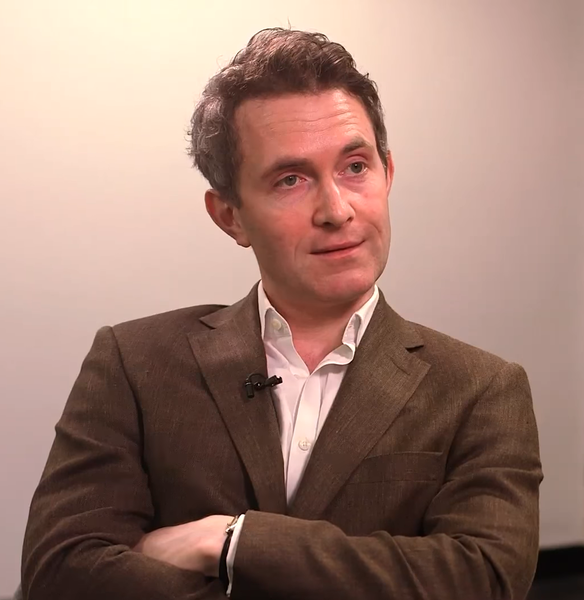
Douglas Murray being interviewed in 2018.
Photo by Rebel Wisdom via Wikimedia Commons.

A “clubbable conservative,” as one reviewer accurately describes him, Murray hit his intellectual stride early, publishing his first book at 18, which attracted the attention and mentorship of polemical giants Christopher Hitchens and Roger Scruton. Quite different in personality from Jordan Peterson (less intensity, more suavity), he’s equally erudite and similarly crowd-pleasing (they’ve done joint appearances in the U.K., attracting massive audiences).

Murray shot to international celebrity with his powerful, if depressing 2017 book, The Strange Death of Europe, which opens with the words, “Europe is committing suicide. Or at least its leaders have decided to commit suicide.” Joining frontline reports from unpleasant way stations in the 2015 migrant crisis to insightful analysis of the West’s present malaise, Murray painted a gloomy picture of continental passivity in the face of momentous cultural change.

In The Madness of Crowds, also inspired by the West’s loss of a “grand narrative,” Murray applies his formidable exegetical skills to the proliferation of identity politics “tripwires” that corrode civic life and wreak havoc with individual lives.

Murray writes: “The interpretation of the world through the lens of ‘social justice,’ ‘identity group politics’ and ‘intersectionalism’ is probably the most audacious and comprehensive effort since the Cold War at creating a new ideology.” Christianity has been spurned, but the religious impulse is inherent and abhors a vacuum. The “religion” of social justice, Murray observes, poured itself into the handy campus vessel of Marxism with remarkable speed.

One of the hallmarks of Marxism – not a bug, but a feature – is its ruthlessness. I was particularly struck by Murray’s quite poignant chapter, “On Forgiveness.” Normal religions offer redemption to sinners. But there is no forgiveness or statute of limitations for thoughtcrimes in the religion of social justice. A mural of Rudyard Kipling’s “If” – voted Britain’s favourite poem – was painted over at the University of Manchester in retroactive punishment for Kipling’s now politically incorrect views on empire. The past, Murray says, is “hostage — like everything else — to any archeologist with a vendetta.”

July 28, 2019

QotD: Anglo-Italian relations, 1922-1940

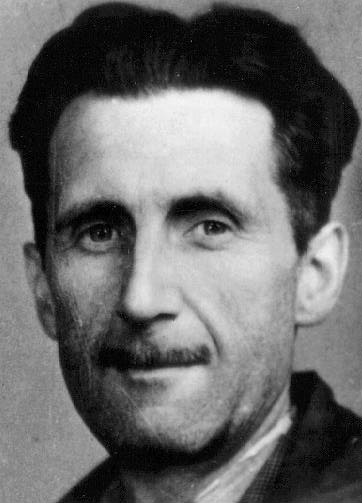
Orwell’s press card portrait, 1943

The history of British relations with Mussolini illustrated the structural weakness of a capitalist state. Granting that power politics are not moral, to attempt to buy Italy out of the Axis — and clearly this idea underlay British policy from 1934 onwards — was a natural strategic move. But it was not a move which Baldwin, Chamberlain and the rest of them were capable of carrying out. It could only have been done by being so strong that Mussolini would not dare to side with Hitler. This was impossible, because an economy ruled by the profit motive is simply not equal to rearming on a modern scale. Britain only began to arm when the Germans were in Calais. Before that, fairly large sums had, indeed, been voted for armaments, but they slid peaceably into the pockets of the shareholders and the weapons did not appear. Since they had no real intention of curtailing their own privileges, it was inevitable that the British ruling class should carry out every policy half-heartedly and blind themselves to the coming danger. But the moral collapse which this entailed was something new in British politics. In the nineteenth and early twentieth centuries, British politicians might be hypocritical, but hypocrisy implies a moral code. It was something new when Tory M.P.s cheered the news that British ships had been bombed by Italian aeroplanes, or when members of the House of Lords lent themselves to organized libel campaigns against the Basque children who had been brought here as refugees.

When one thinks of the lies and betrayals of those years, the cynical abandonment of one ally after another, the imbecile optimism of the Tory press, the flat refusal to believe that the dictators meant war, even when they shouted it from the house-tops, the inability of the moneyed class to see anything wrong whatever in concentration camps, ghettos, massacres and undeclared wars, one is driven to feel that moral decadence played its part as well as mere stupidity. By 1937 or thereabouts it was not possible to be in doubt about the nature of the Fascist régimes. But the lords of property had decided that Fascism was on their side and they were willing to swallow the most stinking evils so long as their property remained secure. In their clumsy way they were playing the game of Machiavelli, of “political realism”, of “anything is right which advances the cause of the Party” — the Party in this case, of course, being the Conservative Party.

All this “Cassius” brings out, but he does shirk its corollary. Throughout his book it is implied that only Tories are immoral. “Yet there is still another England,” he says. “This other England detested Fascism from the day of its birth… this was the England of the Left, the England of Labour.” True, but only part of the truth. The actual behaviour of the Left has been more honourable than its theories. It has fought against Fascism, but its representative thinkers have entered just as deeply as their opponents into the evil world of “realism” and power politics.

“Realism” (it used to be called dishonesty) is part of the general political atmosphere of our time. It is a sign of the weakness of “Cassius”s position that one could compile a quite similar book entitled The Trial of Winston Churchill, or The Trial of Chiang Kai-shek, or even The Trial of Ramsay MacDonald. In each case you would find the leaders of the Left contradicting themselves almost as grossly as the Tory leader quoted by “Cassius”. For the Left has also been willing to shut its eyes to a great deal and to accept some very doubtful allies. We laugh now to hear the Tories abusing Mussolini when they were flattering him five years ago, but who would have foretold in 1927 that the Left would one day take Chiang Kai-shek to its bosom? Who would have foretold just after the General Strike that ten years later Winston Churchill would be the darling of the Daily Worker? In the years 1935-9, when almost any ally against Fascism seemed acceptable, left-wingers found themselves praising Mustapha Kemal and then developing tenderness for Carol of Rumania.

George Orwell, “Who are the War Criminals?”, Tribune, 1943-10-22.

July 26, 2019

The young Boris Johnson at Oxford

Filed under: Britain, Education, Politics — Tags: , , — Nicholas @ 05:00

Toby Young recounts his first encounter with the new Prime Minister of the United Kingdom at Oxford in 1983:

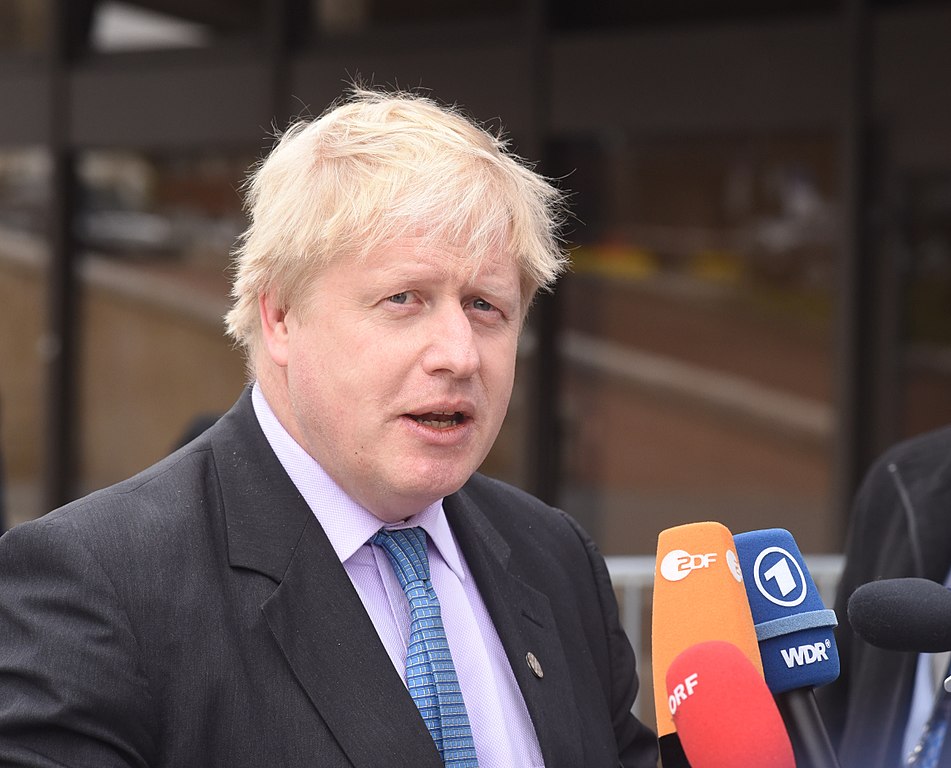
Boris Johnson, Secretary of State for Foreign and Commonwealth Affairs at an informal meeting of the Foreign Affairs Council on 15 February 2018.
Photo by Velislav Nikolov via Wikimedia Commons.

I first set eyes on Boris Johnson in the autumn of 1983 when we went up to Oxford at the same time. I knew who he was since my uncle Christopher was an ex-boyfriend of his mother’s and he had told me to keep an eye out for him, but I still wasn’t prepared for the sight (and sound) of him at the dispatch box of the Oxford Union. This was the world famous debating society where ambitious undergraduates honed their public-speaking skills before embarking on careers in politics or journalism, and Boris was proposing the motion.

With his huge mop of blond hair, his tie askew and his shirt escaping from his trousers, he looked like an overgrown schoolboy. Yet with his imposing physical build, his thick neck and his broad, Germanic forehead, there was also something of Nietzsche’s Übermensch about him. You could imagine him in lederhosen, wandering through the Black Forest with an axe over his shoulder, looking for ogres to kill. This same combination — a state of advanced dishevelment and a sense of coiled strength, of an almost tangible will to power — was even more pronounced in his way of speaking.

He began to advance an argument in what sounded like a parody of the high style in British politics — theatrical, dramatic, self-serious — when — a few seconds in — he appeared to completely forget what he was about to say. He looked up, startled — Where am I? — and asked the packed chamber which side he was supposed to be on. “What’s the motion, anyway?” Before anyone could answer, a light bulb appeared above his head and he was off, this time in an even more orotund, florid manner. Yet within a few seconds he’d wrong-footed himself again, this time because it had suddenly occurred to him that there was an equally compelling argument for the opposite point of view. This endless flipping and flopping, in which he seemed to constantly surprise himself, went on for the next 15 minutes. The impression he gave was of someone who’d been plucked from his bed in the middle of the night and then plonked down at the dispatch box of the Oxford Union without the faintest idea of what he was supposed to be talking about.

I’d been to enough Union debates at this point to know just how mercilessly the crowd could punish those who came before them unprepared. That was particularly true of freshmen, who were expected to have mastered all the arcane procedural rules, some of them dating back to the Union’s founding in 1823. But Boris’s chaotic, scatter-brained approach had the opposite effect. The motion was deadly serious — “This House Would Reintroduce Capital Punishment” — yet almost everything that came out of his mouth provoked gales of laughter. This was no ordinary undergraduate proposing a motion, but a Music Hall veteran performing a well-rehearsed comic routine. His lack of preparedness seemed less like evidence of his own shortcomings as a debater and more a way of sending up all the other speakers, as well as the pomposity of the proceedings. You got the sense that he could easily have delivered a highly effective speech if he’d wanted to, but was too clever and sophisticated — and honest — to enter into such a silly charade. To do what the other debaters were doing, and pretend he believed what was coming out of his mouth, would have been patronising. Everyone else was taking the audience for fools, but not him. He was openly insincere and, in being so, somehow seemed more authentic than everyone else.

To say I was impressed would be an understatement. A few years before arriving at Oxford I had watched the television adaptation of Brideshead Revisited, Evelyn Waugh’s Oxford novel, and had been expecting to meet the modern-day equivalents of Sebastian Flyte and Anthony Blanche: larger-than-life, devil-may-care aristocrats delivering bon mots in between sips of champagne and spoonfuls of caviar. But the reality was very different: warm beer, stale sandwiches and second-hand opinions. Lots of spotty students, all as gauche as me. Less like an Oscar Wilde play than a Mike Leigh film.

In Boris, though, it was as if I’d finally encountered the “real” Oxford, the Platonic ideal. While the rest of us were works-in-progress, vainly trying on different personae, Boris was the finished article. He was an instantly recognizable character from the comic tradition in English letters: a pantomime toff. He was Sir Toby Belch in Twelfth Night demanding more cakes and ale, Bertie Wooster trying to pass himself off as Eustace H. Plimsoll when appearing in court after overdoing it on Boat Race night. Yet at the same time fizzing with vim and vinegar — “bursting with spunk,” as he once put it, explaining why he needs so many different female partners. He was a cross between Hugh Grant and a silverback gorilla.

My uncle had described him as a “genius” and as a boy he’d been regarded as something of a wunderkind. There was the occasion when he was holidaying with his family in Greece, aged 10, and asked a group of Classics professors if he could join their game of Scrabble. They indulged the precocious, blond-haired moppet, only to be beaten by him. Thinking it was a one-off, they asked him to play another round and, again, he won. On and on it went, game after game. At the prep school he attended before going to Eton, Britain’s grandest private school, he was seen as a prodigy. A schoolmaster who taught him back then told his biographer, Andrew Gimson, that he was the quickest-learner he’d ever encountered. In the staff room, the teachers would compare notes about the “fantastically able boy.”

He was without doubt the biggest man on campus — the person most likely to succeed. He made no secret of his desire to be Prime Minister one day, and not just a run-of-the-mill, common-or-garden PM, but up there with Gladstone and Disraeli. And this was a scaling back of his ambitions — as a boy he’d told his younger sister Rachel that he wanted to be “world king.” (There was an intermediate stage during his teenage years when he harboured fantasies of becoming President of the United States — something that’s technically possible, given that he was born in New York.) He was by no means the only member of the Oxford Union to express such hopes during that period, but in his case you felt it might actually happen. Unlike so many other privileged undergraduates, with their vaulting sense of entitlement, Boris’s gargantuan self-belief seemed of a piece with his outsized personality. He had an electrifying, charismatic presence of a kind I’d only read about in books before. Our mutual friend Lloyd Evans, who knew Boris better than me at Oxford, put it well. “He’s a war leader,” he told Andrew Gimson. “He is one of the two or three most extraordinary people I’ve ever met. You just feel he’s going somewhere. People just love him. They enjoy going with him and they enjoy being led.”

To get a sense of Boris Johnson’s unique charm, here’s a brilliant pastiche of some of his TV appearances, stitched together as if it was his Olympic Games Welcome during his time as Lord Mayor of London (do watch, it’s hilarious).


July 20, 2019

“Scheer is demonstrating what it actually looks like for a Canadian political leader to be utterly beholden to a special interest group”

Filed under: Bureaucracy, Cancon, Economics, Food, Politics — Tags: , , , — Nicholas @ 03:00

I wasn’t a fan of Andrew Scheer even before he bought the leadership of the Conservative party with Quebec dairy money. I think he was one of the worst possible choices for Tory leader, but we’re stuck with his ineffectual bought-and-paid-for self to attempt to beat an incumbent PM who has the undying loyalty of 95% of the mainstream media. And we know beyond a shadow of a doubt that his loyalty isn’t to Canada or to the Tories, but to his paymasters in Big Dairy. Despite this, Chris Selley says that The Milk Dud’s vassalage to a well-moneyed and legally privileged class may end up destroying the government cartel that is Supply Management:

Andrew Scheer, paid tool of Big Dairy, chugs some milk during a Press Gallery speech in 2017. I’ve called him the “Milk Dud” ever since.
Screencapture from a CTV video uploaded to YouTube.

There’s no shame in a conservative politician opposing the federal government of a gigantic country containing multitudes of lifestyles trying to create an ideal diet for all its citizens. “I’ll eat what I want, get out of my kitchen,” is a perfectly respectable position — especially since the food guide is such a joyless, under-salted slog. But that’s not Scheer’s position. Instead he’s vowing to “get it right.” This suggests consulting people other than medical and scientific experts, most of whom were relatively pleased with this edition of the food guide. It suggests bringing industry voices back into the mix. And that’s not something anyone other than Big Dairy and Big Meat should want.

The so-con comparison is somewhat facetious, of course: Abortion is a third-rail issue, or at least the media treats it as such, whereas unwavering protectionist support for our dairy farmers is an all-party consensus-cum-contest to see who can most abase themselves. The winner, by far, is Andrew Scheer. On Wednesday he excoriated the Liberal government for allegedly missing deadlines to explain how it would compensate dairy farmers for ever-so-slightly opening the Canadian market to European and Asian countries.

“(This) mistreatment is unacceptable,” he told the Saskatonian audience. His future government would “never back down from defending the (dairy) sector,” he vowed.

In a strange way, it gives me hope. Surely it’s objectively weird that a man the Liberals are trying to portray as the human embodiment of Canada’s future ruination is so cartoonishly in favour of subsidizing and coddling a given industry, thereby continuing to inflate prices for Canadian consumers, and yet his opponents’ only instinct is to find a way to agree with him. By rights it ought to be the Conservatives who bust up lactosa nostra (copyright CBC’s David Cochrane). But having rebuffed Big Dairy’s dubious dietary advice, the option is entirely open to the Liberals as well. The average Canadian grocery shopper will thank whichever party finally gets it done.

July 14, 2019

The Epstein scandal is another example of the importance of accurate names

Filed under: Law, Politics, USA — Tags: , , , , , , — Nicholas @ 05:00

ESR has some concerns about the Epstein case, specifically on the correct terminology to use:

The sage Confucius was once asked what he would do if he was a governor. He said he would “rectify the names” to make words correspond to reality. He understood what General Semantics teaches; if your linguistic map is sufficiently confused, you will misunderstand the territory. And be readily outmaneuvered by those who are less confused.

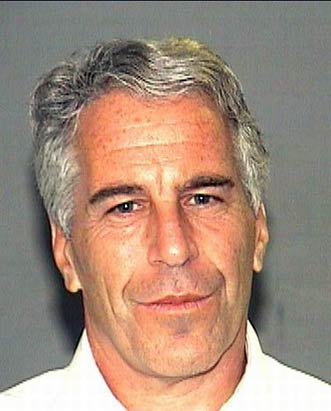
Mug shot of Jeffrey Epstein made available by the Palm Beach County Sheriff’s Department, taken following his indictment for soliciting a prostitute in 2006.
Image via Wikimedia Commons.

And that brings us to the Jeffrey Epstein scandal. In particular, the widespread tagging of Epstein as a pedophile.

No, Richard Epstein is not a pedophile. This is important. If conservatives keep misidentifying him as one, I fear some unfortunate consequences.

Pedophiles desire pre-pubertal children. This is not Epstein’s kink; he quite obviously likes his girls to be as young as possible but fully nubile. The correct term for this is “ephebophile”, and being clear about the distinction matters. I’ll explain why.

The Left has a long history of triggering conservatives into self-discrediting moral panics (“Rock and roll is the devil’s music”). It also has a strong internal contingent that would like to normalize pedophilia. I mean the real thing, not Epstein’s creepy ephebophilia.

Homosexual pedophiles have been biding their time in order to get adult-on-adult homosexuality fully normalized as battlespace prep, but you see a few trial balloons go up occasionally in places like Salon. The last round of this was interrupted by the need to take down Milo Yiannopolous, but the internal logic of left-wing sexual liberationism always demands new ways to freak out the normals, and the pedophiles are more than willing to be next up in satisfying that perpetual demand.

Liberals have proven themselves utterly useless at resisting the liberationist ratchet, so I’m not even bothering to address them. Conservatives, if you want to prevent the next turn, don’t give the pedophilia-normalizers maneuvering room. Rectify the names; make the distinctions that matter.

Epstein’s behavior is repulsive because we judge young postpubertal humans to be too psychologically immature to give adult consent, but it’s nowhere near the evil that is the sexual abuse of prepubertal children.

June 25, 2019

Mark Steyn on Boris Johnson’s very non-traditional lifestyle

Filed under: Britain, Politics — Tags: , , , , — Nicholas @ 03:00

With Boris Johnson’s domestic affairs back in the news after a noisy tiff with his current partner, Mark Steyn briefly discusses the less-than-traditional lifestyle of Mr. Johnson:

Boris Johnson, Secretary of State for Foreign and Commonwealth Affairs at an informal meeting of the Foreign Affairs Council on 15 February 2018.
Photo by Velislav Nikolov via Wikimedia Commons.

The rather tired bon mot on Britain’s soi-disant next prime minister is that the only thing that can stop Boris Johnson is Boris Johnson. He was super-disciplined during the last month and managed to stick to his Trappist vows all the way through to the final round of the first stage of voting on Thursday. Then he celebrated his triumph by spilling red wine on his “partner”‘s sofa which led to her allegedly yelling “Get off me!” and then “Get out of my flat!” and him refusing to. “Partner” is New Britspeak for what old-school Tories would have called a “mistress”. Boris was recently kicked out by his second wife, and so moved in with the new bird, who happens to live in Camberwell, which is full of fashionable Labour Party types surrounding him on all sides with glasses held to the walls. And the cellphone has made the citizenry not only able but eager to play volunteer Stasi.

The standard gag on raffish Tories — you wouldn’t trust him with your wife or your wallet — doesn’t begin to do justice to Boris. He genuinely cannot answer the question how many children he has — or how many he’s sired whose mothers were persuaded to ensure junior never made it out of the maternity ward. Like Trump with the pussy-grabbing tape, his supporters are said to have priced all this in — that, if a flawed vessel is the only way to reach the policy destination, so be it. But Boris in a certain sense is taking Trump to the next level — that, as the bounds of acceptable politics have become ever narrower and more constrained, only a certain size of personality can bust through them, and thus in such a world a low moral character is not faute de mieux but vital and necessary — at least if you’re serious about screwing over the EU commissars. If, per America’s founders, a republic presupposes virtue; whatever it is we are now presupposes a lack of it.

Boris was not an early jumper on the Trump train. On political trends, he is something of a latecomer and an opportunist: Nigel Farage truly wants out of the EU; Boris — who knows? In British terms, Trumpesque policy populism lies with Nigel and the Brexit Party. Boris is offering personality populism, and banking that enough voters will figure the policy comes with it.

« Newer PostsOlder Posts »

Powered by WordPress