
This would be funny if it wasn’t quite such a jarring reminder of how the Soviets used to manage matters. The revolutionary vanguard were not held to the same standards as everyone else because, you know, they were the revolutionary vanguard, leaders of the people. They thus got all the nice apartments in central Moscow as they had to be close to the Ministries where they directed the peasants. They didn’t have to share the apartment because they needed to rest after their labours. And surely those working for the workers should be well rewarded?
So too they didn’t have to line up for the scraps of whatever rotting junk the ration stores had. The KGB, for example, had its own commissary just around the back of Lubyanka – I know, I’ve shopped in it. And higher ranks simply never needed to go shopping at all, the nomenklatura had the government delivery service. Ocado for commies but only really important commies.
This all came under the rubric of comrades of proven worth…
Tim Worstall, “Emma Thompson Is A Comrade Of Proven Worth To Extinction Rebellion”, Continental Telegraph, 2019-04-19.
September 26, 2022
QotD: “Comrades of proven worth”
September 21, 2022
QotD: Why postwar western economic and humanitarian “interventions” almost always failed
Prior to the Cold War, America’s interference in other countries’ internal affairs was practically nonexistent outside of the Caribbean where America’s preoccupation was with the stability in the region. What went on in Egypt, Thailand, Argentina, or Greece was none of our business, nor did we frankly care. However, having just survived the cataclysm of WWII, and the realization that Communism was a danger bent on world domination, and that each country that became Communist made that possibility much more likely changed that laissez faire attitude 180 degrees. Whereas NATO was formed for the purpose of deterring a military attack on Western Europe by the Soviet Union (the generals mentally fighting the last war as is always the case, not realizing that the war now was ideological and propagandistic rather than military), diplomats began to question how to best combat Communist insurgencies in the Third World. The arrived (wrong) conclusion was that the reason a country became Communist was because the dirt-poor people were so desperate that they became Marxists in order to improve their lives, so if the West helped poor countries economically Communists could not gain a foothold. As such, they ignored the fact that most Communist movements are organized and headed not by poor people, but by a cadre of power-hungry middle-class intellectuals.
As has been mentioned, the first approach was with foreign aid. The second was with military intervention, in Korea, Vietnam, Santo Domingo, Grenada, and Lebanon. Although such interventions were mostly successful, they carried a heavy price as American blood was spilled in foreign countries. America’s supposed allies hardly helped at all, including the citizens of the countries (Korea and Vietnam) that themselves were in danger of being conquered by Communist forces.
Armando Simón, “Schlimmbesserung“, New English Review, 2022-06-16.
September 20, 2022
Hannah Arendt in postwar Germany
In Quillette, Roger Berkowitz discusses what Hannah Arendt found when talking to Germans after the Second World War, which she characterized as their collective “escape from reality”:
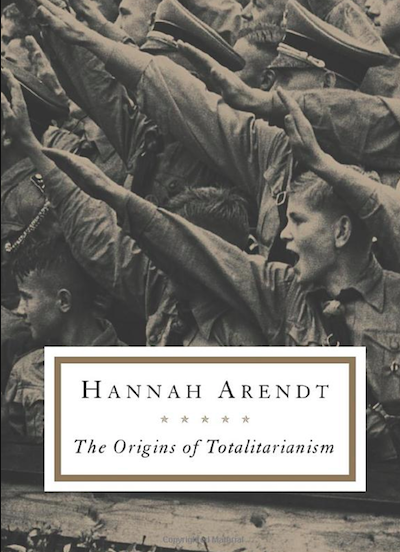
In 1949, when Hannah Arendt (1906–1975) went to Germany as part of the New York-based Jewish Cultural Reconstruction Commission, she was struck by the way the Germans showed an “at times vicious refusal to face and come to terms with what really happened”. This “escape from reality”, as Arendt named it, meant that the reality of the Holocaust and the death factories was spoken of as a hypothetical. And when the truth of the Holocaust was admitted, it was diminished: “The Germans did only what others are capable of doing”.
The Germans, at times, simply denied the facts of what had happened. One woman told Arendt that the “Russians had begun the war with an attack on Danzig”. What Arendt encountered was a “kind of gentleman’s agreement by which everyone has a right to his ignorance under the pretext that everyone has a right to his opinion”. The underlying assumption for such a right is the “tacit assumption that opinions really do not matter”. Opinions are just that, mere opinions. And facts, once they are reduced to opinions, also don’t matter. Taken together, this led to a “flight from reality”.
The focus of Arendt’s lifelong engagement with the human flight from reality was her encounter with ideologies, specifically Nazism and Bolshevism. In The Origins of Totalitarianism and other texts (especially her essay, “On the Nature of Totalitarianism“), Arendt defines an ideology as a system that seeks to explain “all the mysteries of life and the world” according to one idea. Nazism is an ideology that blames economic disaster, political loss, and the evils of modernity on the Jews — inhuman flotsam who must be exterminated to allow a master race to flourish. Bolshevism, on the other hand, “pretends that all history is a struggle of classes, that the proletariat is bound by eternal laws to win this struggle, that a classless society will then come about, and that the state, finally, will wither away”. The bourgeoisie are not simply class traitors, they are a dying class, and killing them only supports a law of history. As ideologies, both Nazism and Bolshevism insist on explaining the events of the world according to theories “without further concurrence with actual experience”. The result, Arendt argues, is that such ideologies bring about an “arrogant emancipation from reality”.
Because an ideology “looks upon all factuality as fabricated”, it “no longer knows any reliable criterion for distinguishing truth from falsehood”. As reality recedes, ideologies organize society to transform their ideas into living reality. If antisemitism as an ideology says that all Jews are beggars without passports, the fact of wealthy and established Jews must be eliminated. If Bolshevism says that the bourgeoisie are corrupt, they must admit their corruption or be killed. The realization of such ideological realities can be accomplished, of course, through terror.
But even before a totalitarian movement takes power and mobilizes the secret police in the machinery of terror, ideological movements can employ propaganda to deny and nullify facts, or change them. The Nazis, she writes, “did not so much believe in the truth of racism as desire to change the world into a race reality”. Similarly, the Bolshevist ideology that classes were dying was not something real, but something that had to be made real. The purges and terror that Stalin unleashed were supposed to “establish a classless society” by exterminating all social groups that might develop into classes. In both instances, the purpose of the ideology was to transform a mere opinion — race consciousness or class consciousness — into the “the lived content of reality”.
The point, as Arendt concludes, is that “ideological consistency reducing everything to one all-dominating factor is always in conflict with the inconsistency of the world, on the one hand, and the unpredictability of human actions, on the other”. What ideology demands is that man — an unpredictable and spontaneous being — cease to exist as such, that all humans be subjected to laws of development that follow ideological truth. That is why the turn from an unreliable reality to coherent fantasy requires an absolute elimination of human spontaneity and freedom.
August 10, 2022
Raising a generation to emulate Pavel Morozov
Theodore Dalrymple on the dangers of a culture that welcomes and supports denunciation as a political mechanism:
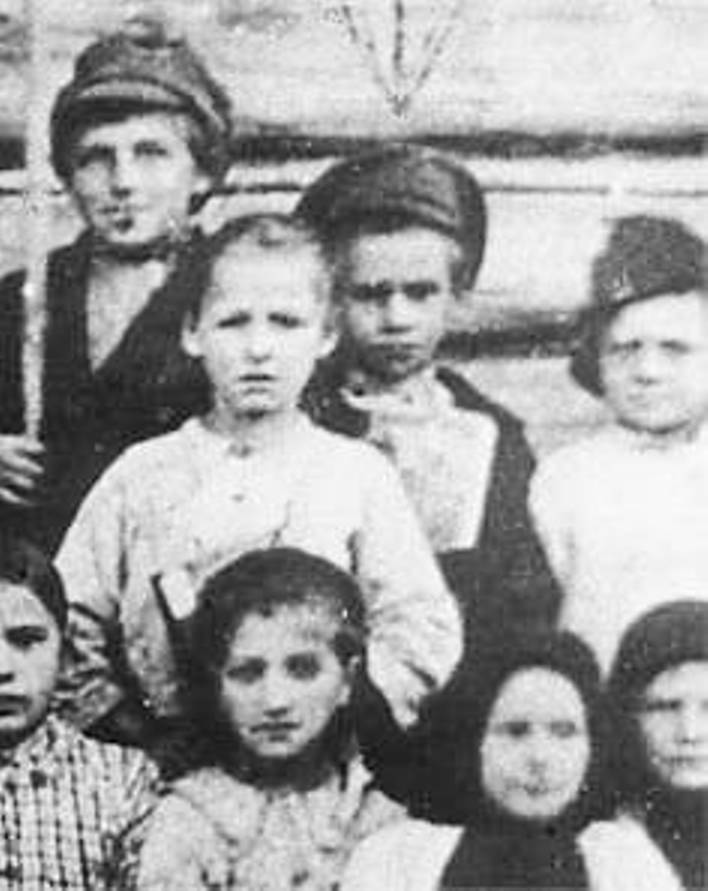
Believed to be the only photograph of Pavel “Pavlik” Morozov (centre, wearing cap), circa 1930.
… a culture of denunciation is an important step in the direction of totalitarianism. Is there anyone whose life is such that the discreditable things done or said by him or her could not be woven into a reason for public execration or worse? The habit of denunciation was a powerful weapon in the hands of every totalitarian dictator.
In the Soviet Union, for example, the story of Pavel Morozov — little Pavlik — was used to inculcate the habit of denunciation as a social duty into Soviet children. Little Pavlik denounced his own parents and grandparents as kulaks, that is to say as rich and exploitative peasants, to the Soviet authorities, and was thereafter “martyred” for his truthfulness. Soviet children were encouraged to emulate lovely little Pavlik by snitching on all around them. There were posters in school of heroic children denouncing their fellows for something that they had done wrong. This was the Soviet version of truth-telling.
We should not complacently suppose that it couldn’t happen here — wherever here is. In Britain recently, which is suffering from a shortage of water because of unusually hot weather, residents of some areas have been prohibited from using hosepipes to water their garden — and have been encouraged to denounce neighbors or others to the authorities who flout the prohibition.
One can just hear the arguments in favor of such denunciations. It’s only fair and right, for example, that everyone should share the hardship caused by the shortage of water. It’s almost psychopathic of some not to obey the rules while most do so: Who do they think they are, that they are not obliged to obey? Moreover, we live in such times that, if you approach such a person directly, he’s likely to become furious and violent. It’s safer to call the authorities and let them deal with him.
This overlooks how easily the culture of denunciation can establish itself, and lead to a society in which everyone fears everyone else. Such is the way in which people are constituted that for many, at least, it’s a pleasure to bring harm to others in the name of doing good for society. That was the justification of denunciation in Nazi Germany, Soviet Russia, and Maoist China, as well as in a host of other totalitarian fiefdoms. And Maugham — he who actively solicits denunciations of Nick Cohen — even admits, perhaps without really meaning to, the pleasure he would derive from passing on any denunciations he receives in a kind of meta-denunciation, as it were.
This is authentically disgusting, but it has the merit of reminding us that totalitarianism did not land on earth like an asteroid but had its origins in the human heart, and that no society can be immune from the temptations of totalitarianism once and for all. Totalitarianism has its pleasures, chief of which is doing harm to others, albeit that today’s denouncer tends to become tomorrow’s denounced.
August 5, 2022
Don Camillo blesses the river Po
Perhaps the first foreign author I encountered as a child was Giovanni Guareschi — in English translation, of course, I’m not a natural linguist — and I’d read most of his stories by the time I was twelve. They didn’t always make a lot of sense to me as far as the political aspects were concerned, but the human stories always hit home. Clearly, Sarah Hoyt (who is a natural linguist … she read them in the original Italian, although I’d expect they would work very well for Portuguese readers) feels much the same way about the Don Camillo stories:
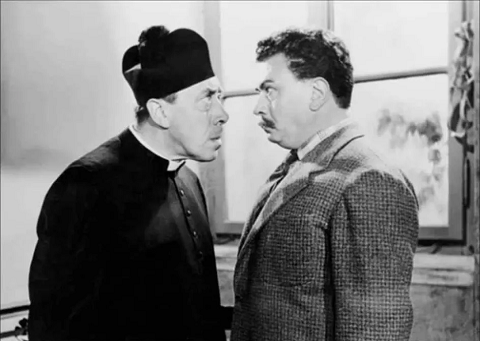
A still from one of the 1952-1965 film adaptations of the Don Camillo stories, with Fernandel as Don Camillo and Gino Cervi as Mayor Peppone.
There is a poignant scene in one of the Giovanni Guareschi Don Camillo books, (set in mid-century Italy, where communism and Catholicism are fighting it back and forth. They’re humorous, profoundly human, and easy reads. The stories are like 200 words each.) in which, during a period of high strife, the priest goes out to bless the river. Btw, if you need examples of how to be a flea on the side of the commies, that character is terribly subversive in little ways (as well as liking to hit them on the head. I might have taken him for a model when I was a pre-teen. Sigh. And Comrade Don Camillo is the best book for how to turn things on their heads if you’re in deep hiding in a lefty stronghold, either professional or geographic.)
Anyway, in the little village on the Po river where the priest and the communist mayor fight it out, the river is an ever present danger, and people cope with it the way they have coped with such things throughout history: every year the priest goes to the river and blesses it, in the hopes that it will become (I am remembering in Italian, the English translation is probably different) “A well behaved citizen and stay within its bounds”.
Now, this is not magic, of course, and the priest explains that. Blessing the river does not guarantee that the river won’t burst out of its bed and flood the village (later on in the book there are accounts of a flood, and if you think that a book can’t paint a picture, be sure it can. For the rest of my life, I’ll carry the image of the priest saying mass in the deserted and flooded village, while across the river, on the safe bank, his flock who fled the flood kneel on the muddy soil at the tolling of the consecration bell. BTW Guareschi is the writer I’d like to be when I grow up. Trained as a journalist, he uses minimal words, but the images stay with you.) It’s just that blessing it gives people hope it won’t, and allows them to live in a precarious place, at a precarious time without losing their minds. (It is important to remember that whatever else humans are, they’re creatures of ritual and habit, and sometimes those are the only panaceas for difficult situations.)
Well, the communists have their dander up, so they tell the priest they want to march in the procession to bless the river with their flags and paraphernalia and the priest says no, they say anyone in the procession will get beaten. They demand the priest cancel it, and people lose their minds. So, the priest says he’ll go alone, if needed. Needless to say, the communists follow, in what is an intimidation maneuver (they have no new moves, really.)
So, Don Camillo, without looking back, gets to the river and prays that the Lord will keep the river within its bounds. And of course, because he knows the audience at his back, he says “If the houses of decent people could float, I’d ask you for a flood like Noah’s. But since the houses of decent people are made of the same stone and brick and sink like the houses of scoundrels, I beg you to make the river behave.”
In case you’re wondering what went wrong in America, and why we are where we are: we forgot our houses can’t flood.
July 26, 2022
Is Trudeau channelling Caligula? – “Let them hate me as long as they fear me”
Spencer Fernando, writing for the National Citizens Coalition:
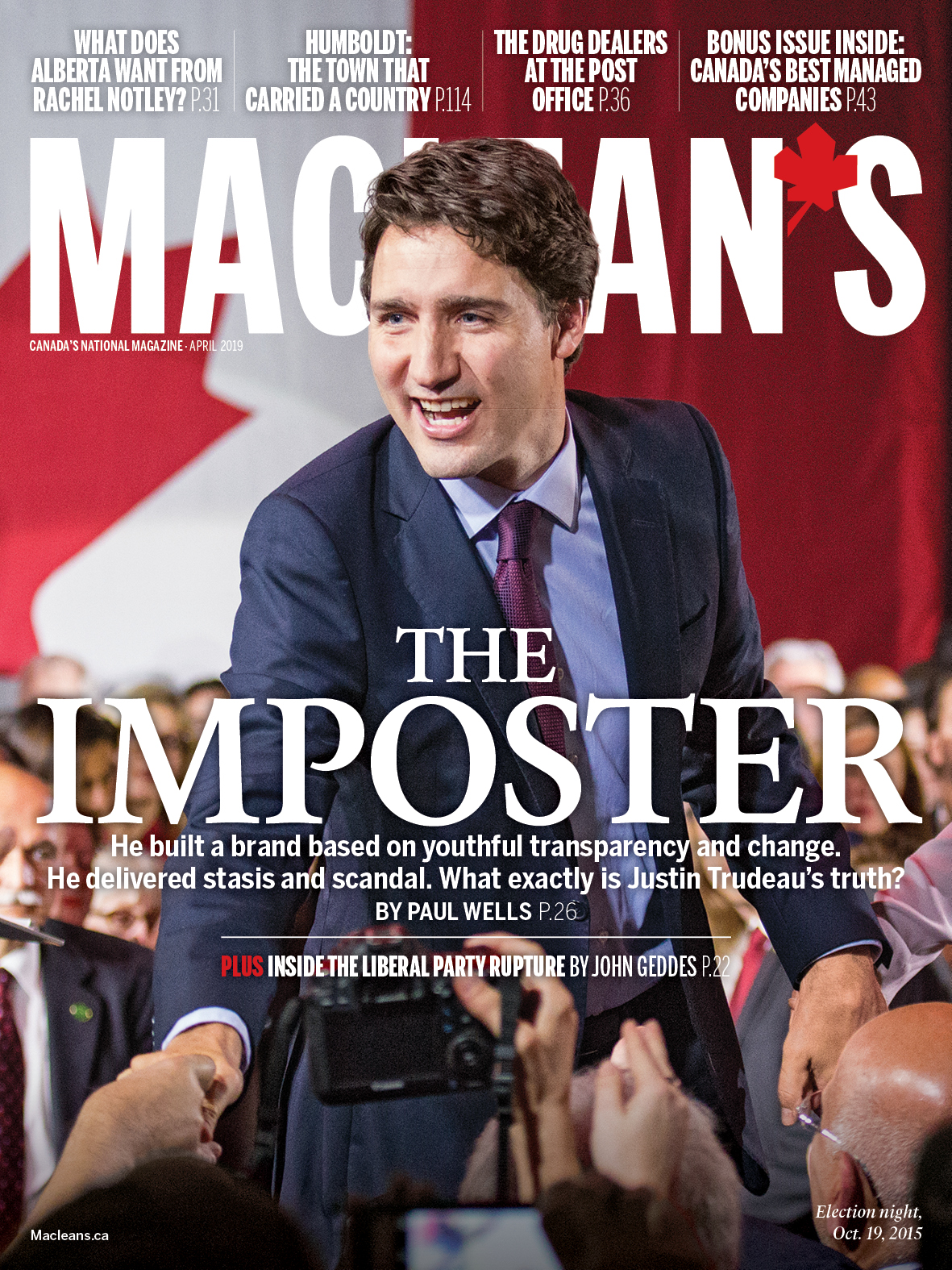
When trying to ascertain where the Trudeau Liberals are trying to take the country, it’s important to look at the foundations of Justin Trudeau’s worldview.
Clearly, he was heavily influenced by his father, someone who continuously expanded the power of the state.
Justin Trudeau’s father was well known as a Communist-sympathizer, being a big fan of both Fidel Castro and Communist China.
Note, the version of the CCP that existed in Pierre Trudeau’s era was even more brutal than the CCP as it exists today. At the time, it was not far removed from the time of Mao’s Great Leap Forward, a government-imposed “reshaping of society” that led to roughly 45 million deaths.
To look at that, and still be a fan of the Chinese Communist Party, is to show a deep ideological commitment to authoritarian socialism and a deep aversion to human freedom.
The apple clearly didn’t fall far from the tree, as Justin Trudeau praised China’s “basic dictatorship” (AKA the centralized power structure that enables horrific crimes).
Trudeau also sought to move Canada closer to China’s orbit, only giving up on that when public opinion – and a subtle revolt among some backbench Liberals – rendered it politically unfeasible.
We can see how the authoritarian socialism that Trudeau praised in China (and let’s not forget his fawning eulogy for Fidel Castro), lines up with the fear and contempt he and the Liberals have for many Canadians.
Now, let’s also note this essential point:
The Liberals continuously target the same individuals that authoritarian socialists and communists have targeted:
Rural Conservatives.
Private Enterprise.
Religious Groups.
Freethinkers.
Individualists.
Private Farmers.
Rural Gun Owners.
Independent Press Outlets.
Historically, those are all groups that the far-left has targeted when given the opportunity.
We only need to look at how the Liberal approach to Covid was modelled after the approach taken by Communist China, and how both the Liberals and the CCP have been largely unwilling to move on.
While the Liberals are more constrained than the CCP by the fact that Canada maintains some freedoms, do we have any doubt that they would be far more severe if they could get away with it?
Remember, the moment he feared losing the 2021 election, Justin Trudeau used very divisive and disturbing rhetoric (especially disturbing when seen in a historical context), and purposely sought to direct hatred and blame towards those who resisted draconian state orders.
Since then, the Trudeau Liberals – even in the face of criticism by a few courageous Liberal MPs who were quickly “put back in their place” – have almost gleefully abused their power, purposely creating an “Us vs Them” narrative designed to pit Canadians against each other.
At the same time, they’ve continued their efforts to gain control over social media, silence dissenting views, and turn the establishment media into an extension of the state propaganda apparatus.
This is all being done because they fear those who have the intelligence and strength of character to see through their agenda.
They fear you, and have contempt for you.
July 14, 2022
QotD: Fascism and anti-semitism
You can have a quite an effective totalitarianism without this; Stalin, for example, never bothered with an SS-equivalent. You can get similar developments under Communism; consider Mao’s Red Guards. And on the third hand, Franco copied that part of the formula without actually being a Fascist. Still – if you think you’ve spotted a fascist demagogue ramping up to takeover, one of the things to check is whether he’s trailing a thug army behind him ready to turn into a personal instrument of force. If he isn’t, you’re probably wrong.
Another thing that follows from the Fascist theory of power is hostility towards markets, free enterprise, and trade. Yes, yes, I know, you’ve heard all your life that fascists are or were tools of capitalist oligarchs, but this is another big lie. In reality about the last person you want to be is a “capitalist oligarch” in the way of one of Maximum Leader’s plans. Because even if he needs you to run your factories, you’re likely to find out all the ways utter ruthlessness can compel you. Threats to your family are one time-honored method. You can’t buy him, because has the power to take anything he really wants from you.
In fact, one of the reasons fascist regimes turn anti-Semitic so often is because Jews are identified with mercantile activity. Which in the Fascist view of things, is corrupting and disruptive of loyalty bonds that should be more important than wealth. Furthermore, Fascism inherited from its parent Marxism the whole critique about capitalism alienating workers from their production.
The political economics of fascism is always state-socialist, and explicitly so. This follows directly from the drive for centralization.
Eric S. Raymond, “Spotting the wild Fascist”, Armed and Dangerous, 2019-04-30.
July 5, 2022
The Republic of China’s “Porcupine strategy”
Originally published in the New York Sun and reposted by the New English Review, Conrad Black believes any attempted amphibious invasion of Taiwan will become the worst invasion outcome since the Athenians assaulted Syracuse in 414-413 BC:
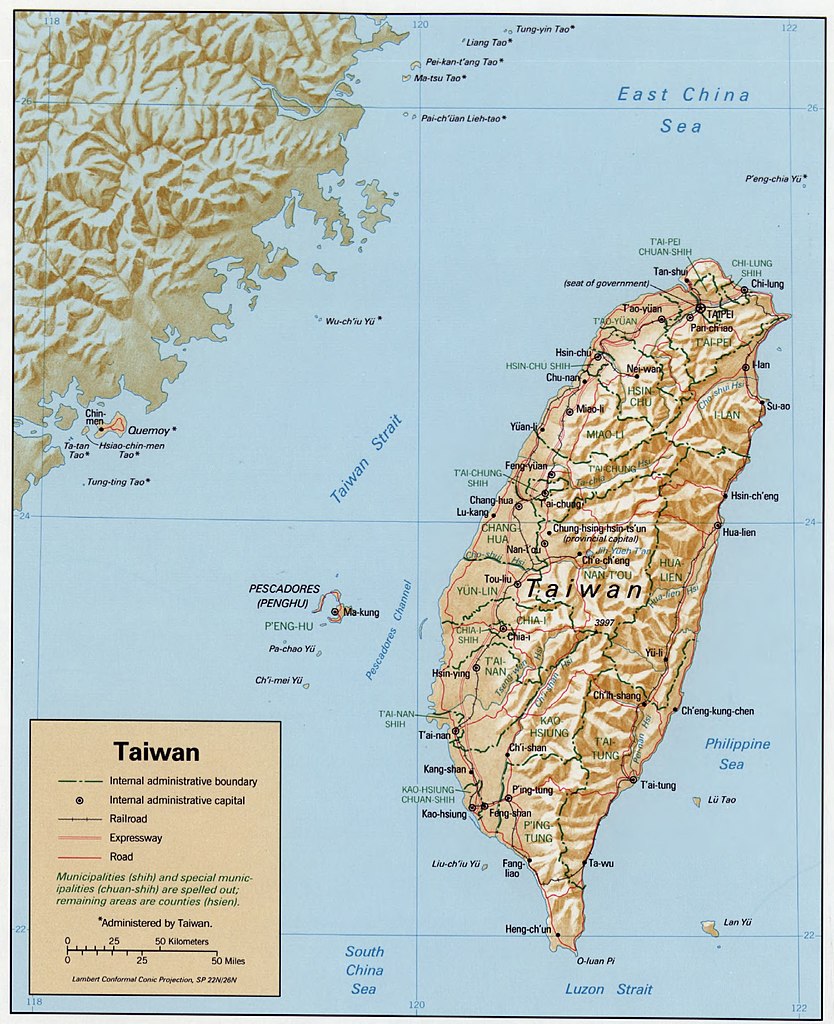
Taiwan relief map.
Library of Congress Geography & Map Division via Wikimedia Commons.
There has for some time been a good deal of flippant talk about a Communist Chinese invasion of the Republic of China on Taiwan, as if that would be a simple military undertaking. It seems to be inadequately appreciated that Taiwan has thought of little else for many years, and is, unlike Ukraine, a very prosperous and technologically sophisticated country that is armed to the teeth with the most advanced American weaponry, and has plotted out a defense in depth that is called its “porcupine strategy”.
Though it is probably accidental, “porcupine” is the word applied to Switzerland by Adolf Hitler in 1941, when, after careful analysis by the German General Staff, he concluded Swiss defenders would inflict a much larger number of casualties on a German invasion force than could possibly be justified by the occupation of the country. (It can be lamented that more recent Western strategists did not apply the same test to Afghanistan.)
Comparisons with Ukraine are inapplicable, other than the fanatical determination of the defenders. Most obviously, Taiwan is not only an island but the Formosa Straits are three to four times as wide as the English Channel from the southern British ports to the beaches of Normandy. The People’s Republic of China would have no choice but to attack amphibiously as they could not possibly imagine success with fewer than 500,000 combat soldiers and no force remotely as large could be parachuted onto Taiwan.
A strike force of 500,000 would probably have to be supplemented by a follow-up force at least as large, all conveyed in a huge armada of slow and vulnerable craft. Taiwan has been supplied with the precise ground and air-launched missiles that the Ukrainians have used to such deadly effect in the Black Sea, including the sinking of the Russian flagship, the heavy missile cruiser Moskva.
Taiwan has a front-line Air Force of about 300 of the latest fully equipped fighter and interceptor aircraft that along with shore batteries could rain a dense and prolonged fire of missiles upon any invasion fleet. Such a fleet, even in the best of weather, would plod through open water for at least ten hours. They would be sitting, or at least slowly moving, ducks throughout that journey. It brings to mind the conclusion of one of Churchill’s Demosthenean addresses in the autumn of 1940: “We are still awaiting the long-promised invasion; so are the fishes.”
June 29, 2022
QotD: How Cadet Che shows that West Point isn’t West Point anymore
Bad as that is, there’s much worse. Notice the passivity of it all. What were any of the parties involved trying to accomplish? If Cadet Che had wanted to get kicked out of the service (as it seems finally happened, according to the linked article), there are a million easier ways. In fact, cadets at West Point are volunteers. The Army makes a big production out of this: If you can’t hack it at the Point, you’re simply not officer material. All it takes is a letter to the commandant, and you’re out — Cadet Che could’ve been drinking beer with his fraternal socialist comrades at Big State 24 hours after turning in his resignation.
Even the kid’s form of “protest” was passive. There’d be a certain utility, I suppose, for the Revolution if the kid had written “I’m a Communist sleeper agent” on the inside of his hat — evidently our standards are so lax that we don’t do basic background checks on our potential military officers. But he didn’t write that. Instead, he wrote “Communism will win,” a passive, bloodless statement … and that’s it.
The passivity is the truly terrifying part. A West Point graduate is among the elite if anyone is — he has command of at least a platoon of heavily armed trained killers, and the radio one of them carries has the power to call in armor, air strikes, cruise missiles … and yet, not “I’m a communist,” not “¡Viva la Revolución!,” not even “Lenin lives!” Just … “communism will win.” How, comrade?
Severian, “The Man of the Hour”, Rotten Chestnuts, 2019-05-22.
June 25, 2022
QotD: The Left’s long march through the institutions
Once they were in, they of course credentialized everything, such that the cultural-transmission professions — journalism, education, even art and music — suddenly required college training … and all the trainers were Reds. Ever wonder why you seemingly have to have a fucking Master’s Degree to get your lit-wank novel published? Seriously: read the author bio of any of the flavor-of-the-minute wunderkinder that get their painfully quirky dreck blurbed in the New York Times Review of Books — every blessed one of them has some kind of advanced degree in “creative writing”. All those graduate-level “creative writing” programs aren’t just make-work for otherwise unemployable Eng-Lit PhDs, in other words. They’re what the Union of Soviet Writers was in the USSR: The guarantors of politically-reliable content.
That’s the setup. Ready for the twist?
They won, but they don’t know it. Not only was the Revolution televised, it’s still being televised, 24 hours a day, on 587+ satellite cable channels and umpteen digital streaming services. Eugene V. Debs’s wettest wet dream couldn’t compare to Current Year America. The SJWs are like the Seekers, out there desperately trying to prepare the world for the UFOs … but the UFO already landed in their backyard, and they were too busy trying to save the world to see it.
That’s why widespread political violence is inevitable, and damn soon. Nancy Pelosi may be the nastiest evil old bitch to ever slime through the halls of Congress, but she’s not stupid. She’s just in an impossible situation. She’s the leader of an organization that didn’t manage its True Believers, and now she’s fucked either way. […]
That’s what the old-school Commies didn’t see coming. Those poor deluded fools really thought that “intellectual” was an adjective. The Russian word for the noun version is intelligentsia, and they gave the Soviet Union no end of trouble — Stalin had to send boxcars of them to Siberia fairly regularly to keep them in line. In the West, though, they really thought that you can have an “intellectual” steelworker, or dockhand, or farmer, and the like. They were counting on it, in fact — see “community colleges were all Red fronts”, above.
Instead, “intellectual” is the True Believer’s self-chosen job description. You can meet some fearsomely learned people in your day-to-day, but the only people you’ll ever meet who use the word “intellectual” without sneering are Media types and their panty-sniffers in the ivory tower. They’re extremely useful idiots, which is why none of Palsy Pelosi’s predecessors sent them to Siberia like they should’ve. And now it’s too late.
Severian, “If the UFO Actually Comes, Part II”, Rotten Chestnuts, 2019-09-26.
March 16, 2022
QotD: Muslim views of western culture
a collection of casinos, supermarkets and whore-houses linked together by endless highways passing through nowhere. All that money, all that effort all those resources that are wasted so that idiotic women and shallow men can prolong their lives … You see ancient women who refuse to die at a normal time and who continue to paint themselves and crave youthful lovers right to the edge of the grave … To eat tons of hamburgers and popcorn, to imbibe oceans of Coca-Cola and whisky, to watch hundreds of hours of stupid television, to copulate mechanically a few hundred times, to be on guard minute against being robbed, raped or murdered. That is the American way of life.
Our civilisation is regarded as evil, and its destruction is taken as a sacred duty for reasons both defensive and offensive.
Defensive
There can be no doubt that Khomeini was a firm anti-communist. But, unlike the timid monarchies of the Arabian Peninsula, he saw quite clearly where the true threat to Islam lay. Throughout his reign, the Russians presented at least a potential threat to the northern borders of Iran, But this was as nothing to the actual ideological threat of the west, Marxism in Iran had converted its tens of thousands, and influenced its hundreds of thousands. But western civilisation — with its clothing fashions, its films, its music, its enshrinement of individual happiness, its secular knowledge — had captured its millions. There was a “Great Satan” devouring Islam; and its body was not communism, but the West; and its head was not Russia, but America, “We must break those pens” he wrote, “that teach people there is something other than divine law. We must smash those mouths that tell the people they are free to say whatever they please, regardless of right and wrong in accordance with the commands of the Almighty”. On this reasoning, to carry the fight from Iran, or wherever, into the west, is the equivalent of turning from the periphery to the centre of an infection.
Offensive
In one of his occasional attempts at humane argument, Khomeini justified a war of extirpation against the west on the following grounds:
If one allows the Infidels to continue playing their role of Corruptors on Earth, their eventual moral punishment will be all the stronger. Thus, if we kill the Infidels in order to put a stop to their [corrupting] activities, we have indeed done them a service. For their eventual punishment will be less.
For the most part, however, it is conversion to Islam that is desired of people in the west. Only those refusing to convert are to be slaughtered. In the first instance, all those areas of the world that were once Islamic, but have since been lost, are to be restored; and all those areas that contain sizeable Moslem minorities are to be Islamised. In 1982, a new map of the world was presented to Khomeini by the Cartological Society in Teheran. It was divided into three regions, distinguished by three colours. First, in green, came the House of Islam — this being the 41 member states of the Islamic Conference, together with soviet central Asia, southern Spain, Malta and Lampedusa, Albania, part of Yugoslavia, north eastern China, parts of Siam, Burma, the Philippines, and most of Africa. The remaining areas, the red and black, were divided between communism and the west. But the final state of affairs is to be a totally Islamic world. No part whatever is to be left in the hands of the “Cross worshippers”, as the Christians are contemptuously termed. Moslems in Great Britain at the moment comprise barely three per cent of the population. Nonetheless, “[t]hose Moslems” says Dr Shabbir Akhtar of the Bradford Council of Mosques, “who find it intolerable to live in a United Kingdom contaminated with the Rushdie virus need to seriously consider the Islamic alternatives of emigration (hijira) to the House of Islam or a declaration of holy war (jihad) in the House of Rejection. The latter may well seem a kind of hasty militancy that is out of the question, though, with Allah on one’s side, one is never in the minority. And England, like all else, belongs to Allah.
March 7, 2022
Wargaming the Spanish Civil War
Of all the wars of the 20th century, the Spanish Civil War has to have been one of the most confusing to outsiders at the time and virtually unreadable to moderns who didn’t live through that tumultuous era. I’ve read and enjoyed Orwell’s Homage to Catalonia, but it’s not a history of the whole war: Orwell was an enlisted volunteer who served on a “quiet” sector until he was seriously wounded by a Nationalist sniper. He discusses the situations he encountered personally and avoids, for the most part, editorializing the larger strategic conflict (the TimeGhost team did a pretty helpful video on how the war was triggered that may be informative). As a result of the lack of clarity and the confused narratives, the Spanish Civil War hasn’t been covered in wargames to any great degree, but Jonathan Kay found a scenario for Advanced Squad Leader on part of the conflict that he clearly found intriguing:
The Spanish Civil War was, in human terms, an epic clash of arms: Almost 300,000 combatants are thought to have been killed, as well as more than 150,000 civilians. The conflict also looms large in the history of the 20th century, having been memorably described by U.S. ambassador to Spain Claude Bowers as the “dress rehearsal” for World War II.
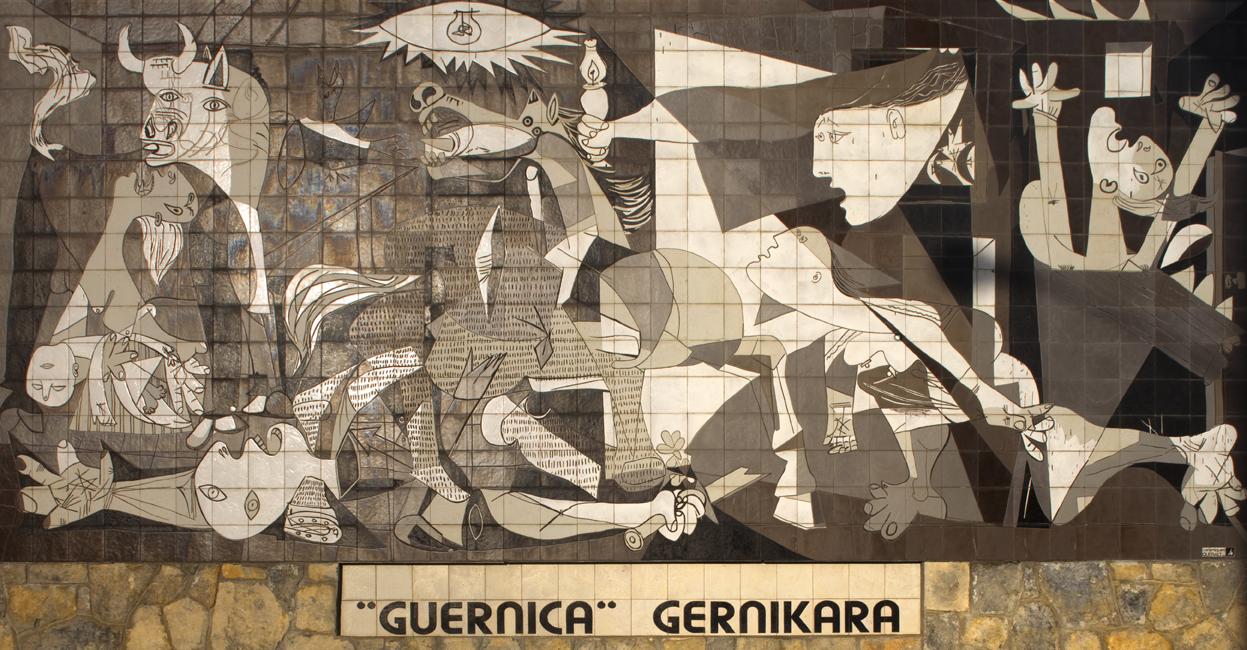
Among the idealistic combatants who travelled to Spain to join the fight against fascism were Ernest Hemingway and George Orwell, whose war experiences served to inform, respectively, For Whom the Bell Tolls and Homage to Catalonia. The war also inspired Pablo Picasso’s unsettling surrealist masterpiece Guernica, which depicted the bombing of the Basque town of the same name on April 26, 1937.
Picasso’s Guernica in mural form in the town of Guernica.
Photo by Papamanila via Wikimedia Commons.All in all, something like 50,000 foreigners assisted the Republican side through the International Brigades — whose Brigada Abraham Lincoln included a Washington Battalion made up of Americans, and a Mackenzie-Papineau Battalion made up of Canadians. At least a quarter of these international volunteers died in combat, but most of the rest went home with frightening stories to tell. Even before the Nazis invaded Poland, the world’s understanding of fascism’s existential threat to humanity was shaped by General Francisco Franco’s successful campaign to topple the Second Spanish Republic.
And yet one thing that the Spanish Civil War has not yielded is a wide array of popular boardgames. This may be partly due to the fact that the conflict was so greatly overshadowed in scale and importance by World War II. But it may also be due to the fact that neither side emerged as sympathetic. As Orwell described in Homage to Catalonia (and as Adam Hochschild described, from a U.S. perspective, in his 2016 book, Spain in Our Hearts: Americans in the Spanish Civil War, 1936–1939), the Republican war effort turned out to be incompetent, fractured, and cynical, with the dominant pro-Stalinist faction eventually turning murderously upon its Trotskyist and anarchist allies. And as late as early March, 1939, just weeks before Franco conquered Madrid and ended the war, Republican forces inside the capital city were engaged in a deadly power struggle within their own ranks. All in all, the many regional and political subplots make the war difficult to model in any kind of conventional wargame (though, of course, this hasn’t stopped numerous game designers from trying).
However, The Beleaguered Capital, HazMo scenario 11, presents a reminder that when Republican and Nationalist forces fought each other in pitched battles, the mode of combat really did offer a preview of World War II, including the use of air power and tanks. (While the only tanks that existed in Spain when the war broke out were a handful of tiny, World War I-era Renault FTs, the Russians sent T-26s to the Republicans while Germany dispatched Pz Is to the Nationalists. In both cases, these vehicles arrived in Spain during the Fall of 1936, just a few months before the December 16 dateline on The Beleaguered Capital.)
January 25, 2022
The fantasy of a modern economy without money
Jon Hersey and Thomas Walker-Werth consider the claim that we’d all be better off without money in a truly modern, egalitarian society:
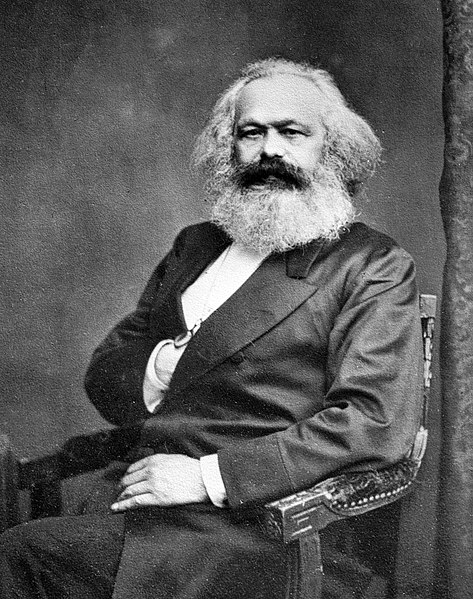
Capitalism, to the extent it has existed, has been incredibly successful at lifting most of humanity out of poverty, incentivizing the creation of incredible, life-enhancing technologies, such as those Maezawa used to make his fortune — not to mention, travel to space. But it’s long had its critics, and he is far from the first to propose a sort of Garden-of-Eden world where everything is plentiful and free. Karl Marx envisioned a similar utopia. Communism, he said, ultimately would bring about a world without money:
In the case of socialised production the money-capital is eliminated. Society distributes labour-power and means of production to the different branches of production. The producers may, for all it matters, receive paper vouchers entitling them to withdraw from the social supplies of consumer goods a quantity corresponding to their labour-time. These vouchers are not money. They do not circulate.
And although “society distributes labour-power” — meaning government planners tell people what to do to ensure that things (such as “free” Ferraris) get made — workers could also all pursue whatever hobbies or occupations strike their fancy. “[I]n communist society,” Marx explained,
where nobody has one exclusive sphere of activity but each can become accomplished in any branch he wishes, society regulates the general production and thus makes it possible for me to do one thing today and another tomorrow, to hunt in the morning, to fish in the afternoon, rear cattle in the evening, criticize after dinner, just as I have in mind, without ever becoming hunter, fisherman, shepherd or critic.
[…]
Although Marx considered himself a social scientist and economist — and although his ideas are still some of the most widely taught — they aren’t much taught in social science or economics departments, except as foils. That’s because virtually all of Marx’s hypotheses have been debunked. For one, who’s going to build the free Ferraris that Maezawa has dreamed up, never mind tackle more mundane tasks, with no incentive? But for those who don’t find such commonsense thought experiments convincing — or who think, as Marx did, that human nature will somehow mysteriously change — the impracticality of Marx’s moneyless state was demonstrated by what Austrian economists have come to call the calculation problem. Ludwig von Mises once explained the problem as follows:
If a hydroelectric power station is to be built, one must know whether or not this is the most economical way to produce the energy needed. How can he know this if he cannot calculate costs and output?
We may admit that in its initial period a socialist regime could to some extent rely upon the experience of the preceding age of capitalism. But what is to be done later, as conditions change more and more? Of what use could the prices of 1900 be for the director in 1949? And what use can the director in 1980 derive from the knowledge of the prices of 1949?
The paradox of “planning” is that it cannot plan, because of the absence of economic calculation. What is called a planned economy is no economy at all. It is just a system of groping about in the dark.
In short, without prices, people have no relatable, quantifiable means of comparing and contrasting options about how to spend time and capital, which is vital for determining how best to use these naturally scarce resources. “New Scientist magazine reported that in the future, cars could be powered by hazelnuts,” said comedian Jimmy Fallon, in a skit that captures this point hilariously. “That’s encouraging, considering an eight-ounce jar of hazelnuts costs about nine dollars. Yeah, I’ve got an idea for a car that runs on bald eagle heads and Fabergé eggs.”
January 18, 2022
Decadence
In the latest Libertarian Enterprise, Sarah Hoyt considers the old Soviet put-down of all of western culture (especially the American one) … that it was decadent:
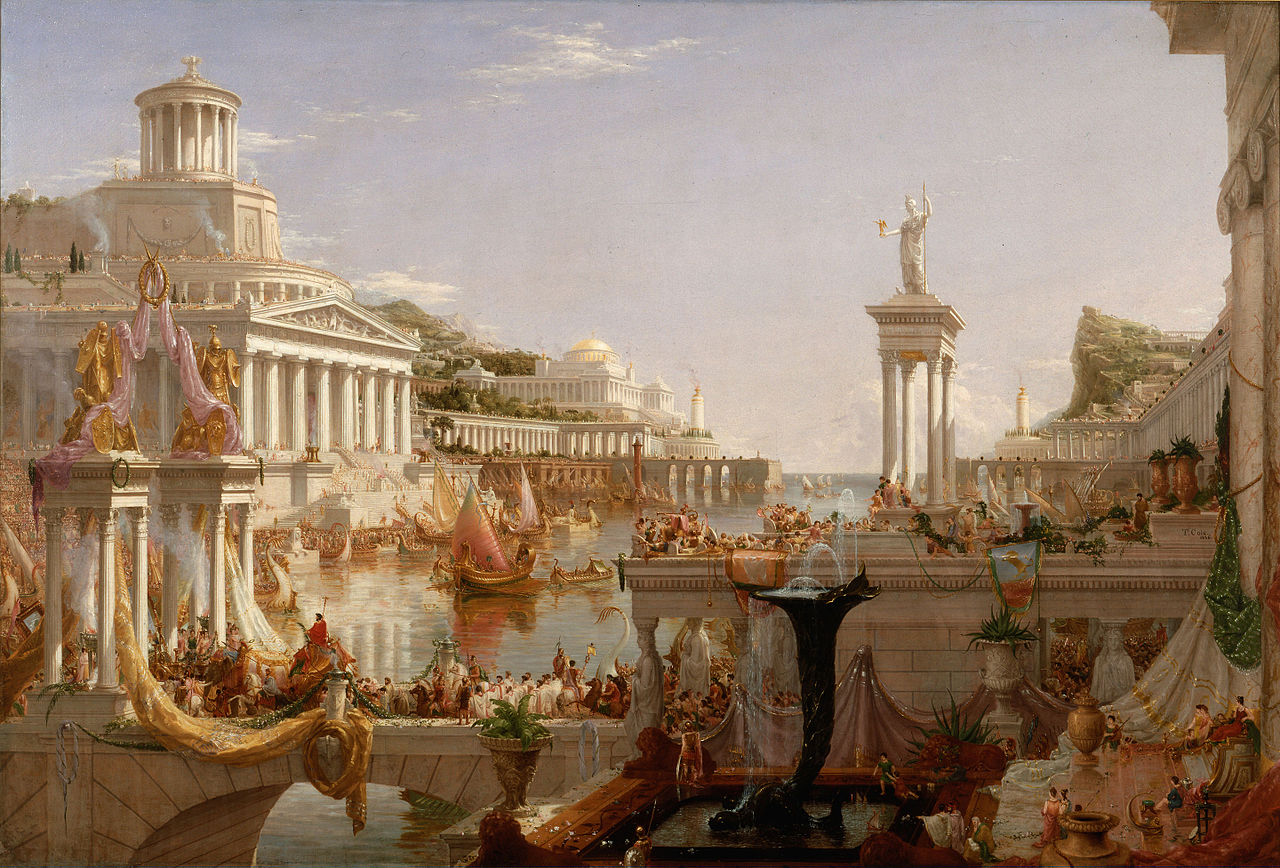
“The Consummation of Empire” from the painting series “The Course of Empire” by Thomas Cole (1801-1848).
New York HIstorical Society collection via Wikimedia Commons.
Yes, sure. I hear any number of you gnashing your teeth on that side of the screen: the soft living, the snowflakery in — mostly — our universities, the demands that everyone cater to them, people being completely terrified of a bad cold. Oh, yeah, rampant crime and bad sexual morals. We’re OBVIOUSLY decadent. How can I make fun of it?
Very easily.
For one your gnashing of teeth rhymes eerily with Romans gnashing of teeth for millennia, long before Rome was anywhere near ripe to fall, and in fact while Rome was the bad ass of the world. Second, it echoes even more eerily all of the Christian explanations of why Rome fell, which curiously also echoed the Christian beliefs in the loss of paradise.
“Decadence is sinfulness, and then comes the end and only G-d can save you” is the narrative there. Which is fine, in a spiritual sense, and completely bonkers insane when it applies to cultures and history. But it served the nascent theocracy that replaced Rome quite well. One of the things it served was to explain why life was now much, much harder. Because you know, abundance is what leads to decadence. Life is too soft, you don’t work hard enough and … bam! suddenly you’re in the middle of an orgy or worshiping a goat or something. Never you mind that the Romans pretty much did that all along, even when they were the badasses of the world. It’s really easy to shape the history of a fallen civilization so it suits the purposes of its successor.
Which brings us to the fact that Communism is a Christian heresy, complete with paradise — the supposed egalitarian and property-free pre-history (it’s also really easy to shape a period that left no account of itself that we can find) — until greed — and in one version PATRIARCHY and in another “whiteness” WTF that means — kicked us out of it. Now we must force the perfect human (Homo Sovieticus!) to emerge, so we can go back to living in caves in (sing it) perfect harmony. (Yeah.)
The complaints of decadence I heard as a young woman were mostly Soviet Agit Prop. Yes, yours were too. They ranged from incoherent to frigging insane. Some of it was a very old rhyming chorus: Americans were decadent because they were too rich. They had too many choices. They were too immoral. They never had enough, and would commit crimes to be richer. They ate too much, drove too much, slept in too comfortable a bed, and in general were DECADENT. Just like Rome before it fell. (If you realize the actual structure of Imperial Rome was closer to the Soviet Union’s, a plunder culture that could only survive by stealing, the whole thing will take your breath away with its chutzpah.
The fact that our (even though at the time it was your, as I was a foreigner at least in some ways) entertainment and art echoed these crazy accusations only made the whole thing stick, so even the right, American loving side (which anyway always has a vast side of puritanism in America. And speaking of puritans, let’s talk about what some of them did to … turkeys? If weird sexual kinks are a sign of decadence, we’ve never been non-decadent) bought into it. I mean Spartacus (the novel) portrait of the decadence of Rome was meant to echo how bad America was. What’s that I hear? The author was a communist? You. Don’t. Say. I think I sent my shocked face out to be mended, but I won’t be a sec while I retrieve it.
In a more personal sense, my own family told me Portugal too was decadent. Why, unlike mom, I didn’t have to walk beside the train line to pick up enough coal for the family to cook. We had butane bottles delivered, even if they were super expensive, so we often cooked on a petrol lamp in the patio, if the weather was fine.
Decadent and soft living, I tell you. Sure, the bathroom was outside, but it was a bathroom, with running water included. JUST like Rome before the fall. How much longer till we started screwing Nightingales’ Tongues, eating Bear Sausages and electing horses to congress (I think in America we’ve been doing that all along, too. Though I’d prefer if every now and then we elected the front half of the horse.)
January 17, 2022
QotD: The British ruling class reaction to fascism and communism
The British ruling class were not altogether wrong in thinking that Fascism was on their side. It is a fact that any rich man, unless he is a Jew, has less to fear from Fascism than from either Communism or democratic Socialism. One ought never to forget this, for nearly the whole of German and Italian propaganda is designed to cover it up. The natural instinct of men like Simon, Hoare, Chamberlain, etc. was to come to an agreement with Hitler. But – and here the peculiar feature of English life that I have spoken of, the deep sense of national solidarity, comes in – they could only do so by breaking up the Empire and selling their own people into semi-slavery. A truly corrupt class would have done this without hesitation, as in France. But things had not gone that distance in England. Politicians who would make cringing speeches about “the duty of loyalty to our conquerors” are hardly to be found in English public life. Tossed to and fro between their incomes and their principles, it was impossible that men like Chamberlain should do anything but make the worst of both worlds.
One thing that has always shown that the English ruling class are morally fairly sound, is that in time of war they are ready enough to get themselves killed. Several dukes, earls and what-not were killed in the recent campaign in Flanders. That could not happen if these people were the cynical scoundrels that they are sometimes declared to be. It is important not to misunderstand their motives, or one cannot predict their actions. What is to be expected of them is not treachery or physical cowardice, but stupidity, unconscious sabotage, an infallible instinct for doing the wrong thing. They are not wicked, or not altogether wicked; they are merely unteachable. Only when their money and power are gone will the younger among them begin to grasp what century they are living in.
George Orwell, “The Lion And The Unicorn: Socialism and the English Genius”, 1941-02-19.


