
While Heinlein (as far as I know) supplied no rationale for the advent and the recession of the craziness in the Crazy Years, A.E. van Vogt was freer with his speculations: insanity, either of individuals or of peoples, in van Vogt’s stories (and perhaps in the theories of Alfred Korzybski, who discovered or invented General Semantics) is caused by a fracture or disjunction between symbol and object. When your thoughts, and the thing about which you think, do not match up on a cognitive level, that is a falsehood, a false belief. When the emotions associated with the thought do not match to the thing about which you think, that is a false-to-facts association, which can range from merely a mistake to neurosis to psychosis, depending on the severity of the disjunction. You are crazy. If you hate your sister because she reminds you of your mother who beat you, that association is false-to-facts, neurotic. If you hate your sister because you have hallucinated that you are Cinderella, that association is falser-to-facts, more removed from reality, possibly psychotic.
The great and dire events of the early Twentieth Century no doubt confirmed Korzybski in the rightness of this theory. Nothing prevents a race of people from contracting and fomenting a false-to-facts belief: the fantasies of the Nazi Germans, pseudo-biology and pseudo-economics combined with the romance of neo-paganism, stirred the psyche of the German people for quite understandable reasons. From the point of view of General Semantics, the Germans had divorced their symbols from reality, they mistook metaphors for truth, and their emotions adapted to and reinforced the prevailing narrative. They told themselves stories about Wotan and the Blood, about being betrayed during the Great War, about needing room to live, about the wickedness of Jewish bankers and shopkeepers, about the origin of the wealth of nations — and they went crazy.
The Russians, earlier, and for equally psychological and psychopathic reasons told themselves a more coherent but more unreal story about history and destiny, taken from a Millenarian cultist named Marx, and they were, on an emotional level even if not on a cognitive level, convinced that shedding the blood of millions would bring about wealth as if from nowhere. And, because they used the word “scientific” to describe their brand of socialism, they actually thought their play-pretend neurotic story was a scientific theory that had been discovered by rigorous ratiocination — and they went crazy.
Berlin was bombed into submission during the Second World War, and the Berlin Wall collapsed along with the Soviet Empire at the end of the Cold War. But the modern methods of erecting false-to-facts dramas appealing to mass psychology, once discovered, did not fall when their practitioners fell: scientific socialism, naziism, fascism, communism, all have in common the subordination of word-association to political will. All these doctrines have a common ancestor, which is the social engineering theory of language: if you change the connotation of word, so the theory runs, you change the connotations of thoughts. General Semantics says that if an individual, or whole people en mass, adopt deliberately false beliefs, supported by deliberately manipulative word-uses, he or they will have increasingly unrealistic and maladaptive behaviors. Introduce Political Correctness, ignore factual correctness, and the people will go crazy.
The main sign of when madness has possessed a crowd, or a civilization, is when the people are fearful of imaginary or trivial dangers but nonchalant about real and deep dangers. When that happens, there is gradual deterioration of mores, orientation, and social institutions — the Crazy Years have arrived.
John C. Wright, “The Crazy Years and their Empty Moral Vocabulary”, John C. Wright, 2019-02-18.
January 1, 2022
QotD: Heinlein’s “Crazy Years”, Alfred Korzybski’s General Semantics, and modern times
December 1, 2021
The Titanic Struggle for Reunion Island – WW2 Special
World War Two
Published 30 Nov 2021It might only be tangentially relevant to the war as a whole, but the Battle for Reunion Island is not only interesting in and of itself, it serves as a microcosm for the war for the French in general. Check it out!
(more…)
November 24, 2021
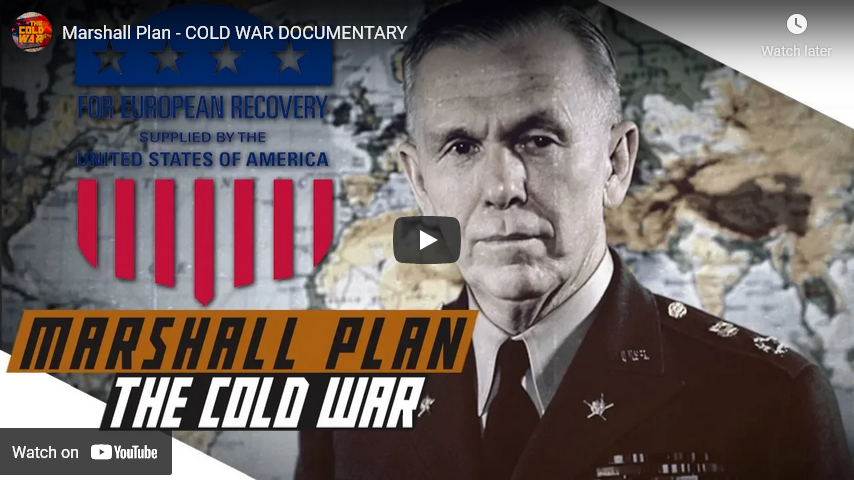
The Marshall Plan
The Cold War
Published 6 Jul 2019Our series on the history of the Cold War period continues with a documentary on the Marshall Plan and how the USA was able to help in the rebuild of the post-War World and gained valuable allies while doing it
Consider supporting us on Patreon: https://www.patreon.com/thecoldwar
November 7, 2021
QotD: Shoe manufacturing in the Soviet Union
After trying several workarounds, GOSPLAN, the state production ministry, decided to use “Gross Output Targets” to produce goods. Which probably worked ok for stuff like rebar, if you don’t care about quality (see Mao’s DIY backyard blast furnaces), but is terrible for stuff like shoes. So let’s say GOSPLAN decides that 100,000 lucky proles of Irkutsk Oblast shall receive one pair of shoes apiece. Since all materials had to be requisitioned in advance from GOSSNAB (I confess: I love Soviet acronyms), and since the production line would need to be re-tooled for each individual size and style of shoe, the factory managers — who had to hit the Gross Output Target, or go tour Siberia — did the only logical thing: They cranked out 100,000 baby shoes, all left feet. (Baby shoes use less leather; the excess can be sold or traded, see below).
Again, Commies couldn’t care less about consumer complaints, but eventually some up and comer in the Party will notice that everyone is wandering barefoot around a big pile of baby shoes. That might make him look bad, so he sends a report, and, after a long and convoluted bureaucratic process, GOSPLAN revises their order: 100,000 pairs of shoes, but in different sizes and styles, for men and women. In response to which, the factory manager does the only logical thing: 99,999 pairs of baby shoes, all left feet, plus one pump and one wingtip.
Lather, rinse, repeat. The factory manager isn’t a bad guy — in fact, let’s say he’s Wyatt. He’s just operating on an entirely different incentive structure than even his immediate boss, to say nothing of the faceless apparatchiks at GOSPLAN. Hitting any Gross Output Target is a real task, given that his workforce is a bunch of illiterate peasants who hate him and are constantly drunk. What probably seems like spectacularly inventive cruelty to the proles of Irkutsk Oblast is just Wyatt doing everything he can to keep his family out of the Gulag. And since Wyatt’s a smart guy, he can get around any target GOSPLAN sets. If they tell him to produce 100,000 pounds of shoes, his factory cranks out one enormous pair of concrete sneakers.
That’s one of Wyatt’s two overriding priorities: Staying out of the Gulag. The other one is: Using whatever he can scrimp, save, or scrounge from GOSSNAB as trade goods in the black market.
Here again, Wyatt’s not a bad guy. He’s not doing this to feather his own nest (though of course he lives a little better than others; he’s only human). In the words of the immortal Mike Tyson, everyone has a plan until he gets punched in the mouth, and even the most meticulously “scientific” management gets punched in the mouth all the time. As we’ve seen, GOSPLAN can’t even get it right with something as low-tech, as easy to mass-produce as shoes, so imagine how they do with more complex bits of equipment. The factory managers, who have to hit the Gross Output Targets, no matter what, quickly figure out that they’ll be waiting until doomsday if they try requisitioning what they need from GOSSNAB, so they form a kind of black market between themselves. Indeed there’s an entire class of quasi-criminals, whose name I forget, that exists only to facilitate such transactions.
Extend that paradigm to everything, and you’ve got life in the USSR. There’s the “official” economy, which is pure fantasy. There’s the black market economy at the factory level, where bulk materials change hands (since the official economy is pure fantasy, nobody blinks an eye when, say, 100,000 metric tons of concrete disappears off a manifest somewhere and reappears, un-manifested (as it were), somewhere else). There’s the black market at the consumer level, since of course the poor proles of Irkutsk Oblast have to have shoes and there’s no way they’re getting them from Wyatt’s factory. And finally, there’s the black market at the service level — those go-betweens arranging for 100,000 metric tons of concrete to fall off a truck in Vladivostok and appear, like magic, in Kiev (and their consumer-level equivalents — think pimps, but for everything).
Severian, “Darker Shade of Black IV: Black Market”, Rotten Chestnuts, 2021-04-02.
October 17, 2021
QotD: Like Justin Trudeau, too many western politicians admire China’s “basic dictatorship”
Then there is the Chinese government’s ability to surveil and control their people – for their own good, of course. How many over here would love a Social Credit System, where they can reward and punish people according to government’s priorities, from environmentally-conscious behaviour to public health considerations. In democracies, the people rate their leaders; in China the leaders rate their people. Just imagine how much more effectively our governments and health authorities would be able to to deal with all of us during the current pandemic if they could “see” and “nudge” every individual at every moment and in every situation. The most dangerous virus to come from China recently is not COVID, it’s “socialism with Chinese characteristics” with its siren call of unrestrained power for large sections of our political and economic elites.
Arthur Chrenkoff, “World hearts commies”, The Daily Chrenk, 2021-07-01.
October 13, 2021
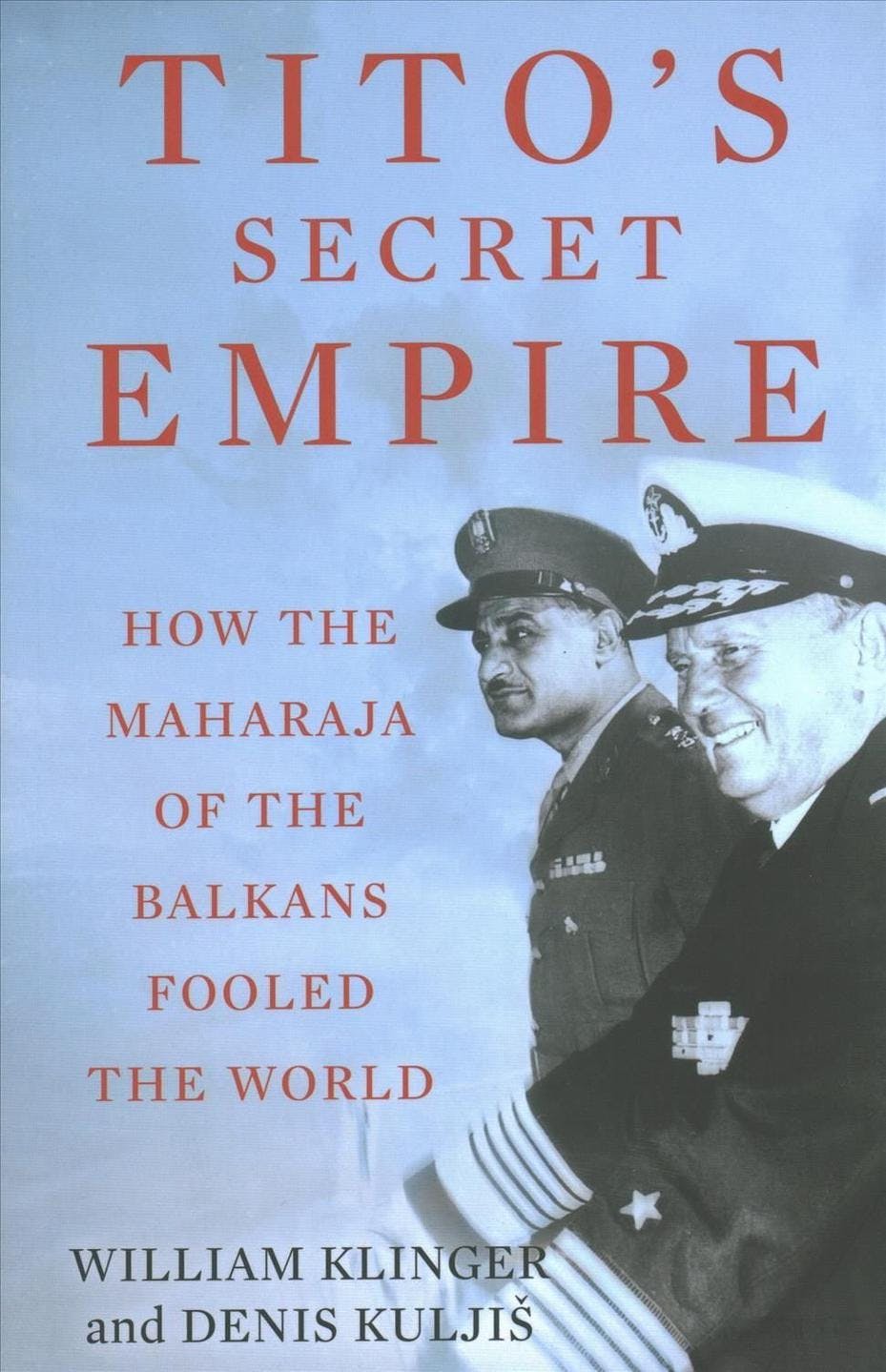
Josip Broz Tito — The “Maharaja of the Balkans”
In The Critic, Thomas Gallagher looks at the man and the myth of Yugoslavia’s communist leader, known to the world as “Tito”:
Decades after his death in 1980, Josip Broz Tito still casts a spell as a larger-than-life figure.
The legend portrays him as a famous military leader and anti-fascist guerrilla fighter who fought off the Nazis and defied Stalin. He then went on to be a champion of peace who stood up for various small nations snapping the coils of European overlordship. He was at home on imperial estates or, more often, on his secluded luxury home on the island of Brioni, with Old Masters adorning his walls and kings, emperors and fellow communist strongmen paying homage.
Despite clumsy language and hyperbole in places, as well as some avoidable errors, Tito’s Secret Empire seeks to debunk Tito’s legend and in several key respects it succeeds. The authors William Klinger and Dennis Kuljiš accord some honours to their subject.
He was a unique character well-equipped to surmount various obstacles during his 88-year life. For the British diplomat, Sir Fitzroy Maclean, he was “a fail-proof survivor”. In 1974 he was hailed by Germany’s Chancellor, Helmut Schmidt, as “the greatest of the winners of the Second World War”.
A benign image persisted, despite Tito being responsible for more acts of mass cruelty than any other European communist leader with the exception of the Soviets. He was admired as a wheeler-dealer in international affairs, from murky transactions to the most delicate undertakings in statecraft. This well-researched book deserves attention for those who wish to peer beyond the carefully cultivated image.
[…]
His 1954 state visit to then-royalist Greece, a regime which he had spent years trying to topple, was an unmistakable indication that he was placing himself at the head of a hybrid regime. Britain’s foreign secretary, Anthony Eden, had already visited him and urged the United States to prop up Tito financially. The favour was not returned. Evidence is provided that Tito played a major role in encouraging Egypt to nationalise the Suez Canal. He saw President Nasser as a kindred spirit, a populist unencumbered by ideology. Tito even more keenly sought to end French rule in Algeria, arming the rebels and offering diplomatic support.
In September 1961, he welcomed dozens of leaders from the promising new “non-aligned” bloc to a conference in Belgrade. Next year China invaded India and his soul-mate, Nehru, turned to the West for help. Thereafter, the non-aligned movement’s influence waned, as did Tito’s with it.
He increasingly became a pensioner of the Soviet Union. American ardour cooled as it became clear how reliant he was on Soviet arms and industrial licences which enabled this supposed ambassador of peace to export weapons to the Third World.
October 9, 2021
QotD: China’s “social credit” policy
The China lobby excuses the policy by comparing it to Western customer loyalty programs and asserting that it’s not in place around the whole country yet. In truth, it’s a typical aspect of Chinese communism, which loosens the reins for a period before tightening them again. Mao instituted the “Thousand Flowers” campaign in the ’50s that encouraged criticism of the party, following up a few years later with the Great Cultural Revolution, in which those critics were shot or sent to the Gobi.
Like it or not, progress of any sort – social, scientific, artistic – is propelled by the mavericks. Beethoven, Tesla, Einstein, Patton, Kubrick, Trump … all individualists – cantankerous, arrogant, belligerent – who pushed against social inertia, no matter what the consequences. Their story, from Socrates on, is the story of the West. With the “Social Credit” program, China is returning to its immemorial preference for stasis, which has led to disaster time and again. The end result will be a society that is stratified, ossified, and petrified. There is evidence that this is occurring right now.
J.R. Dunn, “The Myth of China as Superpower”, American Thinker, 2019-01-09.
August 31, 2021
Spy Affair that Started the Cold War
The Cold War
Published 3 Aug 2019Our series on the history of the Cold War period continues with a documentary on Gouzenko affair — a spy thriller that provoked the beginning of the Cold War.
Consider supporting us on Patreon: https://www.patreon.com/thecoldwar

August 9, 2021
QotD: Leonid Brezhnev and his mother
It’s not really a paradox. Communism is just a con. When the true believers get in the way of the con, they have to be shut up.
The old Soviet joke went like this: General Secretary Brezhnev shows his mother his palatial apartment in Moscow, his fancy dacha in the countryside, his chauffer-driven limousine, his personal helicopter, etc. and says “See mom, I’ve really made it. Aren’t you proud?”
“Very much so,” she says. “But I’m worried, too.”
“What are you worried about?” asks Brezhnev.
“Well, Leonid — what if the communists come back?”
Glenn Reynolds, “This Reminds Me Of The Old Soviet Joke About Leonid Brezhnev And His Mother”, Instapundit, 2018-11-24.
August 6, 2021
Shostakovich: Stalin’s Composer? – WW2 Biography Special
World War Two
Published 5 Aug 2021Leningrad’s Dmitri Shostakovich has risen from a child prodigy to be one of the Soviet Union’s most celebrated composers, having rescued his career from Stalin’s interference along the way. Desperate to defend Russia after the German invasion, he fights back, not with a rifle, but with music.
(more…)
August 4, 2021
Canadian tourist dollars are helping keep Cuba’s struggling economy afloat
In Tuesday’s NP Platformed newsletter, Colby Cosh praises a CBC News (!!!) article on the massive impact of purely Canadian tourist income on Cuba:
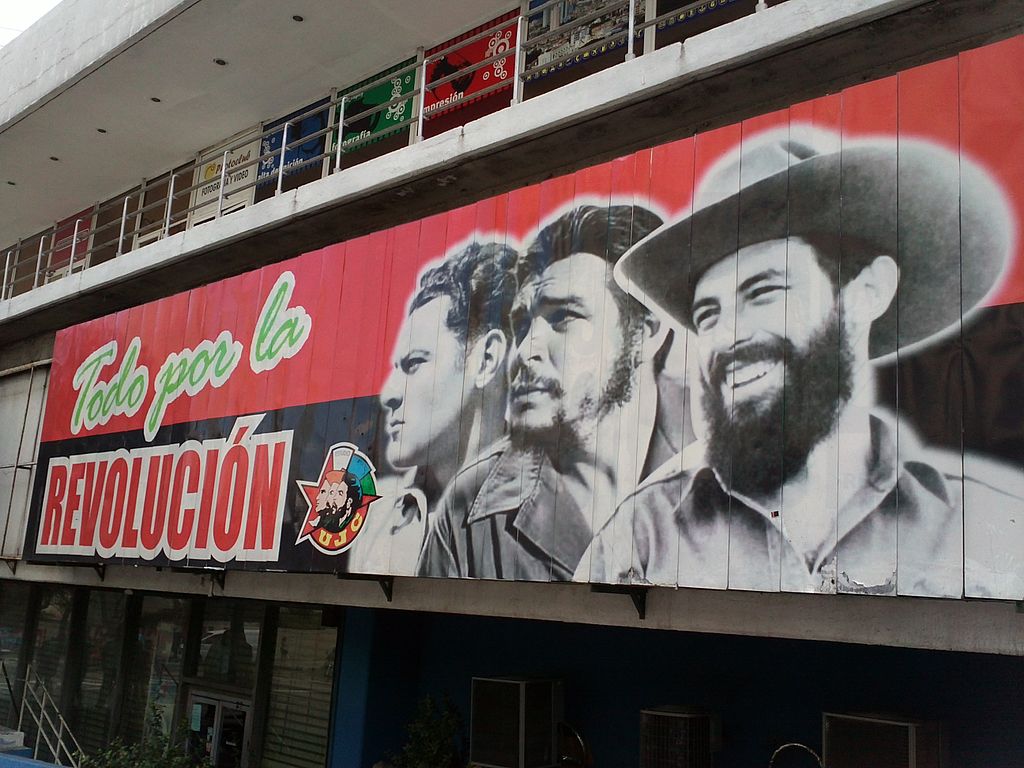
A billboard in Havana, showing Camilo Cienfuegos, Ernesto “Che” Guevara, and Fidel Castro, 4 November 2014.
Photo attributed to Tumpatemcla~commonswiki via Wikimedia Commons.
NP Platformed returns today with that rarest of things in the National Post: an absolutely unironic recommendation to read a CBC News report. The article in question comes from Evan Dyer, and it’s headlined: “How Canadian Tourism Sustains Cuba’s Army And One-Party State“. And it is, we have to confess, a masterpiece of precision. We appreciate the small, uncomfortable barb, for example, concealed in this phrase: “in normal years far more Canadians enter and leave Cuba than citizens of any other country — including Cuba itself.”
Why is Canada a quintessential source of the tourism dollars that flow directly to the Cuban army, or in some cases to partnerships between foreign hospitality providers (like Toronto’s Sunwing Travel Group) and the Cuban army? Last month the world was reminded by Cuban protesters how fragile and miserable the communist island’s economy really is. As people stormed into the streets pleading for food and medicine, sympathizers abroad continued to sing from their moth-eaten hymnal and blame America’s long-standing trade embargo (which allows even American citizens and companies to sell, wait for it, food and medicine to Cuba).
And yet, within Canada, there is no sign of any social stigma attaching to Cuban travel. Perhaps it’s because Latin America is one huge undifferentiated wad in our minds, and if we began to get fussy about the governments of various Caribbean countries (most of which let people leave if they like), we might be forced to … we dunno, winter in Costa Rica or Bermuda or someplace weird like that. Cuba can’t find the cash to keep a fresh coat of paint on a hospital, but the empire of affordable resorts and jineterismo continues to expand. Some of you helped build it.
There is nothing new about this — except the obvious willingness of ordinary Cubans to risk wounds and death to protest against their communist rulers, as Michael Totten reported more than seven years ago:
Cubans in the hotel industry see how foreigners live. The government can’t hide it without shutting the hotels down entirely, and it can’t do that because it needs the money. I changed a few hundred American dollars into convertible pesos at the front desk. The woman at the counter didn’t blink when I handed over my cash — she does this all day — but when she first got the job, it must have been shattering to make such an exchange. That’s why the regime wants to keep foreigners and locals apart.
Tourists tip waiters, taxi drivers, tour guides, and chambermaids in hard currency, and to stave off a revolt from these people, the government lets them keep the additional money, so they’re “rich” compared with everyone else. In fact, they’re an elite class enjoying privileges — enough income to afford a cell phone, go out to restaurants and bars, log on to the Internet once in a while — that ordinary Cubans can’t even dream of. I asked a few people how much chambermaids earn in tips, partly so that I would know how much to leave on my dresser and also to get an idea of just how crazy Cuban economics are. Supposedly, the maids get about $1 per day for each room. If they clean an average of 30 rooms a day and work five days a week, they’ll bring in $600 a month — 30 times what everyone else gets. “All animals are equal,” George Orwell wrote in Animal Farm, his allegory of Stalinism, “but some animals are more equal than others.” Only in the funhouse of a Communist country is the cleaning lady rich compared with the lawyer. Yet elite Cubans are impoverished compared with the middle class and even the poor outside Cuba.
August 2, 2021
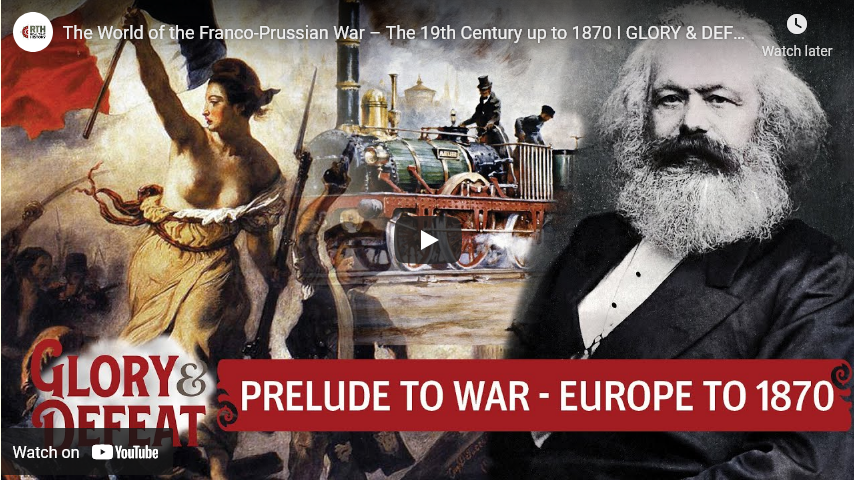
The World of the Franco-Prussian War – The 19th Century up to 1870 I GLORY & DEFEAT
realtimehistory
Published 30 Jun 2021Support Glory & Defeat: https://realtimehistory.net/gloryandd…
Welcome to the first primer episode for Glory & Defeat. In this first primer episode we will take a broad look at the industrial revolution and the emerging new ideologies of the 19th century: Communism and Nationalism.
» OUR PODCAST
https://realtimehistory.net/podcast – interviews with historians and background info for the show.» LITERATURE
Hobsbawm, Eric: The long nineteenth century. 3 Bände. London 1962-1987Kugler, Martin: “Fehleinschätzungen der Menschheit”, in: Die Presse v. 28.2.2010. o.S
Osterhammel, Jürgen: Die Verwandlung der Welt. Eine Geschichte des 19. Jahrhunderts. München 2009
Bruckmüller, Ernst et. al. (ed.): Putzger. Historischer Weltatlas. Berlin 2001
Staas, Christian: “Im Schatten der Schlote”, in: Geo Epoche Nr. 30. Die industrielle Revolution. 2008. S. 72-85
Bischoff, Jürgen: “Vorwärts durch Raum und Zeit”, in: Geo Epoche Nr. 30. Die industrielle Revolution. 2008. S. 56-71
» SOURCES
Engels, Friedrich: Die Lage der arbeitenden Klasse in England. Leipzig 1845» OUR STORE
Website: https://realtimehistory.net»CREDITS
Presented by: Jesse Alexander
Written by: Cathérine Pfauth, Prof. Dr. Tobias Arand, Jesse Alexander
Director: Toni Steller & Florian Wittig
Director of Photography: Toni Steller
Sound: Above Zero
Editing: Toni Steller
Motion Design: Philipp Appelt
Mixing, Mastering & Sound Design: http://above-zero.com
Maps: Battlefield Design https://www.battlefield-design.co.uk/
Research by: Cathérine Pfauth, Prof. Dr. Tobias Arand
Fact checking: Cathérine Pfauth, Prof. Dr. Tobias ArandChannel Design: Battlefield Design
Contains licensed material by getty images
All rights reserved – Real Time History GmbH 2021
August 1, 2021
Christopher Hitchens on George Orwell
DailyHitchens
Published 22 Jan 2010Aug 7, 2009. Christopher Hitchens talks with EconTalk host Russ Roberts about George Orwell. Drawing on his book Why Orwell Matters, Hitchens talks about Orwell’s opposition to imperialism, fascism, and Stalinism, his moral courage, and his devotion to language. Along the way, Hitchens makes the case for why Orwell matters. For more videos, updates and info on Christopher Hitchens, please visit http://www.dailyhitchens.com

July 23, 2021
QotD: Cultural Marxism includes a form of reverse Nazism
There is nothing new under the sun, just the same old zombie ideas that refuse to die. Whether the old or new Marxism, the activists have the same simplistic, blinkered view of life and the same radical solutions. The irony in both cases is that their ideology reaches its peak popularity after the genuine grievances that gave rise to it in the first place have by and large been confronted and addressed. No matter. In the twentieth century, Marxists failed to replace liberal capitalist democracy with their utopia; in the twenty-first, they are trying their luck again. This time it will be “real” socialism, rainbows and unicorns and happily ever after. This time it will be different.
Arthur Chrenkoff, “Why everything is racist”, Daily Chrenk, 2021-04-13.
July 20, 2021
QotD: Lenin’s “Hanging Order”
Elsewhere, Lenin declared that “The proletariat needs state power, the centralized organization of force, the organization of violence, for the purpose of crushing the resistance … and for the purpose of leading the great mass of the population … in the work of organizing a socialist economy.”
In August 1918, Lenin sent his now famous “Hanging Order” telegram. It instructed local Bolsheviks in the Penza region to deal harshly with the farmers (kulaks) who owned land there and were standing in the way of its nationalization. The British historian Robert Service discovered it in Soviet archives in the 1990s. It read as follows:
Comrades! The insurrection of five kulak districts should be pitilessly suppressed. The interests of the whole revolution require this because ‘the last decisive battle’ with the kulaks is now underway everywhere. An example must be made.
- Hang (absolutely hang, in full view of the people) no fewer than one hundred known kulaks, fatcats, bloodsuckers.
- Publish their names.
- Seize all grain from them.
- Designate hostages, in accordance with yesterday’s telegram.
Do it in such a fashion, that for hundreds of miles around the people see, tremble, know, shout: “The bloodsucking kulaks are being strangled and will be strangled.”
Telegraph receipt and implementation.
Yours, Lenin.
P.S. Use your toughest people for this.
That chilling telegram ushered in the “Red Terror” which murdered Russians by the tens of thousands over the next two years.
Lawrence W. Reed, “How Germany’s ‘Deal With the Devil’ Backfired and Changed History”, Foundation for Economic Education, 2021-04-16.


