Marcus Tullius Cicero was one of the most gifted and successful politicians of his day. Unlike nearly all of his peers in the Roman Senate, his family had not been in Roman politics for generations on generations, but rather was new to it. Cicero’s family was a wealthy one, but hailed from the town of Arpinum, about 60 miles from Rome, making Cicero an outsider to elite Roman politics. He made his name as a legal advocate, rather than (in more typical Roman fashion) as a military man. He was the first of his family to enter the Roman Senate (making him a novus homo or “new man”) and was the first such new man to rise all the way to the consulship (the highest Roman office) in thirty years, which should give some sense of the magnitude of that achievement. Moreover, Cicero had managed to get elected in the first year he was eligible, which would have been a banner achievement even for a member of Rome’s traditional upper-class. During that consulship (63 B.C.), he further distinguished himself by foiling a planned coup centered around the influential figure of Catiline (L. Sergius Catilina).
Cicero was a key politician in the Late Republic, but it was his misfortune that his life was spent in an era where words meant less than weapons. He sided with Pompey against Caesar, but was granted clemency after Pompey’s defeat. He was not involved in Caesar’s assassination – he was still too much an outsider for some of the stuck-up Roman elitists who made up the conspiracy (though he correctly pointed out at the time that leaving Antony alive would be a fatal mistake). In the aftermath of the assassination, he identified (correctly) Antony as the key threat to the Republic and worked to discredit him politically in a devastating series of speeches named the Philippics (in honor of a similar set of speeches made by the Athenian Demosthenes against Philip II of Macedon, father of Alexander). Cicero’s political assault on Antony succeeded – his reputation was ruined and his popularity in Rome never recovered – but it cost Cicero his life when Antony, in league with Octavian, moved into the capital and had Cicero murdered. Cicero’s literary legacy survived him, however, in part because it was useful for Augustus’ own political ends (e.g. Plut. Cic. 49.5-6).
Cicero’s position as the most eloquent orator of the Latin language – and probably its best prose stylist – is largely uncontested. It was his speaking skills – honed in the courts – that made him so politically successful. He was also a prolific writer and a tremendous amount of his writings survive, including both legal and political speeches, private letters, handbooks on oratory, and a set of philosophical works. As anyone who has read Cicero can tell you, he also has a deserved reputation for pride and self-aggrandizement. While many of Cicero’s contemporaries and readers down to the modern era have been impressed by Cicero’s thinking and eloquence, I feel confident in asserting no one – alive or dead – will ever be more impressed by Cicero than Cicero was impressed by himself.
Bret Devereaux, “Collections: A Trip Through Cicero (Natural Law)”, A Collection of Unmitigated Pedantry, 2019-12-12.
February 6, 2022
QotD: Marcus Tullius Cicero
November 19, 2021
QotD: People who are interested in history versus “academic” historians
One of many reasons I never went anywhere in my career as an academic historian is that I actually like history. I find it interesting. That’s because I find people interesting, and history is, above all, the study of people and how they be.
Your average academic historian lives entirely in xzheyr own head. They hate and fear people. They have no interest in how people actually are, only in how they should be. Thus, academic history quickly devolves into the worst kind of Social Justice Mad Lib, a never-ending, ever more frantic search for ever more obscure terms to complete the equation: “Despite [barbarities], the [micro-group] were actually only doing it because they were oppressed by the Pale Penis People, because [reasons].”
For example:
This is one of those things that’s true even if it’s not true, because Clown World, but I actually looked this guy up and yeah, he’s real — he’s a “Professor of Practice in Media and Activism at Harvard University”, which is exactly what it sounds like: basically, a tenured pest, who makes very nice bank making students protest shit for class credit. The “new book” referenced in the screenshot isn’t on Amazon yet, so maybe that’s not real, but again, Clown World — even if it’s not real, it’s real, because that’s exactly the kind of thing academic historians do. You probably remember it well from your own college days, if you were in college at any time between about 1985 through 1995, the heyday of “everyone you’ve ever heard of was secretly gay!” pseudo-scholarship.
Severian, “On Boredom”, Rotten Chestnuts, 2021-08-17.

October 4, 2021
Teaching history versus teaching to pass history tests
Severian discusses the problem of university students who know how to do well on multiple-guess tests, but don’t have the intellectual tools to work out answers if they’re not presented the same way as they were in class:

(Not Severian’s old employer, Flyover State) University College, University of Toronto, 31 July, 2008.
Photo by “SurlyDuff” via Wikimedia Commons.
Having realized I made a horrible mistake going into the Ed Biz, I used my last few semesters before pulling the pin as a kind of freelance lab. I’d ask a series of questions with canned answers about, say, the Battle of Gettysburg: The high ground occupied by Union forces was called a) Cemetery Ridge, b) Heartbreak Ridge, c) Federal Ridge, d) Ridge over Troubled Waters, and so on. Then I’d put in a “tie it all together”-type question, like so: In this famous Union victory, a failed assault against higher ground proved decisive. Was it a) Gettysburg, b) Chancellorsville, c) Port Hudson, d) Stalingrad. Note that the correct answer was actually spelled out in the previous questions …
… and I’m sure you can guess how the average student did. Just for fun, go ahead and guess how many students in a typical class of 30 picked “Stalingrad”. I’ll save you the suspense: Whatever you guessed, it’s too low. The reason is: Not knowing how to handle a question that isn’t straight regurgitation, students assume it’s a trick. Since they’ve never heard of the Battle of Stalingrad, that must be the answer (alternate explanation: They knew they skipped a lot of classes, and since they’ve never heard of a Civil War battle at Stalingrad, I must’ve covered it on one of those days they were sleeping off a hangover at 2pm, so it must be the right answer).
Since he teaches high school, Education Realist is more concerned with the “false positives”, the kids who ace the standardized test yet are dumb as fence posts … or, to be fair to them, are just slightly-brighter-than-average, but get the Certified Genius™ stamp on their high school transcripts, because they trained their asses off to ace the standardized tests. Me, I’m more interested in what this says about social decline.
My hypothetical question about the unnamed battle, above, isn’t genius-level stuff. It’s pretty basic, obviously, and at the start of my professing career I never would’ve tried it — NOT because I was so much more conventional back then (though I was), but because I considered it an insult to my students’ intelligence. Back then, I’d expect the average high school freshman to be able to figure that out, with no real strain on the brain …
It takes very long, very diligent, very expensive training to make kids into mere flowchart-followers. It takes even more of all that, plus a kind of sick genius, to turn them into the meat robots I saw at the end of my career, who were so robotic — and I swear this is true — that I could confound quite a few of them simply by switching up the word order. The powerpoint presentation said “The Union won the Battle of Gettysburg”, but the test said “The Battle of Gettysburg was won by ___”, and some large percentage of them would be stumped.
This has been a public service announcement, for all of you who’ve ever felt compelled to come up with some elaborate 4D chess theory about why our overlords do such seemingly stupid, indeed bizarre, things. These are the test-acers … and those are the kinds of tests they’re acing.
September 27, 2021
Why Were Things So Terrible In the 17th Century – General Crisis Theory
Kings and Generals
Published 26 Sep 2021💻 Go to https://NordVPN.com/kingsandgenerals and use code
kingsandgeneralsto get a 2-year plan with a huge discount plus 4 additional months for free. Protect yourself online today!Kings and Generals animated historical documentary series on early modern history and economic history continue with a video on the general crisis theory, as we try to deduce why the 17th century events were so terrible and why so many wars, rebellions, and upheavals happened in this period
Support us on Patreon: http://www.patreon.com/KingsandGenerals or Paypal: http://paypal.me/kingsandgenerals. We are grateful to our patrons and sponsors, who made this video possible: https://docs.google.com/document/d/1o…
The video was made by EdStudio while the script was researched and written by Turgut Gambar. Narration by Officially Devin (https://www.youtube.com/user/OfficiallyDevin)
✔ Merch store ► teespring.com/stores/kingsandgenerals
✔ Podcast ► http://www.kingsandgenerals.net/podcast/
✔ Twitter ► https://twitter.com/KingsGenerals
✔ Instagram ► http://www.instagram.com/Kings_GeneralsProduction Music courtesy of Epidemic Sound: http://www.epidemicsound.com
#Documentary #EarlyModern #GeneralCrisis
September 24, 2021
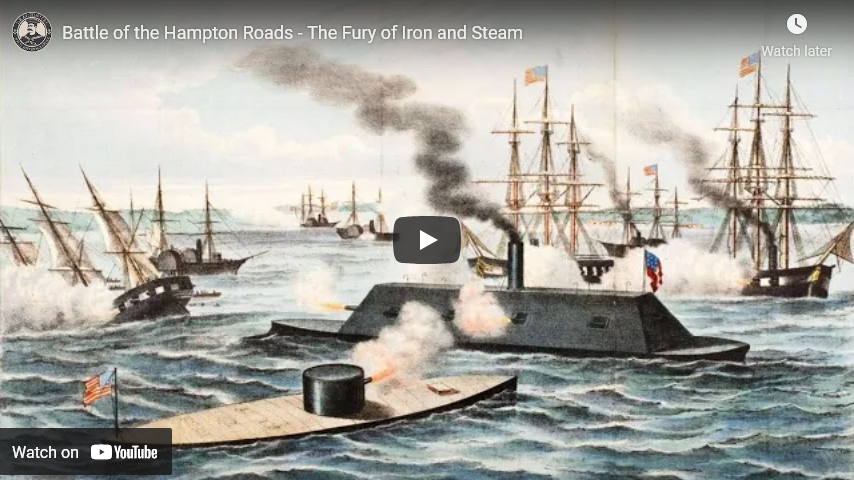
Battle of the Hampton Roads – The Fury of Iron and Steam
Drachinifel
Published 20 Feb 2019The first ironclad vs ironclad battle is reviewed, along with the origins of the ships and some of the myths and legends about this historic battle.
Want to support the channel? – https://www.patreon.com/Drachinifel
Want to talk about ships? https://discord.gg/TYu88mt
September 12, 2021
QotD: The US Supreme Court’s Dred Scott decision of 1857
The Scott decision is now considered an important contributing cause of the U.S. Civil War, which began four years later. It proved, beyond anyone’s doubt, President Abraham Lincoln’s maxim that a sovereign nation could not survive half-slave and half-free. Northern states might be capable of abolishing slavery locally, but this “abolition” would never apply to imported slaves from elsewhere considered as property. One cannot fully understand U.S. history, never mind the progress of its law, without studying and appreciating Taney’s cruel language.
And, indeed, for the world at large, Dred Scott is an unsurpassed reminder of the distinction between law and justice, and of the limitations of a highly reverenced written constitution. Taney not only accepted the (irrefutable) argument that the constitution explicitly countenanced slavery: he wrote fawningly of the Founding Fathers as great men, “high in their sense of honour,” who could never have upheld absolute equality before the law on one hand while hypocritically denying it to Blacks in practice. The Declaration of Independence’s claim that “all men are created equal,” the ex-slaveowner Taney wrote, was never understood by anyone to include inferior races.
Abolitionists of the time saw the innate hypocrisy: the contemporary newspaper editor William Lloyd Garrison risked his life by calling the constitution “a league with hell.” But [University of Buffalo law professor Matthew] Steilen thinks it is better not to expose Black students to the details of that debate. Reading Taney’s “gratuitously insulting and demeaning” words and arguments, he tweeted, is likely to, and there is no other way to put this, injure their feelings. To inquire too deeply into the detail of slavery, and of the law that shielded it, would require Black students to “relive the humiliation” of Dred Scott.
Colby Cosh, “Another Day in a Feelings-First World”, NP Platformed, 2021-06-09.
August 17, 2021
QotD: The “Crisis of the Third Century”
If you’ve read much about (or especially by) them, you know that the Romans were, for lack of a better term, paranoid. It was simply incompatible with the Roman psyche to have any large, organized group of non-Romans anywhere near the Empire’s borders … so the Empire kept expanding, first reducing, then Romanizing, every conceivable threat. They kept doing this long past the point of negative returns, such that the Empire collapsed under the strain of trying to hold itself together.
Stop me if this sounds familiar: A “government” whose only claim to legitimacy is naked force. A large, increasingly rapacious, increasingly class-conscious military with no obvious enemies to fight, and no ability to subdue the ones it settles for. A large, increasingly rapacious, increasingly caste-conscious bureaucracy that views the whole “Imperial” project as one big tax farming operation. Massive, ever-increasing wealth disparities that can only be very temporarily alleviated by debasing the currency, because structural reform is culturally impossible from above, and physically impossible from below. And to top it all off, a weird, apocalyptic religious cult totally destroying the few pan-imperial cultural institutions, including the military.
The history of the Third Century is insanely complex, not well understood in many respects even by field specialists, but the gist of it is clear enough: Some general somewhere decides he’d like to have a crack at emperorizing, so he gets his troops to throw a purple toga on him and proceeds to take on the incumbent. Some other general thinks that’s a pretty nifty idea, so he does the same thing, taking on both the incumbent and the pretender. Not wanting to be left out of the fun, the incumbent’s main general murders the incumbent and takes the crown for himself, fighting whoever’s left, plus whichever of his subordinate commanders decide they want a shot at the big chair. The Senate rubber-stamps one of these clowns, or some other general who decides he’d like to throw his toga into the ring, and civil war follows civil war until one of them temporarily triumphs … only for the same thing to happen again once the shine is off the new guy (usually in less than a year or two).
They called ’em the “Barracks Emperors” for a reason, y’all. And it’s actually worse than that, since lots of times the rebel generals didn’t bother going for the big prize back in Italy. Lots of them decided they’d do just fine ruling, say, Britain, or parts of Gaul, or Asia Minor or Egypt or what have you, while the other guys slugged it out for the increasingly marginalized, if not totally meaningless, “official” title. Declare yourself the Emperor of ___, issue some slapped-together coins with your picture on them, and go nuts. The “Gallic Emperors” had a run of nearly half a century like that — not bad at all for Late Antiquity.
Severian, “The Crisis of the Third Decade”, Rotten Chestnuts, 2021-03-18.
August 1, 2021
QotD: Rudolf Gaida’s convoluted military career
Footnote in Martin Gilbert’s World in Torment: Winston S. Churchill 1917-1922, 1975.
July 5, 2021
Did the CONFEDERACY Have BETTER GENERALS?!?!?!
Atun-Shei Films
Published 4 Jul 2021Checkmate, Lincolnites! Debunking Lost Cause myths – as well as more benign common misconceptions – about the military leadership of the Civil War. Did the South really have all the best battlefield talent? Was the key to Union victory a simple strategy of overwhelming the Confederate army with numbers and resources? Who was better at their job, Ulysses S. Grant or Robert E. Lee?
I’d say watch and find out, but the answer is obviously Grant.
Support Atun-Shei Films on Patreon ► https://www.patreon.com/atunsheifilms
Leave a Tip via Paypal ► https://www.paypal.me/atunsheifilms
Buy Merch ► teespring.com/stores/atun-shei-films
#CheckmateLincolnites #CivilWar #MilitaryHistory
Original Music by Dillon DeRosa ► http://dillonderosa.com/
Reddit ► https://www.reddit.com/r/atunsheifilms
Twitter ► https://twitter.com/atun_shei~REFERENCES~
[1] Andy Hall. “With One Hand Tied Behind its Back” (2013). Dead Confederates Blog https://deadconfederates.com/2013/11/…
[2] G.S. Boritt. Why the Confederacy Lost (1992). Oxford University Press, Page 39-40
[3] Richard E. Beringer. Why the South Lost the Civil War (1986). University of Georgia Press, Page 8-24
[4] Borritt, Page 24-30
[5] Charles Royster. The Destructive War: William Tecumseh Sherman, Stonewall Jackson, and the Americans (1991). Vintage Civil War Library, Page 76
[6] “Lincoln’s Unsent Letter to General Meade”. American Battlefield Trust https://www.battlefields.org/learn/pr…
[7] Eric J. Wittenberg. “A Civil War Witch Hunt: George Gordon Meade, The Retreat from Gettysburg, and the Joint Committee on the Conduct of the War” (2015). Emerging Civil War Blog http://emergingcivilwar.com/2015/07/0…
[8] Report of the Joint Select Committee Appointed to Inquire into the Condition of Affairs in the Late Insurrectionary States, so Far as Regards the Execution of Laws, and the Safety of the Lives and Property of the Citizens of the United States and Testimony Taken (1872). https://quod.lib.umich.edu/m/moa/ACA4…
[9] Andy Hall. “Nathan Bedford Forrest Joins the Kl@n” (2011). Dead Confederates Blog https://deadconfederates.com/2011/12/…
[10] Andy Hall. “Confederate Veterans on Forrest: ‘Unworthy of a Southern Gentleman'” (2013). Dead Confederates Blog https://deadconfederates.com/2013/08/…
[11] Edward Bonekemper. Ulysses S. Grant: A Victor, Not a Butcher (2004). Regnery History, Page 89-92
[12] Mary Boykin Chestnut. A Diary of Dixie (1905). D. Appleton and Company, Page 350
[13] Ernest B. Ferguson. “Catching Up With ‘Old Slow Trot'” (2007). Smithsonian Magazine https://www.smithsonianmag.com/histor…
[14] Bonekemper, Page xii
[15] Bonekemper, Page 308-309
[16] Bonekemper, Page 192-193
[17] Bonekemper, Page 201-203
[18] Justin D. Murphy. American Civil War: Interpreting Conflict Through Primary Documents, Vol. II (2019). ABC-CLIO, Page 331
[19] Bonekemper, Page 121 & 243-245
[20] Elizabeth Brown Pryor. Reading the Man: A Portrait of Robert E. Lee Through his Private Letters (2008) Penguin Books, Page 335
[21] Sean Kane. “Myths and Misunderstandings: Grant as a Slaveholder” (2017). The American Civil War Museum https://acwm.org/blog/myths-misunders…
[22] “Letter from Robert E. Lee to Mary Randolph Custis Lee (December 27, 1856).” Encylopedia Virginia https://encyclopediavirginia.org/entr…
[23] Pryor, Page 144-150
[24] “Ulysses S. Grant and General Orders No. 11”, National Park Service https://www.nps.gov/articles/000/ulys…
General George H. Thomas (1816-1870)
One of the references for the latest Atun-Shei Films “Checkmate Lincolnites!” video was an older article in the Smithsonian Magazine outlining the career of one of the best — yet least known — Union generals in the American Civil War:
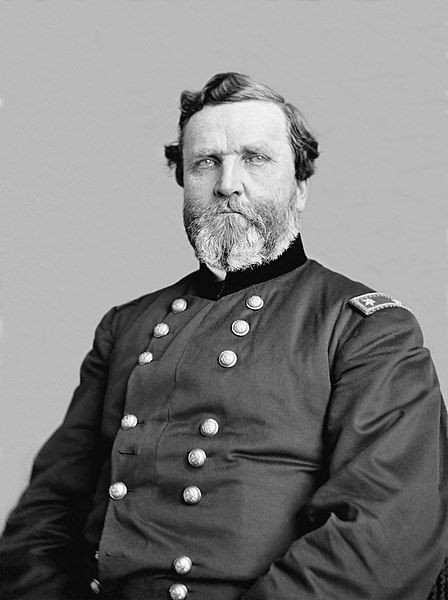
George Henry Thomas (July 31, 1816 – March 28, 1870), the “Rock of Chickamauga”, was a career U.S. Army officer and a Union general during the American Civil War, one of the principal commanders in the Western Theatre.
Image from the Library of Congress Prints and Photographs Division via Wikimedia Commons.
… for Thomas, every battlefield success seemed to stir controversy or the jealousy of ambitious rivals. Unlike other noted generals, he had no home-state politicians to lobby on his behalf in Washington. Ulysses S. Grant, for example, was championed by Illinois congressman Elihu Washburne, and Sherman by his brother, Ohio senator John Sherman. For Thomas, every step upward depended solely on his performance in the field.
In one of the war’s first skirmishes, he led a brigade in the Shenandoah Valley that bested Confederates under Stonewall Jackson. When the dashing Rebel J.E.B. Stuart heard that Thomas was commanding Union cavalry, he wrote to his wife that “I would like to hang him as a traitor to his native state.” Even after that, there was lingering doubt among some Unionists, including Lincoln. Unlike Grant, Sherman, George McClellan and some other ranking Union officers who had broken their military service with years as civilians, Thomas had been a soldier since the day he entered West Point. Yet when his name came up for promotion, the president, restrained by Northern radicals and surrounded in the Federal bureaucracy by Southerners, said, “let the Virginian wait.” But Sherman among others vouched for Thomas, and soon the Virginian was elevated to brigadier general and ordered to organize troops away from Virginia, beyond the Appalachians.
[…]
As Thomas rose, he proved to his men that his addiction to detail and his insistence on preparation saved lives and won battles. His generalship behind the front, before the battle, was generations ahead of his peers. He organized a professional headquarters that made other generals’ staff work seem haphazard. His mess and hospital services, his maps and his scouting network were all models of efficiency; he was never surprised as Grant had been at Shiloh. He anticipated modern warfare with his emphasis on logistics, rapidly repairing his railroad supply lines and teaching his soldiers that a battle could turn on the broken linchpin of a cannon. He demanded by-the-book discipline, but taught it by example. He made no ringing pronouncements to the press. His troops came to understand his fatherly concern for their welfare, and when they met the enemy they had faith in his orders.
In late summer, Rosecrans moved against the Rebel stronghold of Chattanooga, a crucial gateway between the eastern and western theaters of war. Confederate general Bragg pulled out of the town onto the dominating nearby mountains, waiting for Maj. Gen. James Longstreet to bring reinforcements from Virginia. When they came, Bragg threw everything into an assault on Union lines along Chickamauga Creek, just inside Georgia. Thomas’ corps was dug in on the Union left. On the second day of furious fighting, a misunderstood order opened a wide gap on his right. Longstreet’s Rebels crashed through; with the always aggressive John Bell Hood’s division leading, they bent the Union line into a horseshoe.
Rosecrans, certain the battle was lost, retreated into Chattanooga with five other generals and thousands of blue-uniformed soldiers. But Thomas inspired his men to stand fast, and only their determined resistance saved his army from destruction. They held all that afternoon against repeated Confederate assaults, withdrawing into Chattanooga after nightfall. It was the greatest of all battles in the West, and since that day, Thomas has been known to history as the Rock of Chickamauga.
[…]
On December 15, Thomas, unaware that Grant intended to fire him, roared out of his works against Hood. In two days his troops crushed the Rebel army. His infantry, including two brigades of U.S. Colored Troops, smashed into Hood’s troops while the Union cavalry, dismounted with its fast-firing Spencers, curled around and behind the Rebel left. Almost a century later, historian Bruce Catton summed up the battle in two words: “Everything worked.”
Thomas “comes down in history…as the great defensive fighter, the man who could never be driven away but who was not much on the offensive. That may be a correct appraisal,” wrote Catton, an admirer and biographer of Grant. “Yet it may also be worth making note that just twice in all the war was a major Confederate army driven away from a prepared position in complete rout — at Chattanooga and at Nashville. Each time the blow that finally routed it was launched by Thomas.”
Nashville was the only engagement in which one army virtually annihilated another. Thomas B. Buell, a student of Civil War generalship, wrote that in Tennessee, Thomas performed the war’s “unsurpassed masterpiece of theater command and control….So modern in concept, so sweeping in scope, it would become a model for strategic maneuver in 20th-century warfare.” After it, there was no more large-scale fighting west of the Blue Ridge.
June 19, 2021
The context for Confederate general Patrick Cleburne’s proposal to arm slaves to fight the Union
On YouTube, Andy of Atun-Shei Films responds to a social media post that presented Cleburne’s proposal without context, which appears to show Cleburne as an anti-slavery advocate:
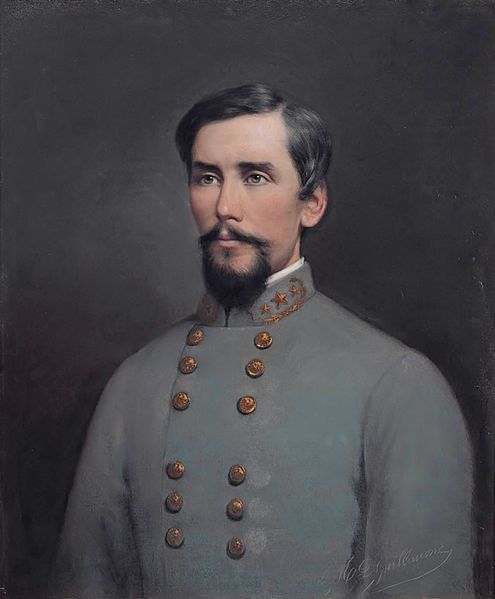
Confederate army Major General Patrick Cleburne.
Painting by M.D. Guillaume (1816-1892) via Wikimedia Commons.
I recently came across a pro-Confederate Facebook post featuring this quote from Confederate major general Patrick Cleburne, written on January 2, 1864:
It is said slavery is all we are fighting for, and if we give it up we give up all. Even if this were true, which we deny, slavery is not all our enemies are fighting for. It is merely the pretense to establish sectional superiority and a more centralized form of government, and to deprive us of our rights and liberties.
Now, I’m not going to share the post itself, as that would inevitably lead to doxxing and bullying. However, this is a teachable moment, a classic example of the beloved Lost Causer past-time of divorcing quotes from their important contexts.
You need to keep a couple things in mind when considering a historical quote. Who is the speaker? Who are they talking to? Do they have an objective in mind? What events surrounding this person, if any, have inspired them to say this particular thing at this particular time?
Quotes by themselves are useless in historical education and can often be misleading. I see y’all making this mistake with the Cornerstone Speech [Wiki] all the time – it’s not the mic drop you think it is. You can’t just shove it in someone’s face and call it a day. If you really want to change minds, you need to present it in its proper context and alongside other evidence. Only then can you craft a complete and compelling argument.
Now as it happens, Alexander Stephens was totally sincere when he called late 18th century notions of racial equality “wrong,” and he spoke for the overwhelming majority of Confederate true believers in the Spring of 1861 when he said that “our new government is founded on exactly the opposite ideas; its foundations are laid, its cornerstone rests, upon the great truth that the [black man] is not equal to the white man; that slavery, subordination to the superior race, is his natural and normal condition.” But without context, how would I know that? When making an argument, the onus of proof is on you.
This particular pro-Confederate post presented the Cleburne quote by itself in meme format without any context whatsoever, so allow me to provide one. At first glance, it seems like Cleburne is espousing anti-authoritarian values. It seems like he is declaring, clearly and definitively, that the Southern states did not secede to preserve slavery, but rather to uphold their regional self-determination.
This quote is from a letter Cleburne wrote to Joseph E. Johnston, his commanding officer in the Army of Tennessee, proposing that the Confederate government emancipate and arm the South’s enslaved men to bolster the thinning ranks of the army. As you may remember from Checkmate Lincolnites, this proposal was met with shock and horror from the Confederate leadership, who quickly rejected it.
But Cleburne saw further than them. He believed – correctly – that unless something drastic was done, the Confederacy was doomed to destruction. As he writes in the proposal, “Instead of standing defiantly on the borders of our territory or harassing those of the enemy, we are hemmed in to-day into less than two-thirds of it, and still the enemy menacingly confronts us at every point with superior forces.”
“If this state continues much longer we must be subjugated,” he continues, arguing that achieving victory would require immense sacrifice, including “the loss of all we now hold most sacred — slaves and all other personal property, lands, homesteads, liberty, justice, safety, pride, manhood.”
June 16, 2021
“One nation, indivisible”?
As a child in England and then in Canada, I was used to the relatively low-key acknowledgements of the Crown and the nation which may be why I was quite befuddled watching American TV portrayal of the in-your-face patriotic displays of the United States, especially the Pledge of Allegiance required of schoolchildren. It seemed oddly statist and even collectivist (although I didn’t know those terms at the time) for a country that constantly seemed to be patting itself on the back as the “home of the free”. I later learned that the Pledge hadn’t even been invented until nearly a century after the nation had been established (and the current version was devised and popularized by a noted utopian socialist, then adopted by Congress in 1942). Tom Mullen explores how the Pledge came about and considers the idea that it is time to drop it:

“American Flag” by JeepersMedia is licensed under CC BY 2.0

An Atlanta, Georgia, charter school announced last week its intention to discontinue the practice of having students stand and recite the Pledge of Allegiance during its schoolwide morning meetings at the beginning of each school day, opting to allow students to recite the pledge in their classrooms instead. Predictably, conservatives were immediately triggered by this “anti-American” decision, prompting the school to reverse its decision shortly after.
The uproar over periodic resistance to reciting the pledge typically originates with Constitution-waving, Tea Party conservatives. Ironically, the pledge itself is not only un-American but antithetical to the most important principle underpinning the Constitution as originally ratified.
[…]
Then, there’s “indivisible”. One would think a federation born by its constituent states seceding from the nation to which they formerly belonged would make the point obvious enough. But the Declaration makes it explicit:
That whenever any Form of Government becomes destructive of these ends, it is the Right of the People to alter or to abolish it, and to institute new Government, laying its foundation on such principles and organizing its powers in such form, as to them shall seem most likely to effect their Safety and Happiness.
It would be impossible to exercise that right — that duty, as the Declaration later calls it — if the republic were indivisible. The strictest constructionists of the time didn’t consider the nation indivisible. Thomas Jefferson didn’t threaten to send troops to New England when some of its states considered seceding upon his election. Quite the opposite. And in an 1804 letter to Joseph Priestly, he deemed a potential split in the union between “Atlantic and Mississippi confederacies” not only possible but “not very important to the happiness of either part.”
The people advocating “one nation, indivisible” in those days were big government Federalists like Hamilton, whose proposals to remake the United States into precisely that were flatly rejected in 1787.
Proponents of absolute, national rule like to quip this question was “settled” by the American Civil War. That’s like saying Polish independence was “settled” by Germany and the Soviet Union in 1939.
In fact, it is precisely the trend towards “one nation” that has caused American politics to become so rancorous, to the point of boiling over into violence, over the course of the last several decades. This continent is inhabited by a multitude of very different cultures, which can coexist peacefully if left to govern themselves. But as the “federal” government increasingly seeks to impose a one-size-fits-all legal framework over people who never agreed to give it that power, the resistance is going to get more and more strident. If there is any chance to achieve peace among America’s warring factions, a return to a more truly federal system is likely the only way.
Getting rid of the un-American pledge to the imaginary nation would be a good, symbolic start.
May 27, 2021
History Summarized: Ancient China
Overly Sarcastic Productions
Published 28 Dec 2018Check out our website at www.OverlySarcasticProductions.com
And after that we’ll defeat the Huns! Join Blue on a trek through the early centuries of Chinese History, from legendary foundations to the Shang and Zhou dynasties, past the Warring States Period, and into the Han dynasty — if you get to the Romance of the Three Kingdoms, you’ve gone too far.
Further reading: China: A History by John Keay
Kings and Generals’ fantastic videos on this subject:
Bactrians: https://youtu.be/IQATsepKoLE
War of the Heavenly Horses: https://youtu.be/g6Rphg_lwwMPATREON: www.patreon.com/OSP
MERCH LINKS:
Shirts – https://overlysarcasticproducts.threa…
All the other stuff – http://www.cafepress.com/OverlySarcas…Find us on Twitter @OSPYouTube!

May 17, 2021
An older BBC dramatization on the slave trade that seems to have gone down the memory hole
At Samizdata, Niall Kilmartin wondered why the BBC hadn’t gotten around to showing a 1970s historical series through the year-and-more of the pandemic lockdowns. He doesn’t mention the name of the series, and an unusually unhelpful BBC site search didn’t turn up a name but IMDB suggests it was 1975 and the series was called The Fight Against Slavery:
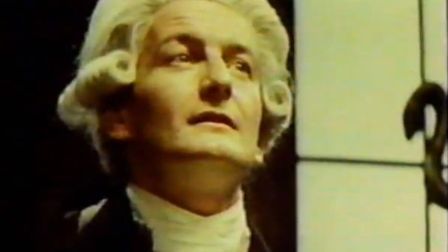
Fifty years ago, the BBC screened a dramatised documentary series about the fight to abolish the slave trade. Even a year of the virus limiting new series, at a time of great BBC eagerness to talk about racism, has not made them screen it again.
– I see one reason why they have not: the series displayed sleazy white slave traders and abusive white slave owners prominently, but it also showed white people eager to end the slave trade and (much worse) black people eager to continue it. It included the king of Dahomey’s threat: “if you do not allow me to sell you my slaves, their fate will be a great deal worse” (a very brief scene of the Dahomey murder spectacle lent meaning to his remark). After abolition was voted, it showed a white slave trader assuring the Dahomans, as a drug dealer might his suppliers, “It is one thing for parliament to pass a law …”, hinting at the Royal Navy’s long and hard campaign to enforce it.
– Only recently did I spot another reason why they would not want to show it again – the scene in which a corrupt old white slave trader warns his young colleague that “it’s more than your life’s worth” to doubt the ability of their slave-selling hosts to count very accurately the quantity of trade goods being handed over in exchange, and to assess their quality knowledgeably. The traders well knew that Africans counted two plus two as four, just as they did. Any trader who imagined that black ability to add diverged enough from white to enable an attempt to short-change them had learned otherwise long before the 1780s.
– The southern Confederacy thought the same. Until its death throes, it forbade enlisting a southern black as a Confederate soldier because, as one Confederate senator put it, “If blacks can make good soldiers then our whole theory of slavery is wrong.” (Perhaps also because even southern white Democrats realised that southern black desire to fight against blacks being freed was likely to be a very minority taste.) But there was one exception. Every regiment had its regimental band, which played to set the pace at the start and end of marches, used trumpets to signal commands in battle – and fought when other duties did not supervene. From its start to its end, Confederate law said any black could enlist as bandsman, with the same pay and perquisites as a white – a very rare example of formal legal equality. (Playing music requires the ability to count time. For the woke, “dismantling the legacy of the Confederacy” apparently includes dismantling its realisation – shared by the Victorian composer Dvorak – that blacks often excelled in music so much as to overcome prejudice against black ability. Today, it’s “racist” to value instrumental skill.)
“Politically correct” has meant “actually wrong” ever since the first commissar explained to the first party comrade that it was neither socialist nor prudent to notice a factual error in the party line. “Structurally racist” is PC’s modern companion. No longer are the woke content merely to imply (“mathematics is racist”, “punctuality is racist”, “politeness is racist”) that blacks can’t count, can’t tell the time and can only behave crudely. They’re starting to say it in words of fewer syllables.
If I’d scrolled down to the comments, I’d have discovered that Natalie Solent had also dug up the name of the series:
Natalie Solent (Essex)
May 10, 2021 at 4:30 pm
Outstanding post, Niall. Was the BBC series you mentioned “The Fight Against Slavery“, written and narrated by Evan Jones? I have not seen it – given that I was ten or eleven in 1975 my parents probably thought I was too young too see it.However someone called “InternetPilgrim” has put up three videos of the series on YouTube. There is a link to Part I here, Part II here and Part III here, so I will try to remedy that lack soon.
May 16, 2021
Bayonets
Lindybeige
Published 26 Feb 2011A weapon can be very effective even if it never actually kills anyone.
Support me on Patreon: https://www.patreon.com/Lindybeige
Lindybeige: a channel of archaeology, ancient and medieval warfare, rants, swing dance, travelogues, evolution, and whatever else occurs to me to make.
▼ Follow me…
Twitter: https://twitter.com/Lindybeige I may have some drivel to contribute to the Twittersphere, plus you get notice of uploads.
website: www.LloydianAspects.co.uk