
Computing Forever
Published on 25 May 2018
May 27, 2018
May 23, 2018
April 5, 2018
Mark Steyn on the YouTube shooting in San Bruno
The shooting at the YouTube offices in San Bruno, California may not be in the headlines for long, as the story is so off-beat compared to other recent events that it doesn’t easily fit the model the media prefers for reporting gun crime (or high tech stories). Mark Steyn calls it the “grand convergence”:
The San Bruno attack also underlines a point I’ve been making for over a decade, ever since my troubles with Canada’s “human rights” commissions: “Hate speech” doesn’t lead to violence so much as restraints on so-called “hate speech” do – because, when you tell someone you can’t say that, there’s nothing left for him to do but open fire or plant his bomb. Restricting speech – or even being perceived to be restricting speech – incentivizes violence as the only alternative. As you’ll notice in YouTube comments, I’m often derided as a pansy fag loser by the likes of ShitlordWarrior473 for sitting around talking about immigration policy as opposed to getting out in the street and taking direct action. In a culture ever more inimical to freedom of expression, there’ll be more of that: The less you’re permitted to say, the more violence there will be.
Google/YouTube and Facebook do not, of course, make laws, but their algorithms have more real-world impact than most legislation – and, having started out as more or less even-handed free-for-alls, they somehow thought it was a great idea to give the impression that they’re increasingly happy to assist the likes of Angela Merkel and Theresa May as arbiters of approved public discourse. Facebook, for example, recently adjusted its algorithm, and by that mere tweak deprived Breitbart of 90 per cent of its ad revenue. That’s their right, but it may not have been a prudent idea to reveal how easily they can do that to you.
What happened yesterday is a remarkable convergence of the spirits of the age: mass shootings, immigration, the Big Tech thought-police, the long reach of the Iranian Revolution, animal rights, vegan music videos… But in a more basic sense the horror in San Bruno was a sudden meeting of two worlds hitherto assumed to be hermetically sealed from each other: the cool, dispassionate, dehumanized, algorithmic hum of High Tech – and the raw, primal, murderous rage breaking through from those on the receiving end.
Comments Off on Mark Steyn on the YouTube shooting in San Bruno
March 31, 2018
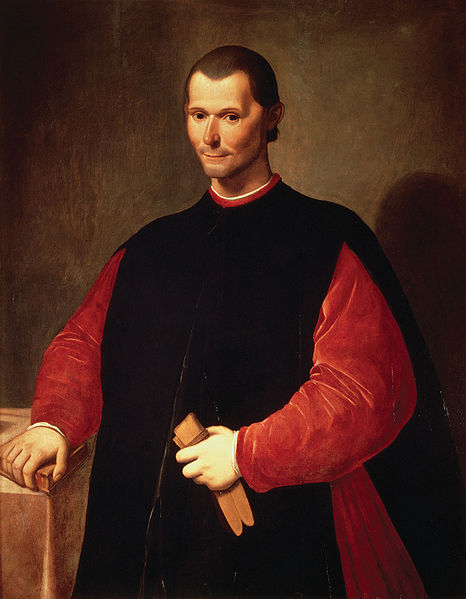
If anybody could be described as Machiavellian, it’d surely be Machiavelli, right?
At the Foundation for Economic Education, Paul Meany tries to rescue the reputation of Niccolò Machiavelli:
Portrait of Niccolò Machiavelli by Santi di Tito (1536-1603)
Via Wikimedia Commons.If you have ever studied Shakespeare, you might have heard your teacher use the word “Machiavellian” to describe amoral characters such as Iago from Othello or Edmund from King Lear. “Machiavellian” denotes a person or action that disregards morality and is wholly self-serving. The origin of the word derives from the famous Florentine politician and writer Niccoló Machiavelli.
[…]
Published posthumously, The Prince left Machiavelli with an infamous reputation as an amoral, atheistic, and cynical writer. In 1559, the Catholic Church put Machiavelli’s works on the Index of Prohibited Books. In the play The Jew of Malta by Christopher Marlowe, written in 1589, Machiavelli appears in the prologue, boldly exclaiming, “I count religion but a childish toy, and hold there is no sin but ignorance.”
Machiavelli came to be associated with an Elizabethan term, “Old Nick,” used to denote the devil. There is a subject of modern psychology, known as the “dark triad,” which focuses on three malevolent personality traits: narcissism, psychopathy, and Machiavellianism.
However, this deeply negative image of Machiavelli did not always exist. In the 17th and 18th centuries, a more positive view of Machiavelli emerged, with authors such as the Republican James Harrington referring to Machiavelli as “the prince of politicians.” During the Italian Renaissance, humanist Giovanni Battista Busini fondly described Machiavelli as “a most extraordinary lover of liberty.”
This praise might seem confusing; after all, the word “Machiavellian” denotes someone who is cunning and unscrupulous. How could a man so devious and pragmatic be called a lover of liberty? The answer lies with Machiavelli’s other book, known as Discourses on Livy, which presents a very different image of his political beliefs.
[…]
The stark differences between Machiavelli’s Discourses on Livy and The Prince come from the nature of the aims of each book. The Prince aims to refine the conduct of a single prince, while Discourses on Livy offers guidance for the entire citizen body. The Prince was written to address a unique political opportunity that quickly evaporated, whereas Discourses on Livy was written to articulate the principles required by republics that sought longevity, liberty, and prosperity.
To this day, there still remains a huge debate over the intricacies and contradictions that characterize Machiavelli’s writings. Machiavelli was an extremely nuanced and original thinker whose reputation should not exclusively be that of an evil schemer. He argued for a republic whose liberty is safeguarded by the common person, in which free, unhindered debate provides the best course of action, and where compromises between opposing groups create harmony. Discourses on Livy reveals another side of Machiavelli, a man committed to the ideals of freedom through the means of representative government.
March 20, 2018
Free speech on the ropes
J.D. Tuccille says the right to freedom of speech isn’t dead, but it might not qualify for a new life insurance policy:
We have an environment in which the president of the United States is dismissive of the free speech rights of his opponents, prominent constitutional scholars sniff at free speech unless it’s used by the “right” people for their favored goals, and the country’s leading civil liberties organization is suffering an internal revolt by staffers who oppose “rigid” support for free speech protections.
Last October, President Trump said “It’s frankly disgusting the way the press is able to write whatever they want to write.” That came just hours after he tweeted, “With all of the Fake News coming out of NBC and the Networks, at what point is it appropriate to challenge their License? Bad for country!” And even before Trump took the oath of office, he’d huffed that protesters who burn American flags should face loss of citizenship or jail.
So if you’re an academic with expertise in constitutional law, and you have months to watch a populist politician who commands the power of the presidency fulminate about punishing those who criticize him, what do you do? If you’re Georgetown Law’s Louis Michael Seidman, you suggest that the president might be on to something.
In a forthcoming paper, Seidman’s main complaint is that free speech doesn’t inherently favor progressivism — it allows too much voice to people who disagree. “At its core, free speech law entrenches a social view at war with key progressive objectives,” writes Seidman.
Sure, “the speech right has instrumental utility in isolated cases,” he adds. But “significant upside potential”? Nah.
[…]
In its early days, the American Civil Liberties Union (ACLU) viewed free speech as a tool of social justice, suited to particular purposes under particular conditions,” wrote Weinrib, calling on the modern organization to rededicate itself to progressive political goals over civil libertarian advocacy.
The ACLU may be close to taking her advice. Last fall, about 200 of the organization’s staff members signed a letter objecting to the groups’ “rigid stance” on the First Amendment. The letter was characterized by former ACLU board member Michael Meyers as “a repudiation of free-speech principles.”
Huh. With a president who openly chafes at criticism and suggests media naysayers should be punished with the force of law, now seems like a perfect time for opponents to rally around unfettered debate and the First Amendment. Instead, lefty academics and activists are lining up to agree with Trump that a free press and individual rights to freedom of speech, belief, and association are indeed overrated overall.
Comments Off on Free speech on the ropes
March 3, 2018
Arguments against having students read To Kill a Mockingbird
I’m very much anti-censorship, so in the vast majority of cases where “pressure groups” are demanding that a book be removed from a school reading list, I’m usually against the idea. Recently, a demand to pull Harper Lee’s To Kill a Mockingbird was denied, but Ann Althouse explains why, unlike so many other efforts, in her opinion this one deserves a fair hearing:
I think the argument against selecting this book — of all books — as the go-to reading about race discrimination is, in fact, very strong. I understand that schools defend their own choices and are dug in here, but the Kameetas made an excellent argument (as far as I can tell from this summary). The black characters are basically “spectators and bystanders.” I think the book is also a problem because:
1. It’s a rape story where the woman lies about rape. Why should the first thing children learn about rape be about the woman lying?
2. Rape is a complex subject, difficult for 9th graders to understand, and yet this rape story is cartoonish, in which the man is absolutely, unquestionably innocent. Why present a book as literature when it deals with this important subject in a completely unsubtle way, completely subordinated to another subject the author is bent on telling (the outrageous accusation against an innocent man)?
3. Racial discrimination is also a complex subject, especially as it persists today, but the racial injustice shown in the book is so exaggerated that it allows a present-day reader to feel smugly distanced. Nobody we know is that over-the-top racist, so weren’t those people back then terrible? That’s not how high-quality literature is supposed to work on readers. They should need to question their own simplistic preconceptions.
4. It’s not a subtle telling of the story of how courts work and might carry forward racial prejudice. The evidence of the man’s innocence is so completely obvious that you have a complete breakdown of justice. That doesn’t begin to enlighten students about how there could be racial disparities in the justice system today. It invites them to sit back and think people in the past were crazy.
5. There is blatant stereotyping of the poor white family, and their problems are not treated as perhaps a consequence of poverty. They’re treated as genetically deficient. They are truly the irredeemable deplorables.
6. There is great sentimentality about this book in the older generation. Having reread this book very carefully and written about it (in the Michigan Law Review, here), I hold the informed opinion that it is not a very good book and the practice of imposing on the younger generations — with endless pressure to regard it as a great classic — deserves serious, vigorous questioning.
Comments Off on Arguments against having students read To Kill a Mockingbird
February 28, 2018
China: Triumph and Turmoil, Episode 1 – Emperors
Niall Ferguson
Published on Jan 31, 2018Niall Ferguson shows how the vast apparatus of the Chinese state has always been called on to subjugate individual freedom to the higher goal of unity. Ferguson also examines how, on the other hand, centralized control produces tensions that threaten to destroy the country.
Comments Off on China: Triumph and Turmoil, Episode 1 – Emperors
QotD: Words as “physical violence”
Berkeley. Evergreen. Middlebury. Missou. Yale. Brown. McMasters. Wilfred Laurier. The list goes on. One must wonder where this trend will ultimately take us. There have been several justifications given for this increasing rash of no-platforming, shaming, and at times, physical violence on North American campuses. In essence, these justifications can be distilled into a triad of well-meaning but ultimately flawed theses, namely, 1.) that all discourse is about power and that any speech that renders a listener physiologically uncomfortable therefore rises to the level of a physical attack upon that individual, thereby justifying actual physical violence in response, 2.) that for the sake of historically marginalized voices, persons who are members of historically privileged groups should forfeit their right to free speech or ought to remain silent, 3.) that certain assertions, even if possibly true, are nonetheless morally impermissible to make since to do so will likely create conditions whereby bad-intentioned persons will inevitably and successfully advance their morally heinous projects.
This first thesis — that all discourse is fundamentally about power — finds its philosophical origins in the likes of post-modernists such as Jacques Derrida and Michel Foucault. To quote Foucault, “Discourses are tactical elements or blocks operating in the field of force relations.” Thus, on Foucalt’s view, if all discourse is, at heart, really just veiled force relations between competing groups; if language isn’t fundamentally capable of being about objective truth or about the world in any meaningful sense, then the ink symbols written on the page and the shaped air admitted from one’s mouth in the forms of ‘rationality’, ‘facts’, ‘knowledge’, and ‘truth’ are just another set of weapons in a person’s overall arsenal to seize and maintain power, no different in kind from weapons of a physical sort. To speak then, on Foucault’s view, is to wield a weapon, albeit a subtler and refined one. The uncomfortable physiological feeling of hearing offensive speech, it would then seem, vindicates this view that one is being attacked. One might thus conclude, “Why not attack back with heavier, more effective, and more expedient weapons?”
Michael Robillard, “In Defense of Offense”, Quillette, 2018-02-05.
Comments Off on QotD: Words as “physical violence”
January 14, 2018
December 28, 2017
QotD: The 1960s cultural revolution
The entire political and cultural trajectory of the decades following World War II in the U.S. was a movement away from the repressions of the Cold War standoff with the Soviet Union, when the House Un-American Activities Committee of the U.S. House of Representatives searched for signs of Communist subversion in every area of American life. A conspicuous target was the Hollywood film industry, where many liberals had indeed been drawn to the Communist Party in the 1930s, before the atrocities of the Stalinist regime were known. To fend off further federal investigation, the major studios blacklisted many actors, screenwriters, and directors, some of whom, like a favorite director of mine, Joseph Losey, fled the country to find work in Europe. Pete Seeger, the leader of the politicized folk music movement whose roots were in the social activism of Appalachian coal-miners in the 1930s, was banned from performing on network TV in the U.S. in the 1950s and ‘60s.
There were sporadic landmark victories for free speech in the literary realm. In 1957, local police raided the City Lights Bookshop in San Francisco and arrested the manager and owner, Beat poet Lawrence Ferlinghetti, for selling an obscene book, Allen Ginsberg’s epic protest poem, Howl. After a long, highly publicized trial, Howl was declared not obscene, and the charges were dropped. The Grove Press publishing house, owned by Barney Rosset, played a heroic role in the battle against censorship in the U.S. In 1953, Grove Press began publishing affordable, accessible paperbacks of the voluminous banned works of the Marquis de Sade, a major thinker about sex and society at the close of the Enlightenment. In 1959, the Grove Press edition of D.H. Lawrence’s 1928 novel, Lady Chatterly’s Lover, then banned in the U.S., was confiscated as obscene by the U.S. Postal Service. Rosset sued and won the case on federal appeal. In 1961, the publication by Grove Press of another banned book, Henry Miller’s 1934 novel, Tropic of Cancer, led to 60 obscenity trials in the U.S. until in 1964 it was declared not obscene and its publication permitted.
One of the supreme symbols of newly militant free speech was Lenny Bruce, who with Mort Sahl transformed stand-up comedy from its innocuous vaudevillian roots into a medium of biting social and political commentary. Bruce’s flaunting of profanity and scatology in his improvisational onstage act led to his arrest for obscenity in San Francisco in 1961, in Chicago in 1962, and in New York in 1964, where he and Howard Solomon, owner of the Café Au Go Go in Greenwich Village, were found guilty of obscenity and sentenced to jail. Two years later, while his conviction was still under appeal, Bruce died of a drug overdose at age 40.
This steady liberalizing trend was given huge impetus by the sexual revolution, which was launched in 1959 by the marketing of the first birth control pill. In Hollywood, the puritanical studio production code, which had been adopted in the early 1930s under pressure from conservative groups like the Legion of Decency and the United States Conference of Catholic Bishops, was gradually breaking down and was finally abandoned by the late 1960s. The new standard of sexual expression was defined by European art films, with their sophisticated scripts and frank nudity. Pop music pushed against community norms: in 1956, Elvis Presley’s hip-swiveling gyrations were cut off by the TV camera as too sexual for the Ed Sullivan Show, which was then a national institution. As late as 1967, the Ed Sullivan Show was trying to censor the song lyrics of major bands like the Doors and the Rolling Stones, who were imitating the sexual explicitness of rural and urban African-American blues. (The Stones capitulated to Sullivan, but the Doors fought back — and were never invited on his show again.) Middle-class college students in the 1960s, including women, began freely using four-letter words that had rarely been heard in polite company, except briefly during the flapper fad of the 1920s. In the early 1970s, women for the first time boldly entered theaters showing pornography and helped make huge hits out of X-rated films like Deep Throat, Behind the Green Door, and The Devil in Miss Jones.
In short, free speech and free expression, no matter how offensive or shocking, were at the heart of the 1960s cultural revolution. Free speech was a primary weapon of the Left against the moralism and conformism of the Right.
Camille Paglia, “The Modern Campus Has Declared War on Free Speech”, Heat Street, 2016-05-09.
Comments Off on QotD: The 1960s cultural revolution
December 14, 2017
Cognitive dissonance in action – Net Neutrality partisans want TRUMP to control the internet
Jon Gabriel on the weird position Net Neutrality fans find themselves in … demanding that Il Donalduce himself, the most hated politician in Liberal America since Richard Nixon be the one to dictate how the internet is run:
If President Trump is some kind of digital facist, he sure has a funny way of going about it.
His FCC chairman is trying to remove government from the Internet, returning it to those dark, authoritarian days of 30 months ago — you know, when pretty much every website, app and online service we use was created.
Bizarrely, these net neutrality alarmists are demanding that Trump maintain control of the Internet, planting his administration firmly between citizens and whatever content they want to view or create.
Even if Democrats were running the show in Washington, how could federal meddling improve the Internet? Do they want the Web run by the bureaucrats who spent $2 billion to build a health care website that didn’t work? Do they want our privacy assured by those behind the National Security Agency?
Nevertheless, progressives insist that Trump regulate the Internet in the name of free speech. Perhaps he can do this between his tweets bashing the press.
[…]
If the FCC approves this new proposal, the worst of federal meddling online will be retired. Instead, the commission will simply require Internet service providers to be transparent about their service offerings. That way, tech innovators will have the information they need and consumers will know which plan works best for them.
In other words, Web users and creators will be back in control of the Internet instead of lawyers and bureaucrats. Just as they were for all but the past couple of years.
To ensure transparency, Pai made all his proposals public before the FCC vote Thursday. A big departure from the Obama administration’s methods, which kept its net neutrality rules secret until after they were approved.
Before the FCC’s heavy-handed intervention, we saw the creation of Amazon, Google and Twitter. If Washington removes these unnecessary regulations as expected, we’ll see the Internet continue to blossom.
And my daughters will get to watch their favorite YouTube celebrities complain about net neutrality for years to come.
Comments Off on Cognitive dissonance in action – Net Neutrality partisans want TRUMP to control the internet
December 1, 2017
Censorship on the web
At City Journal, Aaron Renn explains why some of the concerns about censorship on the Internet are not so much wrong as misdirected:
The basic idea of net neutrality makes sense. When I get a phone, the phone company can’t decide whom I can call, or how good the call quality should be depending on who is on the other end of the line. Similarly, when I pay for my cable modem, I should be able to use the bandwidth I paid for to surf any website, not get a better or worse connection depending on whether my cable company cut some side deal to make Netflix perform better than Hulu.
The problem for net neutrality advocates is that the ISPs aren’t actually doing any of this; they really are providing an open Internet, as promised. The same is not true of the companies pushing net neutrality, however. As Pai suggests, the real threat to an open Internet doesn’t come from your cable company but from Google/YouTube, Twitter, Facebook, and others. All these firms have aggressively censored.
For example, Google recently kicked would-be Twitter competitor Gab out of its app store, not for anything Gab did but for what it refused to do — censor content. Twitter is famous for censoring, as Pai observes. “I love Twitter, and I use it all the time,” he said. “But let’s not kid ourselves; when it comes to an open Internet, Twitter is part of the problem. The company has a viewpoint and uses that viewpoint to discriminate.” (Twitter’s censors have not gotten around to removing the abuse, some of it racist, being hurled at Pai, including messages like “Die faggot die” and “Hey go fuck yourself you Taliban-looking fuck.”)
Google’s YouTube unit also censors, setting the channel for Prager University to restricted mode, which limits access; Prager U. is suing Google and YouTube. YouTube has also “demonetized” videos from independent content creators, making these videos ineligible for advertising, their main source of revenue. Much of the complaining about censorship has come from political conservatives, but they’re not the only victims. The problem is broad-based.
Yet sometimes Silicon Valley giants have adopted a see-no-evil approach to certain kinds of content. Facebook, for instance, has banned legitimate content but failed to stop Russian bots from going wild during last year’s presidential election, planting voluminous fake news stories. Advertisers recently started fleeing YouTube when reports surfaced that large numbers of child-exploitation videos were showing up on supposedly kid-friendly channels. One account, ToyFreaks, had 8 million subscribers — making it the 68th most-viewed YouTube channel — before the company shut it down. It’s not credible that YouTube didn’t know what was happening on a channel with millions of viewers. Other channels and videos featured content from pedophiles. More problems turned up within the last week. A search for “How do I …” on YouTube returned numerous auto-complete suggestions involving sex with children. Others have found a whole genre of “guess her age” videos, with preview images, printed in giant fonts, saying things like, “She’s only 9!” The videos may or may not have involved minors — I didn’t watch them—but at minimum, they trade on pedophilic language to generate views.
Comments Off on Censorship on the web
November 22, 2017
A damned odd canary in this particular coal mine
Megan McArdle on the imminent demise of the FCC’s “Net Neutrality”:
The internet will be filled today with denunciations of this move, threats of a dark future in which our access to content will be controlled by a few powerful companies. And sure, that may happen. But in fact, it may already have happened, led not by ISPs, but by the very companies that were fighting so hard for net neutrality.
Consider what happened to the Daily Stormer, the neo-Nazi publication, after Charlottesville. One by one, hosting companies refused to permit its content on their servers. The group was forced to effectively flee the country, and then other countries, too, shut it down.
Now of course, these are not nice people. Their website espoused vile hate. But the fact remains that what they were publishing was not illegal, merely immoral, and their immoral speech was effectively shut down by a small number of private companies who decided to exercise their considerable control over what we’re allowed to read. And what is to stop them from expanding this decision to other categories, forcing the rest of us to conform to Silicon Valley’s idea of what it is moral and right for us to see?
Fifteen years ago, when I started blogging, it was common to hear that “the internet interprets censorship as damage and routes around it.” You don’t hear that so often anymore, because it’s not true. China has proven very effective at censoring the internet, and as market power has consolidated in the tech industry, so have private firms.
Meanwhile, our experience of the internet is increasingly controlled by a handful of firms, most especially Google and Facebook. The argument for regulating these companies as public utilities is arguably at least as strong as the argument for thus regulating ISPs, and very possibly much stronger; while cable monopolies may have local dominance, none of them has the ability that Google and Facebook have to unilaterally shape what Americans see, hear, and read.
In other words, we already live in the walled garden that activists worry about, and the walls are getting higher every day. Is this a problem? I think it is. But that doesn’t mean that the internet would get better if Google and Facebook and Apple and Amazon were required to make every decision with a regulator hanging over their shoulder to decide whether it was sufficiently “neutral.”
Comments Off on A damned odd canary in this particular coal mine
October 2, 2017
John Cleese: Political Correctness and Islam
Democracy In Name Only
Published on 11 Jan 2017John Cleese speaks frankly about political correctness, the right to offend and Islam.
Comments Off on John Cleese: Political Correctness and Islam


