Quotulatiousness

May 23, 2024

Where does a former general go to get his reputation back?

Filed under: Cancon, Law, Media, Military, Politics — Tags: , , — Nicholas @ 04:00

The National Post reports on a former Canadian senior officer launching a lawsuit in an attempt to clear his reputation after an abortive court martial brought his career to an end:

Lt.-Gen. Steven Whelan, a three-star general who was accused of sexual misconduct in what he claims was a politically motivated prosecution that was then abandoned before he was able to defend himself, is looking for his day in court.

“I didn’t get a chance to tell my side of the story,” he told me.

Whelan’s lawyer, Phillip Millar of Millars Lawyers, has just filed a bruising statement of claim with the Federal Court in Ottawa, naming a who’s who of Canada’s military establishment as defendants; a litany that makes allegations of abuse of office, negligent investigation, malicious prosecution and involvement in media leaks that destroyed Whelan’s reputation and career.

Defendants named in the lawsuit include His Majesty the King in Right of Canada (the Crown) and top brass in the Department of National Defence (DND) and Canadian Armed Forces (CAF): Jody Thomas, former deputy minister of National Defence and former national security advisor to the Prime Minister; General Wayne Eyre, chief of the defence staff; Lt.-Gen. Frances Allen, vice chief of the defence staff; and Lt.-Gen. Jennie Carignan, CAF’s chief of professional conduct and culture.

The allegations stretch all the way to the Prime Minister’s Office.

Last September, Whelan faced a court martial, accused of sexual misconduct purported to have taken place more than a decade ago.

At the trial’s outset, military prosecutors dropped the more serious allegation of improperly communicating with a female subordinate (flirting, in colloquial terms). A week later — following the testimony of the complainant and minutes before Whelan’s lawyers could cross-examine her or hear from other witnesses — prosecutors dropped the remaining charge accusing Whelan of doctoring the same subordinate’s performance evaluation in 2011, allegedly fearing she would disclose their friendly but not physical relationship to others. The court martial came to an abrupt end. Notwithstanding the technical win for Whelan, the allegations effectively sidelined the three-star general.

Casual observers, seeing just how many Canadian generals’ and admirals’ careers have run aground in scandal of one sort or another, might draw conclusions about the quality of the leadership and the deep culture of the Canadian Armed Forces at both military and political levels.

The “post-national” entity formerly known as “Canada”

You have to hand it to the Trudeau family (and all their sycophantic enablers in the legacy media, of course). What other Canadian family has had such an impact on the country? By the time Justin Trudeau’s successor is invited to form a government, Canada will have changed so much — to the point that he could describe us as the first “post-national” country thanks to his unceasing effort to destroy the nation. At The Hub, Eric Kaufmann points the finger at Trudeau’s “Liberal-left extremism” as the motivating factor in Trudeau’s career:

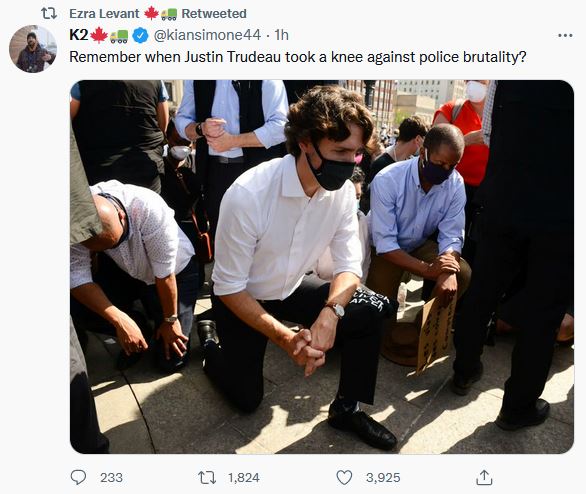
Justin Trudeau has always had a strong affinity for the symbolic gesture, especially when the media are around to record it.

Canada is currently suffering from left-liberal extremism the likes of which the world has never seen. This excess is not socialist or classically liberal, but specifically “left-liberal”. It is evident in everything from this country’s world record immigration and soaring rents to state-sanctioned racial discrimination in hiring and sentencing, to the government-led shredding of the country’s history and memory. Rowing back from this overreach will not be the work of voters in one election, but of generations of Canadians.

The task is especially difficult in Canada, because, after the 1960s, the country (outside of Quebec) transferred its soul from British loyalism to cultural left-liberalism. Its new national identity (multiculturalist, post-national, with no “core” identity) was based on a quest for moral superiority measured using a left-liberal yardstick. Canada was to be the most diverse, most equitable, most inclusive nation in world history. No rate of immigration, no degree of majority self-abasement, no level of minority sensitivity, would ever be too much.

In my new book The Third Awokening, I define woke as the making sacred of historically marginalized race, gender, and sexual identity groups. Woke cultural socialism, the idea of equal outcomes and emotional harm protection for totemic minorities, represents the ideological endpoint of these sacred values. Like economic socialism, the result of cultural socialism is immiserization and a decline in human flourishing. We must stand against this extremism in favour of moderation.

The woke sanctification of identity did not stem primarily from Marxism, which rejected identity talk as bourgeois, but from a fusion of liberal humanism with the New Left’s identitarian version of socialism. What it produced was a hybrid which is neither Marxism nor classical liberalism.

Left-liberalism is moderate on economics, favouring a mixed capitalism in which regulation and the welfare state ameliorate the excesses of the market, without strangling economic growth. Its suspicion of communist authoritarianism helped insulate it from the lure of Soviet Moscow.

On culture, however, left-liberalism has no guardrails. When it comes to group inequality and harm protection, its claims are open-ended, with institutions and the nation castigated as too male, pale, and stale. For believers, the only way forward is through an unrestricted increase in minority representation. They will not entertain the idea that the distribution of women and minorities across different occupations could reflect cultural or psychological diversity as opposed to “systemic” discrimination. This is the origin of the letters “D” and “E” in Diversity, Equity, and Inclusion (DEI). Rather than seeking to optimize equity and diversity for maximal human flourishing, these are ends in themselves that brook no limits.

Left-liberals fail to ring-fence the degree of sensitivity that majority groups are supposed to display toward minority groups. Their emphasis on inclusivity through speech suppression rounds out the “I” in DEI. From racial sensitivity training (starting in the 1970s) to the “inclusive” avoidance of words like “Latino” or “mother” that offend and create a so-called hostile environment that silences subaltern groups, majorities are expected to police their speech.

The Roman Colosseum: What It Was Like to Attend the Games

Filed under: Food, History, Italy — Tags: , , , , — Nicholas @ 02:00

Tasting History with Max Miller
Published Feb 13, 2024

Like at sports events today, you could get snacks and souvenirs in and around the Colosseum in ancient Rome. There were sausages and pastries and small sweet snacks, like these dates. Not the same as modern hot dogs and soft serve, but kind of in the same spirit.

These dates are really, really good. You could grind the nuts into a fine paste, but I like the texture a lot when they’re left a little coarse. They’re very sweet from the dates and the honey, but the salt and pepper balance it so well (highly recommend the long pepper here). Definitely give these a try!
(more…)

QotD: The “creepy male feminist”

Filed under: Media, Politics, Quotations, USA — Tags: , , — Nicholas @ 01:00

Christopher Hitchens used to have a cast-iron rule when it came to hardline Christians and the condemnation of some very particular sins of the flesh. […] I am beginning to wonder whether a similar trend is not emerging with another group, specifically that variety of men whom the internet — with its unerring ability to get to the cruel point — has come to describe as the “creepy male feminist”.

It is a distinctly 2010s phenomenon: the sort of chap who likes to present himself as a great spokesperson for, and defender of women and overdoes it so much that you just know that something else is going on.

He will invariably go beyond the usual courtesies and head some way past the point of merely regarding women as his equal. Instead, the creepy male feminist pulls a number of simultaneous moves. These include (though are not limited to):

  1. Presenting the plight of women in our society as distinctly worse than it is.
  2. Suggesting that everybody knows this but that some people (especially men) are deliberately covering for that fact.
  3. Making the suggestion — sometimes insinuated, often explicit — that nothing and nobody is more willing to stand between women as a whole and such rampaging patriarchs than the male in question. Anyone still unfamiliar with the type might recognise it under another entry in the lexicon of modern ignominy: “White knight” (n).

And a trend can now be observed, which is that with unnerving regularity the type of man who presents himself as the foremost protector of the entire female sex is precisely the person who shortly thereafter is exposed as having tried to help himself in distinctly un-gentlemanly ways.

Douglas Murray in “Beware the creepy male feminist: ‘White knights’ like Robert De Niro often turn out to be less than chivalrous”, Unherd, 2019-11-15.

May 22, 2024

Scott Alexander reviews The Others Within Us

Filed under: Books, Health — Tags: , , — Nicholas @ 05:00

At Astral Codex Ten, Scott Alexander discusses teh new hawtness in psychotherapy as expounded in Robert Falconer’s new book The Others Within Us:

Internal Family Systems, the hot new1 psychotherapy, has a secret.

“Hot new psychotherapy” might sound dismissive. It’s not. There’s always got to be one. The therapy that’s getting all the buzz, curing all the incurable patients, rocking those first few small studies. The therapy that was invented by a grizzled veteran therapist working with Patients Like You, not the out-of-touch elites behind all the other therapies. The therapy that Really Gets To The Root Of The Problem. There’s always got to be one, and now it’s IFS.

Sufficiently new and popular therapies are hard to get. Therapist training starts slow – the founder has to train the second generation of therapists, the second generation has to train the third generation, and so on. IFS says they have a 10,000 person wait list for their training program. So lots of people have heard great things about IFS, maybe read a manual or two, but never tried it or met anyone who has.

What I gather from the manuals: IFS is about working with “parts”. You treat your mind as containing a Self — a sort of perfect angelic intellect without any flaws or mental illnesses — and various Parts — little sub-minds with their own agendas who can sometimes occlude or overwhelm the Self. During therapy, you talk to the Parts, learn their motives, and bargain with them.

For example, you might identify a Part of you that wants to sabotage your relationships. You will visualize and name it — maybe you call her Sabby, and she looks like a snake. You talk to Sabby, and learn that after your first break-up, when you decided you never wanted to feel that level of pain again, you unconsciously created her and ordered her to make sure you never got close enough to anyone else to get hurt. Then you and the therapist come up with some plan to satisfy Sabby — maybe you convince her that you’re older now, and better able to deal with pain, and you won’t blame her if you get close to someone and have to break up again. Then you see a vision of Sabby stepping aside, maybe turning off the Windmill Of Relationship Sabotage or something like that, and then you never sabotage your relationships again. It’s more complicated than that, but that’s the core.

All of this is the classic version everyone learns from the manual. Before we get to the secret, let’s examine two big assumptions in more detail.

First, this isn’t supposed to be just the therapist walking you through guided imagery, or you making up a story you tell yourself. The therapist asks you “Look inside until you find the part that’s sabotaging your relationship”, and you are supposed to discover — not invent, discover — that your unconscious gives it the form of a snake called Sabby. And you are supposed to hear as in a trance — again, not invent — Sabby telling you that she’s been protecting you from heartbreak since your last breakup. When you bargain with Sabby, it’s a two-way negotiation. You learn — not decide — whether or not Sabby agrees to any given bargain. According to Internal Family Systems (which descends from normal family systems, ie family therapy where the whole family is there at once and has to compromise with each other), all this stuff really is in your mind, waiting for an IFS therapist to discover it. When Carl Jung talked about interacting with the archetypes or whatever, he wasn’t being metaphorical. He literally meant “go into a trance that gives you a sort of waking lucid dream where you meet all this internal stuff”.

(After reading the IFS manuals, I tried most of their tricks for initiating this sort of trance and meeting Sabby or whoever. I got nothing. I notice most of the patients with great results are severely traumatized borderlines, ie the same people who often get multiple personality disorder after the slightest hint from a therapist that this might happen. We’ll get back to this analogy later.)

The second assumption is that everything inside your mind is part of you, and everything inside your mind is good. You might think of Sabby as some kind of hostile interloper, ruining your relationships with people you love. But actually she’s a part of your unconscious, which you have in some sense willed into existence, looking out for your best interests. You neither can nor should fight her. If you try to excise her, you will psychically wound yourself. Instead, you should bargain with her the same way you would with any other friend or loved one, until either she convinces you that relationships are bad, or you and the therapist together convince her that they aren’t. This is one of the pillars of classical IFS.

The secret is: no, actually some of these things are literal demons.


    1. Some people object to me calling it “new” – it was developed in the 1980s, and has been popular since the early 2010s. Still, the therapy landscape shifts slowly, and even an exponentially-growing therapy takes a long time to get anywhere.

If you re-define it carefully, you can make any statistical measure look hopeful

Filed under: Economics, Government, Media, Politics, USA — Tags: , , , , , — Nicholas @ 04:00

In his Substack, Tim Worstall jokingly called this piece “Larry Summers Explains Why Americans Hate Joe Biden”:

As a good Democrat of course Larry Summers would never put things in quite that headline way. But the implication of this latest paper with others is to explain why Americans really aren’t as happy as they should be given the economic numbers. The answer being that the economic numbers we all look at to explain how happy folk are aren’t the right economic numbers to explain how happy people are.

We can also make — possibly rightly, possibly wrongly, this might be me projecting more than is merited — a further claim. That Americans simply aren’t as rich as those standard economic numbers suggest either. Which would also neatly explain the general down in the dumps attitude toward the economy.

So, the new paper:

    Unemployment is low and inflation is falling, but consumer sentiment remains depressed. This has confounded economists, who historically rely on these two variables to gauge how consumers feel about the economy. We propose that borrowing costs, which have grown at rates they had not reached in decades, do much to explain this gap. The cost of money is not currently included in traditional price indexes, indicating a disconnect between the measures favored by economists and the effective costs borne by consumers. We show that the lows in US consumer sentiment that cannot be explained by unemployment and official inflation are strongly correlated with borrowing costs and consumer credit supply. Concerns over borrowing costs, which have historically tracked the cost of money, are at their highest levels since the Volcker-era. We then develop alternative measures of inflation that include borrowing costs and can account for almost three quarters of the gap in US consumer sentiment in 2023. Global evidence shows that consumer sentiment gaps across countries are also strongly correlated with changes in interest rates. Proposed U.S.-specific factors do not find much supportive evidence abroad.

OK, or as explained by the Telegraph:

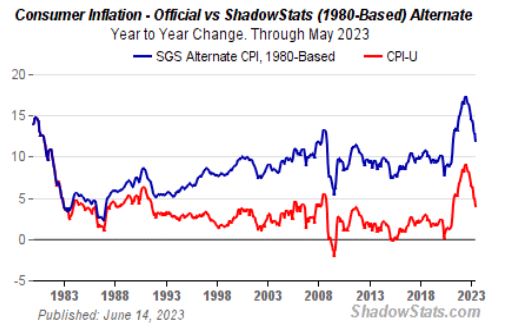
    In it, the authors made a shocking claim: if inflation was measured in the same way that it was measured during the last bout of price rises in the 1970s, data showed that it peaked at 18pc in November 2022. This is far higher than the 9.1pc peak inflation shown by the official data.

    The reason for this discrepancy is that, since the 1970s, economists have removed the cost of borrowing from the Consumer Price Index (CPI). The motivations here were not nefarious. The reasoning of the statisticians had something to it.

And, OK, if inflation peaked at 18%, not 9%, then that would explain why folk are pissed. Sure it would.

[…]

OK. But that means that if inflation was higher than we’ve been using then the deflation of nominal to real GDP is also wrong. Just that one year of 9% recorded but 18% by this new measure is damn near a 10% difference. That’s how much we’re over-estimating real GDP by right now. Add in a couple of years of lower levels of that and being 20% out wouldn’t surprise.

Which would mean that — if this were true and I might be overegging it — Americans are in fact 20% poorer than the Biden Admin keeps saying they are. And yes, that would piss the voters off, wouldn’t it?

Gaslighting has been a staple of the legacy media for quite some time now, going into high gear during the 2016 US Presidential elections and then into overdrive during the pandemic. They probably don’t even realize they’re doing it any more, because it feels “normal” to them. Yet they wonder why their popularity and public trust in their pronouncements continues to drop.

The new queen of the AWFLs

Filed under: Government, Media, Politics, USA — Tags: , , , , , , — Nicholas @ 03:00

Elizabeth Nickson on the rise of new NPR CEO, Katherine Maher:

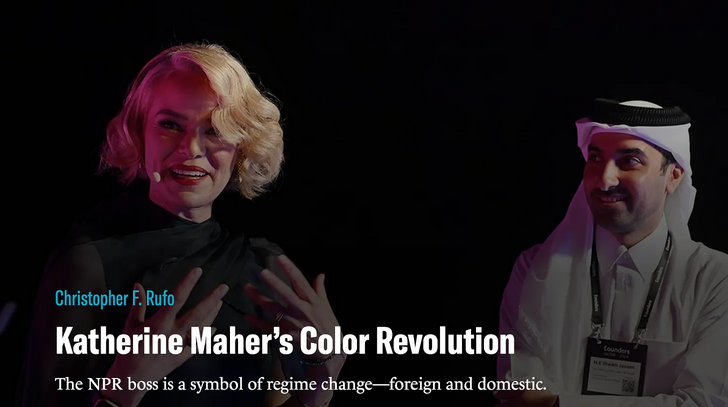
Banner for Christopher Rufo’s article on Katherine Maher at City Journal.
https://christopherrufo.com/p/katherine-mahers-color-revolution

The polite world was fascinated last month when long-time NPR editor Uri Berliner confessed to the Stalinist suicide pact the public broadcaster, like all public broadcasters, seems to be on. Formerly it was a place of differing views, he claimed, but now it has sold as truth some genuine falsehoods like, for instance, the Russia hoax, after which it covered up the Hunter Biden laptop. And let’s not forget our censor-like behaviour regarding Covid and the vaccine. NPR bleated that they were still diverse in political opinion, but researchers found that all 87 reporters at NPR were Democrats. Berliner was immediately put on leave and a few days later resigned, no doubt under pressure.

Even more interesting was the reveal of the genesis of NPR’s new CEO, Katherine Maher, a 41-year-old with a distinctly odd CV. Maher had put in stints at a CIA cutout, the National Democratic Institute, and trotted onto the World Bank, UNICEF, the Council on Foreign Relations, the Center for Technology and Democracy, the Digital Public Library of America, and finally the famous disinfo site Wikipedia. That same week, Tunisia accused her of working for the CIA during the so-called Arab Spring. And, of course, she is a WEF young global leader.

She was marched out for a talk at the Carnegie Endowment where she was prayerfully interviewed and spouted mediatized language so anodyne, so meaningless, yet so filled with nods to her base the AWFULS (affluent white female urban liberals) one was amazed that she was able to get away with it. There was no acknowledgement that the criticism by this award-winning reporter/editor/producer, who had spent his life at NPR had any merit whatsoever, and in fact that he was wrong on every count. That this was a flagrant lie didn’t even ruffle her artfully disarranged short blonde hair.

Christopher Rufo did an intensive investigation of her career in City Journal. It is an instructive read and illustrative of a lot of peculiar yet stellar careers of American women. Working for Big Daddy is apparently something these ghastly creatures value. I strongly suggest reading Rufo’s piece linked here. It’s a riot of spooky confluences.

Intelligence has been embedded in media forever and a day. During my time at Time Magazine in London, the bureau chief, deputy bureau chief and no doubt the “war and diplomacy” correspondent all filed to Langley and each of them cruised social London ceaselessly for information. Tucker Carlson asserted on his interview with Aaron Rogers this week that intelligence operatives were laced through DC media and in fact, Mr. Watergate, Bob Woodward himself, had been naval intelligence a scant year before he cropped up at the Washington Post as “an intrepid fighter for the truth and freedom no matter where it led”. Watergate, of course, was yet another operation to bring down another inconvenient President; at this juncture, unless you are being puppeted by the CIA, you don’t get to stay in power. Refuse and bang bang or end up in court on insultingly stupid charges. As Carlson pointed out, all congressmen and senators are terrified by the security state, even and especially the ones on the intelligence committee who are supposed to be controlling them. They can install child porn on your laptop and you don’t even know it’s there until you are raided, said Carlson. The security state is that unethical, that power mad.

Now, it’s global. And feminine. Where is Norman Mailer when you need him?

Making a French Cleat | Paul Sellers

Filed under: Tools, Woodworking — Tags: , , — Nicholas @ 02:00

Paul Sellers
Published Sep 9, 2015

Have you been looking for a way to hang your wall shelf or clock? Ever wondered what a split cleat or french cleat is? Paul shares this traditional method that really works.

To see a beginner friendly version of how to make a Hanging Wall Shelf, see our sister site: https://commonwoodworking.com/courses…

This video first appeared on https://woodworkingmasterclasses.com

QotD: Are western democracies moving uniformly in the direction of “surface democracy”?

Filed under: Bureaucracy, Government, Politics, Quotations, USA — Tags: , , , — Nicholas @ 01:00

I joked before about refusing to tolerate speculation about the US being a surface democracy like Japan, but joking aside I think even the staunchest defender of the reality of popular rule would concede that things have moved in that direction on the margin. Compare the power of agency rulemaking, federal law enforcement, spy agencies, or ostensibly independent NGOs now to where they were even 10 years ago. It would be a stretch to say that the electorate didn’t have influence over the American state, but can they really be said to rule it? Regardless of exactly where you come down on that question, it’s probably safe to say that you’d give a different answer today than you would have twenty, fifty, or a hundred years ago. Moreover, the movement has been fairly monotonic in the direction of less direct popular control over the government. And in fact this phenomenon is not unique to the United States, but reappears in country after country.

Is there something deeper at work here? There’s a theory, popular among the sorts of people who staff the technocracy, that this is all a perfectly innocent outgrowth of modern states being more complex and demanding to run. The thinking goes that it was fine to leave the government in the hands of yeoman farmers and urban proles a century ago, when the government didn’t do very much, but today the technical details of governance are beyond any but the most specialized professionals, so we need to leave it all to them.

I think this explanation has something going for it, I admire the structure of its argument, but it also can’t be the whole story. For starters, it treats the scope and nature of the state’s responsibilities as a fixed law of nature. Another way to frame this objection is that you can easily take the story I just told and reverse the causality — the common people used to rule, and so they created a government simple enough for them to understand and command; whereas today unelected legions of technocrats rule, and so they’ve created a government that plays to their strengths. There’s no a priori reason to prefer one of these explanations over the other. There needs to be a higher principle, a superseding reason that results in selecting one compatible ruler-state dyad over another. I think there is such a principle, we just have to get darker and more cynical.

John Psmith, “REVIEW: MITI and the Japanese Miracle by Chalmers Johnson”, Mr. and Mrs. Psmith’s Bookshelf, 2023-04-03.

May 21, 2024

Idi Amin would have loved MMT

Filed under: Africa, Economics, History — Tags: , , , , , , — Nicholas @ 05:00

Jon Miltimore talks about the economic disaster of Idi Amin’s Uganda after Amin and his predecessor decided to nationalize most big businesses in the country and then to print money to cover the government shortfalls in revenue that resulted:

Ugandan dictator Idi Amin at the United Nations, October 1975.
Detail of a photo by Bernard Gotfryd via Wikimedia Commons.

Idi Amin (1923-2003) was one of the most ruthless and oppressive dictators of the 20th Century.

Many will remember Amin from the 2006 movie The Last King of Scotland, a historical drama that netted Forest Whitaker an Academy Award for Best Actor for his depiction of the Ugandan president.

While Western media often mocked Amin, who ruled Uganda from 1971 to 1979, as a self-aggrandizing buffoon, they tended to overlook the atrocities he inflicted on his people. He murdered an estimated 300,000 Ugandans, many of them in brutal fashion. One such victim is believed to be Amin’s fourth wife, Kay, whose body was found decapitated and dismembered in a car trunk in 1974, shortly after the couple divorced.

While historians and journalists have tended to focus on Amin’s dismal record on human rights, his economic policies are atrocities in their own right and also deserve attention.

A Brief History of Uganda

Uganda, a landlocked country in the eastern part of Central Africa, received its independence from the United Kingdom on Oct. 9, 1962 (though Queen Elizabeth remained the official head of state). The nation’s earliest years were turbulent.

Uganda was ruled by Dr. Apollo Milton Obote — first as prime minister and then as president — until January 1971, when an upstart general who had served in the British Colonial Army, Idi Amin Dada Oumee, seized control and set himself up as a dictator. (The coup was launched before Amin, a lavish spender, could be arrested for misappropriation of army funds.)

Among Amin’s first moves as dictator was to complete the nationalization of businesses that had begun under his predecessor Obote, who had announced an order allowing the state to assume a 60 percent stake in the nation’s top industries and banks. Obote’s announcement, The New York Times reported at the time, had resulted in a surge of capital flight and “brought new investment to a virtual stand still”. But instead of reversing the order, Amin cemented and expanded it, announcing he was taking a 49 percent stake in 11 additional companies.

Amin was just getting started, however. The following year he issued an order expelling some 50,000 Indians with British passports from the country, which had a devastating economic impact on the country.

“‘These Ugandan ‘Asians’ were entrepreneurial, talented and hard-working people, skilled in business, and they formed the backbone of the economy,” Madsen Pirie, President of the UK’s Adam Smith Institute, wrote in an article on Amin’s expulsion order. “However, Idi Amin favoured people from his own ethnic background, and arbitrarily expelled them anyway, giving their property and businesses to his cronies, who promptly ran them into the ground through incompetence and mismanagement.”

Even as he was nationalizing private industry and expelling Ugandan Asians, Amin was busy rapidly expanding the country’s public sector.

The Ugandan economy was soon in shambles. Amin’s financial advisors were naturally frightened to share this news with Amin, but in his book Talk of the Devil: Encounters With Seven Dictators, journalist Riccardo Orizio says one finance minister did just that, informing Amin “the government coffers were empty”.

The response from Amin is telling.

“Why [do] you ministers always come nagging to President Amin?” he said. “You are stupid. If we have no money, the solution is very simple: you should print more money.”

Tribalism

Filed under: Africa, Americas, History — Tags: , , , , , , — Nicholas @ 04:00

Theophilus Chilton pulls up an older essay from the vault, discussing tribalism, how it likely arose, and examples of cultures that relapsed into tribalism for various reasons:

In this post, I’d like to address the phenomenon of tribalism. There can be two general definitions of this term. The first is attitudinal – it refers to the possession by a group of people of a strong ethnic and cultural identity, one which pervades every level and facet of their society, and which serves to separate (often in a hostile sense) the group’s understanding of itself apart from its neighbours. The second definition is more technical and anthropological, referring to a group of people organised along kinship lines and possessing what would generally be referred to as a “primitive” governmental form centered around a chieftain and body of elders who are often thought to be imbued with supernatural authority and prestige (mana or some similar concept). The first definition, of course, is nearly always displayed by the second. It is this second definition which I would like to deal with, however.

Specifically, I’d like to explore the question of how tribalism relates to the collapse of widely spread cultures when they are placed under extreme stresses.

There is always the temptation to view historical and pre-historical (i.e., before written records were available) people-groups which were organised along tribal lines as “primitives” or even “stupid”. This is not necessarily the case, and in many instances is certainly not true. However, tribalism is not a truly optimal or even “natural” form of social organisation, and I believe is forced onto people-groups more out of necessity than anything else.

Before exploring the whys of tribalism’s existence, let’s first note what I believe can be stated as a general truism – Mankind is a social creature who naturally desires to organise himself along communal lines. This is why cities, cultures, civilisations even exist in the first place. Early in the history of Western science, Aristotle expressed this sentiment in his oft-quoted statement that “Man is by nature a political animal” (ὁ ἄνθρωπος φύσει πολιτικὸν ζῷον). This aphorism is usually misunderstood, unfortunately, due to the failure of many to take its cultural context into account. Aristotle was not saying that mankind’s nature is to sit around reading about politicians in the newspaper. He was not talking about “politics” in some sort of demotic or operational sense. Rather, “political” means “of the polis” [” rel=”noopener” target=”_blank”>link]. The polis, in archaic and classical Greece, was more than just a city-state – it was the very sum of Greek communal existence. Foreigners without poleis were not merely barbarians, they were something less than human beings, they lacked a crucial element of communal existence that made man – capable of speech and reason – different from the animals and able to govern himself rationally. “Political” did not mean “elections” or “scandals”, as it does with us today. Instead, it meant “capable of living with other human beings as a rational creature”. It meant civilisation itself. Tribalism, while perhaps incorrectly called “primitive”, nevertheless is “underdeveloped”. It is in the nature of man to organise himself socially, and even among early and technologically backwards peoples, this organisation was quite often more complex than tribal forms. While modern cities may be populated by socially atomised shells of men, the classical view of the city was that it was vital to genuine humanity.

My point in all of this is that I don’t believe that tribal organisation is a “natural” endpoint for humanity, socially speaking. The reason tribes are tribes is not because they are all too stupid to be capable of anything else, nor because they have achieved an organisation that truly satisfies the human spirit and nature. As the saying goes, “The only morality is civilisation”. The direction of man’s communal association with man is toward more complex forms of social and governing interactions which satisfy man’s inner desire for sociability.

So why are tribal peoples … tribal? My theory is that tribalism arises neither from stupidity or satisfaction, but as a result of either environmental factors such as geography, habitability, etc. which inhibit complexification of social organisation, or else as a result of civilisation-destroying catastrophes which corrode and destroy central authority and the institutions necessary to maintain socially complex systems.

The first – environmental factors – would most likely be useful for explaining why cultures existing in more extreme biomes persist in a tribal state. For example, the Arctic regions inhabited by the Inuit would militate against building complexity into their native (i.e. pre-contact with modern Europeans) societies. The first great civilisations of the river valleys – Egypt, Mesopotamia, the Indus valley, and China – all began because of the organisation needed to construct and administer large scale irrigation projects for agriculture. Yet, the weather in the Arctic precludes any sort of agriculture, as well as many other activities associated with high civilisation such as monumental architecture and large scale trade. The Inuit remained tribal hunter-gatherers not because they were inherently incapable of high culture, but because their surroundings inhibited them from it. Likewise, the many tribal groups in the Rub’ al-Khali (the Empty Quarter of the Arabian peninsula) were more or less locked into a semi-nomadic transhumant existence by their environment, even as the racially and linguistically quite similar peoples of Yemen and the Hadramaut were developing complex agricultural and commercial cultures along the wadis.

However, I believe that the more common reason for tribalism in history is that of catastrophes – of various types, some fast-acting and others much slower – which essentially “turned the world upside down” for previous high civilisations which were affected by them. I believe that there are many examples of this which can be seen, or at least inferred, from historical study. I’ll detail five of them below.

The first is an example which would formerly have been considered to fall into the category of tribes remaining tribal because of geographical factors, but which recent archaeological evidence suggests is not the case. This would be the tribes (or at least some of them) of the Amazon jungles, especially the Mato Grosso region of western Brazil. Long considered to be one of the most primitive regions on the planet, one could easily make the argument that these tribes were such because of the extreme conditions found in the South American jungles. While lush and verdant, these jungles are really rather inhospitable from the standpoint of human habitability – the jungle itself is extremely dense, is rife with parasites and other disease-carriers, and is full of poisonous plants and animals of all kinds. Yet, archaeologists now know that there was an advanced urban culture in this region which supported large-scale root agriculture, build roads, bridges, and palisades, and dammed rivers for the purpose of fish farming – evidently the rumours told to the early Spanish conquistadores of cities in the jungle were more than just myth. This culture lasted for nearly a millennium until it went into terminal decline around 1550 AD, the jungle reclaiming it thoroughly until satellite imaging recently rediscovered it.

What happened? We’re not sure, but the best theory seems to be that diseases brought by Europeans terminated this Mato Grosso culture, destroying enough of its population that urban existence could no longer be sustained. The result of this was a turn to tribalism, a less complex form more easily sustained by the post-plague population. The descendants of this culture are the Kuikuro people, a Carib-speaking tribe living in the region, and probably also other tribes living in the greater area around the Matto Grosso. In the case of the Mato Grosso city culture, the shock of disease against which they had no immunity destroyed their population, and concomitantly their ability to maintain more complex forms of civilisation.

The conical tower inside the Great Enclosure at Great Zimbabwe.
Photo by Marius Loots via Wikimedia Commons.

The second example would be that of the Kingdom of Zimbabwe, centered around its capital of “Great Zimbabwe,” designated as such so as to distinguish it from the 200 or so smaller “zimbabwes” that have been scattered around present-day Rhodesia and Mozambique. Great Zimbabwe, at its peak, housed almost 20,000 people and was the nucleus of a widespread Iron Age culture in southern Africa, and this Bantu culture flourished from the 11th-16th centuries AD before collapsing. It is thought that the decline of Zimbabwean culture was due to the exhaustion of key natural resources which kept them from sustaining their urban culture. The result, if the later state of the peoples in the area is any indicator, was a conversion to the tribal structures more typically associated with sub-Saharan Africa. The direct descendants of the Zimbabwean culture are thought to be the various tribes in the area speaking Shona, a Bantu language group with over 8 million speakers now (post Western medicine and agriculture, of course). Once again, though, we see that when conditions changed – the loss of key resource supports for the urban culture – the shock to the system led to a radical decomplexification of the society involved.


“Modern pop music is to the West what speeches by [Dear Leader] are to North Korea, namely inescapable”

Filed under: Humour, Media — Tags: , , , — Nicholas @ 03:00

Poor Theodore Dalrymple is finding that everyone around him seems to be actively imposing their questionable music choices on him no matter how he tries to decline the offer:

Whenever I try to escape pop music relayed in public places at high volume — which is often, though considerably less often with success — the thought comes into my mind that the harnessing of electricity was a disaster, if not for humanity, at least for civilization if good taste be part of that much-derided entity.

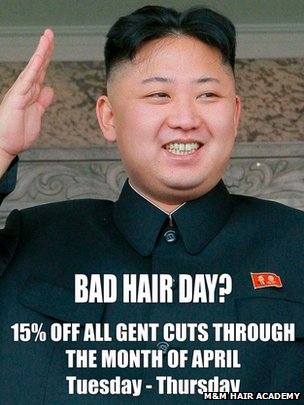
Modern pop music is to the West what speeches by North Korea’s greatest scientist, composer of operas, huntsman, industrial chemist, engineer, poet, agronomist, philosopher, economist, military strategist — in short, its present leader — are to North Korea, namely inescapable. If I were an absolute dictator, which fortunately for me among others I am not, I would forbid the public relay of such music under pain of death by deprivation of sleep.

Unnecessary noise should be regarded in the same way as cigarette smoke now is, a pollutant that infringes the rights of anyone subjected involuntarily to it. My sensitivity to cigarette smoke, incidentally, is now very acute: The other day, in the open street, there was a man sitting on a low wall smoking a cigarette a few yards from me, and I began to cough. This was not merely a psychosomatic reaction; I began to cough before I saw the source of what caused me to do so.

I must have grown up in a world that smelt like an ashtray, so great was the proportion of the population that smoked, but I did not notice it, any more than I noticed the air itself. Every curtain, every carpet, must have been saturated with such smoke, now stale, to say nothing of the fug created by cigarettes under current use. I remember the days when you could smoke on trains and airplanes. At the back of the cabin of the planes were the seats for smokers, not separated off from the rest of the fuselage, and if you were a nonsmoker such as I, you were often (so it seemed) allocated the row just in front of the first of the smokers’ seats, such that you might as well have been in the midst of them. Cigarette smoke on flights was as inescapable as crying babies now seem to be.

Patchett Machine Carbine Mk I: Sten Becomes Sterling

Forgotten Weapons
Published Feb 14, 2024

The Patchett Machine Carbine Mk I is the predecessor to the Sterling SMG. It was developed by George William Patchett, who was an employee of the Sterling company. At the beginning of the wear, Sterling was making Lanchester SMGs, and Patchett began in 1942 working on a new design that was intended to be simpler, cheaper, and lighter than the Lanchester. He used the receiver tube dimensions from the Sten and the magazine well and barrel shroud from the Lanchester. His first prototypes were ready in 1943, but it wasn’t until early 1944 that the British government actually issued a requirement for a new submachine gun to replace the Stens in service.

The initial Patchett guns worked very well in early 1944 testing, which continued into 1945. It ultimately came out the winner of the trials, but they didn’t conclude until World War Two was over — and nothing was adopted because of the much-reduced need for small arms. Patchett continued to work on the gun, and by 1953 he was able to win adoption of it in the later Sterling form — which is a story for a separate video.

The Patchett was not used in any significant quantity in World War Two. At most, a few of them may have been taken on the parachute drops on Arnhem — there are specifically three trials guns which appear referenced in British documents before Arnhem, but are never mentioned afterwards (numbers 67, 70, and 72). Were they taken into the field? We really don’t know.
(more…)

QotD: First Nations warfare in eastern North America

For this week’s book recommendation, I am going with a recent release, Wayne E. Lee, The Cutting-Off Way: Indigenous Warfare in Eastern North America, 1500-1800 (2023). This is one of those books I have been waiting to come out for quite some time, as I studied under the author at UNC Chapel Hill and so had heard parts of this argument laid out for years; it is a delight to see the whole thing altogether now in one place.

Fundamentally, Lee aims in the book to lay out a complete model for Native American warfare in eastern North America (so the East Coast, but also the Great Lakes region and the Appalachian Mountains), covering both the pre-European-contact system of warfare and also how that system changes as a result of contact. In presenting this model of a “cutting-off” way of war, Lee is explicitly looking to supplant the older scholarly model, called the “skulking way of war”, which he argues has been fatally overtaken by developments in history, archaeology and anthropology. As a description of a whole system of war, Lee discusses tactics, the movement of war parties, logistics and also the strategic aims of this kind of warfare. The book also details change within that model, with chapters covering the mechanisms by which European contact seems to have escalated the violence in an already violent system, the impact of European technologies and finally the way that European powers – particularly the English/British – created, maintained and used relationships with Native American nations (as compared, quite interestingly, to similar strategies of use and control in contemporary English/British occupied Ireland).

The overall model of the “cutting-off” way of war (named because it aimed to “cut off” individual enemy settlements, individuals or raiding parties by surprise or ambush; the phrase was used by contemporary English-language sources describing this form of warfare) is, I think, extremely useful. It is, among other things, one of the main mental models I had in mind when thinking about what I call the “First System” of war.1 Crucially it is not “unconventional” warfare: it has its own well-defined conventions which shape, promote or restrict the escalation of violence in the system. At its core, the “cutting-off” way is a system focused on using surprise, raids and ambushes to inflict damage on an enemy, often with the strategic goal of forcing that enemy group to move further away and thus vindicating a nation’s claim to disputed territory (generally hunting grounds) and their resources, though of course as with any warfare among humans, these basic descriptions become immensely more complicated in practice. Ambushes get spotted and become battles, while enmities that may have begun as territorial disputes (and continue to include those disputes) are also motivated by cycles of revenge strikes, internal politics, diplomatic decisions and so on.

The book itself is remarkably accessible and should pose few problems for the non-specialist reader. Lee establishes a helpful pattern of describing a given activity or interaction (say, raids or the logistics system to support them) by leading with a narrative of a single event (often woven from multiple sources), then following that with a description of the system that event exemplifies, which is turn buttressed with more historical examples. The advantage of those leading spots of narrative is that they serve to ground the more theoretical system in the concrete realia of the historical warfare itself, keeping the whole analysis firmly on the ground. At the same time, Lee has made a conscious decision to employ a fair bit of “modernizing” language: strategy, operations, tactics, logistics, ways, ends, means and so on, in order to de-exoticize Native American warfare. In this case, I think the approach is valuable in letting the reader see through differences in language and idiom to the hard calculations being made and perhaps most importantly to see the very human mix of rationalism and emotion motivating those calculations.

The book also comes with a number of maps, all of which are well-designed to be very readable on the page and a few diagrams. Some of these are just remarkably well chosen: an initial diagram of a pair of model Native American polities, with settlements occupying core zones with hunting-ground peripheries and a territorial dispute between them is in turn followed by maps of the distribution of actual Native American settlements, making the connection between the model and the actual pattern of settlement clear. Good use is also made of period-drawings and maps of fortified Native American settlements, in one case paired with the modern excavation plan. For a kind of warfare that is still more often the subject of popular myth-making than history, this book is extremely valuable and I hope it will find a wide readership.

Bret Devereaux, “Fireside Friday, September 29, 2023 (On Academic Hiring)”, A Collection of Unmitigated Pedantry, 2023-09-29.


    1. Itself an ultra-broad category with many exceptions and caveats.

May 20, 2024

The first post-privacy generation in human history

Filed under: Economics, Liberty, Media, Technology, USA — Tags: , , , , — Nicholas @ 05:00

You may have mixed feelings about the Zoomers — even if you happen to be a Zoomer — but it’s beyond argument that they are the first generation who have grown up in a zero-privacy world:

“Privacy” by g4ll4is is licensed under CC BY 2.0 .

Zoomers are the first post-privacy generation in human existence. They will never know a world in which they can try to lose themselves without somehow being tracked. Roughly three years ago, I was speaking with the CEO and founder of a commercial digital advertising company from NYC. He told me that their technology was so powerful that they were able to figure out when people were getting up from their couches to go into another room simply via their own digital advertising software.

It’s very tough to wrap our heads around the complete loss of privacy. For me, I have trouble remembering how it was to be out of instantaneous reach via mobile phone. Pre-mass adoption of cell phones, people would effectively be out of reach i.e. disappear for hours at a time, as the only way to contact them was to call them at home (inb4 beepers, as I never had one). We are constantly tracked and monitored, and our personal data is sold by data brokers all over the globe. One customer of personal ad tracking data is the CIA, as Matthew Petti explains:

    For years, the U.S. government has bought information on private citizens from commercial data brokers. Now, for the first time ever, American spymasters are admitting that this data is sensitive—but they’re leaving it up to the spy agencies on how to use it.

    Last week, Director of National Intelligence (DNI) Avril Haines released a “Policy Framework for Commercially Available Information.” Her office oversees 18 agencies in the “intelligence community“, including the CIA, the FBI, the National Security Agency (NSA), and all military intelligence branches.

    In the 2018 case Carpenter v. United States, the Supreme Court ruled that police need a warrant to obtain mobile phone location data from phone companies. (During the case, the Reason Foundation filed an amicus brief against warrantless snooping.) As a workaround, the feds instead started buying data from third-party brokers.

    Haines’ new framework claims that “additional clarity” on the government’s policies will help protect Americans’ privacy. Yet the document is vague about the specific limits. It orders the agencies themselves to come up with “safeguards that are tailored to the sensitivity of the information” and write an annual report on how they use this data.

more:

    As national security journalist Spencer Ackerman points out in his Forever Wars newsletter, the framework doesn’t require the feds to delete old purchased data. Earlier this year, Sen. Ron Wyden (D–Ore.) called on the NSA to purge all data that it bought without a warrant and without following the Federal Trade Commission’s privacy policies.

    “The framework’s absence of clear rules about what commercially available information can and cannot be purchased by the intelligence community reinforces the need for Congress to pass legislation protecting the rights of Americans,” Wyden tells Reason. “The DNI’s framework is nonetheless an important step forward in starting to bring the intelligence community under a set of principles and policies, and in documenting all the various programs so that they can be overseen.”

Case in point:

    Wyden has been aggressively pushing for transparency on data purchases over the past few years. In 2021, he uncovered that the Defense Intelligence Agency was buying Americans’ smartphone location data. That same year, he sent a letter to Haines and CIA Director Bill Burns complaining about a secretive CIA data collection program. (In an Orwellian turn, the letter itself was classified until 2022.) This year, Wyden revealed more details on NSA data purchases.

    Some of this data is collected and sold directly by the apps. For example, an intelligence company called X-Mode once paid MuslimPro, an app that offers a daily prayer calendar and a compass pointing towards Mecca, to include a few lines of location tracking code. X-Mode then sold the data to U.S. government agencies. MuslimPro claims that it did not intend to sell the data to the government and ended the arrangement after the story broke.

So, yeah … app maker will sell your personal data to a buyer like the CIA.

    In other cases, the data is siphoned from advertising markets. Every time a user opens a website with paid advertisements, their location and attributes appear on a real-time bidding (RTB) exchange, a virtual auction where companies buy ad space. Data brokers posing as advertisers scrape the listings for information on users.

    “Any government with a halfway decent cyber intelligence program is participating in these RTB exchanges, because it’s such an immensely valuable source of data,” says Byron Tau, author of Means of Control: How the Hidden Alliance of Tech and Government Is Creating a New American Surveillance State.

    As a demonstration of how powerful RTB data is, an intelligence contractor used data from the dating app Grindr to track gay government employees from their offices to their homes, Tau reported in his book.

The IRS is in on it too:

    Lawyers for the Internal Revenue Service, on the other hand, have argued that users voluntarily handed over the information, so the government is free to use it. Tau points out that users don’t really know how their data is being resold, and even the RTB exchanges themselves aren’t supposed to be used for data scraping.

    “A lot of these companies that are collecting data from the global population don’t have a real consumer relationship” with the people they’re spying on, Tau says. “Unless you know how to decompile software and you’re technically savvy, you can’t even make informed choices.”

In an increasingly digitized world, the right to privacy becomes wholly unworkable. Think digital payments by way of credit and debit cards vs. cash.

« Newer PostsOlder Posts »

Powered by WordPress