
According to [Governor Harold] Stassen, “My best summary of Dulles is that he always knew he was absolutely right. Further, he knew that anyone who disagreed with him was, of logical necessity, always wrong. And finally, he could not understand how anyone could dare question the fact that he was always right.” It wasn’t just Stassen who had a problem with the priggish Dulles, though. As Supreme Court Justice William O. Douglas once said, “I’m not sure I want to go to heaven. I’m afraid I might meet John Foster Dulles there”. Some U.S. allies had misgivings about Dulles as well. Harold Wilson, a British member of Parliament and future prime minister, once mocked Dulles’s propensity to try to be everywhere all the time: “I heard they are inventing an airplane that can fly without Dulles! They hope soon to get it into production.” Winston Churchill himself once famously mocked Dulles via declension: “Dull, Duller, Dulles”.
Tevi Troy, Fight Club: Rivalries in the White House from Truman to Trump, 2020.
January 6, 2026
QotD: John Foster Dulles
January 5, 2026
Friedman on Orwell
On his Substack, David Friedman considers some of the things that George Orwell was mistaken about in his non-fiction writings:
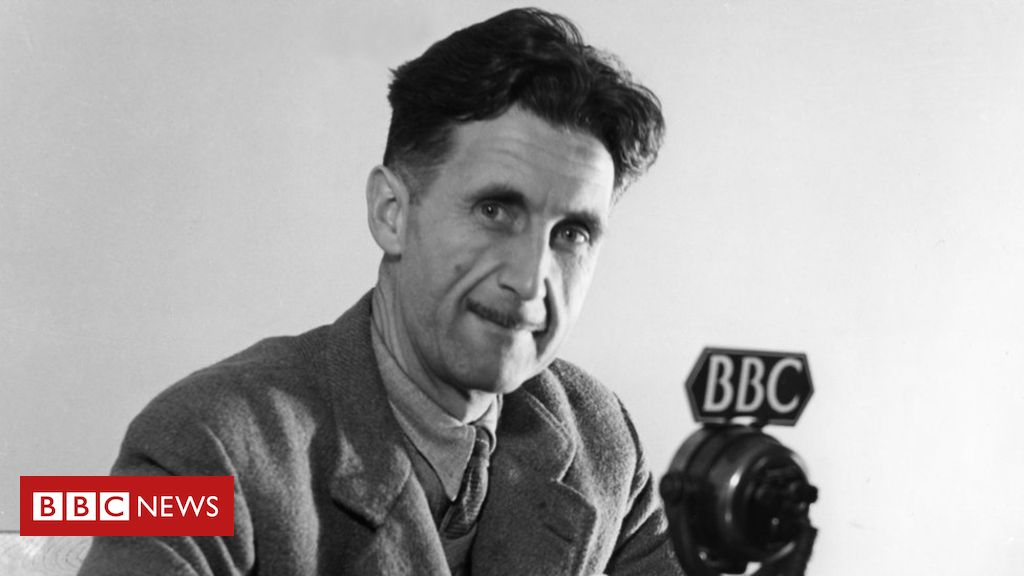
It cannot be said too often – at any rate, it is not being said nearly often enough – that collectivism is not inherently democratic, but, on the contrary, gives to a tyrannical minority such powers as the Spanish Inquisitors never dreamed of. (George Orwell, The Observer, April 9, 1944)
George Orwell got some things right; unlike most political partisans, he saw the problems with the position he supported. He also got quite a lot of things wrong. The quote is from Orwell’s review of two books, The Road to Serfdom by Friedrich Hayek and The Mirror of the Past by K. Zilliacus, a left-wing writer and politician. The conclusion of the review is that Hayek is right about what is wrong with socialism, Zilliacus is right about what is wrong with capitalism, hence that “the combined effect of their books is a depressing one”.
But Zilliacus was wrong about capitalism, as was Orwell, who wrote:
But he [Hayek] does not see, or will not admit, that a return to “free” competition means for the great mass of people a tyranny probably worse, because more irresponsible, than that of the State. The trouble with competitions is that somebody wins them. Professor Hayek denies that free capitalism necessarily leads to monopoly, but in practice that is where it has led, and since the vast majority of people would far rather have State regimentation than slumps and unemployment, the drift towards collectivism is bound to continue if popular opinion has any say in the matter. (“As I Please”, pp.117-119)1
The problem is that Orwell, like many of his contemporaries (and ours), did not understand economics and thought he did. Since he wrote we have had extensive experience with free competition, if not as free as Hayek would have wanted, and the result has not been the nightmare that Orwell expected. “The trouble with competitions is that somebody wins them” sounds right only if you don’t actually understand the logic of a competitive market. In most industries organizational diseconomies of scale, the effect of more layers between the head office and the factory floor, limit the size of the firm to something considerably below the size of the market for what the firm produces. In some fields, such as restaurants or barber shops, the result is an industry with thousands of firms, in some five or ten, in only the rare case of a natural monopoly can one large firm outcompete all of its smaller competitors.
The effect of free competition is not the only thing that Orwell got wrong. Consider his essay on Kipling.2 He gets some things right, realizes that Kipling is not a fascist, indeed less of one than most moderns, and recognizes his talent:
During five literary generations every enlightened person has despised him, and at the end of that time nine-tenths of those enlightened persons are forgotten and Kipling is in some sense still there.
But he gets quite a lot wrong. In arguing that Kipling misunderstood the economics of imperialism, Orwell writes:
He could not understand what was happening, because he had never had any grasp of the economic forces underlying imperial expansion. It is notable that Kipling does not seem to realize, any more than the average soldier or colonial administrator, that an empire is primarily a money-making concern.
In explaining his own view of the logic of empire, what he thought Kipling was missing, Orwell writes:
We all live by robbing Asiatic coolies, and those of us who are “enlightened” all maintain that those coolies ought to be set free; but our standard of living, and hence our “enlightenment”, demands that the robbery shall continue.3
Britain let go of its empire, starting with India. British standards of living did not collapse; by the time all of the colonies were independent, the average real wage in the UK was 50% higher than when Orwell wrote. He could not know the future but he could observe that Switzerland, before the war, was richer than England, Denmark, with no significant colonies, almost as rich, Portugal, with an enormous African empire, much poorer. Whether Britain ran its empire at a net profit or a net loss is, I think, still an open question, but Orwell’s view of colonialism is strikingly inconsistent with the observed effects of decolonization.
Economics is not all that Orwell got wrong about Kipling; he badly underestimated the quality of Kipling’s work, due to having read very little of it. The clearest evidence is Orwell’s description of The Light that Failed as Kipling’s “solitary novel”. Kipling wrote three novels, of which that is by a good margin the worst. Orwell not only had not read Kim, Kipling’s one world class novel, he did not know it existed. In a recent post I listed eighteen works by Kipling that I liked. Orwell mentions only one of them.
- That free capitalism would ultimately fail was still Orwell’s view in 1947:
In North America the masses are contented with capitalism, and one cannot tell what turn they will take when capitalism begins to collapse (“Toward European Unity“)
- Discussed in more detail in an earlier post.
- As late as 1947, Orwell wrote:
The European peoples, and especially the British, have long owed their high standard of life to direct or indirect exploitation of the coloured peoples. (“Toward European Unity“)
International law is more like International “law”
On the social media site formerly known as Twitter, Konstantin Kisin points out that calling it “International Law” gives it a semi-mythic quality that it absolutely does not deserve:
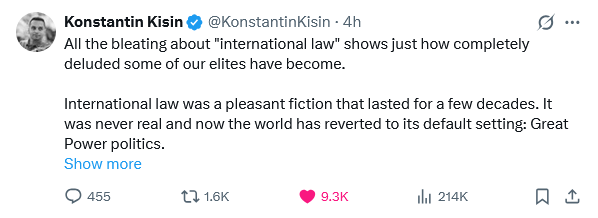
All the bleating about “international law” shows just how completely deluded some of our elites have become.
International law was a pleasant fiction that lasted for a few decades. It was never real and now the world has reverted to its default setting: Great Power politics.
This is why, as a strong Ukraine supporter, I have never talked about international law or called Putin’s attack an “illegal invasion”.
Laws are based on submission to an overarching authority backed by force. There is no such international authority and even if you view the UN as one, it does not have the ability to use force against those who violate “international law” other than against small countries with weak militaries.
When the US attacked Iraq, the UN did nothing.
When Russia invaded Ukraine, the UN did nothing.
If China invades Taiwan tomorrow, the UN will do nothing.If you cannot enforce a law, it’s not a law.
I do not support Ukraine because naughty Vlad broke the rules. I support Ukraine because it’s not in OUR interest in the West to have Russia marauding its way through friendly countries on the borders of Europe. It’s in our interest for us to be as strong as possible and for our adversaries to be as weak as possible.
President Trump is a realist and a pragmatist. He sees through the fictions other “leaders” cling to.
A good leader advances the national interests of his country. If more Western leaders did this, our civilisation would be in a much better place.
I commented on another post that,
For a lot of people (Canadian Liberals and American Democrats in particular), the invocation “international law” has a mesmerizing effect on their ability to reason [insert usual disclaimer that if they could foresee the results of their enlightened beliefs, they wouldn’t be progressives]. They seem to have a quasi-religious belief in the UN as if it were some kind of God-given supergovernment that is always right and must always be obeyed. “World opinion” might as well be the hand of God to them, so any time the legacy media can portray the US (and Trump in particular) as going against “world opinion” they want to get out the sackcloth and ashes … or sack a city and turn it into ashes, whichever comes first.
vittorio analyzes the default position of most progressives on the social media site formerly known as Twitter:
most political issues nowadays can be explained by understanding that american leftists dont have positions, they have oppositions.
their entire belief system is defined by negation of whatever the right supports. this is why portland chants “free maduro” while actual venezuelans celebrate in the streets. they’re not pro-venezuelan or pro democracies, or pro tyrant, or pro maduro, they’re simply anti-american-right.
they’ve outsourced their worldview to institutional narratives for so long that genuine self-reflection would require questioning everything. for them it’s much easier to just oppose. the beliefs arent coherent because they were never meant to be coherent. they only need to signal tribal membership, and leftist membership is gained by opposing the right.
trump does X? the left screams and cries because they wanted Y
trump does Y? the left screams and cries and riots because even if they said they wanted Y, what they meant is that X was the way to go
trump cures cancer? they’ll argue that the cancer cells are alive have a right of free determination
trump saves lives? they’ll protest because somehow those lives didn’t matter and should have been ended
no coherent word model. no logic. pure opposition
at some point you just have to stop engaging with it as if it’s a real political position. it’s not. it’s aesthetic opposition wearing the costume of ideology
As Severian at Founding Questions often remarks, progressives’ core belief is The Great Inversion: “whatever is, is wrong”.
Bingo Bobbins makes the case that “International law is fake and gay”:
Was this operation necessary? Was Maduro really a “narcoterrorist”? I admit that I haven’t really been following all the drama with Venezuela recently, but my intuition is that Maduro was probably accepting bribes to look the other way with regards to drug trafficking, rather than being directly involved. And sure, he was a socialist dictator but there’s plenty of those around. The US doesn’t go and topple dictators unless there is a perceived US interest in doing so.
What Maduro was actually doing was cozying up to China. In fact, he had just finished a meeting with some Chinese ambassadors hours before Delta Force snatched him up by the scruff. This was actually a warning to China not to mess around in our hemisphere. The Trump administration is re-establishing the Monroe Doctrine, or, as he recently called in a press conference, “The Donroe Doctrine“. As far as I can see, this is completely in keeping with my preferred Vitalist Foreign Policy.
You can agree or disagree with this show of force, but please don’t whine to me about “International Law”. International Law is fake and gay. I certainly don’t care that the Trump administration “targeted a political leader”. This is the complaint being leveled by many leftists in regard to the operation. Really, this is just because leftists are anti-American third-worldists, and they are filled with butthurt because “their guy” lost. But, let’s examine this “rule” of not being allowed to target a countries rulers, because it’s particularly ridiculous.
If you have a problem with a specific country, who do you really have a problem with? You have a problem with that country’s leaders, since they are the ones making the decisions. Why wouldn’t you target the leaders? The only reason is that all the leaders from all the countries got together and agreed that they wouldn’t target each other. They would rather resolve their differences by throwing cannon fodder at each other, while keeping themselves off the table. And sure, I understand why that is great for them, but not why it would be great for me (or you).
Of course, the CIA has been ignoring this “international law” for decades, but they’ve been doing it in a very effeminate way, skulking about the world, funding Color Revolutions and clandestinely arming insurgent groups in order to subvert existing regimes. The Donroe Doctrine is much better. Imagine if the Trump administration had tried to handle Maduro the way the Obama administration tried to handle Assad. Fund a decades long civil war, accidentally establish a caliphate, fight a war against said caliphate, facilitate the deaths of tens of thousands of Christians, all to have an even worse dictator eventually rise to power.

Update, 6 January: Welcome, Instapundit readers! Please do have a look around at some of my other posts you may find of interest. I send out a daily summary of posts here through my Substack – https://substack.com/@nicholasrusson that you can subscribe to if you’d like to be informed of new posts in the future.
Interdynamic MP-9 SMG: Origin of the TEC-9
Forgotten Weapons
Published 13 Aug 2025The story of the Tec-9 begins with a Swedish company called Interdynamic AB and their designer Göran Lars Magnus Kjellgren designing a cheap and simple submachine gun for military use. It found no interested clients, and so the company decided to market it in the United States as a semiautomatic pistol. Kjellgren moved to the US in 1979, anglicized his name to George Kellgren, and founded Interdynamic USA with a partner, Carlos Garcia.
The pair produced a few dozen MP-9 submachine guns in 1982 (they were all transferrable, as this was before 1986) as well as a semiauto open bolt version called the KG-9 (Kellgren-Garcia). About 2500 of the KG-9s were made before later in 1982 the ATF determined that it was a machine gun, and they had to redesign it as a closed bolt semiauto, which they named the KG-99. At about this point Kellgren decided to move on to other plans, and he sold his interest in the company to Garcia, who formed a new company called Intratec. Kellgren used the proceeds to start Grendel a few years later.
(more…)
QotD: Nitpicking the opening battle in Gladiator (2000)
The iconic opening battle, set in the Marcomannic Wars (166-180) during the reign of Marcus Aurelius (r. 161-180) dominates the pop-cultural reference points for the Roman army in battle and you can see its heavy influence in things like how the Total War series presents Roman armies (particularly in trailers and other promotional material). Students and enthusiasts alike will often cite this sequence as the thing which sparked their interest in the Roman army. It is hard to overstate how pervasive its influence is in the public imagination of what the Roman army, particularly of the imperial period, was like, especially as its style is imitated by later pop culture works.
Which is why it is so unfortunate that it is such a deceptive historical mess. This sequence in particular is a banner example of what I’ve termed elsewhere the “perils of historical verisimilitude“, the habit of historically based popular-culture works including what we might think of as fake signifiers of research, things that seem historically grounded rather than being historically grounded, as a way to cheaply cash in on the cachet that an actually grounded representation gets.
Gladiator actually provides a perfect metaphor for this: its main character’s name. Russell Crowe proudly informs us he is, “Maximus Decimus Meridius”, a name that certainly sounds suitably Roman, picking up the three-part name with that standard second declension -us ending. It sounds like it could be a real name – if you didn’t know Latin you would probably assume that it could be a real Roman name. But, as we’ve noted, it isn’t a Roman name and in fact gets nearly all of the Roman naming conventions wrong: Roman names are ordered as praenomen, nomen and cognomen, with the nomen indicating one’s gens (“clan” more or less) and the praenomen selected from just a couple dozen common personal names. Decimus is one of those two-dozen common praenomina (which also means it is never going to show up as the name of a gens), so it ought to go first as it is actually his personal name. Meanwhile Maximus (“the greatest”) is very much not one of those roughly two-dozen praenomina, instead being always cognomen (essentially a nickname). Finally Meridius isn’t a Latin word at all (so it can’t be a praenomen personal name nor a cognomen nickname),2 meaning it has to be the nomen (referencing a fictive gens Meridia). Every part of his name is wrong and it should read Decimus Meridius Maximus.
It sounds just right enough to fool your average viewer, while being entirely wrong. It is “truthy” rather than true – verisimilitudinous (like truth), rather than veristic (realistic, true).
In the case of Gladiator‘s opening battle scene, the attention is on creating verisimilitude (without fidelity, as we’ll see) in the visual elements of the sequence and only the visual elements. The visual representation of a Roman army – the equipment in particular – is heavily based on the Column of Trajan (including replicating the Column’s own deceptions) and since that is the one thing a viewer can easily check, that verisimilitude leads a lot of viewers to conclude that the entire sequence is much more historically grounded than it is. They take their cues from the one thing they can judge – “do these fellows wear that strange armor I saw on that picture of a Roman column?” – and assume everything is about as well researched, when in fact none of it is.
Instead, apart from the equipment – which has its own deep flaws – this is a sequence that bears almost no resemblance to the way Roman armies fought and expected to win their battles. The Roman army in this sequence has the wrong composition, is deployed incorrectly, uses the wrong tactics, has the wrong theory of victory and employs the wrong weapons and then employs them incorrectly. Perhaps most importantly the sequence suggests an oddly cavalry-and-archer focused Roman army which is simply not how the Romans in this period expected to win their battles.
Now I want to be clear here that this isn’t a review of the film Gladiator (2000) or my opinion in general on the film. To be honest, unlike the recent sequel, I enjoy Gladiator even though it is historical gibberish. So I am not telling you that you aren’t “allowed” to like Gladiator, but rather simply that, despite appearances, it is historical gibberish, particularly this opening scene, which I often find folks who are aware the rest of the film is historical gibberish nevertheless assume this opening scene is at least somewhat grounded. It is not.
Bret Devereaux, “Collections: Nitpicking Gladiator’s Iconic Opening Battle, Part I”, A Collection of Unmitigated Pedantry, 2025-06-06.
- I’d think its only real rival for prominence would be Spartacus (1960).
- If you are wondering, “but then were does our word “meridian” come from, the answer is from Latin meridies, meaning “midday”.
January 4, 2026
Venezuela in the news
Tim Worstall explains that despite the usual suspects’ claims that “it’s all about the oil!”, it actually isn’t very much about the oil at all:

Trump taking — kidnapping, arresting, to taste — Maduro and his wife simply isn’t about the oil business. Please note, this also isn’t about whether it’s a good idea or not although I’ll admit to thinking that it’s way damn cool — getting in and out of hostile territory without, so far as we know right now, a single American casualty at all? Damn cool in that military sense.
This is about the shrieking we’re getting from the usual suspects — this is all about the oil! See! Ms. Raisin is one I’ve seen online already, there are those quoting that Counterpunch article with the idiot Michael Hudson and so on.
My point is solely and only about access to that oil.
So, travel back 10 to 15 years.
Venezuela’s Orinoco Belt oil is very “heavy”. Technically it is about viscosity but think about it as “thick”. It’s more like treacle than it is like a free flowing liquid. There are also issues with sulphur but leave that alone here. It is, in the technical parlance, “cheap shit”. So bad that it has to be mixed with much lighter (and usually “sweeter”, which means less sulphur) crude oil from different oil fields so you can pump it through a pipeline or get it into a tanker.
Venezuela used to have — still could have — fields of that light and sweet oil but they ran those fields — during and after Chavez — so badly that production fell over. So, they used to actually import US crude oil to then mix with that heavy crude so they could export. They also price petrol — gasoline — so low that they cannot possibly run refineries to make their own gasoline. So, they would import the US crude, mix it, export the blend to the US and then buy back the gasoline from those US Gulf Coast refineries. This was ridiculous, of course, but you know socialists with prices and economies.
It also meant that those US Gulf Coast refineries were adapted to use that Venezuela mix. You can change the mix a refinery uses but it’s potentially costly. The more the mix changes the more the cost rises. But the important thing to note is that the only refineries within cheap shipping distance that could use the Venezuela crude efficiently were those US Gulf Coast ones. Sure, they’d be pissed if they lost access to their supplies but they could be altered to work with other crude mixes. The reliance was much more of Venezuela upon the refineries than the refineries upon Venezuela — at least, the cost of adaptation to a change was lower for the refineries.
OK, so that was the old situation.
Over this past decade and a bit the US — under both Trump and Biden — has been saying, well, you know, we don’t think much of the Venezuelan Government. We also know the only money they get is from crude oil sales, so, if we refused to take that for those Gulf Coast refineries then we could screw with Maduro. Which is what happened — sanctions on Venezuelan oil exports which, most obviously, apply to people shipping into the US and so obeying US law.
Other people who do not, or don’t have to, obey US law haven’t, wholly, been abiding by those sanctions. OK. Maybe that’s all a good idea and maybe it isn’t — not my point here at all.
We should also note that the oil fields in Venezuela actually owned/managed by Chevron, a US company, have still been allowed to ship to the US and elsewhere under US law.
One more little fact. The US is now — as a result of fracking — a net oil exporter. This is also something done under Trump I, the lifting of the ban on crude oil exports. It can still be true that maybe buying in some Venezuelan oil — or Mexican, Canadian, whatever — meets either geographic or blend desires. We’d like some really heavy sludge, for example, or maybe Canadian oil works for Wyoming (not real examples, just ideas). But in terms of total oil production and usage the US produces more than it uses now. So any decision to import is about those marginal issues of location and blend, not urgent necessity for simple crude oil. Fracking works, d’ye see?
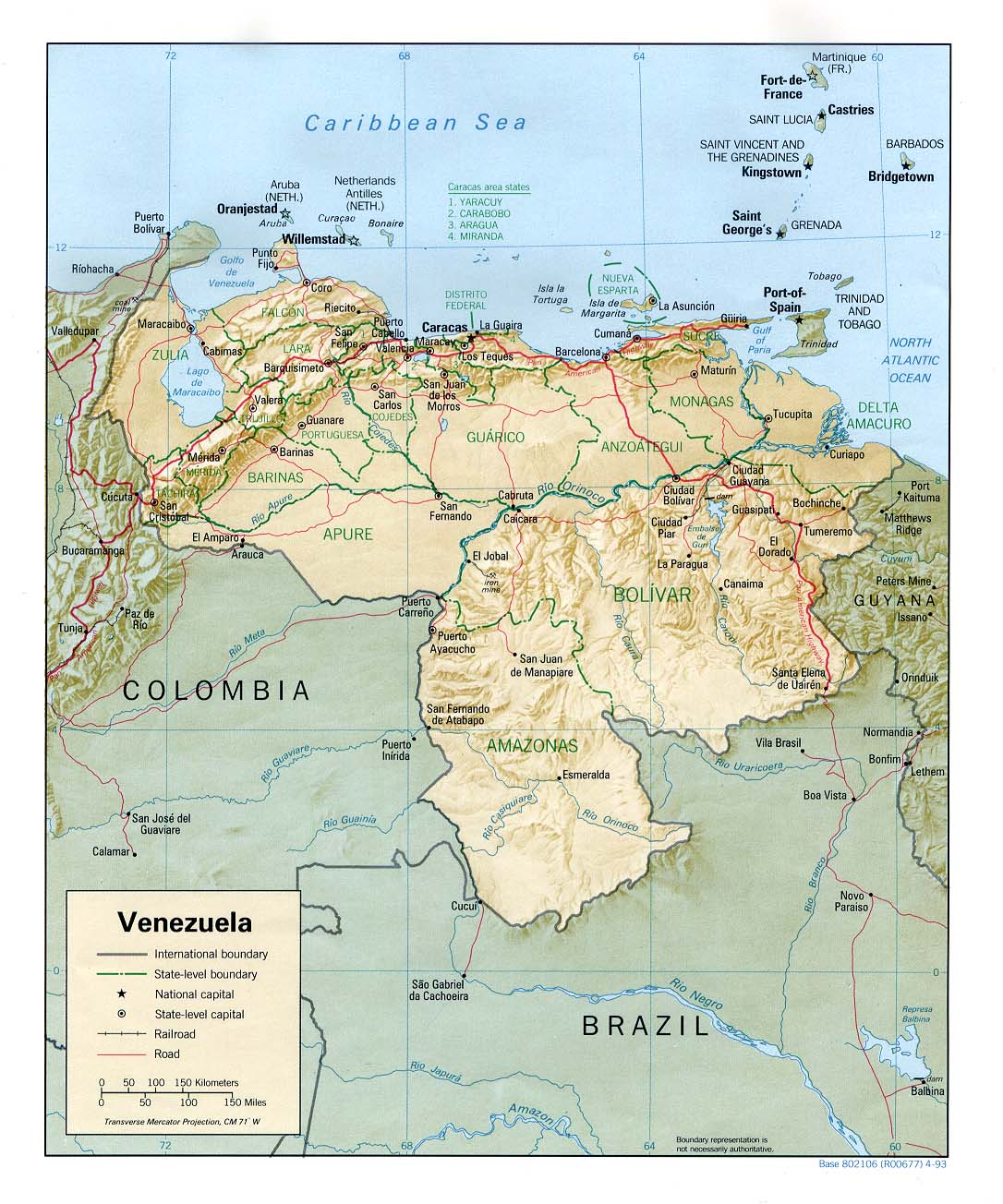
Shaded relief map of Venezuela, 1993 (via Wikimedia Commons)
On the other hand another bunch of the usual suspects are screaming about this as a violation of international law. ESR comments on the social media site formerly known as Twitter:
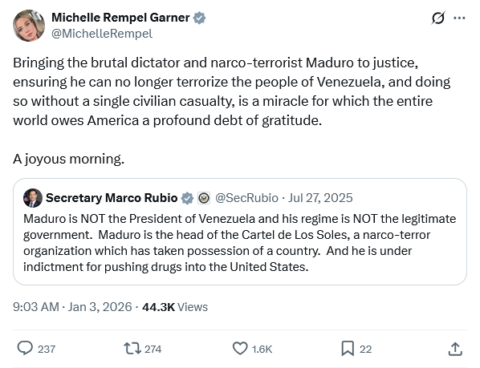
Since there’s a lot of screaming about the legality of black-bagging Nicolas Maduro going on, let’s talk about the game theory of international law.
Before I do that, though, I’m going to acknowledge that the Trump administration’s legal posture doesn’t even implicate international law significantly. Their theory is that Maduro stole an election, is not the legitimate head of state of Venezuela, and is a criminal drug-cartel leader; universal jurisdiction applies.
This is why a photograph of Maduro restrained by a soldier wearing a DEA patch was released.
I’m not here to state a position on whether that legal posture is valid; I want to instead outline a game theory of the “rules-based international order”, which people are complaining has been violated because the US black-bagged a head of state.
There are two different ways to establish a framework of governing law. Most people only understand one of them, which is the imposition of law by a ruler or coalition with force dominance. I’ll call this “unitary law”.
The other mechanism is mostly only understood by a handful of libertarians; it is law as a violence-minimizing equilibrium among a number of roughly equal agents playing an iterated Prisoner’s Dilemma game. In such settings, cooperation evolves naturally and doesn’t have to be handed down by a single ruler or coalition. I’ll call this “IPD law”.
“International law” is enforced by an uneasy combination of both mechanisms. This is more difficult to see than it should be because there’s also a lot of air and bullshit around “international law”, bullshit consisting mostly of wordcels trying to cast magic spells on people with guns.
The air and bullshit is why it’s common to say that international law is a mirage, or a fraud that only serves the interests of the strongest powers. This isn’t true: what is true is that if an international norm is not sustained by being a stable strategy in an IPD game, only force majeure by a dominant power or coalition can uphold it.
Here’s an example of a moral good that was established by unitary law of nations: the general abolition of chattel slavery, which happened because a dominant coalition of Western nations said “Fuck your sovereignty, we’re no longer tolerating this anywhere our militaries can reach.”
Here’s an example of a moral good that was accomplished by IPD law of nations: generally humane treatment of prisoners of war in armed conflicts. This didn’t develop because great powers unilaterally said “stop doing that”, it happened because even a great power at war with a minor one is exposed to effective tit-for-tat retaliation if it abuses POWs.
If you want to understand “international law”, you need to be able to disentangle three different things that claim to be international law: unitary law imposed by great powers, IPD law enforced by the threat of pain-inducing defections in an international tit-for-tat game, and wordcel bullshit.
The thing to bear in mind is just because there’s a lot of wordcel bullshit going around in “international law” doesn’t mean there isn’t a reality underneath.
British Prime Minister Keir Starmer rushes to distance himself from Trump’s action, for fear that someone might possibly mistake him for a vertebrate:

Leave it to the Babylon Bee to find the appropriate framing for a news story:
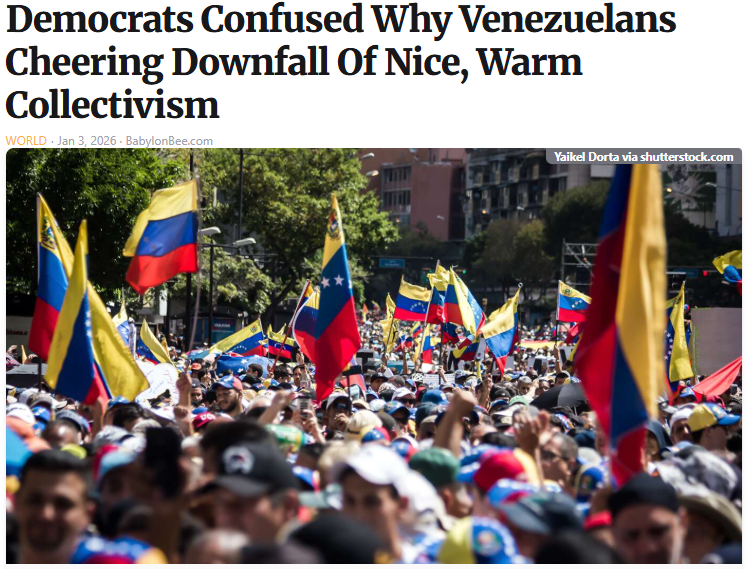
Update, 6 January: Welcome, Instapundit readers! Please do have a look around at some of my other posts you may find of interest. I send out a daily summary of posts here through my Substack – https://substack.com/@nicholasrusson that you can subscribe to if you’d like to be informed of new posts in the future.
The Nazis Win Big at the Polls! – Rise of Hitler 25, July-September 1932
World War Two
Published 3 Jan 2026July starts with ever more violence in the streets of Germany, which Chancellor von Papen uses as an excuse to take state control of Prussia, the largest German state. All this comes ahead of the July elections, in which the Nazi Party is the big winner, now the largest party in Germany and Party Leader Adolf Hitler someone that no one in politics can any longer ignore, including President Hindenburg. This summer really is a summer of drama and intrigue.
(more…)
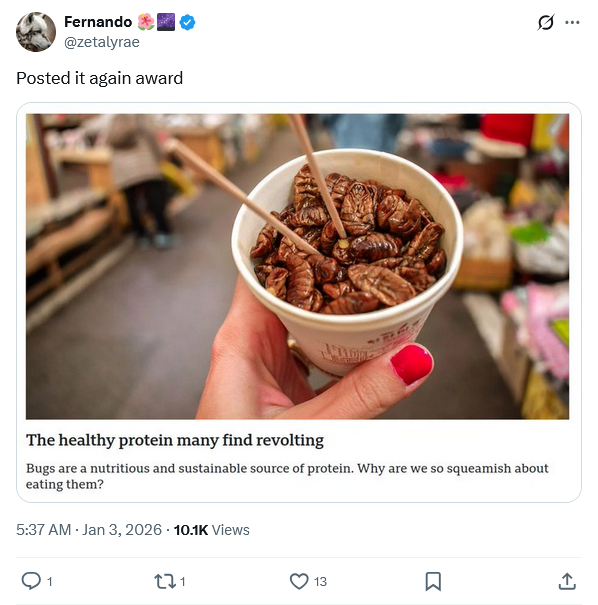
“You will eat the bugs, peasant!”
On the social media site formerly known as Twitter, ESR reacts to yet another “bugs are yummy, peons, you are going to eat them” post:
Contemplating this picture, I had a realization about the people who want you to eat bugs.
The fact that the bugs are disgusting to you is the whole point. Enlisting you as the principal enforcer of your oppression is the program. Fucking with your head is the actual goal, not just a tactic.
It doesn’t matter whether or not Western prejudice against eating insects is irrational. In an alternate world where we routinely eat insects, the people who want you to eat the bugs would find some other kind of disgusting garbage and play to make you eat it.
Because this isn’t sustainability or any of that bullshit. The degradation is the point.
However, even the powers-that-be can’t magically create economic conditions in which insect factories earn profits:

In the renewable frenzy of the early 2020s Ÿnsect raised €600 million to “Reinvent the food chain” and pioneer alternative foods that “respect the planet’s boundaries”. Some $200 million of their funding came from hapless taxpayers somewhere. But in record time, seemingly before it began, it has already gone. Bankrupted. And not because people don’t want to eat mealworms (which they don’t) but because there wasn’t much market in making animal feed either. It turns out that farm owners didn’t want to spend 2 to 10 times as much on “sustainable” cattle fodder. So the company shifted focus to high end pet food, where besotted owners have money to spare, but that crashed too.
h/t Tom Nelson
How reality crushed Ÿnsect, the French startup that had raised over $600M for insect farming
By Anna Heim, TechCrunchThe company’s demise is hardly a surprise, as Ÿnsect had been embattled for months. Still, there is plenty to unpack about how a startup can go bankrupt despite raising over $600 million, including from Downey Jr.’s FootPrint Coalition, taxpayers, and many others.
Ultimately, Ÿnsect failed to fulfill its ambition to “revolutionize the food chain” with insect-based protein. But don’t be too quick to attribute its failure to the “ick” factor that many Westerners feel about bugs. Human food was never its core focus.
It’s only money …
And revenue was the problem. According to publicly available data, Ÿnsect’s revenue from its main entity peaked at €17.8 million in 2021 (approximately $21 million) — a figure reportedly inflated by internal transfers between subsidiaries. By 2023, the company had racked up a net loss of €79.7 million ($94 million).
The vainglorious heady days of climate communism meant some bureaucrats thought it made sense to spend $200 million dollars feeding bugs to cows to try to change rainfall in 2100 AD.
QotD: The boomerang effect
Lament the rise of an opinion or policy without noticing how your preferred policies helped cause it.
Vaccination rates down — because you wrecked the reputation of vaccines during the pandemic by over claiming.
Anti-immigrant feeling leading to difficulties for legal immigrants — because you welcomed millions of illegal immigrants and prevented them being deported.
Prosecution of political opponents — because you did it too.
Dislike seeing people cancelled for their opinions — because you started it.
Rising climate scepticism — because you censored reasonable criticism of climate extremism.
Anger at trans rights activists — because you shouted down concerns about men pretending to be women in sports and prisons.
Government attacks on universities — because you turned them into ideological madrassas.
Patriotic nationalism turning uglier — because you told people flags were racist.
Criticism of judges — because they became nakedly political.
Defunding of biotechnology — because you failed to call out dangerous gain-of-function virology as the likely cause of the death of 20 million+ people.
Etc etc
Matt Ridley, The social media site formerly known as Twitter, 2025-09-27.
January 3, 2026
America’s secret UBI programs
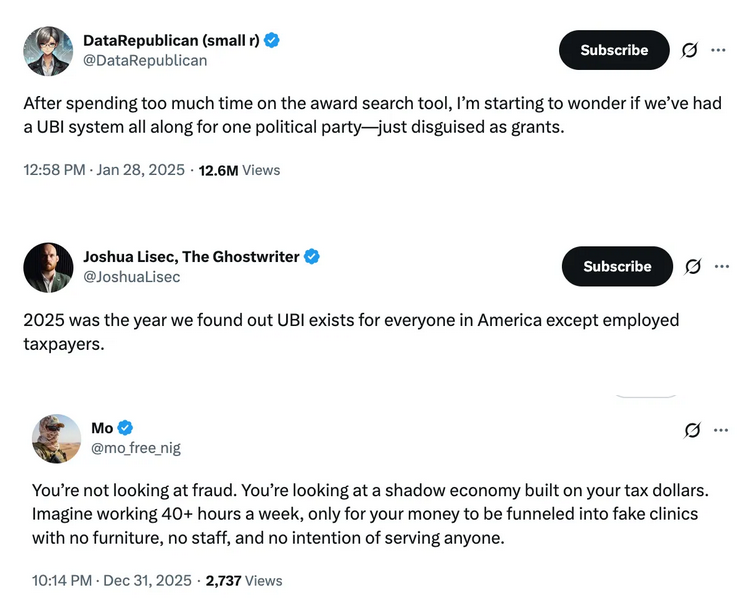
On his Substack, Glenn Reynolds puts the Somali daycare scandal into its proper perspective: it’s not old-fashioned graft but something far bigger and far more destructive to the pillars of western society:
The explosive unveiling of the wildly extensive Somali-run daycare scams in Minnesota has drawn attention to a huge shadow economy, and not just in Minnesota. America, it turns out, is full of people, companies, and organizations that basically live off of fraud. We’re not talking old-fashioned waste, like $600 hammers or $1200 toilet seats. We’re talking about entities whose sole reason for existence consists of being a conduit for taxpayer money to flow directly to the people controlling them, with some of the proceeds being diverted to politicians and political organizations.
People are noticing.
This reverses an old joke told by my Nigerian relatives. A Nigerian visits his rich relative in the United States and is awed by the penthouse apartment, the limo, the private jet and so forth. “How did you make so much money?” he asks. The relative points out the window. “See that bridge? 15%. See that shopping mall? 15%. See that train station? 15%.”
The visitor, inspired, returns home to Nigeria and becomes fabulously wealthy. His rich cousin from America visits and says “How did you make so much money so fast?”
“You see that bridge over there?”
“Nope,” responds the confused relative. The Nigerian cousin points at himself and says “One hundred percent!”
Well, this joke has now been turned around. Leaving aside that we don’t really even build train stations, bridges, or even shopping malls in this country anymore, now it’s America where people are pocketing one hundred percent and not even trying to actually deliver any goods or services. That the people doing this are mostly Africans only adds to the irony.
But what happened?
Well, several things. At base, people defraud the government for the same reason that dogs lick themselves — because they can. One of the things you find in these programs is that there are virtually no controls to ensure that the recipients of the money are legitimate, that the money is spent as promised — in essence, that the bridges get built. (Or, in the case of California, the high speed rail lines.) That lack of controls, of course, is no accident. The systems are designed to promote fraud and to make it hard to catch or punish.
Second, the culture is weaker. In a high trust society, people get angry when there is fraud and move to punish and ostracize the perpetrators. In a low-trust society, people expect it.
Older generations of politicians used to engage more in what George Washington “Boss” Plunkitt called “honest graft”. He defined honest graft as legally exploiting insider knowledge and opportunities from one’s position for personal financial gain, while also benefiting the public or party. A classic example he gave was learning about upcoming public projects (like a new park or bridge) and buying nearby land cheaply before the plans became public, then selling it at a profit to the city. He famously summarized it as: “I seen my opportunities and I took ’em,” comparing it to savvy stock trading on Wall Street. In contrast, dishonest graft involved outright illegal acts, such as blackmail, embezzlement, or extortion (e.g., shaking down gamblers or saloon keepers).
God knows what he would have said about simply taking money for nothing. Would his reaction have been horror? Or admiration?
Is The Matrix a Right-Wing Story?
Feral Historian
Published 2 Jan 2026This is gonna be one of those crazy comment feed vids … The film has made its mark on American political discourse, not only with the adopting of some of its terminology but with opposing sides claiming the story as their own. The Matrix resonates for reasons far beyond authorial intent or individual pieces of inspiration, it has transcended that. And yet, as much as it resonates with the Right, perhaps it shouldn’t when we get to the core of it.
This one really has to be considered in its entirety. Trying to argue about individual sentences in isolation on this one is to miss the point entirely.
(more…)
Britain’s government – a modern-day Ship of Fools
On his Substack, Dr. Robert Lyman takes a break from discussing events in India and Burma during the Second World War to consider the current British government:
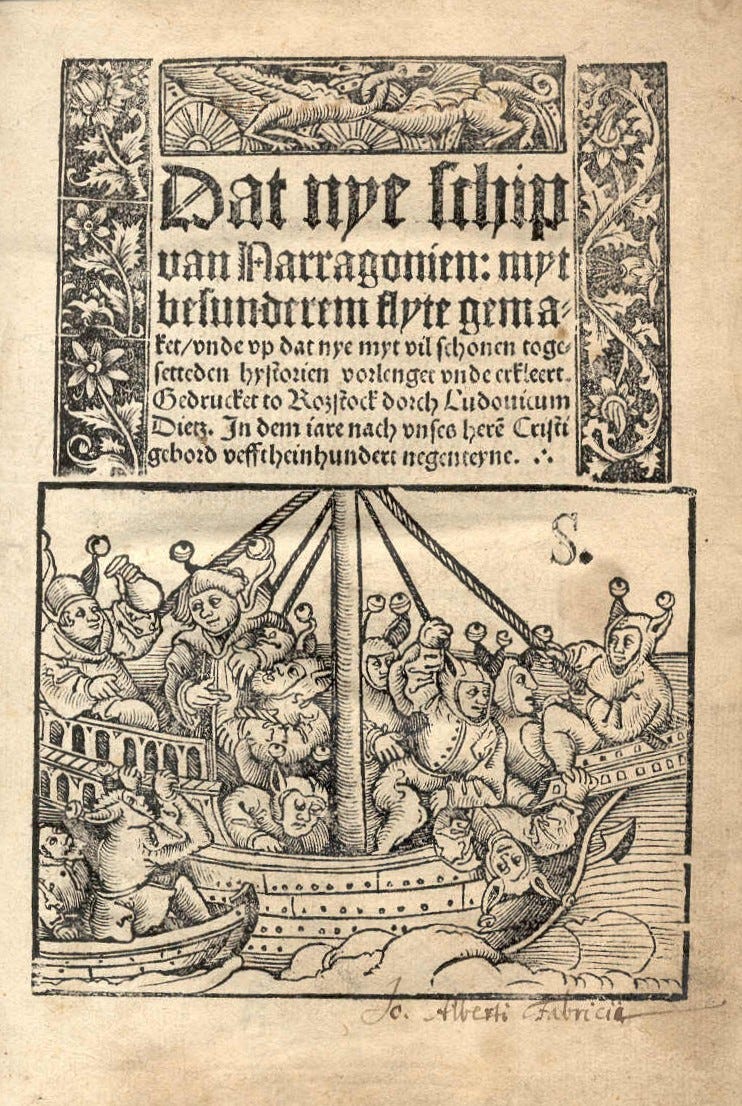
The 1519 title page of Sebastian Brant‘s 1494 satirical book Ship of Fools
I began life as a medievalist and often find myself instinctively going back to old texts when contemplating today’s problems. I have been forced to think much in recent days about the incompetence of our current governing class in respect of their understanding of defence and its value. More especially, their failure to understand how to use the military instruments of defence to uphold our national interest. The Ship of Fools, which first appeared in Plato’s Republic but was resurrected in Europe in the late 1400s as a metaphor for desperately poor leadership, is the perfect allegory for me. It tells a simple story that resonates with thoughtful people in every age who look on in wonderment at the idiots governing them. The story is of a ship with a crew who talk (and drink) a lot, but with their cloth ears make all the wrong decisions. The result is chaos. In the 1480s the ship in question was the Church of Rome, but the allegory is easily transportable to Britain in the early days of 2026. What on earth is going on in defence in the UK as we enter 2026? I can only surmise that in the UK at least, we are in a ship governed by fools.
I was going to start this piece by complaining that our government simply doesn’t understand Clausewitz, but I thought that this might be a little too obtuse for most politicians. But one of Clausewitz’s points about the use of military power is pertinent to our age. When Napoleon invaded Russia in 1812 he did so not because he had an existential hatred of Slavs, or of the Tsar. Indeed, Napoleon and Tsar Alexander I had a remarkably friendly relationship. He did it because the practice of friendly diplomacy between the two leaders had failed. Napoleon had attempted to persuade the Tsar to refuse the British trading rights in Russia’s ports. Alexander I had demurred, so Napoleon considered that the only thing left to him in his tool kit of levers to persuade Alexander to change his mind, was force. So, he marched on Moscow. We know the story and its outcome well, so I won’t rehearse it now. Using this as an example, Clausewitz was simply saying that in the hurly burly of diplomacy, war is one of the tools available to a national leader to persuade an opponent to change course. Hence, we get the oft misquoted Clausewitzian maxim that “War is the continuation of policy with other means”.
Clausewitz was correct, of course. Yet we in Britain have forgotten this, if politicians over the past three decades have really understood it. Since 1990 I am not sure we’ve had any politicians who’ve truly understood it, despite the fine words we get from successive Secretaries of State about the first priority of government being to protect its citizens, etc. This, without action to demonstrate any understanding of how to achieve the protection of our citizens, is merely St Paul’s clanging cymbal. Put frankly, we no longer have an Army, Navy or Air Force able seriously to achieve any form of influence on the European stage — let alone deter an enemy or fight a serious war — and the state of the Continuous At Sea Deterrent (CASD) is abysmal I’m told, though you wouldn’t know this from the hollow rhetoric regularly emanating from No 10. We are deluding ourselves if we think we can exercise real influence in Europe or anywhere else for that matter if we don’t have the practical means to do so.
The truth is that the cupboard is bare.
How have we got to where we are? The primary reason over the years has been the saving of money for politicians who have simply not valued investment in the hard practice of defence, unless it is in a shipyard in their constituency. The end of the Iron Curtain in 1989/90 meant, to many people in the corridors of power, that we no longer needed to bear the burden of spending 5% of GDP on defence.
But a second problem is only becoming clear to me. I hope I am wrong, but I can only conclude that we now have a government that actively hates the idea of defence, and while it will never admit it, is determined to remove it as one of its levers or instruments of power. I came across this in a meeting recently. Why do we need defence, the argument seemed to go, when we should be encouraging the international community to regulate itself by means of adherence to international laws and norms of behaviour? Should not our effort as a country be in building up these international systems and structures of law and governance (many based on the United Nations as an idea and a regulator) and rely on these to reduce the potentiality for war? Surely, building up arms simply makes war more likely, not less?
Update, 4 January: Welcome, Instapundit readers! Please do have a look around at some of my other posts you may find of interest. I send out a daily summary of posts here through my Substack – https://substack.com/@nicholasrusson that you can subscribe to if you’d like to be informed of new posts in the future.
Penelope vs Clytemnestra in Greek Mythology
MoAn Inc.
Published 10 Sept 2025I’m trying out shorter videos on the channel, so this is a very basic breakdown explanation. Clytemnestra and Penelope are polar opposites, and their characters bookend The Odyssey. One is seen as the best wife, one is seen as the worst. They’re supposed to be compared and contrasted in this way: Agamemnon’s homecoming to Mycenae is a warning to Odysseus about what could potentially go very, very wrong with his own return to Ithaca. There are so many fascinating ways to dissect these two women, so please don’t take this as a be-all-end-all!
Voice of Erica Stevenson, host of MoAn Inc.
(more…)
QotD: “Fumbling towards bicameralism”
And yet, “self-deception” shouldn’t be possible. How can you lie to your self? It raises all kinds of heavy epistemological issues, explored in a fun little book called Self-Deception by philosopher Herbert Fingarette. As I recall (it has been years since I’ve read it), Fingarette ends up advancing a kind of split-consciousness theory, too, as the only internally consistent one. How could it be otherwise? The “liar’s paradox” is a fun little game to play in the first class meeting of Logic 101, but nobody can really live that way … and yet we do deceive ourselves, all the time, and no one more than SJWs, whose lives indeed seem to be nothing but “self-deception.”
Bicamerality explains that. The “god” that lives in the smartphone says X today, so X it is. That same “god” says not-X tomorrow, so now it’s not-X! It’s not self-contradiction, it’s not self-deception, for the simple reason that there’s no real “self” at all.
Finally, it explains what might be the most frustrating thing about the Left, the thing that’s likely to end in a nuke or two here before too long: Their utter inability to see the glaringly obvious consequences of their actions. Those of us who tend to see “Leftism” as a big conspiracy love to point out that if they, the Left, were just stupid (childish, contrarian, herd animals, whatever), cold impersonal chance alone would guarantee that at least some of their fuckups would benefit us at least some of the time. Much like The Media’s “retractions” and “admissions” and so on, the “mistakes” always always always go in only one direction … ergo, they’re not mistakes.
That’s the reef on which we “emergent behavior” types always crash. To me, “emergent behavior” still seems like the best explanation … but however the behavior emerges, it’s always retarded. They’ve never made a non-stupid decision, not once, and it’s always stupid in exactly the same way. I remember waking up one morning to the sound of something crashing into my bedroom window. I figured it was a bird, which happens all the time, and it was … except that it kept happening, monotonously, every fifteen seconds or so. I got up to look, and here was a robin, smashing itself into the glass over and over and over again. It was early spring — mating season — and this stupid robin had mistaken its own reflection for a rival. I must’ve watched this bird slam himself into the glass for ten minutes, “attacking” his “rival”, before he knocked himself out cold …
That’s how the Left do. Always. They simply can’t learn, and they can’t change their pattern. The only explanation for that, therefore, must be that it’s programmed. Literally. Zero consciousness involved. They do what they do because they literally cannot do otherwise. Their “god” has put “rage” into their thumos. Just as Achilles would’ve literally jumped off a cliff had his “god” told him to, so the Left does … well, pretty much everything their teevee tells them to.
Needless to say, this has some important implications for practical action. How does one “get inside that OODA loop”, as the keyboard commandos like to say? In the land of the utterly unconscious, the one-brained man is king …
Severian, “Striving Towards Bicamerality”, Founding Questions, 2022-03-20.
Update, 4 January: Welcome, Instapundit readers! Please do have a look around at some of my other posts you may find of interest. I send out a daily summary of posts here through my Substack – https://substack.com/@nicholasrusson that you can subscribe to if you’d like to be informed of new posts in the future.


