
World War Two
Published 2 Nov 2024May 1930 brings political upheaval to the Weimar Republic, with the French deciding to leave the Rhineland, violent clashes between Communists and Nazis, and a surprising alliance that dissolves Saxony’s government. See how these events unfold and shape Germany’s current political landscape.
(more…)
November 3, 2024
Unholy Alliance topples Saxony – Rise of Hitler 05, May 1930
Comments Off on Unholy Alliance topples Saxony – Rise of Hitler 05, May 1930
Kemi Badenoch replaces Rishi Sunak as UK Conservative leader
In the National Post, Michael Murphy discusses the new British Tory leader and why she could be a viable challenger to Two-tier Keir’s Labour government:
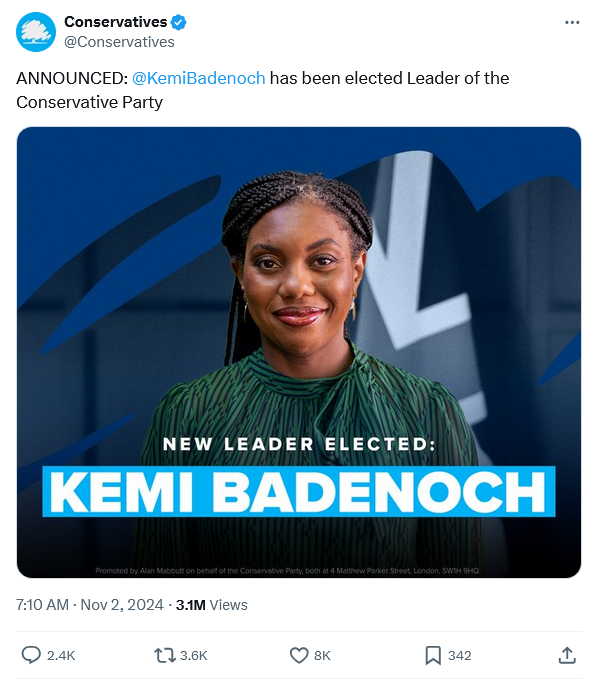
… in July, the Tories were ousted by Labour after 14 years in power, limping on with only 121 seats in the 650 seat House of Commons. But the honeymoon period for Sir Keir Starmer’s Labour government ended almost immediately, as its popularity plummeted faster than that of any administration in recent memory. This has made the Tories interesting once again at precisely the moment when they’ve chosen a new leader: Kemi Badenoch.
The Nigerian-raised mother of three, elected today to lead the Conservative party, threatens to be kryptonite for a Labour party wedded to identity politics. A black, female immigrant at the dispatch box is apt to leave Labour frontbenchers — particularly Sir Keir, a one-time BLM kneeler — somewhat stumped. To make matters worse, Badenoch is a persuasive speaker, commanding a charisma and eloquence that Sir Keir — a dull, po-faced lawyer — does not possess.
These qualities have given Badenoch cross-party appeal within the Tories, rallying endorsements from both the left and right. By endorsing her, however, the party has effectively signed a blank cheque, as Badenoch, unlike her opponents, has made few specific pledges. She has chosen instead to reflect on the election loss and the party’s ideological roots; she is prepared to play the long game, hoping this will allow the Tories to “earn back trust”.
On some issues, though, Badenoch is clear. “The government is doing far too much and it is not doing any of it well — and it is growing and growing,” she declared recently. “The state is too big; we need to make sure there is more personal responsibility.” These ideas are common fare among Conservatives, especially in bloated welfare states like Britain — but her zeal for them evokes, for many, memories of Margaret Thatcher. As the political commentator Simon Heffer wrote, “Mrs Badenoch is the politician who most reminds me of Mrs Thatcher since I last saw Mrs Thatcher”. He noted both women’s hard-mindedness, “deep principles”, and grasp of the “art of the possible”.
Badenoch’s Conservatism can be traced, as the writer Tom Mctague has argued elsewhere, to her beginnings in Africa. Having fled Nigeria during a 1996 military coup, she has a keen, outsider’s appreciation for Britain’s core ideals — not least the rule of law and policing by consent. She is therefore a champion of Britain, of both “the good” and “bad” of its former empire, at a time when it is fashionable to denigrate it, precisely because of her first hand experience that these norms are rare and fragile.
Like Thatcher, Badenoch studied a hard science (computing), marking them out in a Parliament filled with lawyers and humanities graduates. And the swift rise of both women, from modest beginnings through the ranks of the Conservative party, suggests that the “art of the possible” is indeed etched into their stars.
The Armchair General has a few suggestions for Badenoch’s agenda to turn the British economy around:

The new leader of the Conservative Party (image: www.kemibadenoch.org.uk)
My one reservation [about Badenoch] was that, being a software engineer, instead of espousing liberty or slashing laws and regulations, Kemi might reach for more tinkering technocratic solutions — and your humble General is surely not alone in his opinion that we have had quite enough, thank you, of technocratic governments.
However, the more that I consider the severe problems that afflict this country, the more I believe that a process-driven leader, who can focus on the details, might make the biggest difference in the short to medium term.
The immigration issue
As we know, uncontrolled immigration has seized the public imagination greatly — and, indeed, Jenrick centred his campaign around leaving the European Convention on Human Rights (ECHR). We should almost certainly do this anyway — simply because, like the Americans, we should refuse to sign any treaties that raises foreign courts above our own Parliament.
But leaving that aside, the stated problems with mass immigration can largely be divided into two halves:
- cultural differences — these are not insignificant, and it is claimed that they lead to an increase in crime (especially sexual crimes) and an undermining of our high-trust society;
- economic issues — the evidence shows that a massive net influx of low-skilled immigrants depresses wages at the lower end, puts a strain on public services (which cannot expand swiftly enough to accommodate the increase in demand), raises the demand for houses (of which there is a shortage) and thus pushes up prices, and, ultimately, only increases nominal GDP whilst per capita GDP has barely shifted in a decade and a half.
For the purposes of this post, I shall address only the latter issue; given where we are right now, the former is a much thornier problem — at least politically — and probably cannot be solved without radical (and some might say “authoritarian”) action.
The second problem is easier to solve because it is caused, essentially, by the single biggest drag on our economy — our planning system.
[…]
Planning: the Conservatives’ political agenda
The core of the new Conservative manifesto must be a growth agenda; it needs to set out the following core principles:
- if we carry on the current trajectory, the British government will be effectively bankrupt in the next 50 years — so something needs to change;
- therefore, in order to pay for all the goodies that we have promised ourselves (now and in the future), we need to massively accelerate economic growth;
- unless we can build the roads, railways, power stations, research labs, data centres, and homes that we need, then our economy will not grow at the required rate — and spending will need to be cut to the bone;
- given the above, the only way to grow is to reform planning laws;
- removing the barriers to building will lead to greater investment, lower energy prices (leading to even greater investment), greater social mobility, regeneration of all the regions (so-called “levelling up”), and vast increases in per capita GDP;
- where the state invests in infrastructure, then it will cost considerably less than it does currently — meaning that not only will those projects undertaken provide more value for money, but also that many more projects will be viable;
- this prosperity and increased mobility will remove even the perceived need for immigrants to perform low-wage jobs (including in our public services), and remove the economic pressures of those that we have already taken in;1
- if we do it right, then we will also be able to cut taxes without drastically cutting the size of the state.2
The argument needs to be as stark and inevitable as that.
What this means is that the Conservatives need not stand on a platform of slashing state spending — thus addressing the huge numbers of people in this country who, incredibly, still believe in the benevolent state.
Except for one caveat, there really is no downside to adopting Foundations [discussed here], in full, as the core of the next Conservative manifesto (although it should not be the full extent of said manifesto — there are many other areas that need to be addressed, which I shall write about later).
1. As I say, the cultural issues are for another time.
2. Obviously, as a classical liberal, I believe that the size of the state should be drastically cut — but this is not a popular argument in a country that has been raised and educated on socialist doctrine for decades.
Comments Off on Kemi Badenoch replaces Rishi Sunak as UK Conservative leader
Ancient Sparta Historian Breaks Down 300 Movie | Deep Dives
History Hit
Published Jul 8, 2024Ancient Greek historian Roel Konijnendijk takes a deep dive into the historical accuracy of one of the most iconic and ridiculous depictions of the Spartans – 300 (2006).
00:00 Introduction
00:33 Spartan Society and Customs
02:34 Xerxes’ Messenger
06:56 The Ephors, the Oracle and the Carneia
10:30 The 300
15:39 The Persian Fleet
16:14 Thermopylae, the “Hot Gates”
17:17 Spartan Battle Technique
19:12 The Persian Army
24:42 Xerxes
28:28 Ephialtes
32:01 Dilios – Why Did the Spartans Stay?
34:18 The Final Stand
38:44 Aftermath of Thermopylae and Delios
40:53 Movie Quotes: Fact or Fiction?
(more…)
Comments Off on Ancient Sparta Historian Breaks Down 300 Movie | Deep Dives
QotD: Minutemen
Ten years ago, America’s right-wing paramilitaries were so anti-government, they thought that driver’s licenses were an unbearable infringement on their liberties. Now they’re out on the border HELPING THE FEDS ENFORCE THEIR REGULATIONS. What the hell’s up with that?
Granted, there’s not necessarily much overlap between the two groups. But one has supplanted the other in the mass media, the public imagination, and the affection of the right-wing radio hosts — and so help me, I think I miss the days when I felt a certain kinship with the crazies.
Jesse Walker, “More ’90s Nostalgia”, Hit and Run, 2005-07-28.
Comments Off on QotD: Minutemen
November 2, 2024
Maxime Bernier on Canada’s immigration crisis
This article has been posted at the Telegraph in the UK and mailed out by the PPC here in Canada, so I guess it’s okay to share it here:
Newsflash: Canada is in the process of falling apart.
No, it’s not because Quebec is once again threatening to hold a referendum on separation, although this may happen again in the coming years.
Our country is experiencing a series of crises because of the deliberate policy of mass immigration instigated by Justin Trudeau’s Liberal government soon after its election in 2015.
Last year, Canada’s population increased by almost 1.3 million people, or 3.2 per cent. This was the fastest annual population growth rate since the post-war years. The difference however is that this was not caused by a baby boom, since 97 per cent of the growth was due to international migration, mostly from Asia and Africa.
This includes not only immigrants per se – or “permanent residents” – but also so-called temporary foreign workers, foreign students, and asylum seekers. Although supposed to be temporary, the last categories have in fact become pathways to seek permanent residency.
Because of this, housing in Canada has now become completely unaffordable. Young couples who want to have children just cannot afford to buy a home with a nice backyard where they can raise them any more, with the result that our birth rate has dropped dramatically.
Our hospitals, social services, and infrastructures are being overburdened by this massive demographic tsunami.
Immigration is often justified by its supposed positive impact on the economy. But productivity and wages have been stagnant for a decade in Canada, as cheap immigrant labour is favoured by employers over capital investment and automation.
Canadian politics has been mired for months in scandals over foreign interference, in particular China and India. India has been the largest source of immigrants to Canada for several years. Last week, Canada and India expelled diplomats over allegations by the Trudeau government that Indian diplomats have been involved in attacks against Khalistani militants in our country, including the murder last year of one that India considers a terrorist.
Because of mass immigration, Canadian politics is more and more focused not on actual Canadian issues, but on ethnic, religious, and foreign issues and wars, with establishment politicians spending an extraordinary amount of time courting the votes of minority ethnic groups in suburban marginal ridings.
The third most important national party, the New Democratic Party that has kept the Trudeau minority government in power, is headed by Jagmeet Singh. A Sikh by background, he initially declined to condemn Talwinder Singh Parmar, the mastermind responsible for the 1985 bombing of an Air India plane in which hundreds of Canadians were killed. However Singh did change his stance when a Canadian inquiry concluded that Parmar was definitely behind the outrage.
For his part, the leader of the Conservative Party and very likely our next prime minister, Pierre Poilievre, is known for donning national or religious dress as he panders to members of various communities.
In 2018, as a then Conservative Member of Parliament, I posted a series of tweets that denounced what I called Trudeau’s “cult of diversity” which, I contended, would lead to the Balkanisation of Canadian society, and potentially to violence.
Almost daily scenes of Muslims attacking Jewish institutions, Sikhs burning the Indian flag, and Ethiopian factions fighting each other in the streets of our cities, have proven me right.
Publicly attacking these woke dogmas wasn’t allowed at the time in Canada though, and it provoked a huge outcry. Even my leader and colleagues in the Conservative Party denounced me, which led me to resign and launch a populist right-wing party which is broadly the Canadian equivalent of Nigel Farage’s Reform Party.
If you believe that more diversity is always good and always enriches your society, then it’s logical and inevitable that you will end up importing lots of people with incompatible values and attitudes from around the world, including religious fanatics and even terrorists, who can’t possibly integrate in a country with a European, secular Christian heritage.
That’s what we’ve been doing for years, and that’s why everything that historically made Canada what it was is rapidly being destroyed. I know there has been a similar trend in the UK and other European countries, but Canada went way further down this road.
Canada’s demise started when what was already a very diverse country (with Indigenous, French and British founding peoples, and many different regional cultures) fell for this radical version of multiculturalism instead of tempering it with a focus on shared values and attitudes, pride in our history, and in the achievements of Western civilisation.
Now, not only are our democratic institutions, our economy, and our social peace and cohesion, falling apart, but so are our very identity and reason to exist as a country.
All these trends are so overwhelming that, unable to deny the reality any more, the Trudeau government finally announced last week that they would be gradually lowering their immigration targets in the coming years instead of continuing to increase them.
Although this is a massive U-turn for this government, it is far from being a sufficient reduction, and a lot more will need to be done to repair the damage. Otherwise, I don’t believe Canada will survive the 21st century.
Comments Off on Maxime Bernier on Canada’s immigration crisis
I’m only buying tools HERE
Rex Krueger
Published 1 Nov 2024The new platform for buying and selling woodworking tools.
Use the code: STARTNOW to save $5 off ANY first purchase.
To celebrate our launch, we’re running No Fee November! For the entire month of November, sell unlimited tools. NO MARKETPLACE FEES!
Comments Off on I’m only buying tools HERE
The mirage of Trudeau’s mediagenic gun control efforts
To hear the Prime Minister talk about his gun control strategy, it’s been a stunning success. Many police chiefs’ responses thoroughly denounce this as, at best, self-serving spin:

As police unions pillory federal gun bans for doing nothing to address skyrocketing gun crime, an Ontario police department revealed this week that virtually all its crime guns are now illegal imports from the United States.
“Approximately 90 per cent of (the) firearms that we seize are directly traced back to the U.S. And I can say in reality the remaining 10 per cent are likely also from the U.S.,” Peel Regional Police Chief Nishan Duraiappah said at a Monday press conference. The 10 per cent referred to guns that have been modified or had their serial numbers removed, making them harder to trace.
Duraiappah was announcing the results of Project Sledgehammer, the breakup of a gun smuggling ring that included the seizure of a shipment of so-called “giggle switches” — black market devices that can turn a regular handgun into an automatic machine pistol.
But during the press conference, police revealed that both gun crime — and the number of illegal guns in the community — is unlike anything they’ve ever seen.
The Peel Regional Police cover an area immediately to the west of Toronto that includes Mississauga and Brampton. Duraiappah said that only 10 years ago, if a criminal in the Peel Region wanted an illegal gun, “it was doable, but it required a lot of work.”
Now, Peel Police are seizing an illegal gun about once every 30 hours — an 87 per cent increase over the year prior. Illegal guns are now so ubiquitous that they often show up in unrelated investigations, such as an impaired driver having one in his glove compartment.
“The availability of firearms has just saturated the community,” said Duraiappah.
This has all occurred in tandem with a nationwide spike in gun crime, including fatal shootings.
Earlier this year, Statistics Canada published 2022 data showing that “firearm-related violent crime” was at the highest rate recorded since they started tracking it in 2009.
Comments Off on The mirage of Trudeau’s mediagenic gun control efforts
The Short SA.4 Sperrin; Britain’s Back-Up, Back-up Nuclear Bomber
Ed Nash’s Military Matters
Published Jul 9, 2024No, I have no idea how you pronounce “Gyron”.
Comments Off on The Short SA.4 Sperrin; Britain’s Back-Up, Back-up Nuclear Bomber
QotD: UBI discourages low-income workers
Earlier this month, a cross-border team of North American economists published the results of a landmark study, probably the best and most careful yet done, of how low-income workers respond to an unconditional guaranteed income. Not so long ago this would have been a plus-sized news item in narcissistic Canada, for the lead author of the study is a rising economics star at the University of Toronto, Eva Vivalt. The economists, working through non-profit groups, recruited 3,000 people below a certain income cutoff in the suburbs of Dallas and Chicago. A thousand of these, chosen at random, were given a thousand dollars a month for three years. The rest were assigned to a control group that got just $50 a month, plus small extra amounts to encourage them to stay with the study and fill in questionnaires.
That randomization is an important source of credibility, and the study has several other impressive methodological bona fides. If you have an envelope to scribble on the back of, you can see that the payments alone were beyond the wildest dreams of most social science: most of the money was provided by the AI billionaire Sam Altman. But the study also had help from state governments, who agreed to forgo welfare clawbacks from the participants to make sure the observed effects weren’t obscured by local circumstances. Participant households were also screened carefully to make sure nobody in them was already receiving disability insurance. (Free money doesn’t discourage work among people who can’t work — or who absolutely won’t.) And the study combined questionnaire data with both smartphone tracking and state administrative records, yielding an unusually strong ability to answer difficult behavioural questions.
The big picture shows that the free cash — a “universal basic income” (UBI) for a small group of individuals — discouraged paying work, even though everybody in the study was starting out poor. Labour market participation among the recipients fell by two percentage points, even though the study period was limited to three years, and the earned incomes of those getting the cheques declined by $1,500 a year on average. There is no indication that the cash recipients used their augmented bargaining power to find better jobs, and no indication of “significant effects on investments in human capital”, i.e., training and education. The largest change in time use in the experiment group was — wait for it! — “time spent on leisure”.
Colby Cosh, “Universal basic income is a recipe for fiscal suicide (for so many reasons)”, National Post, 2024-07-30.
Comments Off on QotD: UBI discourages low-income workers
November 1, 2024
Canada – 30 protectionist marketing boards wrapped in a flag
In The Line, Greg Quinn points out just how blatantly hypocritical Canada’s politicians and diplomats are in any discussion with other nations when the subject turns to free trade:

Let me say this upfront, and clearly: when it comes to international trade, Canada is protectionist to an astonishing degree whilst at the same time claiming it is a supporter of global free trade. It wants every other country to open up (and complains when they don’t, or when they stand their ground) whilst ensuring access to the Canadian market is more difficult. This is a result of federal policy, inter-provincial restrictions, and vested interests. And it is flagrantly hypocritical.
When it comes to dairy, beef and the mutual recognition of professional qualifications, for example, Canada’s claim to openness is simply a lie. Agricultural groups and businesses dominate and control the local landscape and attempts to either overcome that (or bring external companies in) have failed on many occasions over the years. This could well get worse if the Liberals agree to what the Bloc Québécois has demanded — even more dairy protections — in a desperate attempt to remain in power for a little while longer.
Some of these issues are well known to Canadians — particularly the domestic ones, or the ones that touch on national unity frictions. But I’m not sure Canadians understand how this is perceived globally, including by Canada’s allies. Readers may recall that there was a mild furore a while back when the U.K. dared to pause trade negotiations as Canada refused to move on access for British cheese. There were accusations of the U.K. not playing fair and such like.
It’s bad enough that we “protect” Canadians from lower-priced foreign food, but we even manage to maintain inter-provincial trade barriers that directly harm all Canadian consumers:
Then we have interprovincial trade barriers. According to the Business Council of Alberta in a 2021 report, these barriers are tantamount to a 6.9 per cent tariff on Canadian goods. They also noted that removal of these could boost Canada’s GDP by some 3.8 per cent (or C$80 billion), increase average wages by some C$1,800 per person, and increase government revenues for social programming by some 4.4 per cent.These barriers hinder internal trade between the provinces, including the work of those companies that import goods from other countries.
A freer market, at home or globally, would not solve all the issues that exist with prices, but it would certainly increase competition and give consumers more choice. What exists at the minute is a pretense of choice.
Opening up the Canadian market would certainly benefit other countries, including my own United Kingdom, and there would be some impact on local business and producers. This is true, and acknowledged. But opening itself up to more global trade and dismantling internal trade barriers — and these are things all the politicians insist they like the sound of in theory — would be a win-win for Canadian consumers and Canadian society as a whole. Some big companies and carefully coddled special interests would be upset, but they aren’t supposed to be the ones making decisions in a democracy, or in a free market.
Comments Off on Canada – 30 protectionist marketing boards wrapped in a flag
“[H]er plan will mean the obliteration of your savings, the end of banks and even the destruction of ‘money as we know it'”
It’s astonishing how many highly placed bureaucrats, NGO functionaries, and the very, very wealthy are super gung-ho for reducing the rest of us to the status (and living conditions) of medieval serfs:



This week, VW announced plans to cut tens of thousands of jobs and to close three factories. That is a very big deal, because they have never closed a single German factory before. I try to avoid economic topics, but this story is so much bigger than economics. As Daniel Gräber wrote in Cicero last month, “the VW crisis has become a symbol for the decline of our entire country“.
The Green leftoid establishment are eagerly blaming management for these failures, which is on the one hand not entirely wrong, but on the other hand not nearly an absolution. The German state of Lower Saxony holds a 20% stake in Volkswagen, and so they also manage the company. Recently, in a fit of virtue, they placed a Green politician – Julia Willie Hamburg – on its supervisory board. Hamburg does not even own a car and has used her position to argue that Volkswagen should regard itself not as an automobile manufacturer but as a “mobility services provider” and shift its focus away from “individual transport”.
The absurdly named Julia Willie Hamburg is merely symptomatic of a broader phenomenon. Germany has succumbed to political forces that have nothing but indifference and disdain for the industries that have made us prosperous. Our sitting Economics Minister, Robert Habeck, gave an interview to taz in 2011 in which he said that “fewer cars will not lead to less economic growth, but to new industries”, and attacked “the old growth theory, based on gross domestic product“. And behind Green politicians like Habeck are even more radical forces, like Ulrike Herrmann, the editor of taz, for many years a member of the Green Party and also an open advocate of wide-scale deindustrialisation. Because I am going to quote Herrmann saying some very crazy things, you need to know that she is in no way a fringe figure. She appears regularly on all the respectable evening talkshows and every politically informed person in the Federal Republic knows who she is.
Herrmann has outlined her political views in various books like The End of Capitalism: Why Growth and Climate Protection Are Not Compatible – and How We Will Live in the Future. From these monographs, we learn that Herrmann sees climatism as a means of imposing a centrally planned economy in which we will own nothing and be happy. Happily, Herrmann also talks a lot, and in her various speeches and interviews she states her vision for decarbonising Germany in very radical terms. I am grateful to this twitter user for highlighting typical remarks that Herrmann delivered in April of this year before a sympathetic audience of climate lunatics.
There, Herrmann elaborated on her vision for a future economy in which all major goods would have to be rationed:
Talking about rationing: It’s clear that if we shrink economically, we won’t have to be as poor as the British were in 1939; rather, we’d have to be as rich as the West Germans were in 1978. That is a huge difference, because we can take advantage of all the growth of the post-war period and the entire economic miracle.
The central elements of the economy would have to be rationed. First of all, living space, because cement emits endless amounts of CO2. Actually, new construction would have to be banned outright and living space rationed to 50 square metres per capita. That should actually be enough for everyone. Then meat would have to be rationed, because meat production emits enormous amounts of CO2. You don’t have to become a vegetarian, but you’ll have to eat a lot less meat.
Then train travel has to be rationed. So this idea, which many people also have – “so okay then I don’t have a car but then I always travel on the Intercity Express trains” – that won’t work either, because of course air resistance increases with speed. Yes, it’s all totally insane. Trains won’t be allowed to travel faster than 100 kilometres per hour, but you can still travel around locally quite a lot. This is all in my book, okay? But I didn’t expand on it there because I didn’t want to scare all the readers.
At this point Herrmann begins to cackle manically, ecstatic at the thought that millions of Germans will be stuck riding rationed kilometres on slow local public transit.

Comments Off on “[H]er plan will mean the obliteration of your savings, the end of banks and even the destruction of ‘money as we know it'”
End of typical US political discussion – “I can’t even talk to you about this stuff — you’re so irrational!”
Chris Bray on the widespread phenomenon of progressives who “can’t even” their way out of political discussions that don’t confirm their priors:
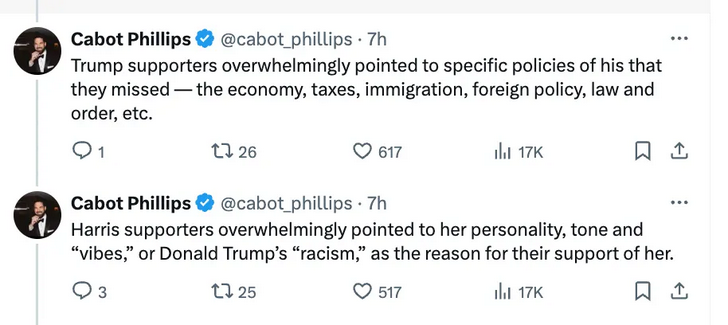
In a long thread on his many discussions over the last year with Trump and Harris supporters, a Daily Wire editor drops this contrast down in the middle:
I live in a deep blue zone, and I have these vibes-and-racism conversations several times a week. I learned today, face-to-face, that Donald Trump hates everyone who isn’t white. I mean, he despises them. All of them. These conversations go like this:
A: Trump is SUCH a fucking racist, man, he hates everyone who isn’t white, how can you even support someone like that?
B: Why is he racist?
A: Are you being serious right now? C’mon, man!
B: No, but why is he racist?
A: I can’t believe you’re defending him!
B: Okay, look: Donald Trump has already been the president for four years. What would you say were the top three racist policies he implemented?
A: You know what, I’m done with this discussion.
B: I’d settle for one really good one. What big racist policy did he implement?
A: I can’t even talk to you about this stuff — you’re so irrational!
Over and over and over and over again, these conversations hit the “I can’t even talk to you about this stuff” moment, the hard shutdown.
- What evidence can you offer for that view?
- [cognitive program shuts down]
Certain trigger terms warn you that the shutdown is moments away: conspiracy theory, disinformation, “what are you even talking about?” This personal observation about social interaction applies equally well to CNN panel discussions, by the way.
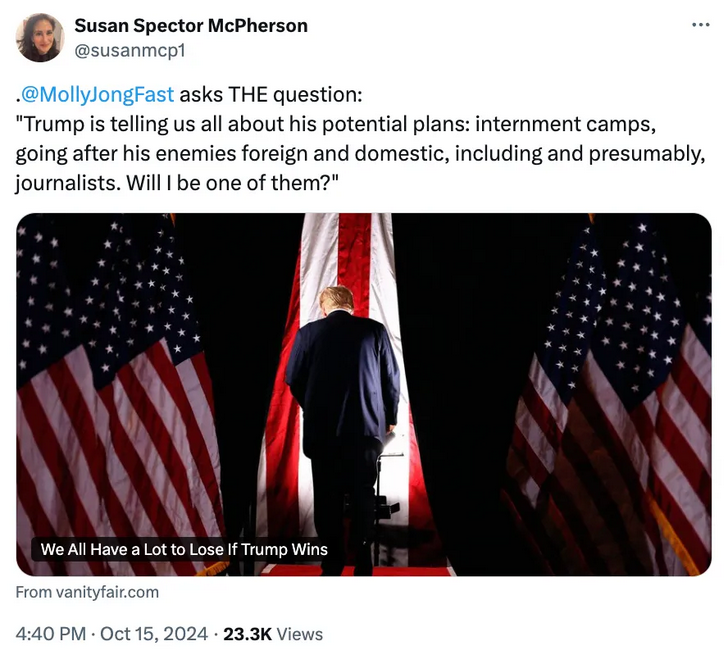
I’ve written before that I had a conversation just after the 2016 election in which I was asked how I could support someone who was going to put my own friends and family in the camps, man, he’s gonna put us in the fucking camps!
Eight years later, and after four years of a Trump presidency in which no one went to the camps, Trump can’t be allowed to return to the White House because, guess what, he’ll send us all to the camps:
FN M249S semiauto for military collectors
Forgotten Weapons
Published Jul 10, 2024In 2015, FN USA introduced a Military Collector product line — semiautomatic versions of their military contract small arms. These were the M4, M16, and — most interestingly — the M249 SAW. The SAW is a version of FN’s Minimi light machine gun, developed in 1974 and adopted by the US in 1982. The semiauto version, designated M249S, is exactly the same as the military M249 but adapted to fire from a closed bolt in semiautomatic only, making it a non-NFA item like any other semiautomatic rifle. The semiauto conversion as done by essentially chopping off the back of the bolt carrier to act as a linear hammer, thus allowing the use of the original style of trigger mechanism. Since its introduction in 2016, FN USA has made more than 10,000 of these rifles, truly proving the depth of American collector interest in this sort of thing (much to the surprise of the Belgian FN administration …).
(more…)
Comments Off on FN M249S semiauto for military collectors
QotD: J.D. Vance, a Führer for the rest of us
Expert: JD Vance’s selection as Trump’s running mate marks the end of Republican conservatism
Quoted for the lulz. Ol’ JD, a Führer for the rest of us.
But since we’re here … a fascinating footnote in Jaynes informs us that schizophrenics, who Jaynes thinks might be throwbacks to the “bicameral mind”, have no problem with “diffused identity” or whatever the term was. Jaynes hypothesizes that ancient, preconscious peoples didn’t see images of their gods in cult objects; they saw the actual, physical gods. We unicameral people can’t wrap our heads around it, since there are lots of statues and they can’t ALL be god — even if we grant that the biggest statue in the best temple can be god, or if we allow that the black meteorite or whatever is really god to them, still, god can’t be diffused like that: Either your statue is god or mine is; or neither of them are, but they can’t both be.
Schizophrenics, at least according to Jaynes, would be down with that. He notes that you can put two guys who think they’re Napoleon in the same padded cell, and you don’t get a schizo bum fight, you get complete agreement: They’re both Napoleon, somehow. The law of the excluded middle, personal identity version, simply doesn’t apply.
And since my hypothesis is that smartphones are re-decameralizing (it’s a word) us at Ludicrous Speed, well … here you go. Donald Trump is Hitler, but J.D. Vance is somehow also Hitler. It’s not like the real, historical Hitler lacked for shitty, evil underlings — J.D could easily be Heinrich Himmler or somebody. But no, he’s gotta be Hitler, the same way Trump has to be Hitler, and if that means they’re somehow both Hitler, well … there it is. Bicamerality for the win.
Severian, “Catching Up With the Crazies”, Founding Questions, 2024-07-29.
Comments Off on QotD: J.D. Vance, a Führer for the rest of us
October 31, 2024
The US federal election goes into garbage time
Lauren Smith on the latest attempt by Joe Biden to suck the oxygen out of the room (Kamala Harris was also speaking while Biden’s “gaffe” grabbed the media’s full attention):
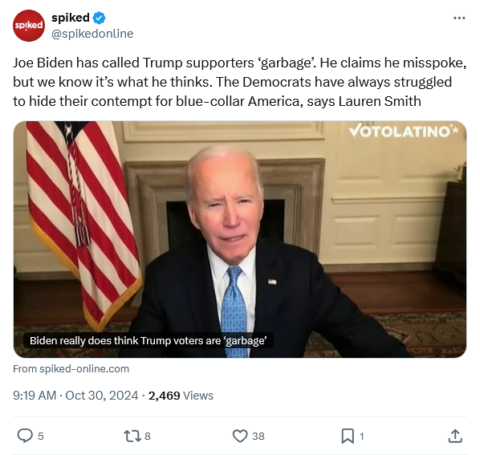
US president Joe Biden has re-emerged from wherever he was being hidden to hand Donald Trump an incredible, accidental boost. In a rare public appearance, he branded Trump’s supporters “garbage“.
For some reason, the president decided to wade into the row over a joke made by comedian Tony Hinchcliffe at a Trump rally in Madison Square Garden last weekend. Hinchcliffe described Puerto Rico as a “floating island of garbage”, sparking some confected outrage among those pretending not to know he was joking. In response, while speaking to Hispanic advocacy group Voto Latino, Biden said: “The only garbage I see floating out here is [Trump’s] supporters”.
The Republicans have understandably seized on the remark. Trump’s running mate, JD Vance, slammed it as “disgusting”. Florida senator Marco Rubio repeated the smear to Trump supporters at a rally in Allentown, Pennsylvania last night, to furious boos from the crowd.
The White House then rushed to try to retract the comments. Today, in a statement on X, Biden claimed that he was actually talking about the “hateful rhetoric” being “spewed” at the rally, not about Trump’s supporters themselves. That, he says, is “all I meant to say”.
But that is plainly not what he said. And everyone can guess it’s probably not what he meant, either. As Trump pointed out at the Allentown rally yesterday, Biden’s “garbage” gaffe is highly reminiscent of Hillary Clinton’s infamous “deplorables” outburst. During her 2016 presidential campaign, she described “half” of Trump’s supporters as “racist, sexist, xenophobic, Islamophobic”, saying they all belonged in a “basket of deplorables”. It was a blunder that many, including Clinton herself, believe cost her the election.
Jim Treacher investigates what he calls “the Case of the Planted Apostrophe” as the bulk of the legacy media rallied to try to cover up, mitigate, or explain away Biden’s “garbage” comment:
I think I heard something about MSNBC intercutting footage from the ’39 rally with the Trump rally? I haven’t watched that network since they fired Olbermann, but it sounds like something they’d do.
Little did they all know what a gift they were about to be handed. One of the speakers at the rally was comedian and Kill Tony podcast host Tony Hinchcliffe, and everybody lost their minds about this joke:
Perfect. The headline wrote itself: TRUMP RALLY BASHES PUERTO RICANS!!!
If Trump wanted to convince everyone he’s not a bigot, Hinchcliffe certainly didn’t do him any favors. Even though, as a few lonesome bloggers shouted into the wilderness, it was a joke.1
The entire journalism industry then spent 48 solid hours pouncing and seizing on Hinchcliffe’s unfortunate wisecrack. “See? Do you see how racist they are? They’re just so … so … racist!!”
Oh, they were so happy.
But they forgot one thing: Grandpa Joe is still around.
And he wants to help.
Emphasis mine:
The Puerto Rican that I know, or Puerto Rico where I’m, in my home state of Delaware, they’re good, decent, honorable people. The only garbage I see floating out there is his supporters. His, his demonization of Latinos is unconscionable.
Oops.
Yes, Joe Biden just called Trump supporters “garbage”. It’s the only clear sentence in that whole paragraph of gibberish.
There are maybe six million Puerto Ricans in America. In 2020, there were something like 75 million Trump voters. I’m no mathematician, but that’s a lot more. If alienating the first group is bad, then alienating the second group is much, much worse.
No matter how much Joe Scarborough hates them.
If a dumb joke by a podcast host matters, then so does the sitting president of the United States telling tens of millions of voters that they’re “garbage”.
1. The journos are now digging into Hinchcliffe’s voting history. They’re investigating a comedian for telling a joke. And they wonder why we hate them.


Comments Off on The US federal election goes into garbage time


