
Forgotten Weapons
Published on 3 Dec 2018http://www.patreon.com/ForgottenWeapons
The hype? Yeah, it’s real. The FG42 is the nicest full-auto full-power rifle I have yet fired. This is a recut of a previous video that YouTube decided to squash.
If you enjoy Forgotten Weapons, check out its sister channel, InRangeTV! http://www.youtube.com/InRangeTVShow
Contact:
Forgotten Weapons
PO Box 87647
Tucson, AZ 85754
December 27, 2018
Shooting the FG42: The Hype is Real
Comments Off on Shooting the FG42: The Hype is Real
December 26, 2018
Operation Sealion: Actually a Bad Idea
Historigraph
Published on 1 Dec 2018Join us in #WarThunder for free using this link and get a premium tank or aircraft and three days of premium time as a bonus: http://v2.xyz/WarThunderWithHistorigraph
If you enjoyed this video and want to see more made, consider supporting my efforts on Patreon: https://www.patreon.com/historigraph
#OperationSealion #Historigraph
►Twitter: https://twitter.com/historigraph
►Instagram: https://www.instagram.com/historigraph
►Patreon: https://www.patreon.com/historigraph
►Discord: https://discord.gg/f8JZw93
►My Gaming Channel: https://www.youtube.com/c/Addaway
►My Twitch: https://www.twitch.tv/addawaySources:
Philips Payson O’Brien, How the War was Won
Stephen Bungay, The Most Dangerous Enemy
Leo McKinstry, Operation Sealion: How Britain Crushed the German War Machine
https://www.naval-history.net for factual information on locations of RN ships
Comments Off on Operation Sealion: Actually a Bad Idea
December 23, 2018
Trouble in China – WW2 – 017 22 December 1939
World War Two
Published on 22 Dec 2018While the Winter War continues with a Soviet armoured attack at Summa and the Lähde Road and the British attack the Germans from the skies in the first official aerial battle of World War Two, there’s trouble in China. Chiang Kai Shek is looking for ways to gain a new advantage on the Japanese.
Follow WW2 day by day on Instagram @World_war_two_realtime https://www.instagram.com/world_war_t…
Between 2 Wars: https://www.youtube.com/playlist?list…
Join us on Patreon: https://www.patreon.com/TimeGhostHistory
Or join The TimeGhost Army directly at: https://timeghost.tvWritten and Hosted by: Indy Neidell
Produced and Directed by: Spartacus Olsson and Astrid Deinhard
Executive Producers: Bodo Rittenauer, Astrid Deinhard, Indy Neidell, Spartacus Olsson
Research by: Indy Neidell
Edited by: Iryna Dulka
Map animations by: Mikk Tali aka Eastory
Community Manager: Joram AppelColorizations by Spartacus Olsson and Norman Steward.
Photos of the Winter War are mostly from the Finnish Wartime Photograph Archive (SA-Kuva).
Eastory’s channel: https://www.youtube.com/channel/UCEly…
Archive by Screenocean/Reuters https://www.screenocean.comA TimeGhost chronological documentary produced by OnLion Entertainment GmbH
Comments Off on Trouble in China – WW2 – 017 22 December 1939
December 19, 2018
HMCS Haida – Guide 027 (Special)
Drachinifel
Published on 13 Aug 2017The most successful Canadian warship, HMCS Haida, is the subject of today’s video
The robotic narration on this video is painfully irritating!
Update, 14 February 2021: Drachinifel updated the narration at some point after I posted the original.
Comments Off on HMCS Haida – Guide 027 (Special)
December 17, 2018
American Jeep vs German Kübelwagen: Truck Face-Off | Combat Dealers
Quest TV
Published on 23 Oct 2018Bruce puts two iconic World War II trucks to the test: the iconic American Jeep and the German Kübelwagen. Which truck will come out on top? #CombatDealers
Comments Off on American Jeep vs German Kübelwagen: Truck Face-Off | Combat Dealers
December 16, 2018
Perkele! Finland Strikes Back – WW2 – 016 15 December 1939
World War Two
Published on 15 Dec 2018In the second week of the Winter War, during multiple counteroffensives, including the famous Sausage War, the Finnish Defence Forces dash any hopes of a quick victory that the Red Army and Stalin might have had.
WW2 day by day on Instagram @World_war_two_realtime https://www.instagram.com/world_war_t…
Between 2 Wars: https://www.youtube.com/playlist?list…
Join us on Patreon: https://www.patreon.com/TimeGhostHistory
Or join The TimeGhost Army directly at: https://timeghost.tvWritten and Hosted by: Indy Neidell
Produced and Directed by: Spartacus Olsson and Astrid Deinhard
Executive Producers: Bodo Rittenauer, Astrid Deinhard, Indy Neidell, Spartacus Olsson
Research by: Indy Neidell
Edited by: Wieke Kapteijns
Map animations by: Mikk Tali aka Eastory
Community Manager: Joram AppelColoring by Spartacus Olsson
Thumbnail depicting Finnish soldiers using a slingshot to lob grenades at the Red Army. Colorized by Cassowary https://www.flickr.com/photos/cassowa…
Eastory’s channel: https://www.youtube.com/channel/UCEly…
Archive by Screenocean/Reuters https://www.screenocean.comA TimeGhost chronological documentary produced by OnLion Entertainment GmbH
Comments Off on Perkele! Finland Strikes Back – WW2 – 016 15 December 1939
Mackenzie King at war
Ted Campbell remembers Canada’s Second World War Prime Minister:
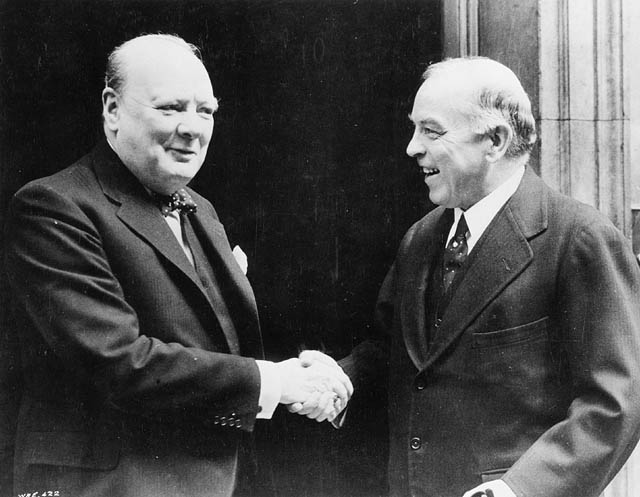
Prime Minister Winston Churchill greets Canadian PM William Lyon Mackenzie King, 1941.
Photo from Library and Archives Canada (reference number C-047565) via Wikimedia Commons.
I was born in 1942, William Lyon Mackenzie King was the prime minister; my mother often said that, in the 1940s, it seemed that he would never cease to be prime minister, and she thoroughly detested him; it wasn’t all of his policies she hated, it was, mainly, how he approached the war, and a few other things ~ she was, later, fond of the Canadian poet F.R. Scott’s rather bitter epitaph:
He seemed to be in the centre because we had no centre,
No vision to pierce the smoke-screen of his politics.Truly he will be remembered wherever men honour ingenuity,
Ambiguity, inactivity, and political longevity.Let us raise up a temple to the cult of mediocrity,
Do nothing by halves which can be done by quarters.Now, Canada fought a good war, we made four absolutely vital contributions:
- We were the true “breadbasket of the empire,” our farmers fed our large Army and much of Britain’s, too;
- We were a major part of the “arsenal of democracy,” our factories and shipyards turned out all of the things, from tanks and trucks and bombers and corvettes to Bren guns and grenades that were needed to help defeat the Axis powers;
- We managed the all important British Commonwealth Air Training Plan that was a key element in the allies’ eventual success; and
- We played a huge and a significant leadership role in the Battle of the Atlantic ~ the only battle Churchill said that he really feared losing.
But under King we did each with apparent reluctance, seemingly trying to never serve any vital interest if there was even a remote chance that any political constituency might be offended ~ something that reminds me of Justin Trudeau in 2018. Our large and entirely commendable war efforts were, in the main, directed, sometimes despite King, by the indefatigable C.D. Howe, and the national unity concerns were assuaged by recruiting the universally respected Louis St Laurent.
The King era was characterized by extraordinarily tepid leadership at the top but brilliant work by strong ministers in a small cabinet. It also began Phase 1 of a national political civil war. I think that in the First World War many Canadians had either understood or had been, largely, indifferent to Quebec’s objections to conscription. But in the 1940s we had better mass communications and many Canadians were less understanding of Quebec’s reluctance to participate in that war, especially as Canadian casualties mounted after Hong Kong and then in Italy and then in France, Belgium and Holland. Louis St Laurent did not try to explain French Quebec’s misgivings to English Canada, his job was to maintain, by force of his own stellar reputation and personality, just enough support in Quebec and, as he easily did, to “outclass” the vocal, crypto-fascist, French Canadian opponents to the war. But there was another division fomenting inside the Liberal Party of Canada: both Howe and St Laurent had a new vision for Canada in the post war world; both saw Canada as an important actor on the world stage; both were frustrated by King’s timid leadership; it is very probable that had St Laurent, the foreign minister, rather than King, [been] the prime minister, led Canada’s delegation to the UN’s founding conference in San Francisco in June of 1945 that Canada, not France, would have been the fifth member of the Security Council (or that it would have had only four members. as originally planned). St Laurent, especially, was known, liked and respected in both London and Washington; both he and Howe were highly regarded as leaders and as statesmen … King was not; Churchill distrusted him because he has actively supported Chamberlain’s appeasement policy and it seems to me that both Churchill and Roosevelt saw him as little more than an errand boy.
Comments Off on Mackenzie King at war
December 10, 2018
Tank Chats #38 Churchill | The Tank Museum
The Tank Museum
Published on 3 Jun 2017Historian David Fletcher MBE, in the 38th Tank Chat discussing the well-loved Churchill tank. The Churchill in this video resides at The Tank Museum, Bovington and was the last Churchill VII of the production line.
The Churchill tank was rushed in to production during the early years of the Second World War. The Churchill tank was one of the most successful British tank designs of the Second World War. They saw service from the 1942 Dieppe raid, through to North Africa, Italy and Europe.
Support the work of The Tank Museum on Patreon: ► https://www.patreon.com/tankmuseum
Or donate http://tankmuseum.org/support-us/donateTwitter: ► https://twitter.com/TankMuseum
Tiger Tank Blog: ► http://blog.tiger-tank.com/
Tank 100 First World War Centenary Blog: ► http://tank100.com/ #tankmuseum #tanks
Comments Off on Tank Chats #38 Churchill | The Tank Museum
December 9, 2018
The Invasion of Finland – WW2 – 015 8 December 1939
World War Two
Published on 8 Dec 2018When the Red Army invades Finland they get a cold reception and a pretty nasty surprise. It looks like team Stalin might just be skating on some very thin ice.
WW2 day by day, every day is now live on our Instagram account @World_war_two_realtime https://www.instagram.com/world_war_t…
Between 2 Wars: https://www.youtube.com/playlist?list…
Join us on Patreon: https://www.patreon.com/TimeGhostHistory
Or join The TimeGhost Army directly at: https://timeghost.tvWritten and Hosted by: Indy Neidell
Produced and Directed by: Spartacus Olsson and Astrid Deinhard
Executive Producers: Bodo Rittenauer, Astrid Deinhard, Indy Neidell, Spartacus Olsson
Research by: Indy Neidell
Edited by: Iryna Dolka
Map animations by: Mikk Tali aka Eastory
Community Manager: Joram AppelColoring by Spartacus Olsson and Norman Stewart, Thumbnail character courtesy of Olga Sharina aka Klimbim
Eastory’s channel: https://www.youtube.com/channel/UCEly…
Norman’s pictures https://oldtimesincolor.blogspot.com/
Archive by Screenocean/Reuters https://www.screenocean.com
A TimeGhost chronological documentary produced by OnLion Entertainment GmbH
Comments Off on The Invasion of Finland – WW2 – 015 8 December 1939
December 7, 2018
“A date that will live in infamy” – Speech
FootageArchive – Videos From The Past
Published on 19 Mar 2015Welcome to FootageArchive! On this channel you’ll find historic and educational videos from the 1900s. Watch, learn, and take a trip back in time as we gain insight into a previous time. Subscribe for more.
Note: this video contains archived public domain / licensed footage. This footage serves documentary purposes on world history and is to be viewed as educational.
Comments Off on “A date that will live in infamy” – Speech
December 4, 2018
QotD: B.H. Liddell Hart and J.F.C. Fuller
The military commentators of the popular press can mostly be classified as pro-Russian or anti-Russian pro-blimp or anti-blimp. Such errors as believing the Maginot Line impregnable, or predicting that Russia would conquer Germany in three months, have failed to shake their reputation, because they were always saying what their own particular audience wanted to hear. The two military critics most favoured by the intelligentsia are Captain Liddell Hart and Major-General Fuller, the first of whom teaches that the defence is stronger that the attack, and the second that the attack is stronger that the defence. This contradiction has not prevented both of them from being accepted as authorities by the same public. The secret reason for their vogue in left-wing circles is that both of them are at odds with the War Office.
George Orwell, footnote to “Notes on Nationalism”, Polemic, 1945-05.
Comments Off on QotD: B.H. Liddell Hart and J.F.C. Fuller
December 2, 2018
The Winter War – WW2 – 014 December 1 1939
World War Two
Published on 1 Dec 2018On the last day of November 1939 the Red Army of the USSR invades Finland and the Winter War begins.
WW2 day by day, every day is now live on our Instagram account @World_war_two_realtime https://www.instagram.com/world_war_t…
Between 2 Wars: https://www.youtube.com/playlist?list…
Join us on Patreon: https://www.patreon.com/TimeGhostHistory
Or join The TimeGhost Army directly at: https://timeghost.tvWritten and Hosted by: Indy Neidell
Produced and Directed by: Spartacus Olsson and Astrid Deinhard
Executive Producers: Bodo Rittenauer, Astrid Deinhard, Indy Neidell, Spartacus Olsson
Research by: Indy Neidell
Edited by: Iryna Dolka
Community Manager: Joram AppelColoring by Spartacus Olsson and Norman Stewart
Norman’s pictures https://oldtimesincolor.blogspot.com/Archive by Screenocean/Reuters https://www.screenocean.com
A TimeGhost chronological documentary produced by OnLion Entertainment GmbH
Comments Off on The Winter War – WW2 – 014 December 1 1939
November 30, 2018
Defense of Poland – Under Siege – Extra History – #2
Extra Credits
Published on 29 Nov 2018This series is brought to you by World of Tanks PC. Check out the game at https://redir.wargaming.net/z3ehuthn/… and use the code ORLIK for extra goodies.
Poland, alone, faces off both Soviet Russia armies and the Germans for five long weeks. Foreign reporter Julien Bryan captures footage of the siege of Warsaw to deliver to the outside world. A resistance builds inside.
Join us on Patreon! http://bit.ly/EHPatreon
Comments Off on Defense of Poland – Under Siege – Extra History – #2
November 29, 2018
The Royal Navy’s “Nelsol” and “Rodnol” – a battleship design driven by lessons from Jutland
One of my favourite quirky ship designs is profiled at Naval Gazing: HMS Nelson and HMS Rodney. These two ships, known derisively by the names “Nelsol” and “Rodnol” (because of their odd profile resemblance to a class of RN oilers, whose names all ended in “-ol”), were the first post-WW1 British battleships designed to incorporate the bitter lessons learned at the battle of Jutland in 1916. Their construction was also influenced by the round of naval treaty talks that aimed to stop a renewed naval arms race and limit the major navies in both number and size of ships.
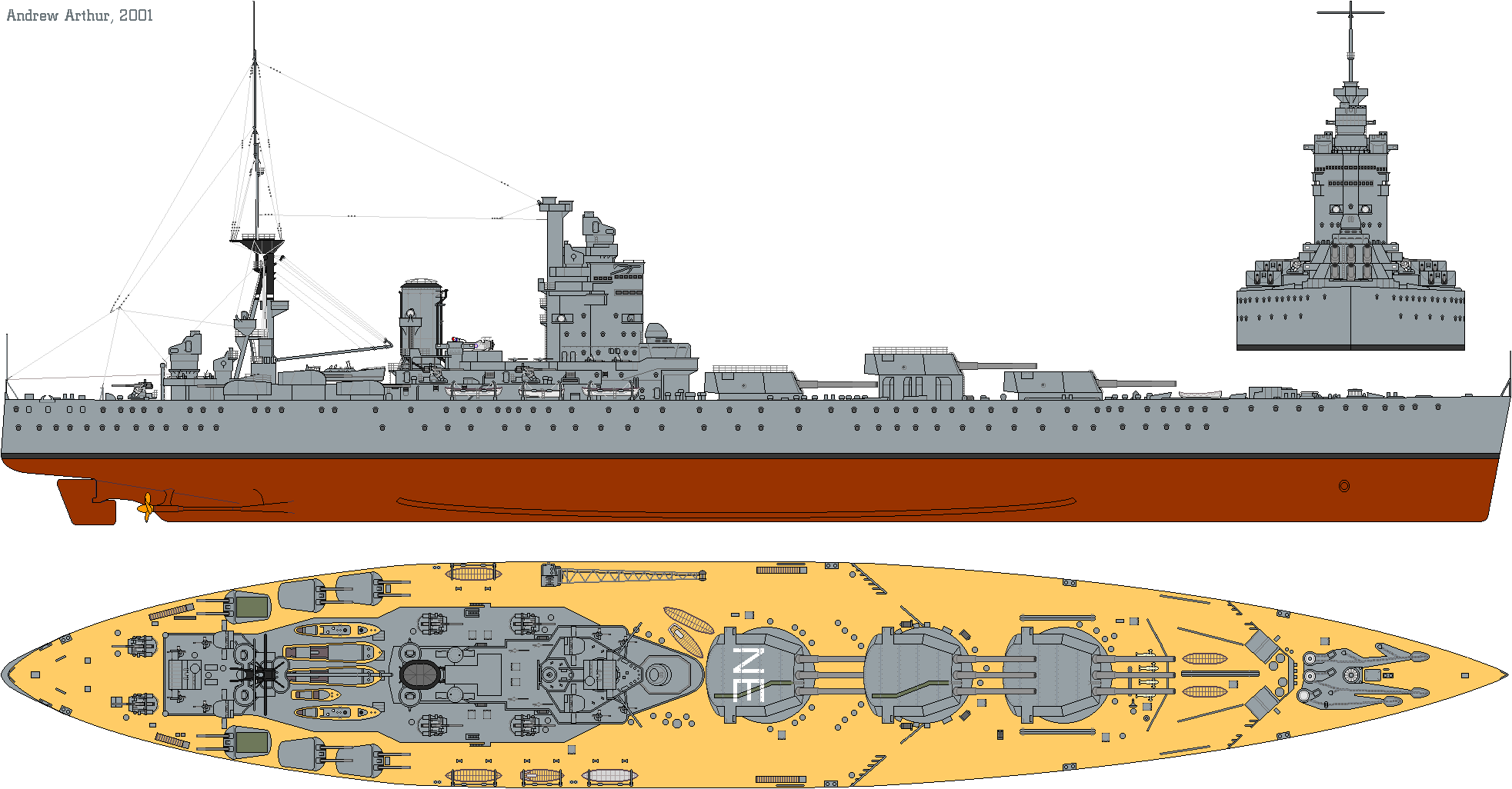
HMS Nelson profile drawing as she appeared circa 1931.
Image by Emoscopes via Wikimedia Commons.
At the end of WWI, the Royal Navy faced a crisis. During the war, it had suspended new capital ship construction except for a handful of battlecruisers, while the American and Japanese building programs had continued to churn out ships that were more modern than the bulk of the British fleet. Worse, the British battlefleet had seen hard war service, and many of the early dreadnoughts were in bad shape and essentially unfit for further service. New battleships would be needed, ships that fully reflected the lessons of the war.
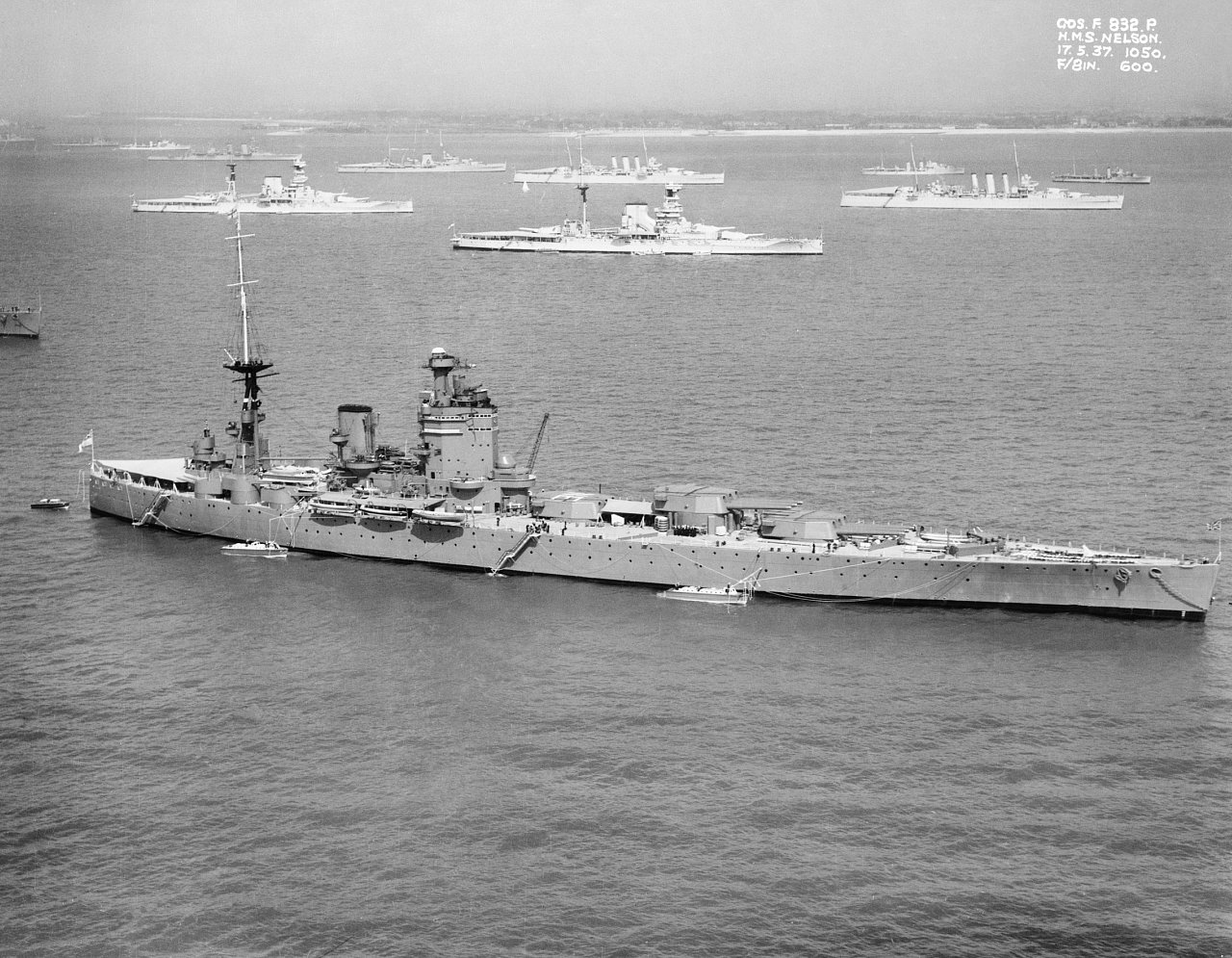
HMS Nelson off Spithead for the 1937 Fleet Review. Anchored in the background are two Queen Elizabeth-class battleships and two cruisers of the London class.
Photo via Wikimedia Commons.The most important of these was the need for an all-or-nothing armor scheme, as developed in the US. The war had seen major improvements in armor-piercing shells, and they required significantly more armor than previous vessels. However, the increased range gave designers a way out. Previously, the size of citadels had been set by the need to preserve stability and buoyancy if the ends were riddled. At long range, the many hits necessary to riddle the ends would not happen, and the citadel could be shrunk to thicken the armor. The British also looked to improve on the 15″ gun due to the proliferation of 16″ weapons in the American and Japanese navies. They investigated the triple turret, abandoned a decade earlier amid fears of increased mechanical complexity, and the 18″ gun under the cover name of 15″/B.
Two parallel design series were started, one for battleships, the other for battlecruisers. As this series was developed, the designers saw a serious problem with the battlecruisers. The boiler uptakes would leave large holes in the armored deck, and if the ship was headed towards the enemy, shells might be able to pass through the holes and into the aft magazines. The solution was to move all three turrets forward of the engines, on the basis of war experience showing that ships rarely if ever engaged targets directly aft.
Comments Off on The Royal Navy’s “Nelsol” and “Rodnol” – a battleship design driven by lessons from Jutland
November 26, 2018
Will the Kriegsmarine Rule the Waves? – WW2 – 013 24 November 1939
World War Two
Published on 24 Nov 2018The European Allies seek a countermeasure to the mysterious German mines, in China the Japanese advance, and in Poland it is the beginning of the Warsaw Ghetto.
WW2 day by day, every day is now live on our Instagram account @World_war_two_realtime https://www.instagram.com/world_war_t…
Join us on Patreon: https://www.patreon.com/TimeGhostHistory
Or join The TimeGhost Army directly at: https://timeghost.tvWritten and Hosted by: Indy Neidell
Produced and Directed by: Spartacus Olsson and Astrid Deinhard
Executive Producers: Bodo Rittenauer, Astrid Deinhard, Indy Neidell, Spartacus Olsson
Research by: Indy Neidell
Edited by: Wieke Kapteijns and Spartacus Olsson
Community Manager: Joram AppelColoring by Spartacus Olsson and Norman Stewart
Norman’s pictures https://oldtimesincolor.blogspot.com/Archive by Screenocean/Reuters https://www.screenocean.com
A TimeGhost chronological documentary produced by OnLion Entertainment GmbH
Comments Off on Will the Kriegsmarine Rule the Waves? – WW2 – 013 24 November 1939


