
BFBS Forces News
Published 19 Oct 2024Say “7.62mm” when talking about rifle and machine gun rounds, and most people will think of the Nato cartridge that was introduced in 1954, but there’s a far older one that’s still in use – the 7.62x54mmR.
While the 7.62x51mm Nato cartridge was brought into service in 1954, the 7.62x54mmR dates back to 1891 in Imperial Russia.
Although this cartridge was developed in Russia, the “R” actually stands for “Rimmed” and this is what makes these two 7.62mm cartridges so different.
(more…)
February 1, 2025
A century of war: The cartridge that remains deadly on today’s battleground
Comments Off on A century of war: The cartridge that remains deadly on today’s battleground
January 29, 2025
Gewehr 98: The German WWI Standard Rifle
Forgotten Weapons
Published 11 Jun 2016The Gewehr 1898 was the product of a decade of bolt action repeating rifle improvements by the Mauser company, and would be the standard German infantry rifle through both World Wars. Today we are looking at a pre-WWI example (1905 production) that shows all the features of what a German soldier would have taken to war in 1914.
Comments Off on Gewehr 98: The German WWI Standard Rifle
January 24, 2025
Was WW1 Pointless? – War Goals Of Every Major Nation
The Great War
Published 13 Sept 2024The First World War is often seen as futile and pointless. Millions of men fought and died for years, but no one was satisfied with the outcome, which did not bring a lasting peace. But that is not how governments and many people saw the war as it was being fought. So what did the countries fighting actually want to achieve? In other words, what was the purpose of the First World War?
(more…)
Comments Off on Was WW1 Pointless? – War Goals Of Every Major Nation
January 23, 2025
QotD: The origins of strategic airpower
In my warfare survey, I have a visual gag where for a week and a half after our WWI lecture, every lecture begins with the same slide showing an aerial photograph (Wiki) of the parallel trenches of the First World War because so much of the apparatus of modern warfare exists as a response, a desperate need to never, ever do the trench stalemate again. And that’s where our story starts.
Fighting aircraft, as a technology in WWI, were only in their very infancy. On the one hand the difference between the flimsy, unarmed artillery scout planes of the war’s early days and the purpose-built bombers and fighters of the war’s end was dramatic. On the other hand the platforms available at the end of the war remained very limited. Once again we can use a late-war bomber like the Farman F.50 – introduced too late to actually do much fighting in WWI – as an example of the best that could be done. It has a range of 260 miles – too short to reach deep into enemy country – and a bomb load of just 704lbs. Worse yet it was slow and couldn’t fly very high, making it quite vulnerable. It is no surprise that bombers like this didn’t break the trench stalemate in WWI or win the war.
However, anyone paying attention could already see that these key characteristics – range, speed, ceiling and the all-important bomb-load – were increasing rapidly. And while the politicians of the 1920s often embraced the assumption that the War to End All Wars had in fact banished the scourge of war from the Earth – or at the very least, from the corner of it they inhabited such that war would now merely be a thing they inflicted on other, poorer, less technologically advanced peoples – the military establishment did not. European peace had always been temporary; the Peace of Westphalia (1648) and the Congress of Vienna (1815) had not ended war in Europe, so why would the Treaty of Versailles (1919)? There had always been another war and they were going to plan for it! And they were going to plan in the sure knowledge that the bombers the next war would be fought with would be much larger, faster, longer ranged and more powerful than the bombers they knew.
One of those interwar theorists was Giulio Douhet (1869-1930), an Italian who had served during the First World War. Douhet wasn’t the only bomber advocate or even the most influential at the time – in part because Italy was singularly unprepared to actually capitalize on the bomber as a machine, given that it was woefully under-industrialized and bomber-warfare was perhaps the most industrial sort of warfare on offer at the time (short of naval warfare) – but his writings exemplify a lot of the thinking at the time, particularly The Command of the Air (1921). But figures like Hugh Trenchard in Britain or Billy Mitchell in the United States were driving similar arguments, with similar technological and institutional implications. But first, we need to get the ideas.
Like many theorists at the time, Douhet was thinking about how to avoid a repeat of the trench stalemate, which as you may recall was particularly bad for Italy. For Douhet, there was a geometry to this problem; land warfare was two dimensional and thus it was possible to simply block armies. But aircraft – specifically bombers – could move in three dimensions; the sky was not merely larger than the land but massively so as a product of the square-cube law. To stop a bomber, the enemy must find the bomber and in such an enormous space finding the bomber would be next to impossible, especially as flight ceilings increased. In Britain, Stanley Baldwin summed up this vision by famously quipping, “no power on earth can protect the man in the street from being bombed. Whatever people may tell him, the bomber will always get through.” And technology seemed to be moving this way as the possibility for long-range aircraft carrying heavy loads and high altitudes became more and more a reality in the 1920s and early 1930s.
Consequently, Douhet assumed there could be no effective defense against fleets of bombers (and thus little point in investing in air defenses or fighters to stop them). Rather than wasting time on the heavily entrenched front lines, stuck in the stalemate, they could fly over the stalemate to attack the enemy directly. In this case, Douhet imagined these bombers would target – with a mix of explosive, incendiary and poison gas munitions) the “peacetime industrial and commercial establishment; important buildings, private and public; transportation arteries and centers; and certain designated areas of civilian population”. This onslaught would in turn be so severe that the populace would force its government to make peace to make the bombing stop. Douhet went so far as to predict (in 1928) that just 300 tons of bombs dropped on civilian centers could end a war in a month; in The War of 19– he offered a scenario where in a renewed war between Germany and France where the latter surrendered under bombing pressure before it could even mobilize. Douhet imagined this, somewhat counterintuitively, as a more humane form of war: while the entire effort would be aimed at butchering as many civilians as possible, he thought doing so would end wars quickly and thus result in less death.
Clever ideas to save lives by killing more people are surprisingly common and unsurprisingly rarely turn out to work.
Bret Devereaux, “Collections: Strategic Airpower 101”, A Collection of Unmitigated Pedantry, 2022-10-21.
Comments Off on QotD: The origins of strategic airpower
December 31, 2024
“Britzkrieg” – Did British Tactics Help Create Blitzkrieg?
The Tank Museum
Published 30 Aug 2024Where did Blitzkrieg, the tactics that enabled Germany to conquer most of Europe in the first years of WW II come from?
Throughout the 1920s and into the ’30s, the German Army was forbidden from developing tanks or experimenting with armoured warfare, but in the same period, the British Army was at the forefront of mechanization and the use of armour on the battlefield.
In this film, we will look at how British tacticians like JFC Fuller and Basil Liddell Hart developed a new and revolutionary way of warfighting and how these principles were taken up and used to devastating effect by the German Army in 1939 and 1940.
00:00 | Intro
02:14 | A New Form of Warfare
04:12 | Plan 1919
07:54 | New Technology – Better Tanks
14:01 | Trials and Tribulations
17:10 | Partly There
20:12 | Fuller’s ChildrenThis video features archive footage courtesy of British Pathé.
#tankmuseum
Comments Off on “Britzkrieg” – Did British Tactics Help Create Blitzkrieg?
December 18, 2024
The modern Furies
In Greek mythology, the Erinyes (the Furies) — euphemized as the Eumenides (the “Gracious ones”) were the goddesses of vengeance. You may dismiss the ancient Greeks and their beliefs, yet they often encapsulate hidden wisdom for those who know how to interpret their stories. Today, as Janice Fiamengo points out, we have no need for mythological Furies, as they’re frequently embodied in otherwise ordinary women:
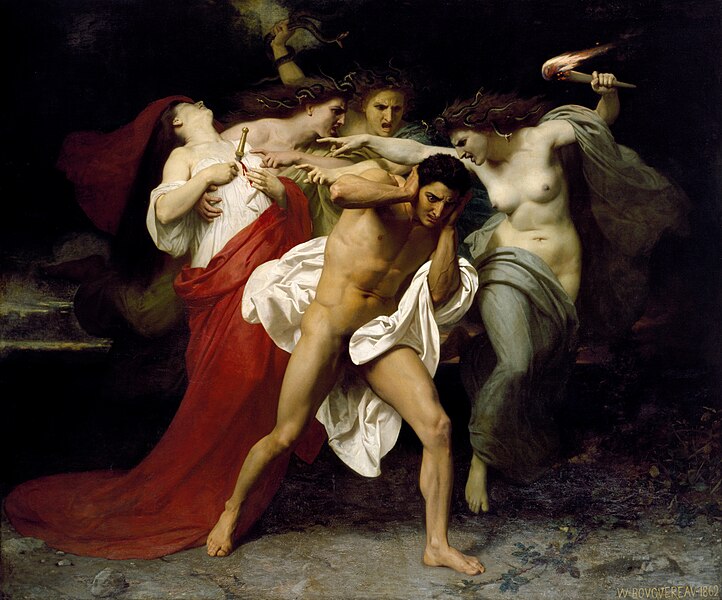
The Remorse of Orestes or Orestes Pursued by the Furies
Oil painting by William-Adolphe Bouguereau, 1862, in the Chrysler Museum of Art via Wikimedia Commons.
Feminist uproar over Trump’s election was easy to predict, and not long in coming. Within ten days of the election, Clara Jeffery wrote in Mother Jones that “Women are furious — in a Greek mythology sort of way“. Taking examples from TikTok, Jeffery chronicled abundant “sorrow, disbelief and terror, but also incandescent rage”, which many women vowed to exorcise on men: “‘If his ballot was red, his balls stay blue‘”, she quoted one.
In The New York Times, a 16-year-old girl, Naomi Beinart, charted her tumultuous emotions, which included a sense of betrayal because her male classmates had carried on with their lives on the day after the election, seemingly immune to the girls’ all-pervasive gloom and outrage. “Many of them didn’t seem to share our rage, our fear, our despair. We don’t even share the same future,” Beinart opined melodramatically.
No one with even a minimal acquaintance with social media can have missed the many similar, raging reactions: the heads being shaved, the death threats, the promised sex strikes, the fantasies of revenge against Trump-voting husbands. We are to understand that the re-election of a man rumored to lack sufficient pro-abortion commitment justifies thousands of self-recorded screams, imprecations, and poisoning plots.
At least one group of women gathered physically in Wisconsin to shout their angst and anger at Lake Michigan, and there have already been tentative (though apparently less enthusiastic than formerly) plans for a revival of the anti-Trump Women’s March protests, in which women with vulgar placards and pink hats exhibited their “collective rage“.
Women’s rage is all the rage.
It is not enough, it seems, for these women to say that they are disappointed by Trump’s win, and certainly inadequate for them to state strong disagreement with his policies or style. Expressing evidence-based positions is the sort of thing a rational person would do, and significant groups of women appear increasingly uninterested in rational talk or behavior. Instead, they reach for the most extreme language, tone of voice, postures and actions to express what feminist journalist Rhiannon Lucy Cosslett called the “visceral” “body horror” produced by the Trump victory, including the “profound physical revulsion” Cosslett and many of her sisters allegedly feel simply as a result of seeing one of Trump’s tweets (talk about fragility!).
Like so many feminist pundits telling us of women’s “horror” and “fury“, the emphasis is squarely on feeling and the female body, as if to bypass the intellect and the will altogether. The idea some feminists once scorned — that women are less reasonable and self-controlled than men — seems to have become a feminist axiom.
[NR: Edited to fix the broken URL.]
Comments Off on The modern Furies
December 16, 2024
Whippet – Fast and Furious 1918 | Tank Chats Reloaded
The Tank Museum
Published Aug 16, 2024Was the British Medium Mk A Whippet the world’s first proper tank?
Able to do 8mph, but incredibly difficult to drive, Whippet was far faster than the British heavy tanks of WW1. Using their speed, Whippets were able to operate behind the enemy front line to destroy enemy formations and create chaos. At a stroke, the tank was transformed from what was effectively a siege engine to a fast-moving weapon of attack and exploitation.
At Amiens in August 1918, a Whippet called Musical Box went on a nine-hour rampage in the German Army’s rearward area destroying an infantry battalion, a divisional supply column and an artillery battery, an unheard of feat.
In this film, we look at the Tank Museum’s rare surviving Whippet, what she was like to crew and fight, tell the story of Musical Box‘s rampage and examine the unique achievement of the Whippet on the WW1 battlefield.
00:00 | Intro
02:08 | Breaking the Stalemate
03:45 | A New Design
08:29 | Does It Work?
09:36 | The Tank Corps’ Surprise
11:41 | Proving Its Worth
16:25 | Armoured Warfare RevolutionisedThis video features archive footage courtesy of British Pathé.
Comments Off on Whippet – Fast and Furious 1918 | Tank Chats Reloaded
December 13, 2024
Modern (western) armies never seem to have enough infantry, no matter how high-tech the battlefield gets
Over the last century, one of the apparent constants in military doctrine has been that the latest and greatest technical innovation has somehow eclipsed the importance of boring old infantry units. Tanks were the future! No, tactical airpower was the future! No, nuclear weapons were the future! No, airmobile and helicopter units were the future! No, drones are the future! Yet every time the guns started firing, the limiting factor always seemed to be “not enough infantry” (at least among western militaries). You definitely needed more specialist and support units to handle the latest whizzy toys being deployed, yet it was still the infantry who mattered in the end. That’s just me noodling … it’s only loosely related to the rest of the post.
In my weekly recommendations list from Substack, they included this post from Bazaar of War which discusses the changes in organization of tactical and operation level units over time to best meet the needs of the modern battlefield:

Command post for a single battalion-sized element in a brigade combat team.
Photo by Sgt Anita Stratton, US Army.
Modern ground forces are torn between two competing demands, for infantry and for enablers. Urban operations and large-scale combat over the past decade demonstrate that infantry remains just as essential as ever. Yet that same infantry needs a lot of low-level support just to survive and remain effective: drone operators, EW, and engineers, not to mention armor and artillery. This poses an obvious dilemma for force management—not least when faced with competing demands for air, naval, and missile assets—but also raises questions about force structure.
Organizing the Force
One of the key decisions in how future wars will be fought is what will be the primary tactical unit. Inevitably, certain command levels are much more important than others: those which require greater freedom from higher headquarters than they allow their own subordinates. This partly comes down to a question of where the combined-arms fight is best coordinated, which in turn depends heavily on technology.
This has varied a lot over time. The main tactical formation of the Napoleonic army was the corps, which had organic artillery, cavalry, and engineers that allowed it to fight independent actions with a versatility not available to smaller units. The Western Front of World War II was a war of divisions at the tactical level and armies at the operational, a pattern which continued through the Cold War. The US Army shifted to a brigade model during the GWOT era, on the assumption that future deployments would be smaller scale and lower intensity; only recently has it made the decision to return to a divisional model. Russia also switched to a brigade model around this time, although more for cost and manpower reasons.
Tweaking the Hierarchy
At the same time, certain echelons have disappeared altogether. The subdivisions of Western armies reached their greatest extent in World War I, as new ones were added at the extremities of the model standardized during the French Revolution: fireteams/squads to execute trench raids, army groups to manage large sections of the front. At the same time, cuts were made around the middle. Machine guns were pushed from the regimental level down to battalions over the course of the war, reducing the number of these bulkier regiments in a division; this accordingly eliminated the need for brigades as a tactical unit.
This continued with the next major war. More organic supporting arms and increased mobility made combat more dispersed, creating the need for supply, communications, intelligence, and medical support at lower levels. As units at each echelon grew fatter, it became too cumbersome to have six separate headquarters from battalion to field army. Midway through World War II, the Soviets followed the Western example of eliminating brigades, and got rid of corps to boot (excepting ad-hoc and specialized formations). During the Cold War, the increasing use of combined arms at a lower level caused most NATO militaries to eliminate the regiment/brigade distinction altogether: the majority favored the larger brigade, which could receive supporting units to fight as a brigade combat team, although the US Marines retained regiments as brigades in all but name (the French, by contrast, got rid of most of their battalions, preferring regiments formed of many companies).
Comments Off on Modern (western) armies never seem to have enough infantry, no matter how high-tech the battlefield gets
December 6, 2024
The Halifax Explosion | A Short Documentary | Fascinating Horror
Fascinating Horror
Published Feb 23, 2021“On the 6th of December 1917 two ships collided in the mouth of Halifax Harbour in Nova Scotia, Canada …”
► Suggestions: hello@fascinatinghorror.co.uk
MUSIC:
► “Glass Pond” by Public Memory#Documentary #History #TrueStories
Comments Off on The Halifax Explosion | A Short Documentary | Fascinating Horror
November 11, 2024
In memoriam
A simple recognition of some of our family members who served in the First and Second World Wars:
The Great War
 Private William Penman, Scots Guards, died 16 May, 1915 at Le Touret, age 25
(Elizabeth’s great uncle)- Private Archibald Turner Mulholland, Argyll & Sutherland Highlanders, mortally wounded 25 September, 1915 at Loos, age 27
(Elizabeth’s great uncle) - Private David Buller, Highland Light Infantry, died 21 October, 1915 at Loos, age 35
(Elizabeth’s great grandfather) - Private Harold Edgar Brand, East Yorkshire Regiment. died 4 June, 1917 at Tournai.
(My first cousin, three times removed) - Private Walter Porteous, Durham Light Infantry, died 4 October, 1917 at Passchendaele, age 18
(my great uncle, who had married the day before he left for the front and never returned) - Corporal John Mulholland, Argyll & Sutherland Highlanders, wounded 2 September, 1914 (shortly before the First Battle of the Aisne), wounded again 29 June, 1918, lived through the war.
(Elizabeth’s great uncle) - John Eleazar (“Ellar”) Thornton, (ranks and dates of service unknown, served in the Royal Garrison Artillery, the East Surrey Regiment, and the Essex Regiment (dates of service unknown, but he likely joined the RGA in 1899). Put on the “Z” list after the war — recall list. He died in an asylum in 1943.
(my grandfather’s eldest brother) - Henry (Harry) Thornton, (uncertain) Lancashire Fusiliers. (We are not sure it is him as there were no identifying family or birth date listed. Rejected for further service.)
(my grandfather’s second older brother)
The Second World War
- Flying Officer Richard Porteous, Royal Air Force, survived the defeat in Malaya, was evacuated to India and lived through the war.
(my great uncle) - Able Seaman John Penman, Royal Navy, served in the Defensively Equipped Merchant fleet on the Atlantic convoys, the Murmansk Run (we know he spent a winter in Russia at some point during the war) and other convoy routes, was involved in firefighting and rescue efforts during the Bombay Docks explosion in 1944, lived through the war.
(Elizabeth’s father. We received his Arctic Star medal in July, 2024.) - Private Archie Black (commissioned after the war and retired as a Major), Gordon Highlanders, captured during the fall of Singapore (aged 15) and survived a Japanese POW camp (he had begun to write an autobiography shortly before he died)
(Elizabeth’s uncle) - Elizabeth Buller, “Lumberjill” in the Women’s Timber Corps, an offshoot of the Women’s Land Army in Scotland through the war.
(Elizabeth’s mother) - Trooper Leslie Taplan Russon, 3rd Royal Tank Regiment, died at Tobruk, 19 December, 1942 (aged 23).
Leslie was my father’s first cousin, once removed (and therefore my first cousin, twice removed). - Reginald Thornton, rank and branch of service unknown, hospitalized during the war with shellshock and was never discharged back into civilian life. He died in York in 1986.
(my grandfather’s youngest brother)
My maternal grandfather, Matthew Kendrew Thornton, was in a reserved occupation during the war as a plater working at Smith’s Docks in Middlesbrough. The original design for the famous Flower-class corvettes came from Smith’s Docks and 16 of the 196 built in the UK during the war (more were built in Canada). My great-grandmother was an enthusiastic ARP warden through the war (she reportedly enjoyed enforcing blackout compliance in the neighbourhood using the rattle and whistle that came with the job).
For the curious, the Commonwealth War Graves Commission the Royal British Legion, and the Library and Archives Canada WW1 and WW2 records site provide search engines you can use to look up your family name. The RBL’s Every One Remembered site shows you everyone who died in the Great War in British or Empire service (Canadians, Australians, New Zealanders, South Africans and other Imperial countries). The CWGC site also includes those who died in the Second World War. Library and Archives Canada allows searches of the Canadian Expeditionary Force and the Royal Newfoundland Regiment for all who served during WW1, and including those who volunteered for the CEF but were not accepted.
In Flanders fields the poppies blow
Between the crosses row on row,
That mark our place; and in the sky
The larks, still bravely singing, fly
Scarce heard amid the guns below.We are the Dead. Short days ago
We lived, felt dawn, saw sunset glow,
Loved and were loved, and now we lie
In Flanders fields.Take up our quarrel with the foe:
To you from failing hands we throw
The torch; be yours to hold it high.
If ye break faith with us who die
We shall not sleep, though poppies grow
In Flanders fields.Lieutenant Colonel John McCrae, MD Canadian Army Medical Corps (1872-1918)
Here is Mark Knopfler’s wonderful song “Remembrance Day” from his Get Lucky album, set to a slideshow of British and Canadian images from World War I through to more recent conflicts put together by Bob Oldfield:
Comments Off on In memoriam
The Angel of Victory: Canada’s Processing of The Great War (Vancouver, BC)
Valour Canada
Published Jan 9, 2024This video, by Hania Templeton, discusses the historical context, significance, and current meaning of The Angel of Victory in Vancouver, BC. Hania’s work received first place in Valour Canada’s 2023 History & Heritage Scholarship (VCHHS) contest.
To learn more about this annually awarded #scholarship, including the rules and regulations for eligible entrants, please visit https://valourcanada.ca/education/vch…
Comments Off on The Angel of Victory: Canada’s Processing of The Great War (Vancouver, BC)
QotD: Military glamour
In the 19th century, warfare was one of the first contexts in which English speakers used the term glamour in its modern metaphorical sense. (The word originally meant a literal magic spell that made people see things that weren’t there.) “Military heroes who give up their lives in the flush and excitement and glamour of battle”, opined a U.S. congressman in 1885, “are sustained in the discharge of duty by the rush and conflict of physical forces, the hope of earthly glory and renown”.
Even people who hated military life could feel the attraction. Writing after the briefest of conscriptions (a single night in the barracks), D.H. Lawrence in 1916 lamented “this terrible glamour of camaraderie, which is the glamour of Homer and of all militarism”.
The slaughter and apparent futility of the Great War changed all that. Peace activists and bitter veterans now saw the “glamour of battle” as a dangerous delusion rather than a valuable inspiration. “Are you going to tell your children the truth about what you endured,” an American challenged fellow veterans in 1921, “or gild your reminiscences with glamour that will make them want to have a merry war experience of their own?” In 1919, the British painter Paul Nash wrote that the purpose of The Menin Road, his bleak portrait of a desolate and blasted landscape, was “to rob war of the last shred of glory, the last shine of glamour.”
Virginia Postrel, “Casualty of War”, Virginia’s Newsletter, 2023-08-10.
Comments Off on QotD: Military glamour
November 9, 2024
History of SAW (Squad Automatic Weapon) use in the US Army
Forgotten Weapons
Published Jul 26, 2024The first squad automatic weapon used by the US Army was the French Mle 1915 Chauchat, which was the primary LMG or automatic rifle for troops in the American Expeditionary Force in World War One. At that time, the Chauchat was a company-level weapon assigned where the company commander thought best. In World War Two, the Chauchat had been replaced by the BAR, and one BAR gunner was in each 12-man rifle platoon. The BAR was treated like a heavy rifle though, and not like a support weapon as light machine guns were in most other armies.
After Korea the value of the BAR was given more consideration and two were put in each squad instead of one, but the M14 replaced the BAR before it could gain any greater doctrinal importance. The M14 was intended to basically go back to the World War Two notion of every man equipped with a very capable individual weapon, and the squad having excellent flexibility and mobility by not being burdened with a supporting machine gun. The M60 machine guns were once again treated as higher-level weapons, to be attached to rifle squads as needed.
After Vietnam, experiments with different unit organization — and with the Stoner 63 machine guns — led to the decision that a machine gun needed to be incorporated into the rifle squad. This led to the request for what became the M249 Squad Automatic Weapon, and its adoption in the 1980s. At last, the American rifle squad included an organic supporting machine gun.
Today, the USMC is once again going back to the earlier model with every rifleman carrying the same weapon, now an M27 Individual Automatic Rifle. The Army may also change its organizational structure with the new XM7 and XM250 rifle and machine gun, but only time will tell …
(more…)
Comments Off on History of SAW (Squad Automatic Weapon) use in the US Army
November 8, 2024
QotD: David Lloyd George and the British Liberal Party
Lloyd George was from nowhere. He grew up in Llanystumdwy, Caernarfonshire, where he lived in a compact cottage with his mother, uncle, and siblings, and was trained as a solicitor in Porthmadog. He rose to dominate British politics, and to direct the affairs of the most expansive empire the world had known, seeing off thousands of more privileged rivals, on the basis of truly exceptional native gifts, and without even speaking English as his first language.
How he got into the position to direct World War I is one of the most remarkable personal trajectories in British history. Contemporaries everywhere saw it as an astonishing story, even in the most advanced democracies. As the New York Times asked when Lloyd George visited America in 1923, “Was there ever a more romantic rise from the humblest beginning than this?”
The second reason why Lloyd George is fascinating is his extraordinary command of words. Collins is good on this. The book is full of speeches that turn tides and smash competitors. Lloyd George could exercise an equally mesmeric command over both the Commons and mass audiences, typically rather different skills. Harold Macmillan called him “the best parliamentary debater of his, or perhaps any, day”.
Biblical references and Welsh valleys suffused his speeches. As another American journalist put it, when Lloyd George was speaking, “none approaches him in witchery of word or wealth of imagery”, with his “almost flawless phraseology” communicated through a voice “like a silver bell that vibrates with emotion”. Leading an imperial democracy through a global war demanded rhetorical powers of the rarest kind. Asquith lacked them. That, amongst other reasons, is why Lloyd George was able to shunt him aside.
The last reason we should all be interested in Lloyd George — as readers will have anticipated — is that he was the last British politician to inter a governing party. His actions during the war split the Liberals into Pro-Asquith and pro-Lloyd George factions, and the government he led from 1916 until 1922 was propped up by the Conservatives. Though the Liberal split was partly healed in 1923, it was all over for the party as a governing force. By the time Lloyd George at last became leader of the Liberal Party (in the Commons) in 1924, he had only a rump of 40 MPs left to command.
By the 1920s, Lloyd George’s shifting ideologies could not easily accommodate the old party traditions or the new forces reshaping allegiances and identities in the aftermath of the war. In 1918 he described his political creed to George Riddell, the press magnate, as “Nationalist-Socialist”. The consequence was an unprecedented redrawing of the map of British party politics, producing the Labour/Conservative hegemony we have lived with ever since.
The rot had arguably begun to set in for the Liberals in the elections of 1910, when they lost their majority. Fourteen years later, in 1924, Lloyd George stepped up to the Commons leadership of an exhausted, defeated party, and neither he nor his successors could arrest the slide into irrelevance. […] The Liberals could not come back because they were left with no clothes of their own. What had once been distinctive lines on economics, religion, welfare, the constitution, foreign policy and even “progress” were either appropriated by their competitors or ceased to be politically relevant. The party’s history as the dominant political force of the last near-century was no proof against radical structural change.
Alex Middleton, “Snapshot of the PM who killed his party”, The Critic, 2024-08-01.
Comments Off on QotD: David Lloyd George and the British Liberal Party
October 13, 2024
The Deadliest Day of the British Army: The Battle of the Somme
The Great War
Published Jun 14, 2024The Battle of the Somme was one of the bloodiest of the First World War. From July to November 1916, millions of men struggled to fight in mud, under crushing shellfire, or in a hail of machine gun bullets. The Somme has been a synonym for the futility of trench warfare, but also the subject of fierce debate – who really won the Battle of the Somme?
(more…)
Comments Off on The Deadliest Day of the British Army: The Battle of the Somme


