In England all the boasting and flag-wagging, the “Rule Britannia” stuff, is done by small minorities. The patriotism of the common people is not vocal or even conscious. They do not retain among their historical memories the name of a single military victory. English literature, like other literatures, is full of battle-poems, but it is worth noticing that the ones that have won for themselves a kind of popularity are always a tale of disasters and retreats. There is no popular poem about Trafalgar or Waterloo, for instance. Sir John Moore’s army at Corunna, fighting a desperate rear-guard action before escaping overseas (just like Dunkirk!) has more appeal than a brilliant victory. The most stirring battle-poem in English is about a brigade of cavalry which charged in the wrong direction. And of the last war, the four names which have really engraved themselves on the popular memory are Mons, Ypres, Gallipoli and Passchendaele, every time a disaster. The names of the great battles that finally broke the German armies are simply unknown to the general public.
The reason why the English anti-militarism disgusts foreign observers is that it ignores the existence of the British Empire. It looks like sheer hypocrisy. After all, the English have absorbed a quarter of the earth and held on to it by means of a huge navy. How dare they then turn round and say that war is wicked?
It is quite true that the English are hypocritical about their Empire. In the working class this hypocrisy takes the form of not knowing that the Empire exists. But their dislike of standing armies is a perfectly sound instinct. A navy employs comparatively few people, and it is an external weapon which cannot affect home politics directly. Military dictatorships exist everywhere, but there is no such thing as a naval dictatorship. What English people of nearly all classes loathe from the bottom of their hearts is the swaggering officer type, the jingle of spurs and the crash of boots. Decades before Hitler was ever heard of, the word “Prussian” had much the same significance in England as “Nazi” has to-day. So deep does this feeling go that for a hundred years past the officers of the British Army, in peace-time, have always worn civilian clothes when off duty.
George Orwell, “The Lion And The Unicorn: Socialism and the English Genius”, 1941-02-19.
September 20, 2021
QotD: English jingoism
September 14, 2021
QotD: “In 1918 it was statistically safer for a British soldier to fight in the trenches of the Western Front than be a prisoner in Germany”
On and on the German outrages went: the sinking of the Lusitania, the execution of Nurse Cavell. Of course, the Allies were not saints, but the fashionable fallacy of moral equivalence — that all sides in the Great War were as bad as each other — founders on the rocks of Germany’s treatment of prisoners of war, who became slave labourers.
This was the main substance of the British agenda at Leipzig. Almost 165,000 British soldiers were taken prisoner on the Western Front between 1914-18; by the end of 1916, almost 80% were forced into labour for the Second Reich. Prisoners were literally worked to death in salt mines. And conditions in many camps were inhuman: in Wittenberg, two water taps served 17,000 Allied PoWs. When typhus struck the camp, the German staff abandoned it and left the prisoners to die. Some 13,000 Brits perished in the Kaiser’s camps — the vast majority because of brutality, disease, malnutrition or exhaustion. But 500 British soldiers were summarily shot or beaten to death at the Kaiser’s pleasure during their detention.
Of all the German PoWs held in Britain during the Great War, 3% died; of the British PoWs held in Germany, more than 10% perished. In 1918 it was statistically safer for a British soldier to fight in the trenches of the Western Front than be a prisoner in Germany. That year, 5.8% of British PoWs in Germany died, compared to 4% of British soldiers on the battlefield.
John Lewis Stempel, “Germany’s First World War Guilt”, UnHerd, 2021-05-25.
August 22, 2021
QotD: Woodrow Wilson, wrong on many things, but quite right on this one thing
National Realism comprehends and respects the perhaps tragic, but nevertheless undeniable, fact that most people are deeply attached to collective identities and aspirations. It accepts as both natural and important that psychological well-being would be rooted in a terroir, a set of traditions or other mythologies about who people are and where they come from, that can serve as a source of meaning and self-understanding, as well as social cohesion. It acknowledges that nationalism is a fixture of modern social and political reality.
The idea that a self-described people should have the right to determine its own collective destiny was once considered progressive. Nineteenth-century liberal nationalists like Giuseppe Mazzini in Italy and Ernest Renan in France saw in the nation-state the fullest political expression of peoplehood, a true source of law and legitimacy, a celebration of diversity, and a font of culture, art, and human flourishing. The idea of national self-determination also resonated with the American Founding and with the Declaration of Independence, which proclaimed that governments derive their powers from the consent of the governed and found in Natural Law the right for one people to “dissolve the political bands which have connected it with another, and to assume among the powers of the earth the separate and equal station to which the Laws of Nature and of Nature’s God entitle them.” For good or ill, the French Revolution had awakened modern ethnic self-awareness among European peoples, and ever since, nationalism has been the most robust political force in international affairs. Nationalism is a property of modern nation states, the same way that gravity is a property of physical matter. It is unwise to underestimate its power.
Diversity is now, supposedly, the primus inter pares of our political values. But ethnic and racial diversity, in all its colorful pageantry, is traditionally associated with empires, not republics. Diversity brings to mind Barbara Tuchman’s description of Queen Victoria’s Diamond Jubilee, with its splendid processions of Royal Nigerian Constabulary, Borneo Dyak Police, turbaned and bearded Lancers of Khapurthala and Badnagar, Zaptichs from Cyprus with their tasseled fezzes and black-maned ponies, Houssas from the Gold Coast, Chinese from Hong Kong, and Malays from Singapore, all paying homage to the great monarch. Imperial Rome was an equally spectacular kaleidoscope of nations and religions. By contrast, republican Rome was merely, austerely, Roman.
As a good Progressive, Wilson understood that modern democratic government is incompatible with multi-ethnic empire. But it took the cataclysmic breakdown of the Old World empires in the meat-grinder of World War I to bring the idea of national self-determination into political focus. It would be wise to remember that that civilization-shattering conflict was blamed in large part on the lack of congruence between state and ethnic boundaries. Most of Wilson’s famous Fourteen Points, outlined 101 years ago this month, were dedicated to correcting this discrepancy on the basis of national self-determination.
E.M. Oblomov, “The Case for National Realism: Diversity is the hallmark of empires, not democracies”, City Journal, 2019-01-02.
August 1, 2021
QotD: Rudolf Gaida’s convoluted military career
Footnote in Martin Gilbert’s World in Torment: Winston S. Churchill 1917-1922, 1975.
July 28, 2021
Possible relic from the 1917 Halifax explosion discovered by scuba diver
If you’re not familiar with the Halifax explosion, I collected some information about it here. One of the lesser-known ships involved in the disaster was the schooner St. Bernard, which was completely destroyed in the explosion of the cargo ship SS Mont Blanc after it collided with the Belgian relief ship Imo in the Narrows:
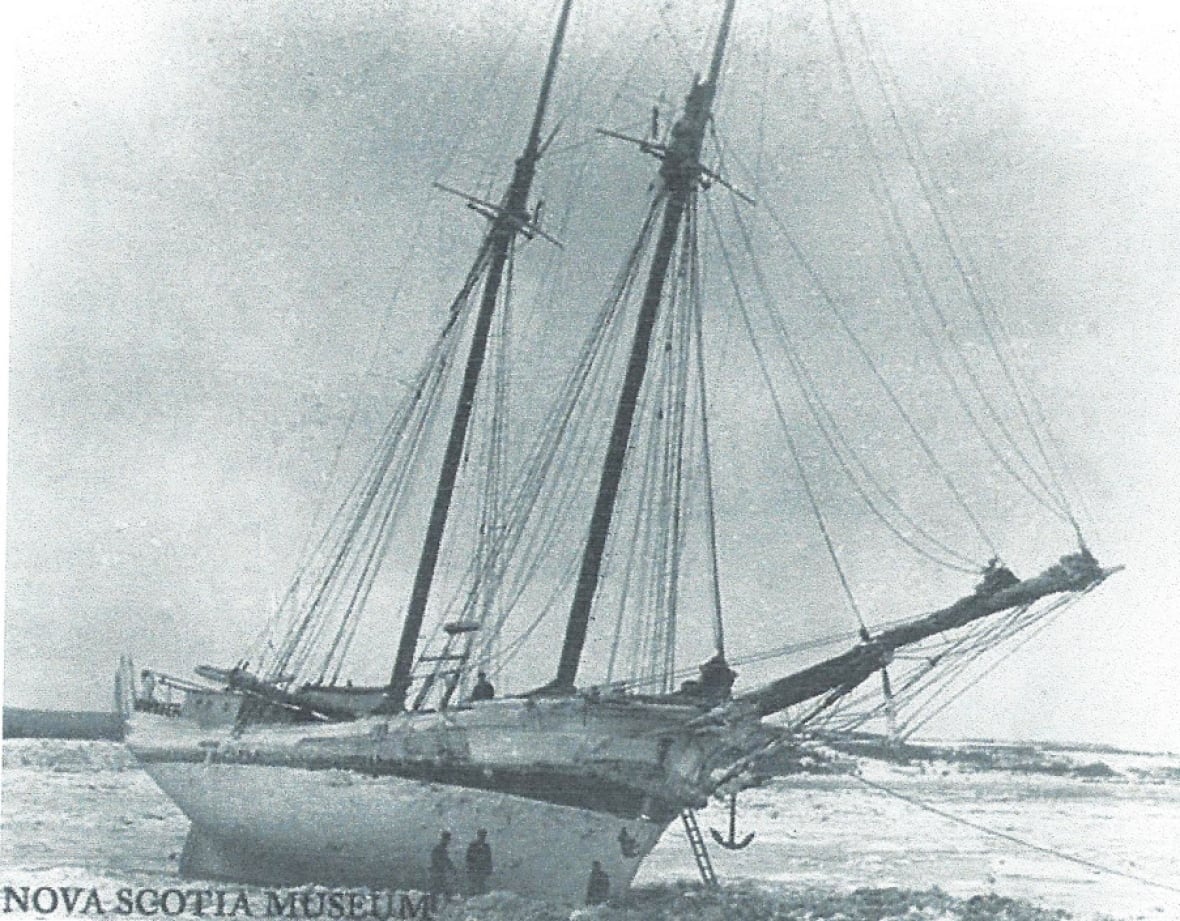
The schooner St. Bernard, which was destroyed when the Mont Blanc exploded nearby.
Photo from the Nova Scotia Museum.
A Halifax scuba diver has found something that could shed a little new light on one aspect of a dark chapter in Nova Scotian history.
Bob Chaulk has explored Halifax harbour from the Bedford Basin to Chebucto Head with hundreds of scuba dives over the last 30 years. But this spring, a routine dive in a small cove in the Narrows between Halifax’s two bridges led him to a big find.
Amid the usual assortment of scuttling crabs, polished bottles and bits of plastic trash, he came upon a huge, heavy object in Tufts Cove.
“When I first saw the anchor, I thought, OK, there’s a wreck here, some old derelict came in here. But there’s no way a ship that size could have gotten in here,” he said.
He explored until his air just about ran out. He estimated the anchor was about two metres long and weighed 135 kilograms. A ship that needed an anchor that size could not have sailed into shallow, rocky Tufts Cove, he thought.
So how did the old anchor get there?
He looked across the Narrows and found himself staring right at ground zero for the Halifax Explosion, which killed nearly 2,000 people. On Dec. 6, 1917, the vessel Imo and the Mont Blanc, a ship carrying explosive cargo, collided. The Mont Blanc caught fire and drifted into Pier 6, a space occupied today by the giant Halifax Shipyard building. The St. Bernard, a lumber schooner, was also at the dock.
“So now you have two ships side by side with a dock in between them. Here’s the Mont Blanc, here’s the Imo,” Chaulk said, showing the ships’ positions with his hands. “This one blows up, destroys this one, and I contend the anchor [of the St. Bernard] went through the air and landed right here.”
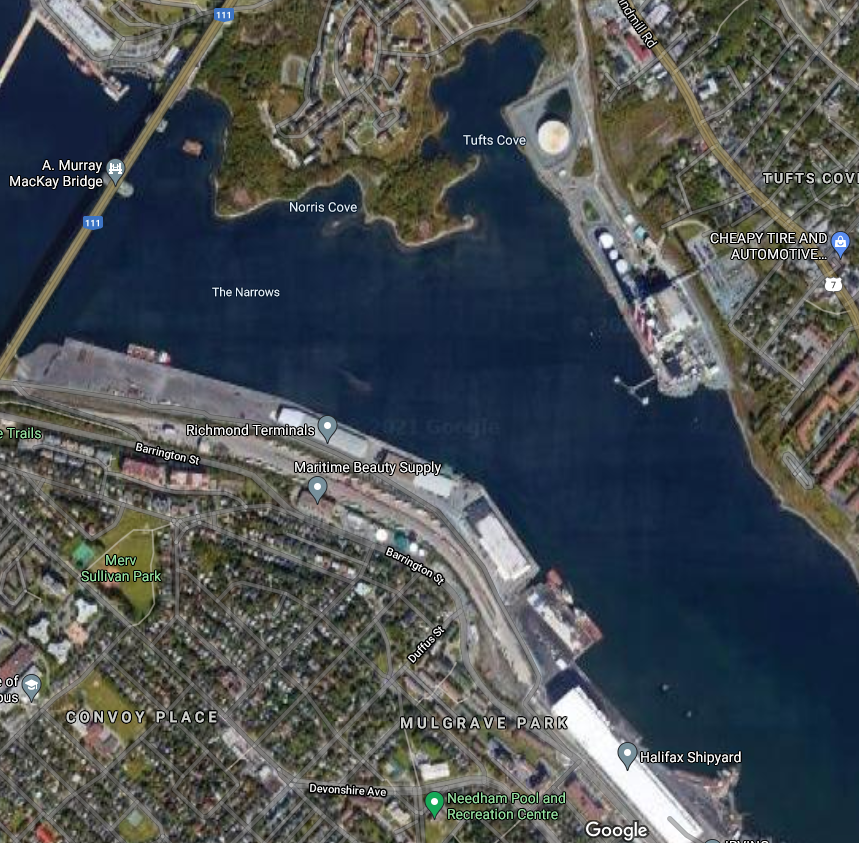
A modern day view of the Narrows, showing Tufts Cove to the north and the huge Halifax Shipyard complex on the south side of the channel.
Google Maps.
I suspect that the paved area to the right of the cove proper is largely landfill and the shoreline of 1917 probably followed much closer to the railway line.
H/T to Colby Cosh for the link.
QotD: Lawrence and the Hejaz railway
Christian Wolmar, Engines of War: How Wars Were Won & Lost on the Railways, 2010.
July 20, 2021
QotD: Lenin’s “Hanging Order”
Elsewhere, Lenin declared that “The proletariat needs state power, the centralized organization of force, the organization of violence, for the purpose of crushing the resistance … and for the purpose of leading the great mass of the population … in the work of organizing a socialist economy.”
In August 1918, Lenin sent his now famous “Hanging Order” telegram. It instructed local Bolsheviks in the Penza region to deal harshly with the farmers (kulaks) who owned land there and were standing in the way of its nationalization. The British historian Robert Service discovered it in Soviet archives in the 1990s. It read as follows:
Comrades! The insurrection of five kulak districts should be pitilessly suppressed. The interests of the whole revolution require this because ‘the last decisive battle’ with the kulaks is now underway everywhere. An example must be made.
- Hang (absolutely hang, in full view of the people) no fewer than one hundred known kulaks, fatcats, bloodsuckers.
- Publish their names.
- Seize all grain from them.
- Designate hostages, in accordance with yesterday’s telegram.
Do it in such a fashion, that for hundreds of miles around the people see, tremble, know, shout: “The bloodsucking kulaks are being strangled and will be strangled.”
Telegraph receipt and implementation.
Yours, Lenin.
P.S. Use your toughest people for this.
That chilling telegram ushered in the “Red Terror” which murdered Russians by the tens of thousands over the next two years.
Lawrence W. Reed, “How Germany’s ‘Deal With the Devil’ Backfired and Changed History”, Foundation for Economic Education, 2021-04-16.
July 11, 2021
History and Disassembly of the Vickers-Berthier MkIII LMG
Forgotten Weapons
Published 19 Sep 2017http://www.patreon.com/ForgottenWeapons
Cool Forgotten Weapons merch! http://shop.bbtv.com/collections/forg…
The Vickers-Berthier was initially designed by Andre Berthier in France prior to World War One. It went through a number of substantial design changes before the war, and was actually ordered in quantity by the United States right at the end of WWI — but the order was cancelled with the armistice. In the 1920s, Berthier sold the design to the Vickers company in England, which wanted a light machine gun to market alongside its Vickers heavy machine gun.
When the British military decided to replace its Lewis and Hotchkiss light machine guns, the Vickers-Berthier was one of the leading contenders, although in the endurance trials it was edged out by the Czech ZB-33, which would ultimately be adopted as the Bren. However, the Indian Army opted to take the Vickers-Berthier, and it was put into production at the Ishapore Rifle Factory and saw substantial use in World War Two.
Mechanically, the Vickers-Berthier is a tilting bolt design with a long stroke gas piston. It has a thorough set of covers over the magazine well and ejection port, and a relatively slow rate of fire. The barrel is quick-changeable, and it feeds from top-mounted 30-round magazines, with an aperture type rear sight being offset to the left side of the gun to clear the magazine.
Thanks to Marstar for letting me examine and shoot their Vickers-Berthier!
If you enjoy Forgotten Weapons, check out its sister channel, InRangeTV! http://www.youtube.com/InRangeTVShow

July 5, 2021
Browning M2HB .50 BMG at the Range
Forgotten Weapons
Published 26 Dec 2020http://www.patreon.com/ForgottenWeapons
https://www.floatplane.com/channel/Fo…
Cool Forgotten Weapons merch! http://shop.bbtv.com/collections/forg…
The Browning M2 heavy machine gun is one of the longest serving firearms in US military service, and still going strong. Let’s take this one out to the range and find out why!
Contact:
Forgotten Weapons
6281 N. Oracle #36270
Tucson, AZ 85740

July 4, 2021
Ma Deuce: The Venerable Browning M2 .50 Caliber HMG
Forgotten Weapons
Published 25 Dec 2020http://www.patreon.com/ForgottenWeapons
https://www.floatplane.com/channel/Fo…
Cool Forgotten Weapons merch! http://shop.bbtv.com/collections/forg…
The M2 Browning machine gun was first conceived in 1918, as a request by General John Pershing of the AEF for a large-caliber anti-aircraft and antitank machine gun. John Browning scaled his M1917 water-cooled .30 caliber design up to .50 caliber, and the first prototypes were test fired in November of 1918. Impetus behind the project faltered after the Armistice, but Colt continued to develop the gun during the 1920s and 1930s. It was first adopted in 1922 by the US Coastal Artillery as an anti-aircraft gun, but significant manufacture would not come until World War Two. By this time, the gun’s main role had shifted, from antitank to being an aircraft armament, and some 2 million were made during World War Two, primarily as aircraft guns.
The M2 remains in service today, highlighting the brilliance and longevity of John Browning’s designs.
Contact:
Forgotten Weapons
6281 N. Oracle #36270
Tucson, AZ 85740

May 25, 2021
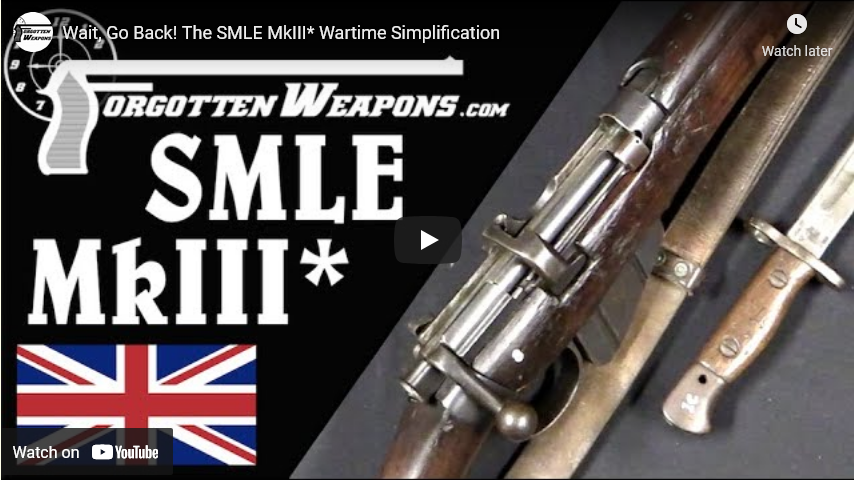
Wait, Go Back! The SMLE MkIII* Wartime Simplification
Forgotten Weapons
Published 10 Feb 2021http://www.patreon.com/ForgottenWeapons
https://www.floatplane.com/channel/Fo…
Cool Forgotten Weapons merch! http://shop.bbtv.com/collections/forg…
The British entered World War One with a technically excellent rifle, with lots of bells and whistles. By 1916, the war was taking a previously unimaginable toll on the industrial capacity of the Empire and rifle production had to be economized. This led to the adoption of the MkIII* pattern of the Lee Enfield, to reduce cost and speed up production. The MkIII* omitted the windage adjustments on the rear sight, the front and rear volley sight elements, and the magazine cutoff. Around the same time, stock discs stopped being stamped with unit information (to avoid giving military intelligence of troop distribution when rifles were captured) and eventually deleted entirely.
The Pattern 1907 bayonet was also changed, although this does not coincide with the MkIII* rifle. In 1913, the British decided to delete the quillon from the standard bayonet. A great many bayonet with quillons were already in service, and those would be used in World War One, although many were modified in the field to cut off the quillons to avoid them hanging up on barbed wire or other obstacles.
Contact:
Forgotten Weapons
6281 N. Oracle #36270
Tucson, AZ 85740
May 18, 2021
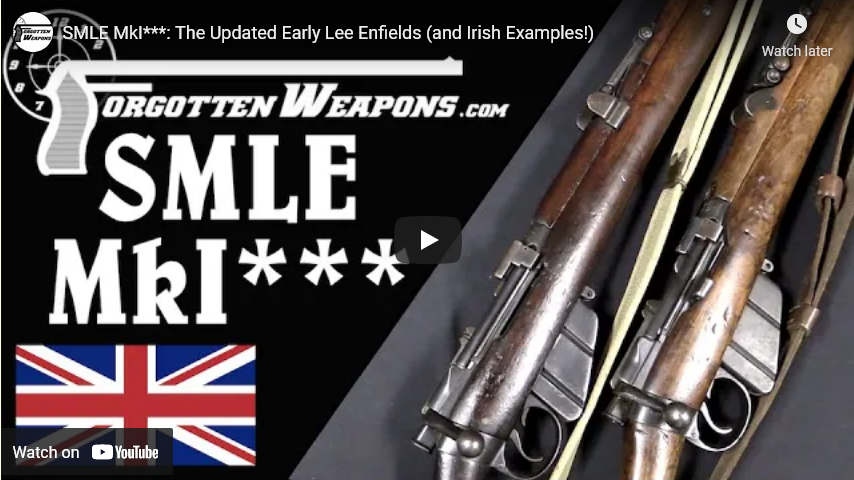
SMLE MkI***: The Updated Early Lee Enfields (and Irish Examples!)
Forgotten Weapons
Published 3 Feb 2021http://www.patreon.com/ForgottenWeapons
https://www.floatplane.com/channel/Fo…
Cool Forgotten Weapons merch! http://shop.bbtv.com/collections/forg…
When the British adopted a new high-velocity spitzer bullet for the .303 cartridge, they had to update their rifles to use it. Specifically, the sights had to be recalibrated for the flatter trajectory of the new MkVII ammunition. In addition, the sight picture was changed from a barleycorn front and V-notch rear to the more precise square front post and rear U-notch.
These rifles are quite scarce, but several thousand were brought into the US in the early 1960s as surplus from Ireland. These Irish examples all had new serial numbers applied when the were sent to Ireland by the British in the 1920s, and they are in two different batches (one in MkI*** configuration, and one with the MkIII rear sight). We will take a look at both patterns today as well, so you can see the difference between the much more available Irish type and the pure British version.
Contact:
Forgotten Weapons
6281 N. Oracle #36270
Tucson, AZ 85740
May 6, 2021
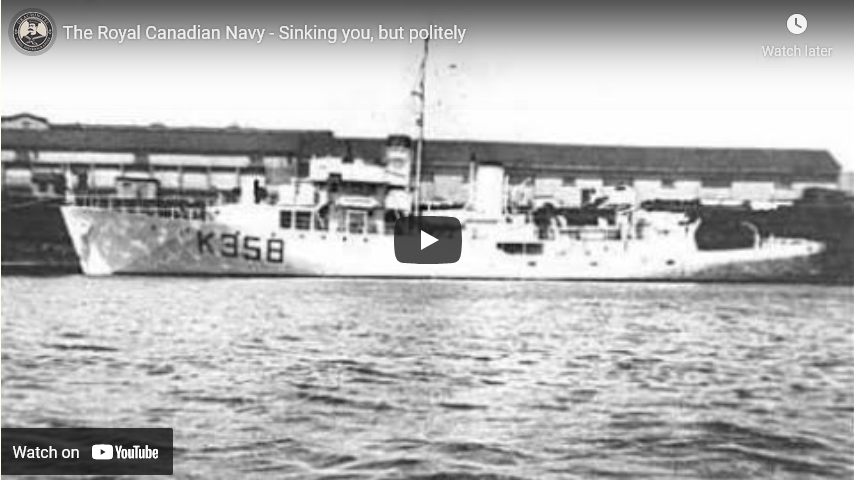
The Royal Canadian Navy – Sinking you, but politely
Drachinifel
Published 27 Jan 2021A brief history of the Royal Canadian Navy from its origins to the end of WW2.
Sources:
https://archive.org/details/seaisatourgatesh00germ
https://www.canada.ca/en/navy/services/history/naval-service-1910-2010.html
Legion Magazine – “Over The Side: The Courageous Boarding Of U-94”
www.amazon.co.uk/No-Higher-Purpose-Operational-1939-1943/dp/1551250616
www.amazon.co.uk/Canadas-Navy-Century-General-Interest/dp/0802042813/Free naval photos and more – www.drachinifel.co.uk
Want to support the channel? – https://www.patreon.com/Drachinifel
Want a shirt/mug/hoodie – https://shop.spreadshirt.com/drachini…
Want a poster? – https://www.etsy.com/uk/shop/Drachinifel
Want to talk about ships? https://discord.gg/TYu88mt
Want to get some books? www.amazon.co.uk/shop/drachinifelDrydock
Episodes in podcast format – https://soundcloud.com/user-21912004
May 5, 2021
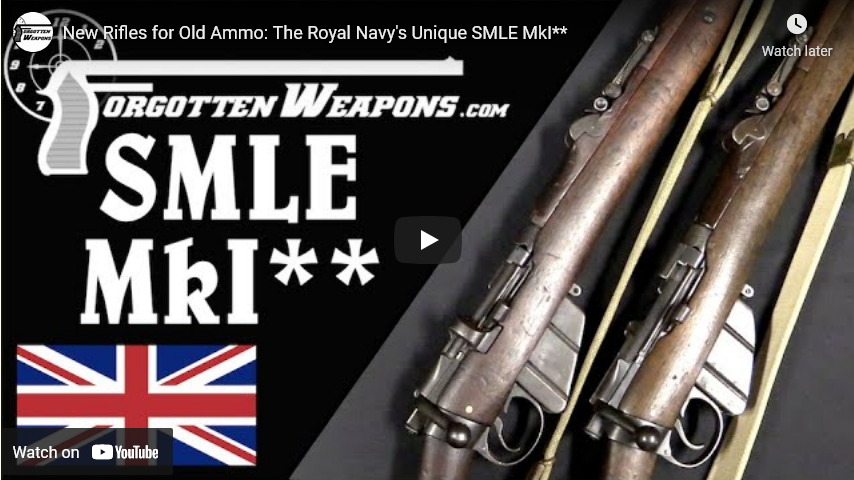
New Rifles for Old Ammo: The Royal Navy’s Unique SMLE MkI**
Forgotten Weapons
Published 27 Jan 2021http://www.patreon.com/ForgottenWeapons
https://www.floatplane.com/channel/Fo…
Cool Forgotten Weapons merch! http://shop.bbtv.com/collections/forg…
When the SMLE was adopted by the British, it was to be the new universal rifle for all branches of service, including the Royal Navy. This suited the Navy just fine; they like the features of the new design. However, the Army quickly moved to update their rifles for the new MkVII Spitzer ammunition, and this was an issue. The Navy still had substantial stockpiles of the older round-nose MkVI cartridge, and did not go through it nearly as quickly as the Army. The Navy did not want to simply throw out their ammunition, but the differences in trajectory between the two types of ammunition was substantial. So the Navy opted to adopt its own unique rifle variation, the MkI**. This in effect was the new Army pattern rifle, but with the rear sight still calibrated for the trajectory of MkVI ammunition.
This pattern was first adopted in 1908, using rifles with the then-standard split charger guide. When the fixed charger bridge was adopted, the Navy (which still had plenty of MkVI ammunition) chose to update its MkI** rifles to fixed charger bridges, without making any change to their designation. Once they finally ran out of the older ammunition during World War One, the rifles were updated once again to what was then the standard MkI*** pattern. As a result, intact MkI** rifles — especially ones with the split charger guide — are extremely rare to find today. Many thanks to the owner of these two specimens for giving me access to share them with you!
Contact:
Forgotten Weapons
6281 N. Oracle #36270
Tucson, AZ 85740
May 1, 2021
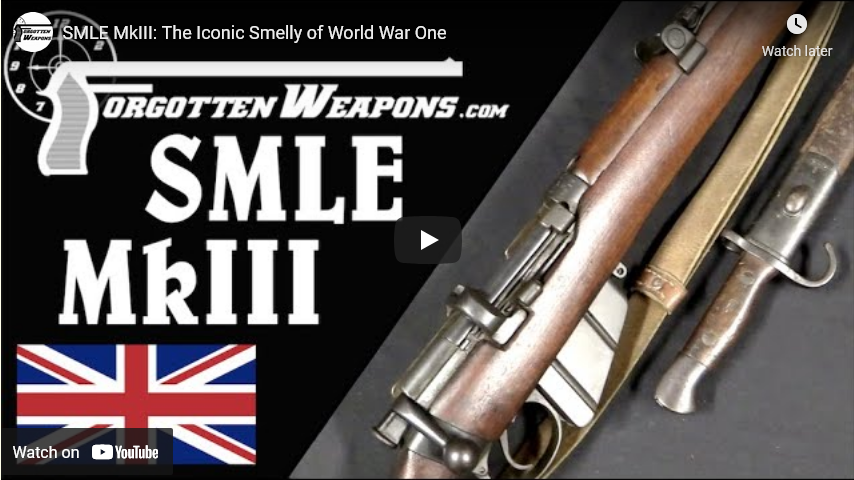
SMLE MkIII: The Iconic Smelly of World War One
Forgotten Weapons
Published 20 Jan 2021http://www.patreon.com/ForgottenWeapons
https://www.floatplane.com/channel/Fo…
Cool Forgotten Weapons merch! http://shop.bbtv.com/collections/forg…
In 1907, the British adopted the final major pattern in the evolution of the Short, Magazine, Lee Enfield. Designated the ShtLE MkIII (Short Lee Enfield) at the time, it would be retroactively renamed Rifle No1 MkIII in the 1920s. This new design was simpler and more durable than its predecessors while actually improving the practical accuracy of the rifle. The rear sight protector wings were substantially strengthened, the front sight became a square post, the front sight protectors were opened up to allow more light in, and the rear sight windage adjustment was simplified — while retailing 1 MOA adjustment clicks and 25m elevation adjustments. A new bayonet was also adopted in 1907 for the MkIII. The previous 1903 pattern bayonet was deemed too short, and the British essentially copied the Japanese Type 30 Arisaka bayonet as its new Pattern 1907 — hooked quillion and all.
The example we are looking at in today’s video is a fantastic specimen, as it was sold out of service to an Australian reservist in 1912 having not received any post-production modifications or updates. It is still sighted for the early MkVI round-nose ammunition, for example, and its bayonet retains the hooked quillion. The rifle’s owner died prior to World War One, and the gun remained stored away and forgotten through both World Wars, where virtually all existing service rifles were taken back into service and updated. Only in the 1960s was this one found, making it a pristine collector’s example to show how the MkIII was originally produced.
Contact:
Forgotten Weapons
6281 N. Oracle #36270
Tucson, AZ 85740