Forgotten Weapons
Published 26 Dec 2020http://www.patreon.com/ForgottenWeapons
https://www.floatplane.com/channel/Fo…
Cool Forgotten Weapons merch! http://shop.bbtv.com/collections/forg…
The Browning M2 heavy machine gun is one of the longest serving firearms in US military service, and still going strong. Let’s take this one out to the range and find out why!
Contact:
Forgotten Weapons
6281 N. Oracle #36270
Tucson, AZ 85740
July 5, 2021
Browning M2HB .50 BMG at the Range
July 4, 2021
Ma Deuce: The Venerable Browning M2 .50 Caliber HMG
Forgotten Weapons
Published 25 Dec 2020http://www.patreon.com/ForgottenWeapons
https://www.floatplane.com/channel/Fo…
Cool Forgotten Weapons merch! http://shop.bbtv.com/collections/forg…
The M2 Browning machine gun was first conceived in 1918, as a request by General John Pershing of the AEF for a large-caliber anti-aircraft and antitank machine gun. John Browning scaled his M1917 water-cooled .30 caliber design up to .50 caliber, and the first prototypes were test fired in November of 1918. Impetus behind the project faltered after the Armistice, but Colt continued to develop the gun during the 1920s and 1930s. It was first adopted in 1922 by the US Coastal Artillery as an anti-aircraft gun, but significant manufacture would not come until World War Two. By this time, the gun’s main role had shifted, from antitank to being an aircraft armament, and some 2 million were made during World War Two, primarily as aircraft guns.
The M2 remains in service today, highlighting the brilliance and longevity of John Browning’s designs.
Contact:
Forgotten Weapons
6281 N. Oracle #36270
Tucson, AZ 85740
May 25, 2021
Wait, Go Back! The SMLE MkIII* Wartime Simplification
Forgotten Weapons
Published 10 Feb 2021http://www.patreon.com/ForgottenWeapons
https://www.floatplane.com/channel/Fo…
Cool Forgotten Weapons merch! http://shop.bbtv.com/collections/forg…
The British entered World War One with a technically excellent rifle, with lots of bells and whistles. By 1916, the war was taking a previously unimaginable toll on the industrial capacity of the Empire and rifle production had to be economized. This led to the adoption of the MkIII* pattern of the Lee Enfield, to reduce cost and speed up production. The MkIII* omitted the windage adjustments on the rear sight, the front and rear volley sight elements, and the magazine cutoff. Around the same time, stock discs stopped being stamped with unit information (to avoid giving military intelligence of troop distribution when rifles were captured) and eventually deleted entirely.
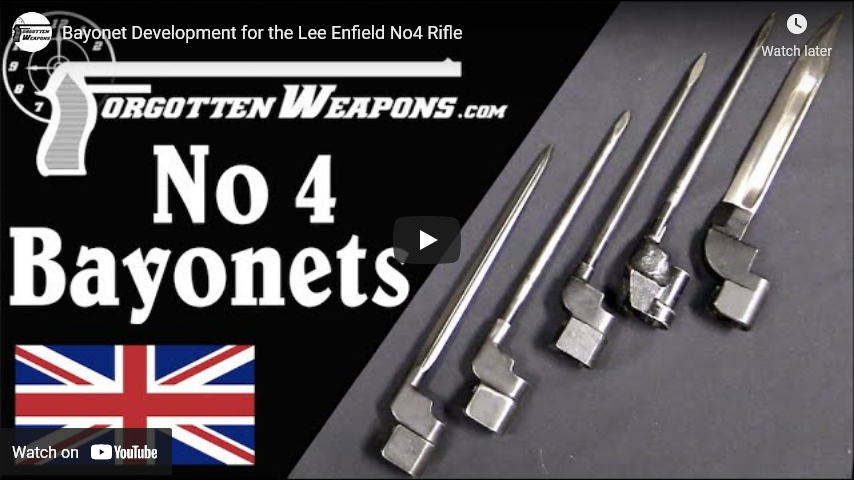
The Pattern 1907 bayonet was also changed, although this does not coincide with the MkIII* rifle. In 1913, the British decided to delete the quillon from the standard bayonet. A great many bayonet with quillons were already in service, and those would be used in World War One, although many were modified in the field to cut off the quillons to avoid them hanging up on barbed wire or other obstacles.
Contact:
Forgotten Weapons
6281 N. Oracle #36270
Tucson, AZ 85740
May 18, 2021
SMLE MkI***: The Updated Early Lee Enfields (and Irish Examples!)
Forgotten Weapons
Published 3 Feb 2021http://www.patreon.com/ForgottenWeapons
https://www.floatplane.com/channel/Fo…
Cool Forgotten Weapons merch! http://shop.bbtv.com/collections/forg…
When the British adopted a new high-velocity spitzer bullet for the .303 cartridge, they had to update their rifles to use it. Specifically, the sights had to be recalibrated for the flatter trajectory of the new MkVII ammunition. In addition, the sight picture was changed from a barleycorn front and V-notch rear to the more precise square front post and rear U-notch.
These rifles are quite scarce, but several thousand were brought into the US in the early 1960s as surplus from Ireland. These Irish examples all had new serial numbers applied when the were sent to Ireland by the British in the 1920s, and they are in two different batches (one in MkI*** configuration, and one with the MkIII rear sight). We will take a look at both patterns today as well, so you can see the difference between the much more available Irish type and the pure British version.
Contact:
Forgotten Weapons
6281 N. Oracle #36270
Tucson, AZ 85740
May 6, 2021
The Royal Canadian Navy – Sinking you, but politely
Drachinifel
Published 27 Jan 2021A brief history of the Royal Canadian Navy from its origins to the end of WW2.
Sources:
https://archive.org/details/seaisatourgatesh00germ
https://www.canada.ca/en/navy/services/history/naval-service-1910-2010.html
Legion Magazine – “Over The Side: The Courageous Boarding Of U-94”
www.amazon.co.uk/No-Higher-Purpose-Operational-1939-1943/dp/1551250616
www.amazon.co.uk/Canadas-Navy-Century-General-Interest/dp/0802042813/Free naval photos and more – www.drachinifel.co.uk
Want to support the channel? – https://www.patreon.com/Drachinifel
Want a shirt/mug/hoodie – https://shop.spreadshirt.com/drachini…
Want a poster? – https://www.etsy.com/uk/shop/Drachinifel
Want to talk about ships? https://discord.gg/TYu88mt
Want to get some books? www.amazon.co.uk/shop/drachinifelDrydock
Episodes in podcast format – https://soundcloud.com/user-21912004
May 5, 2021
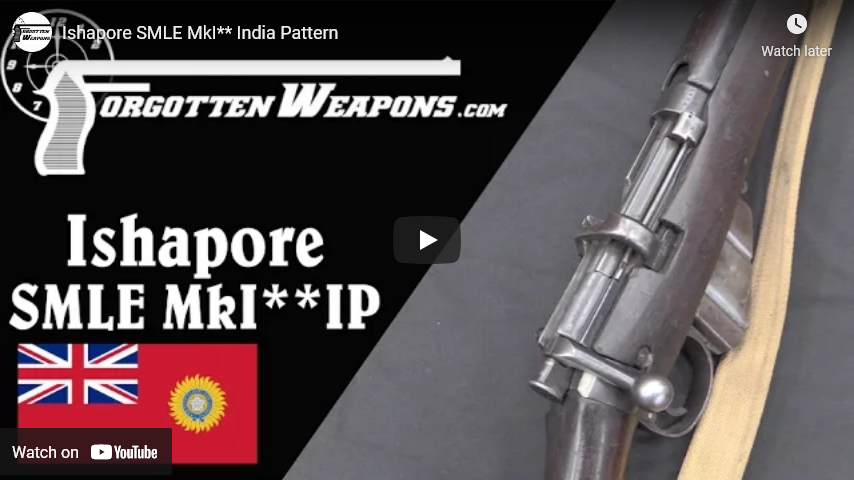
New Rifles for Old Ammo: The Royal Navy’s Unique SMLE MkI**
Forgotten Weapons
Published 27 Jan 2021http://www.patreon.com/ForgottenWeapons
https://www.floatplane.com/channel/Fo…
Cool Forgotten Weapons merch! http://shop.bbtv.com/collections/forg…
When the SMLE was adopted by the British, it was to be the new universal rifle for all branches of service, including the Royal Navy. This suited the Navy just fine; they like the features of the new design. However, the Army quickly moved to update their rifles for the new MkVII Spitzer ammunition, and this was an issue. The Navy still had substantial stockpiles of the older round-nose MkVI cartridge, and did not go through it nearly as quickly as the Army. The Navy did not want to simply throw out their ammunition, but the differences in trajectory between the two types of ammunition was substantial. So the Navy opted to adopt its own unique rifle variation, the MkI**. This in effect was the new Army pattern rifle, but with the rear sight still calibrated for the trajectory of MkVI ammunition.
This pattern was first adopted in 1908, using rifles with the then-standard split charger guide. When the fixed charger bridge was adopted, the Navy (which still had plenty of MkVI ammunition) chose to update its MkI** rifles to fixed charger bridges, without making any change to their designation. Once they finally ran out of the older ammunition during World War One, the rifles were updated once again to what was then the standard MkI*** pattern. As a result, intact MkI** rifles — especially ones with the split charger guide — are extremely rare to find today. Many thanks to the owner of these two specimens for giving me access to share them with you!
Contact:
Forgotten Weapons
6281 N. Oracle #36270
Tucson, AZ 85740
May 1, 2021
SMLE MkIII: The Iconic Smelly of World War One
Forgotten Weapons
Published 20 Jan 2021http://www.patreon.com/ForgottenWeapons
https://www.floatplane.com/channel/Fo…
Cool Forgotten Weapons merch! http://shop.bbtv.com/collections/forg…
In 1907, the British adopted the final major pattern in the evolution of the Short, Magazine, Lee Enfield. Designated the ShtLE MkIII (Short Lee Enfield) at the time, it would be retroactively renamed Rifle No1 MkIII in the 1920s. This new design was simpler and more durable than its predecessors while actually improving the practical accuracy of the rifle. The rear sight protector wings were substantially strengthened, the front sight became a square post, the front sight protectors were opened up to allow more light in, and the rear sight windage adjustment was simplified — while retailing 1 MOA adjustment clicks and 25m elevation adjustments. A new bayonet was also adopted in 1907 for the MkIII. The previous 1903 pattern bayonet was deemed too short, and the British essentially copied the Japanese Type 30 Arisaka bayonet as its new Pattern 1907 — hooked quillion and all.
The example we are looking at in today’s video is a fantastic specimen, as it was sold out of service to an Australian reservist in 1912 having not received any post-production modifications or updates. It is still sighted for the early MkVI round-nose ammunition, for example, and its bayonet retains the hooked quillion. The rifle’s owner died prior to World War One, and the gun remained stored away and forgotten through both World Wars, where virtually all existing service rifles were taken back into service and updated. Only in the 1960s was this one found, making it a pristine collector’s example to show how the MkIII was originally produced.
Contact:
Forgotten Weapons
6281 N. Oracle #36270
Tucson, AZ 85740
April 22, 2021
Charger-Loading Lee Enfields: The CLLE MkI* and MkII
Forgotten Weapons
Published 6 Jan 2020http://www.patreon.com/ForgottenWeapons
https://www.floatplane.com/channel/Fo…
Cool Forgotten Weapons merch! http://shop.bbtv.com/collections/forg…
In our continuing series on the development of the British Lee Enfield rifles, we are looking at the CLLE conversions today. In 1907 the British adopted a new universal short rifle (the SMLE) that used charger (aka stripper) clips. Previous models of the Lee in British service had to be loaded one round at a time by hand. In order to make use of the hundreds of thousands of “Long Lee” (and Metford) rifles already manufactured, the British instituted a program to update them with charger guides. The began in 1908 and ran to 1914, although the majority were done in 1909 and 1910. In addition to removing the dust cover and fitting the charger guide, the front sight, rear sight, magazine, and volley sights were all updated. The new sights were windage-adjustable on both front and rear, and calibrated for Mk VI ammunition (although many were later updated again and re-re-calibrated for Mk VII ammunition).
These CLLE rifles would serve as second-line rifles in World War One and even through the end of World War Two.
Contact:
Forgotten Weapons
6281 N. Oracle #36270
Tucson, AZ 85740
April 12, 2021
“War Communism” in the Soviet Union, 1917-1921
J.W. Rich outlines the economic and humanitarian disaster of Soviet “War Communism” that eventually forced Lenin to bring back some limited elements of capitalism to save the country:
In 1917, the Bolsheviks seized power in Moscow after the deposition of the democratic provisional government which had replaced the Tsar. However, the Bolsheviks’ hold on power was far from secure. There was little affection anywhere for the Tsar, but there was no agreement on what form of government should replace the monarchy. Bolshevism had been on the rise for years, but ideas of democracy and liberalism were gaining popularity as well. Shortly after the 1917 revolution, the Russian Civil War broke out between the Reds, the Bolsheviks, and the Whites, a coalition of anti-Bolsheviks that were generally democratic.
Through the course of the civil war, the Bolsheviks gained more power and control over increasingly large amounts of Russia. With this control, they began to implement their Marxist economic ideas into reality. On January 28, 1918, it was decreed that all factories should be directed by state-appointed managers. In effect, this amounted to a near-complete nationalization of industry. In one fell swoop, the vast majority of the production of Russia’s consumer goods was now under the purview and direction of the state.
On May 9, 1918, a grain monopoly was announced over grain production in the country. All grain harvested across the country was now the property of the state. This was extended even further when a general food levy was announced in January 1919. Any and all food was now the property of the state. In addition, local farm authorities were no longer allowed to set the levy based on harvest estimates. In essence, the state would take however much it wanted from the peasants without any concern if they had enough food to feed themselves and their families.
It was at this point that large-scale forced rationing was introduced. Money was made worthless overnight as ration cards were mandated to the entire population. No longer could you buy whatever you wished with the money you had. The goods allocated for you were predetermined on your ration card.
By late 1920, going into 1921, the Russian Civil War was all but over. The Whites had been soundly defeated by the Reds, giving the Bolsheviks control of nearly the entirety of the country. However, despite the victory in the Civil War, the economy at home was beginning to fall apart. Industrial production was at 20% of pre-war levels by 1920. As a result of this lagging production, there were few goods in the cities available. This resulted in a flight from the cities to the countryside. From 1918 to 1920, eight million people emigrated from the cities to the villages, where there was better hope of finding food or some goods. In Moscow and Petrograd, the population declined by 58.2%
The agricultural situation was not much better. Sheldon Richman records that from 1909-1913, gross agricultural output averaged 69 million tons. By 1921, it was just 31 million. From 1909-1913, sown area was over 224 million acres. In 1921, only 158 million acres were sown. This lack of food resulted in a mass loss of population. From 1917 to 1922, the entire population declined by 16 million, not counting immigration and deaths from the civil war.
War Communism was now fully implemented and the Marxist aspirations of Lenin and the Bolsheviks were now fulfilled. For the people that had to live under War Communism, however, the conditions had become intolerable. In February 1921, labor strikes began to emerge all over Russia. With the end of the civil war and living standards continuing to fall, resistance to the Bolsheviks began to spread throughout the country. Moscow was the first city to strike, with other large cities, such as Petrograd, following. The protestors demanded an end to War Communism and a restoration of private enterprise and civil liberties, such as the freedom of speech and assembly.
The protests escalated when the Kronstadt Naval Base mutinied against the government. Once a bastion of Bolshevik support and fervor, the sailors joined with the laborers in demanding reform and change. A force led by Trotsky was dispatched to deal with the mutiny, but Lenin knew that change was needed. The writing was on the wall for War Communism.
Tom Longboat: The “Bronze Streak to a Wildfire”
The History Guy: History Deserves to Be Remembered
Published 6 May 2019Tom Longboat has been called Canada’s first professional athlete. But amid his setting records and gaining accolades, he served his country in the Great War and fought discrimination. His life is history that deserves to be remembered.
This is original content based on research by The History Guy. Images in the Public Domain are carefully selected and provide illustration. As images of actual events are sometimes not available, images of similar objects and events are used for illustration.
All events are portrayed in historical context and for educational purposes. No images or content are primarily intended to shock and disgust. Those who do not learn from history are doomed to repeat it. Non censuram.
Patreon: https://www.patreon.com/TheHistoryGuy
The History Guy: History Deserves to Be Remembered is the place to find short snippets of forgotten history from five to fifteen minutes long. If you like history too, this is the channel for you.
Awesome The History Guy merchandise is available at:
teespring.com/stores/the-history-guyScript by HCW
#wwi #thehistoryguy #canada
April 10, 2021
QotD: “Too proud to fight”
[T]he example of America must be a special example … the example, not merely of peace because it will not fight, but of peace because peace is the healing and elevating influence of the world and strife is not. There is such a thing as a man being too proud to fight. There is such a thing as a nation being so right that it does not need to convince others by force that it is right.
Woodrow Wilson, speech in Philadelphia, 1915-05.
March 31, 2021
“Rosalie”: Trench Art SMLE with a Most Improbable Story
Forgotten Weapons
Published 21 Dec 2020http://www.patreon.com/ForgottenWeapons
https://www.floatplane.com/channel/Fo…
Cool Forgotten Weapons merch! http://shop.bbtv.com/collections/forg…
Henri Lecorre was a French immigrant to Canada who enlisted in the 22nd Regiment of the Canadian Army in April, 1915. He had a knack for carving things in his rifles, which he started right in basic training, with a Ross rifle he named “Josephine”. That got him sternly rebuked by his Colonel, but he would take up the habit again in 1916 when he arrived in France and began to see combat. At this point the Canadians were issuing SMLE rifles, and Lecorre named his “Rosalie”, after the French bayonet’s nickname.
Lecorre served through 14 major campaigns, and carved each name into his rifle as the years of the war dragged on. He was twice caught and punished for destruction of government property and fined for the cost of the rifle, although he managed to avoid more serious punishment both times. He only embellished the left side of Rosalie, so that his work would be hidden against his leg when standing at attention. By the summer of 1918, Rosalie’s service record included Vimy, Kemmel, St. Eloi, Hoodge, Zellebeck, Courcelette, Bully Grenay, Neuvilles Vaade, Mericour, Lievin, Lens, Cote 70, Passchendaele and Arras.
Fate eventually caught up to Private Lecorre, and in mid-1918 he was seriously wounded in an attack, and woke up in a military hospital in Dieppe. Rosalie was long gone, and Lecorre did not return to combat again.
The story is far from over, however. Rosalie was recovered from the battlefield, and sent back to Enfield with a batch of damaged rifles for refurbishment and reissue. Someone in the factory noticed the carving on it, and it was set aside. The arsenal commander took a liking to it, and it was hung in his office — where it remained for some 30 years. A Canadian officer from the 22nd Regiment noticed it at Enfield — thanks to Lecorre carving his unit’s name into it — during the Second World War, and thought it would be appropriate to return it to the unit’s home town, where the Citadelle Museum was established in 1950, with Rosalie as one of its original exhibits.
In 1956, Lecorre himself happened to visit an exhibition near Quebec City where the museum had set up, and was shocked to see his own Rosalie on display. After some understandable difficulty convincing the officer on duty that it was actually *his* rifle (which Lecorre did by reciting back its serial number unseen), a remarkable reunion took place. The rifle remained with the museum, but now with its full story known. It remains there to this day, on permanent display.
The Citadelle Museum commissioned a reproduction of Rosalie to be used for demonstrations, and it is this rifle which was graciously made available to me for filming, as the original is inaccessible on short notice because of its display case. Many thanks to the Citadelle for the opportunity to present it to you! If you are in Quebec City, make sure to take time to visit them:
https://www.lacitadelle.qc.ca/en/
Contact:
Forgotten Weapons
6281 N. Oracle #36270
Tucson, AZ 85740
March 23, 2021
Why are Pre-War Shipwrecks Disappearing?
Calum
Published 22 Aug 2020Pre-war shipwrecks are disappearing from the seabed. Why? A look at the sad reality of illegal salvaging that is destroying numerous war graves and historical wrecks around the world, told from the site of some of the most famous shipwrecks in the world; Scapa Flow.
The Guardian has done some amazing work in documenting this problem, worth a read if you have the time:
https://www.theguardian.com/world/201…
00:00 – Introduction & History of Scapa Flow
01:00 – Scuttling & Salvaging of the German High Fleet
02:45 – The Value of Pre-War Steel
03:54 – The Disappearing Shipwrecks
06:03 – HMS Royal Oak
10:16 – Disappearing Wargraves
10:58 – OutroTwitter………………….►https://twitter.com/calumraasay
Instagram…………….►http://instagram.com/calumraasay
Website………………..►http://calumgillies.com
March 11, 2021
Italy’s WW1 Heavy Machine Gun: FIAT-Revelli Modello 1914
Forgotten Weapons
Published 9 Dec 2020http://www.patreon.com/ForgottenWeapons
https://www.floatplane.com/channel/Fo…
Cool Forgotten Weapons merch! http://shop.bbtv.com/collections/forg…
Italy was the first major adopter of the Maxim heavy machine gun and had several hundred by 1914 — but wanted to have a domestic design in production as well. The Italian government and military put a lot of resources into the Perino machine gun, but kept it so secret that it was never properly tested and development was very slow. By the time war broke out, the Perino was clearly not ready for field use — and Maxims (along with other foreign designs) were no longer available for commercial sale as production was being taken up by warring nations. This led Italy to adopt a private design of Bethel Revelli in partnership with the FIAT company.
Adopted as the Modello 1914, Revelli’s machine gun was a delayed blowback system with a wedge under mechanical disadvantage holding the bolt closed long enough to safely cycle. Its most unique element was the 50-round mousetrap-type box magazine that used 10 independent stacks of 5 rounds each (a 100-round version was also made). This was a very complex magazine to produce, and much more delicate than the other machine gun feed systems in use at the time. The Revelli is also notable for being the only major machine gun of the period to have a circulating water jacket, operated by a small hand-cranked pump on the condensing tank.
The FIAT-Revelli would see service as both and aircraft and ground gun through World War 1, and was updated in 1935 to an air cooled pattern that would serve through World War 2. These guns are very scarce in the United States today, and I am grateful to the collector who owns this one for providing access to it!
Contact:
Forgotten Weapons
6281 N. Oracle #36270
Tucson, AZ 85740
February 5, 2021
The 369th Infantry Regiment in WW1 – the “Harlem Hellfighters”
Lawrence W. Reed remembers the US regiment that spent the most days in combat during WW1 and was awarded the French Croix de Guerre for the unit’s incredible fighting efforts:

“Some of the colored men of the 369th (15th N.Y.) who won the Croix de Guerre for gallantry in action.” Left to right. Front row: Pvt. Ed Williams, Herbert Taylor, Pvt. Leon Fraitor, Pvt. Ralph Hawkins. Back Row: Sgt. H. D. Prinas, Sgt. Dan Strorms, Pvt. Joe Williams, Pvt. Alfred Hanley, and Cpl. T. W. Taylor.
Records of the War Department General and Special Staffs via Wikimedia Commons.
Formed from a New York National Guard unit, the men of the 369th learned basic military practices at Camp Whitman, New York, before being sent to Camp Wadsworth in Spartanburg, South Carolina, for combat training. They were not welcomed by many of the locals there, and some were subjected to discrimination and vile epithets for no more reason than their color. In December 1917, they were shipped to France where they expected to see action on the front lines.
Their high spirits were quickly dashed when it became apparent the Army did not want to deploy them for anything other than manual labor, far from the fighting. Even the rifles they brought with them were confiscated by US Army officials.
The commander of the American Expeditionary Force, General John J. Pershing, was reluctant to commit any US troops to the front until he felt he had assembled them in sufficient numbers to ensure victory. The French, meanwhile, were desperate for manpower. Finally bowing to French pressure, Pershing gave them the 369th. While some regarded black troops as expendable, they ultimately proved themselves indispensable.
Consider this amazing record of the Harlem Hellfighters: No American unit experienced more time in combat than they did — no less than 191 days under fire. They never lost an inch of ground. The enemy never captured a single of their number. They suffered the highest casualty rate of any US regiment. None deserted. The grateful French bestowed their highest military honor, the Croix de Guerre, upon the entire regiment. Many individuals of the regiment received the US Army’s second-highest award, the Distinguished Service Cross. Posthumously, Henry Johnson received America’s Medal of Honor in 2015. The 369th ended up as the most decorated US regiment of the war.
Another distinguishing feature of the Harlem Hellfighters was their band, the largest and best-known of any regiment. Its leader was James Reese Europe, whose enlistment in 1917 proved to be a boon for recruitment. He was one of America’s best-known black musicians and others like Noble Sissle, who became Europe’s lieutenant and lead vocalist, were eager to serve with him.
Europe’s band was extremely popular with the French, even when Europe introduced his own arrangement of La Marseillaise, France’s national anthem. The Hellfighters’ band brought both jazz and ragtime music to France, where nobody had heard either before.