Quotulatiousness

October 28, 2021

There are bad generals, there are evil generals, and (in a class of his own) there’s Luigi Cadorna

Filed under: Europe, History, Italy, Military, WW1 — Tags: , , , , — Nicholas @ 05:00

Earlier this month, Bret Devereaux took the time to give WW1 Italian general Luigi Cadorna the attention he richly deserved as the worst general of that war (which also included the strong Austrian contender Conrad von Hötzendorf), and certainly must be considered to be in the running as the worst general in military history:

Luigi Cadorna, Marshal of Italy, Chief of Staff of the Italian Army, 1914-1917.
Photo via Wikimedia Commons.

This week we’re going to break from our normal fare and take a bit of a lark. I thought I ought to substantiate the nearly endless shade towards Luigi Cadorna, Italian Army Chief of Staff from 1914-1917 (though I realize after writing this that what I actually ought to have done is just told the same bad joke about Cadorna 11 times in a row and let that stand as the explanation). I said that Cadorna was my pick for the worst general of World War I. Now, as I noted at the time, there is some stiff competition for that position. While I argued that the tactical problem of trench warfare probably wasn’t solvable by any general, that doesn’t mean that some generals didn’t perform better than others under the difficult conditions imposed by the stalemate.

Now I should be clear here what I mean by “worst general”. What I am assessing here is the fellow who was worst at generaling, rather than the worst human being who happened to be a general. That latter prize probably goes to İsmail Enver Pasha, Ottoman Minister of War from 1914 to 1918, a vain, arrogant strutting sort of man who not only utterly botched the only battle in which he commanded directly (Sarikamish, Dec. 1914 – Jan 1915) but who also then blamed his defeat (falsely) on the Armenians and subsequently instigated and played a key role in the Armenian genocide. He then sold his services to the Soviets, before betraying them to side with the Basmachi movement, which didn’t go particularly well either.

We are also here not investigating to see which WWI leader made the single worst decision. As I’ve noted before, the worst decision in the First World War was having a First World War, though the responsibility for that is diffused across multiple different leading figures.

Luigi Cadorna didn’t, to my knowledge, perpetrate any genocides, though as we’ll see, he was cruel and unreasonable. Nor did he bring Italy to war. The son of Count Raffaele Cadorna (who had led the army which captured Rome, completing the unification of Italy), Cadorna’s political connections, particularly to the king Victor Emmanuel III, made him functionally impossible to remove from command after he was made chief of staff in 1914. For his part, Cadorna seems to have spent about as much time fighting a political battle in Rome as he did fighting the actual war on the Isonzo; Cadorna insisted at the outset that he would only accept the job if he was given unfettered, complete authority. As we’ll see, that complete authority is not going to come with complete responsibility for outcomes. But in any event, this is a good illustration of Cadorna’s personality: bitter, arrogant and callous, but with a cruel authoritarian streak and a profound conviction that all of his mistakes were someone else’s fault.

[…] Cadorna has a small, fragile and relatively weak army to work with. Conscription would eventually put millions more Italians in the ranks (and slowly make the equipment situation less of a disaster), but of course everyone else was doing that too and even then it was clear from a simple exercise in demography that Italy’s manpower reserves were likely to be brittle. An equally simple exercise in economic statistics would suggest that while Italy’s army might be made minimally sufficient in equipment (the Italians eventually end up deploying well over a thousand artillery pieces on the Isonzo front, though the quality of their artillery never matched what was available on either side of the Western Front), it would never be excellent. Strategically then, Cadorna had the one army; it was small and weak and it was also effectively all Italy had. Moreover Italy, only recently unified (recall, Cadorna’s father had been directly involved!) was still politically fragile itself and might not take well for horrible casualties. So Cadorna’s army had to be husbanded carefully, spent only in great need and for great benefit.

Instead of doing literally any of that, Cadorna opted to pursue the highest operational tempo of any front of the war. I can’t stress this enough: between May 1915 and October 1917, the French launched (or supported) four offensives (Second Artois, Third Artois/Second Champagne/Loos, the Somme and the Nivelle Offensive; I’m not counting Second Arras as that was a Commonwealth operation in which the French had little part), plus being on the defensive at Verdun. Of course there were lots of minor operations too, but that’s five major operations on the Western Front, where the French were almost totally focused. In contrast, in that same time frame, Cadorna – who again, has the smallest, weakest major army – launches eleven (11)(eleven)(XI)(1011)(I𐤗‎)(ΙΑ)(eleven!?!) offensives on the Isonzo River.

[…]

Because Cadorna thought that discipline and morale were the key components of victory (and also because he seems to have just generally been a cruel, uncaring and authoritarian person) he attempted to enforce both in his army through coercion and cruelty. Cadorna executed around 750 men for cowardice (to my knowledge the highest rate in any army of the war), presided over a military justice regime that convicted something like 3.6% of his army of one disciplinary charge or the other. He dismissed an incredible total of 217 officers during his tenure, frequently because he felt they were not committed enough or aggressive enough and when his army began to fall apart at Caporetto, he ordered the summary execution of officers whose units retreated. It turns out that actually adopting a “the beatings will continue until morale improves” command style does not actually improve morale.

September 28, 2021

Battle of Coronel – Sundown in the Eastern Pacific

Filed under: Britain, Germany, History, Military, Pacific, WW1 — Tags: , — Nicholas @ 04:00

Drachinifel
Published 18 Mar 2020

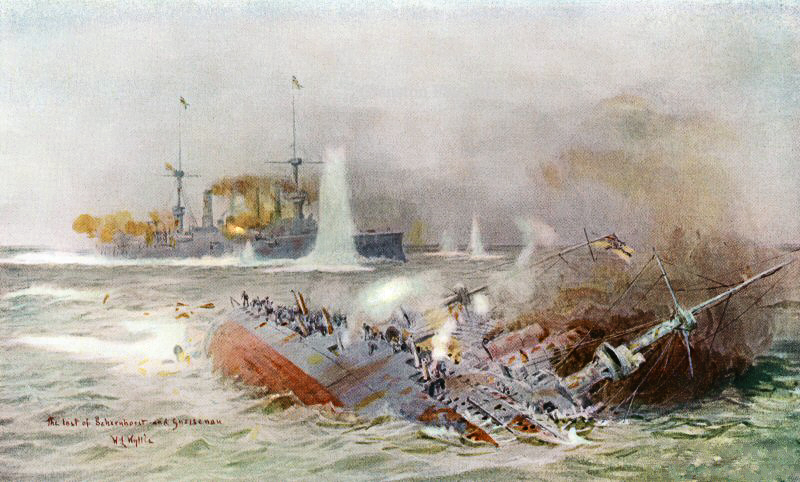
Today we look at the first of two battles involving Admiral von Spee, the Battle of Coronel.

Want to support the channel? – https://www.patreon.com/Drachinifel

Want a shirt/mug/hoodie – https://shop.spreadshirt.com/drachini…

Want a medal? – https://www.etsy.com/uk/shop/Drachinifel

Want to talk about ships? https://discord.gg/TYu88mt

Want to get some books? www.amazon.co.uk/shop/drachinifel

Drydock Episodes in podcast format – https://soundcloud.com/user-21912004

Webley 1913 Semiauto Pistol: Shooting

Filed under: Britain, History, Military, Weapons, WW1 — Tags: , , — Nicholas @ 02:00

Forgotten Weapons
Published 26 May 2017

Following up on yesterday’s history and disassembly of the Webley 1913, today I am taking one of them out to the range. Courtesy of Mike Carrick from Arms Heritage magazine, I am shooting original WWI British .455 SL ammunition. We don’t have a lot of it to work with here, but we will try out some magazine fire as well as some single loading, since the magazine cutoff was one of the relatively unique features of the 1913 Webley.

Overall, from this admittedly limited firing experience, I think the Webley is a rather underrated pistol, probably because of its short service live and unavailable ammunition. Despite its awkward appearance, it handles and points pretty well, and has felt recoil not unlike the Colt 1911, despite having a more powerful cartridge.

Cool Forgotten Weapons merchandise! http://shop.bbtv.com/collections/forg…

http://www.patreon.com/ForgottenWeapons

If you enjoy Forgotten Weapons, check out its sister channel, InRangeTV! http://www.youtube.com/InRangeTVShow

September 27, 2021

How exactly does dazzle paint work?

Filed under: Britain, Cancon, Germany, History, Military, USA, WW1, WW2 — Tags: , , , — Nicholas @ 02:00

Nautical Study
Published 22 May 2021

In early 1917, a British artist by the name of Norman Wilkinson approached the British admiralty with an ingenious idea that would save countless lives from the German U-boat campaign. His idea: dazzle paint. Complex in concept, but just crazy enough to work.

Thanks for your support!

Music: Emperor’s Waltz
https://www.youtube.com/watch?v=foHeA…

All colorized photos in this video have credits attributed to them if I could find them. If you know who colorized any that are left unattributed, please let me know!

September 25, 2021

“Steel Commanders” – Tanks and Panzer! – Sabaton History 106 [Official]

Filed under: Britain, Europe, Germany, History, Media, Military, Russia, USA, WW1, WW2 — Tags: , , , , — Nicholas @ 04:00

Sabaton History
Published 24 Sep 2021

From the first landships of the Great War to the massive armor-battles of Prokhorovka and El-Alamein — the introduction of the tank to the battlefield had changed warfare forever. Impregnable to small-arms fire, they crushed barbed-wire and field fortifications underneath their tracks, paving the way for the infantry’s advance. In independent formations they surged forward at the head of the offensive, outmaneuvering the enemy’s defenses and wreaking havoc in their lines. From the Mark V to the T-34, from the Tiger to the Centurion — the evolution of armor is the history of Steel Commanders.

Support Sabaton History on Patreon: https://www.patreon.com/sabatonhistory

Watch the Official Music Video of “Steel Commanders” here: https://www.youtube.com/watch?v=peTCe…

Listen to Sabaton on Spotify: http://smarturl.it/SabatonSpotify
Official Sabaton Merchandise Shop: http://bit.ly/SabatonOfficialShop

Hosted by: Indy Neidell
Written by: Markus Linke and Indy Neidell
Directed by: Astrid Deinhard and Wieke Kapteijns
Produced by: Pär Sundström, Astrid Deinhard and Spartacus Olsson
Creative Producer: Maria Kyhle
Executive Producers: Pär Sundström, Joakim Brodén, Tomas Sunmo, Indy Neidell, Astrid Deinhard, and Spartacus Olsson
Community Manager: Maria Kyhle
Post-Production Director: Wieke Kapteijns
Editor: Iryna Dulka
Sound Editor: Marek Kaminski
Archive: Reuters/Screenocean – https://www.screenocean.com
Sources:
– IWM E 18376, IWM 357, Q 9249, IWM 1198, IWM 130-09+10, Q 107828, IWM 508-70, KID 109, UKY 502, E 7070, H 37169, MH4107
– wall by mara julieta G., Tree by Joni Ramadhan; from the Noun Project
All music by: Sabaton

An OnLion Entertainment GmbH and Raging Beaver Publishing AB co-Production.

© Raging Beaver Publishing AB, 2019 – all rights reserved.

Webley 1913 Semiauto Pistol: History and Disassembly

Filed under: Britain, History, Military, Weapons, WW1 — Tags: , , , , — Nicholas @ 02:00

Forgotten Weapons
Published 25 May 2017

William Whiting and the Webley company had high hopes for their self-loading pistols being adopted by the British military — but they never got the success they were hoping for.

After the poor performance of the Webley 1904 (https://www.youtube.com/watch?v=-hT38…) at trials, William Whiting decided to make sure his next attempt would be fully developed before he put it in the hands of the military. He did very well at that too, as the gun which would become the Model 1913 Webley did very well from its very first military tests. The Royal Navy was, in fact, quite enthusiastic about it, although the Army was not. The Navy would ultimately adopt the gun and purchase about 8,000 of them during World War One, while the Army acquired just a couple hundred and preferred to stick to its revolvers.

Thanks to Mike Carrick of Arms Heritage magazine for loaning me these pistols to bring to you!

Cool Forgotten Weapons merchandise! http://shop.bbtv.com/collections/forg…

http://www.patreon.com/ForgottenWeapons

If you enjoy Forgotten Weapons, check out its sister channel, InRangeTV! http://www.youtube.com/InRangeTVShow

September 22, 2021

Ishapore SMLE MkI** India Pattern

Filed under: Britain, History, India, Military, Weapons, WW1 — Tags: , , , — Nicholas @ 02:00

Forgotten Weapons
Published 6 Feb 2017

While many people are familiar with the Ishapore 2A1 rifles chambered in 7.62mm NATO (largely thanks to their importation and sale in the US in large numbers), production of Indian Enfield rifles actually dates back to 1905, when the Ishapore arsenal was opened. The first rifles produced there were a batch of 3,000 MkI Enfield rifles in 1908/9. These were of course early pattern SMLEs, with features like split charger bridges, volley sights, and magazine cutoffs. Production quickly changed to the No1 Mk III pattern of rifle, which had been formally adopted in Britain in 1907.

During World War One, the need for arms led to those first early rifles being rebuilt in the MkIII configuration, but they retain their original markings, showing their origin. Today we have one of those first 3,000 to look at.

http://www.patreon.com/ForgottenWeapons

Cool Forgotten Weapons merch! http://shop.bbtv.com/collections/forg…

If you enjoy Forgotten Weapons, check out its sister channel, InRangeTV! http://www.youtube.com/InRangeTVShow

September 20, 2021

QotD: English jingoism

Filed under: Britain, History, Quotations, WW1 — Tags: , , , , , , — Nicholas @ 01:00

In England all the boasting and flag-wagging, the “Rule Britannia” stuff, is done by small minorities. The patriotism of the common people is not vocal or even conscious. They do not retain among their historical memories the name of a single military victory. English literature, like other literatures, is full of battle-poems, but it is worth noticing that the ones that have won for themselves a kind of popularity are always a tale of disasters and retreats. There is no popular poem about Trafalgar or Waterloo, for instance. Sir John Moore’s army at Corunna, fighting a desperate rear-guard action before escaping overseas (just like Dunkirk!) has more appeal than a brilliant victory. The most stirring battle-poem in English is about a brigade of cavalry which charged in the wrong direction. And of the last war, the four names which have really engraved themselves on the popular memory are Mons, Ypres, Gallipoli and Passchendaele, every time a disaster. The names of the great battles that finally broke the German armies are simply unknown to the general public.

The reason why the English anti-militarism disgusts foreign observers is that it ignores the existence of the British Empire. It looks like sheer hypocrisy. After all, the English have absorbed a quarter of the earth and held on to it by means of a huge navy. How dare they then turn round and say that war is wicked?

It is quite true that the English are hypocritical about their Empire. In the working class this hypocrisy takes the form of not knowing that the Empire exists. But their dislike of standing armies is a perfectly sound instinct. A navy employs comparatively few people, and it is an external weapon which cannot affect home politics directly. Military dictatorships exist everywhere, but there is no such thing as a naval dictatorship. What English people of nearly all classes loathe from the bottom of their hearts is the swaggering officer type, the jingle of spurs and the crash of boots. Decades before Hitler was ever heard of, the word “Prussian” had much the same significance in England as “Nazi” has to-day. So deep does this feeling go that for a hundred years past the officers of the British Army, in peace-time, have always worn civilian clothes when off duty.

George Orwell, “The Lion And The Unicorn: Socialism and the English Genius”, 1941-02-19.

September 14, 2021

QotD: “In 1918 it was statistically safer for a British soldier to fight in the trenches of the Western Front than be a prisoner in Germany”

Filed under: Books, Britain, Germany, History, Military, Quotations, WW1 — Tags: , , , — Nicholas @ 01:00

… the Kaiser’s armies behaved abysmally on the battlefields of the Great War fighting foreigners. As soon as the Germany Army crossed the border into Belgium, the atrocities began. If the sensational stories of German soldiers eating Belgian babies can be discounted as Allied propaganda, the painstaking research of Alan Kramer and John Horne, in German Atrocities, 1914: A History of Denial (2001), demonstrates beyond reasonable doubt that Germany engaged in a systematic programme of civilian executions with the purpose of striking terror into the heart of the Belgian population. On 23 August, 1914, in the city of Dinant, the German army burned down a thousand buildings and executed some 674 civilians. The oldest among them was in his 90s; the youngest was barely a month old.

On and on the German outrages went: the sinking of the Lusitania, the execution of Nurse Cavell. Of course, the Allies were not saints, but the fashionable fallacy of moral equivalence — that all sides in the Great War were as bad as each other — founders on the rocks of Germany’s treatment of prisoners of war, who became slave labourers.

This was the main substance of the British agenda at Leipzig. Almost 165,000 British soldiers were taken prisoner on the Western Front between 1914-18; by the end of 1916, almost 80% were forced into labour for the Second Reich. Prisoners were literally worked to death in salt mines. And conditions in many camps were inhuman: in Wittenberg, two water taps served 17,000 Allied PoWs. When typhus struck the camp, the German staff abandoned it and left the prisoners to die. Some 13,000 Brits perished in the Kaiser’s camps — the vast majority because of brutality, disease, malnutrition or exhaustion. But 500 British soldiers were summarily shot or beaten to death at the Kaiser’s pleasure during their detention.

Of all the German PoWs held in Britain during the Great War, 3% died; of the British PoWs held in Germany, more than 10% perished. In 1918 it was statistically safer for a British soldier to fight in the trenches of the Western Front than be a prisoner in Germany. That year, 5.8% of British PoWs in Germany died, compared to 4% of British soldiers on the battlefield.

John Lewis Stempel, “Germany’s First World War Guilt”, UnHerd, 2021-05-25.

August 22, 2021

QotD: Woodrow Wilson, wrong on many things, but quite right on this one thing

Filed under: History, Quotations, USA, WW1 — Tags: , , , , — Nicholas @ 01:00

Woodrow Wilson was wrong about many things, but he was a veritable hedgehog about One Big Thing: the principle of national self-determination. When it came to his dream of the League of Nations, Wilson was a utopian romantic; but on the question of how to draw national political boundaries, he was a Founding Father of what may be called National Realism.

National Realism comprehends and respects the perhaps tragic, but nevertheless undeniable, fact that most people are deeply attached to collective identities and aspirations. It accepts as both natural and important that psychological well-being would be rooted in a terroir, a set of traditions or other mythologies about who people are and where they come from, that can serve as a source of meaning and self-understanding, as well as social cohesion. It acknowledges that nationalism is a fixture of modern social and political reality.

The idea that a self-described people should have the right to determine its own collective destiny was once considered progressive. Nineteenth-century liberal nationalists like Giuseppe Mazzini in Italy and Ernest Renan in France saw in the nation-state the fullest political expression of peoplehood, a true source of law and legitimacy, a celebration of diversity, and a font of culture, art, and human flourishing. The idea of national self-determination also resonated with the American Founding and with the Declaration of Independence, which proclaimed that governments derive their powers from the consent of the governed and found in Natural Law the right for one people to “dissolve the political bands which have connected it with another, and to assume among the powers of the earth the separate and equal station to which the Laws of Nature and of Nature’s God entitle them.” For good or ill, the French Revolution had awakened modern ethnic self-awareness among European peoples, and ever since, nationalism has been the most robust political force in international affairs. Nationalism is a property of modern nation states, the same way that gravity is a property of physical matter. It is unwise to underestimate its power.

Diversity is now, supposedly, the primus inter pares of our political values. But ethnic and racial diversity, in all its colorful pageantry, is traditionally associated with empires, not republics. Diversity brings to mind Barbara Tuchman’s description of Queen Victoria’s Diamond Jubilee, with its splendid processions of Royal Nigerian Constabulary, Borneo Dyak Police, turbaned and bearded Lancers of Khapurthala and Badnagar, Zaptichs from Cyprus with their tasseled fezzes and black-maned ponies, Houssas from the Gold Coast, Chinese from Hong Kong, and Malays from Singapore, all paying homage to the great monarch. Imperial Rome was an equally spectacular kaleidoscope of nations and religions. By contrast, republican Rome was merely, austerely, Roman.

As a good Progressive, Wilson understood that modern democratic government is incompatible with multi-ethnic empire. But it took the cataclysmic breakdown of the Old World empires in the meat-grinder of World War I to bring the idea of national self-determination into political focus. It would be wise to remember that that civilization-shattering conflict was blamed in large part on the lack of congruence between state and ethnic boundaries. Most of Wilson’s famous Fourteen Points, outlined 101 years ago this month, were dedicated to correcting this discrepancy on the basis of national self-determination.

E.M. Oblomov, “The Case for National Realism: Diversity is the hallmark of empires, not democracies”, City Journal, 2019-01-02.

August 1, 2021

QotD: Rudolf Gaida’s convoluted military career

Filed under: Europe, History, Military, Quotations, Russia, WW1, WW2 — Tags: , , , , , — Nicholas @ 01:00

Rudolf Gaida, 1882-1948. Born in Montenegro (then a part of Austria-Hungary). Trained as a pharmacist in Bohemia. Conscripted into the army medical corps, July 1914. Deserted to a Montenegrin regiment, pretending to be an officer, 1915. Captured by the Russians, 1917. In May 1918, with the rank of Captain, he served in the Czechoslovak Corps, and favoured fighting the Bolsheviks. Colonel commanding the Czech forces in Central Siberia, July-October 1918. Supported Admiral Kolchak’s seizure of power at Omsk, November 1918. Promoted Major-General by Kolchak, November 1918. Commanded Kolchak’s Northern Army, June-July 1919, with the rank of Lieutenant-General. Dismissed by Kolchak, July 1919. Attempted unsuccessfully to seize power at Vladivostok, November 1919. Returned to Czechoslovakia, 1920. Chief of the Czech General Staff, 1926. Cashiered for trying to take part in a fascist putsch. Imprisoned for “Banditry”, 1931. Headed the Czech Fascist organization, 1939-45. Arrested as a collaborator, 1945, and subsequently shot.

Footnote in Martin Gilbert’s World in Torment: Winston S. Churchill 1917-1922, 1975.

July 28, 2021

Possible relic from the 1917 Halifax explosion discovered by scuba diver

Filed under: Cancon, History, WW1 — Tags: , , , , — Nicholas @ 03:00

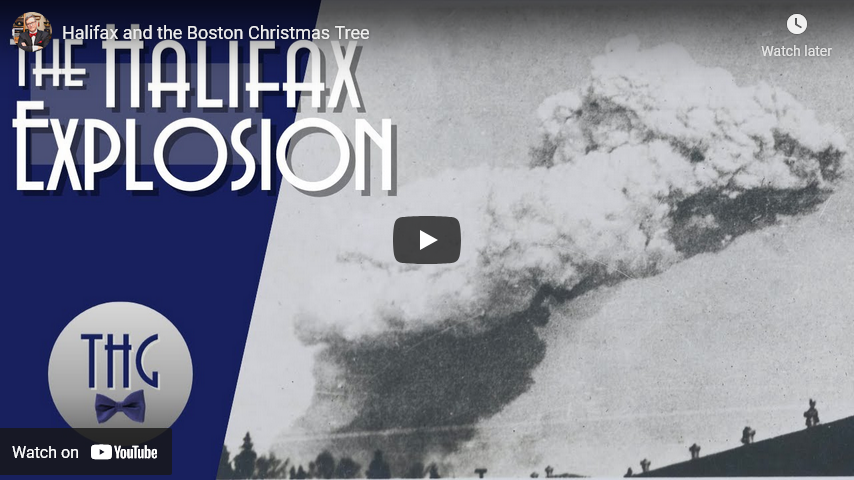
If you’re not familiar with the Halifax explosion, I collected some information about it here. One of the lesser-known ships involved in the disaster was the schooner St. Bernard, which was completely destroyed in the explosion of the cargo ship SS Mont Blanc after it collided with the Belgian relief ship Imo in the Narrows:

The schooner St. Bernard, which was destroyed when the Mont Blanc exploded nearby.
Photo from the Nova Scotia Museum.

A Halifax scuba diver has found something that could shed a little new light on one aspect of a dark chapter in Nova Scotian history.

Bob Chaulk has explored Halifax harbour from the Bedford Basin to Chebucto Head with hundreds of scuba dives over the last 30 years. But this spring, a routine dive in a small cove in the Narrows between Halifax’s two bridges led him to a big find.

Amid the usual assortment of scuttling crabs, polished bottles and bits of plastic trash, he came upon a huge, heavy object in Tufts Cove.

“When I first saw the anchor, I thought, OK, there’s a wreck here, some old derelict came in here. But there’s no way a ship that size could have gotten in here,” he said.

He explored until his air just about ran out. He estimated the anchor was about two metres long and weighed 135 kilograms. A ship that needed an anchor that size could not have sailed into shallow, rocky Tufts Cove, he thought.

So how did the old anchor get there?

He looked across the Narrows and found himself staring right at ground zero for the Halifax Explosion, which killed nearly 2,000 people. On Dec. 6, 1917, the vessel Imo and the Mont Blanc, a ship carrying explosive cargo, collided. The Mont Blanc caught fire and drifted into Pier 6, a space occupied today by the giant Halifax Shipyard building. The St. Bernard, a lumber schooner, was also at the dock.

“So now you have two ships side by side with a dock in between them. Here’s the Mont Blanc, here’s the Imo,” Chaulk said, showing the ships’ positions with his hands. “This one blows up, destroys this one, and I contend the anchor [of the St. Bernard] went through the air and landed right here.”

A modern day view of the Narrows, showing Tufts Cove to the north and the huge Halifax Shipyard complex on the south side of the channel.
Google Maps.

I suspect that the paved area to the right of the cove proper is largely landfill and the shoreline of 1917 probably followed much closer to the railway line.

H/T to Colby Cosh for the link.

QotD: Lawrence and the Hejaz railway

Filed under: Britain, History, Middle East, Military, Quotations, Railways, WW1 — Tags: , , — Nicholas @ 01:00

Lawrence had used Aqaba as a base for repeated attacks on the Hejaz railway until the winter, when there was a lull in the fighting. Allenby’s progress towards Damascus was delayed, too, as two of his divisions (around 25,000 men) were redeployed to the Western Front. In the spring, when the drive to Damascus finally began, the policy towards the railway changed. It was imperative to cut off the line up from the Hejaz so that the Turks could not use it to bring reinforcements from Madinah against Allenby’s forces. Consequently, Lawrence’s group attacked the railway in various places, having developed a more sophisticated type of mine inappropriately called “tulip”. This was a much smaller charge, a mere 2lb of dynamite compared with the 40lb or 50lb ones used previously, and involved placing the charge underneath the sleepers, which would blow the metal upwards “into a tulip-like shape without breaking; by doing so it distored the two rails to which its ends were attached”, which was impossible to repair and consequently forced the Turks to replace the whole section of track. In early April 1918, the last train between Madinah and Damascus made it through but after that the line was blocked by successive attacks which left more Turkish troops stuck in the Hejaz protecting a line that was now of no strategic use than were facing Allenby in Palestine. In the decisvie attack at Tel Shahm, led by General Dawnay, Lawrence showed his regard for the railway by claiming the station bell, a fine piece of Damascus brass work: “the next man took the ticket punch and the third the office stamp, while the bewildered Turks stared at us with a growing indignation that their importance should be merely secondary”. The Turks had clearly never met any British trainspotters with their obsession for railway memorabilia.

Christian Wolmar, Engines of War: How Wars Were Won & Lost on the Railways, 2010.

July 20, 2021

QotD: Lenin’s “Hanging Order”

Filed under: History, Quotations, Russia, WW1 — Tags: , , , , — Nicholas @ 01:00

Lenin is the same cold-blooded thug who famously wrote, “We must be ready to employ trickery, deceit, law-breaking, withholding and concealing truth[.] … We can and must write in a language which sows among the masses hate, revulsion, and scorn toward those who disagree with us.”

Elsewhere, Lenin declared that “The proletariat needs state power, the centralized organization of force, the organization of violence, for the purpose of crushing the resistance … and for the purpose of leading the great mass of the population … in the work of organizing a socialist economy.”

In August 1918, Lenin sent his now famous “Hanging Order” telegram. It instructed local Bolsheviks in the Penza region to deal harshly with the farmers (kulaks) who owned land there and were standing in the way of its nationalization. The British historian Robert Service discovered it in Soviet archives in the 1990s. It read as follows:

    Comrades! The insurrection of five kulak districts should be pitilessly suppressed. The interests of the whole revolution require this because ‘the last decisive battle’ with the kulaks is now underway everywhere. An example must be made.

    1. Hang (absolutely hang, in full view of the people) no fewer than one hundred known kulaks, fatcats, bloodsuckers.
    2. Publish their names.
    3. Seize all grain from them.
    4. Designate hostages, in accordance with yesterday’s telegram.

    Do it in such a fashion, that for hundreds of miles around the people see, tremble, know, shout: “The bloodsucking kulaks are being strangled and will be strangled.”

    Telegraph receipt and implementation.

    Yours, Lenin.

    P.S. Use your toughest people for this.

That chilling telegram ushered in the “Red Terror” which murdered Russians by the tens of thousands over the next two years.

Lawrence W. Reed, “How Germany’s ‘Deal With the Devil’ Backfired and Changed History”, Foundation for Economic Education, 2021-04-16.

July 11, 2021

History and Disassembly of the Vickers-Berthier MkIII LMG

Filed under: History, India, Military, Weapons, WW1, WW2 — Tags: , , , , — Nicholas @ 02:00

Forgotten Weapons
Published 19 Sep 2017

http://www.patreon.com/ForgottenWeapons​

Cool Forgotten Weapons merch! http://shop.bbtv.com/collections/forg…​

The Vickers-Berthier was initially designed by Andre Berthier in France prior to World War One. It went through a number of substantial design changes before the war, and was actually ordered in quantity by the United States right at the end of WWI — but the order was cancelled with the armistice. In the 1920s, Berthier sold the design to the Vickers company in England, which wanted a light machine gun to market alongside its Vickers heavy machine gun.

When the British military decided to replace its Lewis and Hotchkiss light machine guns, the Vickers-Berthier was one of the leading contenders, although in the endurance trials it was edged out by the Czech ZB-33, which would ultimately be adopted as the Bren. However, the Indian Army opted to take the Vickers-Berthier, and it was put into production at the Ishapore Rifle Factory and saw substantial use in World War Two.

Mechanically, the Vickers-Berthier is a tilting bolt design with a long stroke gas piston. It has a thorough set of covers over the magazine well and ejection port, and a relatively slow rate of fire. The barrel is quick-changeable, and it feeds from top-mounted 30-round magazines, with an aperture type rear sight being offset to the left side of the gun to clear the magazine.

Thanks to Marstar for letting me examine and shoot their Vickers-Berthier!

If you enjoy Forgotten Weapons, check out its sister channel, InRangeTV! http://www.youtube.com/InRangeTVShow

« Newer PostsOlder Posts »

Powered by WordPress