
The Great War
Published 28 Apr 2023What was the deadliest day of any nation in WW1? There are multiple candidates for that, but why should we even care? Well, the answer to this question highlights a challenge with popular memory that is often focused on the biggest battles of the war like the Somme or Verdun.
(more…)
April 29, 2023
What Was the Deadliest Day of the First World War?
Comments Off on What Was the Deadliest Day of the First World War?
April 27, 2023
M1908 Mondragon Semiauto Rifle
Forgotten Weapons
Published 24 Nov 2014The M1908 Mondragon is widely acknowledged to have been the first self-loading rifle adopted as a standard infantry arm by a national military force. There are a couple of earlier designs used by military forces, but the Mondragon was the first really mass-produced example and deserves its place in firearms history.
Designed by Mexican general Manuel Mondragon (who had a number of other arms development successes under his belt by this time), the rifles were manufactured by SIG in Switzerland. They are very high quality guns, if a bit clunky in their handling.
The design used a long-action gas piston and a rotating bolt to lock. Interestingly, the bolt had two full sets of locking lugs; one at the front and one at the rear as well as two set of cams for the operating rod and bolt handle to rotate the bolt with. The standard rifle used a 10-round internal magazine fed by stripper clips, but they were also adapted for larger detachable magazines and drums.
Unfortunately, the rifle required relatively high-quality ammunition to function reliably, and Mexico’s domestic production was not up to par. This led to the rifles having many problems in Mexican service, and Mexico refused to pay for them after the first thousand of their 4,000-unit order arrived. The remaining guns were kept by SIG, and ultimately sold to Germany for use as aircraft observer weapons.
(more…)
Comments Off on M1908 Mondragon Semiauto Rifle
April 16, 2023
QotD: Homo electronicus and the permanent caloric surplus
Finally, I suggest that the permanent caloric surplus that has obtained in the West since about 1950 has done more than anything to speciate us Postmoderns. It would take someone who Fucking Loves Science™ way more than I do to assert that the vast, obvious changes in the human race in the 20th century were merely physical. Consider the oft-remarked fact (at the time, at least) that British officers on the Western Front were a full head taller than their men. Then consider (ditto) the more-or-less open secret that a lot of those tall subalterns were gay. Correlation is not causation — growing up in the infamous English public schools probably had a lot to do with it, as Robert Graves himself says — but … there’s a pretty strong correlation.
Excess fat cranks up estrogen levels. You don’t need to be House MD to interpret this finding:
In males with increasing obesity there is increased aromatase activity, which irreversibly converts testosterone to estradiol resulting in decreased testosterone and elevated estrogen levels.
Or this one:
A study supports the link between excess weight and higher hormone levels. The study found that estrogen and testosterone levels dropped quite a bit when overweight and obese women lost weight.
This is not to say those swishy subalterns were fat — indeed, they were comically scrawny compared to Postmodern people. But a little goes a long way when it comes to hormones, especially in a world where “intermittent fasting” wasn’t a fad diet, but a way of life. Any one of us would keel over from hunger if we were forced to eat the kind of diet George Orwell described as his public school’s standard fare.
Follow that trend out to the Current Year, when pretty much everyone is grossly obese compared to even the Silent Generation. Heartiste and other “game” bloggers loved pointing out that the average modern woman weighs as much as the average man did in the 1960s. And while I think that’s overblown — we’re also several inches taller, on average, than 1960s people — there’s definitely something to it, especially when you consider how far the bell curve has shifted to the fat end. Not only do people weigh a lot more on average, the people who weigh more than average now weigh a hell of a lot more than heavier-than-average people did back when. See, for example, the ballooning weight of offensive linemen, who are professionally fat — in 2011 a quarterback, Cam Newton, weighed more than the average offensive lineman in the 1960s.
Put the two trends together and you have, on average, a hormone cocktail way, way different than even 50 years ago … and that’s before you add in things like all-but-universal hormonal contraception, lots of which ends up in municipal drinking water.
Severian, “Recent Evolution”, Rotten Chestnuts, 2020-09-28.
Comments Off on QotD: Homo electronicus and the permanent caloric surplus
April 10, 2023
US Army and Marine Corps deployments other than with the American Expeditionary Forces (AEF)
Another excerpt from John Sayen’s Battalion: An Organizational Study of United States Infantry currently being serialized on Bruce Gudmundsson’s Tactical Notebook shows where US infantry units (US Army and USMC) were deployed aside from those assigned to Pershing’s AEF on the Western Front in France:
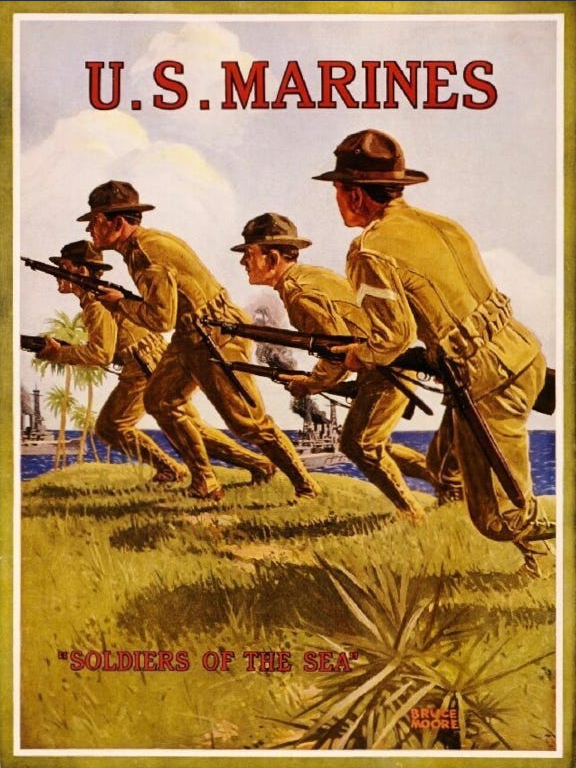
Apart from the war in Europe, the principal military concern of the Wilson administration during 1917-18 was the protection of resources and installations considered vital to the war effort. The threat of German sabotage in the United States was taken very seriously. In addition, Mexico was still unstable politically and sporadic border clashes continued to occur into 1919. Mexican oil was also regarded as an essential resource and the troops stationed on the Mexican border were prepared to invade in order to keep it flowing. However, all the National Guard, National Army, and even the Regular Army regiments raised for wartime only were reserved for duty with the AEF. (The National Army 332nd and 339th Regiments did deploy to Italy and North Russia, respectively, but both remained under AEF command.) This left non-AEF assignments in the hands of the pre-war Regular Army regiments.
Out of 38 Regular infantry regiments available in 1917, 25 were on guard duty within the Continental United States or on the Mexican border and 13 garrisoned U.S. possessions overseas. Local defense forces raised in Hawaii and the Philippines eventually freed the pre-war regiments stationed in those places for duty elsewhere. By the end of the war the 15th Infantry in China, the 33rd and 65th (Puerto Rican) Infantry in the Canal Zone, and the 27th and 31st Infantry (both under the AEF tables) in Siberia were the only non-AEF regiments still overseas. Inside the United States state militia (non-National Guard) units and 48 newly raised battalions of “United States Guards” (recruited from men physically disqualified for overseas service) had freed 20 regiments from stateside guard duties, but not in time for any of them to fight in France.
Only twelve pre-war regiments actually saw combat in the AEF. Nine of them served with the early-arriving 1st, 2nd, and 3rd AEF Divisions. The other three were with the late arriving 5th and 7th Divisions. One more reached France with the 8th Division, but only days ahead of the Armistice. By this time, the Regular Army regiments had long ago been stripped of most of their pre-war men to provide cadre for new units. They were refilled with so many draftees that their makeup scarcely differed from those of the National Army.*
The situation with the Marines was similar to that of the Regular Army. Most Marine regiments had to perform security and colonial policing duties that kept them away from the “real” war in France. Also like the Army, the Marines made Herculean efforts to accommodate a flood of recruits, acquiring training bases at Quantico Virginia and Parris Island South Carolina, as their existing facilities became too crowded. The Second Regiment (First Provisional Brigade) continued to police Haiti while the Third and Fourth Regiments (Second Provisional Brigade) did the same for the Dominican Republic. The First Regiment remained at Philadelphia as the core of the Advance Base Force (ABF) but its role soon became little more than that of a caretaker of ABF equipment.
Although there was little danger from the German High Seas Fleet ABF units might still be needed in the Caribbean to help secure the Panama Canal and a few other critical points against potential attacks by German surface raiders or heavily armed “U-cruisers.” Political unrest was endangering both the Cuban sugar crop and Mexican oil. To address such concerns, the Marines raised the Seventh, Eighth, and Ninth Regiments as infantry units in August, October, and November 1917, respectively. The Seventh, with eight companies went to Guantanamo, Cuba, to protect American sugar interests. The Ninth Regiment (nine companies) and the headquarters of the Third Provisional Brigade followed. The Eighth Regiment with 10 companies, meanwhile, went to Fort Crockett near Galveston, Texas to be available to seize the Mexican oil fields with an amphibious landing, should the situation in Mexico get out of hand.
Three other rifle companies (possibly the ones missing from the Seventh and Ninth Regiments) occupied the Virgin Islands against possible raids by German submarines. In August 1918, the Seventh and Ninth Regiments expanded to 10 companies each. The situation in Cuba having subsided, the Marine garrison there was reduced to just the Seventh Regiment. The Ninth Regiment and the Third Brigade headquarters joined the Eighth at Fort Crockett.**
* Order of Battle of the United States Land Forces in the World War op cit pp. 310-314 and 1372-1379. A battalion of United States Guards was allowed 31 officers and 600 men. These units were recruited mainly from draftees physically disqualified for overseas service. The 27th and 31st Infantry when sent to Siberia were configured as AEF regiments, though they were never part of the AEF. Large numbers of men had to be drafted out of the 8th Division to build these two regiments up to AEF strength. This seriously disrupted the 8th Division’s organization.
** Order of Battle of the United States Land Forces in the World War op cit pp. 1372-78; Truman R. Strobridge, A Brief History of the Ninth Marines (Washington DC, Historical Division HQ US Marine Corps; revised version 1967) pp. 1-2; James S. Santelli, A Brief History of the Eighth Marines (Washington DC, Historical Division HQ US Marine Corps; 1976) pp. 1-3; and James S. Santelli, A Brief History of the Seventh Marines (Washington DC, Historical Division HQ US Marine Corps; 1980) pp. 1-5.
Comments Off on US Army and Marine Corps deployments other than with the American Expeditionary Forces (AEF)
April 9, 2023
USMC units in the American Expeditionary Forces (AEF) in France
Another interesting excerpt from John Sayen’s Battalion: An Organizational Study of United States Infantry currently being serialized on Bruce Gudmundsson’s Tactical Notebook discusses the role of the US Marine Corps on the Western Front as part of Pershing’s AEF:
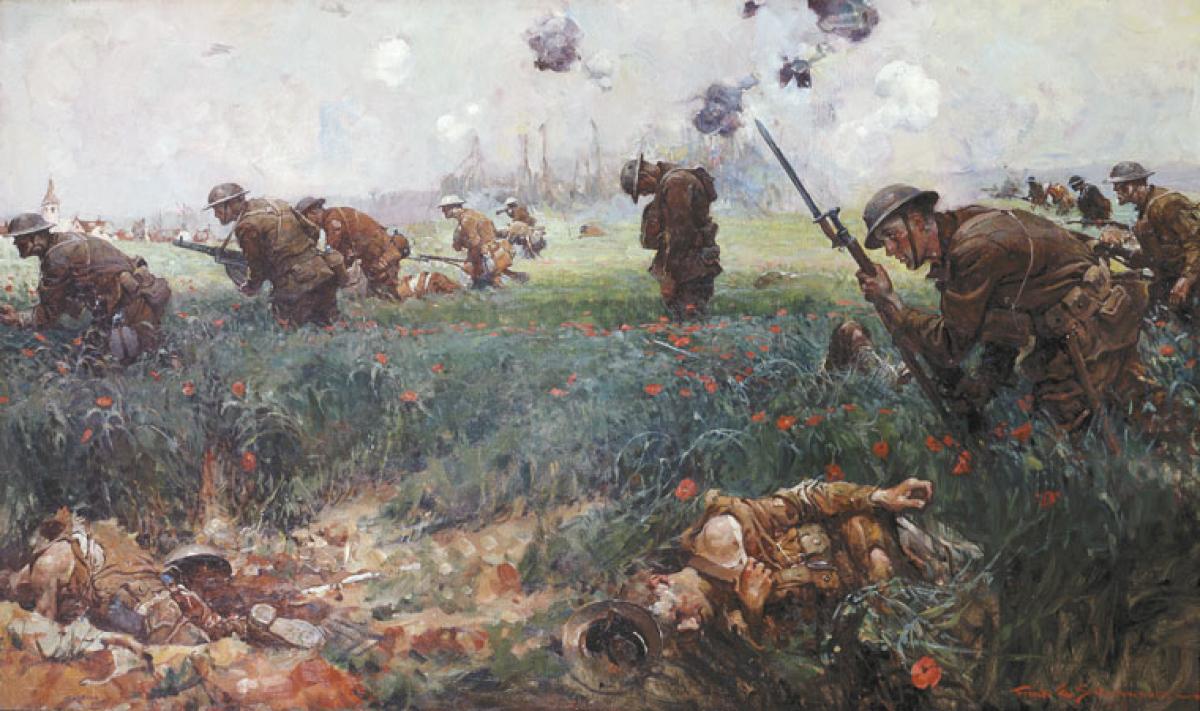
“How Twenty Marines Took Bouresches” by Frank E. Schoonover.
Originally published in the Ladies’ Home Journal Vol. 24 No. 1, via Wikimedia Commons
The Fifth Regiment arrived in France in July 1917. Being the fifth regiment of a four-regiment division, it soon found itself relegated to the sidelines and stuck with all the odd jobs such as providing military police details, couriers, and guards. Correctly reasoning that a larger unit would not be so easily pigeonholed, General Barnett [the Marine Corps Commandant] in October 1917 augmented the Fifth Regiment with the newly formed Sixth Regiment and Sixth Machinegun Battalion. The whole force constituted the AEF Fourth Brigade, or half the infantry of the AEF 2nd Division.*
Although the organization of the Fourth Brigade’s infantry regiments was supposed to be the same as that of all the other AEF infantry regiments, it did in fact differ in some details (see Appendix 2.6). Every Marine rifle and machinegun company had two additional sergeants to serve as gas NCOs and the Marines added gas officers to each battalion headquarters. Whether this helped reduce the number of gas casualties is unclear.
Marine enlisted men also tended to be given higher ranks than their Army counterparts. In a Marine regiment a platoon sergeant was not just the senior sergeant in a platoon, he was a gunnery sergeant, ranking as an Army sergeant first class (a rank that the Army awarded only to specialists) and well above a sergeant. Sergeants commanded all four sections in a Marine rifle platoon and this allowed an additional sergeant per half-platoon. The rifle section included two men trained equipped as snipers (enough for one sniper per half-platoon). Two more snipers were in company headquarters. Since 1887 when test results had exposed their poor marksmanship, the Marines had made rifle shooting into even more of a fetish than it had been in the Army. In contrast to the many soldiers sent into battle without even having fired their rifles, no Marine was even allowed overseas if he had not qualified as an expert rifleman or sharpshooter.
To give extra promotion, pay, and recognition (but not leadership responsibility) to the best shots the Marines introduced the rank of corporal (technical). The rank was also given to mechanics, horseshoers, saddlers, teamsters, and five senior operators in the telephone section of the regimental signal platoon to reward technical proficiency. However, despite their important but difficult and thankless duties, Marine cooks only ranked as privates.
[…]
The Marine AEF regiments differed from their Army counterparts in more than just structural details. They had a huge advantage in manpower quality. Except for about 7,100 draftees accepted during the war’s last weeks, the nearly 79,000 Marines who served in the war were all volunteers. About one sixth of these men had joined prior to the war. This was several times the Army’s percentage of pre-war men, even if those who had only National Guard service are included. Many Marine wartime volunteers were college men and included a lot of athletes.
The large number of officer-quality enlisted men persuaded General Barnett to direct on 4 June 1917 that, in future, all officers be appointed from the ranks. This move had the strong backing of Secretary Daniels who favored the practice of commissioning enlisted men. Such a system would be more in line with what the Germans and French were doing. Even the college men would have to have several months’ enlisted service before they could hope for a commission. By then their leadership potential could be properly evaluated. In addition, many pre-war enlisted men of greater age and experience but less education and growth potential could also become officers. Better still, the Marines were mostly infantry. Unlike the Army, they had few service or technical positions into which their best and brightest could be drained. Instead of getting the dregs, Marine infantry regiments got all the best officers and men. They were always kept at full strength with fully trained replacements, despite heavy casualties.**
The high quality men that the Marines were able to contribute to the AEF provoked a good deal of jealousy within the Army in general and from General Pershing in particular. The latter praised the Marines in private but refused to do so in public. Although Pershing had accepted the Fourth Marine Brigade into the AEF, he rebuffed every offer to send Marine artillery to France. The presence of both Marine infantry and artillery in France would have paved the way for the formation of a Marine AEF division. That would have given the Marines much more publicity at Army expense.
Late in the war Pershing relented enough to accept another Marine infantry brigade, the Fifth, which reached France in September 1918. However, although nearly all these Marines had qualified as expert marksmen, he employed them in menial jobs in the rear areas. At the same time, Pershing was rushing thousands of untrained Army recruits into front line combat where they were routinely and needlessly slaughtered.***
* Major David N. Buckner USMC, A Brief History of the Tenth Marines (Washington DC, Historical Div. HQMC; 1981) pp. 16-17.
** Heinl pp. 191-228; and J. Robert Moskin, The Story of the U.S. Marine Corps (New York, Paddington Press Ltd. 1979) pp. 138-139; LtGen William K. Jones USMC(Ret) A Brief History of the 6th Marines (Washington DC, History and Museum Div. HQMC 1987) p 1.
*** Heinl pp. 194-195 and 208-210; Allan R. Millett, Bullard op cit p. 321.
Comments Off on USMC units in the American Expeditionary Forces (AEF) in France
April 7, 2023
Stormtroopers – The German Elite of WW1 – Sabaton History 119
Sabaton History
Published 6 Apr 2023By the middle of the Great War, several nations had begun to experiment with shock troops, and Germany was one of them. The Sturmtruppen were a revolution on the battlefield, for sure, but what did they actually do? What equipment did they carry and use? What were the men actually like? Today we’ll look at all that.
(more…)
Comments Off on Stormtroopers – The German Elite of WW1 – Sabaton History 119
Manpower shortages in the American Expeditionary Forces (AEF) during WW1
This is an excerpt from Battalion: An Organizational Study of United States Infantry, an unpublished book by the late John Sayen which is being serialized at Bruce Gudmundsson’s Tactical Notebook on Substack. While I haven’t read a lot on the AEF, as I’ve concentrated much more on the Canadian Corps as part of the British Expeditionary Force, I was aware that the American divisions were organized quite differently from either British or French equivalents. The significanly larger division organization — 28,000 men compared to about half that in other allied armies — was intended to give US Army units greater staying power in combat, but it didn’t work out as planned for many reasons:
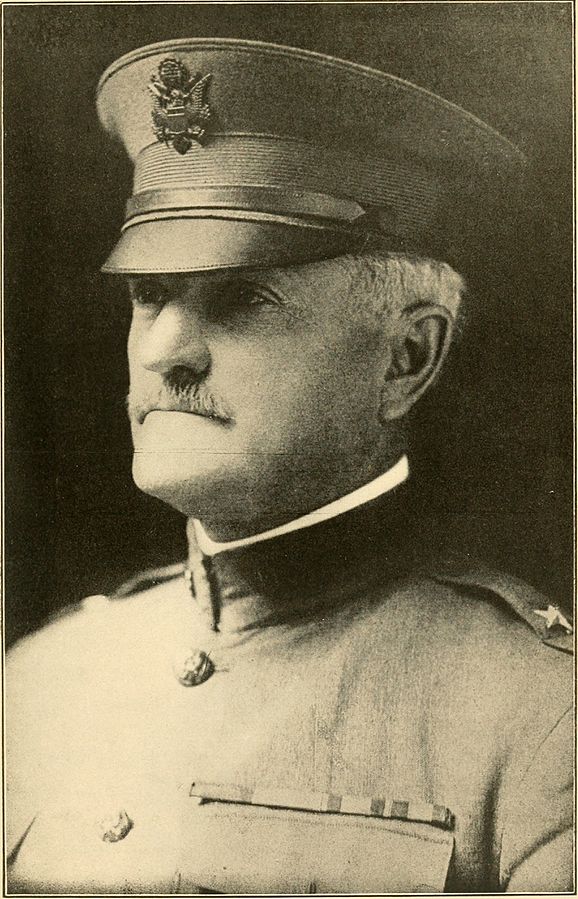
General John J. “Black Jack” Pershing, Commander-in-Chief of the American Expeditionary Forces in France during the First World War.
Image via Wikimedia Commons.
The basic tactical concept behind the square AEF divisions under which the two regiments holding the division’s front line could be relieved by two more regiments to their rear was seriously undermined. The two regiments that were supposed to be resting were the ones that had to man all the work details. When it came time for them to relieve the front-line regiments it was, as historian Allan Millett described it, often a question “of replacing exhausted troops who had suffered casualties with exhausted troops who had not”.
It had certainly not been intended that the infantry serve as labor troops. Such tasks were supposed to have been carried out by separate regiments of pioneers modeled on those used by the French. In the French Army, pioneer regiments were lightly armed infantry serving under corps and army headquarters. They tended to consist of older men and were not the elite assault troops that filled the pioneer platoons in the infantry regiments. Though they could fight when necessary, their main function was to furnish the bulk of the semi-skilled and unskilled labor in the forward areas.
In imitation of this system the War Department raised 37 AEF pioneer regiments. These were organized as AEF infantry regiments without machinegun companies or sapper-bomber, pioneer, or one-pounder gun platoons. Only two of the 29 pioneer regiments to reach France did so before the last three months of the war. One regiment was supposed to go to each army corps and several to each army. However, the AEF pioneers proved to be so badly trained and led (even by AEF standards) that after front line service involving a mere 241 battle casualties most of the pioneers were pulled out of combat to serve as unarmed laborers far to the rear.
It wasn’t just combat casualties that reduced US divisional effectiveness:
Early planning had called for one third of all divisions to serve as replacement depots or field-training units charged with keeping the remaining combat divisions filled with men. The system broke down, however, as heavy losses forced the intended depot divisions to be used as combat units instead. Only six of the 42 AEF divisions to reach France before the Armistice (three more arrived soon afterwards) actually served as replacement or training depots instead of the 14 that were needed.
As an emergency measure, five combat divisions, and later two of the depot divisions, were skeletonized to immediately create urgently needed replacements but, of course, this rendered them useless for either combat or depot duty. Another division had to be fragmented to provide men for rear area support duties and yet another was broken up to flesh out three French divisions. Even in February 1918, (before the AEF had seen serious combat) the four combat divisions in the AEF I Corps were 8,500 men short (mostly in their infantry regiments). The 41st Division, which was the corps’ depot division and charged with supplying those missing men was itself 4,500 men short. By early October 1918, AEF combat units needed 80,000 replacements but only 45,000 were expected before 1 November. At the end of October, the total shortfall had reached 119,690, including 95,303 infantrymen and 8,210 machine gunners. Only 66,490 replacement infantrymen and machine gunners would be available any time soon. For most of the war, AEF combat divisions were typically short by 4,000 men. After August 1918, even divisions fresh from the United States usually needed men. Too many divisions had been organized too quickly.
Of course, the root cause of the manpower problem was even more basic. Men were being used up faster than they could be replaced. The AEF suffered most of its battle casualties between 25 April and 11 November 1918, a period of less than seven months. These combat losses amounted to between 260,000 and 290,000 officers and men, of whom some 53,000 were killed in action or died of their wounds. The rest were wounded or gassed but 85% of these subsequently returned to duty. About 4,500 AEF prisoners of war were repatriated after the Armistice. Five thousand others became victims of “shell shock.” Accidental casualties, including those known to have been caused by “friendly fire” (total friendly fire losses must have been considerable, given the poor state of infantry-artillery coordination), or disease or self-inflicted wounds, far exceeded those sustained in battle.
Two thirds of the more than 125,000 Army and Marine Corps deaths between April 1917 and May 1919 occurred overseas and nearly half (57,000) were from disease. Pneumonia and influenza-pneumonia, which produced the infamous “swine flu” epidemic of 1918, were the chief killers but many victims who became ill before the Armistice did not actually die until after it. Between 14 September and 8 November 1918 some 370,000 cases were reported in the United States alone. Within less than two years between one quarter and one third of the men serving in the US Army had died or became temporarily or permanently disabled by battle, disease, accident, or misconduct. Had such losses continued, the United States might soon have begun to experience the same war weariness and manpower “burnout” that had been plaguing the British, French, and Germans.
With regard to the infantry, the woes of the AEF replacement and training system were much increased by the prevailing belief that because an infantryman needed few technical skills he had little to learn and could be quickly and easily trained from very average human material. Technical arms such as the engineers, signal corps, artillery, and, more significantly, the air corps got the pick of the AEF’s manpower.
The infantry soon became the repository for those deemed unfit for anything better. Many infantrymen saw themselves, and were seen, as cannon fodder. Morale and cohesion were further undermined by the practice of stripping new divisions of men (often before they had even left the United States) to fill older ones. The better men and officers avoided infantry duty to seek less demanding “technical” jobs. Of course, training suffered grievously.
As demands for replacements became more insistent, men who supposedly had received several months’ training were appearing in the front lines not knowing how to load their rifles. Others proved to be recent immigrants who could not speak English. Infantrymen of small physique who might have rendered useful service in non-infantry roles, soon collapsed under the physical burdens placed on them and became liabilities rather than assets. Losses among even good infantry were heavy enough but mediocre infantry melted away at an astonishing rate. Indiscipline, disorganization, and ignorance inevitably increased losses by what must have seemed like a couple of orders of magnitude. These losses were likely to be replaced, if at all, by men of even lower caliber.
Straggling was an especially pernicious problem, which the military police had only limited success in controlling. Even more than actual casualties, it caused some units to simply evaporate. During the Meuse-Argonne offensive, for example, one division reported that it was down to only 1,600 effective men. However, soon after it arrived at a rest area, it reported 8,400 men in its infantry regiments alone.
Comments Off on Manpower shortages in the American Expeditionary Forces (AEF) during WW1
April 2, 2023
QotD: The (in-)effectiveness of chemical weapons against “Modern System” armies
But let’s put that in a real-world context. Five Japanese doomsday cultists used about five liters of sarin in a terror attack on a Tokyo Subway in 1995, deployed, in this case, in a contained area, packed full to the brim with people – a potential worst-case (from our point of view; “best” case from the attackers point of view) situation. But the attack killed only 12 people and injured about a thousand. Those are tragic, horrible numbers to be sure – but statistically insignificant in a battlefield situation. And no army could count on ever being given the kind of high-vulnerability environment like a subway station in an actual war.
In order to produce mass casualties in battlefield conditions, a chemical attacker has to deploy tons – and I mean that word literally – of this stuff. Chemical weapons barrages in the First World War involved thousands and tens of thousands of shells – and still didn’t produce a high fatality rate (though the deaths that did occur were terrible). But once you are talking about producing tens of thousands of tons of this stuff and distributing it to front-line combat units in the event of a war, you have introduced all sorts of other problems. One of the biggest is shelf-life: most nerve gasses (which tend to have very high lethality) are not only very expensive to produce in quantity, they have very short shelf-lives. The other option is mustard gas – cheaper, with a long shelf-life, but required in vast quantities (during WWII, when just about every power stockpiled the stuff, the stockpiles were typically in the many tens of thousands of tons range, to give a sense of how much it was thought would be required – and then think about delivering those munitions).
[…]
But that’s not the only problem – the other problem is doctrine. Remember that the modern system is all about fast movement. I don’t want to get too deep into maneuver-warfare doctrine (one of these days!) but in most of its modern forms (e.g. AirLand Battle, Deep Battle, etc) it aims to avoid the stalemate of static warfare by accelerating the tempo of the battle beyond the defender’s ability to cope with, eventually (it is hoped) leading the front to decompose as command and control breaks down.
And chemical weapons are just not great for this. Active use of chemical weapons – even by your own side – poses all sorts of issues to an army that is trying to move fast and break things. This problem actually emerged back in WWI: even if your chemical attack breaks the enemy front lines, the residue of the attack is now an obstruction for you. […] A modern system army, even if it is on the defensive operationally, is going to want to make a lot of tactical offensives (counterattacks, spoiling attacks). Turning the battle into a slow-moving mush of long-lasting chemical munitions (like mustard gas!) is counterproductive.
But that leaves the fast-dispersing nerve agents, like sarin. Which are very expensive, hard to store, hard to provision in quantity and – oh yes – still less effective than high explosives when facing another expensive, modern system army, which is likely to be very well protected against such munitions (for instance, most modern armored vehicles are designed to be functionally immune to chemical munitions assuming they are buttoned up).
This impression is borne out by the history of chemical weapons; for top-tier armies, just over a century of being a solution in search of a problem. The stalemate of WWI produced a frantic search for solutions – far from being stupidly complacent (as is often the pop-history version of WWI), many commanders were desperately searching for something, anything to break the bloody stalemate and restore mobility. We tend to remember the successful innovations – armor, infiltration tactics, airpower – because they shape subsequent warfare. But at the time, there were a host of efforts: highly planned bite-and-hold assaults, drawn out brutal et continu efforts, dirigibles, mining and sapping, ultra-massive artillery barrages (trying a wide variety of shell-types and weights). And, of course, gas. Gas sits in the second category: one more innovation which failed to break the trench stalemate. In the end, even in WWI, it wasn’t any more effective than an equivalent amount of high explosives (as the relative casualty figures attest). Tanks and infiltration tactics – that is to say, the modern system – succeeded where gas failed, in breaking the trench stalemate, with its superiority at the role demonstrated vividly in WWII.
Bret Devereaux, “Collections: Why Don’t We Use Chemical Weapons Anymore?”, A Collection of Unmitigated Pedantry, 2020-03-20.
Comments Off on QotD: The (in-)effectiveness of chemical weapons against “Modern System” armies
March 29, 2023
The obscure Polish banker who foresaw the carnage and deadlock of the First World War
Jon Miltimore on one of the few people to realize the increased deadliness and growing size of modern armies foreclosed any possibility of a quick, glorious war that would have the troops “home for Christmas”:
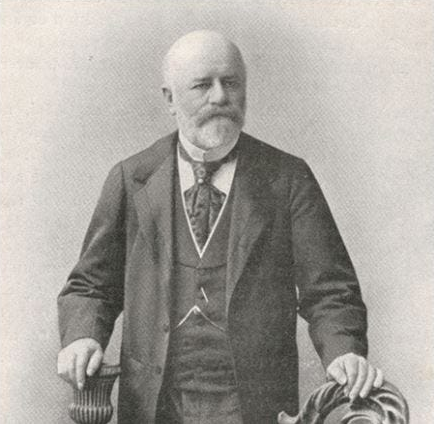
Jan Bloch, author of The War of the Future in its Technical, Economic and Political Relations (1898).
One man who did portend the carnage was Jan Bloch, a Polish banker and railroad baron who moonlighted as a military theorist. In 1898, Bloch published a little-noticed six-volume work titled The War of the Future in its Technical, Economic and Political Relations. The following year, the work was re-published in a single volume under a new title: Is War Now Impossible?
In the work, Bloch, who had closely studied Britain’s campaign in Africa during the Boer War, explained that modern weaponry had become so deadly that it had fundamentally changed warfare. Bayonet charges and cavalry flanking maneuvers were obsolete in an era defined by sophisticated earthworks and precision projectiles, he suggested.
Everybody will be entrenched in the next war. It will be a great war of entrenchments. The spade will be as indispensable to a soldier as his rifle. The first thing every man will have to do, if he cares for his life at all, will be to dig a hole in the ground. War, instead of being a hand-to-hand contest in which the combatants measure their physical and moral superiority, will become a kind of stalemate, in which neither army is able to get at the other, threatening each other, but never being able to deliver a final and decisive attack.
War would be “impossible” in the sense that it would be suicidal. Neither side would be able to gain a decisive advantage, battles along massive contiguous fronts would continue indefinitely.
Was Bloch suggesting that modern man had vanquished war by making it so deadly and terrible? Hardly. He argued that humans would be slow to realize the changes, and the results would be catastrophic.
At first there will be increased slaughter — increased slaughter on so terrible a scale as to render it impossible to get troops to push the battle to a decisive issue. They will try to, thinking that they are fighting under the old conditions, and they will learn such a lesson that they will abandon the attempt forever. Then, instead of war fought out to the bitter end in a series of decisive battles, we shall have as a substitute a long period of continually increasing strain upon the resources of the combatants. The war, instead of being a hand-to-hand contest, in which the combatants measure their physical and moral superiority, will become a kind of stalemate, in which neither army being willing to get at the other, both armies will be maintained in opposition to each other, threatening the other, but never being able to deliver a final and decisive attack …
That is the future of war — not fighting, but famine, not the slaying of men, but the bankruptcy of nations and the breakup of the whole social organization …
First World War generals don’t get much credit for their varied efforts to break the trench warfare deadlock, and later historians certainly piled on for the leaders’ collective failure to resolve the problem, but as Bret Devereaux pointed out, there was no easy solution. Artillery wasn’t the answer, nor were the famed German Stoßtruppen, nor the technical innovation of tanks, nor air power (either tactical or strategic). The technology of the day provide no one answer, but the leaders tried everything they could and the bleeding went on.
Comments Off on The obscure Polish banker who foresaw the carnage and deadlock of the First World War
March 27, 2023
Frommer Pistolen-MG Model 1917: A Crazy Villar Perosa Copy
Forgotten Weapons
Published 23 Nov 2022After encountering Italian Villar Perosa machine pistols in the field, Austro-Hungarian troops requested a similar weapon. The project was given to FÉG to work on, and the result was the Pistolen-MG Model 1917: a pair of Frommer Stop pistols with long barrels and 25-round magazines, redesigned to fire from the open bolt, mounted to an adorably tiny tripod and spade grips.
Only a few dozen of these were made for testing, and they were not accepted for military service. Many thanks to Joschi Schuy for giving me access to film that fantastic surviving example for you!
(more…)
Comments Off on Frommer Pistolen-MG Model 1917: A Crazy Villar Perosa Copy
March 24, 2023
From “railway spine” to “shell shock” to PTSD
At Founding Questions, Severian discusses how our understanding of what we now label “Post-Traumatic Stress Disorder” evolved from how doctors visualized bodily ailments over a century ago:
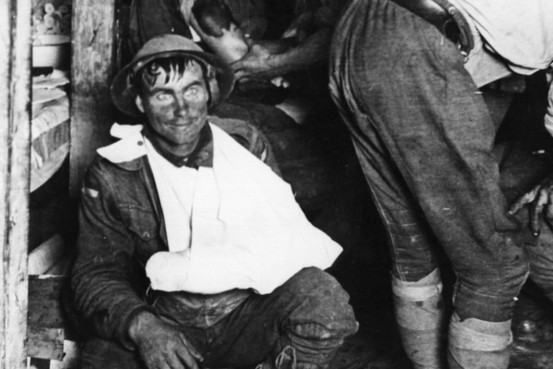
A shell-shocked and physically wounded soldier in the First World War.
I mentioned “shell shock” yesterday, so let’s start there. Medicine in 1914 was still devoted to the “Paris School,” which assumed nothing but organic etiology for all syndromes. Sort of a reverse Descartes — as Descartes (implicitly) “solved” the mind-body problem by disregarding the body, so the “Paris School” of medicine solved it by disregarding the mind. So when soldiers started coming back from the front with these bizarre illnesses, naturally doctors began searching for an organic cause. (That’s hardly unique to the Paris School, of course; I’m giving you the context to be fair to the 1914 medical establishment, whose resistance to psychological explanations otherwise seems so mulish to us).
They’d noticed something similar in the late 19th century, with industrial accidents and especially train crashes. When a train crashed, the people in the first few cars were killed outright, those in the next few wounded, but the ones in the back were often physically fine. But within a few hours to weeks, they started exhibiting all kinds of odd symptoms. Hopefully you’ve never been in a train crash, but if you’ve ever been in a fender-bender you’ve no doubt experienced a minor league version of this.I hit a deer on the highway once. Fortunately I was at highway speed, and hit it more or less dead on (it jumped out as if it were committing suicide), so it got thrown away from the car instead of coming through the windshield. The car’s front end was wrecked, naturally, but I was totally fine. I don’t think the seatbelt lock even engaged, much less the airbag, since I didn’t even have time to hit the brakes.
The next few hours to days were interesting, physiologically. It felt like my body was playing catch up. I had an “oh shit, I’m gonna crash!!!” reaction about 45 minutes after I’d pulled off to the side of the road, duct-taped the bumper back on as best I could, and continued to my destination. All the stuff I would have felt had I seen the deer coming came flooding in. Had I not already been where I was going, I would’ve needed to pull over, because that out of the blue adrenaline hit had my hands shaking, and my vision fuzzed out briefly.
The next morning I was sore. I had all kinds of weird aches, as if I’d just played a game of basketball or something. I assume part of it actually was the impact — it didn’t feel like much in the moment, but if it’s enough to crumple your car’s front end (and it was trashed), it’s enough to give you a pretty good jolt. That would explain soreness in the arms, elbows, and shoulders — a stiff-armed, white-knuckle grip on the steering wheel, followed by a big boom. But I was also just kinda sore all over, plus this generalized malaise. I felt not-quite-right for the next few days. Nothing big, no one symptom I can really put my finger on, but definitely off somehow — a little twitchy, a little jumpy, and really tired.
Having done my WWI reading, I knew what it was, and that’s when I really understood the doctors’ thought processes. I really did take some physical damage, because I really did receive a pretty good full-body whack. It just wasn’t obvious to the naked eye. And since everyone has experienced odd physical symptoms from being rattled around, or even sleeping on a couch or sprung mattress, it makes sense — the impact obviously jiggled my spine, which probably accounts for a great many of the physical symptoms. Hence, “railway spine”. And from there, “shell shock” — nothing rattles your back like standing in a trench or crouching in a dugout as thousands of pounds of high explosive go off around you. It must be like going through my car crash all day, every day.
Skip forward a few decades, and we now have a much better physiological understanding of what we now call (and I will henceforth call) Post-Traumatic Stress Disorder (PTSD). There’s a hypothesis that I personally believe, that “shell shock” is also a whole bunch of micro-concussions as well as “classic” PTSD, but let’s leave that aside for now. The modern understanding of PTSD is largely about chemistry. Cortisol and other stress chemicals really fuck you up. They have systemic physical and mental effects. If those chemicals don’t get a chance to flush out of your system — if you’re in a trench for weeks on end, let’s say — the effects are cumulative, indeed exponential.
Returning to my car crash: I was “off” for a few days because my body got a huge jolt of stress chemicals. That odd not-quite-right thing I felt was those chemicals flushing through. Had I gone to a shrink at that moment, he probably would’ve diagnosed me with PTSD. But I didn’t have PTSD. I had a perfectly normal physiological reaction to a big shot of stress chemicals. If I’d gotten into car crash after car crash, though, day in and day out, that would’ve been PTSD. I’d be having nightmares about that deer every night, instead of just the once. And all that would have cumulative, indeed exponential, effects.
He then goes on to cover similar physical reactions to stimuli in modern life, so I do recommend you RTWT.
Comments Off on From “railway spine” to “shell shock” to PTSD
March 22, 2023
What happened to Colour Sergeant Frank Bourne after Rorke’s Drift?
The History Chap
Published 20 Jul 2022Colour Sergeant Frank Bourne was the senior NCO at the Battle of Rorke’s Drift during the Zulu War of 1879. Superbly played by actor Nigel Green in the 1964 film Zulu, many have wondered why he was never awarded a Victoria Cross when 11 others were. This is the story of what happened to Colour Sergeant Frank Bourne after Rorke’s Drift.
He was actually awarded Britain’s second highest military medal (at the time), the Distinguished Conduct Medal, and ultimately rose from the ranks to become an officer. His military career continued all the way to the First World War, where he was promoted to the rank of Lt. Colonel. Frank Bourne, the last surviving defender of Rorke’s Drift, died in 1945, one day after the Germans surrendered.
(more…)
Comments Off on What happened to Colour Sergeant Frank Bourne after Rorke’s Drift?
March 12, 2023
The young British officer’s attitude toward his men
Dr. Robert Lyman has been working on pulling together various newspaper and magazine articles written by Field Marshal William Slim before the Second World War, to be published later this year. I believe this will include everything he included (in shorter form in some cases) in his 1959 book Unofficial History plus many others. In this excerpt from “Private Richard Chuck, aka The Incorrigible Rogue”, Slim recounts taking command of a company of recent conscripts while recuperating from wounds received earlier in WW1:
“Light duty of a clerical nature,” announced the President of the Medical Board. Not too bad, I thought, as I struggled back into my shirt. “Light duty of a clerical nature” had a nice leisurely sound about it. I remembered a visit I had paid to a friend in one of the new government departments that were springing up all over London at the end of 1915. He had sat at a large desk dictating letters to an attractive young lady. When she got tired of taking down letters, she poured out tea for us. She did it very charmingly. Decidedly, light duty of a clerical nature might prove an agreeable change after a hectic year as a platoon commander and a rather grim six months in hospital. Alas, after a month in charge of the officers’ mess accounts of a reserve battalion, with no more assistant than an adenoidal “C” Class clerk, I had revised my opinion. My one idea was to escape from “light duty of a clerical nature” into something more active. Reserve battalions were like those reservoirs that haunted the arithmetic of our youth — the sort that were filled by two streams and emptied by one. Flowing in came the recovered men from hospitals and convalescent homes and the new enlistments; out went the drafts to battalions overseas. When the stream of voluntary recruits was reduced to a trickle the only way to restore the intake was by conscription, and this was my chance.
It had been decided to segregate the conscripts into a separate company as they arrived. I happened to be the senior subaltern at the moment and I applied for command of the new company. Rather to my surprise, for I was still nominally on light duty, I got it. The conscripts, about a hundred and twenty of them, duly arrived. They looked very much like any other civilians suddenly pushed into uniform, awkward, bewildered, and slightly sheepish, and I regarded them with some misgiving. After all, they were conscripts; I wondered if I should like them.
The young British officer commanding native troops is often asked if he likes his men. An absurd question, for there is only one answer. They are his men. Whether they are jet-black, brown, yellow, or café-au-lait, the young officer will tell you that his particular fellows possess a combination of military virtues denied to any other race. Good soldiers! He is prepared to back them against the Brigade of Guards itself! And not only does the young officer say this, but he most firmly believes it, and that is why, on a thousand battlefields, his men have justified his faith.
In a week I felt like that about my conscripts. I was a certain rise to any remark about one volunteer being worth three pressed men. Slackers? Not a bit of it! They all had good reasons for not joining up. How did I know? I would ask them. And I did. I had them, one by one, into the company office, without even an N.C.O. to see whether military etiquette was observed. They were quite frank. Most of them did have reasons — dependants who would suffer when they went, one-man businesses that would have to shut down. Underlying all the reasons of those who were husbands and fathers was the feeling that the young single men who had escaped into well-paid munitions jobs might have been combed out first.
[…]
We had now advanced far enough in our training to introduce the company to the mysteries of the Mills bomb. There is something about a bomb which is foreign to an Englishman’s nature. Some nations throw bombs as naturally as we kick footballs, but put a bomb into an unschooled Englishman’s hands and all his fingers become thumbs, an ague affects his limbs, and his wits desert him. If he does not fumble the beastly thing and drop it smoking at his — and your — feet, he will probably be so anxious to get rid of it that he will hurl it wildly into the shelter trench where his uneasy comrades cower for safety. It is therefore essential that the recruit should be led gently up to the nerve-racking ordeal of throwing his first live bomb; but as I demonstrated to squad after squad the bomb’s simple mechanism, I grew more and more tired with each until I could no longer resist the temptation to stage a little excitement. I fitted a dummy bomb, containing, of course, neither detonator nor explosive, with a live cap and fuse. Then for the twentieth time I began!
When you pull out the safety-pin you must keep your hand on the lever or it will fly off. If it does it will release the striker, which will hit the cap, which will set the fuse burning. Then in five seconds off goes your bomb. So when you pull out the pin don’t hold the bomb like this!’
I lifted my dummy, jerked out the pin, and let the lever fly off. There was a hiss, and a thin trail of smoke quavered upwards. For a second, until they realized its meaning, the squad blankly watched that tell-tale smoke. Then in a wild sauve qui peut they scattered, some into a nearby trench, others, too panic-stricken to remember this refuge, madly across country, I looked round, childishly pleased at my little joke, to find one figure still stolidly planted before me. Private Chuck alone held his ground, placidly regarding me, the smoking bomb, and his fleeing companions with equal nonchalance. This Casablanca act was, I felt, the final proof of mental deficiency — and yet the small eyes that for a moment met mine were perfectly sane and not a little amused.
“Well,” I said, rather piqued, “hy don’t you run with the others?” A slow grin passed over Chuck’s broad face.
“I reckon if it ‘ud been a real bomb you’d ‘ave got rid of it fast enough,” he said. Light dawned on me.
“After this, Chuck,” I answered, “you can give up pretending to be a fool; you won’t get your discharge that way!”
He looked at me rather startled, and then began to laugh. He laughed quietly, but his great shoulders shook, and when the squad came creeping back they found us both laughing. They found, too, although they may not have realized it at first, a new Chuck; not by any means the sergeant-major’s dream of a soldier, but one who accepted philosophically the irksome restrictions of army life and who even did a little more than the legal minimum.
Comments Off on The young British officer’s attitude toward his men
March 7, 2023
“The First Soldier” – Albert Séverin Roche – Sabaton History 118
Sabaton History
Published 6 Mar 2023This song is the story of Albert Roche, who is very much forgotten today, but after the First World War was THE hero of France. He was hotheaded and tempestuous, but above all he was GOOD. His service — and his legend from that war — is just remarkable, and today we share the war stories of the First Soldier of France.
(more…)
Comments Off on “The First Soldier” – Albert Séverin Roche – Sabaton History 118
March 1, 2023
Mauser WW1 Flyer’s Rifle: the Flieger Selbstlader Karabiner 1916
Forgotten Weapons
Published 1 Nov 2022Paul Mauser dedicated much of his life to the development of a practical semiauto military rifle, and did manage to have a design that was used in combat by Germany in World War One. It began with the model 06/08, a short-recoil, flap-locked design made in both rifle and pistol form. The short recoil idea was disliked by the military for a shoulder rifle, and so Mauser redesigned it to be inertially locked with a fixed barrel. This was sold in small numbers as a sporting rifle, and tested by the military a few years before the war. Once war began, Mauser once again submitted the design for use in an infantry configuration, but the system was too delicate for infantry combat. A second pattern was made for use by fliers, and this was accepted and used in service for that brief period between the introduction of military aviation and the adoption of aerial machine guns.
Designated the FSK-16 (FliegerSelbstladeKarabiner 1916), it was used primarily by balloon and Zeppelin crews. With a large magazine and self-loading action, it was much better for use in aircraft than the typical bolt action infantry rifles — and there was no mud to get into the action while airborne.
(more…)
Comments Off on Mauser WW1 Flyer’s Rifle: the Flieger Selbstlader Karabiner 1916


