
Forgotten Weapons
Published 5 Jul 2017With the advent of the tank in World War One, antitank rifles became a priority for many countries, to provide infantry with some weapon to counter the new armored threat. The best known example of these (and the only one to see significant production before the end of WWI) was the German Tankgewehr, any captured Tankgewehrs would form the basis for the US development of the .50 BMG cartridge.
This experimental Winchester rifle, made in late 1918, was part of that development. It is the only known surviving example of its type, and suffered a catastrophic failure during testing, as the receiver is cracked completely in half. The mechanism, however, is quite interesting. It uses a 1911-styled pistol grip as the bolt handle (similar to the Czech SS41 antitank rifle that would come decades later). It was fitted with a relatively large detachable box magazine and a mounting point for a telescopic sight.
(more…)
October 28, 2023
Prototype Winchester WW1 .50 Cal Antitank Rifle
October 27, 2023
Scientific Wokemerican
In Spiked, James Esses on the formerly respected magazine Scientific American (I’ve been calling it JunkScientific American since they published a story on the “Racist Roots of Fighting Obesity”):
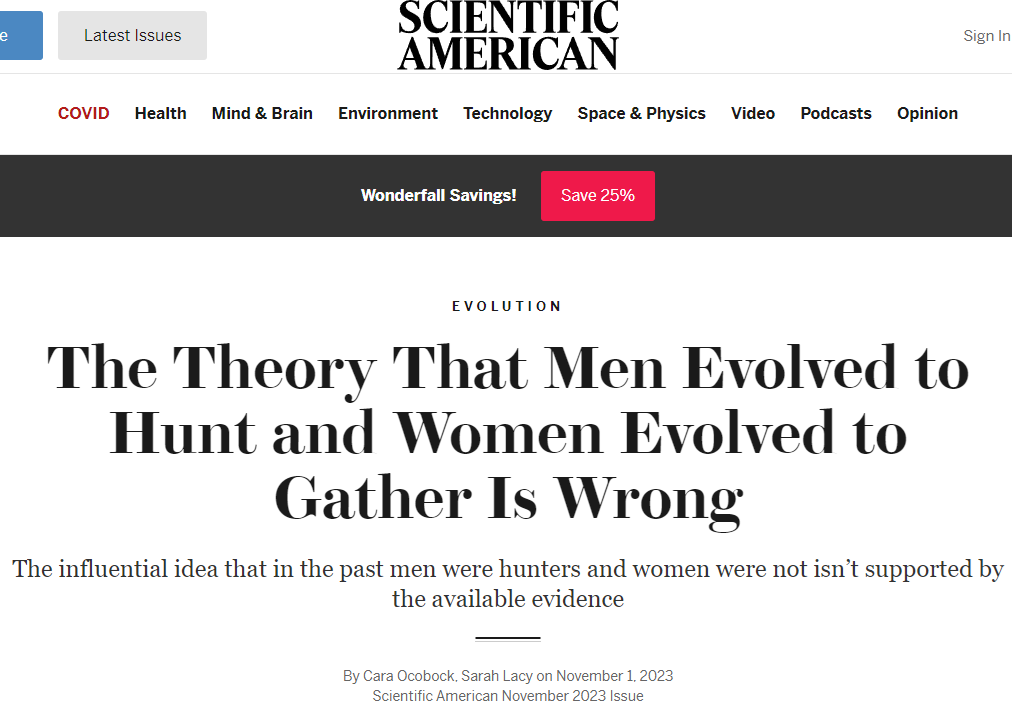
When you come across the longstanding magazine, Scientific American, you could be forgiven for assuming that scientific truth would play a pivotal role in its output.
But not any more, it seems. Scientific American, founded in 1845, is the oldest continuously published magazine in the United States. It has previously featured work by Albert Einstein, among others. However, in recent years, it appears to have been taken over by contributors who consider themselves activists first and scientists second. The magazine’s ethos now includes the express aim of “sharing trustworthy knowledge, enhancing our understanding of the world, and advancing social justice” (my emphasis). It has also started to intervene in electoral politics, too. In 2020, Scientific American broke with a 175-year history of non-partisanship to endorse Joe Biden in the US presidential election.
Worst of all, when its articles touch on questions of gender and biological sex, Scientific American seems to have abandoned objective facts entirely, in favour of trans-activist pseudoscience.
In 2019, an article by Simón(e) D Sun, who identifies as a “transgender nonbinary woman”, tells us to “Stop using phoney science to justify transphobia”. The piece is, as you might expect, filled with ideologically driven language and easily disprovable claims. For instance, it asserts that sex is “assigned” at birth when it is not – it is observed and recorded. It also suggests that “scientific endeavour is quantifiably better when it is more inclusive”. But what if “being inclusive” requires us to deny the reality of biological sex? That would surely put inclusivity at odds with science.
A patronising, finger-wagging tone runs throughout, too. At one point, readers are told to “hold onto your parts, whatever they may be. It’s time for ‘the talk'”.
Ironically, the article undermines its own premise within the first few paragraphs, as it walks readers through the clear biological differences between males and females, ranging from chromosomes to sexual characteristics to brain development. And at the end of the article, having done nothing to challenge the status quo of human biology, we are told: “The science is clear and conclusive: sex is not binary, transgender people are real”.
Of course, nobody has ever claimed “transgender people” are a figment of our imaginations. What gender-critical feminists have argued, however, is that sex is both binary and immutable – and that feeling uneasy about one’s sex is a symptom of mental distress, rather than proof of an innate gender identity that is at odds with one’s body.
And now, for its upcoming November issue, Scientific American has published another piece denying biological reality. Again, this article is peppered with ideological claims that purport to be scientific facts.
The Tale of Fat Man and Little Boy
World War Two
Published 26 Oct 2023Here near the end of 1944, we look at the development of the atomic bomb. What different methods of creating a nuclear reaction are being developed? How close are they to development? How does it work? Will they be able to make one in 1945? Will it go boom?
(more…)
Two wild-eyed optimists claim that things aren’t as bad as you think
Who lets these dangerous lunatics talk to the press? If anyone listens to them, they may get unwarranted optimistic notions that go against the narrative:

Jordan Peterson speaking at an event in Dallas, Texas on 15 June, 2018.
Detail of a photo by Gage Skidmore via Wikimedia Commons.
War is endlessly and eternally horrific. It is understandable and even necessary that the media spotlights today’s conflicts. But this can make us believe that we’re living through unprecedented violence. Russia’s war indeed meant that battle deaths in 2022 reached a high for this century, but they are still very low by historical standards. Last year, 3.5 in 100,000 people died as a consequence of war, below even the 1980s and far below the 20th-century average of 30 per 100,000. The world has in fact become much more peaceful.
This is of course little consolation to those living in conflict zones. But the data speaks to the problem with the constant barrage of contextless catastrophe and doom. Analysis of media content across 130 countries from 1970 to 2010 indicates that the emotional tone has dramatically and consistently become more negative. Negativity sells, but it informs badly.
The same pattern characterizes climate change reporting. A pervasive and false apocalyptic narrative draws together every negative event — ignoring the bigger picture almost entirely. Last summer, for example, forest fires made headlines, but coverage largely failed to mention that the annual burned global area has been declining for decades, reaching the lowest level ever last year. Likewise, deaths from droughts and floods make fill the front pages, but we don’t hear that deaths from such climate-related disasters have declined 50-fold over the past century.
The data show what we all fundamentally know: the world has improved dramatically. Life expectancy has more than doubled since 1900. Two centuries ago, almost everyone was illiterate. Now, almost everyone can read. In 1820, nearly 90 per cent of people lived in extreme poverty. Now it’s less than 10 per cent. Indoor air pollution has declined dramatically, and its outdoor equivalent has also done so in rich countries. If we could choose when to be born, having all the facts at hand, few would choose any time before today.
This incontrovertible progress has been driven by ethical and responsible conduct, trust, well-functioning markets, the rule of law, scientific innovation and political stability. We have to recognize, appreciate and proclaim the value, and comparative rarity, of each of these.
The constant barrage of negative stories may lead us to imagine that our forward progress is about to end. However, the evidence at hand does not support this conclusion. The latest Intergovernmental Panel on Climate Change scenarios indicate that, if not for climate change, the average person would be 4.5-times richer by the end of the century than they are today.
Whisky Folklore – What Is Bourbon? Where Did It Come From?
Townsends
Published 2 Jul 2023Bourbon Whiskey is as American as Hamburgers or the 4th of July. Where did it come from? Where did the tradition start? This episode digs into the history of Bourbon and tries to answer the questions behind this traditional American spirit.
(more…)
October 25, 2023
1847 Walker Revolver: the Texas Behemoth
Forgotten Weapons
Published 18 Nov 2015The Colt 1847 Walker revolver was a massive 4 1/2 pound handgun made for Samuel Walker of the US Mounted Rifles (he also served with the Texas Rangers) as a way to equip mounted troops with greater firepower than single-shot carbines. The Walker was the first true martial handgun made by Colt, and despite its problems (nearly a third of the guns procured by the military would be returned to Colt for repairs, and more than a few literally blew up) it would save Colt from bankruptcy after the commercial failure of his Paterson revolver of 1836.
Only 1100 of these guns were made, 1000 for the military and a further 100 for commercial sale. The military ones were issued to five companied of Mounted Rifles, and can be identified by their factory unit marks for Companies A through E (this particular gun is a Company A one). Roughly half of them were delivered in time to see active use in the Mexican-American War, but all of them would see use for many years later in the hands of the US military, the Texas Rangers, the Confederate military, and in civilian hands. The design would evolve into the Colt Dragoon revolvers and ultimately lead to the 1851 Navy and 1860 Army designs — arguably the most iconic muzzle loading revolvers ever made.
October 24, 2023
See Inside The M3 Grant | Tank Chats Reloaded
The Tank Museum
Published 30 Jun 2023With a crew of six and a chaotically crowded interior, the Grant was a US-produced WW II tank more used by the British and Indian Armies than anyone else. Join Chris Copson as he explores probably the best preserved example of this rare vehicle – and listen out for the cheese sandwich …
(more…)
October 23, 2023
QotD: The real meaning of “Watergate”
I was reflecting this week on my brief stint, many years ago, as a newspaperman. It was a job I loved. I signed on not too many years after the Watergate scandal, and journalists were still flush with heroic ideas about themselves. Woodward and Bernstein — and all reporters by extension — had toppled a corrupt presidency and saved the republic and the Constitution from the kind of behind-the-scenes government tyranny dramatized in such thriller films as The Parallax View and Three Days of the Condor.
[…]
Recently, reading Mark Levin’s Unfreedom of the Press, I was reminded that, before reporters went on their great crusade against Richard Nixon, they had overlooked a whole lot of corruption in the Democrat presidents who preceded him.
Levin tells how John F. Kennedy, with the knowledge of his brother and Attorney General Robert, nudged the IRS into auditing conservative groups. With Kennedy’s approval, the FBI was also employed to investigate those the administration disliked, including Martin Luther King Jr. Lyndon Baines Johnson would later increase the politically motivated auditing and spying. None of this was uncovered until later on.
Ben Bradlee — the editor of the Washington Post, where Woodward and Bernstein broke the Watergate story — was well aware of his pal Kennedy’s misuse of the tax and investigative agencies. Not only did he not report it, he allowed himself and his paper to be manipulated by information JFK had wrongly obtained.
This totally changes the Watergate narrative. Nixon’s dirty tricks and enemy lists may have been creepy and wrong, but the press exposure of these misdemeanors came after years of ignoring similar and worse malfeasance by Democrat administrations.
That changes what Watergate means. That transforms it from a heroic crusade into a political hit job, Democrat hackery masquerading as nobility. The press turned a blind eye to the corruption of JFK and LBJ, then raced to overturn the election of a man they despised — despised in part because he battled the Communism many of them had espoused.
Andrew Klavan, “‘Watergate’ Doesn’t Mean What the Press Thinks It Means: The press turned a blind eye to the corruption of JFK and LBJ, then raced to overturn the election of a man they despised”, The Daily Wire, 2019-08-31.
October 22, 2023
SS Commando Coup in Hungary – WW2 – Week 269 – October 21, 1944
World War Two
Published 21 Oct 2023The Germans engineer a coup in Hungary to keep the Hungarian army in the war, but the Allies have finally entered Germany in force, taking Aachen in the west. The Soviets liberate Belgrade in the east, and launch new attacks in Baltics, and at the other end of the world come American landings in the Philippines, and the recall of Vinegar Joe Stilwell from China.
00:00 Intro
01:00 Recap
01:21 Raids on the Philippines
04:42 The Invasion of Leyte
06:11 Joe Stilwell is recalled from China
08:12 The Battle of Aachen
12:24 Battle of the Scheldt
14:03 Soviet attacks in the Baltics
16:23 Horthy’s fall- a coup in Hungary
19:45 Germans close in on Slovakia
21:55 Belgrade Liberated
24:47 Summary
25:01 Conclusion
(more…)
A lawyer in “deep blue” Pennsylvania discovers that elected bodies don’t have to listen to the voters
Chris Bray on the details of a case from Pennsylvania where an active and involved parent tried to get answers from the elected school board on how they justified imposing masking requirements without a shred of legal power to do so:
In December of 2021, the Pennsylvania Supreme Court ruled that officials in that state had implemented mask mandates that they had no legal authority to impose. The decision in Corman v. Beam is not written in stirring language, and makes no bold declarations about truth, freedom, and the American way; it’s a workmanlike examination of statutory language, quite dull to read. Test me on that characterization, if you want. But the court concluded, importantly, that the mandate had been invalid ab initio — not from the moment the court struck it down, but rather from the moment it was issued. Mask mandates had never been enforceable in Pennsylvania.
In an affluent, deep blue community in the Philadelphia suburbs, a lawyer and parent named Chad Williams took the ruling as vindication. With four children in the local schools, he’d been telling school officials — clearly and often — that they had no legal authority to require masks on campus. To say that they hadn’t listened would be an understatement.
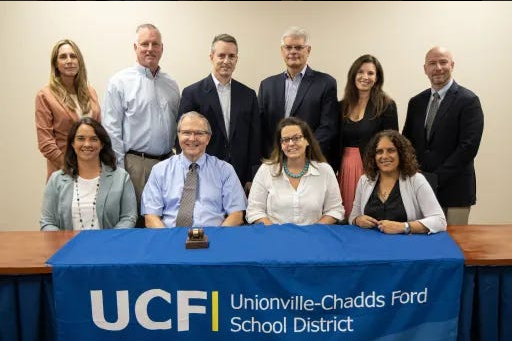
In August of 2020, during a Zoom meeting to decide on in-person school for the soon-to-begin school year, the nine-member Unionville-Chadds Ford school board muted Williams when he asked about the legal basis for the choice.
Repeating the performance, school board members cut the microphones and walked out of one of their own subsequent meetings, in August of 2021, to avoid listening to Williams when he didn’t stop speaking at the three-minute mark during their public comment session. Other parents concerned about forced masking for children received a similarly warm reception. The school board voted unanimously that same night to again impose a mask mandate on their campuses for the new school year.
For Williams, the repeated experience was a shock. He was an experienced lawyer, a parent, an established member of the community, and a volunteer coach at the high school — and he couldn’t get anyone to listen to a reasonable question. He asked his school board to explain the legal basis for a new policy, and “the school board president just cut me off.” Officials were acting in lockstep, without apparent authority, and refusing to explain their choices. “They just wouldn’t answer,” Williams says. Many of us have had this experience.
The school district finally dropped its mask mandate in March of 2022, after the decision from the state Supreme Court. And that was the end — except for one thing. A formal policy of the Unionville-Chadds Ford School District, Policy 906, establishes “a fair and impartial method” for the examination of parent complaints. You can find that policy here, in the section labeled “Community”. The policy is detailed and unambiguous, and starts requiring written reports after the failure of early and informal stages of resolution:
Third Level – If a satisfactory solution is not achieved by discussion with the building principal or immediate supervisor, a conference shall be scheduled with the Superintendent or designee. The principal or supervisor shall provide to the Superintendent or designee a report that includes the specific nature of the complaint, brief statement of relevant facts, how the complainant has been affected adversely, the action requested, and the reasons why such action should be taken or not taken.
Fourth Level – Should the matter not be resolved by the Superintendent or designee or is beyond his/her authority and requires Board action, the Superintendent or designee shall provide the Board with a complete report.
Final Level – After reviewing all information relative to the complaint, the Board shall provide the complainant with its written decision and may grant a hearing before the Board or a committee of the Board.
Williams used Policy 906 to ask the school board to think about what it had done, conducting an independent review of its policy decisions during the pandemic. Why had school officials implemented policies they had no legal authority to impose? Why had they refused to discuss or address parent questions? Why had they stonewalled requests for documents and information — not only from parents, but from a state senator who took an interest in the matter? Williams asked for an apology and “changes in oversight” to prevent a recurrence of unlawful and unexplained policy decisions, using formal school district policy that requires the district to act on complaints.
They haven’t bothered. The Unionville-Chadds Ford School District continues to ignore Williams, not responding to his complaints or opening the inquiry their own policy requires them to pursue. He’s had one sort-of response: In an exchange over the handling of the complaint, the district’s lawyers, at a private law firm, threatened him with legal action — a threat they so far haven’t made good. But from school district officials, the only response to three years of questions is unbroken silence.
October 21, 2023
QotD: The US Army’s Korean War blooding
For his own sake and for that of those around him, a man must be prepared for the awful, shrieking moment of truth when he realizes he is all alone on a hill ten thousand miles from home, and that he may be killed in the next second.
The young men of America, from whatever strata, are raised in a permissive society. The increasing alienation of their education from the harsher realities of life makes their reorientation, once enlisted, doubly important.
Prior to 1950 they got no reorientation. They put on the uniform, but continued to get by, doing things rather more or less. They had no time for sergeants.
As discipline deteriorated, the generals themselves were hardly affected. They still had their position, their pomp and ceremonies. Surrounded by professionals of the old school, largely field rank, they still thought their rod was iron, for, seemingly, their own orders were obeyed.
But ground battle is a series of platoon actions. No longer can a field commander stand on a hill, like Lee or Grant, and oversee his formations. Orders in combat — the orders that kill men or get them killed, are not given by generals, or even by majors. They are given by lieutenants and sergeants, and sometimes by PFC’s.
When a sergeant gives a soldier an order in battle, it must have the same weight as that of a four-star general.
Such orders cannot be given by men who are some of the boys. Men willingly take orders to die only from those they are trained to regard as superior beings.
It was not until the summer of 1950, when the legions went forth, that the generals realized what they had agreed to, and what they had wrought.
The Old Army, outcast and alien and remote from the warm bosom of society, officer and man alike, ordered into Korea, would have gone without questioning. It would have died without counting. As on Bataan, it would not have listened for the angel’s trumpet or the clarion call. It would have heard the hard sound of its own bugles, and hard-bitten, cynical, wise in bitter ways, it would have kept its eyes on its sergeants.
It would have died. It would have retreated, or surrendered, only in the last extremity. In the enemy prison camps, exhausted, sick, it would have spat upon its captors, despising them to the last.
It would have died, but it might have held.
T.R. Fehrenbach, This Kind of War: A Study in Unpreparedness, 1963.
October 20, 2023
QotD: The Gen-X-Files
I wasn’t in any way political back then. If forced to pick a side, I’d have been reflexively liberal, like all college kids are. I didn’t know the first thing about what was going on out in the world, let alone in the corridors of power in Washington, but even I found that pretty farfetched.
More importantly, the zeitgeist I saw was rapidly changing. X Files creator Chris Carter was born in 1956 and grew up in sunny SoCal (his wiki entry makes sure to give us his favorite surfing stance), so he more than most probably wrestled with the dilemma of how to bring Flower Power into Ronald Reagan’s 1980s. Hence the weird disconnect of the early 1990s, when Bill Clinton got his groovy, greasy, chicken-fried hippie self into the White House: The same people who, in their own college days, had nothing but hatred for the CIA and their domestic Mini-Me, the FBI, were all of a sudden kinda sorta coming around on the idea that The Feds are our friends — since, you know, the Feds are now us. It’s probably not a coincidence that Agent Mulder, FBI, was the star of The X-Files.
Explains a lot about “Gen X”, don’t it? When every single authority figure in your life, from the President on down, tells you to Fight the Power, the only way out of the clown show is to be, you know, like, whateverrr about everything — learned helplessness, 1994 version.
But smoked-out, flannel-clad, and apathetic is no way to go through life, and so we turned into a generation of suck-ups and toadies. Oh, the lunatic Marxists in the Teachers’ Unions want to encourage kids to “transition” in elementary school. Dude … you know, like, whateverrr. The college kids of 1994 are the middle managers, the Deep Staters, the lever-pullers of 2021. It’s working out about as well as you might’ve expected. You don’t need Agent Mulder to solve this mystery.
Severian, “1994”, Rotten Chestnuts, 2021-04-15.
October 16, 2023
In ?praise? of the “spoils system”
Glenn Reynolds on the way the US government’s structure changed from the “spoils system” of the early republic to the modern “professional” civil service of today:
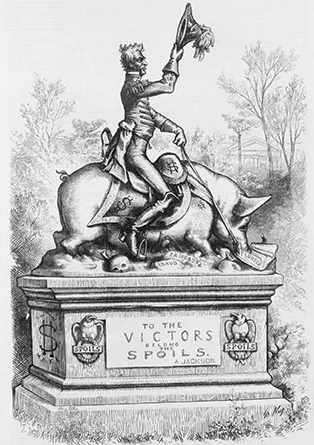
Andrew Jackson sitting on a hog on top of a tomb with the inscription “To the victors belong the spoils”.
Political cartoon by Thomas Nast, Harper’s Weekly, 28 April, 1877.
America’s institutions need structural reform. We need it in academia, we need it in the corporate world, and we need it in government. In all of these fields, the structures, incentives, and institutions that have grown up over time have been destructive, and need to be fundamentally transformed.
I’ll be writing about all of these things down the line, but for now let’s start with government. Though you don’t hear a lot about it on the right, the left is all bent out of shape over the prospect that a Republican administration elected in 2024 might partially deconstruct the existing protected civil service. I, on the other hand, am excited about that prospect, and only wish they’d go farther.
Prior to the adoption of the Pendleton Act in 1883, government employment operated according to the “spoils system”, which meant that hiring in the executive branch was controlled by the Executive. When a new administration came in, everyone’s job was up for grabs, at least potentially. This “rotation in office” had several advantages, which were widely appreciated at the time, and propounded by presidents from Jefferson to Jackson to Lincoln.
Jackson argued that one serving in government for too long would inevitably lose sight of the public interest and come to use office for personal gain. He also maintained that government was or could be made simple enough for men of ordinary ability and experience, so ‘more is lost by the long continuance of men in office than is generally to be gained by their experience’.1
Contrary to popular belief, though, the arrival of a new president didn’t mean that everyone left. Even Andrew Jackson, upon taking office, replaced only about 10% of the federal work force with his own people. Every president understood the value of continuity, and hiring new people is hard work.
But under the spoils system, the fact that the president could replace anyone mean that everyone worked for him. And that meant both that everyone was responsible to the president, and that the president was responsible for everyone in the government, and everything the government did. This is consistent with the Constitution’s vesting clause, which provides that “The executive Power shall be vested in a President of the United States of America.” If the executive branch does it, it’s an executive power, and if it’s an executive power it should be controlled by the president.
Contrast this to a “professional” civil service, in which the president does neither the hiring nor the firing, except with regard to a comparatively small number of senior officials. The civil service doesn’t think of itself as working for the president, really, and will happily drag its feet when it doesn’t like the president’s priorities. And when the bureaucracy misbehaves, or fails to perform, the president can, at least to a degree, blame its recalcitrance for the trouble or lack of results that occurs.
Congress is also let off the hook, yet simultaneously weirdly empowered. Congress can blame “the bureaucracy” for bad things, even when those things result from laws that Congress has passed. Then it can turn around and “help” constituents by intervening with the bureaucracy it has rendered dysfunctional, earning gratitude that may be deserved in a narrow sense, but not in terms of the big picture.
Under a spoils system, on the other hand, nobody gets off the hook. If the bureaucracy misbehaves, the president can fire the misbehavers. If Congress is unhappy with what bureaucrats do, they can demand that the president fire them, and make an election issue out of it if they want.
So why did we wind up with a civil service? As is typical, the fantasy of a neutral, efficient, expert civil service was laid next to the reality of a messy functioning government. But, as is also typical, the fantasy in practice turned out to be considerably less appealing than as proposed.
1. Robert Maranto, Thinking the Unthinkable in Public Administration: A Case for Spoils in the Federal Bureaucracy, Administration & Society, January 1998, 623,625.
The Allied Rape Wave of 1944 – War Against Humanity 116
World War Two
Published 12 Oct 2023Since the earliest days of humanity, where there has been war, there has been rape. This war is no different. As vast armies battle across Europe, the chaos in their wake breeds an epidemic of rape. In its action and its punishment the European rape wave is also highly racialised. It adds up to a storm of suffering.
(more…)
Remington Model 8 (in .25 Remington)
Forgotten Weapons
Published 23 Feb 2014The Remington Model 8 (and the 81, which is mechanically identical) was an early self-loading rifle design by John Browning, and was produced from 1906 into the 1950s. It was available in 4 calibers initially, all of them being rimless, bottlenecked proprietary jobs — the .25, .30, .32, and .35 Remington. The .35 was the most effective on game and was the most popular seller, with the .25 being the least popular. When the Model 81 was introduced (with a heavier forestock and semi pistol grip), it was also made available in .300 Savage. At that time, the Remington factory also offered to rebarrel existing Model 8s for the .300 Savage cartridge.
The Model 8 was a long-recoil design, something that saw little further development and remains one of the least-common types of action. It is interesting to compare the Remington 8 to the Winchester 1905/07/10 series of rifles that came on the market at almost the same time. Both were well-made and effective self-loaders, but with much different target markets and mechanical systems. Winchester opted to make a replacement for the pistol-caliber lever action saddle rifle, and did so using a simple and somewhat brute-force operating system: direct blowback with a heavy bolt and recoil spring. Remington, on the other hand, wanted to make a big-game rifle with very fast follow-up shot capability, and used the far more complex long recoil locked breech system. Both guns are largely forgotten by the gun-owning public today, although they both were widely used and appreciated by hunters for decades.
(more…)


