
World War Two
Published Dec 19, 2023Camouflage comes in many forms, shapes, disguises, and even processes, for there are indeed many ways to hide your soldiers, guns, tanks, and even ships at sea. Today we take a wee look at camouflage during the war.
(more…)
December 22, 2023
Camouflage
Comments Off on Camouflage
December 18, 2023
Battle Taxis | Evolution of the Armoured Personnel Carrier
The Tank Museum
Published 8 Sept 2023Tanks and infantry need to operate together. Tanks provide firepower and protection, the infantry support and protect the tanks. In this video, we look at that vital component of the equation, the Armoured Personnel Carrier and its transition into the modern Infantry Fighting Vehicle.
(more…)
Comments Off on Battle Taxis | Evolution of the Armoured Personnel Carrier
December 17, 2023
The Battle of the Bulge Begins – WW2 – Week 277 – December 16, 1944
World War Two
Published 16 Dec 2023Adolf Hitler’s Ardennes counteroffensive finally goes off this week, and it does indeed catch the Allies by surprise, and they suspend other offensive operations in the west. They are still attacking in Italy, and the Soviets are still advancing in Hungary, trying to cut off Budapest. In the Far East, there are Allied landings on Mindoro, and they are also on the march in Burma, hoping to pin down the enemy.
0:00 Intro
0:55 Recap
1:22 Street fighting in Athens
04:07 Operation Queen ends
06:33 Autumn Mist Offensive plans
09:51 Allied intelligence failures
12:26 The Ardennes Offensive Begins
16:57 Allied attacks in Italy and Soviet plans to surround Budapest
20:07 The Allied offensive in Burma
22:10 Mindoro Landings
24:33 Summary
25:14 Conclusion
(more…)
Comments Off on The Battle of the Bulge Begins – WW2 – Week 277 – December 16, 1944
Mark Knopfler – “Sailing To Philadelphia” (The Studio Albums 1996-2007)
Mark Knopfler
Published 15 Jul 2022Official video to part 2 of Mark Knopfler’s The Studio Albums 1996-2007 featuring the remastered recordings from Sailing To Philadelphia.
(more…)
Comments Off on Mark Knopfler – “Sailing To Philadelphia” (The Studio Albums 1996-2007)
QotD: When “factions” coalesce into “parties”
Madison, Hamilton, and Jay got it wrong. If you recall your high school civics class from back when that was a thing, you’ll remember that the authors of The Federalist Papers thought that geographic expansion would be a check on what they called “faction”, which meant something like “proto political party”. Back in Britain, the “Whigs” and the “Tories” weren’t parties in the modern sense; they were groups of men of a similar outlook that coalesced around a dominant personality, a kind of bastard feudalism for the parliamentary age. But since there are always more clever, ambitious men than there are places for them in such a system, Britain’s “party” system was always tearing itself apart — that’s a big reason the rebellion started in the first place, and one reason the Colonials won the war.
Geographic expansion keeps that in check, the Federalist guys thought, because clever, ambitious men who feel themselves blocked by the Old Boys’ Network can always head west, to try their luck in one of the burgeoning frontier communities. Which worked — that’s the part the Federalist guys got right — but enough clever, ambitious men stayed back East that “factions” transformed into something much worse: Actual political parties.
Severian, “Real Federalism Has Never Been Tried”, Rotten Chestnuts, 2021-05-03.
Comments Off on QotD: When “factions” coalesce into “parties”
December 15, 2023
“Cletus is ’bout to go kinetic, y’all”!
Chris Bray turns to movie trailer analysis as a break from his usual work. Oh, wait, no it’s not really much of a break:
Cletus is ’bout to go kinetic, y’all. I got the news straight from brunch in Brentwood, where people really understand Middle America.
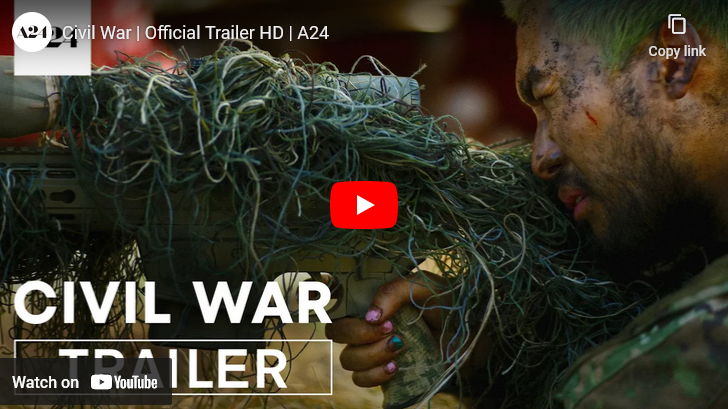
The trailer has dropped for a major new movie about an American civil war. No, not that one: the next one, with the dictatorial president who seizes an unconstitutional third term and refuses to leave the White House, and is an old white guy with big hair who drawls and thinks the world of himself and totally isn’t like any real person they’re trying to compare him to.
Note that the sniper in the thumbnail has camouflaged his rifle with a pile of spaghetti to avoid being seen, but is also wearing … nail polish? I am unfamiliar with this military doctrine, but if you ever find yourself in a war, wear bright shiny things so you blend in with the trees. I hope we’ve all seen the White House Christmas video this year, because I think they might also be gesturing at this brand of postmodern ghillie suit:
Civil War is Hollywood’s other “America collapsing soon” movie, behind the Obama-backed Leave the World Behind, which sounds like a form of torture. […]
You can watch the Civil War trailer to see how utterly dogshit banal it is, but my favorite detail is that Texas and California form an alliance against the US government and secede together. Yes, a long line of development executives said, Texas and California share a political agenda and would obviously make common cause in an insurgency.
I beg you to get drunk and discover on your own what professional entertainment journalists, a real category of human existence, are saying about this movie.


Severian also saw the trailer and as you’d guess it just blew him away:
So let’s see here … Florida and Texas seceding, necessitating the use of airstrikes — indeed, of all available force — against Americans? Check. Journalists as heroes? Check. Brown-skinned folks with funny accents as the only real Americans? Check. A rebel assault on the capitol, complete with explosions at the very heart of Our Democracy™? Check! I don’t think they actually said the names in the trailer — I kinda skimmed, because it’s nauseating — but whaddaya wanna bet the President of Real America has a name like, oh, I dunno … “Joe Ryder”, and the President of Godawful Redneckistan has a name kinda like “Ronald Rumph”?
They’re really steeling themselves to do Whatever It Takes, aren’t they?
Noted in the comments by Andrew: “Fun fact no. 1: there is only one facility in the US that manufactures explosive ordinance for the military. Fun fact no. 2: that facility is in Texas.”
Oh, and apparently red sunglasses are the new MAGA hat.

How far are we from a final communiqué from Kiev saying that “the war situation has developed not necessarily to Ukraine’s advantage”?
Yeah, I stole the idea for the headline from Severian’s post from a few days ago. So sue me. But seriously, CDR Salamander considers what he calls the cold truth of the Russo-Ukrainian war:

Well, history didn’t fold out as the Russians wanted. There was no 3-day war. No 3-week war. No 3-month war either. Kiev remains in Ukrainian hands … but what about a 3-year war?
Despite all the pre-war metrics, the “expertise” of the Smartest People in the Room™, every wargame that would have been run at all our war colleges would have told us that there would not be a conventional war in Ukraine is finishing up its second and going in to its third year, but here we are.
They were all wrong.
A common problem, one that well pre-dates the invasion of Ukraine, is that we have shockingly well credentialed people of influence from both parties who have an inability to understand that Russians are not Westerners. They don’t think like Westerners, though they may look like them.
The Russians have a distinct culture, history, and view of themselves and their place in history. The underperforming political, military, and diplomatic elite in the West — with few exceptions outside the former Warsaw Pact nations now in NATO — expect Russians to react in the same way and to the same degree to the incentives and disincentives that move needles and preferences in DC and Brussels.
Time is always on the side of Russia, which is one of the reasons the slow rolling of weapons to Ukraine has been an exercise of malpractice of the highest degree. You are either in or out.
Two years on, “we” still are not sending a clear signal. It is amazing, really; in military might, GDP, demographics and a whole host of other reasons, Russia should not be as resilient as they are … which is why DC & Brussels are being played so hard. They still do not understand Russia.
Even after 1,000 years of experience, we have Western leaders who refuse to believe that the Russians are fundamentally different than the West is in the 21st Century. You can’t put the cultural ability to absorb damage and brutal patience you cannot see in some metric that can go on a PPT slide.
What the Russians lack in so many other places, they make up for here. As such, this critical part of understanding Russian motivation keeps being missed. Yes to their economy and apocalyptic demographics. Yes to all that.
For all the reasons Russia continues to fight, so too do their Ukrainian brothers – demonstrating greater resilience and endurance that Western expectations.
The time for leaving Ukraine to its fate is long past. Yes, the West has a short attention span and is suffering under the dead hand of entrenched leaders with a defeatist mindset – but none of this is written.
Ukraine can still win – or at least something that can be called a win. It would help if the Russians had some internal issues that required more attention that Ukraine, but even then – all is not worth shrugging over.
Yes, I’ve seen the math — the metrics — but war is informed by math, but not defined within it.
At a relatively modest cost in our treasure and almost none of our blood, we are wearing down Russia’s ability to project power for a generation, perhaps two. Perhaps many more generations should demographic instability mate with political instability. The Ukrainians – facing the same economic and demographic challenges as the Russians – are up for the fight. There is no reason for more comfortable nations who have supported them so far to go wobbly at half-time.
Of course, as noted yesterday, this ship may already have sailed thanks to Hamas.
Comments Off on How far are we from a final communiqué from Kiev saying that “the war situation has developed not necessarily to Ukraine’s advantage”?
QotD: Delayed onset adulthood
At the risk of sounding all White Christian Male and stuff [irony alert], allow me to remind everyone of this excellent precept from Corinthians:
When I was a child, I spake as a child, I understood as a child, I thought as a child: but when I became a man, I put away childish things.
Except that men aren’t doing any of that. Instead, they’re clinging to the artifacts of their childhood, hoping that Mommy will be there to keep the Big Bad Wolf/Zombies away.
What will inevitably happen is calamity. As Charles Norman puts it: “The world is running out of grown-ups. It will probably take tragedies and a prolonged era of diminished affluence for people to grow up.”
Like I said: calamity.
Kim du Toit, “Kiddies”, Splendid Isolation, 2019-08-22.
Comments Off on QotD: Delayed onset adulthood
December 14, 2023
Whatever it is, it sure ain’t Stoicism …
Freddie deBoer doesn’t have a catchy name for this, but you’ll recognize it instantly from the description:
For years now, I’ve written once or twice annually about a phenomenon that I’ve struggled to name but which everyone understands. It’s a particular kind of social and aesthetic culture, not exclusive to Instagram but very heavily associated with it, that merges girlboss feminism with the contemporary therapeutic imperative, a strange syncretic mysticism involving horoscopes and “manifesting”, and a blanket excuse for narcissism and selfishness dressed up in quasi-political and self-help terms. You know what I mean.
Some of these memes are comically ridiculous, most of them are fairly innocuous, and a few of them make me deeply sad. But they all reveal a tangle of conflicting attitudes and ideas that are quite confused. You would never assemble these various impulses into a life philosophy on purpose; they’ve been grafted together mostly thanks to the weird rhythms and path dependence of social media. Either way, I’ve argued that they present an essential problem with any kind of “I can have it all” philosophy — millions of people absorb this stuff, and because many of the things we want in life are zero sum, not all of them in fact can have it all. Almost all of them, in fact, will get very much less than it all. You have this absurd manifesting/The Secret stuff, where grown adults genuinely convince themselves that they can will what they want into being simply through wanting it. Well, alright: what if two people want the same promotion at work, and they’re both manifesting it? The clod philosophy this is all attached to says that whoever wins wanted it more, and since wanting can’t be quantified, no one can ever prove that isn’t true. (Convenient!) Regardless, in the case of the singular promotion and two people manifesting for it, only one of the people who has read endless memes like these actually ends up being self-actualized by success. This is OK; life can be full of contentment and disappointment at the same time. Part of what makes this kind of messaging pernicious, though, is that it suggests that not getting everything you want is always a personal failure you shouldn’t accept.
It is not possible that God promised the whole garden to everyone. (That’s not how fractions work, even for God.) It is not socially responsible to believe that you are entitled to the whole garden. And setting yourself up to see anything short of the whole garden as failure is a recipe for making yourself miserable.
That’s related to another point I’ve made, which is that these memes create an unachievable expectation that healthy, successful women aren’t in possession of ordinary confidence but of lunatic confidence, a kind of confidence rarely seen outside of Michael Jordan or bipolar mania. In a particularly perverse irony of the sort that seems to usually afflict women, this demand for outrageous self-confidence becomes just another bar that women feel like they can’t meet. A whole affirmational culture that ostensibly exists to help and affirm and praise women ends up being just one more on the long list of expectations that our society heaps on them: hard-charging and career-oriented but always putting family first, well put-together but always effortless, sexy but not slutty, Madonna and whore, you know the whole deal. I’m sorry that this stuff is so gendered, but it is, and I’m sorry that I’m the wrong messenger on this topic, but no one else is making these arguments, so I must. Yes, I concede that for most people who indulge in this stuff, it’s a harmless hobby that maybe pushes them to be a little better to themselves. But as time goes on, the messaging has grown more and more deranged, and young people are very susceptible to this sort of thing. And my job is to worry.

Comments Off on Whatever it is, it sure ain’t Stoicism …
The West – “Ukraine? Ukraine? Do we know a ‘Ukraine’?”
In The Line, Andrew Potter notes just how quickly cross-partisan support has eroded since the summer, and especially since the Hamas atrocities in Israel on October 7th:
Well, you can’t say Volodymyr Zelenskyy didn’t try. With a new U.S. aid package for his country frozen by a Republican filibuster, the president of Ukraine made a last-ditch visit to Washington to plea, as he has done so often, for help against the Russian invasion. But unlike previous visits, he was treated more as yesterday’s annoyance than a global statesman fighting for the cause of freedom.
The wheels came off the bus of Western support for Ukraine gradually, then suddenly. The slow distancing from Ukraine has been underway since last summer, but it was finally pushed off the cliff in the wake of the barbarism of Hamas on October 7. Since then, the world’s attention, effort, and in important cases, arms, have been focused on the Middle East. But also, the intensely polarizing character of the Israel-Hamas war has hardened political divisions in almost every country, in a way that has largely destroyed what had been, in many countries, a cross-partisan consensus on Ukraine.
But for all its slow-motion inevitability, it is still shocking to see just how quickly support for Ukraine evaporated, how hollow the promises have been revealed to have been, how ugly the finger pointing has got, and how unprepared NATO, the EU, and the West as a whole are for the danger that is staring them in the face.
Let’s start with a basic fact: the Ukrainian counteroffensive, which began in early summer with so much dramatic hope, has failed. The goal was to drive to the Black Sea, split the Russian forces in half, and begin the work of retaking the sovereign Ukrainian territory that had been seized by Russia since 2014.
It didn’t happen, and it didn’t even come close. Why that is the case has been, and will be, the subject of intense scrutiny and analysis, but what seems clear is that the Russians were given too much time to dig in and lay minefields tens of kilometres deep across the front lines. In the absence of sufficient airpower to achieve air superiority over the battlefield, the attacking Ukrainian forces became sitting ducks to Russian artillery, helicopters, and drones.
So the fight is at a stalemate. The commander of the Ukrainian army, Valerii Zaluzhnyi, said as much in an article he wrote for The Economist at the beginning of November. President Zelenskyy has admitted it as well, as has the head of the Ukraine war cabinet.
This failure need not have been a disaster. Success in battle is never guaranteed, the enemy always gets a vote, and there is nothing stopping the Ukrainians from tending their wounds, burying their dead, and trying again.
Nothing, that is, except the fecklessness, the division, and the bad faith of Ukraine’s partners in the West. Instead of sitting down to figure out what went wrong, adjusting and increasing their aid accordingly, and recommitting to the fight, the whole so-called alliance has degenerated into infighting, blame shifting, and ass-covering. The Washington Post recently had a whole series devoted to giving anonymous American “senior officials” plenty of acreage to underbus the Ukrainians, who were, allegedly, too slow to start the counteroffensive, too cowardly when it finally began, too incompetent in their execution, and too stubborn to listen to the Americans advising them.
This all may be true. But something else is also true: The West, for all its promises to back Ukraine to the hilt, to stand by it through thick and thin, to do whatever it takes as long as it takes, has not done any of this. Support, in the form of arms deliveries, training, aid, ammunition, what have you, has been slow, grudging, performative, and inadequate to the task.
Comments Off on The West – “Ukraine? Ukraine? Do we know a ‘Ukraine’?”
Pervasive disrespect for the human form in art (and everything else) is a leading indicator of collapse
My headline isn’t exactly what Ted Gioia says here (although this is only the beginning of his article, as the rest is behind a paywall) but it’s definitely an aspect of what he’s seeing:

For thousands of years, flourishing societies treated the human form with love and respect.
The connection is hard to describe with precision. But, it seems, you can’t make much progress promoting human rights if you don’t start with some degree of reverence for the embodied individual.
Even neanderthals knew about ornamentation and figurative art, but paintings of actual people, created by communities along the Nile River, some 8,000 years ago, signaled the rise of more advanced, stable institutions. It’s no coincidence that democracy and personal autonomy in Greece and Rome happened in conjunction with obsessively realistic renderings of the human body.
Much of this was lost in the post-classical world, but Renaissance artists rediscovered this passion for the human figure — which was embedded in its nurturing of science, art, and free inquiry
But something very different is happening in our own time.
I won’t offer any theories today. I’ll just share the facts — in the form of news stories, all about different subjects.
None of these stories have any direct connection with the others. Yet they fit together like the pieces of a strange puzzle. The picture they make is ominous.
Maybe you have some explanations. In the meantime, let’s just plunge in …
1. You can’t hear people talking in movies — because directors prefer to share background sounds.
“I used to be able to understand 99% of the dialogue in Hollywood films. But over the past 10 years or so, I’ve noticed that percentage has dropped significantly — and it’s not due to hearing loss on my end. It’s gotten to the point where I find myself occasionally not being able to parse entire lines of dialogue when I see a movie in a theater, and when I watch things at home, I’ve defaulted to turning the subtitles on to make sure I don’t miss anything crucial to the plot.”2. Lead vocalists are getting quieter while the sound of the instruments become louder.
“Lead vocalists have gotten quieter over the decades, compared with the rest of the band. That’s the conclusion of a new study that analyzes chart-topping pop tunes from 1946 to 2020 …”3. Anthropophobia — the fear of other people — is on the rise.
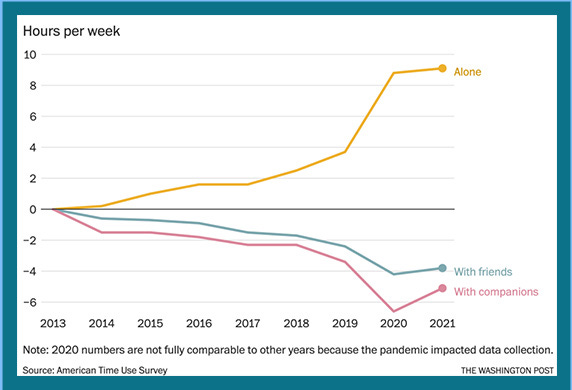
“Anthropophobia, or the fear of people, has so far been America’s most searched-for phobia this year. In that study, anthropophobia accounted for 22% of all phobias that people searched for online, a five-fold increase over 2019. And the state-by-state results affirm common stereotypes. New York’s most-searched phobia in 2020, for example, has been “philophobia.” That’s a big word for the fear of intimacy.”4. Time spent alone is rising for all demographic groups.
“According to data from the American Time Use Survey, the amount of time people spent with their friends, family and other companions was mostly unchanged between 1970 and 2013. Then, after decades of stability, the numbers began falling. By 2019, on average people were spending almost three hours less with their friends than only six years earlier, and four hours less with their family, neighbors and other companions.
“None of that time was transferred to more time with partners, children or others. All of it was swallowed up by time spent alone … Strikingly, the average American teenager today spends 11 hours fewer with their friends than they did only eight years ago, and 12 hours more time alone.”
5. Clothing retailers replace realistic mannequins with abstract forms.
“There were a ton of used mannequins sitting in retailers’ attics and storerooms. Every time they re-merchandised or remodeled, they were bringing in new mannequins to replace the old, increasingly replacing realistics with abstracts. And it wasn’t just full mannequins, it was head forms, leg forms, maternity mannequins, swimwear mannequins and all kinds of props, as well. Retailers would throw these items in the trash.”6. Social media causes children to dislike their own bodies.
“Three out of four children as young as 12 dislike their bodies and are embarrassed by the way they look, increasing to eight in 10 young people aged 18 to 21 … Nearly half of all children and young people aged from 12 to 21 questioned said they have become withdrawn, started exercising excessively, stopped socialising completely or self-harmed because they are regularly bullied or trolled online about their physical appearance.
Comments Off on Pervasive disrespect for the human form in art (and everything else) is a leading indicator of collapse
December 13, 2023
“Harvard stands firmly behind President Claudine Gay”
 Chris Bray discusses the sure-to-be-continued saga of a plagiarist — who’s also a full-time water-carrier for terrorism — who happens (for the moment) to head
 HAMAS University Harvard University:
Harvard stands firmly behind President Claudine Gay, a remarkably undistinguished scholar and academic leader who has been lavishly overpraised and promoted beyond her ability for three decades. They do this, they have just explained, because Harvard is deeply committed to a culture of academic freedom, open discourse, and cultural pluralism:
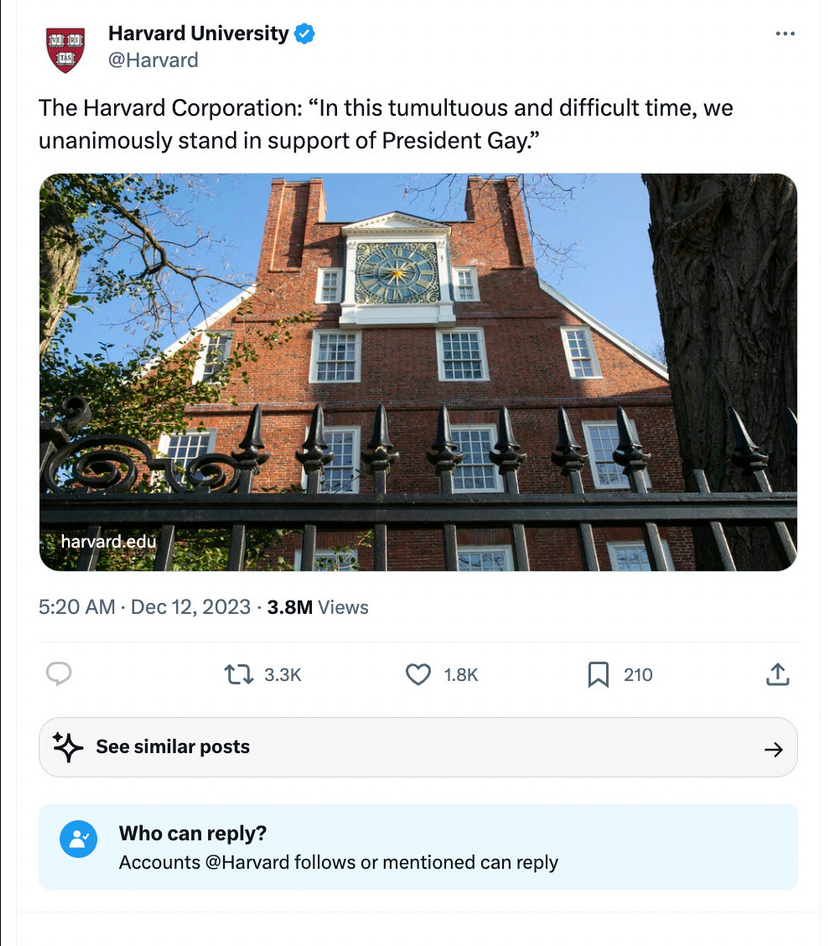
In this tumultuous and difficult time, we unanimously stand in support of President Gay. At Harvard, we champion open discourse and academic freedom, and we are united in our strong belief that calls for violence against our students and disruptions of the classroom experience will not be tolerated. Harvard’s mission is advancing knowledge, research, and discovery that will help address deep societal issues and promote constructive discourse, and we are confident that President Gay will lead Harvard forward toward accomplishing this vital work.
And so here’s the tweet — I insist on still calling them tweets — in which Harvard announces that it has posted its public letter on its insistent promotion of open and constructive discourse:
We stand for open discourse! (Replies are closed.)
Coprophagiacs eat so much shit that it stops being shit, and just becomes the thing they eat. Every word of a statement from the enormously high-status trustees of an enormously high-status institution is just ludicrous. They self-refute, casually, without noticing.
Every day now, I think about a term that lawyers use: a colorable argument. If you have a colorable argument, you can file your lawsuit without being instantly thrown out of the courtroom. You may not have the winning argument, and you may not even have a really good argument, yet, but you have enough of an argument that you can start. Then, through the discovery process and with some luck and hard work, maybe you can build the actual winning argument. But for now, you have some not-totally-implausible factish claims, and you can more or less connect it all to a law of some kind, and you can walk into the courtroom without the judge bursting into laughter. You have a colorable argument; you have the bare minimum.
Look how much of the culture is made up of people who don’t have a colorable argument. Look how much total nonsense streams by.
Now, about those plagiarism allegations against the president of what is alleged to be one of the nation’s most prestigious universities:
With regard to President Gay’s academic writings, the University became aware in late October of allegations regarding three articles. At President Gay’s request, the Fellows promptly initiated an independent review by distinguished political scientists and conducted a review of her published work. On December 9, the Fellows reviewed the results, which revealed a few instances of inadequate citation. While the analysis found no violation of Harvard’s standards for research misconduct, President Gay is proactively requesting four corrections in two articles to insert citations and quotation marks that were omitted from the original publications.
She did absolutely nothing wrong, and that’s why she’s requesting corrections on 18% of her exceptionally thin scholarly record. No big deal, she’s just correcting “citations and quotation marks that were omitted”. Who omitted them? That’s the wrong question, see, because what happened is just that they “were omitted”. The quotation marks didn’t insert themselves. I demand that the quotation marks be denied tenure for wandering away from the page!
Comments Off on “Harvard stands firmly behind President Claudine Gay”
December 10, 2023
“The peasants are revolting!”
Chris Bray says we’re back to aristocracy:
What do Americans think of vitriolic language directed at government?
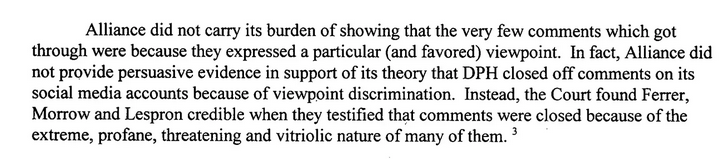
Remember that Superior Court Judge William Fahey has just tentatively ruled, in a First Amendment lawsuit over the decision by the Los Angeles County Department of Public Health to forbid public comments on its social media posts, that the county has not engaged in viewpoint discrimination, because the public is yucky:
Comments were closed to the public because many were “extreme” and vitriolic; therefore, no First Amendment violation has occurred. Government cannot discriminate against your viewpoint if your viewpoint is extreme, or if it’s expressed too strongly; the First Amendment only protects inoffensive expression.
The lowest-hanging fruit for the counterargument is all in New York Times Company v. Sullivan, in which a quite liberal Supreme Court repeatedly and very clearly spelled out the American standard for the criticism of government. Justice Arthur Goldberg, in a concurring opinion: “In my view, the First and Fourteenth Amendments to the Constitution afford to the citizen and to the press an absolute, unconditional privilege to criticize official conduct despite the harm which may flow from excesses and abuses”.
This is how the Supreme Court showed up in 1964 to start thinking about a case involving the limits of speech about public officials; as Justice William Brennan, Jr. wrote in the majority opinion, “we consider this case against the background of a profound national commitment to the principle that debate on public issues should be uninhibited, robust, and wide-open, and that it may well include vehement, caustic, and sometimes unpleasantly sharp attacks on government and public officials.”
Compare that conclusion to the argument that government has not engaged in viewpoint discrimination, because it banned comments only in the context of being addressed with vitriol. We didn’t say we didn’t didn’t like their viewpoint; we just said that their opinions were too extreme.
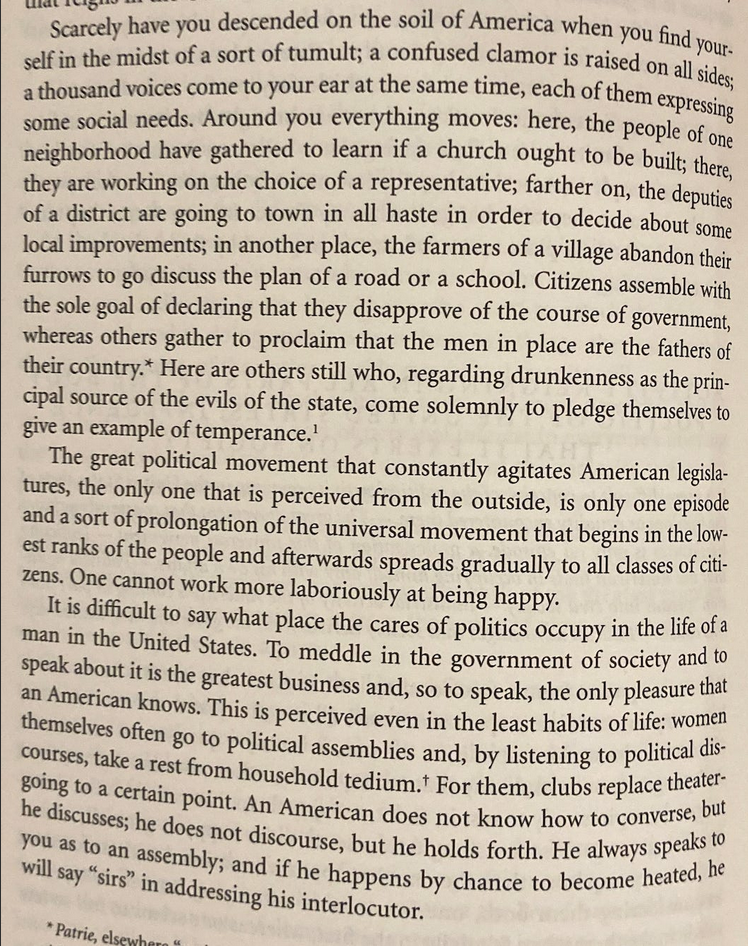
But here’s the important thing about New York Times Company v. Sullivan: it’s a history lesson. The majority opinion quotes James Madison and John Stuart Mill, and examines debates over public speech in the early republic. Looking at the national past and its political sources, they saw only the idea that government officials may properly be addressed with whatever degree of firmness citizens choose to apply. American politics were never polite, and were never thought to be. The tumult of a democratic republic, Tocqueville wrote, “begins in the lowest ranks of the people”, storming the seats of government to shout their disapproval:
“… if he happens by chance to become heated”. That wasn’t pathology or exception; a French observer touring America thought that heated denunciations of government were signs of … a weekday. A scholar of early American politics has written colorfully about the way national officials limited the aggressiveness of attacks on their character: they shot each other, or threatened to.
Comments Off on “The peasants are revolting!”
Can the Americans Stop the Kamikazes? – WW2 – Week 276 – December 9, 1944
World War Two
Published 9 Dec 2023This is a very busy week of the war. In the west, the Americans manage to reach the Roer River in force, but haven’t taken any of its dams; in Italy, the Allies liberate Ravenna; the Soviet advance in Hungary continues, and the Soviets even set up a new Hungarian government; martial law is declared in Greece; the Japanese make a corridor to Indochina; the fighting on Leyte continues, and the kamikaze menace becomes ever more worrisome.
00:00 INTRO
01:10 British intelligence failure
01:55 Allies reach the Roer River
05:35 Problems with Devers’ 6th Army Group
07:41 Allies liberate Ravenna
08:50 Soviet advances in Hungary
12:10 Soviets set up a new Hungarian government
13:47 A deadly demonstration and martial law in Greece
18:33 Japanese establish a corridor to Indochina
19:59 Leyte and kamikaze attacks
23:45 CONCLUSION
(more…)
Comments Off on Can the Americans Stop the Kamikazes? – WW2 – Week 276 – December 9, 1944
December 9, 2023
The coming Micro-Macro culture war … and who’s going to win it
Ted Gioia outlines the dismal state of the “macro” culture — television, movies, newspapers, book publishing and all the big corporations that control them — with the dynamism of the “micro” culture:
In the beginning, all culture was microculture.
You knew what was happening in your tribe or village. But your knowledge of the wider world was limited.
So you had your own songs and your own stories. You had your own rituals and traditions. You even had your own language.
But all these familiar things disappeared when you went off into the world. That was dangerous, however. That’s why only heroes, in traditional stories, go on journeys.
You learn on the journey. But you might not survive.
But all that changed long before I was born.
In my childhood, everything was controlled by a monoculture. There were only three national TV networks, but they were pretty much the same.
When I went to the office, back then, we had all watched the same thing on TV the night before. We had all seen the same movie the previous weekend. We had all heard the same song on the radio while driving to work.
The TV shows were so similar that they sometimes moved from CBS to NBC, and you never noticed a change. The newscasters also looked pretty much the same and always talked the same — with that flat Midwestern accent that broadcasters always adopted in the US.
The same monoculture controlled every other creative idiom. Six major studios dominated the film business. And just as Hollywood controlled movies, New York set the rules in publishing. Everything from Broadway musicals to comic books was similarly concentrated and centralized.
The newspaper business was still local, but most cities had 2 or 3 daily newspapers — and much of the coverage they offered was interchangeable. Radio was a little more freewheeling, but eventually deregulation allowed huge corporations to acquire and standardize what happened over the airwaves. [NR: I suspect the “freewheeling” went away once the government started imposing regulations, and the corporate consolidation was enabled when they “deregulated” the radio licensing regime several decades later.]
When I went to work in an office, back then, we had all watched the same thing on TV the night before. We had all seen the same movie the previous weekend. We had all heard the same song on the radio while driving to work.
And that’s why smart people back then paid attention to the counterculture.
The counterculture might be crazy or foolish or even boring. But it was still your only chance to break out of the monolithic macroculture.
Many of the art films I saw at the indie cinema were awful. But I still kept coming back — because I needed the fresh air these oddball movies provided. For the same reason, I read the alt weekly newspapers and kept tabs on alt music.
In fact, whenever I saw the word alt, I paid attention.
That doesn’t mean that I hated the major TV networks, or the large daily newspaper, or 20th Century Fox. But I craved access to creative and investigative work that hadn’t been approved by people in suits working for large organizations.
The Internet should have changed all this. And it did — but not much. Even now the collapse in the monoculture is still in its early stages.
But that’s about to change.
If you don’t pay close attention, the media landscape seems pretty much the same now as it did in the 1990s. The movie business is still controlled in Hollywood. The publishing business is still controlled in New York. The radio stations are still controlled by a few large companies. And instead of three national TV networks plus PBS, we have four dominant streaming platforms — who control almost 70% of the market.
So we still live in a macro culture. But it feels increasingly claustrophobic. Or even worse, it feels dead.
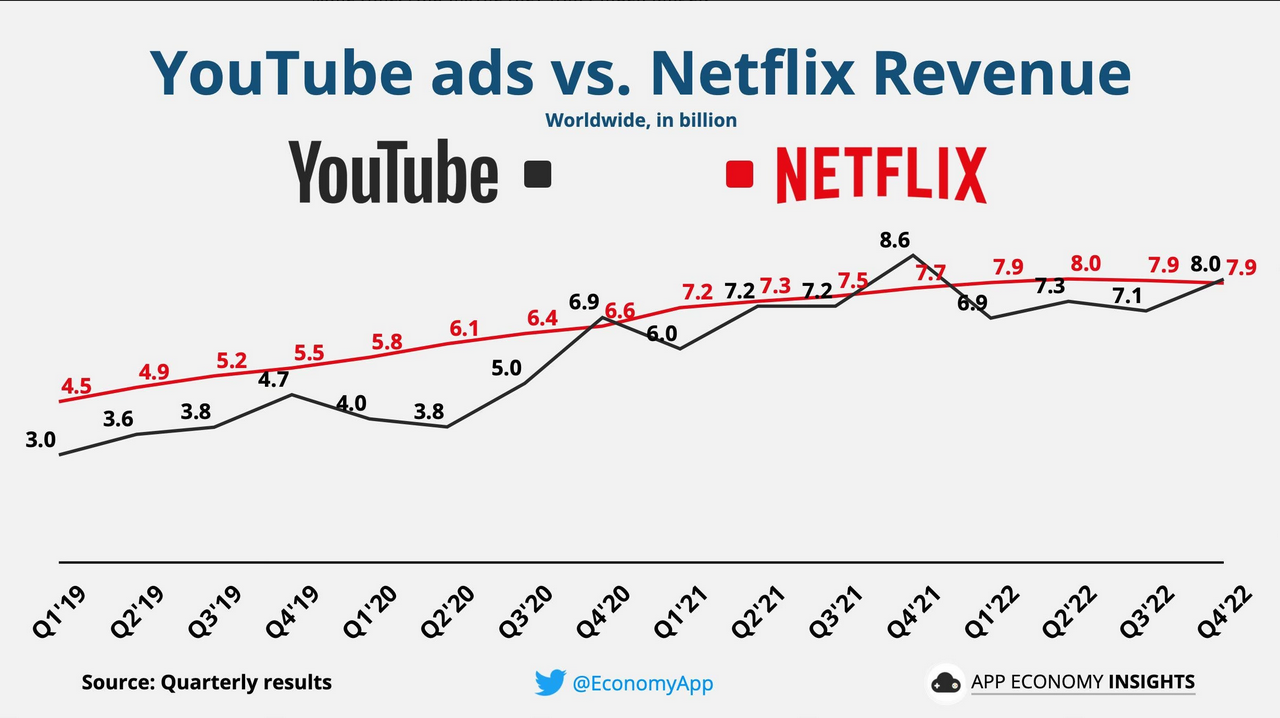
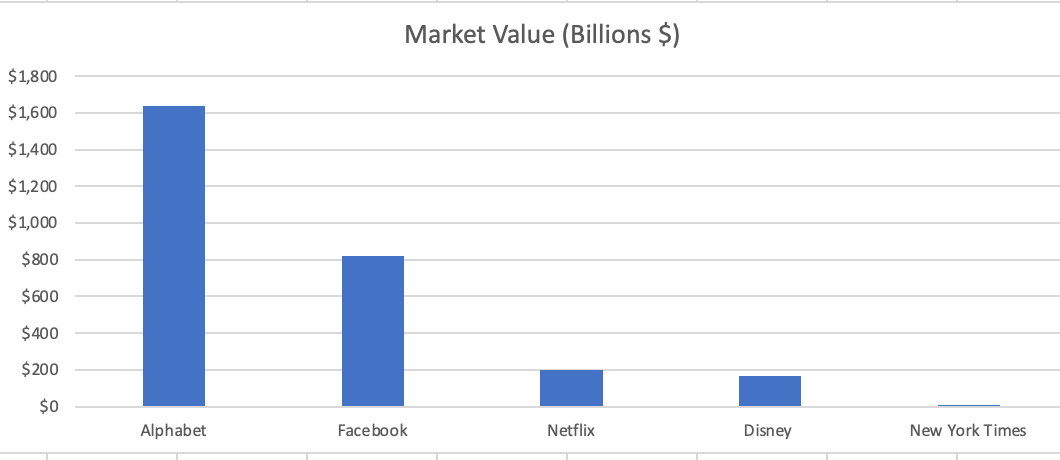
Meanwhile, a handful of Silicon Valley platforms (Google, Facebook, etc.) have become more powerful than the New York Times or Hollywood studios or even Netflix. It’s not even close — the market capitalization of Google’s parent Alphabet is now almost ten times larger than Disney’s.
But here’s the key point — these huge tech companies rely on the microculture for their dominance.
Where is Facebook without users contributing photos, text and video? Where is Google’s YouTube without individual creators?
In terms of economic growth or audience capture, the microculture has already won the war. But it doesn’t feel that way.
Why not?
First and foremost, Silicon Valley is a reluctant home for the microculture. To some extent Alphabet and Facebook are even going to war with microculture creators — they try to make money with them even while they punish them.
- So Mark Zuckerberg needs creators, but won’t even let them put a live link on Instagram and limits their visibility on Facebook and Threads.
- Alphabet needs creators to keep YouTube thriving, but gives better search engine visibility to total garbage that pays for placement.
- Twitter also claims it wants to support independent journalists — but if you’re truly independent from Elon Musk, your links are brutally punished by the algorithm.
This tension won’t go away, and next year it will get worse. The microculture will increasingly find itself at war with the same platforms they rely on today.
And legacy media and non-profits are even more hostile to emerging media. Go see who wins Pulitzer Prizes, and count how many journalists on alternative platforms get honored.
I’ll save you the trouble. They don’t.
Comments Off on The coming Micro-Macro culture war … and who’s going to win it


