
Oh, Apple Computer. What sorts of antics are you into this month?
Since the iPhone was released two years ago, watching Apple keep its obsessive vise grip on the device while trying to promote third party application development has been one solid I-didn’t-know-you-could-do-that after another.
Battle the recording industry for liberal music licensing terms and build the largest online music store, all the while living out the RIAA’s wet dream by manually approving every bit of code that runs on a computing device? I didn’t know you could do that.
Being run by an ex-hippie CEO who used to spike his Oolong tea with LSD, and then carrying on Jerry Falwell’s legacy by protecting the children from iPhone programs that show a bit too much skin? I didn’t know you could do that.
Have a board member whose own company makes a device that directly competes with your bread and butter? Well, I knew you could do that in Silicon Valley, because we’re all such good friends.
That is, at least, until the old crusties from AT&T show up with their Geritol and single letter ticker symbol. Here in the Valley, we run more at a line-of-blow-off-a-stripper’s-ass speed, so when Apple rejected the Google Voice application for the iPhone, everyone suspected that AT&T strong-armed them into kicking the Google to the curb. In fact, the move was so out of character that the US Federal Communications Commission (FCC) — the governmental agency responsible for keeping seven dirty words off the public airwaves — started asking questions. Well, Apple got all butthurt and went on the defensive, posting an open reply to the FCC on their website.
Ted Dziuba, “Feds break Apple’s code of App Store silence: Heads you’re in. Tails you’re out”, The Register, 2009-08-31
August 31, 2009
QotD: Apple’s App Store Antics
August 30, 2009
Always remember to RTFM . . . or else
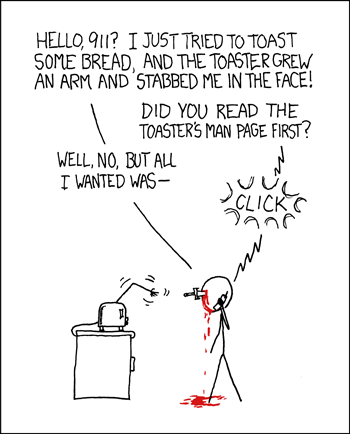
If you’re not already reading xkcd, why the hell not?
Technology . . . can’t live without it . . . but . . .
After getting home from Pittsburgh yesterday, I discovered that my desktop computer has developed a problem while I was away. It no longer thinks it has a DVD writer or a second hard drive, and takes forever to boot.
I tried checking the physical connections between the two drives and the motherboard, and between the drives and the power supply, but they seem to be solid. This means the desktop is headed into the shop this afternoon. Drat!
August 27, 2009
The only Canadian conspiracy theory
American conspiracy enthusiasts have plenty to choose from, but their Canadian confreres don’t have much . . . but they do have the Avro Arrow controversy:
InnovationCanada.ca spoke with Campagna 50 years after the only examples of Canada’s premier jet fighter were cut into pieces.
InnovationCanada.ca (IC): What would most Canadians be shocked to find out about the Arrow, 50 years after its demise?
Palmiro Campagna (PC): Most people don’t know that the order to destroy the Arrow did not come from Prime Minister John Diefenbaker. One theory was that Diefenbaker decided to cancel as this was a Liberal project and he had problems with A.V. Roe president Crawford Gordon. But the reports I had declassified showed that was clearly not the case.
The decision to cut the Arrows into scrap was blamed on Diefenbaker as an act of vengeance, but it was actually an act of national security. The Arrow was an advanced piece of military technology, and the Canadian government didn’t want the test planes to go to a Crown disposal group that would be allowed to auction them off to anyone in the world.
I’ve written a little bit about the Arrow controversy back in 2004:
I hate to sound like a killjoy, but everything I’ve read about the AVRO Arrow says that, while Dief was widely viewed as an idiot for destroying the . . . finished planes, it would never have been a viable military export for Canada. The plane was great, there seems to be no question about that, but it was too expensive for the RCAF to be the only purchaser, and neither the United States nor the United Kingdom was willing (at that time) to buy from “foreign” suppliers. With no market for the jet, regardless of its superior flying and combat qualities, there was little point in embarking on full production.
Also, given the degree of penetration by Soviet spies, the Canadian government took the easiest option in destroying the prototypes. That doesn’t make it any less tragic if you’re a fan, but it does put it into some kind of perspective, I hope.
August 21, 2009
More on DNA as a crime-fighting tool
Charles Stross looks at the situation in Britain:
NDNAD, the UK’s National DNA Database, run by the Forensic Science Service under contract to the Home Office contains DNA “fingerprints” for lots of folk — 5.2% of the population as of 2005, or 3.1 million people. Some of them are criminals; some of them are clearly innocent, but were either charged with a crime and subsequently found not guilty, or had the misfortune to be detained but not subsequently charged (that is: they’re not even suspects). The Home Office takes a rather draconian view of the database’s utility, and objects strenuously to attempts to remove the records of innocent people from it — it took threats of legal action before they agreed to remove the parliamentary Conservative Party’s Immigration spokesman from the database (which he’d been added to in the course of a fruitless investigation into leaked documents that had embarrased the government) — so if senior opposition politicians have problems with it, consider the prospects for the rest of us.
In use …
Whenever a new profile is submitted, the NDNAD’s records are automatically searched for matches (hits) between individuals and unsolved crime-stain records and unsolved crime-stain to unsolved crime-stain records — linking both individuals to crimes and crimes to crimes. Matches between individuals only are reported separately for investigation as to whether one is an alias of the other. Any NDNAD hits obtained are reported directly to the police force which submitted the sample for analysis.
Now, this in itself is merely a steaming turd in the punchbowl of the right to privacy: but its use as a policing intelligence tool is indisputable. While there are some very good reasons for condemning the way it’s currently used (for example, its use in the UK has sparked accusations of racism), I can’t really see any future government forgoing such a tool completely; a DNA database of some kind is too useful. So what interests me here is the potential for future catastrophic failure modes.
Now that we’re pretty certain that DNA evidence can be easily faked, the focus of how it can be used in investigations must shift from “presence proving guilt” to “absence implying innocence”.
August 19, 2009
24th Air Force now activated
The US Air Force has officially activated the 24th Air Force, consisting of the 688th Information Operations Wing and the 67th Network Warfare Wing:
According to Air Force Space Command, under which the new cyber force comes, the 688th will be “exploring, developing, applying and transitioning counter information technology, strategy, tactics and data to control the information battle space”. The unit was formerly known as the Air Force Information Operations Center, and will continue to function as an “information operations centre of excellence”.
The 67th, by contrast, seems to be a more offensive unit. It will “execute computer network exploitation and attack” as required, and when not doing that will conduct “electronic systems security assessments” for US military units and facilities.
August 18, 2009
This is very much an unwelcome technical discovery
DNA evidence can be created to match a known profile:
Scientists in Israel have demonstrated that it is possible to fabricate DNA evidence, undermining the credibility of what has been considered the gold standard of proof in criminal cases.
The scientists fabricated blood and saliva samples containing DNA from a person other than the donor of the blood and saliva. They also showed that if they had access to a DNA profile in a database, they could construct a sample of DNA to match that profile without obtaining any tissue from that person.
“You can just engineer a crime scene,” said Dan Frumkin, lead author of the paper, which has been published online by the journal Forensic Science International: Genetics. “Any biology undergraduate could perform this.”
H/T to Radley Balko.
August 15, 2009
Computers . . . can’t live with ’em, can’t live without ’em
It’s been a bad week for electronics around here. Last month, I bought an external 20″ monitor for Elizabeth to use with her laptop. It worked great — until last week. Then, she started getting BSOD issues and the external monitor would start flashing until she disconnected it.
Off to the shop it went. We’d bought the laptop and the monitor from the same place, with a verbal assurance that they’d work together (and really, in this day and age, how unusual is it to connect an external monitor to a laptop?). The technician was rather dismissive, telling Elizabeth that she probably just needed to download new drivers (she already had, with no improvement). He said they’d run some tests, install updated drivers and run it for 24 hours to verify that it was working properly. She got a call on Thursday to come in and pick up the equipment — it was working fine now.
On Friday, she got there after work to discover that the laptop had exhibited the same reported symptoms during the day, so it was back to the drawing board. So she continued using my laptop.
Which started to have problems first thing this morning . . . the mouse wasn’t showing up on the screen, and the screen itself was very dim (as though it was on battery power). A shutdown-and-reboot cycle seems to have fixed the problem, but it’s a bit of a concern: the laptop is my primary business machine. I’d definitely be delayed if it needed any extensive repair/reconfiguration work.
August 12, 2009
Woodworking tools from Altoids tins
Over at the Woodworking Magazine blog, they challenged their readers to come up with tools using Altoids tins as raw materials. The readers rose to the challenge, and then some:
I was worried this would happen. Some of the entrants to our contest to build a tool from an Altoids tin built tools that actually worked. Sigh. Woodworkers are so practical.
We’re also practical. And so the winner of our contest is Tom Bier, who built a working router plane from an Altoids tin. The tool is impossibly clever – you open the lid to store the iron and thumbscrew. Heck I’d buy one.

Final appearance of the Free Agent drive
In February, 2008, I bought a Free Agent USB hard drive to use as a backup device for the various computers in our home network. It lasted a month before failure started to set in. A few tweaks, a few visits to the support website, and it worked … until April. This time, it really was dead, so I got an RMA number, shipped it back, and eventually got a replacement drive.
The fact that I’m posting yet another tale of woe should tell you that the replacement was no better than the original. In fact, the replacement drive timed its failure to be almost as inconvenient as possible, failing just before it was needed to move files off a failing internal drive.
So the replacement drive has been sitting around for nearly a year, gathering dust. Yesterday, I wondered if it might be a problem that it wasn’t designed to work with Windows XP (why some deep thinking designer might have made that decision, I’ve no idea, but bear with me for a second). So I plugged it into my laptop, which is running Vista. It was recognized and configured immediately. I tested basic functionality by copying a few files over to the USB drive, then verifying that they were identical to the originals. Having passed that rudimentary test, I then dumped a medium-sized backup to the USB drive.
Twenty-six gigabytes of data went down … and 56 bytes were recorded on the USB drive. Yep. Bytes. Not Gigabytes, Bytes.
Now I’m going to borrow a sledgehammer, to ensure that this particular Free Agent drive never bothers anyone else . . .
Update, 14 August: Misery loves company: James Lileks posted a couple of tweets on a similar note.
Just had my fourth pocket hard drive go south. It won’t mount. Why does tech-talk sound like a robot’s sex-chat transcript?
It’s a Maxtor drive, btw. Apparently I enabled Daisy Mae Mode: looks hot, but can’t read or write.
August 11, 2009
Legal FAIL
Andrew Orlowski shows why Charlie Nesson might as well have been custom-created by the RIAA:
Nesson has achieved something I thought was completely impossible in 2009, and that’s to allow the US recording industry’s lobby group to paint itself in a sympathetic light. No longer must the RIAA explain why their biggest members are not using technology to make money for the people they represent. The Boston case allowed the four major labels to justify an enforcement policy against opponents who appeared compulsively dishonest, irrational, paranoid, and with an abnormal sense of entitlement.
Nice work, Charlie.
Nesson failed in his avowed mission “to put the record industry on trial”. He failed to show why disproportionate statutory damages are harmful, which could have had a lasting constitutional effect. He failed to paint the defendent as sympathetic, or “one of us”. He failed to demonstrate why copyright holders make lousy cops. He even had a Judge noted for her antipathy to the big record labels. In short, he ceded the moral high ground completely and utterly to the plaintiffs, the four major record labels. The labels’ five year campaign against end users is finally at a close, but Nesson’s performance leaves it looking (undeservedly) quite fragrant.
It’s hard to imagine a worse result for anyone except the RIAA . . . they won big, and it’s hard to fault the jury for deciding the way they did . . . Nesson pretty much handed the case to the RIAA on platter:
Nesson could have pointed to the billions of royalties that haven’t been collected by the major labels failure to monetize P2P file sharing. He could have added that the Big Four don’t speak for other parts of the music business in putting Enforcement first. He missed the opportunity to gain the moral and intellectual high ground. Now I’ve no doubt Nesson is sincere in his beliefs that he’s doing everyone a favour, but then again, there’s a bloke on my bus who thinks he’s Napoleon.
Nesson’s case was a misanthropic bundle of intellectual prejudices, a worker’s paradise in which everyone has rights, except creative people. In his Kumbaya world, we’d all be better off, except the people who actually do the art. But once the jury had heard from Tenenbaum — a deeply unpleasant defendant — the die was cast.
The final word, of course, should go to “Weird Al” Yankovic, with his heart-felt, moving “Don’t Download This Song”.
Deleting your cookies doesn’t protect your privacy
According to a report in Wired, there are lots of sites out there (including whitehouse.gov) who are actively circumventing the common practice and zombifying the cookies you thought you’d deleted:
More than half of the internet’s top websites use a little known capability of Adobe’s Flash plugin to track users and store information about them, but only four of them mention the so-called Flash Cookies in their privacy policies, UC Berkeley researchers reported Monday.
Unlike traditional browser cookies, Flash cookies are relatively unknown to web users, and they are not controlled through the cookie privacy controls in a browser. That means even if a user thinks they have cleared their computer of tracking objects, they most likely have not.
What’s even sneakier?
Several services even use the surreptitious data storage to reinstate traditional cookies that a user deleted, which is called ‘re-spawning’ in homage to video games where zombies come back to life even after being “killed,” the report found. So even if a user gets rid of a website’s tracking cookie, that cookie’s unique ID will be assigned back to a new cookie again using the Flash data as the “backup.”
This would be a good opportunity for Adobe (who control the Flash cookie capability) and the browser developers to get together and provide end users with enhanced capability to turn off these zombies. Probably a tiny percentage of current users ever bother to delete cookies, so it’s not like this would seriously undermine legitimate uses of cookies, but it would put a bit more control of how personal information is used back in the hands of the individual.
Of course, back here in the real world, I don’t honestly expect any such thing, but regulation is almost always the wrong answer to a given problem on the internet. But that’s what we’re likely to get . . .
August 8, 2009
August 7, 2009
DDoS attacks target one pro-Georgian user
I find this hard to credit, but CBS says that yesterday’s distributed denial-of-service attacks on Twitter, Facebook, YouTube, Blogger, and LiveJournal were all aimed at one particular user:
The blogger, who uses the account name “Cyxymu,” (the name of a town in the Republic of Georgia) had accounts on all of the different sites that were attacked at the same time, Max Kelly, chief security officer at Facebook, told CNET News.
“It was a simultaneous attack across a number of properties targeting him to keep his voice from being heard,” Kelly said. “We’re actively investigating the source of the attacks and we hope to be able to find out the individuals involved in the back end and to take action against them if we can.”
Kelly declined to speculate on whether Russian nationalists were behind the attack, but said: “You have to ask who would benefit the most from doing this and think about what those people are doing and the disregard for the rest of the users and the Internet.”
Twitter was down for several hours beginning early Thursday morning, and suffered periodic slowness and time-outs throughout the day.
If it turns out that this is true, I guess it’ll be easier to start looking for the controller of the massive botnet that conducted the attacks . . . and probably has a physical presence near the Kremlin.
Update: The Guardian has more on the story.
August 6, 2009
Twitter under DOS attack
Twitter users have been unable to access the site for most of Thursday morning, due to a Denial-of-Service (DOS) attack:
The extended silence in a normally noisy Twitterworld began around 9 a.m. Twitter later posted a note to its status update page saying the site had been slowed to a standstill by an attack.
In a denial-of-service attack, hackers typically direct a “botnet,” often made up of thousands of malware-infected home PCs, toward a target site in an effort to flood it with junk traffic. With the site overwhelmed, legitimate visitors cannot access the service.
“On this otherwise happy Thursday morning, Twitter is the target of a denial-of-service attack. Attacks such as this are malicious efforts orchestrated to disrupt and make unavailable services such as online banks, credit card payment gateways, and in this case, Twitter for intended customers or users,” co-founder Biz Stone said in a blog post. “We are defending against this attack now and will continue to update our status blog as we continue to defend and later investigate.”
Update: Service is back, intermittantly. More background on the attack here.


