
Published on 6 Dec 2014
This talk was given at a local TEDx event, produced independently of the TED Conferences. The Internet is on Fire
Mikko is a world class cyber criminality expert who has led his team through some of the largest computer virus outbreaks in history. He spoke twice at TEDxBrussels in 2011 and in 2013. Every time his talks move the world and surpass the 1 million viewers. We’ve had a huge amount of requests for Mikko to come back this year. And guess what? He will!
Prepare for what is becoming his ‘yearly’ talk about PRISM and other modern surveillance issues.
December 17, 2014
The Internet is on Fire | Mikko Hypponen | TEDxBrussels
Comments Off on The Internet is on Fire | Mikko Hypponen | TEDxBrussels
December 15, 2014
December 13, 2014
Innovative use of old downhill skis
Dave Trant posted a link to this Instructables post on making a recurve bow from old skis:


This bow is made from a pair of Fischer downhill skis. It pulls 58# at @ 28″. The riser is made from walnut and pecan and is coated in a satin polyurethane finish. The string is made from paracord with bowlines. This will be replaced by a dacron string when I get the time to make one.
The takedown shown in these photos is a followup to the instructable I wrote earlier this year. I have received many questions asking “just how powerful a bow can you make from skis?”. This takedown bow shoots nearly as fast as my fiberglass/wood laminate recurves. Once I get my hands on a chronograph I will actually provide some numbers. But based on target penetration and my experience I’d have to say that it performs quite comparably.
Comments Off on Innovative use of old downhill skis
December 10, 2014
QotD: Quality, innovation, and progress
Measured by practically any physical metric, from the quality of the food we eat to the health care we receive to the cars we drive and the houses we live in, Americans are not only wildly rich, but radically richer than we were 30 years ago, to say nothing of 50 or 75 years ago. And so is much of the rest of the world. That such progress is largely invisible to us is part of the genius of capitalism — and it is intricately bound up with why, under the system based on selfishness, avarice, and greed, we do such a remarkably good job taking care of one another, while systems based on sharing and common property turn into miserable, hungry prison camps.
We treat the physical results of capitalism as though they were an inevitability. In 1955, no captain of industry, prince, or potentate could buy a car as good as a Toyota Camry, to say nothing of a 2014 Mustang, the quintessential American Everyman’s car. But who notices the marvel that is a Toyota Camry? In the 1980s, no chairman of the board, president, or prime minister could buy a computer as good as the cheapest one for sale today at Best Buy. In the 1950s, American millionaires did not have access to the quality and variety of food consumed by Americans of relatively modest means today, and the average middle-class household spent a much larger share of its income buying far inferior groceries. Between 1973 and 2008, the average size of an American house increased by more than 50 percent, even as the average number of people living in it declined. Things like swimming pools and air conditioning went from being extravagances for tycoons and movie stars to being common or near-universal. In his heyday, Howard Hughes didn’t have as good a television as you do, and the children of millionaires for generations died from diseases that for your children are at most an inconvenience. As the first 199,746 or so years of human history show, there is no force of nature ensuring that radical material progress happens as it has for the past 250 years. Technological progress does not drive capitalism; capitalism drives technological progress — and most other kinds of progress, too.
Kevin D. Williamson, “Welcome to the Paradise of the Real: How to refute progressive fantasies — or, a red-pill economics”, National Review, 2014-04-24
Comments Off on QotD: Quality, innovation, and progress
December 7, 2014
A Supreme Court decision that actually improved privacy rights for Canadians
The courts have far too often rolled over for any kind of police intrusions into the private lives of Canadians, but a decision from earlier this year has actually helped deter the RCMP from pursuing trivial or tangential inquiries into their online activity:
A funny thing happens when courts start requiring more information from law enforcement: law enforcers suddenly seem less interested in zealously enforcing the law.
Back in June of this year, Canada’s Supreme Court delivered its decision in R. v. Spencer, which brought law enforcement’s warrantless access of ISP subscriber info to an end.
In a unanimous decision written by (Harper appointee) Justice Thomas Cromwell, the court issued a strong endorsement of Internet privacy, emphasizing the privacy importance of subscriber information, the right to anonymity, and the need for police to obtain a warrant for subscriber information except in exigent circumstances or under a reasonable law.
The effects of this ruling are beginning to be felt. Michael Geist points to a Winnipeg Free Press article that details the halcyon days of the Royal Canadian Mounted Police’s warrantless access.
Prior to the court decision, the RCMP and border agency estimate, it took about five minutes to complete the less than one page of documentation needed to ask for subscriber information, and the company usually turned it over immediately or within one day.
Five minutes! Amazing. And disturbing. A 5-minute process indicates no one involved made even the slightest effort to prevent abuse of the process. The court’s decision has dialed back that pace considerably. The RCMP is now complaining that it takes “10 hours” to fill out the 10-20 pages required to obtain subscriber info. It’s also unhappy with the turnaround time, which went from nearly immediate to “up to 30 days.”
In response, the RCMP has done what other law enforcement agencies have done when encountering a bit of friction: given up.
“Evidence is limited at this early stage, but some cases have already been abandoned by the RCMP as a result of not having enough information to get a production order to obtain (basic subscriber information),” the memo says.
Comments Off on A Supreme Court decision that actually improved privacy rights for Canadians
Another (mechanical) step closer to true battlefield armoured suits
In Popular Mechanics, Erik Schechter talks about the most recent DARPA work on power-assisted suits for soldiers in the field:
The Army doesn’t have an Iron Man suit. Yet. But the Defense Advanced Research Projects Agency (DARPA) Warrior Web program is a step closer to developing a soft, low-powered exosuit that will augment the physical capabilities of soldiers. Worn under the uniform, the proposed suit will allow troops to carry 100-plus pounds of equipment without risking the joint and back injuries that typically accumulate in the field.
The Warrior Web program, which is also supported by the U.S. Army Research Laboratory (ARL), just wrapped up its first phase in which it tested exosuit components in the lab and the outdoors, says Mike LaFiandra, Dismounted Warrior Branch chief at ARL’s Human Research Engineering Directorate. In their next step, engineers will test how various pieces developed by different program participants perform when integrated into one suit. Basically, DARPA is “looking for performers to pair up and say, ‘We’re going to pair up this ankle with this knee’ and come up with a system that they bring here to evaluate,” LaFiandra says. That will take 18 to 24 months.
That first phase involved nine prototypes. By Phase II, the program was down to six, including entries from the Harvard University’s Wyss Institute, Ekso Bionics (now a subsidiary of Google), and Arizona State University’s Human Machine Integration Laboratory.
Comments Off on Another (mechanical) step closer to true battlefield armoured suits
December 5, 2014
The urban light-rail mania
If you live in a city, chances are that the politicians of your ‘burgh are talking light rail. Unless, of course, you already are suffering under the burden of a light rail project snarling traffic during construction … and snarling traffic in operation. Light rail, in general, is an attempt to resurrect the streetcar era by vast infusions of tax dollars. It’s an attempt to solve a traffic management problem in one of the more inefficient ways possible: to get a few people out of their cars and into modern streetcars instead.
I’m not anti-rail by any means. I travel five days a week on a heavy rail commuter train that does a pretty fair job of getting me where I need to go in a timely and economical fashion. Worse than that, I’m a railway fan — as I’ve mentioned before, I founded a railway historical society. I’m not against light rail due to some sort of anti-rail bias … I’m against it because it’s almost always too expensive, too inflexible, and too politicized.
Georgi Boorman wonders why so many cities are still falling into the light rail trap:
In a previous piece, I discussed the radical ideological roots of the mass transit scam. There are some, such as Seattle City Councilwoman Kshama Sawant (who urged Boeing factory workers to seize control of the plant and begin building mass transit) who believe centralization and a complete shift to mass transit are crucial for cities’ futures. Others simply buy into this myth that light rail and trolleys will somehow elevate their cities to the next level of sophistication — the very prospect of which is ignorant, at best, and self-indulgent, at worst.
The overwhelming evidence shows that these mass transit projects do little to improve our quality of life, in terms of easing congestion and expanding access to jobs and, despite popular perception, have no significant net environmental benefits since they rarely succeed in their express goal of removing cars from the road or decreasing congestion-induced idle times, a frequently cited contributor to greenhouse-gas emissions. As the satirical online newspaper The Onion reported, “98% of Americans favor public transportation for others.” That statistic may be fake, but we’ve all experienced the sentiment.
Even the writers of The Simpsons seem to understand the comical nature of light-rail adoption in American cities, brilliantly satirizing the salesmanship by transit authorities. The salesman, “Lyle Lanley,” begins by comparing the Simpsons’ town of Springfield to Shelbyville. “This is more of a Shelbyville idea,” he says slowly, turning his back to the crowd. “Now, wait a minute!” the Springfield mayor responds hastily, “We’re just as smart as the people of Shelbyville—just tell us your idea and we’ll vote for it!”
Gleefully, Lanley begins his presentation; with a grand sweeping gesture, the salesman uncovers a model of the city, complete with buildings, trees, and a brand new Springfield Monorail zooming through the town on its miniature tracks. Holding up a map labeled with all the towns to which he’s sold monorails, he exclaims, “By gum, it put them on the map!” Continuing his pitch, Langley heightens the townspeople’s imaginations and sells them on the “novel” idea of their very own monorail.
In other words, the buy-in had nothing to do with demand for a certain kind of transportation, and everything to do with wanting do the same as other cities that have, or are building, the same thing. Of course, 50 years ago the Seattle Center monorail (built by the German company Alweg) could easily have been said to have elevated the Emerald City at the 1962 World’s Fair, being the cutting-edge of rail technology at the time; but building monorails, light rails, and streetcars in 2014 is a regressive move that mirrors the past rather than engages with the present while leaving room for future innovation.
Comments Off on The urban light-rail mania
Ross Perot (of all people) and one of the earliest real computers
At Wired, Brendan I. Koerner talks about the odd circumstances which led to H. Ross Perot being instrumental in saving an iconic piece of computer history:
Eccentric billionaires are tough to impress, so their minions must always think big when handed vague assignments. Ross Perot’s staffers did just that in 2006, when their boss declared that he wanted to decorate his Plano, Texas, headquarters with relics from computing history. Aware that a few measly Apple I’s and Altair 880’s wouldn’t be enough to satisfy a former presidential candidate, Perot’s people decided to acquire a more singular prize: a big chunk of ENIAC, the “Electronic Numerical Integrator And Computer.” The ENIAC was a 27-ton, 1,800-square-foot bundle of vacuum tubes and diodes that was arguably the world’s first true computer. The hardware that Perot’s team diligently unearthed and lovingly refurbished is now accessible to the general public for the first time, back at the same Army base where it almost rotted into oblivion.
ENIAC was conceived in the thick of World War II, as a tool to help artillerymen calculate the trajectories of shells. Though construction began a year before D-Day, the computer wasn’t activated until November 1945, by which time the U.S. Army’s guns had fallen silent. But the military still found plenty of use for ENIAC as the Cold War began — the machine’s 17,468 vacuum tubes were put to work by the developers of the first hydrogen bomb, who needed a way to test the feasibility of their early designs. The scientists at Los Alamos later declared that they could never have achieved success without ENIAC’s awesome computing might: the machine could execute 5,000 instructions per second, a capability that made it a thousand times faster than the electromechanical calculators of the day. (An iPhone 6, by contrast, can zip through 25 billion instructions per second.)
When the Army declared ENIAC obsolete in 1955, however, the historic invention was treated with scant respect: its 40 panels, each of which weighed an average of 858 pounds, were divvied up and strewn about with little care. Some of the hardware landed in the hands of folks who appreciated its significance — the engineer Arthur Burks, for example, donated his panel to the University of Michigan, and the Smithsonian managed to snag a couple of panels for its collection, too. But as Libby Craft, Perot’s director of special projects, found out to her chagrin, much of ENIAC vanished into disorganized warehouses, a bit like the Ark of the Covenant at the end of Raiders of the Lost Ark.
Lost in the bureaucracy

An ENIAC technician changes a tube. (Photo: US Army)
Comments Off on Ross Perot (of all people) and one of the earliest real computers
December 4, 2014
“Hiram Maxim’s business was secure”
Paul Richard Huard has another in his series of blog posts on the weapons of the 20th century:
During the early morning of Oct. 25, 1893, a column of 700 soldiers from the British South African Police camped in a defensive position next to the Shangani River.
While they slept, the Matabele king Lobengula ordered an attack on the column, sending a force of up to 6,000 men — some armed with spears, but many with Martini-Henry rifles.
Among its weapons, the column possessed several Maxim machine guns. Once a bugler sounded the alert, the Maxims spun into action — and the results were horrific.
The Maxim gunners mowed down more than 1,600 of the attacking Matabele tribesman. As for the British column, it suffered four casualties.
The British military not only measured the Maxim gun’s success by the number of Matabele killed in action. They could gauge the Maxim’s potential as a weapon of psychological warfare.
In the aftermath, several Matabele war leaders committed suicide either by hanging themselves or throwing themselves on their spears. That is how Earth-shattering a weapon the Maxim gun was.
“The round numbers are suspicious,” C.J. Chivers wrote in The Gun, his history of automatic weapons. “But the larger point is unmistakable. A few hundred men with a few Maxims had subdued a king and his army, and destroyed the enemy’s ranks. Hiram Maxim’s business was secure.”
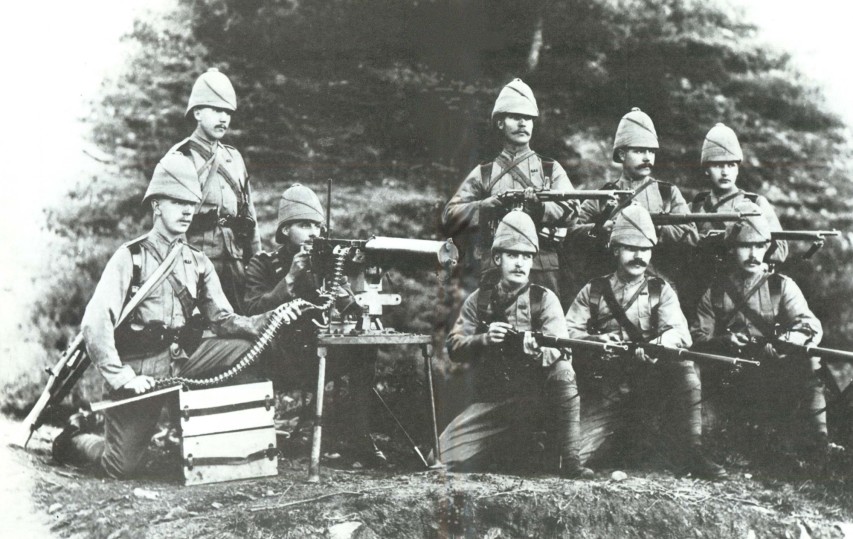
A British Maxim gun section that took part in the Chitral Relief Expedition of 1895. Public domain photo
Comments Off on “Hiram Maxim’s business was secure”
December 3, 2014
The Tech Model Railroad Club’s role in the rise of the hacking community
Steven Levy talks about one of the less likely origins of part of the hacking world — MIT’s model railroad club:
Peter Samson had been a member of the Tech Model Railroad Club since his first week at MIT in the fall of 1958. The first event that entering MIT freshmen attended was a traditional welcoming lecture, the same one that had been given for as long as anyone at MIT could remember. LOOK AT THE PERSON TO YOUR LEFT … LOOK AT THE PERSON TO YOUR RIGHT … ONE OF YOU THREE WILL NOT GRADUATE FROM THE INSTITUTE. The intended effect of the speech was to create that horrid feeling in the back of the collective freshman throat that signaled unprecedented dread. All their lives, these freshmen had been almost exempt from academic pressure. The exemption had been earned by virtue of brilliance. Now each of them had a person to the right and a person to the left who was just as smart. Maybe even smarter.
There were enough obstacles to learning already — why bother with stupid things like brown-nosing teachers and striving for grades? To students like Peter Samson, the quest meant more than the degree.
Sometime after the lecture came Freshman Midway. All the campus organizations — special-interest groups, fraternities, and such — set up booths in a large gymnasium to try to recruit new members. The group that snagged Peter was the Tech Model Railroad Club. Its members, bright-eyed and crew-cutted upperclassmen who spoke with the spasmodic cadences of people who want words out of the way in a hurry, boasted a spectacular display of HO gauge trains they had in a permanent clubroom in Building 20. Peter Samson had long been fascinated by trains, especially subways. So he went along on the walking tour to the building, a shingle-clad temporary structure built during World War II. The hallways were cavernous, and even though the clubroom was on the second floor it had the dank, dimly lit feel of a basement.
The clubroom was dominated by the huge train layout. It just about filled the room, and if you stood in the little control area called “the notch” you could see a little town, a little industrial area, a tiny working trolley line, a papier-mache mountain, and of course a lot of trains and tracks. The trains were meticulously crafted to resemble their full-scale counterparts, and they chugged along the twists and turns of track with picture-book perfection. And then Peter Samson looked underneath the chest-high boards which held the layout. It took his breath away. Underneath this layout was a more massive matrix of wires and relays and crossbar switches than Peter Samson had ever dreamed existed. There were neat regimental lines of switches, and achingly regular rows of dull bronze relays, and a long, rambling tangle of red, blue, and yellow wires—twisting and twirling like a rainbow-colored explosion of Einstein’s hair. It was an incredibly complicated system, and Peter Samson vowed to find out how it worked.
There were two factions of TMRC. Some members loved the idea of spending their time building and painting replicas of certain trains with historical and emotional value, or creating realistic scenery for the layout. This was the knife-and-paintbrush contingent, and it subscribed to railroad magazines and booked the club for trips on aging train lines. The other faction centered on the Signals and Power Subcommittee of the club, and it cared far more about what went on under the layout. This was The System, which worked something like a collaboration between Rube Goldberg and Wernher von Braun, and it was constantly being improved, revamped, perfected, and sometimes “gronked” — in club jargon, screwed up. S&P people were obsessed with the way The System worked, its increasing complexities, how any change you made would affect other parts, and how you could put those relationships between the parts to optimal use.
Comments Off on The Tech Model Railroad Club’s role in the rise of the hacking community
December 1, 2014
The Soviet tank that won the war in the East
Paul Richard Huard looks at the tank that took away the Panzer’s reputation for invincibility, the T-34:

T-34/85 at musée des blindés de Saumur (via Wikipedia)
The T-34 had its problems — something we often forgotten when discussing a tank with a legendary reputation. The shortfalls included bad visibility for the crew and shoddy Soviet workmanship.
“They were good, but they were not miracle weapons and they had their faults,” writes Philip Kaplan in Rolling Thunder: A Century of Tank Warfare. “But the T-34, for all its faults, is now often referred to by tank experts and historians as possibly the best tank of the war.”
World War II German Field Marshall Ewald Von Kleist was more succinct. “The finest tank in the world,” is how he described the T-34.
The origins of the T-34 are simple enough. The Red Army sought a replacement for the BT-7 cavalry tank, which was fast-moving and lightly armored for use in maneuver warfare. It also had Christie suspension, one reason for the tank’s increased speed.
But during a 1938-to-1939 border war with Japan, the BT-7 fared poorly. Even with a low-powered gun, Japanese Type 95 tanks easily destroyed the BT-7s. Tank attack crews also assaulted the BT-7s with Molotov cocktails, reducing the Soviet tank to a flaming wreck when ignited gasoline dripped through chinks between poorly welded armor into the tank’s engine compartment.
[…]
By the end of the war, the Soviet Union had produced nearly 60,000 T-34 tanks — proving the point that quantity does have a quality all of its own.
At first, the Germans were at a loss when it came to countering the threat the T-34 posed. The Germans’ standard anti-tank guns, the 37-millimeter Kwk36 and the 50-millimeter Kwk 38, couldn’t put a dent in the Soviet tank with a shot to its front.
That left the Germans with a limited set of tactics. German tankers could attempt flank shots with their guns. The Wehrmacht could lay mines. Soldiers risked their lives in close assaults employing satchel charges and Molotov cocktails.
In what could be called an act of desperation, the Germans even used modified 88-millimeter anti-aircraft guns to stop attacking T-34s with direct fire.
Comments Off on The Soviet tank that won the war in the East
November 30, 2014
Medium.com goes all “Rathergate” on a 1970s LEGO letter
I managed to miss the initial controversy about a typographical hoax that might not have been so hoax-y:
According to the website of the Independent newspaper, LEGO UK has verified the 1970s ‘letter to parents’ that was widely tweeted last weekend and almost as widely dismissed as fake. Business as usual in the Twittersphere — but there are some lessons here about dating type.
‘The urge to create is equally strong in all children. Boys and girls.’ It’s a sentiment from the 1970s that’s never been more relevant. Or was it?
Those of us who produce or handle documents for a living will often glance at an example and have an immediate opinion on whether it’s real or fake. That first instinct is worth holding on to, because it comes from the brain’s evolved ability to reach a quick conclusion from a whole bunch of subtle clues before your conscious awareness catches up. It’s OK to be inside the nearest cave getting your breath back when you start asking yourself what kind of snake.
But sometimes you will flinch at shadows. Why did this document strike us as wrong when it wasn’t?
First, because the type is badly set in exactly the way early consumer DTP apps, and word processor apps to this day (notably Microsoft Word), set type badly — at least without the intervention of skilled users. I started typesetting on an Atari ST, the poor man’s Mac, in 1987. The first desktop publishing program for that platform was newly released, running under Digital Research’s GEM operating system. It came with a version of Times New Roman, and almost nothing else. Me and badly set Times have history.
In the LEGO document, the kerning of the headline is lumpy and the word spacing excessive. The ‘T’ seems out of alignment with the left margin, even after allowing for a lack of optical adjustment. The paragraph indent on the body text has been applied from the start, contrary to modern British typesetting practice; the first line should be full-out. The leading (vertical space between lines of text) is not quite enough for comfort, more appropriate to a dense newspaper column than this short blurb.
There’s also an error in the copy: ‘dolls houses’ needs an apostrophe. Either before or after the last letter of ‘dolls’ would be fine, depending on whether you think you mean a house for a doll or a house for dolls. But it definitely needs to be possessive.
It wasn’t just that the type looked careless. It was that it stank of the careless use of tools that shouldn’t have been available to its creators.

Comments Off on Medium.com goes all “Rathergate” on a 1970s LEGO letter
November 25, 2014
When was it exactly that “progress stopped”?
Scott Alexander wrote this back in July. I think it’s still relevant as a useful perspective-enhancer:
The year 1969 comes up to you and asks what sort of marvels you’ve got all the way in 2014.
You explain that cameras, which 1969 knows as bulky boxes full of film that takes several days to get developed in dark rooms, are now instant affairs of point-click-send-to-friend that are also much higher quality. Also they can take video.
Music used to be big expensive records, and now you can fit 3,000 songs on an iPod and get them all for free if you know how to pirate or scrape the audio off of YouTube.
Television not only has gone HDTV and plasma-screen, but your choices have gone from “whatever’s on now” and “whatever is in theaters” all the way to “nearly every show or movie that has ever been filmed, whenever you want it”.
Computers have gone from structures filling entire rooms with a few Kb memory and a punchcard-based interface, to small enough to carry in one hand with a few Tb memory and a touchscreen-based interface. And they now have peripherals like printers, mice, scanners, and flash drives.
Lasers have gone from only working in special cryogenic chambers to working at room temperature to fitting in your pocket to being ubiquitious in things as basic as supermarket checkout counters.
Telephones have gone from rotary-dial wire-connected phones that still sometimes connected to switchboards, to cell phones that fit in a pocket. But even better is bypassing them entirely and making video calls with anyone anywhere in the world for free.
Robots now vacuum houses, mow lawns, clean office buildings, perform surgery, participate in disaster relief efforts, and drive cars better than humans. Occasionally if you are a bad person a robot will swoop down out of the sky and kill you.
For better or worse, video games now exist.
Medicine has gained CAT scans, PET scans, MRIs, lithotripsy, liposuction, laser surgery, robot surgery, and telesurgery. Vaccines for pneumonia, meningitis, hepatitis, HPV, and chickenpox. Ceftriaxone, furosemide, clozapine, risperidone, fluoxetine, ondansetron, omeprazole, naloxone, suboxone, mefloquine, – and for that matter Viagra. Artificial hearts, artificial livers, artificial cochleae, and artificial legs so good that their users can compete in the Olympics. People with artificial eyes can only identify vague shapes at best, but they’re getting better every year.
World population has tripled, in large part due to new agricultural advantages. Catastrophic disasters have become much rarer, in large part due to architectural advances and satellites that can watch the weather from space.
We have a box which you can type something into and it will tell you everything anyone has ever written relevant to your query.
We have a place where you can log into from anywhere in the world and get access to approximately all human knowledge, from the scores of every game in the 1956 Roller Hockey World Cup to 85 different side effects of an obsolete antipsychotic medication. It is all searchable instantaneously. Its main problem is that people try to add so much information to it that its (volunteer) staff are constantly busy deleting information that might be extraneous.
We have the ability to translate nearly major human language to any other major human language instantaneously at no cost with relatively high accuracy.
We have navigation technology that over fifty years has gone from “map and compass” to “you can say the name of your destination and a small box will tell you step by step which way you should be going”.
We have the aforementioned camera, TV, music, videophone, video games, search engine, encyclopedia, universal translator, and navigation system all bundled together into a small black rectangle that fits in your pockets, responds to your spoken natural-language commands, and costs so little that Ethiopian subsistence farmers routinely use them to sell their cows.
But, you tell 1969, we have something more astonishing still. Something even more unimaginable.
“We have,” you say, “people who believe technology has stalled over the past forty-five years.”
1969’s head explodes.
Replica WW1 tanks at the Tank Museum
While they’re not true replica vehicles, the British Mark IV and the German A7V tanks can be seen at the Tank Museum in Bovington:
Uploaded on 11 Jan 2012
The Tank Museum has obtained the tank used in Steven Spielberg’s new World War One blockbuster Warhorse.
The fully operational replica of a British Mk IV tank is set to go on display when the film is released next week, and will also be used in the Dorset based Museum’s tank displays later in the year.
The full sized replica was based on the Museum’s own Mark IV, which was built in 1917. OSCAR award-wining special effects company Neil Corbould Special Effects LTD, whose credits include Saving Private Ryan and Gladiator, visited The Tank Museum in 2010 to take measurements from the vehicle and copy original documents related to the MK IV tank held in the Museum’s Archive.
Published on 30 Nov 2012
The Tank Museum has acquired a working replica of a German First World War tank. See it in action here, alongside our British First World War replica from the film War Horse. For more information, visit www.tankmuseum.org.
Comments Off on Replica WW1 tanks at the Tank Museum
November 24, 2014
Allow more competition in the broadband marketplace
At Techdirt, Karl Bode points out the existing problem with lack of competition in the US broadband industry is largely due to various levels of government meddling with the market:
While Title II is the best net neutrality option available in the face of a lumbering broadband duopoly, it still doesn’t fix the fact that the vast majority of customers only have the choice of one or two broadband options. It’s this lack of competition that not only results in net neutrality violations (as customers can’t vote down stupid ISP behavior with their wallet), but the higher prices and abysmal customer service so many of us have come to know and love. Stripping away protectionist state laws can help a little, as can the slow rise of services like Google Fiber. But even these efforts can only go so far in blowing up a broadband duopoly, pampered through regulatory capture and built up over a generation of campaign contributions.
One solution is the return to the country’s barely-tried implementation of unbundling and network open access, or requiring that the nation’s subsidy-slathered monopolists open their networks to allow other competitors to come in and compete. There are many variations of this concept, and it’s something Google Fiber promised in its markets before backing away from it (much like their vocal support of net neutrality). Obviously being forced to compete is an immensely unpopular concept for the nation’s incumbent ISPs. Given that those companies dictate and often literally write the nation’s telecom laws, these requirements were eliminated in a number of policies moves starting in 2001 and culminating in the FCC’s Triennial Review Remand Order of 2004 (pdf).
This was amazingly presented at the time as a way to improve competition and spur investment, but primarily resulted in a bloodbath as dozens of consumer-friendly, smaller independent ISPs and CLECs were killed off, perpetuating and further cementing the noncompetitive duopoly we have today.
[…]
Despite the fact this model clearly works, it’s never considered in policy discussions as a serious possibility. Why? Quite simply because the incumbent providers don’t want it. Through the use of their various PR folk, astroturfers, think tankers, fauxcademics and assorted hired mouthpieces, they’ve successfully managed to utterly vilify the concept, painting it as the very worst sort of government meddling in (not actually) free markets. Instead, we’ve chosen to head down the path of letting the nation’s duopolists dictate telecom policy, and the end result should at this point be painfully obvious to everyone. Well, except the industry lobbyists who still somehow insist we’re all living in a competitive broadband Utopia.
Comments Off on Allow more competition in the broadband marketplace


