
On Monday afternoon Harris came round; he had a cycling paper in his hand.
I said: “If you take my advice, you will leave it alone.”
Harris said: “Leave what alone?”
I said: “That brand-new, patent, revolution in cycling, record-breaking, Tomfoolishness, whatever it may be, the advertisement of which you have there in your hand.”
He said: “Well, I don’t know; there will be some steep hills for us to negotiate; I guess we shall want a good brake.”
I said: “We shall want a brake, I agree; what we shall not want is a mechanical surprise that we don’t understand, and that never acts when it is wanted.”
“This thing,” he said, “acts automatically.”
“You needn’t tell me,” I said. “I know exactly what it will do, by instinct. Going uphill it will jamb the wheel so effectively that we shall have to carry the machine bodily. The air at the top of the hill will do it good, and it will suddenly come right again. Going downhill it will start reflecting what a nuisance it has been. This will lead to remorse, and finally to despair. It will say to itself: ‘I’m not fit to be a brake. I don’t help these fellows; I only hinder them. I’m a curse, that’s what I am;’ and, without a word of warning, it will ‘chuck’ the whole business. That is what that brake will do. Leave it alone. You are a good fellow,” I continued, “but you have one fault.”
“What?” he asked, indignantly.
“You have too much faith,” I answered. “If you read an advertisement, you go away and believe it. Every experiment that every fool has thought of in connection with cycling you have tried. Your guardian angel appears to be a capable and conscientious spirit, and hitherto she has seen you through; take my advice and don’t try her too far. She must have had a busy time since you started cycling. Don’t go on till you make her mad.”
Jerome K. Jerome, Three Men on the Bummel, 1914.
January 18, 2015
QotD: The power of advertising
January 16, 2015
Germany and Canada are neck-and-neck … in the helicopter fail zone
Every now and again, I’ve reminded you about the sad, sad state of the Canadian Armed Forces’ long quest to get new helicopters. If any other western country has had a worse time trying to re-equip their military with capable helicopters, Germany must come close to the top of the list:
As early as the mid-1980s, German army aviation needed new helicopters. Its Vietnam-era Bell UH-1s and Sikorsky CH-53s had seen better days.
France, West Germany, Italy, The Netherlands and the United Kingdom got together in 1985 and drafted a scheme to develop a new fly-by-wire, multipurpose helicopter—the NH90. The U.K. soon left the project.
[…]
The NH90 itself struggled through its long years of development—and ultimately proved less than perfectly reliable. The Dutch have struggled to prevent corrosion in their naval NH90s that deploy aboard warships. The Germans have had problems of their own.
In Germany, the NH90 was originally supposed to open a new era of air-assault operations, wherein different variants of the NH90 would haul troops, vehicles and equipment in lightning-fast attacks behind enemy lines. There would also be a naval version.
But when the Cold War ended, funding became scarce. The German military had wanted more than 200 HN90s but ultimately ordered just 122, making large-scale air assaults unlikely. The first few machines arrived in December 2006.
Another seven years passed before Germany deployed the NH90. In April 2013, several of the copters began flying medical-evacuation missions in Afghanistan.
On June 19, 2014, an engine on one of the deployed NH90s exploded during a training mission over Uzbekistan. On Nov. 17, the German aviation security advisory board grounded the whole fleet.
January 15, 2015
Why the EFF can’t do an iPhone version of their mobile app
Last week, the Electronic Frontier Foundation‘s Corynne McSherry had to break the sad news to Apple iPhone users that due to Apple’s incredibly restrictive developer rules, the EFF cannot produce an iPhone version of their mobile app:
As we have been saying for years now, the [Apple] Developer Agreement is bad for developers and users alike. Here are a few of the terms that we are worried about:
Ban on Public Statements: Section 10.4 prohibits developers from making any “public statements” about the terms of the Agreement. This is particularly strange, since the Agreement itself is not “Apple Confidential Information” as defined in Section 10.1. So the terms are not confidential, but developers are contractually forbidden from speaking “publicly” about them.
Ban on Reverse Engineering: Section 2.6 prohibits any reverse engineering (including the kinds of reverse engineering for interoperability that courts have recognized as a fair use under copyright law), as well as anything that would “enable others” to reverse engineer, the software development kit (SDK) or iPhone OS.
App Store Only: Section 7.3 makes it clear that any applications developed using Apple’s SDK may only be publicly distributed through the App Store, and that Apple can reject an app for any reason, even if it meets all the formal requirements disclosed by Apple. So if you use the SDK and your app is rejected by Apple, you’re prohibited from distributing it through competing app stores like Cydia.
No Tinkering with Any Apple Products: Section 3.2(e) is the “ban on jailbreaking” provision that appears to prohibit developers from tinkering with any Apple software or technology, not just the iPhone, or “enabling others to do so.”
Apple Owns Your Security: Section 6.1 explains that Apple has to approve any bug fixes or security releases. If Apple does not approve such updates very quickly, this requirement could put many people in jeopardy.
Kill Your App Any Time: Section 8 makes it clear that Apple can “revoke the digital certificate of any of Your Applications at any time.” Steve Jobs once confirmed that Apple can remotely disable apps, even after they have been installed by users. This contract provision would appear to allow that.
We have some other concerns as well, but these top the list.
January 14, 2015
British PM’s latest technological brain fart
Cory Doctorow explains why David Cameron’s proposals are not just dumb, but doubleplus-dumb:
What David Cameron thinks he’s saying is, “We will command all the software creators we can reach to introduce back-doors into their tools for us.” There are enormous problems with this: there’s no back door that only lets good guys go through it. If your Whatsapp or Google Hangouts has a deliberately introduced flaw in it, then foreign spies, criminals, crooked police (like those who fed sensitive information to the tabloids who were implicated in the hacking scandal — and like the high-level police who secretly worked for organised crime for years), and criminals will eventually discover this vulnerability. They — and not just the security services — will be able to use it to intercept all of our communications. That includes things like the pictures of your kids in your bath that you send to your parents to the trade secrets you send to your co-workers.
But this is just for starters. David Cameron doesn’t understand technology very well, so he doesn’t actually know what he’s asking for.
For David Cameron’s proposal to work, he will need to stop Britons from installing software that comes from software creators who are out of his jurisdiction. The very best in secure communications are already free/open source projects, maintained by thousands of independent programmers around the world. They are widely available, and thanks to things like cryptographic signing, it is possible to download these packages from any server in the world (not just big ones like Github) and verify, with a very high degree of confidence, that the software you’ve downloaded hasn’t been tampered with.
[…]
This, then, is what David Cameron is proposing:
* All Britons’ communications must be easy for criminals, voyeurs and foreign spies to intercept
* Any firms within reach of the UK government must be banned from producing secure software
* All major code repositories, such as Github and Sourceforge, must be blocked
* Search engines must not answer queries about web-pages that carry secure software
* Virtually all academic security work in the UK must cease — security research must only take place in proprietary research environments where there is no onus to publish one’s findings, such as industry R&D and the security services
* All packets in and out of the country, and within the country, must be subject to Chinese-style deep-packet inspection and any packets that appear to originate from secure software must be dropped
* Existing walled gardens (like Ios and games consoles) must be ordered to ban their users from installing secure software
* Anyone visiting the country from abroad must have their smartphones held at the border until they leave
* Proprietary operating system vendors (Microsoft and Apple) must be ordered to redesign their operating systems as walled gardens that only allow users to run software from an app store, which will not sell or give secure software to Britons
* Free/open source operating systems — that power the energy, banking, ecommerce, and infrastructure sectors — must be banned outright
David Cameron will say that he doesn’t want to do any of this. He’ll say that he can implement weaker versions of it — say, only blocking some “notorious” sites that carry secure software. But anything less than the programme above will have no material effect on the ability of criminals to carry on perfectly secret conversations that “we cannot read”. If any commodity PC or jailbroken phone can run any of the world’s most popular communications applications, then “bad guys” will just use them. Jailbreaking an OS isn’t hard. Downloading an app isn’t hard. Stopping people from running code they want to run is — and what’s more, it puts the whole nation — individuals and industry — in terrible jeopardy.
January 12, 2015
Virginia Postrel on “the power of seemingly trivial inventions to utterly transform our notion of ‘normal’ life”
In The Weekly Standard, Virginia Postrel reviews Packaged Pleasures by Gary S. Cross and Robert N. Proctor:
Toward the end of the nineteenth century, a host of often ignored technologies transformed human sensual experience, changing how we eat, drink, see, hear, and feel in ways we still benefit (and suffer) from today. Modern people learned how to capture and intensify sensuality, to preserve it, and to make it portable, durable, and accessible across great reaches of social class and physical space.
Eating canned peaches in the winter, buying a chocolate bar at the corner newsstand, hearing an opera in your living room, and immortalizing baby’s first steps in a snapshot all marked a radical shift in human experience. Replacing scarcity with abundance and capturing the previously ephemeral — these mundane pleasures defied nature as surely as did horseless carriages.
It’s a keen insight and a valuable reminder of the power of seemingly trivial inventions to utterly transform our notion of “normal” life. Cross and Proctor carry their theme through chapters on cigarettes, mass-market sweets (candy, soda, ice cream), recorded sound, photographs and movies, and amusement parks. The somewhat eccentric selection reflects the authors’ scholarly backgrounds. In his previous work, Cross, a historian at Penn State, has focused primarily on childhood and leisure, which presumably explains the amusement parks. Proctor, a historian of science at Stanford, has written extensively on tobacco and cancer, including in his Golden Holocaust: Origins of the Cigarette Catastrophe and the Case for Abolition (2012).
The authors are at their best when showing how incremental improvements cumulate to create dramatic technological and cultural changes. They start with the packaging itself. “Industrial containerization,” they write, “made it possible to distribute foods throughout the globe; think only of what it would be like to live in a world without tin cans, cardboard cartons, and bottled drinks.” The “tubularization” represented by cylinders such as cigarettes, tin cans, and soda bottles (not to mention lipsticks and bullet shells) transformed manufacturing and marketing as well as distribution, giving producers easily fillable containers that could be labeled, branded, and advertised.
Historians unduly slight packaging technologies, the authors suggest, because “tubing the natural world” developed so gradually. Although the metal can dates back to 1810, it took nearly a century of refinements in stamping, folding, and soldering to achieve the design that changed the world: the “sanitary can,” which used crimped double seams and no interior solder to create an airtight seal. This was the design, Cross and Proctor write, that “allowed a wide range of tinned food to reach urban populations, especially as rival processors introduced ever-cheaper and more attractive foodstuffs festooned with colorful labels and catchy brand names.”
January 11, 2015
Is more immigration the answer? It depends on how you frame the question
Jay Currie looks at one of the traditional way of looking at the benefits of immigration — as providing society with workers who will “do the jobs Canadians/Americans won’t do” and wonders if that’s actually true in today’s increasingly technological world:
The elite refrain seems to be that if we want to maintain our welfare system, pensions, healthcare and the like we have simply no choice but to import drafts of tax serfs to make up our declining numbers. Is that true?
Here are a few ideas to extend the independence of the Boomers and reduce the need for immigrants at any cost.
- Postpone retirement to 70 or even 75: the boomers parents are extending life expectancy rapidly. 90 is the new 70. Greater activity, a keener sense of healthy life style choices and, as Doug Coupland put it, “Vitamin D and baby aspirin and (mum’s) going to live forever.” Boomers are nuts to be thinking of retirement at 60 unless they really are too sick to work. So don’t. Pushing back the retirement and pension ages saves a lot of pension money and reduces the need to bring in more people.
- Have more children. Not something the boomers can do but our kids can and should. But to do this we need a lot of very family friendly policy. Income splitting is a cute idea but hardly a huge incentive to family formation. Big tax deductions for kids number three, four and five could help a bit. But those are governmental changes.
[…]
- Where possible transfer wealth early. There are a lot of older boomers whose parents have died and left good big whacks of dough. And those same boomers are coming to the end of their mortgages. Here is a hint: offer your kids some money. And not, ideally, as a loan. An outright gift is more useful. Don’t tie it to real estate either. There is going to be a massive correction in Canadian real estate but even if there wasn’t tying a gift to what is usually a debt and endless expense is a poor idea.
[…]
- Build houses and condos which can adapt to the changing needs and means of families. Everything from in-law suites to legally easy house splitting needs to be done to drive down the price of housing in Canada. Yes there is a correction coming but that does not change the fact there are many cities where housing is unaffordable. Build rental housing for families. Build up market rental housing. Encourage density. Make it possible to rent with a 1/5 of your average income rather than 1/2.
- Use technology in place of people. A lot of the jobs “Canadians just will not do” should not be done at all by anyone. From self cleaning toilets – already done in Japan – to robotic floor cleaners and fast food “servers” there are lots of jobs which can and will be done by robots. Pushing that sort of technology will reduce the need for more immigrants.
[…]
If you actually look at those numbers seriously and, instead of 10% use 5%, you’ll see that 900,000 low skill jobs are going to get eaten by robots and IT over the next decade. 90,000 a year. Now, look at the naturalized Canadian number for 2014 again 260,000. If half our new citizens are entering the labour force that is 130,000 new workers per year in an economy which will be shedding 90,000 jobs per year. Does that make any sense at all?
January 10, 2015
Sub-orbital airliners? Not if you know much about economics and physics
Charles Stross in full “beat up the optimists” mode over a common SF notion about sub-orbital travel for the masses:
Let’s start with a simple normative assumption; that sub-orbital spaceplanes are going to obey the laws of physics. One consequence of this is that the amount of energy it takes to get from A to B via hypersonic airliner is going to exceed the energy input it takes to cover the same distance using a subsonic jet, by quite a margin. Yes, we can save some fuel by travelling above the atmosphere and cutting air resistance, but it’s not a free lunch: you expend energy getting up to altitude and speed, and the fuel burn for going faster rises nonlinearly with speed. Concorde, flying trans-Atlantic at Mach 2.0, burned about the same amount of fuel as a Boeing 747 of similar vintage flying trans-Atlantic at Mach 0.85 … while carrying less than a quarter as many passengers.
Rockets aren’t a magic technology. Neither are hybrid hypersonic air-breathing gadgets like Reaction Engines‘ Sabre engine. It’s going to be a wee bit expensive. But let’s suppose we can get the price down far enough that a seat in a Mach 5 to Mach 10 hypersonic or sub-orbital passenger aircraft is cost-competitive with a high-end first class seat on a subsonic jet. Surely the super-rich will all switch to hypersonic services in a shot, just as they used Concorde to commute between New York and London back before Airbus killed it off by cancelling support after the 30-year operational milestone?
Well, no.
Firstly, this is the post-9/11 age. Obviously security is a consideration for all civil aviation, right? Well, no: business jets are largely exempt, thanks to lobbying by their operators, backed up by their billionaire owners. But those of us who travel by civil airliners open to the general ticket-buying public are all suspects. If something goes wrong with a scheduled service, fighters are scrambled to intercept it, lest some fruitcake tries to fly it into a skyscraper.
So not only are we not going to get our promised flying cars, we’re not going to get fast, cheap, intercontinental travel options. But what about those hyper-rich folks who spend money like water?
First class air travel by civil aviation is a dying niche today. If you are wealthy enough to afford the £15,000-30,000 ticket cost of a first-class-plus intercontinental seat (or, rather, bedroom with en-suite toilet and shower if we’re talking about the very top end), you can also afford to pay for a seat on a business jet instead. A number of companies operate profitably on the basis that they lease seats on bizjets by the hour: you may end up sharing a jet with someone else who’s paying to fly the same route, but the operating principle is that when you call for it a jet will turn up and take you where you want to go, whenever you want. There’s no security theatre, no fuss, and it takes off when you want it to, not when the daily schedule says it has to. It will probably have internet connectivity via satellite—by the time hypersonic competition turns up, this is not a losing bet—and for extra money, the sky is the limit on comfort.
I don’t get to fly first class, but I’ve watched this happen over the past two decades. Business class is holding its own, and premium economy is growing on intercontinental flights (a cut-down version of Business with more leg-room than regular economy), but the number of first class seats you’ll find on an Air France or British Airways 747 is dwindling. The VIPs are leaving the carriers, driven away by the security annoyances and drawn by the convenience of much smaller jets that come when they call.
For rich people, time is the only thing money can’t buy. A HST flying between fixed hubs along pre-timed flight paths under conditions of high security is not convenient. A bizjet that flies at their beck and call is actually speedier across most intercontinental routes, unless the hypersonic route is serviced by multiple daily flights—which isn’t going to happen unless the operating costs are comparable to a subsonic craft.
January 7, 2015
Cory Doctorow on the dangers of legally restricting technologies
In Wired, Cory Doctorow explains why bad legal precedents from more than a decade ago are making us more vulnerable rather than safer:
We live in a world made of computers. Your car is a computer that drives down the freeway at 60 mph with you strapped inside. If you live or work in a modern building, computers regulate its temperature and respiration. And we’re not just putting our bodies inside computers — we’re also putting computers inside our bodies. I recently exchanged words in an airport lounge with a late arrival who wanted to use the sole electrical plug, which I had beat him to, fair and square. “I need to charge my laptop,” I said. “I need to charge my leg,” he said, rolling up his pants to show me his robotic prosthesis. I surrendered the plug.
You and I and everyone who grew up with earbuds? There’s a day in our future when we’ll have hearing aids, and chances are they won’t be retro-hipster beige transistorized analog devices: They’ll be computers in our heads.
And that’s why the current regulatory paradigm for computers, inherited from the 16-year-old stupidity that is the Digital Millennium Copyright Act, needs to change. As things stand, the law requires that computing devices be designed to sometimes disobey their owners, so that their owners won’t do something undesirable. To make this work, we also have to criminalize anything that might help owners change their computers to let the machines do that supposedly undesirable thing.
This approach to controlling digital devices was annoying back in, say, 1995, when we got the DVD player that prevented us from skipping ads or playing an out-of-region disc. But it will be intolerable and deadly dangerous when our 3-D printers, self-driving cars, smart houses, and even parts of our bodies are designed with the same restrictions. Because those restrictions would change the fundamental nature of computers. Speaking in my capacity as a dystopian science fiction writer: This scares the hell out of me.
January 4, 2015
“Google self-driving cars are timid”
The Oatmeal got a chance to ride in one of Google’s self-driving cars, and learned six things from his experience:
2. Google self-driving cars are timid.
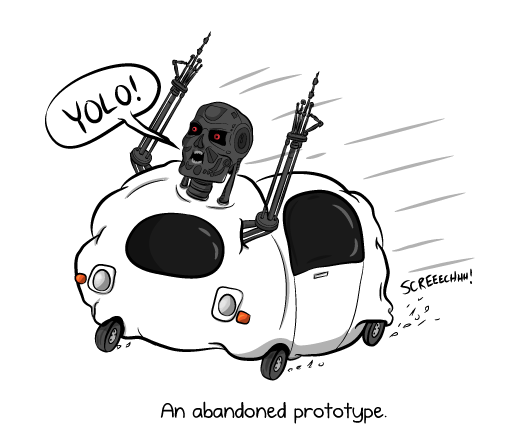
The car we rode in did not strike me as dangerous. It struck me as cautious. It drove slowly and deliberately, and I got the impression that it’s more likely to annoy other drivers than to harm them. Google can adjust the level of aggression in the software, and the self-driving prototypes currently tooling around Mountain View are throttled to act like nervous student drivers.
In the early versions they tested on closed courses, the vehicles were programmed to be highly aggressive. Apparently during these aggression tests, which involved obstacle courses full of traffic cones and inflatable crash-test objects, there were a lot of screeching brakes and roaring engines and terrified interns. Although impractical on the open road, part of me wishes I could have experienced that version as well.
December 31, 2014
The psychological value of online gaming
At Massively, Andrew Ross talks to the lead author on a recent paper that — unlike the pop-psych headlines in the newspapers — shows a much more positive side to gamers and online gaming:
Every time we talk about scientific research on Massively, readers argue that results from game studies should be “obvious” and are a waste of time/money or that everyone knows MMOs are filled with anti-social trolls. Kowert told me that game studies are “not unique in these criticisms,” though “they may seem stronger within this field due to the perceived frivolity of games and gaming as a field of study”:
Even though gaming continues to grow in importance and popularity within society, there is still so much that remains unknown about how and why people are using this medium and what are its potential uses and effects (both positive and negative). For example, it has long been assumed that online game players are all reclusive, overweight, lonely, teenage males. This is reflected in the cultural stereotype of the group as seen in the news media and popular culture (Make Love, Not Warcraft, anyone?).
In her paper Reconsidering the Stereotype of Online Gamers, Kowert and her colleagues examined the validity of these stereotypes. As we discussed yesterday, the results proved that the opinions people hold about gamers don’t quite match the media’s stereotypes, even among non-gamers. Without research, we wouldn’t have this information, and for me as a gamer, it’s encouraging to know that times are changing. Plus, it gives you ammo when Uncle Frank tries to put down your hobby this holiday season.
During my examination of the research into online games and real world friendships among emotionally sensitive users, I realized I could see myself in the findings. As a child, I was very shy; part of the problem was that I didn’t know how to react to people’s emotions. One article about social gaming and lonely lives argued that people who game a lot can sometimes have trouble connecting with non-gamers. Many “enthusiastic hobbyists” also have this issue, whether their hobby is sports or soap operas or games.
Kowert says this is correct to an extent; we’ve all met the hardcore sports fans who spouts sports jargon. “There is some uniqueness in the social profile of individuals who choose to exclusively engage in hobbyist activities that are mediated by technology, such as online games,” Kowert told me. “For instance, you state that you were shy as a child and preferred standing in the background rather than diving right into new social situations. Knowing this about yourself, you may have been more apprehensive to join, let’s say, a sports club or a board game group, than popping in on an online forum discussing sports or joining online gaming club.”
In other words, it’s not that all people who play online games are shy or are using the internet to overcome some of their social problems, but for those who suffer from those problems, online gaming could be a good way for them to meet others. Being online allows people to share a social space without the fears and consequences associated with face-to-face socialization. For example, I rarely went to parties in high school, but I did run events in the online games I played, especially in older MMOs. In more raid-oriented MMOs, people constantly told me I was doing something “different,” something unique or strange, and that made me stand out as also being different. In short, I was using the game world in a different way than other more mainstream gamers did, which echoes Kowert’s research about emotionally sensitive players using game spaces in unique ways. She explains:
Previous research has largely focused on the relationship between MMORPG play and social outcomes, as MMORPGs are believed to have a unique ability to promote sociability between users (see Mark Chen’s 2009 book Leet Noobs for a more in-depth discussion of the social environment of MMOs). As cooperation between users is often crucial to game play, the social environment of MMORPGs differs from other genres, such as multi-player first-person shooter games where gameplay is more about competition than cooperation and the social environment is more often characterized by competitiveness, trash-talking, and gloating (for more on this research see Zubek & Khoo, 2002 [PDF]). These differences in social environments are likely to differentially impact the social utility of the space as well as the social relationships that may come from it.
December 30, 2014
How did so many episodes of Doctor Who go missing?
At Samizdata, Patrick Crozier explains how the cost of a new technology and the union work rules of the 1960s led to so many great (and not-so-great) British TV shows being lost to posterity:
Something like two fifths of the Doctor Who episodes produced before 1970 are “missing” from the BBC archive. Although it is now 20 years since I found out about it, I still find it difficult to believe that such an act of cultural vandalism was allowed to take place. But it was.
So why are so many missing? In Wiped! Richard Molesworth describes the whole sorry tale in exhaustive (and some times exhausting) detail. It begins with Doctor Whos being recorded on videotape. In the 1960s videotape was a new technology and as such, expensive. Broadcasters were understandably keen to re-use the tapes whenever they could.
Another factor in this was the deal that the BBC had made with the actors’ union Equity. Younger readers may be unfamiliar with this but in the 1960s and 1970s unions were extraordinarily powerful. The deal between Equity and the BBC meant that an episode could only be repeated for two years and after that only with Equity’s specific permission. So, you’d have a situation where after 2 years you would have videotapes that effectively could not be broadcast and an engineering department banging on the door demanding they be allowed to wipe them. As a consequence every single inch of 1960s Doctor Who was wiped. It was far from alone. Episodes of Top of the Pops, the Likely Lads, Not only but also…, Z-Cars, Til death us do part and many others met a similar fate.
In the interests of fairness I should point out that when it came to wiping TV programmes the BBC was far from the only offender. There is almost nothing left of the first season of the Avengers for instance. Or Sexton Blake. About half of the highly-rated Callan (played by Edward Woodward) is also missing. However, all the Saints and Danger Mans are still with us. Meanwhile, my understanding is that most American TV, even from the 1950s still exists.
And compounding the problem … even when the BBC wanted to get rid of old episodes of TV shows, they still held the copyrights:
One thing that particularly sticks in my craw is the fact that even after the BBC did everything in its power to destroy these episodes it still has copyright to them. This has some very peculiar effects as I shall explain.
As I said, many episodes no longer exist as films or tapes. But all the audios exist (recorded off-air by fans), as do the scripts and a large number of photographs, otherwise known as “tele-snaps”. Over the years a cottage industry has grown up assembling these disparate elements into what are known as “reconstructions”. Now, they’re not very good and they are really only for the dedicated fan – people like me in other words – but right now they are the best we’ve got. Sadly, these too are affected by BBC copyright. For many years they were only available on videotape and on a non-profit basis. The producers were wary of annoying the BBC. And then one day someone (quite reasonably you’d think) decided to start putting them up on YouTube. Oh dear, the BBC really didn’t like that. Not only did they force YouTube to take a whole load of them down but seem to have closed down the reconstruction business temporarily if not permanently. Bastards.
December 28, 2014
Guns in fiction
Larry Correia talks about how to write about firearms:
No matter what your views on guns are, you’re likely to eventually come across the subject in your writing, so I thought it would be prudent to bring on a guest to discuss how best to go about it.
I’m sure you’ve all seen wild west movies where someone gets shot and then flies backwards several feet. Or in modern movies someone shoots the bottom of a car, then it explodes easily on the first shot. With the dramatics that Hollywood adds to gun use, it’s not surprising that it eventually affects how authors write about them.
Interview:
Ryan: What are the common pitfalls in fiction where it’s clear that the author has never held or fired a modern firearm?
Larry: It isn’t just guns, but any topic where the reader is an expert and the author is clueless. The problem is that when you write something that the reader knows is terribly wrong, it kicks them right out of the story and ruins the experience for them. Guns are especially hard because they are super common in fiction, and there are tons of readers who know about them.
Most of these really glaring errors can be taken care of with a little bit of cursory research. Technical things can be taken care of by a few minutes on the manufacturer’s webpage, which will keep your characters from dramatically flipping off the safety on a gun that doesn’t have one.
Beyond that, however, is the actual use of the gun. The character using it should have a realistic amount of knowledge based on their skill, knowledge, ability, and training. If you are gong to be writing about a character who is a professional gunslinger, then you need to do some research to make sure that person does what a professional gunslinger would do.
Ryan: If an author does not have access to a firearm or gun range, what are the best methods to brush up on them?
Larry: Actually shooting is best, but if you can’t, find friends who know guns and pick their brains. The problem here is like I mentioned, realistic amounts of knowledge for a particular character and your friends are going to vary just as much in real life. Just because somebody on the internet told you something doesn’t make it true.
Most online firearms forums are pretty cool about authors coming on and asking questions. Just don’t be a jerk about it.
Be careful because there are a lot of urban legends out there about guns. 5.56 doesn’t tumble through the air. A near miss of a .50 BMG won’t tear your limbs off. That is nonsense. So, the best thing to do is ask a group of people, and in short order you should be able to tell who actually has a clue and then disregard the crazy.
December 27, 2014
ESR on the origins of open source theory
Eric S. Raymond acknowledges the strong influence of evolutionary psychology on the development of open source theory:
Yesterday I realized, quite a few years after I should have, that I have never identified in public where I got the seed of the idea that I developed into the modern economic theory of open-source software – that is, how open-source “altruism” could be explained as an emergent result of selfish incentives felt by individuals. So here is some credit where credit is due.
Now, in general it should be obvious that I owed a huge debt to thinkers in the classical-liberal tradition, from Adam Smith down to F. A. Hayek and Ayn Rand. The really clueful might also notice some connection to Robert Trivers’s theory of reciprocal altruism under natural selection and Robert Axelrod’s work on tit-for-tat interactions and the evolution of cooperation.
These were all significant; they gave me the conceptual toolkit I could apply successfully once I’d had my initial insight. But there’s a missing piece – where my initial breakthrough insight came from, the moment when I realized I could apply all those tools.
The seed was in the seminal 1992 anthology The Adapted Mind: Evolutionary Psychology and the Generation of Culture. That was full of brilliant work; it laid the foundations of evolutionary psychology and is still worth a read.
(I note as an interesting aside that reading science fiction did an excellent job of preparing me for the central ideas of evolutionary psychology. What we might call “hard adaptationism” – the search for explanations of social behavior in evolution under selection – has been a central theme in SF since the 1940s, well before even the first wave of academic sociobiological thinking in the early 1970s and, I suspect, strongly influencing that wave. It is implicit in, as a leading example, much of Robert Heinlein’s work.)
The specific paper that changed my life was this one: Two Nonhuman Primate Models for the Evolution of Human Food Sharing: Chimpanzees and Callitrichids by W.C. McGrew and Anna T.C. Feistner.
In it, the authors explained food sharing as a hedge against variance. Basically, foods that can be gathered reliably were not shared; high-value food that could only be obtained unreliably was shared.
The authors went on to observe that in human hunter-gatherer cultures a similar pattern obtains: gathered foods (for which the calorie/nutrient value is a smooth function of effort invested) are not typically shared, whereas hunted foods (high variance of outcome in relation to effort) are shared. Reciprocal altruism is a hedge against uncertainty of outcomes.
The Railroad Signal – New York Central Railroad Educational Documentary 1948
Uploaded on 30 Nov 2011
New York Central Railroad Educational Documentary from 1948 that gives an overview of railroad signals and related safe working infrastructure used by trains, as well as the ongoing improvements to the signalling systems due to technological advances.
The film was released as part of the NYC’s “Running the Railroad” series, and features many examples of different signalling systems in use by the New York Central Railroad, as well as lots of scenes of passenger and freight trains. .
December 18, 2014
Admiral Grace Hopper
The US Naval Institute posted an article about the one and only Admiral Grace Hopper earlier this month to mark her birthday:
The typical career arc of a naval officer may run from 25-30 years. Most, however, don’t start at age 35. Yet when it comes to Rear Adm. Grace Hopper, well, the word “typical” just doesn’t apply.
Feisty. Eccentric. Maverick. Brilliant. Precise. Grace Hopper embodied all of those descriptions and more, but perhaps what defined her as much as anything else was the pride she had in wearing the Navy uniform for 43 years. Ironically, Rear Adm. Grace Hopper — “Amazing Grace” as she was known — had to fight to get into the Navy.
Grace Brewster Murray was born into a well-off family in New York on Dec. 9, 1906. She could have followed what many of her peers did during those times: attending college for a year or two, getting married then devoting their lives to their families and volunteer work.
Instead, Grace’s path would be less traveled. Encouraged to explore her innate curiosity on how things worked, a 7-year-old Grace dismantled all of the family’s alarm clocks trying to put them back together again. Rather than banishment from the practice, she was allowed one to practice on.
[…]
When she joined the WAVES in December 1943, Lt. j.g. Grace Hopper was 37 years old. Williams noted that after graduating at the top of her class of 800 officer candidates in June 1944, Hopper paid homage to Alexander Wilson Russell, her great-grandfather, the admiral who apparently took a “dim view of women and cats” in the Navy and laid flowers on his grave to “comfort and reassure him.”
Hopper was sent to the Bureau of Ordnance Computation Project at Harvard University under the guidance of Howard Aiken. The Harvard physics and applied mathematics professor helped create the first Automatic Sequence Controlled Calculator (ASCC), better known as Mark I. He ran a lab where design, testing, modification and analysis of weapons were calculated. Most were specially trained women called computers. “So the first ‘computers’ were women who did the calculating on desk calculators,” Williams said. And the time it took for the computers to calculate was called “girl hours.”
What happened next put Hopper on a new path that would define the rest of her life, according to a passage in the book Improbable Warriors: Women Scientists in the U.S. Navy during World War II also by Williams.
On July 2, 1944, Hopper reported to duty and met Aiken.
“That’s a computing engine,” Aiken snapped at Hopper, pointing to the Mark I. “I would be delighted to have the coefficients for the interpolation of the arc tangent by next Thursday.”
Hopper was a mathematician, but what she wasn’t was a computer programmer. Aiken gave her a codebook, and as Hopper put it, a week to learn “how to program the beast and get a program running.”
Hopper overcame her lack of programming skills the same way she always tackled other obstacles; by being persistent and stopping at nothing to solve problems. She eventually would become well-versed in how the machine operated, all 750,000 parts, 530 miles of wire and 3 million wire connections crammed in a machine that was 8-feet tall and 50-feet wide.


