
Google this week unveiled the latest iteration of its driverless-car experiment, a prototype vehicle with no steering wheel or brake pedal. Reactions came in three main modes: terror, in the case of traditional automobile manufacturers; gee-whiz enthusiasm among nerds such as yours truly; and, most important, withering criticism from assorted design and automotive critics, who denounced the vehicles’ 1998-iMac-on-wheels aesthetic as too cute by a (driverless) mile, an Edsel as reimagined by Jony Ive. Every wonder that comes (in this case literally) down the pike is met with a measure of scorn by various aficionados and sundry mavens, who are annoying but who also are, regardless of whether they intend or realize it, champions of civilization. The iterative, evolutionary process of product design and refinement is the main engine of progress in material standards of living on this planet, and every condescending, self-righteous snob who pronounces every innovation not quite good enough is making humanity better off.
The Google driverless car may turn out to be the iPod of the automotive world, or it may fail. It may be the case that another firm (though I would not bet on General Motors) will produce a better version; it is more likely that, as with traditional cars, dozens of firms will offer scores of competing products, each serving a different need or taste. It may be the case that the most economically consequential application of the technology is moving cargo rather than people. Or maybe people won’t like them; you never can tell. What is important is that the evolutionary process be allowed to play out with a minimum of political interference.
Kevin D. Williamson, “Race On, for Driverless Cars: On the beauty of putting the consumer in the driver’s seat”, National Review, 2014-06-01.
February 11, 2015
QotD: Driverless cars and their critics
February 9, 2015
The fantasy that CSE/CSIS oversight will actually protect the privacy of Canadians
Michael Geist on the rather disturbing news that Canadian intelligence agencies are busy watching the uploads of every internet user (including the Canadian users that CSE/CSIS are theoretically banned from tracking by the letter of the law):
… the problem with oversight and accountability as the primary focus is that it leaves the substantive law (in the case of CSE Internet surveillance) or proposed law (as in the case of C-51) largely unaddressed. If we fail to examine the shortcomings within the current law or within Bill C-51, no amount of accountability, oversight, or review will restore the loss of privacy and civil liberties.
First, consider the Snowden revelations that the CSE has been the lead on a surveillance initiative that gathers as many as 15 million uploads and downloads per day from a wide range of hosting sites that even appear to include the Internet Archive. The goal is reputed to be to target terrorist propaganda and training materials and identify who is uploading or downloading the materials. The leaked information shows how once a downloader is identified, intelligence agencies use other databases (including databases on billions of website cookies) to track the specific individual and their Internet use within hours of identified download.
The Levitation program, which removes any doubt about Canada’s role in global Internet surveillance, highlights how seemingly all Internet activity is now tracked by signals intelligence agencies. Note that the sites that host the downloads do not hand over their usage logs. Rather, intelligence agencies are able to track who visits the sites and what they do from the outside. That confirms a massive surveillance architecture of Internet traffic operating on a global scale. Is improved oversight in Canada alone going to change this dynamic that crosses borders and surveillance agencies? It is hard to see how it would.
Moreover, these programs point to the fundamental flaw in Canadian law, where Canadians are re-assured that CSE does not – legally cannot – target Canadians. However, mass surveillance of this nature does not distinguish between nationalities. Mass surveillance of a hundred million downloads every week by definition targets Canadians alongside Internet users from every corner of the globe. To argue that Canadians are not specifically targeted when it is obvious that the personal information of Canadians is indistinguishable from everyone else’s data at the time of collection, is to engage in meaningless distinctions that only succeed in demonstrating the weakness of Canadian law. Better oversight of CSE is needed, but so too is a better law governing CSE activities.
Admiral Grace Hopper – the programmer who logged the very first real “bug”
Not all women can code … but neither can all men. Pretending that because all women can’t code means no women can code is an exercise of idiots that is easily dismissed by the very existence of Admiral Grace Hopper, USN:

The First “Computer Bug” Moth found trapped between points at Relay #70, Panel F, of the Mark II Aiken Relay Calculator while it was being tested at Harvard University, 9 September 1947. The operators affixed the moth to the computer log, with the entry: “First actual case of bug being found”. (The term “debugging” already existed; thus, finding an actual bug was an amusing occurrence.) In 1988, the log, with the moth still taped by the entry, was in the Naval Surface Warfare Center Computer Museum at Dahlgren, Virginia, which erroneously dated it 9 September 1945. The Smithsonian Institute’s National Museum of American History and other sources have the correct date of 9 September 1947 (Object ID: 1994.0191.01). The Harvard Mark II computer was not complete until the summer of 1947.
The SR-71 “Blackbird”
At Sploid, Jesus Diaz shares some photos from the secret assembly line that built the SR-71 aircraft:

Built and designed in the 1960s after the A-12 Oxcart, the SR-71 Blackbird is still the fastest, most vanguardist air-breathing airplane in the history of aviation. These once classified photos reveal how Lockheed built both birds in secret, in California. They look taken at the Rebel base in Hoth.

The Blackbirds kept flying long after their retirement from the USAF. One of them stayed at NASA: Here’s a photo from the Armstrong Flight Research Center (then Dryden) of an SR-71 being retrofitted for test of the Linear Aerospike SR Experiment (LASRE).
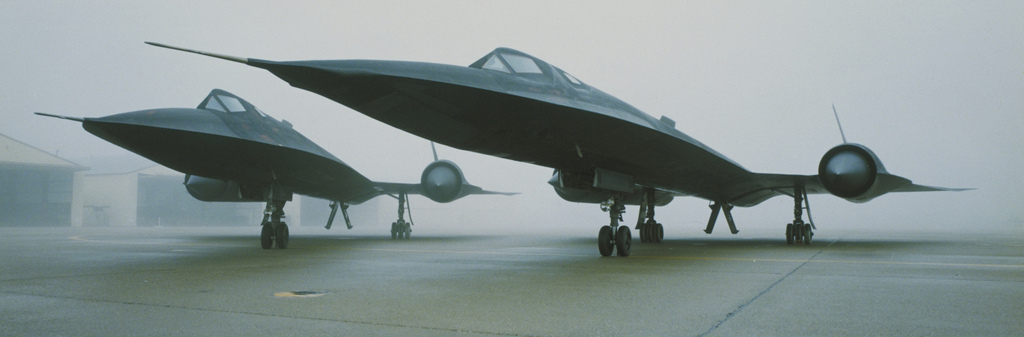
H/T to Dave Owens for the link, and also a H/T to Jeff for linking to another photo story about how the aircraft were transported from Lockheed’s Skunk Works to Area 51.

February 7, 2015
Now afflicting Chinese internet users – “Straight Man Cancer”
At The Diplomat, Nancy Tang explains a sudden outbreak of “Straight Man Cancer” among China’s Weibo users:
“A woman only has one ambition. In her heart, she sees love and childrearing as the most important thing in life.” On January 12, 2015, scholar Zhou Guoping thus tweeted on Weibo, the popular Chinese microblogging platform. Zhou later responded to the backlash, saying, “I agree with women’s liberation and equality between women and men… However, no matter how talented [women] are or what achievements they reach, if [a woman] refuses to, or doesn’t know how to be a gentle lover, a caring wife, a loving mother, the sense of beauty she gives me will be greatly reduced.” Both tweets were subsequently removed by Zhou.
Chinese commentators quickly diagnosed Zhou, a popular public intellectual at the state think tank Chinese Academy of Social Sciences, with “Straight Man Cancer.” The term “Straight Man Cancer,” coined in mid-2014, refers to chauvinist, judgmental behavior and language that propels sexist double standards or belittles women. Zhou’s controversial tweets exposed him to public scrutiny and attracted state attention. Communist Party mouthpiece People’s Daily re-posted an editorial, calling for the use of law and public opinion in order to “prevent ‘Straight Man Cancer’” in the private realm from “spreading into the public domain.” State news agency Xinhua also published the transcript of a newspaper interview with Zhou, in which he shamelessly called himself a “feminist.”
Zhou is by no means the sole Chinese straight man afflicted with Straight Man Cancer. In the aftermath of Zhou’s tweets, Chinese netizens have dug up other notable cases of public figures infected by the “epidemic.” Han Han, popular author-blogger and youth icon, is another representative of the cancerous straight male among Chinese millennials. He has stated in an interview that “there is no way that my girlfriend would [be allowed to] work outside of the household.” The renowned Chinese translator of Haruki Murakami, Lin Shaohua, has warned men against housework, which he thinks of as detrimental to masculinity and having the potential to make men effeminate or gender-bent. Tsinghua University sociologist Sun Liping has suggested that decreasing female employment and facilitating earlier female retirement would alleviate the social pressure caused by China’s large population. New Confucian scholar Qi Yihu has also advocated that women work only half-time so that they can rear children. Meanwhile, even these infuriating sexist remarks are eclipsed by intolerable misogynistic violence: While most sexists perpetrate unfair stereotypes, some actively hate on women and harm women’s well-being. For instance, the celebrity English teacher Li Yang, misogynist and perpetrator of domestic violence, is considered a “terminally ill” case of Straight Man Cancer.
February 6, 2015
The Avro Arrow
Published on 2 Feb 2015
The Avro Canada CF-105 Arrow was a delta-winged interceptor aircraft, with nuclear rockets and missiles, designed and built by Avro Canada as the culmination of a design study that began in 1953. The Arrow is considered to have been an advanced technical and aerodynamic achievement for the Canadian aviation industry. The CF-105 (Mark 2) held the promise of near-Mach 2 speeds at altitudes of 50,000 feet (15,000 m) and was intended to serve as the Royal Canadian Air Force’s primary interceptor in the 1960s and beyond. But when it was canceled it was a ruin for Canada’s pride. – https://en.wikipedia.org/wiki/Avro_Canada_CF-105_Arrow
February 5, 2015
Regulating the internet … in the name of fairness
At Coyote Blog, Warren Meyer is starting to think that a large number of internet fans are idiots:
So, out of the fear […] that some people will get better service than others — something that, oh by the way, has never really happened so is entirely hypothetical — you are urging on a regulatory regime originally designed for land-line phone companies, a technology that basically went unchanged for decades at a time. The phones that were in my home at my birth in 1962 were identical to the one in my dorm room when AT&T was broken up in 1982. Jesus, we are turning the Internet into a public utility — name three innovations from an American public utility in the last 40 years. Name one.
And all you free-speech advocates, do you really think the Feds won’t use this as a back-door to online censorship? We are talking about the same agency that went into a tizzy when Janet Jackson may have accidentally on purpose shown a nipple on TV. All that is good with TV today — The Sopranos, Game of Thrones, Arrested Development, etc. etc. etc. results mainly from the fact that cable is able to avoid exactly the kind of freaking regulation you want to impose on the Internet.
Here is my official notice — you have been warned, time and again. There will be no allowing future statements of “I didn’t mean that” or “I didn’t expect that” or “that’s not what I intended.” There is no saying that you only wanted this one little change, that you didn’t buy into all the other mess that is coming. You let the regulatory camel’s nose in the tent and the entire camel is coming inside. I guarantee it.
De-mythologizing the M-14
At Looserounds, a bit of an exercise in stripping away the myths and legends about the M-14:

Go on to any gun forum, and it won’t take you long to find people willing to tell you how great the M14 is. How accurate,like a laser, tough as tool steel with no need to baby it or clean it. Powerful as a bolt of lightening, and how well loved it was by those early users who refused the M16 because they wanted a “real” weapon made of wood and steel … But, is all that really true? Maybe it is a triumph of nostalgia over common sense and reality. One truth is, it was never really liked as much as people think they remember.
[…]
To quote Lt Colonel Chandler owner of Iron Brigade Armory and former Officer in Charge of many USMC marksmanship and sniping programs.
“Remember that the US Army struggled for more than twenty years to transform the M14 into a sniper type weapon. The Army finally abandoned all attempts to salvage the M14 rifle. Continued use of the M14 as anything other than a drill rifle is better described as DISASTER. ( emphasis Chandler’s). The M14 is old, and has never been more than a modified M1 Garand.”
“Unfortunately the M14 rifle is costly to modify and modification requires many man hours of skilled labor. In the field the m14 cannot maintain accuracy. The Army refused to admit that they could not solve the M14’s accuracy problems and wasted two decades attempting to make a silk purse from an old infantry rifle. Milspec spare parts are no longer made and those that can be found are often inferior, and ill fitting.”
“The M14 requires constant ( continual ) maintenance. Maintenance on an M14 progress geometrically. That means if you double an M14 rifle’s use, you quadruple its maintenance.”
“The world has moved beyond the M14. The weapon remains a standard piece only because it is used ( though less and less) in service rifle competition marksmanship, which is very different from field use. If anyone recommends it, run them through.”
“It is ironic that some of the USMC rifle competitors whose accurized M14s have been consistently waxed by the Army’s M16 s are supporting the use of the M14 as accurate rifles.”
“As we discuss the costs of bringing scoped M14s onto line in large quantities, allow me another digression. The M14 is a bitch to keep in tune, and a untuned M14, no matter who did the accurizing is about as accurate as a thrown rock . Unless the M14 is continually babied it will not retain accuracy. ( this is an important note from LT Col Chandler for those who fire 100 rounds a year and tell you the M14/M1A is wonderful). Imagine the hardships and brutalities a scoped M14 will experience as a DM weapon in combat. ( one recalls the story of Carlos Hathcock walking back the shoot house and starting to pass out, another Marine grabbed the accurized M14 and let The Ultimate Sniper fall face first into the asphalt. Letting a weakened man fall to keep the pathetic NM M14 accurate). No M14 ever built will stay accurately zeroed and tight group shooting , (meaning close to MOA) under field conditions.”
Chandler goes on to point out the requirements in specially qualified armorers who know how and can keep a M14 accurate and how even in the early 2000s those men are almost extinct in the USMC accuracy and Sniping world.
I can honestly say that I don’t have a dog in this fight. As the Canadian Army standardized on the FN C1A1 well before my militia days began, it was the only assault rifle I had extensive experience with … and I loved it. If the government hadn’t pre-emptively added the FN to the restricted weapons list, I’d certainly have bought one when they were being retired from active service. I’ve fired an M-14 once, and I’ve fired an M-16 once, but that’s nowhere near enough exposure to make any kind of judgement about either weapon (and they’d really have to impress the hell out of me to displace the FN in my estimation anyway).
February 4, 2015
The theory of electromagnetism doesn’t look a day over 149
Robyn Arianrhod on the sesquicentential one of the most important discoveries that helped create the world we live in today:
It’s hard to imagine life without mobile phones, radio and television. Yet the discovery of the electromagnetic waves that underpin such technologies grew out of an abstract theory that’s 150 years old.
Our knowledge of the existence of such waves is a direct result of James Clerk Maxwell’s theory of electromagnetism which was first published in January 1865.
Electromagnetism itself was discovered physically rather than theoretically. Some time around 1820, the Danish physicist Hans Oersted noticed that when you switch on an electric current, a nearby magnet – such as the needle of a compass – actually jumps, as if the changing electric current was itself a magnet.
Then, in 1831 (the year Maxwell was born in Edinburgh) the English physicist and chemist Michael Faraday discovered that if you move a magnet through a coil of wire, you create an electric current in the wire without the aid of batteries or other electricity supply.
Faraday was so intrigued by the surprising ability of moving magnets to create electricity that he created a tiny prototype of the electric generator. He also created a prototype of the electric motor, but it would take decades before engineers were able to develop working motors and generators.
Nevertheless, basic technologies had begun to flow almost immediately after the phenomenon of electromagnetism was discovered: in particular, the telegraph – the first high-speed global telecommunications system.
February 2, 2015
January 31, 2015
India and the INSAS rifle
Earlier this month, I linked to an article about the low reputation enjoyed by India’s first domestically designed and manufactured assault rifle. According to Strategy Page, there’s a potential change of heart by the Indian military on the INSAS rifle:
In response to the growing combat losses because of flaws in the locally made INSAS (Indian Small Arms System) 5.56mm assault rifle, the Indian government seems likely to capitulate and allow the military to get a rifle that works. Unfortunately for nationalist politicians, this will probably be a foreign rifle, and the leading candidate is Israeli.
This all began in the 1980s when there was growing clamor for India to design and build its own weapons. This included something as basic as the standard infantry rifle. At that time soldiers and paramilitary-police units were equipped with a mixture of old British Lee-Enfield bolt action (but still quite effective) rifles and newer Belgian FALs (sort of a semi-automatic Lee-Enfield) plus a growing number of Russian AK-47s. The rugged and reliable Russian assault rifle was most popular with its users.
In the late 1980s India began developing a family of 5.56mm infantry weapons (rifle, light machine-gun and carbine). Called the INSAS, the state owned factories were unable to produce the quantities required (and agreed to). Worse, the rifles proved fragile and unreliable. The design was poorly thought out and it is believed corruption played a part because the INSAS had more parts than it needed and cost over twice as much to produce as the AK-47.
The original plan was to equip all troops with INSAS weapons by 1998. Never happened, although troops began to receive the rifle in 1998. By 2000 half the required weapons ordered were still not manufactured. Moreover in 1999 the INSAS weapons got their first real combat workout in the Kargil campaign against Pakistan. While not a complete failure, the nasty weather that characterized that battle zone high in the frigid mountains saw many failures as metal parts sometimes cracked from the extreme cold. Troops complained that they were at a disadvantage because their Pakistani foes could fire on full automatic with their AK-47s while the INSAS rifles had only three bullet burst mode (which, fortunately, sometimes failed and fired more than three bullets for each trigger pull.) What was most irksome about this was that the INSAS rifles were the same weight, size and shape as the AK-47 but cost about $300 each, while AK-47s could be had for less than half that. The INSAS looked like the AK-47 because its design was based on that weapon.
Update: Added the link to Strategy Page.
January 29, 2015
Browning’s solution to the handgun problem
Last week, Tam saluted John Moses Browning on the occasion of his birthday, and celebrated the problem he solved:
So, the problem with a self-loading pistol is keeping the action closed until the bullet has left the muzzle and pressure in the chamber has dropped low enough that the brass case will be ejected neatly, as opposed to being transformed into a spray of shrapnel in the shooter’s face.
Early autopistols relied on complex mechanical setups, like the well-known Borchardt/Luger mechanism derived from Maxim’s toggle joint, to provide mechanical disadvantage against which the recoil had to work.
It would not shock me to learn that the two main parts of that toggle required more separate machining steps than an entire modern pistol slide. Further, the entire works were exposed to the great outdoors. Friend Marko once jokingly called it “The perfect handgun for a gunfight in a computer clean room.”
So, what are our choices to hold the breech closed for that crucial fraction of a second? Well, there’s spring pressure, but you can only add so much of that before the action can’t be worked by human hands. You can also add weight to the breechblock.

January 25, 2015
QotD: TED
Take the curious phenomenon of the TED talk. TED – Technology, Entertainment, Design – is a global lecture circuit propagating “ideas worth spreading”. It is huge. Half a billion people have watched the 1,600 TED talks that are now online. Yet the talks are almost parochially American. Some are good but too many are blatant hard sells and quite a few are just daft. All of them lay claim to the future; this is another futurology land-grab, this time globalised and internet-enabled.
Benjamin Bratton, a professor of visual arts at the University of California, San Diego, has an astrophysicist friend who made a pitch to a potential donor of research funds. The pitch was excellent but he failed to get the money because, as the donor put it, “You know what, I’m gonna pass because I just don’t feel inspired … you should be more like Malcolm Gladwell.” Gladwellism – the hard sell of a big theme supported by dubious, incoherent but dramatically presented evidence – is the primary TED style. Is this, wondered Bratton, the basis on which the future should be planned? To its credit, TED had the good grace to let him give a virulently anti-TED talk to make his case. “I submit,” he told the assembled geeks, “that astrophysics run on the model of American Idol is a recipe for civilisational disaster.”
Bratton is not anti-futurology like me; rather, he is against simple-minded futurology. He thinks the TED style evades awkward complexities and evokes a future in which, somehow, everything will be changed by technology and yet the same. The geeks will still be living their laid-back California lifestyle because that will not be affected by the radical social and political implications of the very technology they plan to impose on societies and states. This is a naive, very local vision of heaven in which everybody drinks beer and plays baseball and the sun always shines.
The reality, as the revelations of the National Security Agency’s near-universal surveillance show, is that technology is just as likely to unleash hell as any other human enterprise. But the primary TED faith is that the future is good simply because it is the future; not being the present or the past is seen as an intrinsic virtue.
Bryan Appleyard, “Why futurologists are always wrong – and why we should be sceptical of techno-utopians: From predicting AI within 20 years to mass-starvation in the 1970s, those who foretell the future often come close to doomsday preachers”, New Statesman, 2014-04-10.
January 18, 2015
“The INSAS is a very bad rifle”
Indian troops suffer a particularly bad experiment in local sourcing of equipment:

INSAS rifle (via Wikipedia)
In 1999, the Indian Army fought a three-month-long undeclared war with Pakistan. It was also the combat debut of India’s new INSAS battle rifle.
The INSAS is a very bad rifle.
During the conflict — waged over the disputed and mountainous Kargil district in the province of Kashmir — the Indian troops’ rifles jammed up, and their cheap, 20-round plastic magazines cracked in the cold weather.
Designed to shoot in semi-automatic and three-round burst modes, some soldiers would pull the trigger, and the gun would unexpectedly spray rounds like a fully automatic.
Soldiers also preferred the heavier 7.62-millimeter rounds in the FAL rifle, which the INSAS and its 5.56-millimeter rounds replaced.
Then in 2005, Maoist rebels attacked a Nepalese army base. The Nepalese troops had INSAS rifles bought from India. During the 10-hour-long battle, the rifles overheated and stopped working. The Maoists overran the base and killed 43 soldiers.
“Maybe the weapons we were using were not designed for a long fight,” Nepalese army Brig. Gen. Deepak Gurung said after the battle. “They malfunctioned.”


