
Uninsulated Crimp
Published on 10 Apr 2013James May gives a straightforward guide to some of science’s big ideas, explaining everything from evolution and Einstein to engineering and chemistry.
April 2, 2019
James May’s Things You Need To Know – Series 2 – Episode 5 – Engineering (S02E05)
Comments Off on James May’s Things You Need To Know – Series 2 – Episode 5 – Engineering (S02E05)
October 9, 2018
QotD: The universe
There is a theory which states that if ever anyone discovers exactly what the Universe is for and why it is here, it will instantly disappear and be replaced by something even more bizarre and inexplicable.
There is another theory which states that this has already happened.
Douglas Adams, The Restaurant at the End of the Universe, 1980.
Comments Off on QotD: The universe
August 28, 2018
Stross in conversation with Heinlein
Charles Stross explains why so many Baby Boomer SF writers fall so far short when they write in imitation of Robert Heinlein:
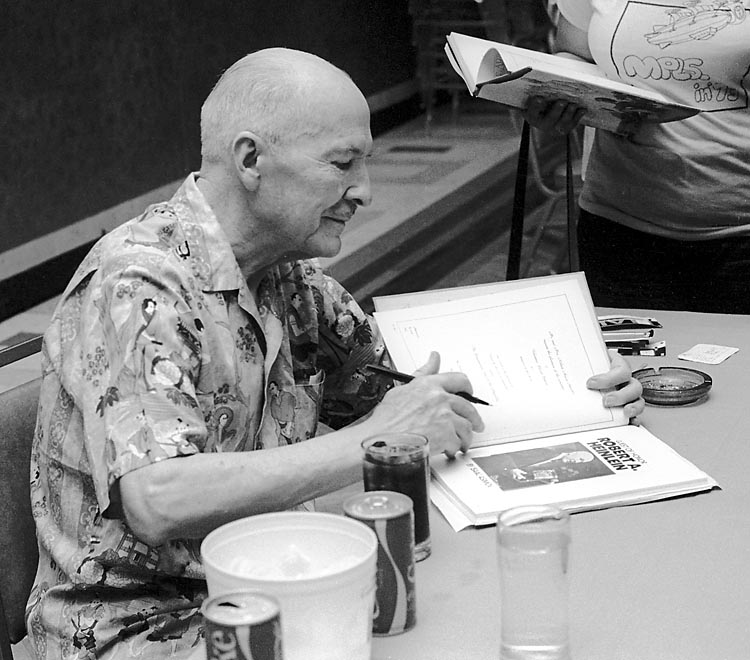
Robert A. Heinlein at the 1976 World Science Fiction Convention
Via Wikimedia Commons.
RAH was, for better or worse, one of the dominant figures of American SF between roughly 1945 and 1990 (he died in 1988 but the publishing pipeline drips very slowly). During his extended career (he first began publishing short fiction in the mid-1930s) he moved through a number of distinct phases. One that’s particularly notable is the period from 1946 onwards when, with Scribners, he began publishing what today would be categorized as middle-grade SF novels (but were then more specifically boys adventure stories or childrens fiction): books such as Rocket Ship Galileo, Space Cadet, Red Planet, and Have Space Suit, Will Travel. There were in all roughly a dozen of these books published from 1947 to 1958, and as critic John Clute notes, they included some of the very best juvenile SF ever written (certainly at that point), and were free of many of the flaws that affected Heinlein’s later works — they maintained a strong narrative drive, were relatively free from his tendency to lecture the reader (which could become overwhelming in his later adult novels), and were well-structured as stories.
But most importantly, these were the go-to reading matter for the baby boom generation, kids born from 1945 onwards. It used to be said, somewhat snidely, that “the golden age of SF is 12”; if you were an American boy (or girl) born in 1945 you’d have turned 12 in 1957, just in time to read Time for the Stars or Citizen of the Galaxy. And you might well have begun publishing your own SF novels in the mid-1970s — if your name was Spider Robinson, or John Varley, or Gregory Benford, for example.
Then a disturbing pattern begins to show up.
The pattern: a white male author, born in the Boomer generation (1945-1964), with some or all of the P7 traits (Pale Patriarchal Protestant Plutocratic Penis-People of Power) returns to the reading of their childhood and decides that what the Youth of Today need is more of the same. Only Famous Dead Guy is Dead and no longer around to write more of the good stuff. Whereupon they endeavour to copy Famous Dead Guy’s methods but pay rather less attention to Famous Dead Guy’s twisty mind-set. The result (and the cause of James’s sinking feeling) is frequently an unironic pastiche that propagandizes an inherently conservative perception of Heinlein’s value-set.
It should be noted that Charles Stross is politically left, so calling something “conservative” is intended to be understood as a pejorative connotation, not merely descriptive.
But here’s the thing: as often as not, when you pick up a Heinlein tribute novel by a male boomer author, you’re getting a classic example of the second artist effect.
Heinlein, when he wasn’t cranking out 50K word short tie-in novels for the Boy Scouts of America, was actually trying to write about topics for which he (as a straight white male Californian who grew up from 1907-1930) had no developed vocabulary because such things simply weren’t talked about in Polite Society.
Unlike most of his peers, he at least tried to look outside the box he grew up in. (A naturist and member of the Free Love movement in the 1920s, he hung out with Thelemites back when they were beyond the pale, and was considered too politically subversive to be called up for active duty in the US Navy during WW2.) But when he tried to look too far outside his zone of enculturation, Heinlein often got things horribly wrong. Writing before second-wave feminism (never mind third- or fourth-), he ended up producing Podkayne of Mars.
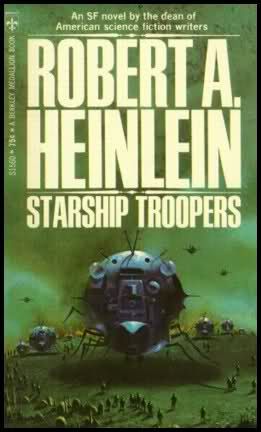
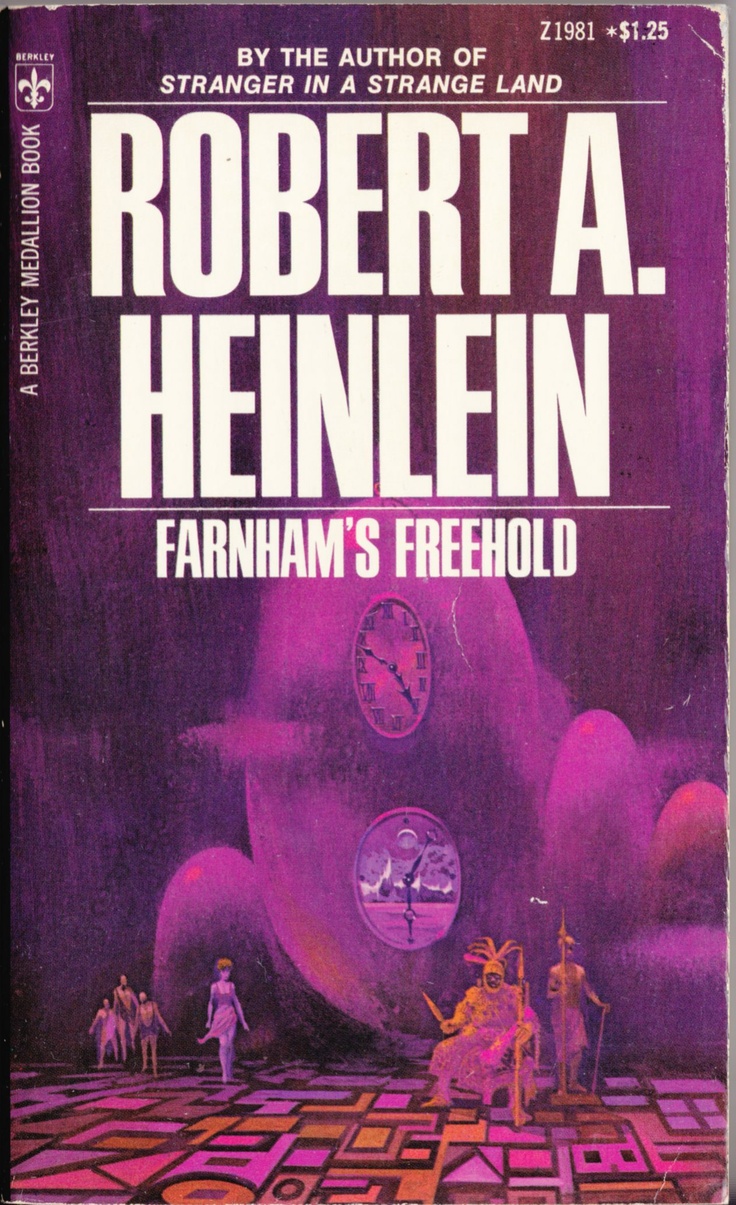
Trying to examine the systemic racism of mid-20th century US society without being plugged into the internal dialog of the civil rights movement resulted in the execrable Farnham’s Freehold. But at least he was trying to engage, unlike many of his contemporaries (the cohort of authors fostered by John W. Campbell, SF editor extraordinaire and all-around horrible bigot). And sometimes he nailed his targets: The Moon is a Harsh Mistress as an attack on colonialism, for example (alas, it has mostly been claimed by the libertarian right), Starship Troopers with its slyly embedded messages that racial integration is the future and women are allowed to be starship captains (think how subversive this was in the mid-to-late 1950s when he was writing it).
In contrast, Heinlein’s boomer fans rarely seemed to notice that Heinlein was all about the inadmissible thought experiment, so their homages frequently came out as flat whitebread 1950s adventure yarns with blunt edges and not even the remotest whiff of edgy introspection, of consideration of the possibility that in the future things might be different (even if Heinlein’s version of diversity ultimately faltered and fell short).
August 2, 2018
Books on the ISS
No, that’s not books about the International Space Station, but physical books on the ISS:
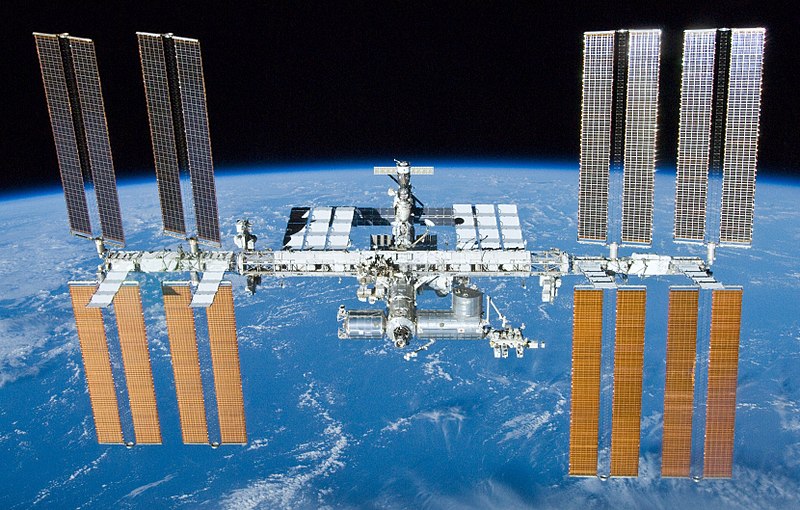
The International Space Station is featured in this image photographed by an STS-132 crew member on board the Space Shuttle Atlantis after the station and shuttle began their post-undocking relative separation. Undocking of the two spacecraft occurred at 10:22 CDT on 23 May 2010, ending a seven-day stay that saw the addition of a new station module, Rassvet, replacement of batteries and resupply of the orbiting outpost.
Via Wikimedia Commons
The astronauts on the International Space Station are obviously busy people, but even busy people need some time to relax and unwind. In addition to a well-stocked film library (particularly strong on movies with a space theme, including 2001: A Space Odyssey and Gravity), there are also plenty of books in their informal library.
Some are brought up by the astronauts – Susan Helms was allowed ten paperbacks and chose Gone With the Wind, Vanity Fair and War and Peace in her carryon. Others come with space tourists such as billionaire businessman Charles Simonyi, who brought Faust and Robert Heinlein’s The Moon is a Harsh Mistress.
Authors whose works appear several times in the list include Daniel J. Boorstin (3 books), Terry Brooks (5), Lois McMaster Bujold (11), John Le Carré (3), and David Weber (13).
Comments Off on Books on the ISS
June 6, 2018
QotD: When the “Right Stuff” becomes “old school”
Consider the popular conception of firefighters: brave, selfless, strong enough to haul an incapacitated person from a burning building.
A few years ago, at a conference, I learned that many women were failing to qualify as firefighters, because they were coming up short on the strength test. What was so interesting, though, was that in practice, it turns out that one of the most important skills a firefighter needs is not so much the strength to drag an unconscious person from a building, but, far more commonly, the ability to coax someone who’s in danger and is terrified to come with them. Apparently, many women turn out to be far more persuasive than men – highlighting the importance of selection based on real-world skills, rather than legacy stereotypes.
Space flight offers another striking example of this phenomenon. In the context of a recent Tech Tonics podcast interview with Dorit Donoviel, director of the Biomedical Innovations Laboratory at the Center for Space Medicine at Baylor College of Medicine, I had told Dr. Donoviel about my lifelong interest in astronomy and space, about launching Estes rockets and my love of the National Air and Space Museum and above all, about my affection for the heroism captured in the movie The Right Stuff, an all-time favorite.
In response, she laughed, and told me how “old school” that thinking was. When the space program started out, she explained, there was an exceptional degree of risk involved, and astronauts tended to be selected from the ranks of fighter pilots – because, in her words, they had “the skill sets and the cojones.” But today, she said, things are different – in large measure because the “space program is a lot safer than it used to be.”
Consequently, Donoviel explained, “Today what we’re looking for is less of the sort of alpha-male pilots, and more of the sort of scientists and engineers, geologists and earth scientists, folks who can work together in a cohesive manner in a team.”
Moreover, she added, the astronaut of the future needs to be able to endure long periods of boredom and the prolonged lack of stimulation – in many ways, the opposite of high-adrenaline “seat-of-the-pants flying” that in some ways characterized the early astronaut missions.
In space travel, as in firefighting, our notion of what constitutes the right skill set has evolved appreciably.
David Shaywitz, “Evolving Notions Of The Right Stuff — In Spaceflight And In Medicine”, Forbes, 2016-09-20.
Comments Off on QotD: When the “Right Stuff” becomes “old school”
February 13, 2018
Elon Musk as Heinlein’s Delos D. Harriman – “Selling the moon is just what Musk is doing”
I suspect I’d recognize a lot of the books in Colby Cosh‘s collection, as we’re both clearly Robert Heinlein fans. In a column yesterday, he pointed out the strong parallels between Heinlein’s fictional “Man Who Sold the Moon” and his closest counterpart in our timeline, Elon Musk:
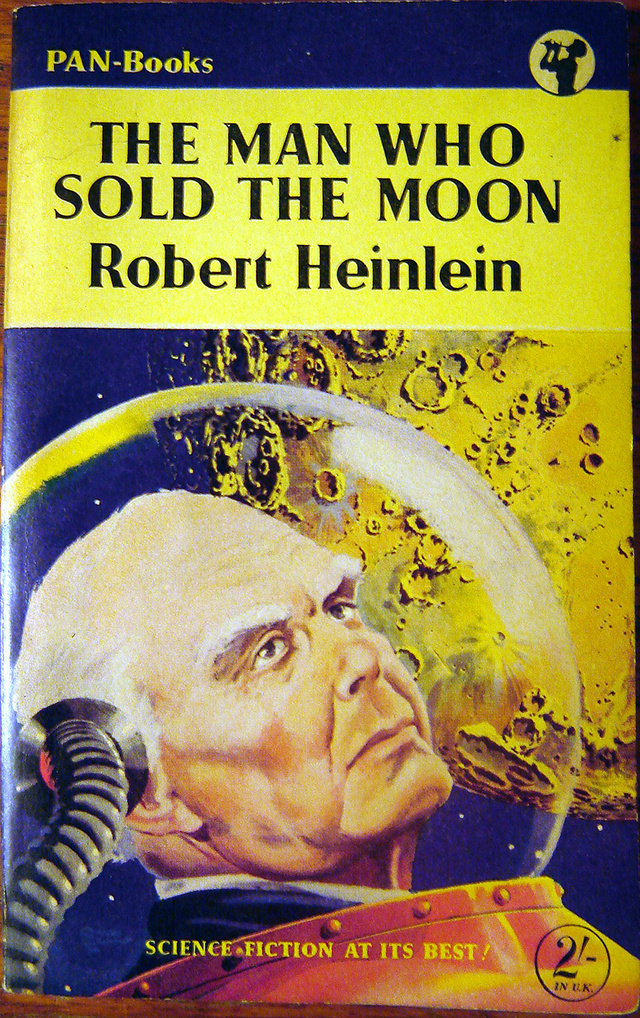
Written between 1939 and 1950 for quickie publication in pulp magazines, the Future History is a series of snapshots of what is now an alternate human future — one that features atomic energy, solar system imperialism, and the first steps to deep space, all within a Spenglerian choreography of social progress and occasional resurgent barbarity. It stands with Isaac Asimov’s Foundation trilogy as a monument of golden-age science fiction.
[…]
The result, in the key story of the Future History, is an uncannily accurate description of the design and launch of a Saturn V rocket. (Written before 1950, remember.) But because Heinlein happened not to be interested in electronic computers, all the spacefaring in his books is done with the aid of slide rules or Marchant-style mechanical calculators (which, in non-Heinlein history, had to become obsolete before humans could go to Luna at all). Heinlein sends people to colonize the moon, but nobody there has internet, or is conscious of its absence.
Given that his ideas about computers were from the pre-computer era and even the head of IBM thought there’d be a worldwide demand for a very small number of his company’s devices, that’s not surprising at all. In one of his best novels, a single computer runs almost all of the life support, heat, light, transportation and communication systems on Luna … and is self-aware, but lonely. In later works where computers appear, they tend to be individual personalities or even minor characters, but they’re anything but ubiquitous: powerful, but rare.
I suspect the lack of an internet-equivalent derives both from the nature of his conception of how computing would progress and a form of the Star Trek transporter problem – it solves too many plot issues that could otherwise be usefully woven into stories.
The “key story” I just mentioned is called “The Man Who Sold The Moon.” And if you’re one of the people who has been polarized by the promotional legerdemain of Elon Musk — whether you have been antagonized into loathing him, or lured into his explorer-hero cult — you probably need to make a special point of reading that story.
The shock of recognition will, I promise, flip your lid. The story is, inarguably, Musk’s playbook. Its protagonist, the idealistic business tycoon D.D. Harriman, is what Musk sees when he looks in the mirror.
“The Man Who Sold The Moon” is the story of how Harriman makes the first moon landing happen. Engineers and astronauts are present as peripheral characters, but it is a business romance. Harriman is a sophisticated sort of “Mary Sue” — an older chap whose backstory encompasses the youthful interests of the creators of classic pulp science fiction, but who is given a great fortune, built on terrestrial transport and housing, for the purposes of the story.
February 10, 2018
When cinematography wins out over reality
Earlier this month, Charles Stross talked about why he’s been reading less and less science fiction lately, and touched on SF movies and (for example) why George Lucas chose to model space combat on World War 1 aircraft battles:
When George Lucas was choreographing the dogfights in Star Wars, he took his visual references from film of first world war dogfights over the trenches in western Europe. With aircraft flying at 100-200 km/h in large formations, the cinema screen could frame multiple aircraft maneuvering in proximity, close enough to be visually distinguishable. The second world war wasn’t cinematic: with aircraft engaging at speeds of 400-800 km/h, the cinematographer would have had a choice between framing dots dancing in the distance, or zooming in on one or two aircraft. (While some movies depict second world war air engagements, they’re not visually captivating: either you see multiple aircraft cruising in close formation, or a sudden flash of disruptive motion — see for example the bomber formation in Memphis Belle, or the final attack on the U-boat pen in Das Boot.) Trying to accurately depict an engagement between modern jet fighters, with missiles launched from beyond visual range and a knife-fight with guns takes place in a fraction of a second at a range of multiple kilometres, is cinematically futile: the required visual context of a battle between massed forces evaporates in front of the camera … which is why in Independence Day we see vast formations of F/A-18s (a supersonic jet) maneuvering as if they’re Sopwith Camels. (You can take that movie as a perfect example of the triumph of spectacle over plausibility at just about every level.)
… So for a couple of generations now, the generic vision of a space battle is modelled on an air battle, and not just any air battle, but one plucked from a very specific period that was compatible with a film director’s desire to show massed fighter-on-fighter action at close enough range that the audience could identify the good guys and bad guys by eye.
Let me have another go at George Lucas (I’m sure if he feels picked on he can sob himself to sleep on a mattress stuffed with $500 bills). Take the asteroid field scene from The Empire Strikes Back: here in the real world, we know that the average distance between asteroids over 1km in diameter in the asteroid belt is on the order of 3 million kilometers, or about eight times the distance between the Earth and the Moon. This is of course utterly useless to a storyteller who wants an exciting game of hide-and-seek: so Lucas ignored it to give us an exciting game of …
Unfortunately, we get this regurgitated in one goddamned space opera after another: spectacle in place of insight, decolorized and pixellated by authors who haven’t bothered to re-think their assumptions and instead simply cut and paste Lucas’s cinematic vision. Let me say it here: when you fuck with the underlying consistency of your universe, you are cheating your readers. You may think that this isn’t actually central to your work: you’re trying to tell a story about human relationships, why get worked up about the average spacing of asteroids when the real purpose of the asteroid belt is to give your protagonists a tense situation to survive and a shared experience to bond over? But the effects of internal inconsistency are insidious. If you play fast and loose with distance and time scale factors, then you undermine travel times. If your travel times are rubberized, you implicitly kneecapped the economics of trade in your futurescape. Which in turn affects your protagonist’s lifestyle, caste, trade, job, and social context. And, thereby, their human, emotional relationships. The people you’re writing the story of live in a (metaphorical) house the size of a galaxy. Undermine part of the foundations and the rest of the house of cards is liable to crumble, crushing your characters under a burden of inconsistencies. (And if you wanted that goddamn Lucasian asteroid belt experience why not set your story aboard a sailing ship trying to avoid running aground in a storm? Where the scale factor fits.)
Whatever you do, don’t go asking him about Han Solo’s claimed Kessel Run in less than 12 parsecs…
Comments Off on When cinematography wins out over reality
January 25, 2018
The Canals of Mars – Eye of the Beholder – Extra Sci Fi – #10
Extra Credits
Published on 23 Jan 2018The Canals of Mars ignited so many imaginations, especially in science fiction stories, but they never really existed. What made us believe in them? And why did so many writers keep dreaming about them even after the theory had been disproved?
Comments Off on The Canals of Mars – Eye of the Beholder – Extra Sci Fi – #10
January 7, 2018
Carbon Fiber – The Material Of The Future?
Real Engineering
Published on 27 Feb 2017
Comments Off on Carbon Fiber – The Material Of The Future?
January 3, 2018
BAHFest London 2017 – Louie Terrill: Why the Kessler Syndrome is key to humanity’s future
BAHFest
Published on Dec 11, 2017Watch Louie Terrill at BAHFest London 2017 present his theory, “Making sure we’re all in this together: Why the Kessler Syndrome is key to humanity’s future.”
BAHFest is the Festival of Bad Ad Hoc Hypotheses, a celebration of well-researched, logically explained, and clearly wrong scientific theory. Additional information is available at http://bahfest.com/
Comments Off on BAHFest London 2017 – Louie Terrill: Why the Kessler Syndrome is key to humanity’s future
December 21, 2017
UFOs? Again?
I must admit I share Colby Cosh’s just disproven belief that we were done with the UFO craze:
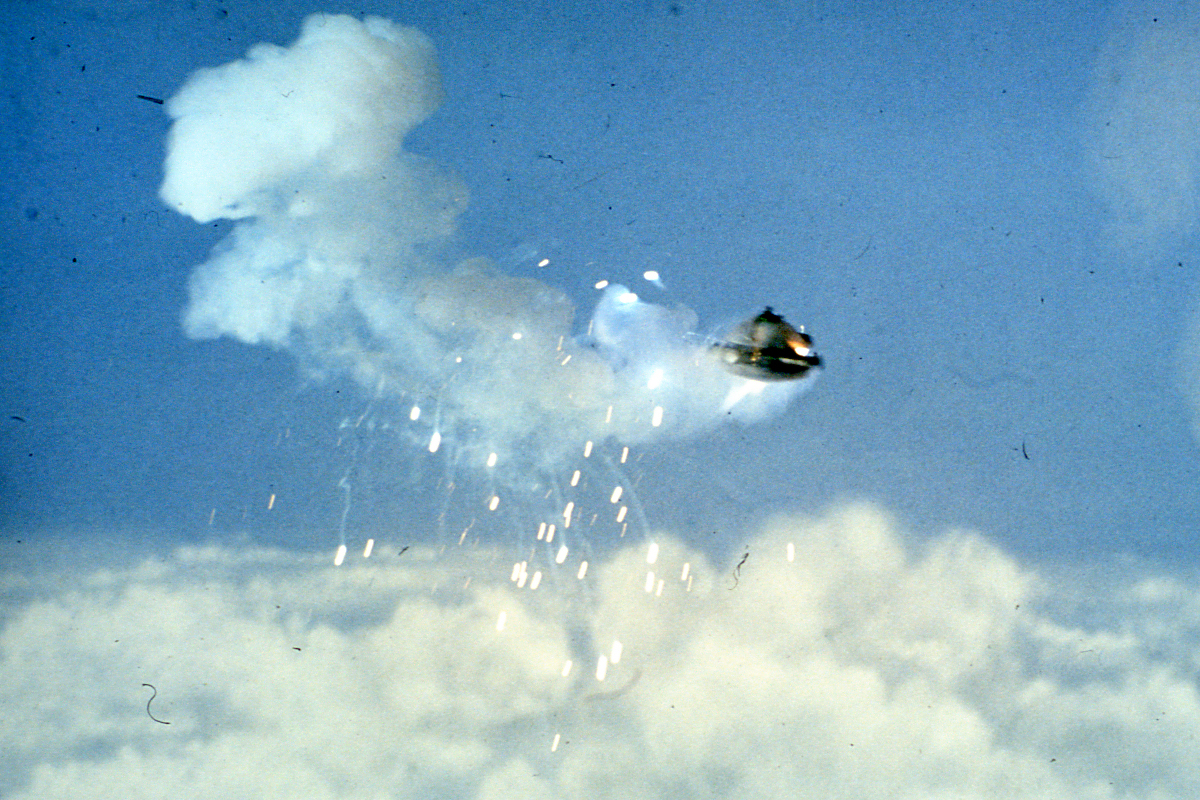
Yeah, I know: wrong UFO
There can no longer be any doubt: every fashion phenomenon does come back. I, for one, really thought we had seen the last of UFO-mania. When I was a boy, the idea of stealthy extraterrestrial visitors zooming around in miraculous aircraft was everywhere in the nerdier corners of popular culture. If you liked comic books or paperback science fiction or Omni magazine — and especially if those things were among the staples of your imaginative diet — there was no getting away from it.
Anyone remember the NBC series Project U.F.O. (1978-79), inspired by the USAF’s real Project Blue Book program? As the anthology show’s Wikipedia page observes, most episodes had the plot of a Scooby-Doo cartoon, only backwards: they would end with the investigating protagonists discovering that UFOs remained impenetrably Unidentifiable, but must be “real” craft capable of physically improbable manoeuvres. (I know citing Wikipedia will savour of pumpkin-spice holiday laziness on my part, but the Scooby thing is a truly perceptive point by some anonymous Wiki-genius.)
Then, at the end of the show, a disclaimer would appear on-screen: “The U.S. Air Force stopped investigating UFOs in 1969. After 22 years, they found no evidence of extra-terrestrial landings and no threat to national security.”
[…]
There are very good reasons for a superpower’s military apparatus to devote a little money to following up UFO sightings. “Threat Identification”? Sure, whatever. Plenty of U.S. military flyers have seen UFOs, and these people ought to be comfortable reporting odd occurrences without ridicule. But if I were American, I would definitely want most of that budget to go to Scully rather than Mulder. Don’t throw cash at someone who really, really wants to believe.
What I find vexing is that most of the response to the Times story has been in the spirit of “Whoa, aliens!” rather than “Taxpayers got robbed.” Young people may know on some level that ubiquitous good-quality cameras have all but eliminated civilian UFO sightings. But they lack the personal memory of a live, thriving UFO fad, one that bred quasi-scholarly international UFO-study associations along with a whole publishing industry devoted to UFO tales. I wonder if the Times’ piece on UFO research, by the very virtue of its flat-voiced Grey Lady objectivity, is having the same weird effect as that disclaimer they showed at the end of Project U.F.O.
October 18, 2017
Wheel of Future History
exurb1a
Published on 16 Oct 2017It’s 2017. No jet packs yet, but 3D printed beer will be here soon so just shhhhhhhhh.
The poem near the end is ripped off from Rudyard Kipling’s “If”. It’s a good one. Check it out ► https://www.poetryfoundation.org/poems/46473/if—
Comments Off on Wheel of Future History
Are There Parts of German WW1 Warships in Space?
Real Engineering
Published on 19 Jul 2017
Comments Off on Are There Parts of German WW1 Warships in Space?
September 28, 2017
Back to the Moon in 2019?
Charles Stross thinks a US circumlunar expedition is on the cards for just two years ahead, and he might well be right:
If Donald Trump is still president, US astronauts will return to circumlunar space around July 16th, 2019 …
That’s the 50th anniversary of the launch of Apollo 11. It’s also 6-12 months on from the projected date of Musk’s translunar tourist trip on a Falcon Heavy.
I expect Falcon Heavy to be delayed a few months, minimum, because no new launch vehicle ever flies on time, especially a crew-rated one, but it’s currently due to fly around December this year for the first time, with a vehicle currently undergoing integration at Cape Canaveral and commercial orders for subsequent flights. It’s rather hard to describe it as vaporware at this point. The same goes for the Dragon 2 crewed capsule; it’s due for a first uncrewed orbital flight test in March 2018, and a crewed orbital test flight later in 2018.
[…]
I’m making this a prediction, however, because the POTUS factor.
July 2019 lies within the term in office of Donald Trump (or Mike Pence, depending whether impeachment/removal has happened first then). Trump is nothing if not an egomaniac, and offering him the opportunity to make a historic phone call to lunar orbit in front of the TV cameras is a guaranteed ego-stroke. Trump is of an age to have young-adult memories of Apollo and I can’t see the idea not appealing to him if he can take credit for it.
So I’m betting that this is how Musk will fund development of his lunar-orbit capability.
(Terms and conditions: prediction invalid in event of nuclear war, global environmental or economic collapse, Trump and Pence both being impeached, or a Dragon 2 capsule exploding in flight, because any of these things might impact the launch schedule.)
Note: Charles is quite a fan of the impeachment scenario, if you hadn’t picked that up from context. The fact that he’s very much not a Trump fan actually makes his prediction that much more striking: he has no interest or desire to see Trump get a propaganda coup to end his term in office.
Comments Off on Back to the Moon in 2019?
August 8, 2017
QotD: The next “Carrington Event”
The last one happened in 1859. The Earth was hit by a cloud of magnetized plasma from a “coronal mass ejection” — something that our Sun often does. Most fly off in other directions; the last that barely missed us was in July, 2012. (You can tell it missed from the fact that the Internet still exists.) The last bullseye on our beloved planet was named after the brilliant English amateur astronomer, Richard Carrington (1826–75), who, in the course of figuring out what happened, demonstrated the existence of “solar flares.”
He was trying to explain why telegraph operators all over the world, on the 1st of September, 1859, were suddenly getting electric shocks; and then, prior to the whole cable system going down, why some had been able to send and receive messages even after disconnecting their power. Too, why auroras had lit up the night sky at temperate latitudes so bright people could read newspapers by it; or why those at higher elevations near the equator could enjoy the aurora borealis and the aurora australis — simultaneously.
Now, the world a sesquicentury ago was not so dependent upon electricity as it is today. And the system of telegraphy was so ridiculously simple, that it was soon repaired. I daresay Morse Code is worth learning in preparation for the next Carrington Event — which, when it comes, we will be able to predict, at best, a few hours in advance. (Other cosmic events might impinge on our lifestyles meanwhile, but I like to consider my apocalypses one at a time.)
Gentle reader may do a mental inventory of the gizmos in his environment that are connected directly or indirectly to the power grid. Then add in anything that contains a computer chip, whether it happened to be “on” or “off” when the Earth’s magnetic field was impacted. For I assume it will all turn “on” of its own, for a brief but memorable interval.
The “beauty” (as they say in Cape Breton) is that we have no back-up system, and moreover, there can be no back-up, except what we can rig from horse, or paddle. For we have made ourselves totally dependent upon sparks.
On the plus side, the environmentalists may exult, because the quick reduction of the world’s population to post-Plague mediaeval levels could prove a lucky break for the other endangered species.
It will, even more happily, improve national security for the survivors in USA. For the same magnetic storm that makes the cities (and towns) of America uninhabitable will also have disabled the military capacities of Russia, China, and Iran. If they want to come at us they will have to do so in sailing ships. Moreover, the depopulation of Mexico will probably reduce the invasion threat from there, whether or not Donald Trump is President.
David Warren, “The highest tech”, Essays in Idleness, 2015-08-22.
Comments Off on QotD: The next “Carrington Event”


