
In my youth, I shared a house with some communists of the very old-fashioned variety. They believed in industrial production because it inevitably resulted in that finest flower of humanity, the factory worker, who would, ex officio, be a foot soldier of the Revolution. No Leonardo da Vinci or Mozart for them! They believed, rather, in the Soviet Union’s ever-rising production, or at any rate graphs of ever-rising production, of something called pig iron, which at some point would overtake that of the United States and Western Europe combined, to the enormous benefit, of course, of the indigenous people of the Siberian tundra. They couldn’t see a landscape without wanting to garnish it with a factory chimney belching smoke, the blacker the better, as a symbol of what they called Man’s triumph over Nature (early communist propaganda and iconography were full of chimneys belching black smoke). They thought of Nature as an enemy, as a malign obstacle to be wrestled with and overcome, or as an evil conscious force obstructing Mankind’s progress to a glorious and infinitely abundant future. The extinction of animal species was welcome to them, not only if they, the extinct species, were in some way noxious to Man or deleterious to his advance, such as flies and snakes, but as symbolizing his increasing mastery over the surface of the Earth. Knowledge is power, and power is what they cared about.
Theodore Dalrymple, “A Matter of Respect”, Taki’s Magazine, 2019-12-31.
December 3, 2024
QotD: Old fashioned communists
December 2, 2024
QotD: Intersectionality on campus
Perhaps the most pernicious consequence of intersectionality, however, is its effect on the culture of elite college campuses. Some claims about “campuses-gone-crazy” are surely overblown. For instance, judging from my experience at Columbia, nobody believes there are 63 genders, and hardly anyone loves Soviet-style communism. (That said, the few communists on campus tend to despise intersectionality with an unusual passion.) But one thing is certainly not exaggerated: intersectionality dominates the day-to-day culture. It operates as a master formula by which social status is doled out. Being black and queer is better than just being black or queer, being Muslim and gender non-binary is better than being either one on its own, and so forth. By “better”, I mean that people are more excited to meet you, you’re spoken of more highly behind your back, and your friends enjoy an elevated social status for being associated with you.
In this way, intersectionality creates a perverse social incentive structure. If you’re cis, straight, and white, you start at the bottom of the social hierarchy — especially if you’re a man, but also if you’re a woman. For such students, there is a strong incentive to create an identity that will help them attain a modicum of status. Some do this by becoming gender non-binary; others do it by experimenting with their sexuality under the catch-all label “queer”. In part, this is healthy college-aged exploration — finding oneself, as it were. But much of it amounts to needless confusion and pain imposed on hapless young people by the bizarre tenets of a new faith.
Coleman Hughes, “Reflections on Intersectionality”, Quillette, 2020-01-13.
December 1, 2024
QotD: Recording and codifying the land that William conquered
[…]
In brief, Scott argues that the process of making a society “legible” to government officials obscures social reality, to the point where the government’s maps and charts and graphs take on a life of their own. It’s recursive, such that those well-intentioned schemes end up first measuring, then manipulating, the wrong thing in the wrong way, to the point that the social “problem” the process was supposed to address drops out entirely — all you have, at the end, is powerpoint girls critiquing spreadsheet boys because their spreadsheets don’t have enough animation, and vice versa.
Scott doesn’t use the Domesday Book as an example (IIRC from a graduate school class 20-odd years ago, anyway), but it’s one we’re probably all familiar with. The first thing William the Conqueror needed to know is: what, exactly, have I conquered? So he sent out the high-medieval version of spreadsheet boys to take a comprehensive survey of the kingdom. Turns out the Duke of Earl’s demense runs from this creek to that rock. He has five underlings, and their domains run from etc.
The point of all this, of course, was so that Billy C. could call the Duke of Earl on the carpet, point to the spreadsheet, and say “You owe me a cow, three chickens, and two months in the saddle as back taxes.” It worked great, except when — as, it seems, is inevitable — the high-medieval equivalent of the spreadsheet boys did the high-medieval version of “ctrl-c”; just copying and pasting the information over. Eventually the tax situation got way out of whack, as it did for most every pre-modern government running a similar system — one of the reasons declining Chinese dynasties had such fiscal problems, for instance, is that the tax surveys only got updated every two centuries or so, such that a major provincial lord was still only paying 20 silver pieces in taxes, when he should’ve been paying 20,000 (and his peasants were all paying 20 when all they could afford was 2).
In other words: unless the spreadsheet boys periodically go out and check that the numbers on their spreadsheets actually correspond in some systematic, more-or-less representative way to some underlying social reality, government policy is being set by make-believe.
Severian, “The Finger is Not the Moon”, Rotten Chestnuts, 2021-09-14.
November 30, 2024
QotD: Unrealized promises of a “Great Society”
Amity Shlaes, Great Society: A New History, 2020.
November 29, 2024
QotD: Why nothing gets done in the Current Year
Having pumped billions of dollars into building the next generation of computer chip factories in the US, the Biden administration is facing new pressure over the health and safety risks those facilities could pose. Environmental reviews for the new projects need to be more thorough, advocates say. They lack transparency around what kinds of toxic substances factory workers might handle, and plans to keep hazardous waste like forever chemicals from leaching into the environment have been vague.
A coalition of influential labor unions and environmental groups, including the Sierra Club, have since submitted comments to the Department of Commerce on draft environmental assessments, saying that the assessments fall short. The coalition’s comments flag lists of potential issues at several projects in Arizona and Idaho, including how opaque the safety measures that manufacturers will take to protect both workers and nearby residents are.
This is not a serious complaint. This is actually the national association of environmental studies writers spotting a gravy train passing by and desiring to dip their ladle in. And that’s all it is too. But it’s also that excellent example of why fuck all ever gets built. We’ve an entire — and politically powerful — class that makes their living producing the hundred tonne reports that accompany building anything. And they’re not going to allow anything to be built unless they get paid for writing hundred tonne reports. And, to complete the circle, if every activity requires a hundred tonne report then fuck all will ever get done.
There was, back a time, a law passed about blood minerals. The law said anyone who might use them must write to all suppliers to ask if they do. Then those said anyones must tell consumers whether they do. This cost $4 billion just in the first year. From what I’ve heard — and might take the trouble to prove one day — the bloke who led the campaign for the law requiring the letters now runs a very profitable consultancy advising large corporates on how to write the letters. $4 billion spent by society so that one bloke can gain a minor summer place in the Hamptons. This doesn’t make us richer as a whole, it’s pissing the wealth of the nation up the wall.
Carthage, it’s the only solution. The biggest problem who is who the hell would buy our nice new stock of enslaved environmental bureaucrats? Razing, salt, ploughs, these are easy but who’s mad enough to offer a positive price for the last part of the process?
Tim Worstall, “Why Fuck All Ever Gets Done In This Modern World”, It’s all obvious or trivial except …, 2024-08-28.
November 28, 2024
QotD: The trace italienne in fortification design
Since the goal remains preventing an enemy from entering a place, be that a city or a fortress, the first step has to be to develop a wall that can’t simply be demolished by artillery in a good afternoon or two. The solution that is come upon ends up looking a lot like those Chinese rammed earth walls: earthworks are very good at absorbing the impact of cannon balls (which, remember, are at this point just that: stone and metal balls; they do not explode yet): small air pockets absorb some of the energy of impact and dirt doesn’t shatter, it just displaces (and not very far: again, no high explosive shells, so nothing to blow up the earthwork). Facing an earthwork mound with stonework lets the earth absorb the impacts while giving your wall a good, climb-resistant face.
So you have your form: a stonework or brick-faced wall that is backed up by essentially a thick earthen berm like the Roman agger. Now you want to make sure incoming cannon balls aren’t striking it dead on: you want to literally play the angles. Inclining the wall slightly makes its construction easier and the end result more stable (because earthworks tend not to stand straight up) and gives you an non-perpendicular angle of impact from cannon when they’re firing at very short range (and thus at very low trajectory), which is when they are most dangerous since that’s when they’ll have the most energy in impact. Ideally, you’ll want more angles than this, but we’ll get to that in a moment.
Because we now have a problem: escalade. Remember escalade?
Earthworks need to be wide at the base to support a meaningful amount of height, tall-and-thin isn’t an option. Which means that in building these cannon resistant walls, for a given amount of labor and resources and a given wall circuit, we’re going to end up with substantially lower walls. We can enhance their relative height with a ditch several out in front (and we will), but that doesn’t change the fact that our walls are lower and also that they now incline backwards slightly, which makes them easier to scale or get ladders on. But obviously we can’t achieved much if we’ve rendered our walls safe from bombardment only to have them taken by escalade. We need some way to stop people just climbing over the wall.
The solution here is firepower. Whereas a castle was designed under the assumption the enemy would reach the foot of the wall (and then have their escalade defeated), if our defenders can develop enough fire, both against approaching enemies and also against any enemy that reaches the wall, they can prohibit escalade. And good news: gunpowder has, by this point, delivered much more lethal anti-personnel weapons, in the form of lighter cannon but also in the form of muskets and arquebuses. At close range, those weapons were powerful enough to defeat any shield or armor a man could carry, meaning that enemies at close range trying to approach the wall, set up ladders and scale would be extremely vulnerable: in practice, if you could get enough muskets and small cannon firing at them, they wouldn’t even be able to make the attempt.
But the old projecting tower of the castle, you will recall, was designed to allow only a handful of defenders fire down any given section of wall; we still want that good enfilade fire effect, but we need a lot more space to get enough muskets up there to develop that fire. The solution: the bastion. A bastion was an often diamond or triangular-shaped projection from the wall of the fort, which provided a longer stretch of protected wall which could fire down the length of the curtain wall. It consists of two “flanks” which meet the curtain wall and are perpendicular to it, allowing fire along the wall; the “faces” (also two) then face outward, away from the fort to direct fire at distant besiegers. When places at the corners of forts, this setup tends to produce outward-spiked diamonds, while a bastion set along a flat face of curtain wall tends to resemble an irregular pentagon (“home plate”) shape [Wiki]. The added benefit for these angles? From the enemy siege lines, they present an oblique profile to enemy artillery, making the bastions quite hard to batter down with cannon, since shots will tend to ricochet off of the slanted line.
In the simplest trace italienne forts [Wiki], this is all you will need: four or five thick-and-low curtain walls to make the shape, plus a bastion at each corner (also thick-and-low, sometimes hollow, sometimes all at the height of the wall-walk), with a dry moat (read: big ditch) running the perimeter to slow down attackers, increase the effective height of the wall and shield the base of the curtain wall from artillery fire.
But why stay simple, there’s so much more we can do! First of all, our enemy, we assume, have cannon. Probably lots of cannon. And while our walls are now cannon resistant, they’re not cannon immune; pound on them long enough and there will be a breach. Of course collapsing a bastion is both hard (because it is angled) and doesn’t produce a breach, but the curtain walls both have to run perpendicular to the enemy’s firing position (because they have to enclose something) and if breached will allow access to the fort. We have to protect them! Of course one option is to protect them with fire, which is why our bastions have faces; note above how while the flanks of the bastions are designed for small arms, the faces are built with cannon in mind: this is for counter-battery fire against a besieger, to silence his cannon and protect the curtain wall. But our besieger wouldn’t be here if they didn’t think they could decisively outshoot our defensive guns.
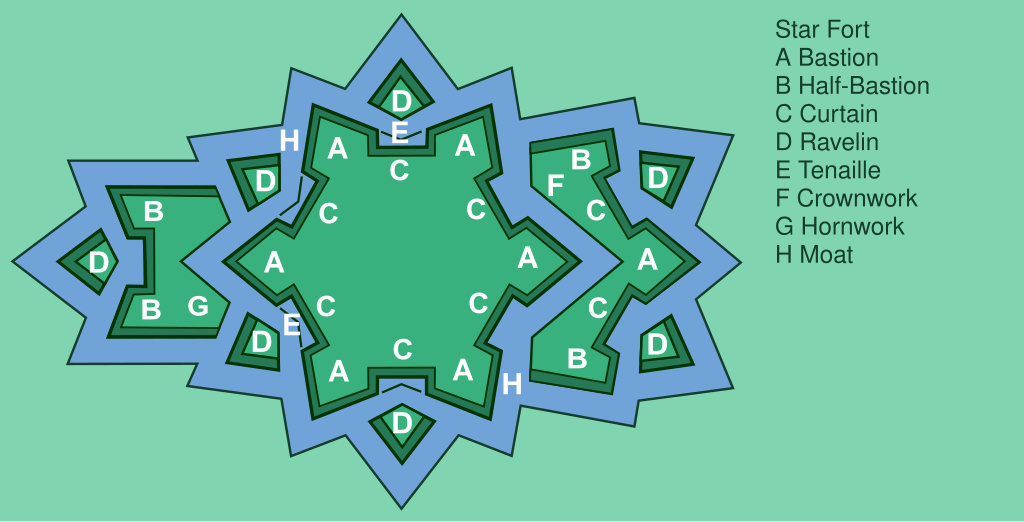
But we can protect the curtain further, and further complicate the attack with outworks [Wiki], effectively little mini-bastions projecting off of the main wall which both provide advanced firing positions (which do not provide access to the fort and so which can be safely abandoned if necessary) and physically obstruct the curtain wall itself from enemy fire. The most basic of these was a ravelin (also called a “demi-lune”), which was essentially a “flying” bastion – a triangular earthwork set out from the walls. Ravelins are almost always hollow (that is, the walls only face away from the fort), so that if attackers were to seize a ravelin, they’d have no cover from fire coming from the main bastions and the curtain wall.
And now, unlike the Modern Major-General, you know what is meant by a ravelin … but are you still, in matters vegetable, animal and mineral, the very model of a modern Major-General?
But we can take this even further (can you tell I just love these damn forts?). A big part of our defense is developing fire from our bastions with our own cannon to force back enemy artillery. But our bastions are potentially vulnerable themselves; our ravelins cover their flanks, but the bastion faces could be battered down. We need some way to prevent the enemy from aiming effective fire at the base of our bastion. The solution? A crownwork. Essentially a super-ravelin, the crownwork contains a full bastion at its center (but lower than our main bastion, so we can fire over it), along with two half-bastions (called, wait for it, “demi-bastions”) to provide a ton of enfilade fire along the curtain wall, physically shielding our bastion from fire and giving us a forward fighting position we can use to protect our big guns up in the bastion. A smaller version of the crownwork, called a hornwork can also be used: this is just the two half-bastions with the full bastion removed, often used to shield ravelins (so you have a hornwork shielding a ravelin shielding the curtain wall shielding the fort). For good measure, we can connect these outworks to the main fort with removable little wooden bridges so we can easily move from the main fort out to the outworks, but if the enemy takes an outwork, we can quickly cut it off and – because the outworks are all made hollow – shoot down the attackers who cannot take cover within the hollow shape.
An ideal form of a bastion fortress to show each kind of common work and outwork.
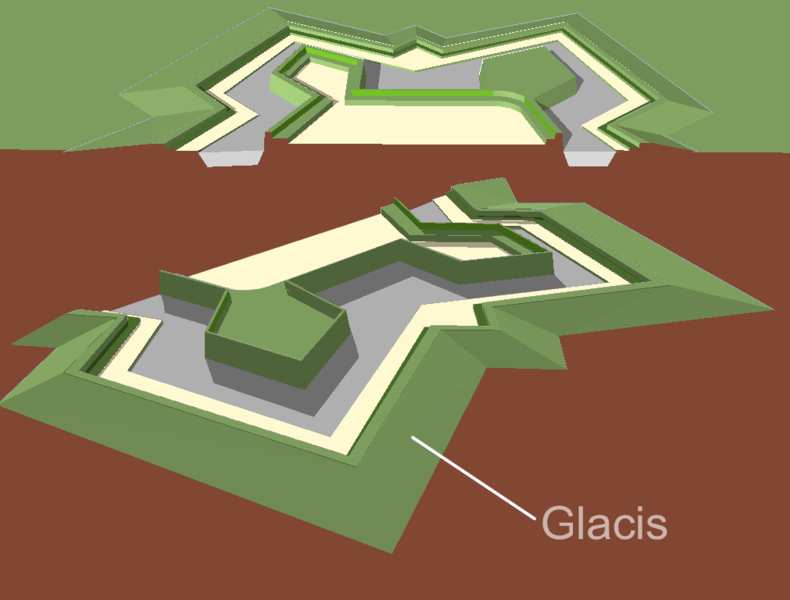
Drawing by Francis Lima via Wikimedia Commons.We can also do some work with the moat. By adding an earthwork directly in front of it, which arcs slightly uphill, called a glacis, we can both put the enemy at an angle where shots from our wall will run parallel to the ground, thus exposing the attackers further as they advance, and create a position for our own troops to come out of the fort and fire from further forward, by having them crouch in the moat behind the glacis. Indeed, having prepared, covered forward positions (which are designed to be entirely open to the fort) for firing from at defenders is extremely handy, so we could even put such firing positions – set up in these same, carefully mathematically calculated angle shapes, but much lower to the ground – out in front of the glacis; these get all sorts of names: a counterguard or couvreface if they’re a simple triangle-shape, a redan if they have something closer to a shallow bastion shape, and a flèche if they have a sharper, more pronounced face. Thus as an enemy advances, defending skirmishers can first fire from the redans and flèches, before falling back to fire from the glacis while the main garrison fires over their heads into the enemy from the bastions and outworks themselves.
A diagram showing a glacis supporting a pair of bastions, one hollow, one not.
Diagram by Arch via Wikimedia Commons.At the same time, a bastion fortress complex might connect multiple complete circuits. In some cases, an entire bastion fort might be placed within the first, merely elevated above it (the term for this is a “cavalier“) so that both could fire, one over the other. Alternately, when entire cities were enclosed in these fortification systems (and that was common along the fracture zones between the emerging European great powers), something as large as a city might require an extensive fortress system, with bastions and outworks running the whole perimeter of the city, sometimes with nearly complete bastion fortresses placed within the network as citadels.
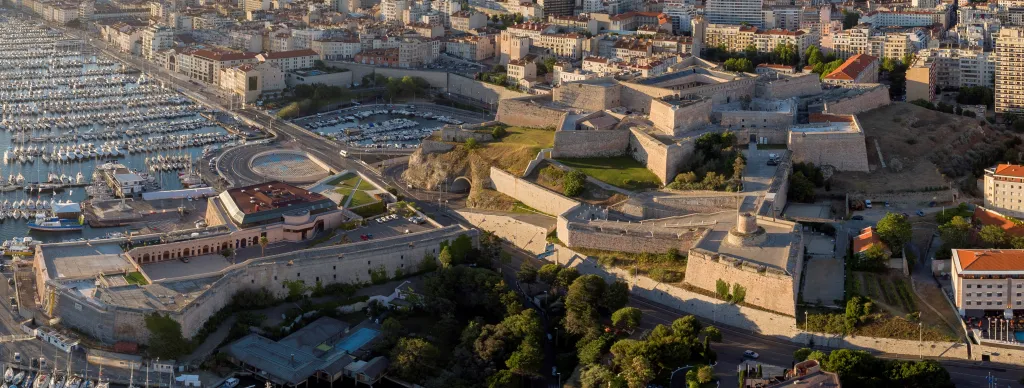
Fort Saint-Nicolas, which dominates the Old Port of Marseille. The fort forms part of a system with the low outwork you see here and also an older refitted castle, Fort Saint-Jean, on the other side of the harbor.
Photo via Wikimedia Commons.All of this geometry needed to be carefully laid out to ensure that all lines of approach were covered with as much fire as possible and that there were no blindspots along the wall. That in turn meant that the designers of these fortresses needed to be careful with their layout: the spacing, angles and lines all needed to be right, which required quite a lot of math and geometry to manage. Combined with the increasing importance of ballistics for calculating artillery trajectories, this led to an increasing emphasis on mathematics in the “science of warfare”, to the point that some military theorists began to argue (particularly as one pushes into the Enlightenment with its emphasis on the power of reason, logic and empirical investigation to answer all questions) that military affairs could be reduced to pure calculation, a “hard science” as it were, a point which Clausewitz (drink!) goes out of his way to dismiss (as does Ardant du Picq in Battle Studies, but at substantially greater length). But it isn’t hard to see how, in the heady centuries between 1500 and 1800 how the rapid way that science had revolutionized war and reduced activities once governed by tradition and habit to exercises in geometry, one might look forward and assume that trend would continue until the whole affair of war could be reduced to a set of theorems and postulates. It cannot be, of course – the problem is the human element (though the military training of those centuries worked hard to try to turn men into “mechanical soldiers” who could be expected to perform their role with the same neat mathmatical precision of a trace italienne ravelin). Nevertheless this tension – between the science of war and its art – was not new (it dates back at least as far as Hellenistic military manuals) nor is it yet settled.
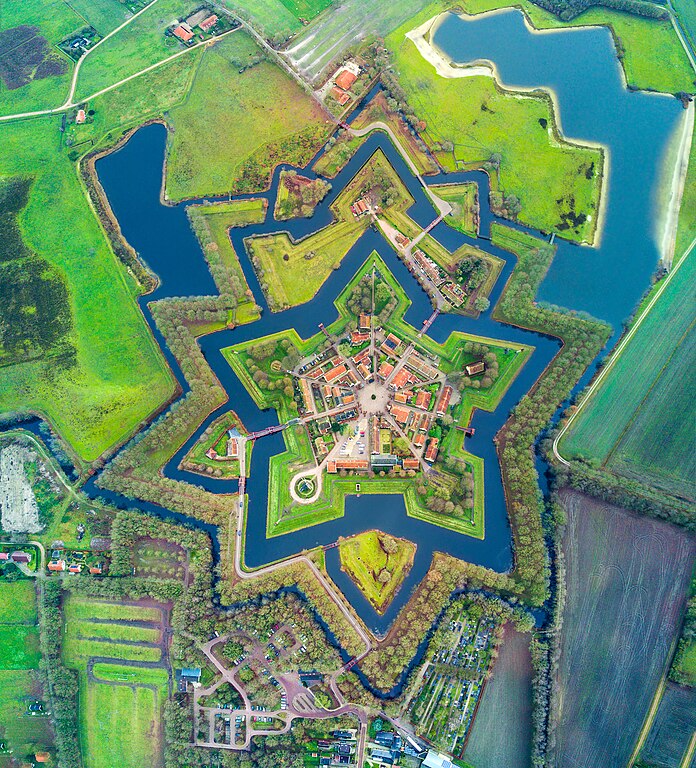
An aerial view of the Bourtange Fortress in Groningen, Netherlands. Built in 1593, the fort has been restored to its 1750s configuration, seen here.
Photo by Dack9 via Wikimedia Commons.But coming back to our fancy forts, of course such fortresses required larger and larger garrisons to fire all of the muskets and cannon that their firepower oriented defense plans required. Fortunately for the fortress designers, state capacity in Europe was rising rapidly and so larger and larger armies were ready to hand. That causes all sorts of other knock on effects we’re not directly concerned with here (but see the bibliography at the top). For us, the more immediate problem is, well, now we’ve built one of these things … how on earth does one besiege it?
Bret Devereaux, “Collections: Fortification, Part IV: French Guns and Italian Lines”, A Collection of Unmitigated Pedantry, 2021-12-17.
November 27, 2024
QotD: The Great Library and its competitors
The Ptolemies were not the only successors to Alexander who built a Mouseion with a library; their Seleucid rivals in Syria also built one in Antioch in the reigns of Antiochus IX Eusebes (114-95 BC) or Antiochus X Philopater (95-92 BC). Roman aristocrats and rulers also included the establishment of substantial libraries as part of their civic service. Julius Caesar had intended to establish a library next to the Forum in Rome but this was ultimately achieved after his death by Gaius Asinius Pollio (75 BC – 4 AD), a soldier, politician and scholar who retired to a life of study after the tumults of the Civil Wars. Augustus established the Palatine Library in the Temple of Apollo and founded another one in the Portus Octaviae, next to the Theatre of Marcellus at the southern end of the Field of Mars. Vespasian established one in the Temple of Peace in 70 AD, but probably the largest of the Roman libraries was that of Trajan in his new forum beside the famous column that celebrates his Dacian wars. As mentioned above, this large building probably contained around 20,000 scrolls and had two main chambers – one for Greek and the other for Latin authors. Trajan’s library also seems to have established a design and layout that would be the model for libraries for centuries: a hall with desks and tables for readers with books in niches or shelves around the walls and on a mezzanine level. Libraries also came to be established in Roman bath complexes, with a very large one at the Baths of Caracalla and another at the Baths of Diocletian.
Several of these libraries were substantial. The Library of Celsus at Ephesus was built in c. 117 AD by the son of Tiberius Julius Celsus Polemaeanus in honour of his father, who had been a senator and consul in Rome, and its reconstructed facade is one of the major archaeological features of the site today. It was said to be the third largest library in the ancient world, surpassed only by the great libraries of Pergamon and Alexandria. The Great Library of Pergamon was established by the Attalid rulers of that city state and it was the true rival of the library of the Alexandrian Mouseion. It is said that the Ptolemies were so threatened by its size and the reputation of its scholars that they banned the export of papyrus to Pergamon, causing the Attalids to commission the invention of parchment as a substitute, though this is most likely a legend. What is absolutely clear, however, is that the idea that the Great Library of Alexandria was unique, whether in nature or even in size, is nonsense.
The weird idea that the loss of the Great Library was some kind of singular disaster is at least partially due to the fact that none of the various other great libraries of the ancient world are known to casual readers, so it may be easy for them to assume it was somehow unique. It also seems to stem, again, from the emphasis in popular sources on the mythical immense size of its collection which, as discussed above, is based on a naive acceptance of varied and wildly exaggerated sources. Finally, it seems to stem in no small part from (yet again) Sagan’s influential but fanciful picture of the institution as a distinctively secular hub of scientific research and, by implication, technological innovation.
Tim O’Neill, “The Great Myths 5: The Destruction Of The Great Library Of Alexandria”, History for Atheists, 2017-07-02.
November 26, 2024
QotD: Hesiod’s five ages of man
Hesiod is the seventh century BC management book writer. He didn’t write about digital strategy, but his poems drone on in the earnest monotone of an old-school sociology lecturer who — after years of correcting student papers — decides to try his hand at fine letters. Hesiod is ace at conveying fact, but not at re-inventing it. This makes him a fine chronicler, but not a poet. I cannot imagine anyone reading Works and Days today for anything other than anthropological curiosity.
I don’t remember all eight hundred lines of Works and Days — just five stanzas: one for each of the Five Ages of Men. First came the Golden Age, in which the land was bounteous, the forests were rich with game, and men were decent, happy, and favoured by the gods. But this state of bliss didn’t last. Cracks began to appear during the next generation with the emergence of the Silver Race — small crooks and delinquents who “could not keep from sinning and from wrongdoing one another”. Zeus didn’t like them and eventually killed them off. The third generation, the Bronze Race, managed to be an even greater disgrace, a bunch of hoodlums of great physical strength with “unconquerable arms which grew from their shoulders on their strong limbs.” (I find this image rather powerful. It reminds me of my gym on a Friday night.) Things looked up momentarily during the subsequent Heroic Age, as Zeus created a “god-like race of hero-men called demi-gods”. But everything went definitively, irrevocably tits-up in the fifth and final age: the Iron Age. Land became barren, crops wilted, stock died of disease; men were poor, men were bitter, son betrayed father, neighbour killed neighbour, chaos and treachery ruled.
As a story of decline and fall, it’s a nice one (although I’ve seen better). In terms of literary merit, it’s nowhere near Homer. So why am I harping on Hesiod? (Now do pay attention, as here comes the point of this essay.) The key variable between the time when men were happy and the time when they were not, according to Hesiod, is work. “In the Golden Age,” he writes, men “lived like gods … remote and free from … hard toil …” But in the Iron Age, “men never rest from labour …” Writing about the Iron Age — the age of hard work and misery — Hesiod wrote about his own time, but he also wrote about our time. We live in the Iron Age. It is a sad age. It is the age when people have to work. And work kills the spirit.
Elena Shalneva “Work — the Tragedy of Our Age”, Quillette, 2020-01-29.
November 25, 2024
QotD: Le Corbusier
But most bureaucrats aren’t evil, just ignorant … and as Scott shows, this ignorance isn’t really their fault. They don’t know what they don’t know, because they can’t know. Very few bureaucratic cock-ups are as blatant as Chandigarh, where all anyone has to do is look at pictures for five minutes to conclude “you couldn’t pay me enough to move there”.
Severian, “The Finger is Not the Moon”, Rotten Chestnuts, 2021-09-14.
November 24, 2024
QotD: Wood
Joseph Lstiburek, Builder’s Guide to Cold Climates, 2000.
November 23, 2024
How the US Paranoia of Leftism was Born
World War Two
Published 21 Nov 2024Elizabeth Bentley’s defection in 1945 didn’t just expose a Soviet spy network — it fueled America’s second Red Scare and a wave of anti-communist paranoia. Her revelations about Soviet infiltration within the U.S. government became a catalyst for McCarthyism, reshaping American politics and society in an era defined by fear and suspicion.
(more…)
QotD: Nietzsche’s message
H.L. Mencken, “Transvaluation of Morals”, The Smart Set, 1915-03.
November 22, 2024
QotD: Pre-modern armies on the move
(As an aside: one my enduring frustrations is the tendency of pre-modern strategy games to represent most flat areas as “plains” of grassland often with a separate “farmland” terrain type used only in areas of very dense settlement. But around most of the Mediterranean, most of the flat, cleared land at lower elevations would have been farmland, with all of the obstructions and complications that implies; rolling grasslands tend to be just that – uplands too hilly for farming.)
The other problem is pathfinding and geolocation. Figuring out where you off-road overland with just a (highly detailed) map and a compass is sufficiently difficult that it is a sport (Orienteering). Prior to 1300, armies in the broader Mediterranean world were likely to lack both; the compass (invented in China) arrives in the Mediterranean in the 1300s and detailed topographical maps of the sort that hikers today might rely on remained rare deep into the modern period, especially maps of large areas. Consequently it could be tricky to determine an army’s exact heading (sun position could give something approximate, of course) or position. Getting lost in unfamiliar territory was thus a very real hazard. Indeed, getting lost in familiar territory was a real hazard: Suetonius records that Julius Caesar, having encamped not far from the Rubicon got lost trying to find it, spent a whole night wandering trying to locate it (his goal being to make the politically decisive crossing with just a few close supporters in secrecy first before his army crossed). In the end he had to find a local guide to work his way back to it in the morning (Suet. Caes. 31.2). So to be clear: famed military genius Julius Caesar got lost trying to find a 50 mile long river only about 150 miles away from Rome when he tried to cut cross-country instead of over the roads.
Instead, armies relied on locals guides (be they friendly, bought or coerced) to help them find their way or figure out where they were on whatever maps they could get together. Locals in turn tend to navigate by landmarks and so are likely to guide the army along the paths and roads they themselves use to travel around the region. Which is all as well because the army needs to use the roads anyway and no one wants to get lost. The road and path network thus becomes a vital navigational aid: roads and paths both lead to settlements full of potential guides (to the next settlement) and because roads tend to connect large settlements and large settlements tend to be the objectives of military campaigns, the road system “points the way”. Consequently, armies rarely strayed off of the road network and were in most cases effectively confined to it. Small parties might be sent out off of the road network from the main body, but the main body was “stuck” on the roads.
That means the general does not have to cope with an infinitely wide range of maneuver possibilities but a spiderweb of possible pathways. Small, “flying columns” without heavy baggage could use minor roads and pathways, but the main body of the army was likely to be confined to well-traveled routes connecting large settlements.
Bret Devereaux, “Collections: Logistics, How Did They Do It, Part III: On the move”, A Collection of Unmitigated Pedantry, 2022-08-12.
November 21, 2024
QotD: The 1965 Immigration Act
Caldwell’s book is far too nuanced and expansive to cover here. But he identifies key moments and key changes. The 1965 Immigration Act was the beginning of a huge experiment in human history. It was complemented by open bipartisan-elite toleration of mass undocumented immigration across the southern border. And civil rights became something other than ending racial discrimination by the state: It became a regime of ending discrimination by individuals in economic and social life; then it begot affirmative action, in which race played an explicit part in an individual’s chance of getting into college; and it culminated in the social-justice agenda, which would meaningfully do away with the American concept of individual rights and see it replaced by a concept of racial group rights. Caldwell sees the last 50 years as a battle between two rival constitutions: one dedicated to freedom, the other to equality of outcomes, or “equity.” And I think he is right to see the former as worth fighting for.
But how do we get out of this trap? That’s where the depression sinks in. Neither Caldwell nor Klein see a way back to a common weal and a common good. Ezra offers some technical corrections — ending the Electoral College, the filibuster, and winner-takes-all voting. And they might help, although their potential unintended consequences should be carefully considered. Then he recommends meditation to control our own primal instincts — a role that Christianity traditionally held. (I don’t disagree with Ezra on the benefits of meditation, but it’s hardly a game-changer in America in 2020.) Caldwell proposes something far more drastic: a repeal of the 1964 Civil Rights Act. Yes, you read that right. The proposal’s perversity matches its impossibility — and it’s buried in one sentence on the penultimate page of the book.
So much of Caldwell’s polemical history is fresh air; but the bleakness of its reactionary mood reveals how tribal Caldwell has become. He can barely eke out a few sentences reluctantly acknowledging some of the good things that the last 50 years have brought — in the lives of many women, in the prospects for African-Americans, in the dignity of homosexuals. He never acknowledges that Obama actually stood a chance of healing racial divides, if the GOP hadn’t demonized him from the start. And as an old friend of Chris’s, I know him to be a more gracious and humane person than this polemic might, at times, suggest. But that such a good man has gotten caught up in polarization and tribalism and such a brilliant man sees no hope for a peaceful resolution merely reveals how deep our problem is.
I have a smidgen more optimism. I see in the long-delayed backlash to the social-justice movement an inkling of a new respect for individual and creative freedom and for the old idea of toleration rather than conformity. I see in the economic and educational success of women since the 1970s a possible cease-fire in the culture wars over sex. I see most homosexuals content to live out our lives without engaging in an eternal Kulturkampf against the cis and the straight. Race? Alas, I see no way forward but a revival of Christianity, of its view of human beings as “neither Jew nor Gentile, neither slave nor free, nor is there male and female, for you are all one in Christ Jesus”. This means such a transcendent view of human equality that it does not require equality of outcomes to see equal dignity and worth.
Yes, I’m hoping for a miracle. But at this point, what else have we got?
Andrew Sullivan, “America Needs A Miracle”, New York, 2020-01-31.
November 20, 2024
QotD: The Chads, the Staceys, and the Incels
These boys have their own vocabulary and belief systems. Pretty girls (Staceys) all sleep with the same few Alpha men (Chads). The Staceys ride the Cock Carousel, ie, have sex with the same few Chads. All this sluttish behaviour gives the Staceys something called A Thousand Cock Stare.
It is a grim world, in which women are evil and manipulative, and hated both for being sluts and for being virgins. It is a world in which pictures of pretty girls with their pet dogs are unbelievably sinister. These boys choose to live in this bleak world. They are culpable. But, if you tell all young, white boys that they are damned, why should they not behave as if they are damned?
A society which does not allow for people to atone, to be redeemed, and to be judged on their intent and actions is a miserable place. Most people interact with each other without antagonism most of the time. We should start being a bit more forgiving to each other, ditch the Puritanism and learn to cherish the well-meaning stumble towards decency. Even if, sometimes, we fall.
Antonia Senior, “Identity politics is Christianity without the redemption”, UnHerd, 2020-01-20.


