
… the basics of the confidence game have not changed all that much with the new technology. The confidence man gets his name because he is adept at winning the confidence of the mark. The mark then lowers his defenses and foolishly trusts the con man, rather than his own natural skepticism. The mark is manipulated into thinking the con man is a friend or at least someone who can be trusted. The con man then uses that trust to exploit the mark.
The way in which the con men does this is by flattery. The mark trusts the con man, because the con man finds small ways to confirm the beliefs of the mark. The adept grifter will be a good listener and pick up the little things that the mark thinks are important, like religious beliefs or opinions about personal matters. Seemingly out of the blue, the con man will express those same opinions, which flatters the mark. After all, everyone likes being told that their private opinions are smart.
That’s something you see with the internet grifters. They often have worn a lot of masks as they seek out on-line audiences. […]
Another aspect of the con that remains constant is how the con man uses his alleged status as a victim to work the mark. Con men will use their mark’s natural empathy to win their confidence. Today that often means claiming the big bad tech companies are censoring them. Alternatively, they will claim evil trolls are haunting their internet activity, causing them harm. The term troll has been changed from meaning someone seeking attention to something almost supernatural.
The Z Man, “Carny Town”, The Z Blog, 2019-12-29.
April 29, 2025
April 28, 2025
QotD: “Redpill poisoning”
Hunter Ash @ArtemisConsort
There is a phenomenon I call redpill poisoning where someone sees through the establishment matrix, but then starts assuming the exact opposite of that narrative is always true. This oneshots a lot of smart people.Absolutely. Among other things, I think this explains why a large minority of conservatives have become suckers for Russian propaganda about the Ukraine war.
I like your term “redpill poisoning” and will adopt it.
ESR, Twitter, 2025-01-25.
April 27, 2025
QotD: Fighting against Japan in the Pacific
And lord knows the Americans took the bait, more than once. If “bait” is really the right word, because if you’ve got no choice … the early campaigns in the Solomons were so legendarily nasty for that reason: You have no choice but to go right up the pipe to seize an objective, and if you do, the enemy has no choice but to go right up the pipe to get it back.
The genius of the later American strategy — and credit where it’s due, few people have a lower opinion of MacArthur than I, but this was brilliant — was to simply go around. Heavy bomber strips are a must, and in the even fewer places in the Pacific that can take heavy bombers, the Americans had no choice but to go right up the chute … but carrier airpower can do a hell of a lot, particularly when it can move about completely unmolested by the enemy. Thus the Americans turned all those guaranteed meat grinders the Japanese had set up for them into big open-air POW camps, without bothering to go in there and force them to surrender (which, of course, they wouldn’t). Have fun starving in your bunkers, boys; we’ll just leave a covering naval detachment, to make sure you can’t evacuate; see you when the war’s over.
Severian, “Strategy”, Founding Questions, 2021-11-21.
April 26, 2025
QotD: “Woke”
Moreover, this monomaniacal need to expose an ever-expanding set of “phobias” in society means that they end up detecting prejudice even where it does not exist. In the absence of evidence of racism the woke have a habit of simply concocting it; hence the continual emphasis on “unconscious bias”, “white privilege” and “institutional power structures”. Such ideas have germinated over many years in academia – particularly in the postmodern branches of critical theory – and have since seeped into the mainstream.
This is why the public is routinely confronted with absurd articles in the media grounded in an extreme form of intersectionality. One, for instance, claims that white women are “evil”, another that white DNA is an “abomination”. Barely a day goes by without some frenzied denunciation of a movie or a television series for its lack of diversity and positive representation, as though the function of the arts is to send a message that accords with identitarian values.
Few members of the public are entirely familiar with the jargon (“cisgender”, “mansplaining”, “toxic masculinity”), but are assured nonetheless that the premises are indisputable. There’s a very good reason why the Catholic Church resisted translating the Bible into the vernacular for so long. Those in power are always threatened when the plebeians start thinking for themselves and asking difficult questions.
Some commentators have recently raised concerns that “woke” has been weaponised by the far right as a slur against anti-racist campaigners. Afua Hirsch, for instance, has claimed in the Guardian that anyone using the word is “likely to be a right-wing culture warrior angry at a phenomenon that lives mainly in their imagination”. This strikes me as particularly odd, given the Guardian‘s own frequent use of the word, including in headlines such as “Can a woke makeover win Barbie and Monopoly new fans?” and “My search for Mr Woke: a dating diary”. Perhaps Hirsch’s colleagues are further to the right than is generally supposed.
Andrew Doyle, “Why I’m anti-woke”, Spiked, 2020-02-04.
April 25, 2025
QotD: Taqiyya
According to sharia, in certain situations, deception – also known as “taqiyya“, based on Quranic terminology – is not only permitted but sometimes obligatory. For instance, contrary to early Christian history, Muslims who must choose between either recanting Islam or being put to death are not only permitted to lie by pretending to have apostatised, but many jurists have decreed that, according to Quran 4:29, Muslims are obligated to lie in such instances.
Origins of taqiyya
As a doctrine, taqiyya was first codified by Shia Muslims, primarily as a result of their historical experience. Long insisting that the caliphate rightly belonged to the prophet Muhammad’s cousin and son-in-law, Ali (and subsequently his descendents), the Shia were a vocal and powerful branch of Islam that emerged following Muhammad’s death. After the internal Islamic Fitna wars from the years 656 AD to 661 AD, however, the Shia became a minority branch, persecuted by mainstream Muslims or Sunnis – so-called because they follow the example or “sunna” of Muhammad and his companions. Taqiyya became pivotal to Shia survival.
Interspersed among the much more numerous Sunnis, who currently make up approximately 90 per cent of the Islamic world, the Shia often performed taqiyya by pretending to be Sunnis externally, while maintaining Shia beliefs internally, as permitted by Quranic verse 16:106. Even today, especially in those Muslim states where there is little religious freedom, the Shia still practice taqiyya. In Saudi Arabia, for instance, Shias are deemed by many of the Sunni majority to be heretics, traitors and infidels and like other non-Sunni Muslims they are often persecuted.
Several of Saudi Arabia’s highest clerics have even issued fatwas sanctioning the killing of Shias. As a result, figures on the Arabian kingdom’s Shia population vary wildly from as low as 1 per cent to nearly 20 per cent. Many Shias living there obviously choose to conceal their religious identity. As a result of some 1,400 years of Shia taqiyya, the Sunnis often accuse the Shias of being habitual liars, insisting that taqiyya is ingrained in Shia culture.
Conversely, the Sunnis have historically had little reason to dissemble or conceal any aspect of their faith, which would have been deemed dishonorable, especially when dealing with their historic competitors and enemies, the Christians. From the start, Islam burst out of Arabia subjugating much of the known world, and, throughout the Middle Ages, threatened to engulf all of Christendom. In a world where might made right, the Sunnis had nothing to apologise for, much less to hide from the “infidel”.
Paradoxically, however, today many Sunnis are finding themselves in the Shias’ place: living as minorities in Western countries surrounded and governed by their traditional foes. The primary difference is that, extremist Sunnis and Shia tend to reject each other outright, as evidenced by the ongoing Sunni-Shia struggle in Iraq, whereas, in the West, where freedom of religion is guaranteed, Sunnis need only dissemble over a few aspects of their faith.
Articulation of taqiyya
According to the authoritative Arabic text, Al-Taqiyya Fi Al-Islam: “Taqiyya [deception] is of fundamental importance in Islam. Practically every Islamic sect agrees to it and practices it. We can go so far as to say that the practice of taqiyya is mainstream in Islam, and that those few sects not practicing it diverge from the mainstream … Taqiyya is very prevalent in Islamic politics, especially in the modern era.”
The primary Quranic verse sanctioning deception with respect to non-Muslims states: “Let believers not take for friends and allies infidels instead of believers. Whoever does this shall have no relationship left with Allah – unless you but guard yourselves against them, taking precautions.” (Quran 3:28; see also 2:173; 2:185; 4:29; 22:78; 40:28.)
Al-Tabari’s (838-923 AD) Tafsir, or Quranic exegeses, is essentially a standard reference in the entire Muslim world. Regarding 3:28, he wrote: “If you [Muslims] are under their [infidels’] authority, fearing for yourselves, behave loyally to them, with your tongue, while harbouring inner animosity for them … Allah has forbidden believers from being friendly or on intimate terms with the infidels in place of believers – except when infidels are above them [in authority]. In such a scenario, let them act friendly towards them.”
Regarding 3:28, the Islamic scholar Ibn Kathir (1301-1373) wrote: “Whoever at any time or place fears their [infidels’] evil, may protect himself through outward show”.
As proof of this, he quotes Muhammad’s companions. Abu Darda said: “Let us smile to the face of some people while our hearts curse them”. Al-Hassan said: “Doing taqiyya is acceptable till the day of judgment [in perpetuity]”.
Other prominent ulema, such as al-Qurtubi , al-Razi, and al-Arabi have extended taqiyya to cover deeds. Muslims can behave like infidels – from bowing down and worshipping idols and crosses to even exposing fellow Muslims’ “weak spots” to the infidel enemy – anything short of actually killing a fellow Muslim.
Raymond Ibrahim, “Islam’s doctrines of deception”, Middle East Forum, 2008-10-01.
April 24, 2025
QotD: The Phalanx
So let’s start with the equipment, formation and fighting style. The older hoplite phalanx was a shield wall, using the large, c. 90cm diameter aspis and a one-handed thrusting spear, the dory. Only the front rank in a formation like this engaged the enemy, with the rear ranks providing replacements should the front hoplites fall as well as a morale force of cohesion by their presence which allowed the formation to hold up under the intense mental stress of combat. But while hoplites notionally covered each other with their shields, they were mostly engaged in what were basically a series of individual combats. As we noted with our bit on shield walls, the spacing here seems to have been wide enough that while the aspis of your neighbor is protecting you in that it occupies physical space that enemy weapons cannot pass through, you are not necessarily hunkered down shoulder-to-shoulder hiding behind your neighbor’s shield.
The Macedonian or sarisa-phalanx evolves out of this type of combat, but ends up quite different indeed. And this is the point where what should be a sentence or two is going to turn into a long section. The easy version of this section goes like this: the standard Macedonian phalangite (that is, the soldier in the phalanx) carried a sarisa, a two-handed, 5.8m long (about 19ft) pike, along with an aspis, a round shield of c. 75cm carried with an arm and neck strap, a sword as a backup weapon, a helmet and a tube-and-yoke cuirass, probably made out of textile. Officers, who stood in the first rank (the hegemones) wore heavier armor, probably consisting of either a muscle cuirass or a metal reinforced (that is, it has metal scales over parts of it) tube-and-yoke cuirass. I am actually quite confident that sentence is basically right, but I’m going to have to explain every part of it, because in popular treatments, many outdated reconstructions of all of this equipment survive which are wrong. Bear witness, for instance, to the Wikipedia article on the sarisa which gets nearly all of this wrong.
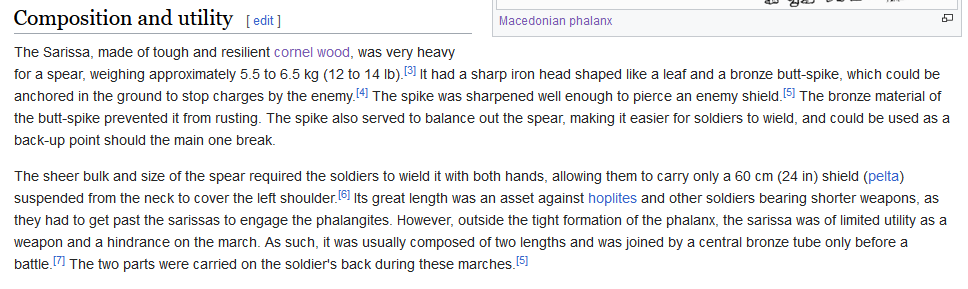
Wikipedia‘s article on the topic as of January, 2024. Let me point out the errors here.
1) The wrong wood, the correct wood is probably ash, not cornel – the one thing Connolly gets wrong on this weapon (but Sekunda, op. cit. gets right).
2) The wrong weight, entirely too heavy. The correct weight should be around 4kg, as Connolly shows.
3) Butt-spikes were not exclusively in bronze. The Vergina/Aigai spike is iron, though the Newcastle butt is bronze (but provenance, ????)
4) They could be anchored in the ground to stop cavalry. This pike is 5.8m long, its balance point (c. 1.6m from the back) held at waist height (c. 1m), so it would be angled up at something like 40 degrees, so anchoring the butt in the ground puts the head of the sarisa some 3.7m (12 feet) in the air – a might bit too high, I may suggest. The point could be brought down substantially if the man was kneeling, which might be workable. More to the point, the only source that suggests this is Lucian, a second century AD satirist (Dial Mort. 27), writing two centuries after this weapon and its formation had ceased to exist; skepticism is advised.
5) We’ll get to shield size, but assuming they all used the 60cm shield is wrong.
6) As noted, I don’t think these weapons were ever used in two parts joined by a tube and also the tube at Vergina/Aigai was in iron. Andronikos is really clear here, it is a talon en fer and a douille en fer. Not sure how that gets messed up.Sigh. So in detail we must go. Let us begin with the sarisa (or sarissa; Greek uses both spellings). This was the primary weapon of the phalanx, a long pike rather than the hoplite‘s one-handed spear (the dory). And we must discuss its structure, including length, because this is a case where a lot of the information in public-facing work on this is based on outdated scholarship, compounded by the fact that the initial reconstructions of the weapon, done by Minor Markle and Manolis Andronikos, were both entirely unworkable and, I think, quite clearly wrong. The key works to actually read are the articles by Peter Connolly and Nicholas Sekunda.1 If you are seeing things which are not working from Connolly and Sekunda, you may safely discard them.
Let’s start with length; one sees a very wide range of lengths for the sarisa, based in part on the ancient sources. Theophrastus (early third century BC) says it was 12 cubits long, Polybius (mid-second century) says it was 14 cubits, while Asclepiodotus (first century AD) says the shortest were 10 cubits, while Polyaenus (second century AD) says that the length was 16 cubits in the late fourth century.2 Two concerns come up immediately: the first is that the last two sources wrote long after no one was using this weapon and as a result are deeply suspect, whereas Theophrastus and Polybius saw it in use. However, the general progression of 12 to 14 to 16 – even though Polyaenus’ word on this point is almost worthless – has led to the suggestion that the sarisa got longer over time, often paired to notions that the Macedonian phalanx became less flexible. That naturally leads into the second question, “how much is a cubit?” which you will recall from our shield-wall article. Connolly, I think, has this clearly right: Polybius is using a military double-cubit that is arms-length (c. 417mm for a single cubit, 834mm for the double), while Theophrastus is certainly using the Athenian cubit (487mm), which means Theophrastus’ sarisa is 5.8m long and Polybius’ sarisa is … 5.8m long. The sarisa isn’t getting longer, these two fellows have given us the same measurement in slightly different units. This shaft is then tapered, thinner to the tip, thicker to the butt, to handle the weight; Connolly physically reconstructed these, armed a pike troupe with them, and had the weapon perform as described in the sources, which I why I am so definitively confident he is right. The end product is not the horribly heavy 6-8kg reconstructions of older scholars, but a manageable (but still quite heavy) c. 4kg weapon.
Of all of the things, the one thing we know for certain about the sarisa is that it worked.
Next are the metal components. Here the problem is that Manolis Andronikos, the archaeologist who discovered what remains our only complete set of sarisa-components in the Macedonian royal tombs at Vergina/Aigai managed to misidentify almost every single component (and then poor Minor Markle spent ages trying to figure out how to make the weapon work with the wrong bits in the wrong place; poor fellow). The tip of the weapon is actually tiny, an iron tip made with a hollow mid-ridge massing just 100g, because it is at the end of a very long lever and so must be very light, while the butt of the weapon is a large flanged iron butt (0.8-1.1kg) that provides a counter-weight. Finally, Andronikos proposed that a metal sleeve roughly 20cm in length might have been used to join two halves of wood, allowing the sarisa to be broken down for transport or storage; this subsequently gets reported as fact. But no ancient source reports this about the weapon and no ancient artwork shows a sarisa with a metal sleeve in the middle (and we have a decent amount of ancient artwork with sarisae in them), so I think not.3
Polybius is clear how the weapon was used, being held four cubits (c. 1.6m) from the rear (to provide balance), the points of the first five ranks could project beyond the front man, providing a lethal forward hedge of pike-points.4 As Connolly noted in his tests, while raised, you can maneuver quite well with this weapon, but once the tips are leveled down, the formation cannot readily turn, though it can advance. Connolly noted he was able to get a English Civil War re-enactment group, Sir Thomas Glemham’s Regiment of the Sealed Knot Society, not merely to do basic maneuvers but “after advancing in formation they broke into a run and charged”. This is not necessarily a laboriously slow formation – once the sarisae are leveled, it cannot turn, but it can move forward at speed.
The shield used by these formations is a modified form of the old hoplite aspis, a round, somewhat dished shield with a wooden core, generally faced in bronze.5 Whereas the hoplite aspis was around 90cm in diameter, the shield of the sarisa-phalanx was smaller. Greek tends to use two words for round shields, aspis and pelte, the former being bigger and the latter being smaller, but they shift over time in confusing ways, leading to mistakes like the one in the Wikipedia snippet above. In the classical period, the aspis was the large hoplite shield, while the pelte was the smaller shield of light, skirmishing troops (peltastai, “peltast troops”). In the Hellenistic period, it is clear that the shield of the sarisa-phalanx is called an “aspis” – these troops are leukaspides, chalkaspides, argyraspides (“white shields”, “bronze shields”, “silver shields” – note the aspides, pl. of aspis in there). This aspis is modestly smaller than the hoplite aspis, around 75cm or so in diameter; that’s still quite big, but not as big.
Then we have some elite units from this period which get called peltastai but have almost nothing to do with classical period peltastai. Those older peltasts were javelin-equipped light infantry skirmishers. But Hellenistic peltastai seem to be elite units within the phalanx who might carry the sarisa (but perhaps a shorter one) and use a smaller shield which gets called the pelte but is not the pelte of the classical period. Instead, it is built exactly like the Hellenistic aspis – complete with a strap-suspension system suspending it from the shoulder – but is smaller, only around 65cm in diameter. These sarisa-armed peltastai are a bit of a puzzle, though Asclepiodotus (1.2) in describing an ideal Hellenistic army notes that these guys are supposed to be heavier than “light” (psiloi) troops, but lighter than the main phalanx, carrying a smaller shield and a shorter sarisa, so we might understand them as an elite force of infantry perhaps intended to have a bit more mobility than the main body, but still be able to fight in a sarisa-phalanx. They may also have had less body-armor, contributing that the role as elite “medium” infantry with more mobility.6
Finally, our phalangites are armored, though how much and with what becomes really tricky, fast. We have an inscription from Amphipolis7 setting out military regulations for the Antigonid army which notes fines for failure to have the right equipment and requires officers (hegemones, these men would stand in the front rank in fighting formation) to wear either a thorax or a hemithorakion, and for regular soldiers where we might expect body armor, it specifies a kottybos. All of these words have tricky interpretations. A thorax is chest armor (literally just “a chest”), most often somewhat rigid armor like a muscle cuirass in bronze or a linothorax in textile (which we generally think means the tube-and-yoke cuirass), but the word is sometimes used of mail as well.8 A hemithorakion is clearly a half-thorax, but what that means is unclear; we have no ancient evidence for the kind of front-plate without back-plate configuration we get in the Middle Ages, so it probably isn’t that. And we just straight up don’t know what a kottybos is, although the etymology seems to suggest some sort of leather or textile object.9
In practice there are basically two working reconstructions out of that evidence. The “heavy” reconstruction10 assumes that what is meant by kottybos is a tube-and-yoke cuirass, and thus the thorax and hemithorakion must mean a muscle cuirass and a metal-reinforced tube-and-yoke cuirass respectively. So you have a metal-armored front line (but not entirely muscle cuirasses by any means) and a tube-and-yoke armored back set of ranks. I would argue the representational evidence tends to favor this; we most often see phalangites associated with tube-and-yoke cuirasses, rarely with muscle cuirasses (but sometimes!) and not often at all in situations where they have the rest of their battle kit (helmet, shield, sarisa) as required for the regular infantry by the inscription but no armor.
Then there is the “light” reconstruction11 which instead reads this to mean that only the front rank had any body armor at all and the back ranks only had what amounted to thick travel cloaks. Somewhat ironically, it would be really convenient for the arguments I make in scholarly venues if Sekunda was right about this … but I honestly don’t think he is. My judgment rebels against the notion that these formations were almost entirely unarmored and I think our other evidence cuts against it.12
Still, even if we take the “heavy” reconstruction here, when it comes to armor, we’re a touch less well armored compared to that older hoplite phalanx. The textile tube-and-yoke cuirass, as far as we can tell, was the cost-cutting “cheap” armor option for hoplites (as compared to more expensive bell- and later muscle-cuirasses in bronze). That actually dovetails with helmets: Hellenistic helmets are lighter and offer less coverage than Archaic and Classical helmets do as well. Now that’s by no means a light formation; the tube-and-yoke cuirass still offers good protection (though scholars currently differ on how to reconstruct it in terms of materials). But of course all of this makes sense: we don’t need to be as heavily armored, because we have our formation.
Bret Devereaux, “Collections: Phalanx’s Twilight, Legion’s Triumph, Part Ia: Heirs of Alexander”, A Collection of Unmitigated Pedantry, 2024-01-19.
1. So to be clear, that means the useful is P. Connolly, “Experiments with the sarissa” JRMES 11 (2000) and N. Sekunda, “The Sarissa” Acta Universitatis Lodziensis 23 (2001). The parade of outdated scholarship is Andronikos, “Sarissa” BCH 94 (1970); M. Markle, “The Macedonian sarissa” AJA 81 (1977) and “Macedonian arms and tactics” in Macedonia and Greece in Late Classical and Early Hellenistic Times, (1982), P.A. Manti, “The sarissa of the Macedonian infantry” Ancient World 23.2 (1992) and “The Macedonian sarissa again” Ancient World 25.2 (1994), J.R. Mixter, “The length of the Macedonian sarissa” Ancient World 23.2 (1992). These weren’t, to be clear, bad articles, but they are stages of development in our understanding, which are now past.
2. Theophrastus HP 3.12.2. Polyb. 18.29.2. Asclepiodotus Tact. 5.1; Polyaenus Strat. 2.29.2. Also Leo Tact. 6.39 and Aelian Tact. 14.2 use Polybius’ figure, probably quoting him.
3. Also, what very great fool wants his primary weapon, which is – again – a 5.8m long pike that masses around 4kg to be held together in combat entirely by the tension and friction of a c. 20cm metal sleeve?
4. Christopher Matthew, op. cit., argues that Polybius must be wrong because if the weapon is gripped four cubits from the rear, it will foul the rank behind. I find this objection unconvincing because, as noted above and below, Peter Connolly did field drills with a pike troupe using the weapon and it worked. Also, we should be slow to doubt Polybius who probably saw the weapon and its fighting system first hand.
5. What follows is drawn from K. Liampi, Makedonische Schild (1998), which is the best sustained study of Hellenistic period shields.
6. Sekunda reconstructs them this way, without body armor, in Macedonian Armies after Alexander, (2013). I think that’s plausible, but not certain.
7. Greek text is in Hatzopoulos, op. cit.
8. Polyb. 30.25.2. Also of scale, Hdt. 9.22, Paus. 1.21.6.
9. The derivation assumed to be from κοσύμβη or κόσσυμβος, which are a sort of shepherd’s heavy cloak.
10. Favored by Hatzopoulos, Everson and Connolly.
11. Favored by Sekunda and older scholarship, as well as E. Borza, In the Shadow of Olympus (1990), 204-5, 298-9.
12. Representational evidence, but also the report that when Alexander got fresh armor for his army, he burned 25,000 sets of old, worn out armor. Curtius 9.3.21; Diodorus 17.95.4. Alexander does not have 25,000 hegemones, this must be the armor of the general soldiery and if he’s burning it, it must be made of organic materials. I think the correct reading here is that Alexander’s soldiers mostly wore textile tube-and-yoke cuirasses.
April 23, 2025
QotD: Why most westerners aren’t having kids
John: I am a simple man, and prefer simple (preferably materialist) explanations. It’s effective birth control, duh.
Oh, I’m sure all the stuff [Family Unfriendly author Timothy P.] Carney talks about in his book plays some role. All the economic factors and the regulatory factors and the changed social expectations and the lack of sidewalks, and the blah blah blah. But why did those things all happen, all of a sudden? It’s actually very simple — now you can have sex without children necessarily resulting.
The correct way to view all the changes that Carney lists is as a sort of transmission belt that has slowly and inexorably propagated and magnified the effects of the one, very simple technological change that occurred. The story goes something like this: birth control is introduced, but large families are still normative and supported by generations of cultural accretion. So people still have an above-replacement number of kids, because they remember their mothers and grandmothers having 10 or 12 kids, and because society is still basically set up for families. But time passes, and culture gradually shifts to accommodate material reality. Law and economics follow culture. The next generation remembers their parents having 3 or 4, and maybe manages 1 or 2 themselves. The fewer people are having lots of kids, the less of a constituency there is for having lots of kids, and the harder society makes it, further turning the screws on marginal parents.
One objection from those who disdain the simple, materialist explanation is that the change didn’t happen overnight. The transmission belt theory nicely addresses this — it doesn’t happen overnight because societies have culture, and culture has inertia. Even insanely messed-up cultures that are inimical to human flourishing are hard to change. A residual, pro-childrearing cultural hangover can last for a while after the facts on the ground shift, and means people keep having babies for a little while. But it can’t last forever. Eventually it crumbles.
The other big objection to this theory, one Carney raises himself, is that if you do surveys of people, especially women, they report having fewer children than they want. So, the argument goes, it can’t just be birth control, because if it were people would have all the kids they want. But the answer to this is so obvious I’m shocked it isn’t apparent to Carney. People have high time-preference. People procrastinate. People are really bad at doing things which are hard in the short-term but make you happy in the long-term. The great thing about unprotected sex is that it connects your short-term and long-term happiness. As soon as you have the option to not have a baby right now, this time, it’s awfully tempting to say: “you know, I totally want all the diapers and spit-up eventually, but not this time, maybe next time”. In other words, people only reach the actual number of children they want via happy accidents or, in the old days, by having all thoughts of long-term consequences banished by good old-fashioned lust. This is literally why evolution made sex fun. The position of having to make an affirmative decision to have a baby is completely unnatural, and sometimes I’m amazed that anybody does it at all.
So you wind up with people like the friend I mentioned at the end of this book review (who, by the way, a year and a half later is still no closer to having a baby). Desperately wanting a child, sort of, but too neurotic or hesitant or conflicted or something to do it. In the old days, it would have been simpler, because they wouldn’t have had a choice. Biology would have made the decision for them, and a few years later they’d be happily bouncing a baby on their knee (or miserably bouncing a baby, whatever, the point is they’d have a baby). I really think that’s all there is to it. What truly blows my mind is that Carney wrote an entire book about this stuff while barely mentioning birth control (and only discussing its second-order cultural effects when he did). Presumably he had orders from his Jesuit masters to avoid the topic lest his cover be blown.
Jane and John Psmith, “JOINT REVIEW: Family Unfriendly, by Timothy P. Carney”, Mr. and Mrs. Psmith’s Bookshelf, 2024-10-14.
April 22, 2025
QotD: Fear, uncertainty, and doubt from the Reagan era
“There is, for instance, enough water in the planet to drown everyone four thousand times; there are enough matches to set fire to every wooden building; enough kitchen knives to murder all the husbands of the world; enough hairspray (if drunk) to poison all their wives; enough pillows to smother the entire population of Asia; enough pencils to put out everyone’s eyes; enough fishbones to choke the combined population of France and Italy; enough ties, belts, suspenders, and pyjama draw strings to hang everyone over the age of forty; enough cigarettes (if eaten) to make everyone in Africa south of the Sahara throw up; enough stairs for all the toddlers in the world to fall down; enough statues to crush the inhabitants of the fourteen largest cities in the American Midwest; enough piano wire to garrot three-quarters of the population of Roumania; enough frozen lamb chops to club to death the entire Scottish aristocracy.”
Granted, the weight of human suffering. Granted, that we all progress to biological death, after a brief illusion of invincibility. But would it be entirely irresponsible, to dance our way through the interim? Even while the vultures are circling in the sky?
David Warren, “Be afraid, be very afraid”, Essays in Idleness, 2020-04-14.
April 21, 2025
Bonus QotD: Pierre Poilievre
However, this widespread dissatisfaction has so far failed to coalesce into any meaningful populist insurgency opposing the Laurentian elite. Until recently, the leader of Canada’s Conservative Party, Pierre Poilievre, was coasting towards an easy electoral landslide on the back of this simmering popular anger, with his primary and indeed only selling point being that he is not Justin Trudeau. That is not to say that he is terribly different from Justin Trudeau. For American readers, Poilievre can be best described as vaguely reminiscent of Pete Buttigieg, with politics a hair to the right of the left of the right of Buttigieg’s left.
On a policy level the Conservatives are practically identical to the liberals; indeed, on immigration, after the LPC was forced by overwhelming weight of public opinion to slightly reduce the rate at which they lavished student visas and temporary foreign worker visas on their clients, Poilievre’s Conservatives essentially allowed the Liberals to outflank them to the right on the immigration issue, despite mass deportations being a very clear electoral winner.
Only very recently did Poilievre finally pledge to reduce immigration to “only” a quarter of a million a year … still a far cry from the clear necessity to reverse the flood that Trudeau and the rest of his World Economic Forum Young Global Leader alumni unleashed on the country.
John Carter, “Maple Maidan”, Postcards From Barsoom, 2025-02-15.
QotD: Thomas Hobbes’ view of the “state of nature” in Leviathan
The idea of “natural rights” was nothing new, of course. It goes back to at least Aristotle; Thomism and the whole medieval Scholastic schmear is incomprehensible without it. But Aristotle lived in a pre-Christian world, and Aquinas in a monolithically Catholic one. Both would find the idea of two sets of believers going to the hilt at each other over different versions of the same god incomprehensible. But that was the reality in Hobbes’s day, and it was real enough to reduce parts of Germany to cannibalism — the best modern estimates put casualties from the Thirty Years’ War at World War I levels proportional to population. That simply couldn’t go on, especially with the infidel Turk hammering at the gates.
Thus Hobbes decided to write God out of the picture. There’s lots of debate over Hobbes’s personal religious beliefs, if any; ranging from “he was a sincere, if somewhat unorthodox, Anglican” to “he was a raging atheist”. It doesn’t matter for our purposes. All we need to know is: because appeal to Scripture couldn’t end in anything but more bloodshed, perforce political legitimacy must be secularized, and the old concept of “natural rights” seemed to be the answer. Do we have rights just by virtue of being human, and if so, what are they?
Thus the “state of nature”. Hobbes was always quite clear that this was a thought experiment, not a statement about historical anthropology. His employer, the Cavendish family, the Earls (later Dukes) of Devonshire, were investors in the Virginia Company, and we believe Hobbes acted on their behalf in some capacity with the Company. So he knew better than anyone that the North American Indians weren’t in the state of nature (as he semi-jokingly suggested in Leviathan). Only semi-jokingly, though, because […] it was a real question back in the 1500s just what authority, if any, the conquistadores had to overthrow the native regimes in New Spain. Cortes and the boys might’ve laughed when the Requirimiento was read out, but they nonetheless felt compelled to do it, to legally cover their monarchs’ asses.
From the perspective of post-Hobbes political philosophy, it’s an easy answer. Montezuma was legitimately ruler of the Aztecs, as they, the Aztecs, had gotten out of the state of nature the way everyone else does: Via the “social contract” (recall that Hobbes himself doesn’t use this term). But since international relations remain in the state of nature, by definition, that’s all the justification the Spaniards would’ve needed. That Fernando and Isabella would’ve cheerfully burnt Hobbes at the stake is ironic, Alanis-level at least, but they were practical people; they’d be happy to use his arguments
Severian, “Range Finding III: Natural Law”, Founding Questions, 2021-11-23.
April 20, 2025
QotD: “Hate speech”
This is why they balk and protest when the words free speech are used against them. They detest the idea that they are enemies of liberty. But of course that is precisely what they are. Just consider that nonsensical chant “Hate speech is not free speech”. There are two profound moral problems with this idiotic tautology. The first is that, actually, even genuinely hateful speech, including racist gibberish and misogynistic blather, should be free speech. By its very definition freedom of speech should extend to all speech, even speech we detest. And secondly, “hate speech” has become a slippery, amorphous category that now covers not only foul old nonsense like Holocaust denial, but also trans-sceptical feminism, criticism of Islam, opposition to mass immigration, and so on. “Hate speech” really means thoughtcrime. It is an utterly ideological category used by the cultural and intellectual elites to demonise and censor ideas, beliefs and moral convictions they disapprove of. The war on “hate speech” is the new war on heresy, on free-thinking, on minority opinion, on challenging beliefs. It is blatant censorship.
The illiberal liberals’ conflation of genuine hatred with moral opinion, all of which then gets cynically collapsed under the name of “hate speech”, was beautifully captured in an exchange on the BBC’s Politics Live yesterday. Pushing back against the FSU’s Inaya Folarin Iman, Baroness Kennedy arrogantly predicted that the FSU would be embraced by “racists … people who hate homosexuals, who hate trans people, [and] people … who have hostile views towards Islam”. Hold on. One of these things is not like the others. What is wrong with having hostile views on Islam? Is hostility towards a powerful world religion now a form of “hate speech”? Yes, it is. Kennedy’s conflation of criticism of Islam with racism and homophobia perfectly encapsulated the way in which “hate speech” is now used to police not only genuinely hateful ideas, but also blasphemy against religious ideas. Even that key freedom human beings fought so hard for – the right to mock gods and prophets and religious ideology – is now threatened by the censorious ideology of “hate speech”.
Brendan O’Neill, “Why we must win the fight for free speech”, Spiked, 2020-02-26.
April 19, 2025
QotD: Allied air and sea operations won WWII
The Allies won the war by using air power to destroy the German and Japanese capacity both to produce military equipment and to transport it to the battlefield. By 1944-45, the Germans and Japanese could not use their economies to arm and supply their armies on the battlefield, leading to their inevitable defeat.
In the European war, American and British airpower: (a) directly destroyed a significant amount of productive capacity, (b) rendered remaining capacity far less efficient, (c) made it impossible for the Germans to defeat western ground forces, and (d) compelled the Germans to waste tremendous resources on air defense and exorbitant, ultimately ineffective vengeance weapons.
In the Pacific, the United States used carrier-based airpower, submarines, and bomber-deployed mines to isolate Japan from the resources of the empire it conquered in 1941-42. American bombers also directly destroyed factories and transportation systems, leading to similar levels of economic dysfunction as in Germany.
Anonymous, “Your Book Review: How the War Was Won“, Astral Codex Ten, 2024-08-09.
April 18, 2025
QotD: Literature in (and after) the late Western Roman Empire
Well, no.
Here I think the problem is the baseline we assess this period against. Most people are generally aware that the Greeks and Romans wrote a lot of things and that we have relatively few of them. Even if we confine ourselves only to very successful, famous Greek and Roman literature, we still only have perhaps a low single-digit percentage of it, possibly only a fraction of a percent of it. In our post-printing-press and now post-internet world, famous works of literature do not simply vanish, generally and it is intuitive to assume that all of these lost works must have been the result of some catastrophe or intentional sabotage.
I am regularly, for instance, asked how I feel about the burning of the Library of Alexandria. The answer is … not very much. The library burned more than once and by the time it did it was no longer the epicenter of learning in the Mediterranean world. Instead, the library slowly declined as it became less unique because other libraries amassed considerable collections. There was no great, tragic moment where countless works were all lost in an instant. That’s not how the chain of transmission breaks. Because a break in the chain of transmission requires no catastrophe – it merely requires neglect.
The literature of the Greeks and Romans (and the rest of the ancient iron age Mediterranean) were largely written on papyrus paper, arranged into scrolls. The problem here is that papyrus is quite vulnerable to moisture and decay; in the prevailing conditions in much of Europe papyrus might only last a few decades. Ancient papyri really only survive to the present in areas of hard desert (like Egypt, conveniently), but even in antiquity, books written on papyrus would have been constantly wearing out and needing to be replaced.
Consequently, it didn’t require anyone going out and destroying books to cause a break in the chain of transmission: all that needed to happen was for the copying to stop, even fairly briefly. Fortunately for everyone, Late Antiquity was bringing with it a new writing material, parchment, and a new way of putting it together, the codex or book. The transition from papyrus to parchment begins in the fourth century, but some books are still being produced in papyrus in the 7th century, particularly in the Eastern Mediterranean. Whereas papyrus is a paper made of papyrus stalks pressed together, parchment is essentially a form of leather, cleaned, soaked in calcium lye and scraped very thin. The good news is that as a result, parchment lasts – I have read without difficulty from 1200 year old books written on parchment (via microfilm) and paged through 600 year old books with my own hands. Because making it requires animal hide, parchment was extremely expensive (and still is) but its durability is a huge boon to us because it means that works that got copied onto parchment during the early middle ages often survive on that parchment down to the present.
But of course that means that the moment of technological transition from short-lived papyrus to long-lasting parchment was always going to be the moment of loss in transition: works that made it to parchment would largely survive to the present, while works that were not copied in that fairly narrow window (occupying Late Antiquity and the Early Middle Ages) would be permanently lost. And that copying was no simple thing: it was expensive and slow. The materials were expensive, but producing a book also required highly trained scribes (often these were monks) who would hand copy, letter by letter, the text for hundreds of pages. And, for reasons we’ll talk about later in this series, the resources available for this kind of copying would hit an all-time-low during the period from the fifth to the seventh centuries – this was expensive work for poor societies to engage in.
And here it is worth thus stopping to note how exceptional a moment of preservation this period is. The literary tradition of Mediterranean antiquity represents the oldest literary tradition to survive in an unbroken line of transmission to the present (alongside Chinese literature). The literary traditions of the Bronze Age (c. 3000-1200 BC and the period directly before antiquity broadly construed) were all lost and had to be rediscovered, with stone and clay tablets recovered archaeologically and written languages reconstructed. The Greeks and Romans certainly made little effort to preserve the literature of those who went before them!
In that context, what is actually historically remarkable here is not that the people of Late Antiquity and the Early Middle Ages lost some books – books had always been being lost, since writing began – but that they saved some books. Never before had a literary tradition been saved in this way. Of course these early copyists didn’t always copy what we might like. Unsurprisingly, Christian monks copying books tended to copy a lot more religious texts (both scriptures but also patristic texts). Moreover, works that were seen as important for teaching good Latin (Cicero, Vergil, etc.) tended to get copied more as well, though this is nothing new; the role of the Iliad and the Odyssey in teaching Greek is probably why their manuscript traditions are so incredibly robust. In any event, far from destroying the literature of classical antiquity, it was the medieval Church itself that was the single institution most engaged in the preservation of it.
At the same time, writers in the fifth, sixth and seventh centuries did not stop writing (or stop reading). Much of the literature of this period was religious in nature, but that is no reason to dismiss it (far more of the literature of the Classical world was religious in nature than you likely think, by the by). St. Augustine of Hippo was writing during the fifth century; indeed his The City of God, one of the foundational works of Christian literature, was written in response to the news of the sack of Rome in 410. Isidore of Seville (560-636) was famous for his Etymologies, an encyclopedia of sorts which would form the foundation for much of medieval learning and which in its summaries preserves for us quite a lot of classical bits and bobs which would have otherwise been lost; he also invented the period, comma and colon. Pope Gregory I (540-604) was also a prolific writer, writing hundreds of letters, a collection of four books of dialogues, a life of St. Benedict, a book on the role of bishops, a commentary on the Book of Job and so on. The Rule of St. Benedict, since we’ve brought the fellow up, written in 516 established the foundation for western monasticism.
And while we’ve mostly left the East off for this post, we should also note that writing hardly stopped there. Near to my heart, the emperor Maurice (r. 582-602) wrote the Strategikon, an important and quite informative manual of war which presents, among other things, a fairly sophisticated vision of combined arms warfare. Roman law also survived in tremendous quantities; the emperor Theodosius II (r. 402-450) commissioned the creation of a streamlined law code compiling all of the disparate Roman laws into the Codex Theodosianus, issued in 439. Interestingly, Alaric II (r. 457-507), king of the Visigoths in much of post-Roman Spain would reissue the code as past of the law for his own kingdom in 506 as part of the Breviary of Alaric. Meanwhile, back at Constantinople, Justinian I (r. 527-565) commissioned an even more massive collection of laws, the Corpus Iuris Civilis, issued from 529 to 534 in four parts; a colossal achievement in legal scholarship, it is almost impossible to overstate how important the Corpus Iuris Civilis is for our knowledge of Roman law.
And it is not hard again to see how these sorts of literary projects represented a continuing legacy of Roman culture too (particularly the Roman culture of the third and fourth century), concerned with Roman law, Roman learning and the Roman religion, Christianity. And so when it comes to culture and literature, it seems that the change-and-continuity knight holds the field – there is quite a lot of evidence for the survival of elements of Roman culture in post-Roman western Europe, from language, to religion, to artwork and literature. Now we haven’t talked about social and economic structures (that’s part III), so one might argue we haven’t quite covered all of “culture” just yet, and it is necessary to note that this continuity was sometimes uneven. Nevertheless, the fall of Rome can hardly be said to have been the end of Roman culture.
Bret Devereaux, “Collections: Rome: Decline and Fall? Part I: Words”, A Collection of Unmitigated Pedantry, 2022-01-14.
April 17, 2025
QotD: Explaining mid-century American support of Chiang Kai-Shek and the Republic of China
PR: Because the missionaries in China had decided that it was going to become their great project, channeling that global do gooder impulse that had lain dormant since the end of the Civil War as their Great Cause — the missionaries were the grandchildren of the abolitionists and they took their fanaticism straight from that movement. China was to be “saved” from paganism, Catholicism and colonialism and they formed some kind of proto-NGO, ensuring that their views were made the policy of the government. It is not a coincidence that both Chaing and his wife were Protestant Christian converts (at least nominally) That impulse to “nation build” China into a facsimile of Progresssive Christian America (excluding, of course, the Old Confederacy) is the source of the drive to make their fantasy real, like that Utopian impulse we described the other day that is a bedrock of the Juggalo mindset. To find the roots of the China obsession you have to understand the power of the missionary movement. Nothing to me sums it up better than Kenneth Wherry, who became a big player in the China Lobby, with his mix of naivety, pathological altruism, and religious fervor-
With God’s help, we will lift Shanghai up and up, ever up, until it is just like Kansas City …
[…]
That’s an important point — the Protestants never had the same fervor to make Vietnam or Cuba or even the Philippines (even though it was OUR colony) into Kansas City, because they were either already Catholic or had a minority Catholic elite. China, however, gave them that sweet Protestant fix in making a new China with the “right” kind of Christianity. It’s also why they hated Japan so — Japan had slammed the door on Protestant missionaries pretty hard and their Christian minority (in Nagasaki, ironically) was Catholic.
From the comment thread on “WNF: A Twofer”, Founding Questions, 2025-01-15.
April 16, 2025
QotD: Coffee
Not that I know anyone who does that.
[…]
One of the commenters asked “Canned coffee?”, to which Steve made the obvious response: “I am not a coffee connoisseur. After all, we are talking about medicine, not a beverage.”
Steve H., “Caffeine and Socialism”, Hog On Ice, 2005-08-05.


