
Of all actors, the most offensive to the higher cerebral centers is the one who pretends to intellectuality. His alleged intelligence, of course, is always purely imaginary: no man of genuinely superior intelligence has ever been an actor. Even supposing a young man of appreciable mental powers to be lured upon the stage, as philosophers are occasionally lured into bordellos, his mind would be inevitably and almost immediately destroyed by the gaudy nonsense issuing from his mouth every night. That nonsense enters into the very fiber of the actor. He becomes a grotesque boiling down of all the preposterous characters that he has ever impersonated. Their characteristics are seen in his manner, in his reactions to stimuli, in his point of view. He becomes a walking artificiality, a strutting dummy, a thematic catalogue of imbecilities.
There are, of course, plays that are not wholly nonsense, and now and then one encounters an actor who aspires to appear in them. This aspiration almost always overtakes the so-called actor-manager that is to say, the actor who has got rich and is thus ambitious to appear as a gentleman. Such aspirants commonly tackle Shakespeare, and if not Shakespeare, then Shaw, or Hauptmann, or Rostand, or some other apparently intellectual dramatist. But this is seldom more than a passing madness. The actor-manager may do that sort of thing once in a while, but in the main he sticks to his garbage. […]
It is commonly urged in defense of certain actors that they are forced to appear in that sort of stuff by the public demand for it that appearing in it painfully violates their secret pruderies. This defense is unsound and dishonest. An actor never disdains anything that gets him applause and money; he is almost completely devoid of that aesthetic conscience which is the chief mark of the genuine artist. If there were a large public willing to pay handsomely to hear him recite limericks, or to blow a cornet, or to strip off his underwear and dance a polonaise stark naked, he would do it without hesitation and then convince himself that such buffooning constituted a difficult and elevated art, fully comparable to Wagner’s or Dante’s. In brief, the one essential, in his sight, is the chance to shine, the fat part, the applause. Who ever heard of an actor declining a fat part on the ground that it invaded his intellectual integrity? The thing is simply unimaginable.
H.L. Mencken, “The Allied Arts: The Cerebral Mime”, Prejudices: Second Series, 1920.
April 26, 2014
QotD: Acting
April 21, 2014
QotD: Vikings!
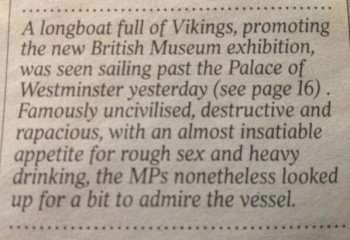
– Spotted yesterday in the Times (which is behind a paywall) of the day before yesterday by 6k. “Very good” says he. Indeed.
Brian Micklethwait, “Samizdata quote of the day”, Samizdata, 2014-04-19.
April 20, 2014
QotD: Musical tastes
It was my business for a long time to tell people that approached the bandstand that their favorite song was of absolutely no interest to everyone else in the room, and we weren’t going to play it. It’s a delicate thing to tell people that the song that contains both the name of their illegitimate children and their pit bulls, and whose album cover is featured on both a tattoo on their chest and painted on the side of their van, isn’t very entertaining. Such information upsets people, like going to the monkey house at the zoo and throwing your poo at the apes. Those monkeys stop in their tracks and stare at you, I’m telling you.
Don’t ask me how I know that.
Sippican Cottage, “Well, I Put The Quarter Right In That Can, But All They Played Was Disco, Man”, Sippican Cottage, 2013-05-06
April 18, 2014
QotD: Opera
Opera, to a person genuinely fond of aural beauty, must inevitably appear tawdry and obnoxious, if only because it presents aural beauty in a frame of purely visual gaudiness, with overtones of the grossest sexual provocation. The most successful opera singers of the female sex, at least in America, are not those whom the majority of auditors admire most as singers but those whom the majority of male spectators desire most as mistresses. Opera is chiefly supported in all countries by the same sort of wealthy sensualists who also support musical comedy. One finds in the directors’ room the traditional stock company of the stage-door alley. Such vermin, of course, pose in the newspapers as devout and almost fanatical partisans of art; they exhibit themselves at every performance; one hears of their grand doings, through their press agents, almost every day. But one has merely to observe the sort of opera they think is good to get the measure of their actual artistic discrimination.
The genuine music-lover may accept the carnal husk of opera to get at the kernel of actual music within, but that is no sign that he approves the carnal husk or enjoys gnawing through it. Most musicians, indeed, prefer to hear operatic music outside the opera house; that is why one so often hears such things as “The Ride of the Valkyrie” in the concert hall. “The Ride of the Valkyrie” has a certain intrinsic value as pure music; played by a competent orchestra it may give civilized pleasure. But as it is commonly performed in an opera house, with a posse of flat beldames throwing themselves about the stage, it can only produce the effect of a dose of ipecacuanha. The sort of person who actually delights in such spectacles is the sort of person who delights in plush furniture. Such half-wits are in a majority in every opera house west of the Rhine. They go to the opera, not to hear music, not even to hear bad music, but merely to see a more or less obscene circus. A few, perhaps, have a further purpose; they desire to assist in that circus, to show themselves in the capacity of fashionables, to enchant the yokelry with their splendor. But the majority must be content with the more lowly aim. What they get for the outrageous prices they pay for seats is a chance to feast their eyes upon glittering members of the superior demi-monde, and to abase their groveling souls before magnificoes on their own side of the footlights. They esteem a performance, not in proportion as true music is on tap, but in proportion as the display of notorious characters on the stage is copious, and the exhibition of wealth in the boxes is lavish.
H.L. Mencken, “The Allied Arts: Opera”, Prejudices: Second Series, 1920.
April 16, 2014
QotD: The wizards of the web
You would have thought this would have sunk in by now. The fact that it hasn’t shows what an extraordinary machine the internet is — quite different to any technology that has gone before it. When the Lovebug struck, few of us lived our lives online. Back then we banked in branches, shopped in shops, met friends and lovers in the pub and obtained jobs by posting CVs. Tweeting was for the birds. Cyberspace was marginal. Now, for billions, the online world is their lives. But there is a problem. Only a tiny, tiny percentage of the people who use the internet have even the faintest clue about how any of it works. “SSL”, for instance, stands for “Secure Sockets Layer”.
I looked it up and sort of understood it — for about five minutes. While most drivers have at least a notion of how an engine works (something about petrol exploding in cylinders and making pistons go up and down and so forth) the very language of the internet — “domain names” and “DNS codes”, endless “protocols” and so forth — is arcane, exclusive; it is, in fact, the language of magic. For all intents and purposes the internet is run by wizards.
And the trouble with letting wizards run things is that when things go wrong we are at their mercy. The world spends several tens of billions of pounds a year on anti-malware programs, which we are exhorted to buy lest the walls of our digital castles collapse around us. Making security software is a huge industry, and whenever there is a problem — either caused by viruses or by a glitch like Heartbleed — the internet security companies rush to be quoted in the media. And guess what, their message is never “keep calm and carry on”. As Professor Ross Anderson of Cambridge University says: “Almost all the cost of cybercrime is the cost of anticipation.”
Michael Hanlon, “Relax, Mumsnet users: don’t lose sleep over Heartbleed hysteria”, Telegraph, 2014-04-16
April 14, 2014
QotD: Collard’s Law
Given enough funding and little accountability, any organisation tends to look like a shit copy of the public sector.
Lewis Collard, in a comment on ESR’s Google+ post, 2014-04-13
April 13, 2014
QotD: Politicians
Being an MP is a vast subsidized ego-trip. It’s a job that needs no qualifications, it has no compulsory hours of work, no performance standards, and provides a warm room, a telephone and subsidized meals to a bunch of self-important windbags and busybodies who suddenly find people taking them seriously because they’ve go the letters ‘MP’ after the their name.
Jonathan Lynn, “Yes Minister Series: Quotes from the dialogue”, JonathanLynn.com
April 12, 2014
QotD: Canada’s “small country” syndrome
It’s been a decade since Robert Fulford popularized the term: “The Longest Undefended Neurosis in the World.” It’s about as accurate a description of Canada-US relations as has ever been offered. The eagerness which, even at this late date, we lap up any mention of Canada on US media is oddly pathetic. This is the sort of behaviour typically seen in small bankrupt countries. Any mention of Portugal outside of Portugal is almost immediately reported on the state broadcaster. There is a strange cloying quality about such reports. A desperate yelling: “Hey we used to be important!”
It’s a small country thing. When a big country thinks this way you get French-style arrogance: “Hey we still are important, it’s that you lot aren’t clever enough to realize that blindingly obvious fact.”
Today Rob Ford is probably the most famous Canadian in history, save William Shatner. Neither men’s careers has done much to change international perceptions of Canada. We’re boring and probably polite. From time to time we kill seals and moose, though not necessarily in that order. As a general rule we avoid doing evil things. Short of carpet bombing a small country, which is well beyond our military capabilities, nothing we do will change these perceptions. We could annex Buffalo, something within our military capabilities, but I suspect most Americans would probably be grateful. They might throw in Rochester as a parting gift.
Richard Anderson, “Talking With Americans About Canadians”, The Gods of the Copybook Headings, 2014-04-10
April 11, 2014
QotD: Romantic views of death in battle
And we ourselves? Let us not have too much hope. The chances are that, if we go to war, eager to leap superbly at the cannon’s mouth, we’ll be finished on the way by an ingrowing toenail or by being run over by an army truck driven by a former Greek bus-boy and loaded with imitation Swiss cheeses made in Oneida, N. Y. And that if we die in our beds, it will be of measles or albuminuria.
The aforesaid Crile, in one of his smaller books, A Mechanistic View of War and Peace, has a good deal to say about death in war, and in particular, about the disparity between the glorious and inspiring passing imagined by the young soldier and the messy finish that is normally in store for him. He shows two pictures of war, the one ideal and the other real. The former is the familiar print, “The Spirit of ’76,” with the three patriots springing grandly to the attack, one of them with a neat and romantic bandage around his head apparently, to judge by his liveliness, to cover a wound no worse than an average bee-sting. The latter picture is what the movie folks call a close-up of a French soldier who was struck just below the mouth by a German one-pounder shell a soldier suddenly converted into the hideous simulacrum of a cruller. What one notices especially is the curious expression upon what remains of his face an expression of the utmost surprise and indignation. No doubt he marched off to the front firmly convinced that, if he died at all, it would be at the climax of some heroic charge, up to his knees in blood and with his bayonet run clear through a Bavarian at least four feet in diameter. He imagined the clean bullet through the heart, the stately last gesture, the final words: “Therese! Sophie! Olympe! Marie! Suzette! Odette! Denise! Julie! … France!” Go to the book and see what he got … Dr. Crile, whose experience of war has soured him against it, argues that the best way to abolish it would be to prohibit such romantic prints as “The Spirit of ’76” and substitute therefore a series of actual photographs of dead and wounded men. The plan is plainly of merit. But it would be expensive. Imagine a war getting on its legs before the conversion of the populace had become complete. Think of the huge herds of spy-chasers, letter-openers, pacifist-hounds, burlesons and other such operators that it would take to track down and confiscate all those pictures!
H.L. Mencken, “Exeunt Omnes”, Prejudices: Second Series, 1920.
April 10, 2014
QotD: Confirmation bias for thee but not for me
The last few days have provided both a good laugh and some food for thought on the important question of confirmation bias — people’s tendency to favor information that confirms their pre-existing views and ignore information that contradicts those views. It’s a subject well worth some reflection.
The laugh came from a familiar source. Without (it seems) a hint of irony, Paul Krugman argued on Monday that everyone is subject to confirmation bias except for people who agree with him. He was responding to this essay Ezra Klein wrote for his newly launched site, Vox.com, which took up the question of confirmation bias and the challenges it poses to democratic politics. Krugman acknowledged the research that Klein cites but then insisted that his own experience suggests it is actually mostly people he disagrees with who tend to ignore evidence and research that contradicts what they want to believe, while people who share his own views are more open-minded, skeptical, and evidence driven. I don’t know when I’ve seen a neater real-world example of an argument that disproves itself. Good times.
Yuval Levin, “Confirmation Bias and Its Limits”, National Review, 2014-04-09
April 9, 2014
QotD: “Perhaps being a boy is a learning disorder”
… more children are being diagnosed with “autism spectrum disorders” than ever, specifically that diagnoses have gone from one in about a hundred and fifty to about one in sixty eight. A lot of these diagnoses are for children with extremely mild Aspergers, right at the borderline between normal (whatever that is) and Aspergers. Now this may be a result of more people suffering from ASD’s, especially extremely mild Aspergers, as a result of cumulative mutations and pregnant women being exposed to environmental risks. Or it could be that ever since the Fed’s started throwing money at diagnosing and providing educational services for kids with ASD’s they have become the diagnoses de jour. In fact, it is worth noting that since the Feds started throwing more money at ASD’s and less at ADD and ADHD the number of children diagnosed with the former has increased and the latter two decreased. Apparently getting more Federal funding causes learning/psychological disorders and getting funding cut cures them.
That or educators are blowing off the needs of kids with disorders that are not “getting the love.” My own personal opinion is that favored problems get over-diagnosed and those not blessed with Fed money get under-diagnosed. Shame on the education establishment either way.
It should also be noted that whichever disorder is getting attention it seems to hit males about four times as often as females. In fact, it seems that a lot of the descriptors of symptoms for various ASD’s and ADD read like pretty normal behavior for boys.
Perhaps being a boy is a learning disorder (there’s a large number of females who would nod their head in agreement with this thesis).
A.X. Perez, “Old News Interpreted”, Libertarian Enterprise, 2014-04-06
April 8, 2014
QotD: Making certain arguments “beyond the pale”
The right to free speech may begin and end with the First Amendment, but there is a vast middle where our freedom of speech is protected by us — by our capacity to listen and accept that people disagree, often strongly, that there are fools, some of them columnists and elected officials and, yes, even reality-show patriarchs, that there are people who believe stupid, irrational, hateful things about other people and it’s okay to let those words in our ears sometimes without rolling out the guillotines.
[…]
The trouble, I think, is when ostracizing a viewpoint as “beyond the pale” becomes not an end but a means to an end; that by declaring something unsayable, we make it so. It makes me uncomfortable, even as I see the value of it. I for one would love homophobia to fully make it on that list, to get to the point where being against gay marriage is as vulgar and shameful as being against interracial marriage. But it isn’t. Maybe it will be. But it isn’t. And kicking a reality-show star off his reality show doesn’t make that less true. Win the argument; don’t declare the argument too offensive to be won. And that’s true whether it’s GLAAD making demands of A&E or the head of the Republican National Committee making demands of MSNBC.
The bottom line is, you don’t beat an idea by beating a person. You beat an idea by beating an idea. Not only is it counter-productive — nobody likes the kid who complains to the teacher even when the kid is right — it replaces a competition of arguments with a competition to delegitimize arguments. And what’s left is the pressure to sand down the corners of your speech while looking for the rough edges in the speech of your adversaries. Everyone is offended. Everyone is offensive. Nothing is close to the line because close to the line is over the line because over the line is better for clicks and retweets and fundraising and ad revenue.
Jon Lovett, “The Culture of Shut Up: Too many debates about important issues degenerate into manufactured and misplaced outrage — and it’s chilling free speech”, The Atlantic, 2014-04-07
March 26, 2014
QotD: Britain’s “common culture”
In The Lion and the Unicorn, George Orwell wrote that the most salient fact about England’s liberal elite was “their severance from the common culture of the country”. By “the common culture” Orwell was thinking of things like beer and bingo, as well as smutty humour, the tabloid press and a distrust of the state and its officials. What connects these things, according to Orwell, is that they all have a whiff of rebelliousness about them, something that appeals to the Sancho Panza in all of us rather than the Don Quixote – “your unofficial self, the voice of the belly protesting against the soul”. These are the things ordinary people genuinely enjoy, as opposed to what they ought to enjoy. In indulging in these simple, unpretentious pleasures, they are making use of their freedom to spend their money on whatever they like, not what various authority figures think they should spend it on. “One thing one notices if one looks directly at the common people, especially in the big towns, is that they are not puritanical,” wrote Orwell. “They are inveterate gamblers, drink as much beer as their wages will permit, are devoted to bawdy jokes, and use probably the foulest language in the world.”
The reason the liberal elite are disconnected from this culture isn’t simply because it’s alien to them. It’s also because they actively disapprove of it. Unlike the common people, they are puritanical. They think gambling, drinking and bawdy humour, not to mention tabloid newspapers, are wrong and they often give vent to these feelings. Alongside a desire for a more just society, sits a yearning for a purer, less sinful society, one in which the workers spend their evenings reading self-improving books – Booker Prize-winning novels – and engaging in traditional arts and crafts, like basket making. The reason they seek political power isn’t primarily because they want to protect working-class people from being exploited by evil capitalists. They want to protect them from themselves.
Toby Young, “The Conservatives should become the party of beer, bingo and Lamborghinis”, Telegraph, 2014-03-26
March 24, 2014
QotD: On Women’s Power
If you have never been sexually attracted to women, you will never quite understand the monumental power of female sexuality, except by proxy or in theory, nor will you quite know the immense advantage it gives us over men. Dating women as a man was a lesson in female power, and it made me, of all things, into a momentary misogynist, which I suppose was the best indicator that my experiment had worked. I saw my own sex from the other side, and I disliked women irrationally for a while because of it. I disliked their superiority, their accusatory smiles, their entitlement to choose or dash me with a fingertip, an execution so lazy, so effortless, it made the defeats and even the successes unbearably humiliating. Typical male power feels by comparison like a blunt instrument, its salvos and field strategies laughably remedial next to the damage a woman can do with a single cutting word: no.
Sex is most powerful in the mind, and to men, in the mind, women have a lot of power, not only to arouse, but to give worth, self-worth, meaning, initiation, sustenance, everything. Seeing this more clearly through my experience, I began to wonder whether the most extreme men resort to violence with women because they think that’s all they have, their one pathetic advantage over all she seems to hold above them. I make no excuses for this. There are none. But as a man I felt vaguely attuned to this mind-set or its possibility. I did not inhabit it, but I thought I saw how rejection might get twisted beyond recognition in the mind of a discarded male where misogyny and ultimately rape may be a vicious attempt to take what cannot be taken because it has not been bestowed.
There were other surprising discoveries. With all the anger I felt flowing in my direction — anger directed at the abstraction called men — I was not expecting to find, nestled within the confines of female heterosexuality, a deep love and genuine attraction for real men. Not for women in men’s bodies, as the prejudicial me had thought. Not even just for the metrosexual, though he has his audience, but for brawny, hairy, smelly, stalwart, manly men; bald men, men with bellies, men who can fix things and, yes, men who like sports and pound away in the bedroom. Men whom women loved for being men with all the qualities that testosterone and the patriarchy had given them, and whom I have come to appreciate for those very same qualities, however infuriating I still find them at times.
Dating women was the hardest thing I had to do as Ned, even when the women liked me and I liked them. I have never felt more vulnerable to total strangers, never more socially defenceless than in my clanking suit of borrowed armour. But then, I guess maybe that’s one of the secrets of manhood that no man tells if he can help it. Every man’s armour is borrowed and 10 sizes too big, and beneath it he’s naked and insecure and hoping you won’t see.
That, maybe, was the last twist of my adventure. I passed in a man’s world not because my mask was so real, but because the world of men was a masked ball. Eventually I realised that my disguise was the one thing I had in common with every guy in the room. It was hard being a guy.
Rather than choosing to become a woman again, it is probably truer to say that I reverted to form. I stopped faking it. I came back to myself, proud, free and glad in every way to be a woman.
Norah Vincent, “Double agent” (an edited extract from Self-Made Man: My Year Disguised As A Man), Guardian, 2006-03-18.
March 23, 2014
QotD: Woodrow Wilson
The fraudulence of Wilson is now admitted by all save a few survivors of the old corps of official press-agents, most of them devoid of both honesty and intelligence. No unbiased man, in the presence of the revelations of Bullitt, Keynes and a hundred other witnesses, and of the Russian and Shantung performances, and of innumerable salient domestic phenomena, can now believe that the Doctor dulcifluus was ever actually in favor of any of the brummagem ideals he once wept for, to the edification of a moral universe. They were, at best, no more than ingenious ruses de guerre, and even in the day of their widest credit it was the Espionage Act and the Solicitor-General to the Post Office, rather than any plausibility in their substance, that got them that credit. In [Theodore] Roosevelt’s case the imposture is less patent; he died before it was fully unmasked. What is more, his death put an end to whatever investigation of it was under way, for American sentimentality holds that it is indecent to inquire into the weaknesses of the dead, at least until all the flowers have withered on their tombs. When, a year ago, I ventured in a magazine article to call attention to Roosevelt’s philosophical kinship to the Kaiser I received letters of denunciation from all parts of the United States, and not a few forthright demands that I recant on penalty of lynch law. Prudence demanded that I heed these demands. We live in a curious and often unsafe country.
H.L. Mencken, “Roosevelt: An Autopsy”, Prejudices, part 2, 1920.


