
Paltrow seemed to arrive on the scene having everything and wanting for nothing.
Funny, that’s also the most accurate description of an AWFL ever penned. Who the hell are they, and where did they come from? How do they have the free time and endless disposable cash to do literally every single thing they do?
In 2001, she promoted Shallow Hal — in which she played Rosemary, an obese woman whose “inner beauty” is only visible to Hal (Jack Black) — by talking about doing practice runs in her character’s fat suit. “I got a real sense of what it would be like to be that overweight, and every pretty girl should be forced to do that.”
Wait, this is supposed to be a hit piece? Because that might be the most sensible thing I have ever heard a woman say. Yes, definitely they should be forced to do that, if not the full Norah Vincent. If you’re halfway presentable, ladies — hell, if you’re not grossly deformed — you’re playing life on “God mode”. Look at all the simps in your social media feeds, and tell me I’m wrong. Being forced to go around in a fat suit for a week or two is a necessary corrective.
Paltrow’s first big trip on the Hollywood hater-go-round was 1998, the year she won the Best Actress Oscar for Shakespeare in Love and gave a memorably messy, genuinely emotional acceptance speech. (Days after her win, Salon was among many outlets eviscerating her.) What viewers didn’t see, Odell notes, is the amount of effort by Miramax head Harvey Weinstein to make Shakespeare a winner, raise the profile of his still-independent studio, and solidify his belief that Paltrow belonged to him.
I’m going to stop here, because there’s really no point. I just wanted everyone to remember Shakespeare in Love. You do remember Shakespeare in Love, don’t you?
Of course you don’t; it was silly and forgettable at the time, and now is remembered, if at all, as a bizarre footnote — it’s the movie that won Best Picture over Saving Private Ryan. From the perspective of 2025, then, it sure looks like 1998 was the official start of the Girlboss Era.
Severian, “Kvetching Up With Karen: DC Edition”, Founding Questions, 2025-08-14.
December 19, 2025
QotD: “1998 was the official start of the Girlboss Era”
December 18, 2025
QotD: Reserved for women
Woman is the luckier sex for two reasons. Without shame we can indulge in a good cry and we have the babies.
Tears do help, no matter what the cynics say. The resilience and longer life of women probably are due to our ability to clear supercharged emotional atmosphere with occasional violent storms.
The symptoms follow a pattern. For days you feel low. You mope, and worry over nothing. Then some little upset comes and you hit bottom. Waves of misery wash over you. They flatten you out.
Then grief grips your soul and sobs rack your body. When ended it’s as if you were born again. The good old “I’m alive” feeling floods your being. You wash your face, and powder your nose and for the next six months the family can expect reasonable behavior from you. Such outbursts are better than a bottle of drug store tonic for feminine nerves.
Men, poor things, can’t have such a release for fear of becoming softies. Instead, they indulge in profanity, which is a poor substitute for tears.
They mention their great achievements with pride, but not one ever emerged from months of discomfort and pain, clasping a live baby.
Life’s high moments are rare and brief. And God saved the best for us.
“Nonsense,” I can hear the realists say. “Babies are a commonplace biological fact.” Which proves that they talk nonsense, for every woman knows that her baby is a miracle made of Heaven-spun dreams.
Mrs. Walter Ferguson, “Reserved for women”, The Pittsburgh Press, 1946-09-17.
December 17, 2025
QotD: The origins of Progressivism
Vladimir Lenin, I’ll remind you, once famously said “The goal of socialism is communism”. Both are political and ethical “philosophies” based on taking stuff away from those who created it or earned it, and giving it to those who didn’t — who’ll vote for you. Collectivism, which is the generic term for both of these viewpoints and every other politic-economic scam like them, is nothing more than a pathetically transparent, sleazy attempt to make theft appear respectable. It’s always easier to take away or destroy than to create or build. Stealing from others became very popular in the first half of the 19th century (“Property is theft” — Pierre-Joseph Proudhon) when it was formalized as an ideology.
From that beginning, 170 years ago, socialists began to imagine a bright, glowing, prosperous Utopian future for themselves, based entirely on theft. With every decade that passed, their physically, logically impossible fantasies became more and more real to them. It’s like the old psychiatrist joke that the difference between neurotics and psychotics is that neurotics build castles in the air, whereas psychotics move in and live in them.
The “Progressive” movement began to really blossom in the latter half of the 19th century. They were establishing socialist colonies practically everywhere. American socialist newspaper editor Horace Greeley told his readers, “Go west, young man” and to establish socialist colonies. Looking Backward, a badly-written socialist screed by Edward Bellamy and more-talented others like H. G. Wells’ When the Sleeper Wakes and The Time Machine became immensely popular. The idea of an inevitable, unstoppable socialist “wave of the future” became popular and lasted at least until I was in college in the 1960s.
L. Neil Smith, “Why They Hate Donald Trump”, Libertarian Enterprise, 2018-12-30.
December 16, 2025
QotD: Arms and the (pre-modern) man (at arms)
Here we do have some significant price data, but of course its tricky to be able to correlate a given value for arms and armor with something concrete like wages in every period, because of course prices are not stable. But here are some of the data points I’ve encountered:
We don’t have good Roman price data from the Republic or early/high Empire, unfortunately (and indeed, the reason I have been collecting late antique and medieval comparanda is to use it to understand the structure of earlier Roman costs). Hugh Elton1 notes that a law of Valens (r. 364-378) assessed the cost of clothing, equipment and such for a new infantry recruit to be 6 solidi and for a cavalryman, 13 solidi (the extra 7 being for the horse). The solidus was a 4.5g gold coin at the time (roughly equal to the earlier aureus) so that is a substantial expense to kit out an individual soldier. For comparison, the annual rations for soldiers in the same period seem to have been 4-5 solidi, so we might suggest a Roman soldier is wearing something like a year’s worth of living expenses.2
We don’t see a huge change in the Early Middle Ages either. The seventh century Lex Ripuaria,3 quotes the following prices for military equipment: 12 solidi for a coat of mail, 6 solidi for a metal helmet, 7 for a sword with its scabbard, 6 for mail leggings, 2 solidi for a lance and shield for a rider (wood is cheap!); a warhorse was 12 solidi, whereas a whole damn cow was just 3 solidi. On the one hand, the armor for this rider has gotten somewhat more extensive – mail leggings (chausses) were a new thing (the Romans didn’t have them) – but clearly the price of metal equipment here is higher: equipping a mailed infantryman would have some to something like 25ish solidi compared to 12 for the warhorse (so 2x the cost of the horse) compared to the near 1-to-1 armor-to-horse price from Valens. I should note, however, warhorses even compared to other goods, show high volatility in the medieval price data.
As we get further one, we get more and more price data. Verbruggen (op. cit. 170-1) also notes prices for the equipment of the heavy infantry militia of Bruges in 1304; the average price of the heavy infantry equipment was a staggering £21, with the priciest item by far being the required body armor (still a coat of mail) coming in between £10 and £15. Now you will recall the continental livre by this point is hardly the Carolingian unit (or the English one), but the £21 here would have represented something around two-thirds of a year’s wages for a skilled artisan.
Almost contemporary in English, we have some data from Yorkshire.4 Villages had to supply a certain number of infantrymen for military service and around 1300, the cost to equip them was 5 shillings per man, as unarmored light infantry. When Edward II (r. 1307-1327) demanded quite minimally armored men (a metal helmet and a textile padded jack or gambeson), the cost jumped four-fold to £1, which ended up causing the experiment in recruiting heavier infantry this way to fail. And I should note, a gambeson and a helmet is hardly very heavy infantry!
For comparison, in the same period an English longbowman out on campaign was paid just 2d per day, so that £1 of kit would have represented 120 days wages. By contrast, the average cost of a good quality longbow in the same period was just 1s, 6d, which the longbowman could earn back in just over a week.5 Once again: wood is cheap, metal is expensive.
Finally, we have the prices from our ever-handy Medieval Price List and its sources. We see quite a range in this price data, both in that we see truly elite pieces of armor (gilt armor for a prince at £340, a full set of Milanese 15th century plate at more than £8, etc) and its tricky to use these figures too without taking careful note of the year and checking the source citation to figure out which region’s currency we’re using. One other thing to note here that comes out clearly: plate cuirasses are often quite a bit cheaper than the mail armor (or mail voiders) they’re worn over, though hardly cheap. Still, full sets of armor ranging from single to low-double digit livres and pounds seem standard and we already know from last week’s exercise that a single livre or pound is likely reflecting a pretty big chunk of money, potentially close to a year’s wage for a regular worker.
So while your heavily armored knight or man-at-arms or Roman legionary was, of course, not walking around with the Great Pyramid’s worth of labor-value on his back, even the “standard” equipment for a heavy infantryman or heavy cavalryman – not counting the horse! – might represent a year or even years of a regular workers’ wages. On the flipside, for societies that could afford it, heavy infantry was worth it: putting heavy, armored infantry in contact with light infantry in pre-gunpowder warfare generally produces horrific one-sided slaughters. But relatively few societies could afford it: the Romans are very unusual for either ancient or medieval European societies in that they deploy large numbers of armored heavy infantry (predominately in mail in any period, although in the empire we also see scale and the famed lorica segmentata), a topic that forms a pretty substantial part of my upcoming book, Of Arms and Men, which I will miss no opportunity to plug over the next however long it takes to come out.6 Obviously armored heavy cavalry is even harder to get and generally restricted to simply putting a society’s aristocracy on the battlefield, since the Big Men can afford both the horses and the armor.
But the other thing I want to note here is the social gap this sort of difference in value creates. As noted above with the bowman’s wages, it would take a year or even years of wages for a regular light soldier (or civilian laborers of his class) to put together enough money to purchase the sort of equipment required to serve as a soldier of higher status (who also gets higher pay). Of course it isn’t as simple as, “work as a bowman for a year and then buy some armor”, because nearly all of that pay the longbowman is getting is being absorbed by food and living expenses. The result is that the high cost of equipment means that for many of these men, the social gap between them and either an unmounted man-at-arms or the mounted knight is economically unbridgeable.7
Bret Devereaux, “Fireside Friday, January 10, 2025”, A Collection of Unmitigated Pedantry, 2025-01-10.
- Warfare in Roman Europe AD 350-425 (1996), 122.
- If you are wondering why I’m not comparing to wages, the answer is that by this point, Roman military wages are super irregular, consisting mostly of donatives – special disbursements at the accession of a new emperor or a successful military campaign – rather than regular pay, making it really hard to do a direct comparison.
- Here my citation is not from the text directly, but Verbruggen, The Art of War in Western Europe during the Middle Ages (1997), 23.
- From Prestwich, Armies and Warfare in the Middle Ages (1996).
- These prices via Hardy, Longbow: A Social and Military History (1992).
- Expect it no earlier than late this year; as I write this, the core text is actually done (but needs revising), but that’s hardly the end of the publication process.
- Man-at-arms is one of those annoyingly plastic terms which is used to mean “a man of non-knightly status, equipped in the sort of kit a knight would have”, which sometimes implies heavy armored non-noble infantry and sometimes implies non-knightly heavy cavalry retainers of knights and other nobles.
December 15, 2025
QotD: Free-form Jazz
James Lileks, The Bleat, 2005-09-05.
December 14, 2025
QotD: Why are Castles?
Castles differ from that other standby of medieval fortifications — city walls — in one crucial way, and that difference sheds a lot of light on their military application.
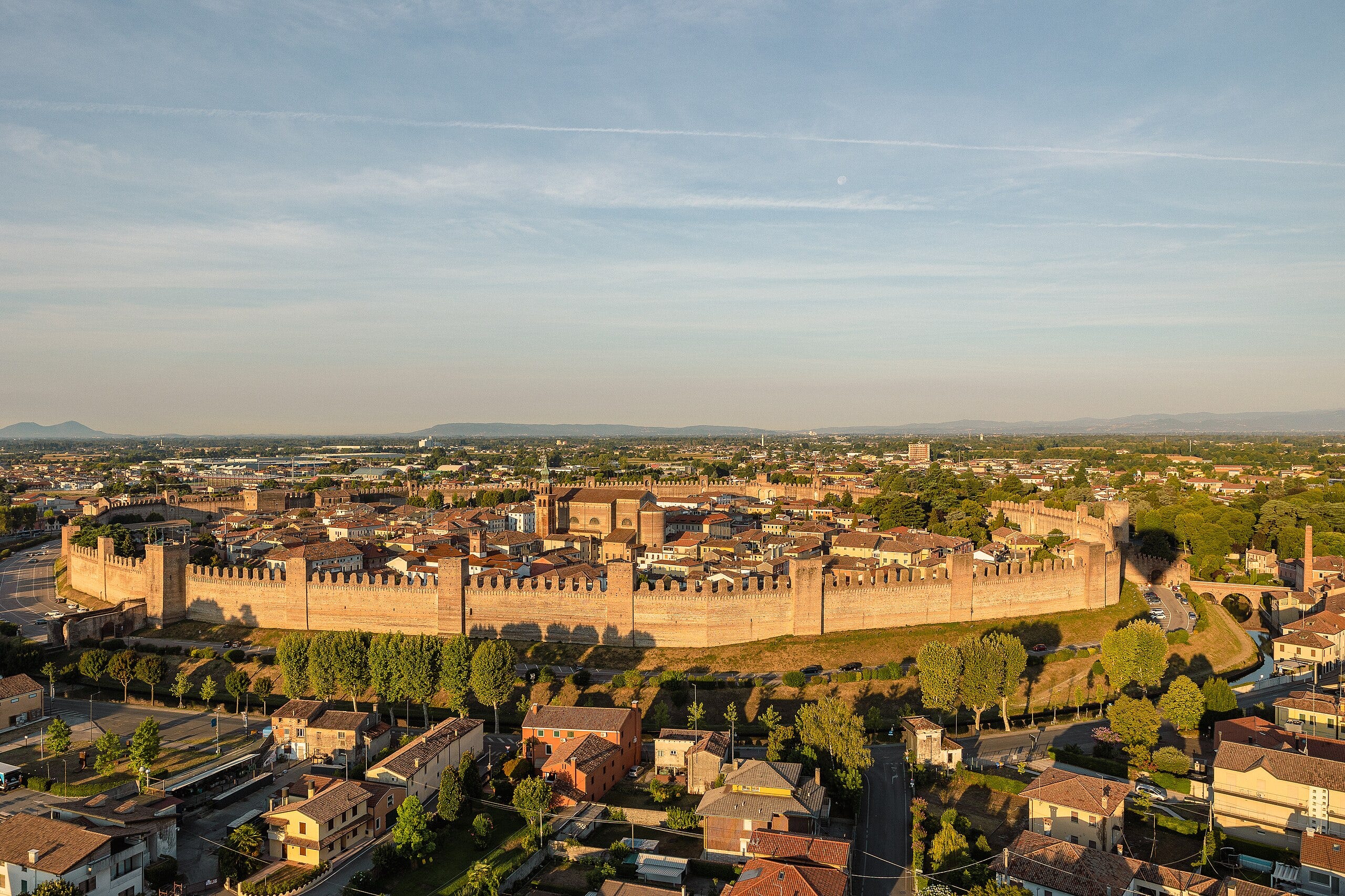
The walls of Cittadella, Italy (photo by Edoardo Bortoli, CC BY-SA 4.0).
A massive city wall, like the one shown above, has the very clear purpose of limiting access to a city or town. Close the gates, and no one can get in. Try to get in, and we’ll shoot you! The walls are meant to protect the settlement, both its inhabitants as well as its structures and physical wealth.
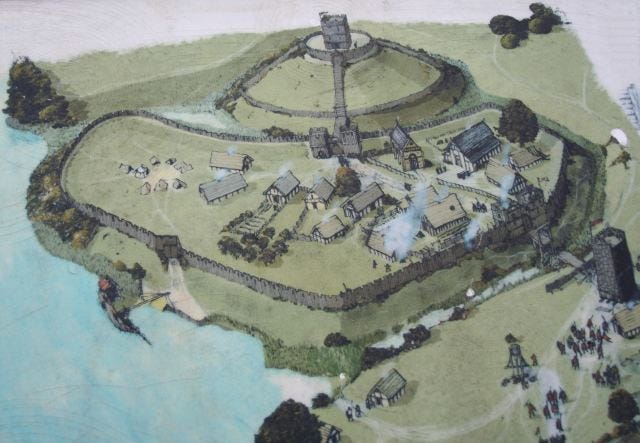
A castle, on the other hand, has a much smaller footprint than a city. It might only be a few buildings and a courtyard. Indeed, as we’ll see later in the series, the earliest castles (the classic “motte and bailey” design) were relatively small fortifications of earth and timber, capable of being built in a matter of days.
Image of a motte and bailey style castle. This particular one would take much longer than a few days to make, but it’s worth noting that even this “primitive” castle of timber and earth would have been a serious problem for any attacker. (Duncan Grey – Display Board of Huntingdon Hill Motte and Bailey Castle – CC BY-SA 2.0).
Especially if a lord was not in residence, a castle might only have a garrison of a few dozen, a far cry from the walls around urban centers that protected thousands or tens of thousands of lives!
So why bother?
Because, unlike a city wall which is meant to defend everything within it, a castle isn’t built in order to protect a tiny bit of land on top of a hill. Instead (say it with me, class): a castle is built to deny an enemy freedom of movement.
It’s not about what’s inside the walls. It’s about what’s outside the walls.
A castle allows you to control a disproportionately large area of land.
That control matters a great deal, because land was the source of wealth in pre-modern contexts. In societies where 80-95% of the populace were farmers, wealth and power came from controlling arable land. Capital did not derive principally from urban centers — wealthy and valuable as those were.1
Before we go further into how that impacts war and politics, I want to take a moment and dig deeper into why a castle allows its owner to control the land, because it’s something that’s usually glossed over, and understanding this dynamic will have a significant bearing on everything else we talk about here.
The Ugly Nature of Rule
As I’ve explained before, in order to actually rule an area, the ruler needs to have a monopoly on legitimate violence within that area. The emphasis here is on legitimate violence, which is significantly different than just “brute force”; force alone will always be a temporary and unstable method of rule. [You can read this explainer for more on that.] A ruler’s legitimacy allows that monopoly to continue unopposed.
One of the main reasons why a ruler needs that monopoly is that it allows for the collection of resources for use by the state. I’m going to lump all this together under the word “taxes”, but to be clear: in pre-modern societies, “taxes” could include manual labor commitments, payments in kind (in crops, in material, etc.), or in cash.
For all that, the ruler needs his agents to have unfettered access to the country he aims to rule; his tax collectors, law enforcers, merchants, judges, and certainly his lords and military all need to be able to move freely throughout the realm in order to do all the necessary business of maintaining law, order, and the collection of taxes.
Those are the most basic elements of statehood, the most basic mechanism of ordinary, everyday governing.
Castles fit into that system the same as any other governmental or administrative center: it’s a place to collect and store resources, a place for state agents to shelter, a locale for arbitration of justice, a residence for a lord … A castle can be a courthouse, police station, secret service listening post, governor’s mansion, and revenue service office all in one.
And a castle is fortified for much the same reasons that governmental buildings across history have always been fortified.
Even if the majority of a subject populace believes your rule is legitimate — a big if! — then there will still be people who chafe at the collection of taxes and who feel wronged by the administration of justice. Those outliers — if indeed they even are outliers — might try something stupid, like taking back their resources or stabbing your
thugspeace-loving tax collectors. Better to have everything locked up, right?And if the castle is large, and visibly imposing? Well that doesn’t hurt, does it?
That’s the every-day purpose of castles, at least in the sense that on any average Tuesday morning, that’s what the castle is for. That’s what people in the castle are doing. Ruling.
Eric Falden, “What Were Castles Actually For?”, Falden’s Forge, 2025-07-29.
1. There are exceptions, of course, such as thassalocratic polities. But sea-faring societies don’t built castles and are therefore WAY outside the bounds of this discussion.
December 13, 2025
QotD: Victorian mores, homosexuality, and the Empire
This is where modern identity politics really messes up historical analysis. We probably all know that the vast majority of Victorian homosexuals were married, because the vast majority of Victorians were married. This isn’t my professional field, but because I went to grad school I’m pretty well up on it – the ivory tower finds Victorian poofters endlessly fascinating, because they are huge homo cheerleaders (obviously), but also because of the costumes.
Women and gay men love playing dress up — have you noticed? — and Victorian dress up is the best, because it’s a) expensive, and b) time consuming, but also c) flattering to just about any body type. It was socially acceptable among the upper classes to be porky (and nobody dresses up like a chimney sweep or factory hand), so both men’s and women’s fashion in the Late Victorian era can accommodate modern bodies. (Unlike the early Victorian era, which continued Regency fashion. They’d love to dress up Regency style — there’s a reason “Regency romance” is the most popular genre of light porno books for cat ladies — but it takes a specific physical type to pull off, and they don’t have it). […]
Anyway, where was I? Oh yeah — lots of people in grad school really, really into Victorian queers, so if I seem extremely well informed on this topic, don’t read too much into it.
“Repressed homosexual” was redundant back then. Oscar Wilde, for instance, was sort of the ur-homo — he was so gay, just gazing too long at a picture of him at his dandiest could give you an uncomfortably strong urge to touch a penis. […] Oscar Wilde was also married, and had two children, because that’s how even the queerest of the queer rolled in Victorian London.
Given that, you’d expect one of two things to happen to public schoolboys once they got out into the bush. Either they’d totally let their freak flag fly — you know, given that everyone else in their social world was an equally repressed public schoolboy — or they’d bottle it up even further, because it was important to show nothing but the best image of Her Majesty’s servants to the wogs at all times.
As far as I know, the latter was almost universally the case. Before the opening of the Suez Canal (1869), you could have a nonstop bacchanalia over there … if you were straight. Those guys could, and did, rock the casbah with extreme prejudice. It started tapering off early in Victoria’s reign, but in the late 1700s you had British army officers converting to Islam (no, really) for the express purpose of getting even more tail, by marrying the Koranically sanctioned four wives (sometimes with all the age of consent queasiness that implies).
The repressed homos, on the other hand, got really into scholarship. It’s not generally known (because even then the vast majority of their works were of interest only to micro-specialists) but Anglo-Indians were insanely productive scholars, on every conceivable topic. You could fill a decent sized library with their five-, seven-, nine-volume works on Sanskrit philology, and the botany of the lower Himalayas, or the migratory habits of tigers, or pretty much anything. And if they weren’t the scholarly sort, the repressed homos simply threw themselves into their work, of which there was always an endless supply — take a look at a map of India, recall that there were at most 200,000 Britons in the whole place, and you’ll see what I mean.
So: Were they going out there to get away from Victorian women? Absolutely. Were they therefore going to turn the place into Studio 54? Absolutely not.
Severian, “Ruling Caste II”, Founding Questions, 2022-03-10.
December 12, 2025
QotD: Crime and the army
But in the Army, “crime” is capable of infinite shades of intensity. It simply means “misdemeanor”, and may range from being unshaven on parade, or making a frivolous complaint about the potatoes at dinner, to irrevocably perforating your rival in love with a bayonet. So let party politicians, when they discourse vaguely to their constituents about “the prevalence of crime in the Army under the present effete and undemocratic system”, walk warily.
Ian Hay (Major John Hay Beith), The First Hundred Thousand: Being the Unofficial Chronicle of a Unit of “K(1)”, 1916.
December 11, 2025
QotD: Being a bore
My problem is that I have two modes of socializing: to be silent or boring. I cannot make small talk, for when I try to do so my words turn to dust in my mouth, as it were, before I have even uttered them. I can talk only on matters of impersonal interest.
My problem is that I am a serial monomaniac, with one subject occupying the foreground of my mind for up to a few months. In the midst of my enthusiasm, I cannot imagine that other people are not as fascinated by the subject as I. The subject of my monomanias are various: Haitian history; the disappearance of the cuckoo from the English countryside; the life of Caradoc Evans, the Welsh writer of the early part of the 20th century; etc. I never stick with anything long enough to be a scholar of it.
When my wife kicks me under the table, it is usually in mid-anecdote. I cannot stop straightaway, abruptly, for that would look peculiar, as if I were having a fit or a stroke. But I have to bring it to a quicker end than I had anticipated, omitting details that to me had seemed choice and amusing. Often, I have to admit, my wife has heard them before.
Of course, I don’t agree that I am being, or have ever been, boring. Bores don’t know that they are boring, just as people with halitosis don’t know that their breath smells. I look at the people around the dinner table and think they are glued to what I am saying. The fact that I don’t really give them any alternative doesn’t occur to me. How, in any case, could anyone be uninterested in the story of le Roi Christophe who built, or had built, one of the wonders of the world, La Citadelle, near Cap-Haitien, or of how people threw bricks through Caradoc Evans’ windows, so disgusted were they by his literary portrayal of his countrymen? In those days, literature was important.
Theodore Dalrymple, “Full Bore”, Taki’s Magazine, 2020-05-29.
December 10, 2025
QotD: The “rules” of Gonzo journalism
- The story behind the story is the real story.
- The writer is now the hero of each episode.
- All this gets written in the style of a personal communication to the reader of the real, dirty inside stuff — straight, with no holds barred.
Why couldn’t you write journalism like this? In fact, a whole generation learned to do just that, mostly by imitating Hunter S. Thompson.
But it grows tired and predictable in the hands of today’s imitators — and the Gonzo King never invited either of those modifiers. Yes, blogs and Substacks are part of his legacy, formats that blur the line between diary, confession, and journalism. But he did it before all the rest, not as a desktop publisher — instead putting his life at risk on the road with total fear and loathing.
So if Substack is the grandchild of Hunter Thompson and New Journalism, it is a tame, well-behaved descendant — and nothing like its brave forebear, who kept going full speed without a helmet until the end.
Even the reader has to run to keep up.
Ted Gioia, “The Rise and Fall of Hunter Thompson (Part 2 of 3)”, The Honest Broker, 2025-09-08.
December 9, 2025
QotD: The development of army discipline and drill in pre-modern armies
The reason we cannot just call this “drill” is because while drill is the most common way agrarian societies produce this result, it is not the only way to this end. For instance as we’ve discussed before, steppe nomads could achieve a very high degree of coordination and synchronization without the same formal systems of drill because the training that produced that coordination was embedded in their culture (particularly in hunting methods) and so young steppe nomad males were acculturated into the synchronicity that way. That said for the rest of this we’re going to place those systems aside and mostly focus on synchronized discipline as a result of drill because for most armies that developed a great deal of synchronized discipline, that’s how they did it.
Fundamentally the principle behind using drill to build synchronized discipline is that the way to get a whole lot of humans to act effectively in concert together is to force them to practice doing exactly the things they’ll be asked to do on the battlefield a lot until the motions are practically second nature. Indeed, the ideal in developing this kind of drill was often to ingrain the actions the soldiers were to perform so deeply that in the midst of the terror of battle when they couldn’t even really think straight those soldiers would fall back on simply mechanically performing the actions they were trained to perform. That in turn creates an important element of predictability: an individual soldier does not need to be checking their action or position against the others around them as much because they’ve done this very maneuver with these very fellows and so already know where everyone is going to be.
The context that drill tends to emerge in (this is an idea invented more than once) tends to give it a highly regimented, fairly brutal character. For instance in early modern Europe, the structure of drill for gunpowder armies was conditioned by elite snobbery: European officer-aristocrats (in many cases the direct continuation of the medieval aristocracy) had an extremely poor view of their common soldiers (drawn from the peasantry). Assuming they lacked any natural valor, harsh drill was settled upon as a solution to make the actions of battle merely mechanical, to reduce the man to a machine. Roman commanders seemed to have thought somewhat better of their soldiers’ bravery, but assumed that harsh discipline was necessary to control, restrain and direct the native fiery virtus (“strength/bravery/valor”) of the common soldier who, unlike the aristocrat, could not be expected to control himself (again, in the snobbish view of the aristocrats).
In short, drill tends to appear in highly stratified agrarian societies, the very nature of which tends to mean that drill is instituted by a class of aristocrats who have at best a dim view of their common soldiers. Consequently, while the core of drill is to simply practice the actions of battle over and over again until they become natural, drill tends to also be encrusted with lots of corporal punishments and intense regulation as a product of those elite attitudes. And though it falls outside of our topic today it seems worth noting that our systems of drill to produce synchronized discipline have the same roots (deriving from early modern musket drill).
Bret Devereaux, “Collections: Total Generalship: Commanding Pre-Modern Armies, Part IIIa”, A Collection of Unmitigated Pedantry, 2022-06-17.
December 8, 2025
QotD: Austerity versus “austerity”
Words have connotations as well as denotations, and one way of insinuating an untruth into someone’s mind is to disconnect the two, so that the denotation and the connotation are at variance and even opposite. An excellent example of this is in the use of the word austerity as applied to certain government economic policies. Frequently one reads, for example, that the difficulties of countries such as Britain and France in the matter of responding to the Covid-19 epidemic were caused by previous government austerity, that is to say, failure to spend more. But irrespective of whether, had the governments spent more (and France already devotes a greater proportion of its GDP to healthcare than the great majority of countries at the same economic level), the epidemic would have been more easily mastered, their policies in restricting their expenditure cannot be called austerity, because they still spent more than their income: as, in fact, they had done almost continually for forty years.
Supposing I were to say, “This year I’m going in for austerity. Last year I spent ten per cent more than my income, but this year I am going to spend only five per cent more,” you would think I were uttering a sub-Wildean paradox. But if I were to say only, “This year I’m going in for austerity,” you would think I were going to wear a hair shirt and subsist on locusts and honey. To say that the British and French governments have exercised austerity is to mean the first and imply the second, which is clearly dishonest: though we should note that the proper term, reduction of the deficit, is neutral as to whether it is economically wise or unwise. After all, I can borrow equally to start a business or drink champagne for breakfast.
Theodore Dalrymple, “Controlling Thought”, New English Review, 2020-06-09.
Update, 9 December: Welcome, Instapundit readers! Please do have a look around at some of my other posts you may find of interest. I send out a daily summary of posts here through my Substack – https://substack.com/@nicholasrusson that you can subscribe to if you’d like to be informed of new posts in the future.
December 7, 2025
QotD: The Great Applesauce Blight of 1977/78
As we take our own little march down memory lane, let me state up front that I can’t stomach applesauce, just can’t. I liked it as a kid but now it has less appeal than the prospect of being duct taped to a chair, face down, in prison. Yeah, I hate it.
This may seem unreasonable, but anyone who was in at the time, at least in the Army or Marines, and some portion thereof that actually went to the field a lot, will probably remember the Great Applesauce Blight of 1977 and 1978, which was the reason I can’t stand the crap.
The “Great Applesauce Blight?” you ask. Oh, yeah.
The story I got, after some years and some digging, goes like this: It seems that sometime in the late 1960s or early 1970s, a fruit company – the Monterey Fruit Company, so it was said – was going out of business. So the Monterey Fruit Company, if that’s who it really was, called the Department of Defense and said, “Boys, have we got a deal for you. Hundreds upon hundreds of tons of Grade A applesauce, and you can have it. All of it. Cheap.”
McNamara and his Whiz Kids – neither of them ever sufficiently to be damned, of course – were gone, but their spirits remained. Department of Defense, ever conscious of the value of a well-squeezed penny, bought that inventory of applesauce, and began to put it into the old style, canned, MCI; Meal, Combat, Individual, which is to say, “C-rations”.
C Rations of the day were entirely canned and composed of a main meal, for one meal, plus either a cake (or very rarely, canned bread) or fruit of some kind, usually a small tin of peanut butter or cheese of some kind of jam or jelly, and one or another type of B Unit, which would have some variant of crackers plus either candy or cocoa. Sometimes, as with the B-2 unit, the cheese was in those.
Now, perusing a case of 1978 C-rats, which would have been newer than those of the Great Applesauce Blight, but still broadly similar, one notes that there were twelve menus, twelve different main meals, and 12 different kinds of dessert, a sundry pack, plus variable candies, spreads, etc. Of that latter twelve, eight were fruit and four were cake of some kind. I seem to recall that, possibly for reasons of economy, the amount of fruit during the Great Applesauce Blight had gone up to usually ten cans out of twelve, some extra cheese or peanut butter seemed to be included with some, and the cakes went down to two, one of which was going to be Chocolate Nut Roll, essentially inedible, from the Nashville Bread Company and the other would be the even more thoroughly disgusting fruit cake. I don’t recall who made that, and that lack of memory may have been an automatic defense against a future charge of capital murder. None of the cakes except pound cake could be relied on to be edible, and pound cake was always rare.
Now picture this, you’re a soldier in the Panama Canal Zone, training – training hard – to fight for the Canal, living in the jungle maybe twenty-five or more days and nights a month, eating C-rats to the tune of sixty or seventy a month, and virtually every meal contains applesauce or something more innately disgusting. “No, none of that nice fruit cocktail or those ever so delectable pear slices for you, young man; Department of Defense, to save a few bucks, has determined that applesauce is good enough, three meals a day, for weeks on end.”
*****
Now we were already kind of thin, because no military feeding system can ever completely keep up with the caloric requirements for a soldier either continuously fighting or realistically training to fight. Normally, this isn’t a problem because he can pack it on in the mess hall. These were unusual circumstances, though, with an unusually high chance of fighting – or riot control, which is worse – over the Canal. So we’re pretty much living out there, in pretty much trackless jungle, with nothing like enough helicopters for regular hot rations from the mess. Besides that, the old 193rd Infantry Brigade, in the Panama Canal Zone, was unusual in that it made a very serious effort to train even the cooks to fight, which takes time, too. C’s are pretty much it.
Even so, thin and hungry or not, after a month or two we could not eat the applesauce. That was probably seven or eight hundred calories a days that just got tossed.
We began going from thin to frigging emaciated.
*****
When I think upon the Great Applesauce Blight, though, I do not think about hardship or hunger. No, I think – as we old farts are wont to – about happier aspects of it.
Now this is no shit:
There we were, the heavy mortar platoon of 4th Battalion, 10th Infantry, stuck on top of a non-descript hill somewhere southwest of Gamboa, Canal Zone.
PFC McBrayer had a birthday out there in the jungle. I think it was his nineteenth birthday. None of us had been able to do any shopping, so we were all just stuck for getting him a birthday present. “I’m not giving up my pet scorpion,” said Big Al, who in fact, had a pet scorpion for the mega-ant versus scorpion gladiatorial combats we used to stage. “I’d offer to give him some of my crotch rot,” said Art, “but I think he already has some of his own.” “Howler monkey?” “Who’s going to catch it? And those suckers are mean, too.” “How about a sloth? They’re easy to catch.” “If the Lord God didn’t see fit to give B’rer Sloth an asshole, I don’t see why we should add to his troubles by catching him and wrapping him as a present.” Finally someone, I don’t think it was me, might have been Sergeant Sais, said, “Gentlemen, there can be only one proper gift under the circumstances,” and then he held up a – you guessed it – can of applesauce.
So we stuck nineteen or twenty Canal Zone Matches in a Nashville Bread Company Chocolate Butt Roll, invited McBrayer over, torched off the matches, sang Happy Birthday, then presented him his can of applesauce.
He was touched; you could see that. As he dashed tears from his eyes while making his, “Gee, you guys are just all so special … you shouldn’t have,” speech, you could see the emotion radiating from his face. And then, all choked up, he turned to go and tossed that can off applesauce off the hill with a casual contempt I have never seen before or since. It was the sheer, distilled essence of everything we all felt about applesauce.
Tom Kratman, The social media site formerly known as Twitter, 2025-09-05.
December 6, 2025
QotD: King Henry wants a divorce
In 1532, then, Parliament presented the King with the Supplication Against the Ordinaries. “Ordinaries” means “members of a religious order” — basically, the Supplication is everyone’s beefs with the Church. You can read the list at the Wiki link, but they all boil down to this: The Church was effectively a state-within-the-State, operating a different system of law, taxation, etc. And that’s what praemunire means, too — “a 14th-century law that prohibited the assertion or maintenance of papal jurisdiction, or any other foreign jurisdiction or claim of supremacy in England, against the supremacy of the monarch”. By accusing Wolsey of it, Henry VIII was saying that he, Wolsey, was ultimately working for the Church, not the King … which is kinda what you’d expect from a Cardinal, no?
That’s the problem.
Long story short, by 1532 the state-within-the-State that was the Church was blocking the upward mobility of new men like Thomas Cromwell.1 There was an entire secular education system; it was cranking out talented, ambitious men; in short, there was an “overproduction of elites”, since there were limited spaces in the nobility and the Church and they were all already occupied by either bluebloods, or guys like Wolsey who had jumped on the gravy train much earlier.
But this was an artificial bottleneck. The Tudor state had plenty of room to expand; they needed far more educated bureaucrats than the old system was capable of supplying. The old system needed to go, on order to make room for the new, and in many ways that’s what the Reformation was: A brushfire, clearing off the deadwood. A political and administrative brushfire, disguised as a theological dispute. It’s no accident that the most Reformed polities — late Tudor England, the Netherlands, the Schmalkaldic League — were the most politically and economically efficient ones, too.
And by Reforming the Church, the brushfire could extend to the rest of the depraved, decadent, moribund, fake-and-gay culture. The Renaissance is obsessive about the old, but it is, obviously, something very very new. People raised in the Late Medieval world were emotionally incapable of a total break with the past — I don’t think any culture really is, but a culture as hidebound as the Middle Ages certainly isn’t. But so long as they could find some warrant for change in the Classical past (and being the inventive types they were, they’d always find such a warrant), they could purge the culture, root and branch, in the guise of “returning ad fontes“.
Severian, “Reformation II”, Founding Questions, 2022-03-08.
- This is where the analogy breaks down, because Late Medieval men were not Postmodern men — Cromwell was actually loyal to Wolsey almost to his, Cromwell’s, literal death. Men had honor back then. It also speaks to the kind of man Wolsey must’ve been, to have inspired the loyalty of a guy like Cromwell despite it all. Cromwell was a ruthless motherfucker, even by Tudor England’s Olympic-class standards; he’d stab his own mother if he found it politically necessary; but he still stayed loyal to his man even when it looked like that would cost him his life.
December 5, 2025
QotD: The Anglosphere
Ironically – and this must drive those of a pro-EU frame of mind nuts – it is still North America, with its rawer culture and politics, its legal similarities to the UK (for good and for ill) that resonates, even in the minds (for want of a better noun) of the sort of folk going on BLM demos. What goes on in France, Germany or Italy tends not to have the same grip on the mind. The Atlantic is wide and the Channel is narrow, but in every other sense, it is the other way around. To that extent, then, the Anglosphere lives, even in the hearts and minds of the far Left.
Johnathan Pearce, “The Anglosphere and our present discontents”, Samizdata, 2020-06-08.


