Quotulatiousness

April 13, 2023

Beeching plus 60

Filed under: Britain, Economics, History, Politics, Railways — Tags: , , , , — Nicholas @ 03:00

In The Critic, Peter Caddick-Adams notes that it’s just past 60 years since one of the most controversial documents the British government published during the latter half of the 20th century: The Beeching Report.
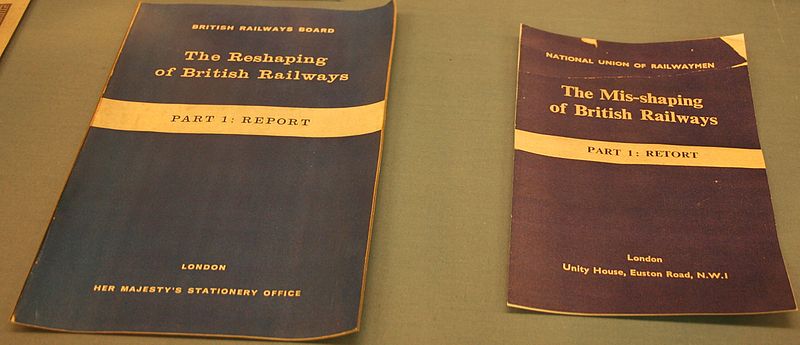
The British Railways Board’s publication The Reshaping of British Railways, Part 1: Report, Beeching’s first report, which famously recommended the closure of many uneconomic British railway lines. Many of the closures were implemented. This copy is displayed at the National Railway Museum in York beside a copy of the National Union of Railwaymen’s published response, The Mis-shaping of British Railways, Part 1: Retort.
Photo by RobertG via Wikimedia Commons.

Wednesday, 27 March 1963 marked the day when a civil servant with a doctorate in physics, seconded from ICI, proudly flourished a report he had written. That man was Dr Richard Beeching, and the result of his recommendations contained in The Reshaping of British Railways are with us to this day.

Beeching identified many unprofitable rail services and suggested the widespread elimination of a huge number of routes. He identified 2,363 stations for closure, along with 6,000 miles of track — a third of the existing network — with the loss of 67,700 jobs. His stated aim was to prune the railway system back into a profitable concern. Behind Beeching, seconded to the newly-established British Railways Board, stood the figure of the publisher-turned-Prime Minister, Harold Macmillan. He knew a thing or two about railways, having been a pre-nationalisation director of the Great Western Railway. It put him in the delightful position of never having to pay for a train ticket.

Macmillan observed from a shareholder’s point of view, “you can pour all in money you want, but you can never make the damned things pay for themselves”. In his view, the railway network and infrastructure of wagon works, tiny branch lines, cottages for signallers, crossings keepers and station masters, with most halts staffed 18 hours a day, amounted to a social service, albeit an expensive one. It had made the prosperity of Victorian Britain possible and was sustaining it still. From nationalisation in 1948, the railways themselves had attempted to make savings, closing 3,000 miles of track and reducing staff from 648,000 to 474,000. That famous Ealing comedy film of 1953, The Titfield Thunderbolt, about a group of villagers trying to keep their branch line operating after British Railways decided to close it, already reflected concern and railway nostalgia.

Britain’s literary and celluloid love affair with iron rails and steam began as long ago as 1905 with the publication of Edith Nesbit’s The Railway Children, a success which peaked when the book was made into a highly successful movie in 1970. Meanwhile, professional sleuths and loafers like Sherlock Holmes, Bulldog Drummond, Lord Peter Wimsey, Hercule Poirot and Bertie Wooster capitalised on the branch line network in their methodology of moving swiftly about pastoral England in their hunts for miscreants. It was the success of The Lady Vanishes, a 1938 mystery thriller set on a continental train, that launched Alfred Hitchcock as a world-class director. David Lean’s Brief Encounter of 1945, based on Noël Coward’s earlier one-act play, Still Life, attached deep romance to station platforms and waiting rooms, reminiscent of so much heartache in the recently fought world war. It is still regarded as one of the greatest of all British-made films. None of this mattered to Beeching, the man who was “Britain’s most-hated civil servant” at his death in 1985, a moniker still used today.

There’s an argument that Beeching was deliberately set up as a patsy for the real villains, Ernest Marples and Harold MacMillan:

The cold, dispassionate Beeching was absolutely the wrong man for the job. As he told the Daily Mirror at the time, “I have no experience of railways, except as a passenger. So, I am not a practical railwayman. But I am a very practical man.” John Betjeman, writing persuasively and eloquently in the Daily Telegraph each week, and later Ian Hislop, hit the right note in observing that Beeching, and all he stood for were technocrats. They “weren’t open to arguments of romantic notions of rural England, or the warp-and-weft of the train in our national identity. They didn’t buy any of that, and went for a straightforward profit and loss approach, from which we are still reeling today”.

However, it has also been argued that Beeching was the unwitting fall-guy for the Minister of Transport of the day, Ernest Marples. He was a self-made businessman who “got things done”, but he retained an air of shadiness about him. Macmillan should have known better. Marples had been managing director of Marples Ridgway, awarded contracts to build the first motorways. When challenged about a conflict of interest, he sold his 80 per cent shareholding to his wife. Elevated to the peerage, Marples fled to Monaco in 1975 to avoid prosecution for tax fraud. So, in some ways, the thing was a stitch-up. Marples directly benefited from the widespread cuts advocated by his subordinate, Beeching. Macmillan had his eye off the ball and was already considering retirement, hastened by an operation for prostate cancer six months after Beeching’s report.

The Prime Minister was astute enough to ensure the press presented the cuts in a positive way, however. From the Cabinet papers of the day, we now know the day before the publication of The Reshaping of British Railways, Beeching’s findings were rewritten to suggest the cuts were the first phase of a co-ordinated national transport policy, with advanced plans to replace the axed rail networks with improved minor roads and local bus services. In reality this was political fantasy (my inner lawyer cautions against more extremist language), for the bus-road subsidy would have cost more than that already paid to the railways. The promise of replacement bus services should have come with a guarantee of remaining in place for at least 10-15 years, because most were withdrawn after two, forcing more motor traffic onto an already inadequate road network.


April 12, 2023

“Stunning and brave” or “deliberately constructed misogyny”?

Filed under: Health, Media, Politics, USA — Tags: , , , , , — Nicholas @ 05:00

In The Critic, Jean Hatchet points out how well Dylan Mulvaney’s act is working to both maximize Mulvaney’s career and to actively denigrate women:

If a man seeks to humiliate a woman he encounters, nothing is easier than reducing her appearance to a mere caricature. Men do this directly in front of the woman they are targeting: lifting their voice to a squeak, exaggerating hand gestures, pushing out pretend breasts, wiggling their bum, pouting and fiddling with their hair. Most of these men confine the taunt to the woman in front of them, and the woman often feels and displays a righteous rage. However, when it comes to Dylan Mulvaney, the Tik Tok user who has become famous for his grotesque parody of women, women are not supposed to react critically. They are seen as cruel or “transphobic” if they express annoyance at being so grossly insulted.

In March 2022 Dylan Mulvaney saw a way to take his barely-concealed disdain for women up a level, with predictable success. After his career as a musical actor had stalled due to the Covid pandemic, with people finding solace daily on Tik Tok, wily Dylan invented a new role that guaranteed his future wealth and success. He announced he was embarking on a journey of “being a girl” and began a series of videos documenting this ludicrous notion.

Shortly before this year-long, very public “transition”, Mulvaney performed a pilot video for his current lucrative act. In it he told the viewer that he “had trouble finding roles” so a friend had invented one for him, a “femme character”. His character wears a pink dress and pearls, white gloves and ankle socks. At this point Mulvaney must have been delighted to glimpse a potential new career path. It was a very savvy move for him to extend and develop this caricature of a 1950s woman. Now, just over a year later, Dylan Mulvaney has highly paid “partnerships” with a number of companies including Budweiser, Kate Spade and — during the past week, to great objection — the Sportwear giant Nike.

In an inflammatory paid partnership video with Nike, an inanely grinning, barefoot Mulvaney wears a Nike sports bra and leggings. He performs a series of ridiculous moves including comedic side stretches, a theatrical run kicking his heels up nonsensically and failed chorus-line high kicks. He almost runs backwards into a hedge at one point and pulls a comedy expression of shock. It all looks ridiculous and slapstick. It mocks women by suggesting they exercise trivially and ineffectively, but smiling throughout.

The media seems unwilling to focus on the actual reasons many women are angry about this. It has focused instead on stating that objections to the sponsorship are because Dylan is trans. This is not why women are outraged. When a man “performs woman” in front of women to such a humiliating degree, when he waggles and jiggles and implies that weakness and silliness are inherent to being a woman who plays sport, women appropriately see this for the deliberately constructed misogyny it is. Ria Chapman, a London PE teacher, told me why she finds this act so irritating and offensive:

    Girls are still routinely bullied and mocked for being sporty and or breaking stereotypes, their achievements and ambitions not being celebrated and valued like those of their male peers. For a sports company the size of Nike to use a male performing a parody of what he believes women behave like during sport only adds to the ammunition that boys will use to put girls down.

Utilising female stereotypes is the foundation of Mulvaney’s role. On his “Day 1 of being a girl” video debut, he said:

    I’ve already cried three times, written a scathing email I didn’t send, ordered dresses online that I couldn’t afford and when someone asked me how I was, I said “I’m fine” but I wasn’t fine. How did I do, ladies?

All of this encapsulates the stereotype of women as emotionally fragile, frivolous spendthrifts, imprudent around clothes and financially inept. In the stereotype Dylan performs, women routinely suppress our emotions and focus on being polite at all times. It is an archaic depiction of requisite female behaviour which was seared into women’s consciousness over decades in the past. This view of “girlhood” took further decades for feminist women to dismantle. Dylan Mulvaney is building it back up before our eyes and we refuse to stay quiet about it.

Bud Light’s latest brand ambassador, Dylan Mulvaney

Omnipolitization, the scourge of the western world

Theophilus Chilton, reposting from 2018 (!), explains why the inexorable spread of government everywhere in the west has led us to a situation where every election is “the most important election in history”, and every government decision can infringe upon or even ruin the lives of millions of people as mere side-effect:

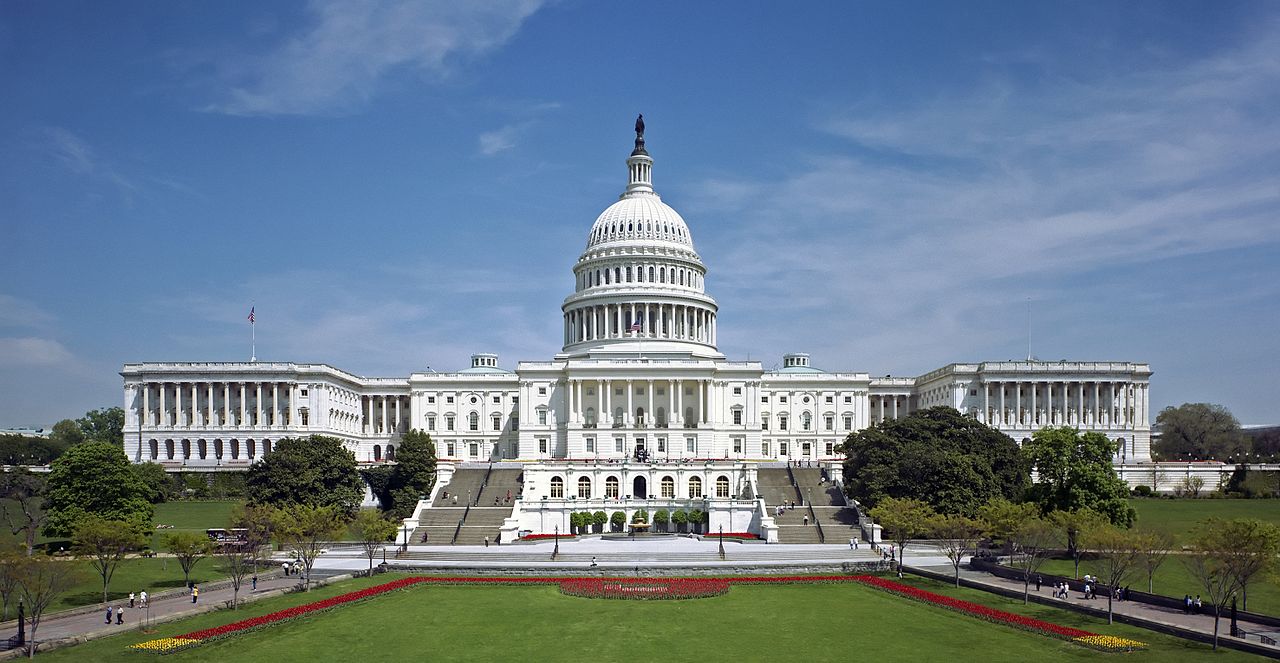
The western front of the United States Capitol. The Neoclassical style building is located in Washington, D.C., on top of Capitol Hill at the east end of the National Mall. The Capitol was designated a National Historic Landmark in 1960.
Photo via Wikimedia Commons.

Politics in the United States have become an all-encompassing nightmare from which the average American cannot hope to escape. As American democracy (you know, the “freedom” form of government) expands the reach of the managerial state into every area of modern life, the stakes involved in the political process have mushroomed, with control over the lives of hundreds of millions of people hanging in the balance. It’s little surprise that each election season stretches out over a year, and (as Florida and Georgia recently showed us) doesn’t end once the voting is “officially” over.

It’s reached the point where literally everything is involved in some way with politics. Your choice of restaurant now signals your political inclinations, and thus who will harass you while eating there. Businesses themselves feel compelled to virtue signal, usually in a leftward direction, lest they bring upon themselves threats of boycott, bad publicity, or worse. It has escalated to the point where being the public face of the “wrong” side earns you harassment and menace to your physical health, as Tucker Carlson and several Republican members of Congress have found out. Expressing the “wrong” opinions in the workplace or online can get you reprimanded or fired.

How did we reach that point?

It hearkens back to something I wrote about earlier concerning the tyranny of the technical society. In our particular case, we are seeing a situation playing out in real time whereby “political techniques” first pioneered by Lenin in establishing and maintaining Soviet control over Russia are being used to bring every facet of modern life into the political realm. Every action and attitude has a political ramification which can affect your employment, your access to social amenities, and even (eventually) your freedom from the gulag.

This omnipolitisation leads inevitably into a dichotomy between formal and informal power in the US governing system. Formal power is exactly as it sounds – the “constitutional” (written or otherwise) distribution of decision and policy-making authority in a government, i.e. which entity or body gets to legally do what. This usually involves theoretical limits on the roles or extent of governing authority, which sets it in opposition to the principle of omnipolitics. Conversely, informal power is also exactly as it sounds – it is power wielded extra-constitutionally (yet in a very real sense) by those who “shouldn’t” be exercising it, but nevertheless are.

QotD: Karen

Back in March, I was certain this whole thing [the pandemic] would blow over in a matter of weeks. It’s a Karen-driven phenomenon, I argued, but unlike everything everything else they do, this time Karen’s going to have to shoulder the burden herself. She’ll have fun berating the manager of the local Starbucks for not closing down … until she realizes there’s no place to get a half-caff, triple-foam, venti soy latte frappuccino. Nor is there any place to dump her self-propelled lifestyle accessories kids while she gets exalted at hot yoga and the nail salon, now that school’s out. Give her a week without Starbucks, I said, locked in her house with Kayden, Brayden, Jayden, and Khaleesi, and she’ll demand we never mention the word “flu” again.

In other words, I misunderstood the essence of Karen. Karen is — first, foremost, and always — a victim. I of all people should’ve known better, because I was surrounded by Karens all the time in my personal and professional life. I’ve mentioned this story before, but bear with a quick repeat: At one of my first teaching gigs, at the big directional tech that makes up a lot of “Flyover State”, the department’s women got it into their vapid little heads that they — women — were being systematically excluded from positions of power. The fact that the department chair was a woman, and in fact the whole department, emeritus through first year grad student, was something like 65% female should’ve been their first clue, but nevertheless, they persisted. They got together a blue-ribbon commission, as one does, and studied the shit out of the problem. The much-ballyhooed report revealed …

… that all the positions of authority in the department, every blessed one, was held by a female. At which point, without missing a single fucking beat, they started complaining that being forced to hold all these positions of authority was keeping them from making adequate career progress.

I shit you not.

That’s Karen, my friends.

Severian, “The Civil War That Wasn’t”, Rotten Chestnuts, 2020-09-09.

April 11, 2023

The end of single-sex spaces began in the 1970s, at least for men

Filed under: Business, Government, Law, Media, Politics, Sports, USA — Tags: , , , , , — Nicholas @ 03:00

Janice Fiamengo points out that the initial loss of single-sex spaces began a long time ago and for what — at the time — seemed sensible and egalitarian reasons:

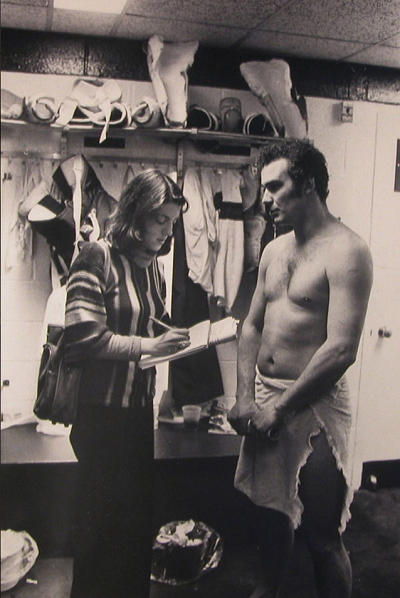
Robin Herman of the New York Times was one of the first two female reporters ever allowed into NHL dressing rooms, starting with the 1975 NHL All-Star Game in Montreal.

There has been a good deal of talk lately about women’s spaces being invaded by biologically male persons identifying as women. Some women’s campaigners claim that the trans phenomenon constitutes an attack on womanhood itself, an attempt to “erase” women and replace them with men who perform womanhood. Some even call it a new form of patriarchy.

But well before women had their single-sex spaces threatened, something similar had already happened to men. Beginning in the 1970s, men’s spaces were usurped, their maleness was denigrated, and policies and laws forced changes in male behavior that turned many workplaces into feminized fiefdoms in which men held their jobs only so long as women allowed them to. The very idea of an exclusively male workspace or club — especially if it was a space for socializing (not so much if it was a sewer, oil field, or shop floor in which men did unpleasant, dangerous work) — came to be seen as dangerous. In light of the recent furor over single-sex spaces for women, it is useful to consider the source of some men’s justifiable apathy and resentment.

At my new academic job in the late 1990s, a woman who had been the first female historian hired into her department used to tell a story she’d had passed on to her from a male colleague. After the decision had been made to hire her, one of the historians said to another somewhat dolefully, “I guess that’s the end of our meetings in the urinal.” The joke ruefully acknowledged, and good-naturedly accepted, the end of their all-male work environment.

Though this woman didn’t have any trouble with her male colleagues, who welcomed her civilly, she told the story with an edge of contempt. Even thoroughly modern men, the story suggested, held a foolish nostalgia for pre-feminist days.

But was it foolish — or did the men recognize something real?

No one thought seriously, then, about the disappearance of men’s single-sex spaces. The idea that men and boys need places where they can be with other men (defended, for example, in Jack Donovan’s The Way of Men) would have been cause, amongst the women I knew, for scornful laughter. In 2018, anti-male assumptions had become so deeply entrenched that the female author of a Guardian article titled “Men-only clubs and menace: how the establishment maintains male power” simply could not believe that any decent man could legitimately seek out male-only company.

Under the circumstances of mixed groups of reporters crowding into team locker rooms after games, it’s rather surprising how few “towel malfunction” incidents have been reported.

April 10, 2023

The ADL would like to warn you away from that dangerous source of information, Substack

Filed under: Media, Politics, USA — Tags: , , , — Nicholas @ 05:00

Chris Bray doesn’t seem to be taking the ADL’s dire warnings seriously here:

The ADL has written a much-discussed hit piece about Substack

    Substack, a subscription-based online newsletter platform for independent writers, continues to attract extremists and conspiracy theorists who routinely use the site to profit from spreading antisemitism, misinformation, disinformation and hate speech.

… and I’m grateful. It’s gloriously stupid and clumsy, and shows how the braindead disinformation racket works. If you read Jacob Siegel’s important examination of the disinformation hoax in Tablet, and then read the ADL’s laugh-out-loud stupid article about Substack, you’ll be inoculated. You’ll be a dead end for this mind virus. See, this discussion is a vaccine, and that means it’s good and you can’t ever question it.

Start with the headline:

So the opening claim, the frame the headline establishes as you wade into the text, is that this is an exposé of antisemitism, of people — like Nazis! — who hate Jews. Substack is a Nuremberg rally, y’all, and Leni Riefenstahl has the film rights. The topic of the piece is hate and bigotry. And then the text says things like this:

1.) Antisemitism is on Substack!

2.) For example, Steve Kirsch criticizes Covid vaccines.

Pretty sure Steve Kirsch is Jewish, by the way, and listed alongside other monsters who publish on the Jew-hating platform Substack. Also a vicious hater writing on the antisemitic platform, as the ADL warns us: Chaya Raichik (of Libs Of TikTok fame), an orthodox Jew. I’m not a technical expert, but this may be poor form for antisemitic publishing. “Anti-Papist mob to publish G.K. Chesterton box set”.

The lumping in of this thing, this thing, and this entirely other thing is a way to dirty up a bunch of Not X by reference to X, warning about antisemitism at the top and then delivering text about people who criticize pharmaceutical products. This website hosts people who love terrorism, genocide, and baking. For example, cupcakes.

Second, and this amazes me, the ADL piece — in 2023! — runs on the premise that the line between good information and dangerous disinformation is perfectly clear and eternally unchanging. Steve Kirsch writes “anti-vaccine conspiracy theories”. See, and not one of those have ever proved to be true. What we think is true now about mRNA vaccines in the spring of 2023 is exactly what we believed in March of 2020. Truth never changes, and no ambiguity ever exists in any scientific question. No debate is ever real or reasoned. No skeptic has ever turned out to be right about anything, ever, on any topic in any field, like eugenics and phrenology. This narrative approach, the rhetorical equivalent of watching a writer hit himself in his own drooling face with a boot, is why every person of ordinary good sense sighs heavily at the first sign that someone claims status as a disinformation expert.

April 9, 2023

What’s the “exit strategy” from the Trump fiasco in NYC?

Filed under: Law, Media, Politics, USA — Tags: , , — Nicholas @ 06:00

Severian wonders how the deep state’s public muppets will manage now that former President Donald Trump has been brought to court:

Let us ask ourselves, then, what The Left‘s “exit strategy” could possibly be, for any of their outstandingly Juggalicious projects. They of course don’t actually have one — “grokking the skull-fuckingly obvious consequences of their actions” not being the Left’s long suit — but if they did, what would it be?

And I admit, I’m buffaloed. We’ve already talked about the Ukraine thing, so let’s contemplate how the BOM’s “indictment” ends.

One wonders what happens if they throw the book at him. What’s the max sentence? It’s important. Does he face actual jail time? How much? I’m assuming for the purposes of this exercise that the jury will not only convict him, but give him the max, because c’mon man, this is AINO — we live in a Prerogative State now; jaywalking is a federal pound me in the ass prison offense if you can be proven to have voted the wrong way. What can they give him?

[…]

Throw BOM in the slammer, and there you have it. Not even Toby fucking Keith could fail to conclude that we now live in a police state. They’re screwed …

But they’re equally screwed if he gets off, because then their guys will go nuts, and forget passive resistance, the Left gets to riot. And riot they shall, because they’ve got a real taste for it now. Even if everything breaks perfectly for the Juggs for the next few years, Antifa etc. will still be rioting whenever they feel aggrieved — and when do they not? — simply because they like it. And they never face any consequences, so why not flip cars and break shit and light buildings on fire every time Starbucks raises the price of a frappucino?

Same deal if the BOM gets a slap on the wrist. I think that was the original plan, insofar as they’re capable of planning — indict him, slap him on the wrist, and turn him loose. They didn’t think past “getting him off the 2024 ballot”. If they even thought that far … which I doubt, but let’s give them the benefit of the doubt. Even though they must know that 2024 will be Fortified for Democracy™, the BOM’s very existence terrifies them, because he shows that there’s a possible alternative. We see him for the ridiculous CivNat pussy he is, and we know full well we’re not voting ourselves out of what’s coming. But they see him as a real threat.

A Serious version of the BOM would be a very big deal indeed. They can’t allow that to happen. And so long as the BOM stays on this side of the grass, that seems to them to be a live possibility.

So what can they do? Seriously asking. How the hell do they get themselves out of this? If you were the Machiavelli behind Les Juggs, what would you tell them to do? I’m a Historian, so I can envision a lot more “worst case scenario” than most people, and all I can think of is “Roll the fucking tanks”. I don’t think even their total lock on the Media will work this time — you can instruct them to never speak of it again, but they don’t see themselves as your loyal stenographers anymore; they consider themselves news makers, not just news reporters.

Maybe … just maybe … you could sacrifice Alvin Bragg. Throw the case out for the obviously political hitjob it is, then keester Bragg with everything in the arsenal. Disbar him; haul him up on “prosecutorial misconduct” charges, and the throw the book at him. If I were trying to get Les Juggs out of it with the minimum of violence while maintaining the barest fig leaf of legitimacy for The System, that’s what I’d advise.

But they’re simply not psychologically capable of doing that. Admitting it’s a hitjob means admitting that the BOM was right about something, and that cannot stand.

The technocratic elite believe “You cannot be trusted with your own mind”

Filed under: Media, Politics, USA — Tags: , , , , — Nicholas @ 05:00

Chris Bray explains why he was struggling to write about the farcical events in New York City and the show trial of Bad Orange Man:

I started to write about the precedents for the Trump indictment and related topics in the recent criminalization of political disagreement, but I couldn’t summon up the energy to keep going. I was boring myself, and I kept stopping. It took a couple of days, but I figured it out: I realized that I was treating a pseudo-event as an event.

The thing that finally got me over the cognitive hump was Jacob Siegel’s massive article on the disinformation hoax, which you have no choice but to read. I printed it out and read it on paper, and I suggest you do the same. He’s describing, in depth and with considerable precision, an information technocracy organized around a principle now taken as a given by the governing class: “You cannot be trusted with your own mind.” There’s much more to say about it, but I’m mostly not going to say it. Siegel said it, and you should go see what he said. It’s important, and will show up in political discussions for a long time.

However. The development of this enormous manipulative apparatus, policing your perceptions and putatively guardrailing where your mind can go, cannot succeed. It treats bytes as trees; it treats information, or pieces of pseudo-information, as reality, and presumes that your perception can be shaped. It presumes that Twitter can become real, that repetition coupled with repression of the counterclaim can make you think X is Not-X. It can’t. The Federal Center for Lake Perception, working in conjunction with an endless variety of lake-centered NGOs and lake-describing academic researchers, tells you your house sits next to a lake. You look outside and don’t see a lake. The end. Hundreds of paid influencers can tell you that a lump of shit is filet mignon, and social media companies can suspend the accounts of users who say that the shit is shit, but then you take a bite.

That which is, is. Its isness is ineradicable. You’re a person in the world; you can see what is and what isn’t, and you mostly can’t not see, even if you try to make your mind comply. Starving person reads wall poster declaring resounding success of annual crops due to Great Leap Forward, dies of hunger.

Alex Berenson said on Twitter that the mRNA injections don’t prevent transmission or infection, so his account was cancelled and he was denounced for disinformation, so now you know that the injections do prevent transmission and infection. Right? Mind control. Very effective. Your brain just slides right in between those guardrails, doesn’t it, and there’s nothing you can do to stop it.

April 8, 2023

“The evidences of history and human nature are very clear: the Enlightenment was a tremendously bad idea”

Theophilus Chilton tries to persuade conservatives and libertarians that Classical Liberalism has failed:

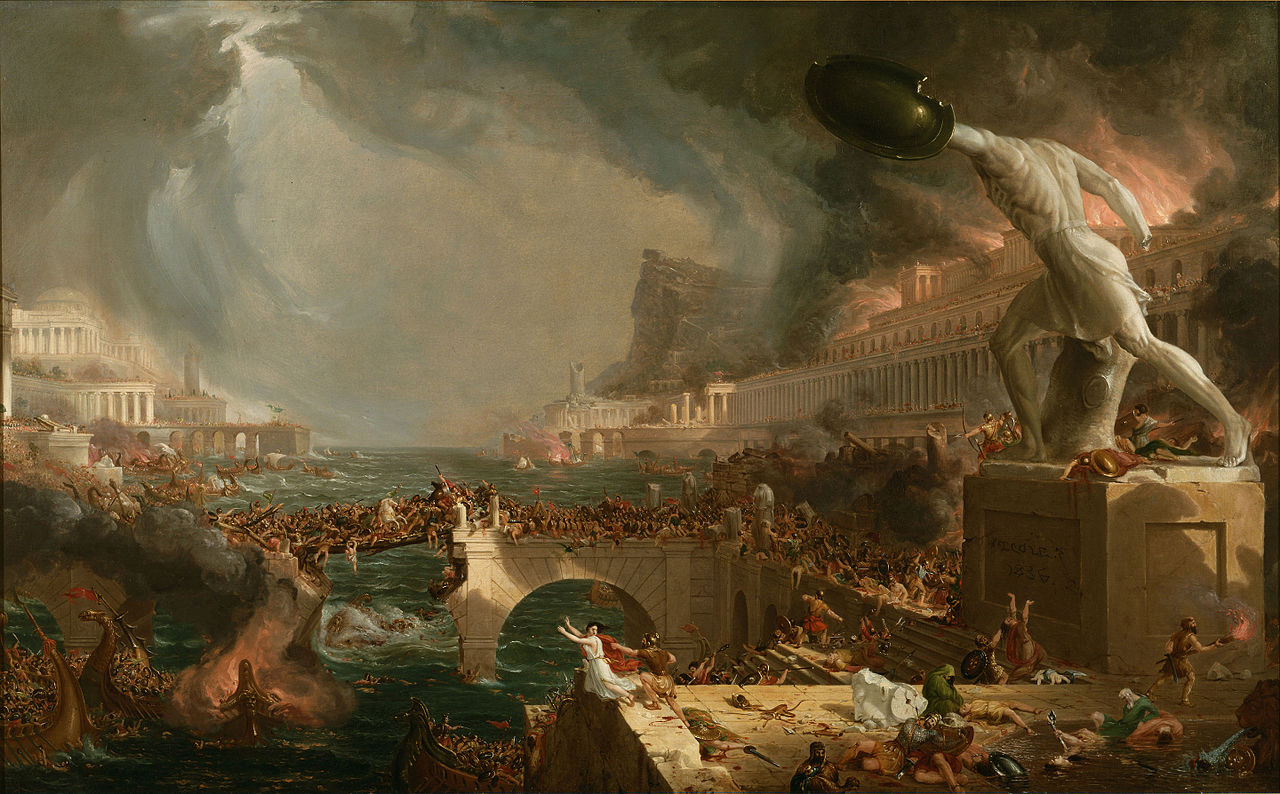
The Course of Empire – Destruction by Thomas Cole, 1836.
From the New York Historical Society collection via Wikimedia Commons.

The premise for this article might seem surprising to many who are used to believing that the Fukuyaman “end of history”, with its proposed ultimate victory of liberal democracy and market capitalism, is a done deal. After all, we look around the world and see the spread of democracy (even if by military force) taking place, as well as seeing the world seemingly integrated into a global economy characterized by complete fungibility of capital, resources, and labour. Yet, while this may be the façade which we are presented, it is manifestly obvious that most of what is called “democracy” is a sham and most of what is called “capitalism” is merely a cover for cronyism at the highest levels. This is the case even in the United States. We can no longer call our system “liberal” in any sort of classical sense when you can be jailed for referring to someone with the “wrong” pronoun and where the supposedly “free” press is effectively only the propaganda arm of one political party.

All over the world, classical liberalism is being supplanted by socialism and progressivism. This is obvious. What is even more obvious is that classical liberalism has been completely unable to prevent this from occurring. While there are some places where the tide is at least being slowed, this is due to the efforts of nationalists and others calling for stronger government along reactionary and traditional lines, not by those advocating for Reaganism, Thatcherism, or other manifestations of modern classical liberalism. Indeed, the two primary expressions of modern classical liberalism – libertarianism and American-style conservatism – are basically failures in every way. Libertarianism has devolved into a clown show of competing virtue signals, while conservatism (which has yet to actually conserve anything) has fastened onto itself the straitjacket of ideological dogmatism dictated to it by neo-conservatives and K-Street lobbyists.

We should not be surprised, however, that this has been the case. Classical liberalism itself was doomed from its inception. The reason for this is that classical liberalism derived directly from the sort of shoddy and shallow philosophies that drove the so-called “Enlightenment”. The Enlightenment – which we were all told was a good thing by our publik skoolz – represented a marked departure by Western civilisation from traditional realities upon which successful Western cultures were built. In contrast to the traditional values of the West, Enlightenment values represented a very skewed, unrealistic form of wishful thinking. Once these departures began to be codified into practice at the national level, it was only a matter of time before the leftward drift affected even the most morally well-insulated nations.

Below, I would like to discuss four basic areas where classical liberalism as an Enlightenment philosophy was set up for failure from the beginning.

On a somewhat less polemic level, Andrew Potter wonders if the sense of civilizational decline and dissolution many of us are feeling is down to the lack of community:

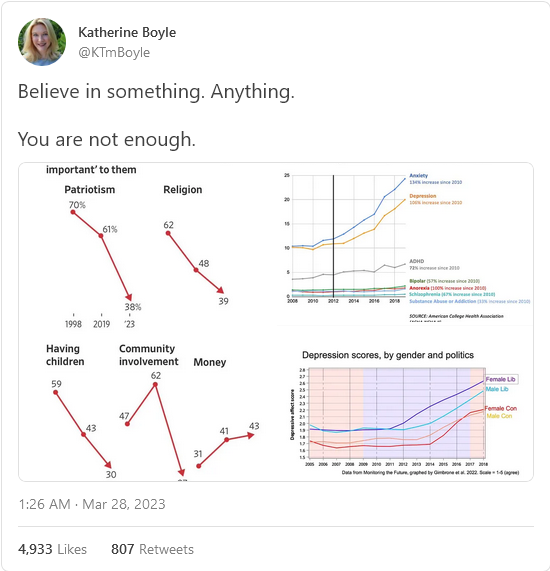
Here are some charts that were going around the social media the other day:

Boyle — a partner at Andreessen Horowitz — paired these charts with links to a series of reports and studies connecting these declines to a clutch of modern day problems, in particular rising levels of anxiety and depression, despair, most notably amongst the young.

As the boomers used to say, you don’t need a weatherman to know which way the wind is blowing. The Western world is in a bit of a funk.

Our political systems have become impossibly polarized, our economies stagger from one crisis to the next, and the welfare state is bumping up against the limits imposed by escalating costs and diminishing state capacity. All of this comes as people are losing faith in the institutions that have served for decades as the building blocks of a cohesive society. Our reserves of social capital are depleted as numerous countries report falling levels of patriotism, religiosity, and community-mindedness. Everyone’s more or less given up on having kids, while close to a third of men aged 18-30 haven’t had sex in the past year.

These stats vary from country to country, and some places are obviously doing better than others. But the trends are grim across the board; there’s no question that, in general, people in the West are in a bad way. The debate revolves around the cause or causes of these phenomena. Is it social media? The pandemic? Housing prices, debt and precarious employment?

One possibility is that the problem lies with the modern world itself. That the basket of rights-based political individualism and consumer-driven economic capitalism might provide us with all manner of creature comforts and technological wonders, but it doesn’t give us meaning. At the dark heart of liberalism lies nihilism.

This is not a new charge, it has been around as long as there has been liberalism. Yet there’s a bit of disagreement over exactly where the problem lies. For some, from Dostoevsky to the existentialists, the worry was deeply metaphysical: that in the absence of a god, or some comparable external source of absolute morality, the only alternative is raw moral relativism.

For other critics, the complaint is more aesthetic. The consumer goods and individualistic values that liberalism promotes are seen as terribly shallow and narcissistic, with the vulgar virtues of television and cheeseburgers supplanting the higher arts of opera and the terroir.

But there’s another argument, that sort of splits the difference between the metaphysical and the aesthetic worries. This is the idea that for all its promotion of radical pluralism, liberalism is actually hostile to true difference and diversity, of the sort that permits the flourishing of distinct communities. This was the central complaint of the Canadian philosopher George Grant, whose anti-American nationalism was based not on any sense that Canada was intrinsically worthwhile, but that its more collective approach to public life would foster a communitarianism that was not possible in the United States.

April 7, 2023

Political demands without proper definitions

Filed under: Media, Politics, USA, Weapons — Tags: , , — Nicholas @ 05:00

Chris Bray identifies an all-too-common pattern from the people who demand change, but can’t seem to adequately explain what they’re so all-fired passionate about:

There’s an exchange I’ve seen a dozen times in the last few months, and it’s always more or less the same. The faces and the names change, but the structure of the discussion is consistent. It happened last week between Senator John Kennedy and Homeland Security Secretary Alejandro Mayorkas (video is time-stamped to 1:55 or so, when the discussion begins, but Substack sometimes eats the timestamp, so fast-forward if necessary):

I won’t quote from it, because it’s so casually bizarre and unsettling you should just watch it to see for yourself, but Kennedy notes that Mayorkas has recently and very publicly demanded a federal ban on assault weapons — and then he asks Mayorkas to define “assault weapons”. You want to ban X, so what is X? What is the thing you intend to ban?

Mayorkas responds with all known forms of rhetorical deflection short of diving under the table: “I defer to the experts,” do it for the children, it is no longer acceptable to do nothing as people die, the children the children the children. But he will not propose a definition for the term. He wants to ban something, but he refuses to say what he wants to ban. Kennedy keeps asking; Mayorkas keeps right on with not ever saying. The closest he ever comes to an answer is that at one point he tentatively upspeaks a firm maybe, saying that possibly assault weapons are kind of … military style? But then he won’t say what that means, either.

Not noticing himself, Mayorkas just comes right out and says one of the things that fatally undermines his own claim that he lacks the expertise to participate in the discussion, noting that he worked as both an assistant U.S. attorney and as the U.S. Attorney for the Central District of California while the last federal assault weapons ban was on the books. So he’s been a federal prosecutor, and has led federal prosecutors, during a period when federal prosecutors went to court to enforce an assault weapons ban, but he can’t possibly discuss a legal definition of the term “assault weapon,” because he’s not an expert in a question that was central to his professional identity for years. I don’t know nothin’ about all this giraffe anatomy, says local zoo veterinarian.

So this is the structure of the exchange:

    Very Senior Government Official: I demand that we do X, because X is very important.

    Questioner: Okay, what is X?

    Very Senior Government Official: I have no idea.

[…]

Over and over and over again, prominent members of the political class argue for things by throwing their givens around the room, and that’s all they can do. I feel very strongly that we need common sense solutions, in the sense that the solutions we need are very common sense things that we can all agree are very common sense. If you try to penetrate the half-millimeter of topsoil to find out what’s underneath, you see that there isn’t anything down there. You can ask them to explain their underlying premises, or to explain by logical steps how they reached their policy conclusions, but you’re just being charitable. They don’t have any of that, and wouldn’t admit it if they did. They simply feel, senator, that we must protect the children. With bipartisan solutions. That are common sense.

Yes, this is sometimes a tactic, and they know what they mean. But the brittle crust at the top edge of the discourse increasingly seems to not be characterized by the sneaky maneuver. There’s often nothing to probe for. There’s no debate to be had by opening a space for the discussion. Remarkable numbers of “leaders” read what’s on the index card — and then look up, finished with the statement, waiting for a treat like a golden retriever.

    I am for [symbol]!

    Mister Secretary, what do you mean by [symbol]?

    I am for [symbol], I am for [symbol]! (Long pause.) I am for [symbol!]

So it seems to me that the first fact about our political discourse is that it’s increasingly about nothing, populated by people who don’t mean anything and can’t think about anything. There’s often no possibility of an exchange that leads to a deepened understanding, because there’s nothing in there. We must fight inflation by passing the Inflation Reduction Act! The public sphere has been emptied; its where we go to pass null sets back and forth.

QotD: The effluvium of the university’s overproduction of progressive “elites”

By the late 1990s the rapid expansion of the universities came to a halt, especially in the humanities. Faculty openings slowed or stopped in many fields. Graduate enrollment cratered. In my own department in 10 years we went from accepting over a hundred students for graduate study to under 20 for a simple reason. We could not place our students. The hordes who took courses in critical pedagogy, insurgent sociology, gender studies, radical anthropology, Marxist cinema theory, and postmodernism could no longer hope for university careers.

What became of them? No single answer is possible. They joined the work force. Some became baristas, tech supporters, Amazon staffers and real estate agents. Others with intellectual ambitions found positions with the remaining newspapers and online periodicals, but most often they landed jobs as writers or researchers with liberal government agencies, foundations, or NGOs. In all these capacities they brought along the sensibilities and jargon they learned on campus.

It is the exodus from the universities that explains what is happening in the larger culture. The leftists who would have vanished as assistant professors in conferences on narratology and gender fluidity or disappeared as law professors with unreadable essays on misogynist hegemony and intersectionality have been pushed out into the larger culture. They staff the ballooning diversity and inclusion commissariats that assault us with vapid statements and inane programs couched in the language they learned in school. We are witnessing the invasion of the public square by the campus, an intrusion of academic terms and sensibilities that has leaped the ivy-covered walls aided by social media. The buzz words of the campus — diversity, inclusion, microaggression, power differential, white privilege, group safety — have become the buzz words in public life. Already confusing on campus, they become noxious off campus. “The slovenliness of our language”, declared Orwell in his classic 1946 essay, “Politics and the English Language“, makes it “easier for us to have foolish thoughts.”

Orwell targeted language that defended “the indefensible” such as the British rule of India, Soviet purges and the bombing of Hiroshima. He offered examples of corrupt language. “The Soviet press is the freest in the world.” The use of euphemisms or lies to defend the indefensible has hardly disappeared: Putin called the invasion of Ukraine “a special military operation”, and anyone calling it a “war” or “invasion” has been arrested.

But today, unlike in 1946, political language of Western progressives does not so much as defend the indefensible as defend the defendable. This renders the issue trickier than when Orwell broached it. Apologies for criminal deeds of the state denounce themselves. Justifications for liberal desiderata, however, almost immunize themselves to objections. If you question diversity mania, you support Western imperialism. Wonder about the significance of microaggression? You are a microaggressor. Have doubts about an eternal, all-inclusive white supremacy? You benefit from white privilege. Skeptical about new pronouns? You abet the suicide of fragile adolescents.

Russell Jacoby, “The Takeover”, Tablet, 2022-12-19.

April 5, 2023

Justin Trudeau chooses the Argentinian model over the Canadian model

In The Line, Matt Gurney considers the proposition that “Canada is broken”:

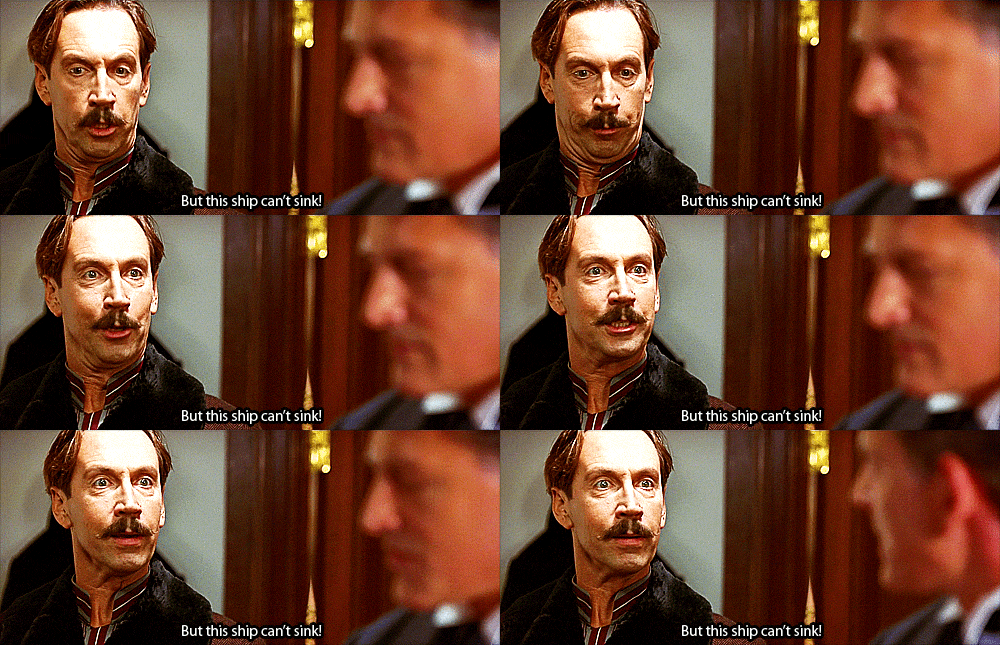
To the growing list of articles grappling with the issue of whether Canada is broken — and how it’s broken, if it is — we can add this one, by the Globe and Mail‘s Tony Keller. I can say with all sincerity that Keller’s is one of the better, more thoughtful examples in this expanding ouevre. Keller takes the issue seriously, which is more than can be said of some Canadian thought leaders, whose response to the question is often akin to the Bruce Ismay character from Titanic after being told the ship is doomed.

(Spoiler: it sank.)

But back to the Globe article. Specifically, Keller writes about how once upon a time, just over a century ago, Canada and Argentina seemed to be on about the same trajectory toward prosperity and stability. If anything, Argentina may have had the edge. Those with much grasp of 20th-century history will recall that that isn’t exactly how things panned out. I hope readers will indulge me a long quote from Keller’s piece, which summarizes the key points:

    By the last third of the 20th century, [Argentina] had performed a rare feat: it had gone backward, from one of the most developed countries to what the International Monetary Fund now classifies as a developing country. Argentina’s economic output is today far below Canada’s, and consequently the average Argentinian’s income is far below that of the average Canadian.

    Argentina was not flattened by a meteor or depopulated by a plague. It was not ground into rubble by warring armies. What happened to Argentina were bad choices, bad policies and bad government.

    It made no difference that these were often politically popular. If anything, it made things worse since the bad decisions – from protectionism to resources wasted on misguided industrial policies to meddling in markets to control prices – were all the more difficult to unwind. Over time the mistakes added up, or rather subtracted down. It was like compound interest in reverse.

And this, Keller warns, might be Canada’s future. As for the claim made by Pierre Poilievre that “Canada is broken”, Keller says this: “It’s not quite right, but it isn’t entirely wrong.”

I disagree with Keller on that, but I suspect that’s because we define “broken” differently. We at The Line have tried to make this point before, and it’s worth repeating here: we think a lot of the pushback against the suggestion that Canada might be broken is because Canada is still prosperous, comfy, generally safe, and all the rest. Many, old enough to live in paid-off homes that are suddenly worth a fortune, may be enjoying the best years of their lives, at least financially speaking. Suggesting that this is “broken” sometimes seems absurd.

But it’s not: it’s possible we are broken but enjoying a lag period, spared from feeling the full effects of the breakdown by our accumulated wealth and social capital. The engines have stopped, so to speak, but we still have enough momentum to keep sailing for a bit. Put more bluntly, “broken” isn’t a synonym for “destroyed”. A country can still be prosperous and stable and also be broken — especially if it was prosperous and stable for long enough before it broke. The question then becomes how long the prosperity and stability will last. Canada is probably rich enough to get away with being broken for a good long while. What’s already in the pantry will keep us fed and happy for years to come.

But not indefinitely.

April 4, 2023

“We can at least appreciate the irony of an Indian and Pakistani coming to blows over the issue of partitioning Britain”

Filed under: Britain, Europe, Politics — Tags: , , , , , — Nicholas @ 03:00

Ed West on the historical oddity of the three leaders of Eire, Scotland, and the United Kingdom all being of south Asian descent:

Irish Taoiseach Leo Varadkar and British Prime Minister Rishi Sunak
Composite image from extra.ie

There’s a joke going around Irish WhatsApp that goes like this: “An Irishman, Englishman and Scotsman sit down for a historic summit regarding their ancient grievances.” The image shows the Taoiseach Leo Varadkar, British Prime Minister Rishi Sunak and Humza Yousaf, newly elected First Minister of Scotland.

That three men of South Asian ancestry now lead those three nations is something which even ten years ago would have seemed implausible; a generation further back simply bizarre. And that doesn’t take into account Britain’s most senior directly elected politician, London Mayor Sadiq Khan.

What makes it stranger is that Mr Yousaf, of Pakistani origin, and Sunak, of Indian descent – although both via British East Africa – will be engaged in deciding the future of the Union. As one wit put it, “We can at least appreciate the irony of an Indian and Pakistani coming to blows over the issue of partitioning Britain.”

Yet although both Scotland and England are now led by men with roots in the subcontinent, that is where the comparisons between the two countries end. Yousaf might like to mimic American race talking points, but he presides over a country which is overwhelmingly white and will remain so (although we’re still awaiting the latest census results); the southern kingdom is in contrast now very multiracial, and projected to get more so – a process accelerated by the Tory Government.

Britain has undergone a demographic revolution since the Second World War, a transformation into a multicultural society. Out of the ashes of the British Empire the country’s rules ended up creating a new empire at home, one where this time they could be the good guys. Just like the first British Empire, this one might be called Anglo-Indian, with the two leading parties partly aligning along old divisions between Hindu and Muslim. Like the first empire, this new diverse rainbow of nations entails strict new blasphemy codes, even if now dressed up as hate speech.

Yet this great change has hardly affected Scotland. The two countries have diverged along different paths, and this is perhaps one reason why it may prove hard to hold our multicultural empire together, although it’s a cause liberal defenders of Britishness are loath to admit. Where once the countries were brought together by Protestantism, the English language and empire, now the new “good” British Empire drives them apart, while the English language is a global source of division.

April 2, 2023

“Digital blackface” (and it’s not Justin Trudeau trying on fresh face paint)

Filed under: Media, Politics, Technology, USA — Tags: , , , — Nicholas @ 04:00

Kat Rosenfield on the desperate efforts of the terminally online to make “digital blackface” a cancellable crime for white people:

Five years after Sweet Brown’s original interview, it was given new weight with the coining of a phrase. In a Teen Vogue essay, Lauren Michele Jackson described the act of non-black people using reaction GIFs featuring black Americans as “digital blackface”. And so, a trend was born: The New York Times weighed in, followed by The Guardian, followed by the mommy bloggers and the service journalists. Just when it seemed like the internet had squeezed the concept dry, it returned again, last weekend, in the form of a clickbaity banner on the front page of CNN: “What’s ‘digital blackface’? And why is it wrong when White people use it?”

For those who remember this argument in its original iteration, the immediate reaction is probably best encapsulated by a meme from the pre-social internet — not one of the ones that allegedly constitutes digital blackface, but the one from Mean Girls, in which an enraged Regina George hisses: “Stop trying to make ‘fetch’ happen! It’s not going to happen!” We do not need to do this again. This argument was transparent, racebaiting, outrage fodder even when it was new; now, it is all of that and tired.

If anything, the notion that, as CNN’s John Blake insists, employing reaction GIFs featuring black people represents “one of the most insidious forms of contemporary racism” is illustrative of just how badly the discourse is foundering in the wake of the massive racial reckoning sparked by the murder of George Floyd. All that momentum, all that money, all those marches and protests and pleas for real change end up being squandered again and again on luxury beliefs: galaxy-brained takes that circulate like wildfire among members of the coastal media class while being utterly bewildering to any normal person. The absurdity of Blake’s argument seems obvious even for those who think America is a long way from being a post-racial paradise. This is a country where black citizens remain underrepresented in key positions of power, and disproportionately suffer from poverty and violence. How terminally online must one be to think that the “most insidious” form of racism comes in the form of some 60-year-old Facebook grandma in Des Moines who feels that her emotions are best represented by a GIF of Stanley from The Office rolling his eyes?

But then, one gets the sense that no one does think this. Not even the people who are earning a living — or at least, a few hundred freelance dollars a pop — by arguing as much. Every writer who tackles this topic has dutifully attempted to connect the mimetic phenomenon of reaction GIFs to the atrocious (and happily defunct) practice of minstrel shows featuring performers in actual blackface. But given the integrated state of contemporary society, and the substantive difference between posting a video of a black cultural icon and doing a mocking impression of one yourself, that’s a tough argument to sell.

Often, those recycling it don’t even seem to be trying. Women’s Health claims that using the wrong reaction GIFs isn’t just upstream from minstrelsy, but also from murder: “[As] it has been proven throughout U.S. history, a Black man can be killed for demonstrating aggression, confusion, or even indifference. Popular GIFs of Kanye West looking serious, Nick Young with question marks around his face, and others, show Black men expressing themselves which, while technically be harmless [sic], can oftentimes be fatal.”

This isn’t just unpersuasive; it’s practically incoherent. Does anyone believe this argument? Does anyone even believe that the writer believed it? The whole enterprise feels so convictionless, more like a simulation of an opinion than the real thing.

April 1, 2023

The fastest growing demographic in Canada might be the “Pretendians”

Filed under: Cancon, History, Media, Politics — Tags: , , , , , — Nicholas @ 04:00

In Quillette, George Case outlines the fraught topic of claimed First Nations heritage among Canadians:

“The Pretendians”, a CBC documentary – https://www.cbc.ca/passionateeye/episodes/the-pretendians

Many North Americans have cited such extraction as a conversation piece, an exotic mark of character, or just an intriguing bit of genealogy: among them are singers Cher and Beyoncé, actor Johnny Depp, rockers Jimi Hendrix and Robbie Robertson, baseball great Johnny Bench, and numerous others.

That such backgrounds are both perfectly plausible and difficult to verify tells us something about the history of the human species since 1492. Consensual or coerced relations between Europeans, Africans, and Indigenous people throughout the Americas — even when socially deplored or officially prohibited—must have happened countless times to generate the populace we are today. Most of us, by some measure, are mini-melting pots. And consider, too, today’s routine unions of partners whose great-grandparents might have been horrified at the prospect of “marrying out”: Protestants with Catholics, Jews with Gentiles, Asians with Anglos, and a rainbow of other combinations. Indeed, to oppose such relationships, and the products thereof, is now usually seen as a small-minded prejudice of the ignorant and intolerant.

Unless the opponent happens to be a Native person. In Canada, over the last few years, a rash of scandals have erupted over prominent figures whose claims of Aboriginal heritage have been heatedly disproved, like novelist Joseph Boyden, actress and filmmaker Michelle Latimer, academic Carrie Bourassa, and former judge Mary Ellen Turpel-Lafond. The uproar around “Pretendians” has raised uncomfortable questions around race and politics that the angriest Aboriginals may not have intended in their denunciations. Métis lawyer Jean Teillet has called the phenomenon “the ultimate step in colonialism”, while on The Indigenous Foundation website, Neegahnii Madeline Chakasim has asserted, “To claim Indigenous ancestry and/or claim to be a member of a Nation without any evidence, or claiming Indigeneity for the fun of it, is a complete slap to the face of any existing Indigenous person.” And Ojibwe writer Drew Hayden Taylor explained the message of his 2022 documentary, The Pretendians, by remarking, “In past centuries, the dominant culture has tried to take so many things from us, leaving behind the one thing most important to us: who we are.”

Yet just who are “we”? As with so much else in conventional Canadian wisdom around Native issues, the jealous guarding of authentic Native identity has its logical terminus in a separate-but-equal regime that contradicts the universal impartiality promised to all citizens: sanctioned racial essentialism for Aboriginals, mandatory multiculturalism for everyone else. Never discriminate against, but always discriminate in favor. In principle, all people are to be treated interchangeably, but in practice, one subset of people must be impermeably sealed off from others. At its creepiest, the Pretendian problem has echoes of the one-drop standards that obtained in Nazi Germany and the Jim Crow American South, insofar as sorting the real Natives from the fake ones is determined in part by a biological purity that few other cultures attempt to preserve, much less openly endorse.

It’s also ironic that in many episodes of exposed Pretendians, the purported disadvantage of a Native background — statistically, Canadian Natives are poorer than non-Natives, suffer higher rates of addiction and suicide, and have long been overrepresented in prisons and as victims of crime — is used as a bonus credential in academia or the arts. Schools and other institutions eager to boast of their ameliorative “Indigenization” programs have hired, commissioned works by, or otherwise granted special recognition to applicants based on unchecked claims of Aboriginal ancestry.

Eventually — and inevitably — some of those claims turn out to be flimsy: a vague personal biography here, a tenuous adoption record there, suspicious gaps in government documentation (Canadian Natives are entitled to hold a “Status Indian” card issued by federal or provincial agencies) somewhere else. This has happened across Canada, from Vancouver’s Emily Carr University of Art and Design, where faculty member Gina Adams’s Native lineage was called into question in 2021, to Kingston Ontario’s Queen’s University, where no less than six instructors and staff had their Native self-identification doubted in an anonymous report that came out the same year.

Complicating these situations, however, is that few of these cases seem to have been deliberate frauds. Even the famous imposter Archie Belaney (1888–1938), an Englishman whose Scottish-Apache persona of “Grey Owl” was wholly invented, parlayed his imaginary Native status into genuinely progressive campaigns for wilderness conservation in the early 20th century.

« Newer PostsOlder Posts »

Powered by WordPress