Quotulatiousness

September 18, 2024

Sexual objectification … is it okay when you do it to yourself?

Filed under: Britain, Media, Politics — Tags: , , , — Nicholas @ 05:00

On her Substack, Janice Fiamengo talks about the “Curious Case of the Self-Objectifying Feminist”:

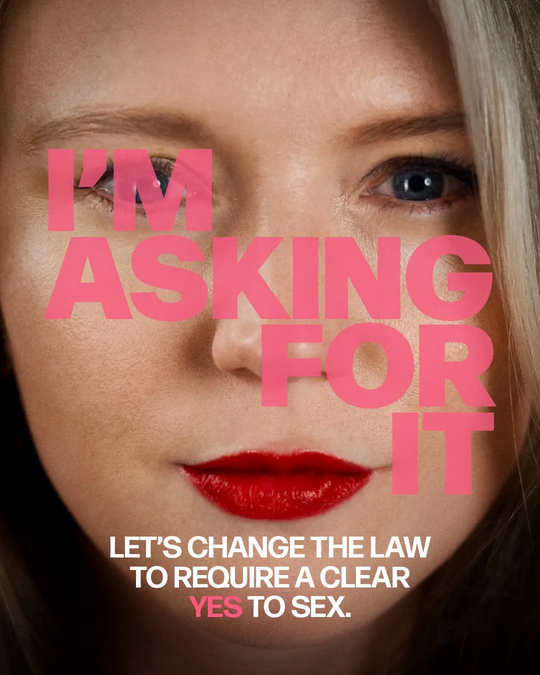
Not long ago, a British campaign for affirmative consent legislation featured images of women paired with the slogan “I’m asking for it“. The whole point, of course, is that they’re not asking for “it”. The phrase is meant to evoke men who justify their sexual assaults of women by claiming that the victim wanted to be raped. What the women are asking for is legislation to make it a criminal offence for a man to have a sexual encounter with a woman without eliciting an explicit “Yes” from her at every stage (how far we have moved from the relatively simple “No means no”).

The most striking of the ads features the face of Charlotte Proudman, the well-known feminist barrister and zealous anti-male advocate who once denounced a fellow lawyer for complimenting her LinkedIn photo. In the picture, Proudman confronts the viewer with a sexy, smoldering look and a slight half-smile. Her face is carefully made up to accentuate her feminine sexuality, with dark-tinted eyelashes and gleaming red lips outlined in vivid lip gloss. In order to object to men’s sexualization of women, Proudman has sexualized herself.

We are told that the campaign was “deliberately bold and intentionally provocative”. It was designed to “stop viewers in their tracks“, so that we would think about how women are mistreated under the law. Male viewers whose minds stray to sex are, one can only assume, to be brought up short, ashamed and convicted of sin.

The double messaging is deliberate — but confusing. Most people looking at Charlotte Proudman’s sex-kitten face will not, in my opinion, contemplate misogynistic attitudes or the scourge of sexual violence. On the contrary, most viewers will be “stopped in their tracks” by the overtness of Proudman’s sensual self-display. It seems odd that an ad claiming that women should not be seen to invite sexual advances features a woman who seems to be inviting sexual advances.

Feminists have for decades claimed that such sexualization has been forced on women to their detriment. In the fashion industry, in movies, and in daily life, according to feminist philosophers like Sandra Lee Bartky, men compel women to advertise their sexuality as their primary power, to redden their lips, assume sexual poses and flatter the voracious male gaze, becoming “object and prey for the man“.

For centuries, we’re told, patriarchal societies denied women the opportunity to do anything with their lives but live out male sexual fantasies, whether as virgin or whore, Madonna or muse. A male-defined culture made the woman accentuate her youth, shave her legs, remain svelte, and present herself for visual consumption, “living her body as seen by another, an anonymous patriarchal Other“: a degrading spectacle from which all women would be better off free.

Yet here is a campaign designed by feminists to support alleged rape victims, with the same (objectionable) self-presentation by the ad’s primary subject, who is obviously not posing against her will and obviously has many choices about how to present herself. The only difference, it seems, is that in this case, the woman’s self-display is entirely of her own defiant volition.

One wouldn’t think that would be sufficient for a diehard feminist like Proudman, or for any equality-minded modern woman with a thousand choices about what to do with her life.

When I was a little girl in the early 1970s, I took it for granted that self-respecting women wanted to be appreciated for the qualities of their minds and characters. One of the first slogans I remember was the somewhat puzzling “Love me for my mind, not my body”. At the time, around six or seven years old, I thought it would be nice to be loved for any reason. Only later did I understand the implication: to be loved for one’s body was not truly to be loved at all, for the body was a superficial, mutable aspect of the self, destined to deteriorate with time. Moreover, according to the general feminist perspective, the body was all that sexist men cared about, especially the sexual parts. This was objectification, the reduction of the whole woman with all she had to offer (her kindness, her wit, her unique thoughts) to a thing. It was shameful and degrading.

Canucks. In. Space – “racist, exploitative, elitist, and environmentally destructive”

Filed under: Cancon, Military, Politics, Space — Tags: , , , , , — Nicholas @ 03:00

In the National Post, Tristin Hopper‘s First Reading on a recently commissioned report for the Canadian Armed Forces on space exploration from an intersectional feminist viewpoint:

As Canada prepares to send an astronaut on the first manned moon mission in more than 50 years, its own military has commissioned a $32,250 report on how space exploration may actually be “racist, exploitative, elitist, and environmentally destructive”.

The 48-page report, entitled Hidden Harms: Human (In)security in Outer Space, concludes that human usage of space is currently “masculine, militarized and state-based”.

The authors also bemoan a space exploration field that is beholden to colonial concepts such as “technospeak” and “expertise”, and which doesn’t give appropriate weight to “spirituality, astrology, and cosmology, the last of which views celestial bodies in space as animated beings and not mere objects”.

As such, the report concludes that space will continue to be a realm of “hidden violence” against the world’s marginalized until “gender, race, class, ability, and sexuality” can be put at “the centre” of how decisions are made in the cosmos.

“Leadership is needed to normalize inclusion of different perspectives,” reads a conclusion.

The report has very little positive to say about the current state of human space exploration or space technology.

The whole endeavour is criticized as “technology-biased” because it fails to consider “gendered effects”. It’s “geography-biased”, because it doesn’t include equal participation from poorer countries.

It “normalize(s) violence and exploitation” by using language that depicts “outer space as a hostile and desolate environment that is unpeopled/inhuman and controlled so that it can provide an extractable resource”.

The construction of launch pads, satellite receivers and other ground infrastructure causes “disproportionate harm to Indigenous communities by severing their connection to ancestral lands”.

The report is also deeply critical of the fact that space is disproportionately inhabited by able-bodied males from wealthy countries. “Existing approaches are ahistorical and thus invisibilize diverse stakeholders and voices,” it reads.

Hidden Harms contains little to no discussion of the technical aspects of space exploration or technology. The word “rocket”, for instance, appears only once in a footnote in relation to how a falling rocket stage could hurt Inuit people. The word “orbit” appears in the text just once, when referencing how states could impose extraterrestrial harm by “permanently damaging objects on orbit”.

Nevertheless, the report is clear that all of these technical considerations should become secondary to “intersectional, decolonial, and humanitarian perspectives”.

“We must make space for the unfamiliar and the uncomfortable,” it reads.

It’s hardly surprising that an “intersectional feminist” view of space exploration would be harshly negative — what is surprising is that the Canadian Armed Forces paid to have this intellectual drivel written. A bit over $30k isn’t even a rounding error for the federal government, but as an indicator of just how federal bureaucrats are spending their departmental budgets it does seem to indicate that there’s a lot of fat in those budget numbers.

September 17, 2024

Noormohamed: “Nice newspaper, National Post. It’d be a shame if …”

Filed under: Business, Cancon, Media, Politics — Tags: , , — Nicholas @ 03:00

One of the more blatant examples of Liberals saying the quiet part out loud:

We need to talk about Liberal MP Taleeb Noormohamed and his not so subtle reminder to the National Post that it wouldn’t exist without the benefaction of Prime Minister Justin Trudeau’s government.

Noormohamed, Parliamentary Secretary for Heritage – the ministry responsible for media welfare – did so via a post on X in which he told NP Comment senior editor Terry Newman: “Your paper wouldn’t be in business were it not for the subsidies that the government that you hate put in place — the same subsidies your Trump-adjacent foreign hedge fund owners gladly take to pay your salary.”

I wrote at length about this for The Line and, being aware that there is some crossover among subscribers, I won’t repeat that, but here’s a summary, followed by an update and then we’ll dig a little deeper into government funding for media, trans activist extremism in the Senate and other juicy stuff.

As I wrote in The Line concerning the government’s willingness to put the squeeze on media, “Nothing Noormohamed said was untrue. He and I are in perfect alignment in the view that were it not for the patronage of the Justin Trudeau government, Postmedia (and likely the Toronto Star) would by now have ceased to exist. Some of its titles may have sold for parts, but most of its zombie products would have been dispatched long ago with a bankruptcy bullet to the brain, allowing new media to spring forth from decay.”

You can read it all here.

But the most alarming part of this story isn’t that Noormohamed said what he said. That was appalling but predictable. What’s truly chilling is that he could flex his muscles, whip out his influence and intimidate what was once a free and independent press in this country and get away with it.

There were just a handful of media responses to his highly inappropriate but not unexpected behaviour. A week later, I could find no fiery or even gentle editorials condemning his statements. My Google search revealed just three news stories (Western Standard, True North & Rebel News) while none of the nation’s leading commentators cleared their throats to object.

Perhaps this is because media decided it was no big deal that an influential government MP was reminding them to keep in mind just who is paying their bills when they sit down to write. It could also be that they are bothered by it but don’t wish to draw the public’s attention to their new role as government dependents because they know it undermines public trust in them. Or, they have just given up on the idea of freedom of the press but want to keep it as their dirty little secret. Maybe all three. All I could hear was the silence of the lambs being led to the slaughter.

September 16, 2024

Anger sells – “Words like ‘wrong’, ‘bad’, ‘awful’, ‘hate’, ‘sick’, ‘fight’, and ‘scary’ each predict a 2.3% increase in click-through rates”

Filed under: Media, Politics, Technology, USA — Tags: , , , , , , — Nicholas @ 03:00

Rob Henderson explains the incentives that lead to provoking as much anger as possible among readers (and especially voters):

It seems like people are angrier than ever. According to a poll by CBS News, 84 percent of Americans believe we are angrier than previous generations. Another survey recently found that nine in ten Americans can name either a recent news event or something about American politics that made them angry, while only half could identify a recent news event or something about American politics that made them proud.

What explains this feeling of rage? One noteworthy reason is that exploiting anger is politically convenient.

The strategic use of anger in politics has transformed it from a natural human emotion into a weapon of division, with far-reaching consequences for our social cohesion and democratic governance.

According to Steven Webster, author of “American Rage: How Anger Shapes Our Politics” and assistant professor of political science at Indiana University, “Anger provides ample benefits to those politicians who are able to use it most skillfully”.

Indeed, across political settings, angry people are more likely to vote than those who are not angry. In other words, politicians who can stoke anger can use it to motivate their base. The angrier voters are at the opposing party, the more likely they are to show up to the polls to support their own party. As Webster puts it, “angry voters are loyal voters”.

Political anger has consequences that extend beyond how Americans view their governing institutions or the opposing political party. When American voters are angry about politics, they are inclined to avoid social interactions or social events where they are likely to come into contact with those whose political leanings differ from their own.

In a chapter titled “Emotions in Politics” published last year, the psychologists Florian van Leeuwen and Michael Bang Peterson suggest that along with other emotions, anger “seems to be a distinct strategy for increasing what one is entitled to in the minds of others”.

Provoking rage against selected groups is an effective way to promote unity in politics. Today, many Americans across the political spectrum are encouraged to feel they are being victimized. It’s no coincidence that one of Donald Trump’s go-to lines on the campaign trail is “They’re laughing at us”. Being laughed at induces humiliation, which often quickly transforms into rage.

In a notable historical illustration of a political movement using anger as a limitless source of ideological fuel, consider the case of the “Recalling Bitterness” campaign in Maoist China. In the 1960s, the communist dictator Mao Zedong grew worried that ordinary Chinese citizens were developing lukewarm attitudes about the socialist revolution. In response, the regime forced people into rituals in which they publicly announced how bad life was before they had been liberated. Mao ordered writers and artists to rewrite history through the lens of class struggle to suit the needs of his political agenda. Regime officials held meetings encouraging peasants to describe how much better life was now compared to pre-liberation, hoping to convince them that the revolution’s successes outnumbered its failures. The “devils” here were reactionaries, landlords, rich farmers, and counterrevolutionaries. Documenting the rituals of the Recalling Bitterness campaign, the historian Guo Wu has written, “Only poor peasants were allowed to speak; former landlords and rich peasants were silenced”.

September 15, 2024

QotD: “Primordial” Marxism

By “primordial Marxism” I mean Marx’s original theory of immiseration and class warfare. Marx believed, and taught, that increasing exploitation of the proletariat would immiserate it, building up a counterpressure of rage that would bring on socialist revolution in a process as automatic as a steam engine.

Inconveniently, the only place this ever actually happened was in a Communist country – Poland – in 1981. I’m not going to get into the complicated historiography of how the Soviet Revolution itself failed to fit the causal sequence Marx expected; consult any decent history. What’s interesting for our purposes is that capitalism accidentally solved the immiseration problem well before then, by abolishing Marx’s proletariat through rising standards of living – reverse immiseration.

The most forward-thinking Marxists had already figured out this was going to be a problem by around 1910. This began a century-long struggle to find a theoretical basis for socialism decoupled from Marxian class analysis.

Early on, Lenin developed the theory of the revolutionary vanguard. In this telling, the proletariat was incapable of spontaneously respond to immiseration with socialist revolution but needed to be led to it by a vanguard of intellectuals and men of action which would, naturally, take a leading role in crafting the post-revolutionary paradise.

Only a few years later came one of the most virulent discoveries in this quest – Fascism. It is not simplifying much to say that Communists invented Fascism as an escape from the failure of class-warfare theory, then had to both fight their malignant offspring to death and gaslight everyone else into thinking that the second word in “National Socialism” meant anything but what it said.

During its short lifetime, Fascism did exert quite a fascination on the emerging managerial-statist elite. Before WWII much of that elite viewed Mussolini and Hitler as super-managers who Got Things Done, models to be emulated rather than blood-soaked tyrants. But Fascism’s appeal did not long survive its defeat.

Marxists had more success through replacing the Marxian economic class hierarchy with other ontologies of power in which some new victim group could be substituted for the vanished proletariat and plugged into the same drama of immiseration leading to inevitable revolution.

Most importantly, each of these mutations offered the international managerial elite a privileged role as the vanguard of the new revolution – a way to justify its supremacy and its embrace of managerial state socialism. This is how we got the Great Inversion – Marxists in the middle and upper classes, anti-Marxists in the working class being dismissed as gammons and deplorables.

Leaving out some failed experiments, we can distinguish three major categories of substitution. One, “world systems theory”, is no longer of more than historical interest. In this story, the role of the proletariat is taken by oppressed Third-World nations being raped of resources by capitalist oppressors.

Though world systems theory still gets some worship in academia, it succumbed to the inconvenient fact that the areas of the Third World most penetrated by capitalist “exploitation” tended to be those where living standards rose the fastest. The few really serious hellholes left are places (like, e.g. the Congo) where capitalism has been thwarted or co-opted by local bandits. But in general, Frantz Fanon’s wretched of the Earth are now being bourgeoisified as fast as the old proletariat was during and after WWII.

The other two mutations of Marxian vanguard theory were much more successful. One replaced the Marxian class hierarchy with a racialized hierarchy of victim groups. The other simply replaced “the proletariat” with “the environment”.

Eric S. Raymond, “The Great Inversion”, Armed and Dangerous, 2019-12-23.

September 13, 2024

“The problem [with America] is and has always been the people and their beliefs”

Filed under: Books, History, Media, Politics, USA — Tags: , , , — Nicholas @ 04:00

Chris Bray puts on the old biohazard suit and goes wading into the political book section, this time looking at two recent tomes by NeverTrumpers Robert Kagan and Tom Nichols:

Robert Kagan speaking in Warsaw, 2008-04-17.
Photo by Mariusz Kubik via Wikimedia Commons.

If you want to know where we are as a country, get your hands on a copy of Robert Kagan’s new book, Rebellion. Don’t worry, you won’t even need to crack the spine and open it. Kagan, who married the Queen of Eternal War Victoria Nuland and helped found the now defunct neoconservative Project for a New American Century, has written a warning about the dangerous renascence of antiliberalism in American political life: intolerance, a rejection of minority rights, hatred of progress. America is in deep trouble, Kagan warns. We’re close to losing our democracy! You can already see the freshness and originality of his thought.

Flip it. Take the book, turn it around, and look at that back cover, which carries an excerpt from inside, getting right to the meat of the thing. The problem isn’t the media, Kagan concludes. And it isn’t government. It isn’t a problem with institutions at all: “The problem is and has always been the people and their beliefs”. The thing that’s wrong with America is Americans, full stop. The country works brilliantly, except for the existence of the population. Imagine how healthy we would become if we could just get rid of them.

Should you make the mistake of opening the book, your experience will get worse in a hurry. The intellectual muddle is fatal. Here’s Kagan’s summary of the one big problem that runs through all of American history: “A straight line runs from the slaveholding South in the early to mid-nineteenth century to the post-Reconstruction South of the late nineteenth and early twentieth centuries, to the second Ku Klux Klan of the 1920s, to the Dixiecrats of the 1940s and 1950s, to Joseph McCarthy and the John Birch Society of the 1950s and 60s, to the burgeoning Christian nationalist movement of recent decades, to the New Right of the Reagan Era, to the Republican Party of today.”

All of those movements are precisely the same, you see. Ronald Reagan was a latter-day Ben Tillman, the Birchers merely a rebrand for the 1940s Southern Democrats, and Barry Goldwater was a fitting heir to Nathan Bedford Forrest. A shrewd mind is at work here. All, Kagan concludes, were figures representing “antiliberal groups”: “All have sought to ‘make America great again,’ by defending and restoring the old hierarchies and traditions that predated the Revolution.” The American Revolution, he means. The Dixiecrats and the Birchers and Reagan and Trump all want to restore Parliamentary supremacy and the landed aristocracy, or … something.

But pretend, for a moment, that Kagan has made some form of coherent statement about American history. He is arguing for the protection of the liberal order, the dignity of the common man and the premise that we’re all created equal. At the same time, he says, the biggest problem with America is … the American people themselves. How do those two claims fit together? What kind of politics can we frame around the dignity and inherent worth of the common man, who is stupid and worthless?

See also, on this theme, anything the former U.S. Naval War College professor Tom Nichols has written in the last decade, such as his warning in Our Own Worst Enemy: The Assault from Within on Modern Democracy that “our fellow citizens are an intolerable threat to our own safety” — a claim that closely mirrors Kagan’s warning about America being plagued by Americans. Consider this framing very carefully: if a threat is intolerable, what do you have to do about it?

Kagan’s base argument sounded better in the original German.

September 11, 2024

“You call someplace paradise, kiss it goodbye”

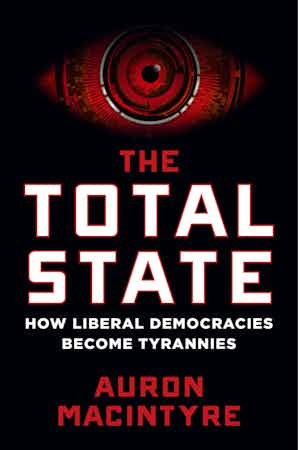
At The Upheaval, N.S. Lyons reviews The Total State: How Liberal Democracies Become Tyrannies by Auron MacIntyre:

Even when our nation’s dysfunction becomes too obvious to ignore, average Americans tend to comfort themselves with the story that it at least remains a democratic, constitutional republic. For such Americans, it’s probably been a confusing summer.

One moment the sitting president was, according to the near-universal insistence of mainstream media, sharp as a tack — all evidence to the contrary declared merely dangerous disinformation. The next he was suddenly agreed to be non compos mentis, unceremoniously ousted from the ballot for reelection, and replaced, not in a democratic primary but through the backroom machinations of unelected insiders. Overnight, the same media then converged to aggressively manufacture a simulacrum of sweeping grassroots enthusiasm for that replacement, the historically unpopular Kamala Harris. To call this a palace coup via The New York Times would seem not to stray too far from observable events.

What, some may wonder, just happened to our sacred democracy?

For those on the growing segment of American politics broadly known as the “New Right,” none of this was a surprise. The basic premise of the New Right — whose ranks notably include now-vice presidential candidate J.D. Vance — is that the governance of our country simply doesn’t function as we’re told it does. In fact, the United States has not operated as a constitutional republic for some time now; it is only the façade of one, effectively controlled by an unevictable cadre of rapacious plutocratic elites, corrupt party insiders, unelected bureaucrats, and subservient media apparatchiks — in short, a wholly unaccountable oligarchy.

Among the sharpest recent guides to this argument—and, in my view, to our current broader political moment—is a slim new book by the columnist and influential young New Right thinker Auron MacIntyre, titled The Total State: How Liberal Democracies Become Tyrannies.

MacIntyre provides a dispassionate dissection of how, without any cabal or specific conspiracy, an elite class captured all our major public and private institutions, hollowed them out, set them all marching in lockstep against the American middle-class, and made a mockery of the notion of constitutional “checks and balances”. The resulting “total state” now operates in increasingly flagrant contradiction to the interests of the American people and democratic government while “wearing the old regime like a skinsuit”.

Essential to understanding this total state is the concept of managerialism, an idea first pioneered by an older generation of political thinkers like James Burnham which has been recovered from relative obscurity and re-employed by the New Right. In this framing, America is today effectively run by a “managerial elite”, which presides over a broader professional managerial class — think college administrators, corporate HR managers, and non-profit activists. Fundamentally, the business of such people is not producing or building anything, providing any essential service, or even making critical leadership decisions, but the manipulation and management — that is, surveillance and control — of people, information, money, and ideas.

The story of the fall of the American republic is the story of the managers’ rise to power everywhere.

In part, this was the inevitable outcome of technological and economic change following the industrial revolution, which made it necessary to expand the ranks of people schooled in managing large, complex organizations. But, as MacIntyre demonstrates, it was also the result of a deeply misguided urge, pioneered by early progressives, to de-risk and “depoliticize” politics by handing over decision-making to technocratic “experts”. The hope was that these experts could rationally and neutrally administer government and society from the top down, through the same principles and processes of “scientific management” first applied to the assembly line.

This proved disastrous.

September 10, 2024

Chilling effect (with a British accent) – “No one is now sure what they are allowed to say”

Filed under: Britain, Liberty, Media, Politics — Tags: , , , , , — Nicholas @ 04:00

Spaceman Spiff makes a bid to star in one of Gauleiter Keir Stürmer’s big show trials, coming far too soon to a town hall near you:

In Britain many of us now walk on eggshells.

The country and its systems are broken. Free speech is being outlawed. Many are frightened to say anything, although it doesn’t stop them noticing and thinking.

Recent emphasis on invented categories of offence — misinformation, disinformation and now malinformation — mean almost anything can come under the purview of the State and its informers, from ill-timed comments to jokes and humorous observations.

Famously, memes based on simple observation are admissible in Britain’s world-famous show trials, including this one no doubt:1

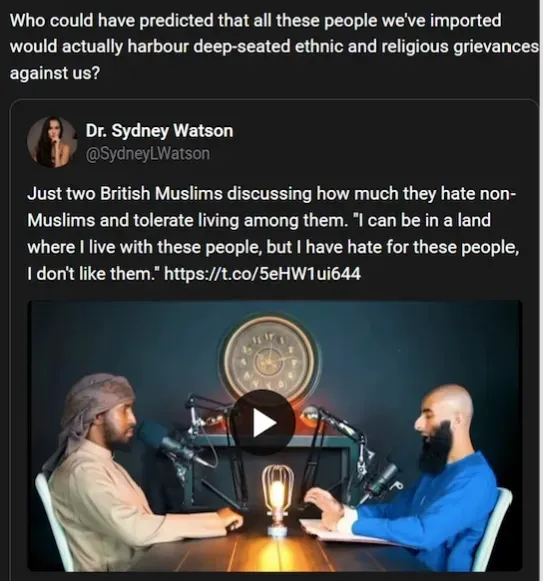
It is difficult to know what people are thinking when they endorse the importation of people who want to kill them for their lifestyle choices.

Everything must be monitored because less and less can be tolerated by those in positions of authority. Their narratives are failing, and they are panicking. They are getting desperate.

Noticing is verboten

Many of the topics that trigger the strongest response by the British Government are simply unpopular policies that normal people can no longer ignore.

More accurately, policies that directly affect growing numbers of law-abiding taxpayers who did not vote for them.

Do not discuss immigration

Mass immigration is the supreme example. Britain’s cities are being flooded with “asylum seekers”, most of whom are economic migrants with no right to settle in the country.

Many are alien peoples from distinct cultures with no connection to Europe and a poor track record of assimilation.

They are aided by an army of well-funded human rights lawyers who distort laws designed to help the genuinely dispossessed, which most immigrants are not.

Thanks to our generosity many privileges are extended to foreigners that are unavailable to natives such as free housing and financial help on the understanding these are used sparingly and temporarily to aid the desperate.

These myriad of kindnesses did not emerge to serve those who want the benefits of first-world living while dodging the corresponding costs; the development of high-trust social structures, the communal spirit that transcends tribalism, and the selflessness it all requires. These are rare phenomenon much of the world cannot produce or maintain, and they are being squandered in Western nations by the selfish obsessed with demonstrating their own virtue.

No serious discussion of immigration is tolerated at any level in Britain. However, this does not stop the erosion of goodwill upon which most of their schemes depend. The generosity they abuse is a limited resource and the magnanimity upon which it depends is evaporating quickly.


    1. Many are being jailed in Britain for posting memes and related social media content. The judges often go to some lengths to confirm it is not the content of the material they are questioning as they are perfectly legal, but the perceived intent behind the posting itself.

    This unprecedented legal descent into clairvoyance, hate speech and arrogance is relatively new. It will not age well and tells us more about the decline in competency in the judiciary than anything else. Standards are clearly not what they once were.

    To put this kind of absurd reasoning on display in irremovable public court records speaks to the level of delusion and arrogance we are now dealing with in Britain. Our social betters are truly lost in a world of their own.

September 9, 2024

Update your Overton Window – “[A]nyone to the immediate right of 2024 liberal democracy is a fascist”

Filed under: Europe, Germany, Media, Politics, USA — Tags: , , , , , — Nicholas @ 04:00

In Niccolo Soldo’s weekly commentary, a few insights into European “mainstream” political views on extreme right-wing crypto-fascists like … everyone who doesn’t support far left positions:

If you think that US media is bad, you should check out just how awful their German colleagues are. Their media is filled to the brim with daily hysteria about the Russians, Nazis, fascists, and so on. Every single day is a struggle to survive against these existential threats.

To the mainstream German media, a conservative Christian Democrat (the kind that ruled much of Western Europe during the Cold War) like Viktor Orban is a fascist in disguise. To the mainstream German media, a statist centrist like Vladimir Putin is Hitler without the disguise. A 90s Clinton Liberal like Donald Trump is both.

Thankfully, Der Spiegel reached out to writers and researchers who specialize in fascism to tell us that all of the above are fascists, and some are Nazis too:

    The reversion to fascism is a deep-seated fear of modern democratic societies. Yet while it long seemed rather unlikely and unimaginable, it has now begun to look like a serious threat. Vladimir Putin’s imperial ambitions in Russia. Narendra Modi’s Hindu nationalism in India. The election victory of Giorgia Meloni in Italy. Marine Le Pen’s strategy of normalizing right-wing extremism in France. Javier Milei’s victory in Argentina. Viktor Orbán’s autocratic domination of Hungary. The comebacks of the far-right FPÖ party in Austria and of Geert Wilders in the Netherlands. Germany’s AfD. Nayib Bukele’s autocratic regime in El Salvador, which is largely under the radar despite being astoundingly single-minded, even using the threat of armed violence to push laws through parliament. Then there is the possibility of a second Trump administration, with fears that he could go even farther in a second term than he did during his first. And the attacks on migrant hostels in Britain. The neo-Nazi demonstration in Bautzen. The pandemic. The war in Ukraine. The inflation.

Meloni, Modi, Milei, Wilders, Bukele … all are suspected of crypto-fascism here.

Trump? “Fascist”, says neo-conservative Robert Kagan:

    In May 2016, Donald Trump emerged as the last Republican standing following the primaries, and the world was still a bit perplexed and rather concerned when the historian Robert Kagan published an article in the Washington Post under the headline “This is how fascism comes to America.”

    The piece was one of the first in the U.S. to articulate concerns that Trump is a fascist. It received significant attention around the world and DER SPIEGEL published the article as well. It was an attention-grabbing moment: What if Kagan is right? Indeed, it isn’t inaccurate to say that Kagan reignited the fascism debate with his essay. Interestingly, it was the same Robert Kagan who had spent years as an influential member of the Republican Party and was seen as one of the thought leaders for the neocons during the administration of George W. Bush.

    The article has aged well. Its characterization of Trump as a “strongman”. Its description of his deft use of fear, hatred and anger. “This is how fascism comes to America, not with jackboots and salutes,” Kagan wrote, “but with a television huckster, a phony billionaire, a textbook egomaniac ‘tapping into’ popular resentments and insecurities, and with an entire national political party – out of ambition or blind party loyalty, or simply out of fear – falling into line behind him.”

Jason Stanley, the Jacob Urowsky Professor of Philosophy at Yale University, says that fascism has already come to America:

    Six years ago, Stanley published a book in the U.S. called How Fascism Works: The Politics of Us and Them. The German translation only appeared two months ago, a source of annoyance for Stanley. He also has German citizenship and says that he loves the country despite everything.

    So how does fascism work? Modern-day fascism, Stanley writes, is a cult of the leader in which that leader promises rebirth to a disgraced country. Disgraced because immigrants, leftists, liberals, minorities, homosexuals and women have taken over the media, the schools and cultural institutions. Fascist regimes, Stanley argues, begin as social and political movements and parties – and they tend to be elected rather than overthrowing existing governments.

Timothy Snyder says that both Trump AND Putin are fascists:

    Timothy Snyder speaks thoughtfully and quietly, but with plenty of confidence. Putin is a fascist. Trump is a fascist. The difference: One holds power. The other does not. Not yet.

    “The problem with fascism,” Snyder says, “is that it’s not a presence in the way we want it to be. We want political doctrines to have clear definitions. We don’t want them to be paradoxical or dialectical.” Still, he says, fascism is an important category when it comes to understanding both history and the present, because it makes differences visible.

Austrian Political Scientist Natascha Strobl says that fascists are now everywhere:

    But this kind of violence can be seen everywhere, says the Austrian political scientist Natascha Strobl. It merely manifests itself differently than it did in the 1920s, when, early on in the fascist movement in northern Italy, gangs of thugs were going from village to village attacking farmer organizations and the offices of the socialist party, killing people and burning homes to the ground. Today, says Strobl, violence is primarily limited to the internet. “And it is,” says Strobl, “just as real. The people who perpetrate it believe they are involved in a global culture war, a struggle that knows no boundaries. An ideological civil war against all kinds of chimeras, such as ‘cultural Marxism’ or the ‘Great Replacement’.”

For Bulgarian think-tanker Ivan Krastev, AfD is a fascist organization:

    It is all rather perplexing. Back in Berlin, Ivan Krastev makes one of his Krastevian jokes. An American judge, he relates, once said that he may not be able to define pornography, “but I know it when I see it”. The reverse is true with fascism, says Krastev: It is simple to define, but difficult to recognize when you see it.

    The “F-word”. F as in fascism or F as in “Fuck you”. It is permissible, as a court in Meiningen ruled, to refer to Höcke as a fascist. The question remains, though, what doing so actually achieves.

So there you have it: anyone to the immediate right of 2024 liberal democracy is a fascist.

Bill C-63, the Online Harms Act

In the National Post, Barbara Kay explains why the Trudeau government will probably be urgently trying to get Bill C-63 through into law when Parliament resumes sitting later this month:

The sands of time were already running low for Justin Trudeau’s government. Jagmeet Singh’s just-announced withdrawal from their mutually supportive contract has widened the waist of the hourglass. Parliament resumes sitting on Sept. 16, and the Liberals will urgently seek to pass Bill C-63, the Online Harms Act, now in its second reading.

If passed in its present incarnation, this deeply flawed bill will drastically curtail freedom of speech in Canada (which, to be fair, is not an outlier on digital crackdowns in the West. Switzerland, of all places, just passed similar legislation).

We already have hate-crime laws in the Criminal Code that address advocacy for genocide, incitement of hatred and the wilful promotion of hatred. Apart from its laudatory intentions in removing online content that sexually victimizes children, Bill C-63 seeks to curb all online hate speech through unnecessary, inadvisable and draconian measures inappropriate to a democracy.

The law would create a new transgression: an “offence motivated by hated” which would raise the maximum penalty for advocacy of genocide from five years to life imprisonment. What kind of mindset considers the mere expression of hateful ideas as equivalent in moral depravity to rape and murder? Such instincts call to my mind the clever aperçu by anti-Marxist pundit David Horowitz that “Inside every progressive is a totalitarian screaming to get out”.

Another red flag: The law would give new powers to the federal cabinet to pass regulations that have the same force as legislation passed by Parliament, and that could, say, shut down a website. Unlike legislation, regulations created by cabinet do not require debate, votes or approval of Parliament. They can be decided in secrecy and come into force without public consultation or debate.

Yet another is the restoration of the “communication of hate speech” offence to the Canadian Human Rights Act, a provision similar to the one repealed in 2012. Frivolous or malicious complaints could be made against persons or organizations, granting complainants significant potential for financial reward at no personal cost, win or lose. Moreover, under this law, a complainant’s sense of injury from published words would trump a defence of objective truth. This is an open invitation for myriad social malcontents and grievance-mongers to swarm the system, with no regard for the inevitable harm done to those who they target.

September 8, 2024

The last dispatch from Toronto before the catastrophe began

Filed under: Business, Cancon, Media, Politics, Wine — Tags: , , , , — Nicholas @ 03:00

Toronto, in fact all of Ontario, may no longer be there when you get up tomorrow morning. As Chris Selley explained in his brave, final communiqué from the doomed province:

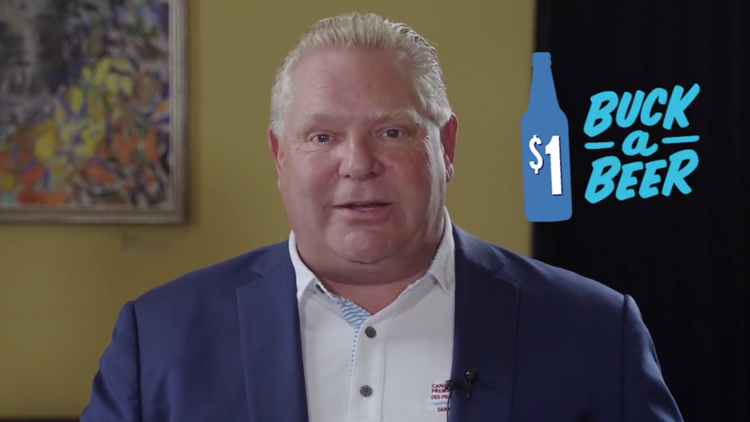
Doug Ford, the form of the destructor Ontario chose.

Dear non-Toronto friends,

This city is in crisis. This may be my last communiqué before the telex goes down for good, and I feel honour-bound to tell the world of my city’s plight. If the worst should occur, which it almost certainly will, please tell our story.

The unthinkable has occurred: Doug Ford’s madmen and women at Queen’s Park have licensed hundreds upon hundreds of new locations — called “convenience stores”, in local parlance — to sell beer, wine, cider and pre-mixed cocktails.

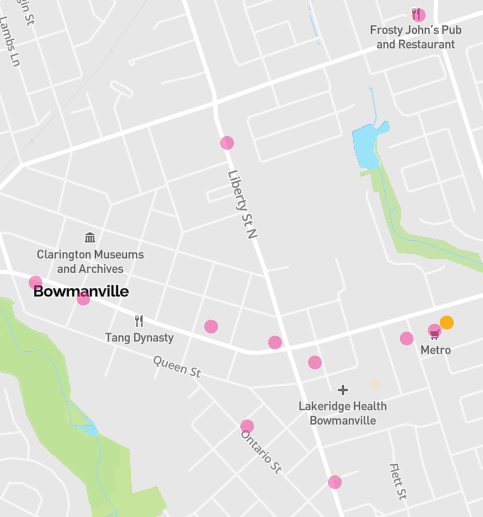
They did this instead of fixing health care, if you can believe that. And, outrage upon outrage, the government even made a map of such locations — as if delivering fallen Ontarians one by one to Mr. Booze himself.

Why, within just a few hundred metres of where I write, through my tears, I can discern on the map more than five such new locations. There’s Mei Convenience, Mimi Variety, Lucy Grocery and Meat, Queen & Jarvis Convenience … the list goes on, and on, my God. Church attendance is reportedly soaring as Torontonians steel themselves for the forthcoming.

Ford’s government did this entirely to solicit corporate donations to his party (some say that’s actually illegal, but whatever) from his buddies at convenience-store empires 7-Eleven and Couche-Tard … and presumably from Mimi and Lucy, whoever they are. Very rich women, clearly.

Instead of fixing health care!

Until recently, some semblance of sanity prevailed: The nearest government-run liquor store to where I sit now is a 15-minute walk away; the nearest Beer Store, the privately owned former quasi-monopoly where you’re still supposed to return your bottles and cans, is nearer to 20 minutes.

And now, suddenly, a bottle or can is shockingly near to hand. And this will lead to more alcohol-related harms. Of this there is no doubt, as one expert recently told the Toronto Methodist Star: “Harm will increase in Ontario. That is straightforward.”

It is true that many jurisdictions around the world report similar or lower levels of alcohol consumption and related harms than Ontario despite having much greater access to retail alcohol — Italy, Greece, the United States — but that is not germane to this discussion. Ontarians are not like other people. Ontario is not like other places. We are worse. Or maybe better. Or some combination of the two.

It’s true! Even saintly Bowmanville has been sullied with the demon liquor thanks to Premier Ford’s diabolical plan:

September 7, 2024

What is Jagmeet Singh’s actual plan here?

Filed under: Cancon, Government, Media, Politics — Tags: , , , , — Nicholas @ 05:00

In The Line, Jen Gerson outlines the NDP leader’s options now that the Confidence and Supply Agreement has been “ripped up”:

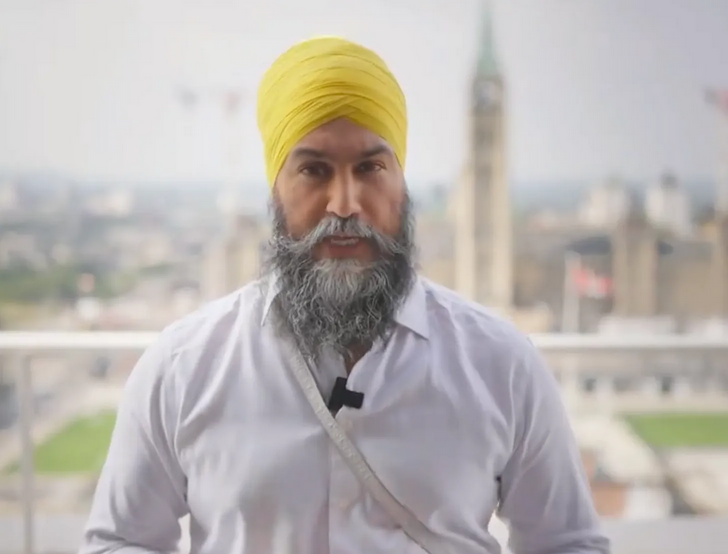
Federal NDP leader Jagmeet Singh announces the end of the Confidence and Supply Agreement.
Screencap from the NDP official video via The Line,

… I’m starting to consider the possibility that Jagmeet Singh is bad at politics.

I mean, think about this.

We at The Line have long pointed out that CASA was a bad deal for the NDP. It earned the party only a few piecemeal spending concessions like two-treatment Pharmacare and a half-baked dental program. It’s the Liberals who will, and have, taken full credit for both.

Meanwhile, Singh has lost all credibility as a government critic. What blows he can level at the Liberals are fatally undermined by the fact that he’s supported them for years. If the Liberals are complacent in enabling corporate greed, then Singh is demonstrably an enabler of a government that is “too weak, too selfish and too beholden to corporate interest to fight for people”?

I realize that nobody in Liberal-land is going to take this advice seriously, but I’m going to offer it anyway. On its current trajectory, Canada is heading toward a two-party system. Either the Liberals are going to eat the NDP, or the NDP is going to eat the Liberals. Until Wednesday, I put my money on the latter. Now, I’m not so sure.

If the Liberals maintain any existential instinct at all, they’d call Singh’s bluff. Drop the writ on a party that’s demonstrably unprepared to fight the battle it’s proclaimed. Eat the left, and survive to fight on another day. The meal is right there for the taking.

Singh’s big announcement about “ripping up” CASA — meep meep — gains him absolutely nothing. What additional leverage can he expect to acquire in a post-CASA parliament that he didn’t already possess?

Perhaps Wednesday’s announcement was merely a gambit to soothe internal problems, or distance himself from the Liberals. Okay, fine. This might be a viable strategy if it buys Singh a few months to trash Trudeau and raise funds off the effort while frantically trying to wash off the stinky stain of hypocrisy.

But what’s going to happen when the Liberals face their next confidence motion, presumably as soon as the Conservatives can arrange one? What happens at the next one, and the next one after that?

What credibility can Singh possibly hope to maintain if he votes for the Liberals, again? How in the world is the NDP seriously going to claim to have ripped up CASA while effectively acting as if it is in a CASA? The NDP cannot credibly distance itself from the sitting government while spending the next year propping up said government again and again and again in successive confidence motions. Especially after such a brazen display of pulling out of the deal.

No. They’re going to have to pull the trigger, and soon. Obviously. Clearly.

Singh sees this.

Right?

Trump’s visit to Arlington broke all the norms – no President has ever done this before!

Not being an American, I didn’t realize that sitting and former Presidents were banned from the grounds of Arlington National Cemetery, so Trump’s norm-obliterating visit has attracted widespread vilification from all corners of the nation:

If you read the news, Donald Trump recently did something so shocking and unprecedented that observers are staggered by his descent into evil:

He went to Arlington National Cemetery and brought a photographer, so the only possible comparison is to Literally Adolf Hitler. It was so outrageous for Trump to perform the Nazi maneuver of being photographed at Arlington that the son of the late Senator John McCain was forced to make an announcement to the world, revealing that the horror of the event had forced him to change his party registration and support the Democratic presidential candidate:

Sample framing from that story:

    Jimmy McCain, who has served for 17 years in the military and is an intelligence officer, said he was angered by Trump’s conduct at the cemetery last week, adding “it was a violation.”

    “It just blows me away,” he told CNN. “These men and women that are laying in the ground there have no choice” about being in a political ad.

See how evil Donald Trump is? No McCain man would ever stand for some bastard shooting a political ad at Arlington National Cemetery. Also, you can click here to watch the political ad that John McCain shot at Arlington National Cemetery.

[…]

September 6, 2024

Climate catastrophism in a phrase – “The sky gods are angry and we’re all gonna pay”

Filed under: Environment, History, Media, Politics, USA — Tags: , , , , — Nicholas @ 04:00

Relax, weather-panic true believers — this is a post from Jim Treacher who gets paid to write funny stuff. This means you can mock everything in it as “fake news”:

I’m pretty old at this point, and for my whole life, the media has been predicting the weather will kill us all.

When I was a kid, the news was all about the coming Ice Age.

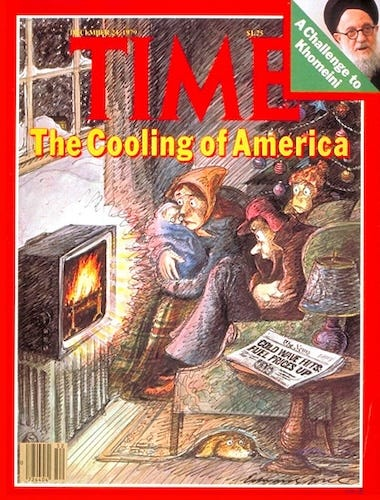
Brrrrr! Iran was a bunch of terrorist assholes even back in the ’70s, but the existential threat to America hadn’t been updated yet. They thought the cold was gonna get us.

And that dumb magazine was only $1.25 an issue! Everything might be more expensive 45 years later, but at least we haven’t all frozen to death.

Then the big threat became “global warming”. But when people noticed it wasn’t getting any warmer outside, despite the climate models that were supposed to horrify us, the scare tactic became “climate change”. They didn’t think we’d notice, I guess.

And through it all, there was one constant refrain: The sky gods are angry and we’re all gonna pay.

Do you leave your phone charger plugged in when you’re not using it? Do you drive a gas-powered car because it actually works? Then you’re destroying the planet, according to a pack of millionaires with yachts and private jets.

But now the celebrities and other climate supplicants are in dismay. The weather is letting them down again! Yet another of their predictions hasn’t come true, and they want to know why their climate deities have abandoned them.

Judson Jones, NYT:

    Halfway through an Atlantic hurricane season that forecasters expected would be one of the most active on record, there has been a considerable interlude in storms during what is typically the busiest portion of the season, leaving observers to wonder if the forecast was a bust — or if the worst may be yet to come.

    Often, at this time of the year, it isn’t uncommon to see two, three or even four named storms occurring simultaneously. But on Wednesday there were no current storms, and there hasn’t been one since Hurricane Ernesto formed, beginning as a tropical storm, on Aug. 12 …

    Despite the reprieve in recent weeks, though, “it is too early to dismiss the seasonal hurricane outlook as a bust,” said Dan Harnos, a meteorologist at the NOAA Climate Prediction Center.

You got that? We haven’t endured as many deadly, destructive hurricanes as the scientists predicted. And they’re worried about it. They want people to suffer and die, but they’re hopeful that nature will still unleash its fury on us.

There’s still time for the worst to happen. Fingers crossed!

“I support Jagmeet Singh’s right to terminate his half pregnancy”

Filed under: Cancon, Media, Politics — Tags: , , , , — Nicholas @ 03:00

Matt Gurney on NDP Leader Jagmeet Singh’s decision to pull the plug on the Confidence and Supply Agreement that had propped up Justin Trudeau’s government, long after it became clear that the Liberals were garnering all the benefits and the NDP were losing core supporters over the arrangement:

Let us start with words of affirmation and support: I support Jagmeet Singh’s right to terminate his half pregnancy. How could anyone not? His constant daily humiliation was getting uncomfortable to observe.

I know you might be expecting some kind of political analysis here. What will the end of the Confidence and Supply Agreement — or Supply and Confidence Agreement (we probably should’ve settled on one before the thing collapsed)—mean for Canadian politics, the upcoming elections, and the next general federal election? But the truth is, I don’t know. No one does. All we can say with any particular certainty is that our minority government situation has become more complicated. The Conservatives will keep trying to bring the government down. Don’t be surprised if they try to make everything a confidence motion, if only to further embarrass Singh. The NDP, for their part, will face some brutal decisions. Most polls show them heading for a wipeout, with half of their seats looking likely to flip to someone else. They’d need a huge spike in the polls just to break even. So, that’s going to be fun for them to navigate. Then, of course, there’s Justin Trudeau and the Liberals. Their prospects look awfully bleak, too. But it’s entirely possible they might decide to rip the Band-Aid off and call an election at some point in the reasonably near future.

Am I predicting any of these things? No. Like I said, I have no idea what’s going to happen. If I had to guess, I’d say the NDP will continue to support the government unofficially for the foreseeable future while all the parties reassess the new reality on the ground. But that guess is entirely subject to revision as events unfold. Time will tell. What more can I offer you?

So, in terms of political commentary on yesterday’s news, that’s about it. I don’t expect any immediate changes, and we’ll see where things shake out. Thanks for reading.

But there is a related point I’d like to make. And though it may sound snarky, I mean it with total sincerity. I am so, so happy for Jagmeet Singh. Since the deal was announced, he’s had to keep Trudeau in office while also acting like he was as disgusted with the PM as the typical Canadian voter seems to be. It was, truly, cringe-inducing, a real-life manifestation of the first half of the Hot Dog Car sketch (the back half gets weird).

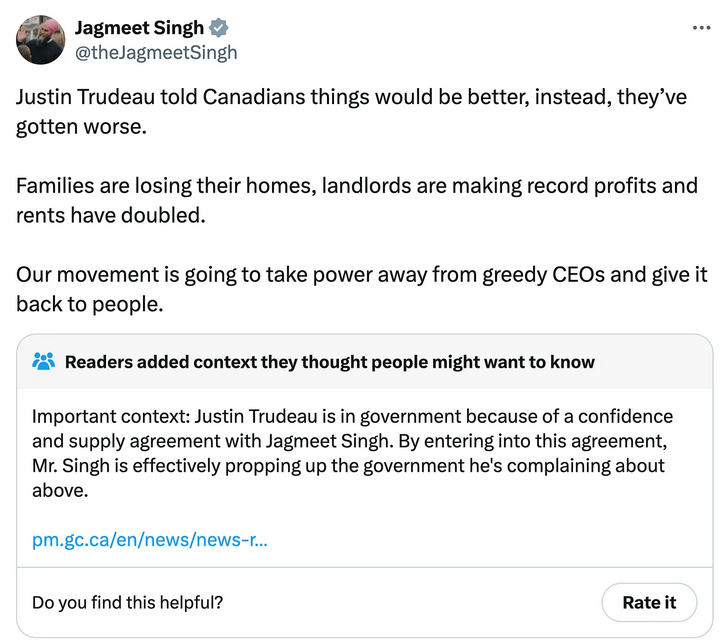
I wasn’t kidding when I said it was painful to watch. And it wasn’t just me who noticed — a few podcasts ago, Jen and I had a laugh at Singh getting hit by Twitter’s Community Notes fact-checking service. After one of his regular tweets attacking Trudeau, a note was added to it, reminding readers that Singh was officially, as per a signed agreement, responsible for keeping Trudeau in power. It was laugh out loud funny, and, alas for the NDP leader, we were very much laughing at him, not with him.

That’s finished now. His nightmare is over. He can stop looking so goddamn ridiculous every day now. The deal is dead.

And now that it is, we can finally take a long look back at it and wonder how the hell Singh ever decided that the deal, or at least how he behaved during the deal, was a good idea.

In the National Post, Chris Selley seems a bit less charitable toward Singh, for largely the same reason … the pain and humiliation was almost entirely self-inflicted:

So, the deal is off. NDP leader Jagmeet Singh apparently located a few scraps of dignity in some long-forgotten kitchen drawer or closet. Just minutes before Prime Minister Justin Trudeau was set for a press conference to give himself yet more credit for the NDP’s national school-lunch program, Singh announced he was calling off the NDP’s two-and-a-half-year-old confidence-and-supply agreement with the governing Liberals.

“Canadians are fighting a battle … for the future of the middle class,” Singh pronounced. “Justin Trudeau has proven again and again he will always cave to corporate greed.” Reports suggest it was the Liberals last month ordering the railway unions back to work and into binding arbitration with their employers that finally soured the milk in Dipperland.

“In the next federal election, Canadians will choose between Pierre Poilievre’s callous cuts or hope” Singh continued, casting himself as the Barack Obama figure in the forthcoming contest — “hope,” he specified, “that when we stand united, we win; that Canada’s middle class will once again thrive together.”

Because a Canadian political announcement must come with some impenetrable bafflegab, Singh added the following: “It’s always impossible until it isn’t. It can’t be done until someone does it.”

Up is left. Forward is up. United we dance. The future.

All the reasons for the NDP to cut the Liberals loose on Wednesday were so myriad and obvious that it’s difficult to remember what on earth the point of this agreement was supposed to be. Singh got no cabinet seats out of it, maybe just a few “thanks for your contribution” pats on the back from Trudeau and his ministers along the way. But the NDP essentially gave away any policy wins to the Liberals.

New Democrats understand better than anyone else the fundamentally amoral nature of the Liberal Party of Canada. They understand the Liberals’ all but total conflation of the party’s best interests with the country’s, and therefore its utter lack of shame. Anything the Liberal party does, anything it says, even if it’s completely the opposite of it did and said yesterday, is precisely the medicine Canada needs. And the NDP understands as well as the Conservatives do how mainstream Canadian media privileges the Liberals in that regard.

« Newer PostsOlder Posts »

Powered by WordPress