Quotulatiousness

November 26, 2020

Fixing the US federal election mechanism to prevent errors or fraud from distorting the results

Filed under: Government, Law, Politics, USA — Tags: , — Nicholas @ 03:00

Down south, our American neighbours held a federal election at the beginning of November. Ignoring the Associated Press trying to annoint the winner, we still don’t legally know who won and the tallies in several states are still being challenged. This is an embarassing situation for the “leaders of the free world” and common sense changes to the way the vote is conducted seem to be the best way to ensure that the results are known quickly and that the results will fairly represent the way the voters chose to exercise their franchise. At Steyn Online, Tal Bachman has a fairly concrete set of suggestions that would be a significant improvement over the system in place today:

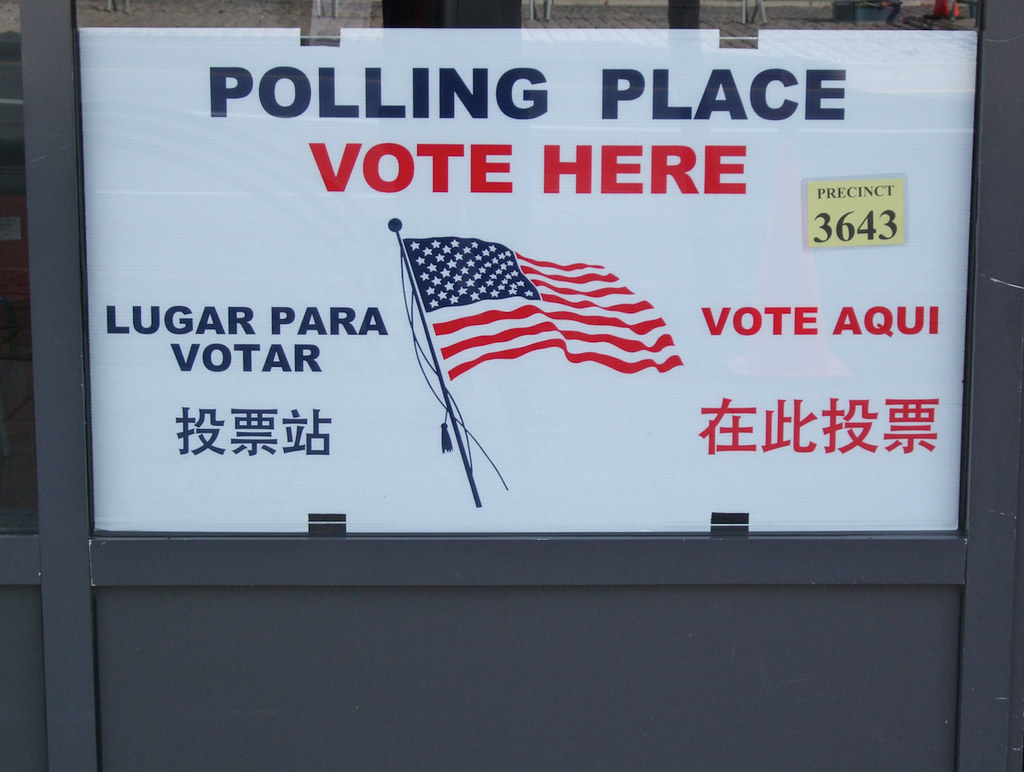
“Polling Place Vote Here” by Scott Beale is licensed under CC BY-NC-ND 2.0

First, it’s run by a single-purpose, rigorously impartial, devoutly transparent federal entity overseeing federal elections (about which more below).

Yes, I know we’re all sick of the federal Leviathan. I know it already has far too much power. It’s just that in this case, we don’t have much choice, do we? We’re going on well over a century of chronic Democrat Party presidential vote-rigging; and it appears they just ran one of their classic tricks again just a few weeks ago. At some point, pro-America voters have to stop making excuses for why they shouldn’t try solutions to these nation-destroying problems, and just try them.

Yes, I know this would require a constitutional amendment. But let’s assume for now we could get one of those passed.

Second: The new federal entity — let’s call it Elections USA — would then divide the nation into voting districts of equal size for purposes of federal election (that could occur within pre-existing congressional districts). Elections USA would then further subdivide the voting districts into smaller units. Working with the postal service, Elections USA would then draw up a list of voters in each unit, and designate a voting station for residents of that particular unit.

Third: In preparation for election day, Elections USA would send out flyers informing households of where to vote. The information would also be made available on the Elections USA website.

Fourth: On election day, voters travel to their designated voting stations: an elementary or high school, a union hall, a community center, whatever.

Each voting station is watched over by police or other security guards.

As voters approach, they join a quick-moving line. At the front, they present two pieces of government issued ID, at least one with a photo. A volunteer finds the voter on her list of voters for that unit. (If they’ve come to the wrong polling station, they are redirected to the right polling station).

The voter then approaches the voting station in a large, open room, where another volunteer hands him a paper ballot. Picking up the provided pencil, he marks the ballot behind a screen, folds the ballot, and drops into the voting box in full view of the poll clerk and attendant witnesses sitting a few feet away—typically, a few volunteers from political parties who act as “scrutineers”, or official observers and verifiers. The voter then leaves. The entire process never takes more than fifteen minutes.

Once polls close, no one is allowed to enter or leave the premises until the vote count is completed.

The poll clerk — still in full view of the scrutineers — dumps the ballots on to a table and sorts them into piles according to the candidate/party voted for. She then counts the votes for each, showing them to the scrutineers as she goes. Once the votes are counted, a supervisor is called over to the table. After verifying that the scrutineers are satisfied with the counting, and resolving any lingering concerns, the supervisor signs off on the count, and the ballots are immediately placed in a special, sealed envelope. The sealed envelope is then stamped, and cannot be opened without subsequent detection.

The ballot count numbers are then phoned into Elections USA, right then and there, again in view of the scrutineers, who verify that the numbers called in match the numbers they witnessed during the count.

Once all the numbers are called in to Elections USA — a process which never takes more than two hours — the supervisor then physically transports the sealed envelopes (each marked with information like Voting Desk #4 at Poll Station #15) to the Elections USA depot, where she hands them over.

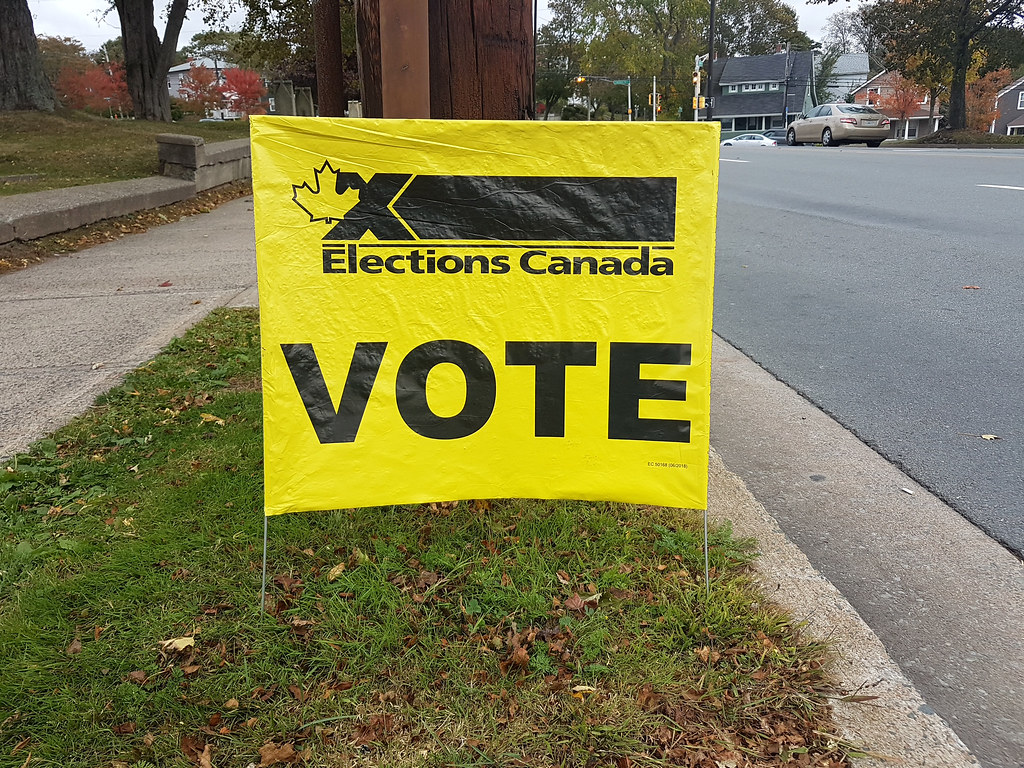
“2019 Canadian federal election – VOTE” by Indrid__Cold is licensed under CC BY-SA 2.0

The sealed envelopes are then transported to Elections USA employees, who will then verify, and eventually formally certify, that all the numbers called in from each desk of each polling station of each voting district in the country matches the number of actual ballots. In the unlikely event any question arises about accuracy, the ballots can be accessed and counted again.

In a simple process like this, the media will have accurate election results within two hours of the polls closing, and there is virtually no opportunity for fraud. I can attest to that, because I myself have witnessed this exact process in real life quite a few times, and am friendly with several people who volunteer as election workers on election days. What I described is how elections are conducted in Canada, but not only in Canada: an identical or similar process is used in most other English-speaking countries. A few simple security protocols — not least of which is, no computerized voting machines — and your election is as fraud-proof as this mortal realm would ever allow.

When you compare this typical voting procedure to the morass of conflicting voting regulations representing fifty states, many of which — incredibly — do not even require that the voter present identification before voting, and which are being manipulated by the very state party hacks tasked with preventing fraud, you begin to see just how desperately America needs electoral reform. Credible stories of poll watchers being denied access, for example, in any normal country, would be regarded as completely unacceptable, to the point where the votes in that area would be likely thrown out as a matter of course. And yet, that type of chicanery is now so common in the United States, most people take for granted it goes on. That’s how far the window of acceptable behavior has moved.

QotD: The “history-as-nightmare” narrative

Filed under: History, Politics, Quotations — Tags: , — Nicholas @ 01:00

The idea of the past as nothing but a nightmare, specifically one of injustice, is probably the prevailing historiographical trope of our time. Certainly no one could reasonably claim that nightmares have been lacking in human history. And yet, at the same time, it is undeniable that there has been progress: very few of us would care to take our chances in the kind of conditions, either political or material, that prevailed in, say, the 16th century.

The fact remains, however, that for more than one reason, history-as-nightmare is nowadays an infinitely more powerful organising narrative principle than history-as-progress.

In the first place, nightmares present themselves much more vividly to the imagination than the slow accretion of progress, just as hell is much more easily envisaged than heaven — and more enjoyable to imagine, too.

In the second place, when progress occurs, it is immediately taken for granted, as if it were a merely natural process that had never really required human effort to take place. Who now is grateful for the elimination of the suffering caused by peptic ulceration, for example? There is simply no cultural recollection of peptic ulceration at all, though well within living memory books were written about how to live with, or despite, your ulcer, what diet to take to assuage your ulcer, and so forth. Once they are cured, it is simply taken for granted that people do not have such maladies — progress magically did away with them.

In the third place, and most importantly, the fact of progress is much less useful to political entrepreneurs than is the narrative of history as nothing but a nightmare that continues to the present day and, as Marx put it, weighs upon the brain of the living. Only by keeping the memory of the nightmare ever-present in the minds of their sheep, thereby stoking resentment, may the political shepherds herd, and then fleece, the flock.

A fourth great advantage of history-as-nightmare is that it explains the failures and failings of everybody who is dissatisfied or disappointed with his life. To misquote Shakespeare: The fault, dear Brutus, is not in ourselves, but in our stars, that we are underlings. We do not fail the world, the world fails us. How comforting a thought!

Theodore Dalrymple, “Against History-as-Nightmare”, Law & Liberty, 2020-08-11.

November 24, 2020

Is the day of the orator over?

In The Critic, Nigel Jones considers some of the great orators of history:

Prime Minister Winston Churchill greets Canadian PM William Lyon Mackenzie King, 1941. Churchill was certainly one of the great orators of history … Mackenzie King, on the other hand, certainly was not.
Photo from Library and Archives Canada (reference number C-047565) via Wikimedia Commons.

On 19 November 1863, President Abraham Lincoln rose to speak at Gettysburg, Pennsylvania, the battlefield which four and a half months before had seen the decisive turning point of the American Civil War. Lincoln was not even the principal speaker at the ceremony to dedicate a cemetery for those who had fallen in the battle.

Before he spoke, the President had to sit through a two-hour address by a pompous official orator, a windbag called Edward Everett. But when he finally got to his feet Lincoln entered political immortality. He spoke for only two minutes, but the few words he uttered about “Government of the people, by the people, and for the people” have echoed down the years – even Mrs Thatcher made a recording of them – inspiring and rousing generations to value and defend democracy.

Winston Churchill’s iconic status as Britain’s greatest Prime Minister largely rests on the handful of radio speeches he growled out to the nation in the darkest days of World War Two: “… fight them on the beaches … so much owed by so many to so few … this was their finest hour …” and so on.

Ever since Roman statesmen such as Cato and Cicero delivered their speeches on the Capitol, oratory like that spoken by Lincoln and Churchill has been a mainstay of western civilisation and governance. A carefully constructed argument or a few ringing phrases having the power to change minds, stiffen sinews, and bring down leaders.

Churchill himself was brought to supreme political power in 1940 by the power of the spoken word. Those words were spoken by one politician – his friend and schoolmate Leo Amery – quoting another, when Amery repeated Oliver Cromwell’s words dismissing the Long Parliament in calling for the end of Neville Chamberlain’s feeble administration: “You have sat here too long for any good you have been doing. Depart, I say, and let us have done with you: in the name of God, go!” Chamberlain, albeit reluctantly, went.

November 21, 2020

“Ah, and so it begins. The problematization of Substack”

Filed under: Media, Politics — Tags: , , — Nicholas @ 05:00

Writing — appropriately — on Substack, Jen Gerson outlines her transition from full-time journalist to journalist-subsisting-on-the-crumbs-of-direct-reader-support at The Line:

True story: an ambitious young man with an idea for a startup gave me a ring on the phone. He wanted to start a new platform for writers and journalists; what would it take to encourage a writer like me to abandon the mainstream media and go fully independent? I explained the sort of site that might entice me — a clean and painless user interface, basic word processor, and something to take care of IT and payment back end. I then hung up the phone and thought to myself: “Nice guy. Too bad that idea isn’t going anywhere.”

After all, why would I abandon paying gigs in mainstream journalism for the uncertainty of direct reader support? It was a crazy idea.

Years passed.

Well, this gentleman went off to form a company called, uh, Substack, and after Andrew Sullivan left New York Magazine to reconstitute the Daily Dish under the aegis on this very platform, I was forced to dredge up this gentleman’s email and offer to eat my hat.

Because by then, mainstream media was in a state of financial and moral disarray and it was time for me to do what I would have done three years earlier if I had possessed the foresight — start The Line. In any case, the founder of Substack was very kind and even managed to schedule a call with me, at which point I said: “OK, you were right.”

This was one of the conversations that eventually led to my co-founding this fine newsletter that you are reading now, but in the course of this chat I had to ask another question: “You know they’re going to come after you, right? Are you ready for that?”

He said Substack is, indeed, committed to serving its community of writers — provided they aren’t spreading hate or disinformation, of course — but I suspect the company is only beginning to gain a glimpse of the test ahead.

When I read the Columbia Journalism Review‘s piece “The Substackerati“, released this week, my first response was: “Ah, and so it begins. The problematization of Substack.”

Brendan O’Neill: My Beef With Millennials

Filed under: Britain, Liberty, Politics — Tags: , , , , — Nicholas @ 04:00

Independent Man
Published 13 Aug 2017

Original Video: https://www.youtube.com/watch?v=iV5Qv…

PATREON: https://www.patreon.com/independentman
IM SHOP: https://shop.spreadshirt.com/INDEPEND…
PayPal: https://www.paypal.me/IndependentMan
TWITTER: https://twitter.com/Independt_Man
MINDS https://www.minds.com/IndependentMan
VIDME: https://vid.me/independentman

QotD: Using a “wokescreen”

Filed under: Media, Politics, Quotations, Religion — Tags: , , , , — Nicholas @ 01:00

To better understand the era we are living through, it might help to first understand the nature of the “wokescreen”. Like those billowy emissions of dry-ice in a 1980s pop video, this device is useful if you want to hide bad and egregious behaviour from public view.

It is, essentially, a new iteration of an old rule: the one stating that the person commonly to be found complaining most vociferously about a particular vice is the one disproportionately likely to be guilty of said vice.

Through decades past, this rule applied to people who were literally in the clerical class. It was, for instance (see the late Cardinal Keith O’Brien), the priest or bishop who denounced homosexuality in the most vociferous terms who would turn out to have their own peculiar interpretation of “the laying on of hands”, tending to revolve around the knees of young male seminarians.

And there is sense in this of course. Through overt displays of moral opprobrium, the petitioner imagines that everyone’s attention will be diverted. Through stressing their virtue overmuch, however, such people raise a perceptible flag to anyone with an eye for human hypocrisy.

Today, of course, the clerical class is not the clergy. It is generally a rich, massively protected, metropolitan and often corporate or corporate-backed class which poses as the defender and then enforcer of all the easiest, least-controversial causes of the time. These shift, naturally, but today a person who wishes to cloak themselves in virtue will talk up their “anti-racism” credentials; will talk about “feminism” as though women’s rights have only just occurred to them; they will stress their green credentials; and of course they will rush to the defence of anyone who claims to identify as a tree or a hedgerow and assert that said person’s right to so identify is not just ancient and long-established but biologically incontrovertible. All give off immense warning-signs.

Douglas Murray, “Do you know what a wokescreen is?”, UnHerd, 2020-08-13.

November 20, 2020

The political danger if the “chumps” unite

Filed under: Economics, Education, Politics, USA — Tags: , , , — Nicholas @ 03:00

In City Journal, James B. Meigs describes what he calls the “Chump Effect” in American politics:

Senator Elizabeth Warren speaking at the Iowa Democrats Hall of Fame Celebration in Cedar Rapids, Iowa, on 9 June, 2019.
Photo by Lorie Shaull via Wikimedia Commons.

Last January, a small but telling exchange took place at an Elizabeth Warren campaign event in Grimes, Iowa. At the time, Warren was attracting support from the Democratic Party’s left flank, with her bulging portfolio of progressive proposals. “Warren Has a Plan for That” read her campaign T-shirts. The biggest buzz surrounded her $1.25 trillion plan to pay off student-loan debt for most Americans.

A man approached Warren with a question. “My daughter is getting out of school. I’ve saved all my money [so that] she doesn’t have any student loans. Am I going to get my money back?”

“Of course not,” Warren replied.

“So you’re going to pay for people who didn’t save any money, and those of us who did the right thing get screwed?”

A video of the exchange went viral. It summed up the frustration many feel over the way progressive policies so often benefit select groups, while subtly undermining others. Saving money to send your children to college used to be considered a hallmark of middle-class responsibility. By subsidizing people who run up large debts, Warren’s policy would penalize those who took that responsibility seriously. “You’re laughing at me,” the man said, when Warren seemed to wave off his concerns. “That’s exactly what you’re doing. We did the right thing and we get screwed.”

That father was expressing an emotion growing more common these days: he felt like a chump. Feeling like a chump doesn’t just mean being upset that your taxes are rising or annoyed that you’re missing out on some windfall. It’s more visceral than that. People feel like chumps when they believe that they’ve played a game by the rules, only to discover that the game is rigged. Not only are they losing, they realize, but their good sportsmanship is being exploited. The players flouting the rules are the ones who get the trophy. Like that Iowa dad, the chumps of modern America feel that the life choices they’re most proud of — working hard, taking care of their families, being good citizens — aren’t just undervalued, but scorned.

The word “chump” probably derives from an ancient Norse term for a stump or large chunk of wood. The modern word “blockhead” comes to mind, which — no coincidence — was Lucy’s favorite label for the too-trusting Charlie Brown in the Peanuts comic strip. Lucy never tired of snatching away the football; Charlie fell for it every time. We all know the feeling: when you’re inching forward in the freeway exit lane, say, and another driver flies past and swerves onto the ramp at the last second; when your child has to complete her college-entrance exams within a designated time period, but your neighbor’s child gets twice as long because of a suddenly diagnosed “learning disability”; when you pay extra to have your pet travel in the airplane’s cargo hold but the yipping poodle across the aisle, an “emotional-support animal,” gets to ride on its owner’s lap for free. You didn’t know that you could get an emotional-support card just by claiming an anxiety disorder and paying a fee to an online agency? What are you — a chump?

Quebec makes Canada’s politics really weird

J.J. McCullough
Published 2 Mar 2019

Hypocrisies and blind spots stemming from the role played by French Canadians and the French language in Canada’s politics.

FOLLOW ME:

🇨🇦Support me on Patreon! https://www.patreon.com/jjmccullough
🤖Join my Discord! https://discord.gg/xQzjBRE
👾Watch me on Twitch! https://www.twitch.tv/jj_mccullough
🇺🇸Follow me on Instagram! https://www.instagram.com/jjmccullough/
🇨🇦Visit my Canada Website http://thecanadaguide.com

QotD: Tolerance

Filed under: Liberty, Politics, Quotations — Tags: , , — Nicholas @ 01:00

Look, I don’t like the parading of emotions by politicians anyway: it’s not to my taste. But for a Liberal to speak ill of tolerance is to square-dance in a minefield. “Tolerance” is shorthand for the existence of a society in which persons cohabit, trade and debate without killing one another over their differences — even those differences which are serious, fundamental and intractable. Tolerance truly is the signature accomplishment of our country, and of countries like ours: it is the crucial difference between nice places to live and the not-so-nice. To dismiss it is to abandon the old liberals’ confidence that familiarity between different groups and sects may in fact lead to love and acceptance — that it is the foundation for the organic growth of a neighbourliness that cannot be ordered up like a meal or created by fiat.

Tolerance represents a mutual compact to which the state itself is a party. And its minimalism is an important feature. Tolerance does not ask you to approve of gay people, or to like atheists, or to appreciate a jaunty Sikh turban, or to trust a redhead. It insists only that you treat them as humans and fellow citizens — equal to yourself in legal endowments and social entitlements, and most particularly in the right to be left alone.

Tolerance means you do not persecute; you do not abuse; you do not commit or threaten violence. It is a restriction on behaviour, above all, or, more broadly, on conduct: it is not a test of one’s disposition, private opinions or feelings.

Colby Cosh, “‘Can we stop talking about tolerance?’ Lord, I hope not”, National Post, 2018-08-23.

November 19, 2020

White Lives Matter More – A Summer of Blood | BETWEEN 2 WARS: ZEITGEIST! | E.04 – Summer 1919

TimeGhost History
Published 18 Nov 2020

Technology promises a better and more connected world in the summer of 1919. But battles still rage everywhere over who will inherit it.

Join us on Patreon: https://www.patreon.com/TimeGhostHistory

Subscribe to our World War Two series: https://www.youtube.com/c/worldwartwo…
Like TimeGhost on Facebook: https://www.facebook.com/TimeGhost-16…

Hosted by: Indy Neidell
Written by: Indy Neidell and Francis van Berkel
Director: Astrid Deinhard
Producers: Astrid Deinhard and Spartacus Olsson
Executive Producers: Astrid Deinhard, Indy Neidell, Spartacus Olsson, Bodo Rittenauer
Creative Producer: Maria Kyhle
Post-Production Director: Wieke Kapteijns
Research by: Indy Neidell and Francis van Berkel
Image Research by: Miki Cackowski and Michał Zbojna
Edited by: Michał Zbojna
Sound design: Marek Kamiński

Colorizations:
Mikołaj Uchman
Spartacus Olsson

Sources:
From the Noun Project: bridge by Adrien Coquet, Delete by Kevin Eichhorn, Fire by Sweet Farm, Model T by Alex Valdivia, people by Anastasia Latysheva, peoples by Musmellow, revolt by Symbolon, Smoke by Krish, people by Nithinan Tatah, explosion by Aldric Rodríguez

Archive by Screenocean/Reuters https://www.screenocean.com.

A TimeGhost chronological documentary produced by OnLion Entertainment GmbH.

From the comments:

TimeGhost History
21 hours ago
Four episodes into this new series and we think it’s going pretty well. Behind-the-scenes we have been getting ahead with our planning to make make things as laser-focused as possible and we have some pretty fascinating pieces of history we want to talk about.

But we know that there is always a learning curve with a new series and we care what our community thinks. It’s the TimeGhost Army who make our content possible so we’d like to hear from you what you think about Season Two of Between 2 Wars. What are you enjoying about it? Is there anything you think we should work on? How do you feel about Indy’s outrageous suits and ties?

November 18, 2020

QotD: Feminism and gender equality

Filed under: Politics, Quotations, USA — Tags: , , , , — Nicholas @ 01:00

It takes one’s breath away to watch feminist women at work. At the same time that they denounce traditional stereotypes they conform to them. If at the back of your sexist mind you think that women are emotional, you listen agape as professor Nancy Hopkins of MIT comes out with the threat that she will be sick if she has to hear too much of what she doesn’t agree with. If you think women are suggestible, you hear it said that the mere suggestion of an innate inequality in women will keep them from stirring themselves to excel. While denouncing the feminine mystique, feminists behave as if they were devoted to it. They are women who assert their independence but still depend on men to keep women secure and comfortable while admiring their independence. Even in the gender-neutral society, men are expected by feminists to open doors for women. If men do not, they are intimidating women.

Thus the issue of Summers’s supposedly intimidating style of governance is really the issue of the political correctness by which Summers has been intimidated. Political correctness is the leading form of intimidation in all of American education today, and this incident at Harvard is a pure case of it. The phrase has been around since the 1980s, and the media have become bored with it. But the fact of political correctness is before us in the refusal of feminist women professors even to consider the possibility that women might be at any natural disadvantage in mathematics as compared with men. No, more than that: They refuse to allow that possibility to be entertained even in a private meeting. And still more: They are not ashamed to be seen as suppressing any inquiry into such a possibility. For the demand that Summers be more “responsible” in what he says applies to any inquiry that he or anyone else might cite.

Harvey Mansfield, “Fear and Intimidation at Harvard”, Weekly Standard, 2005-03-07.

November 17, 2020

Cancel culture comes for Donald Trump’s lawyers

Filed under: Law, Liberty, Politics, USA — Tags: , , , , — Nicholas @ 05:00

Mark Steyn reported yesterday that the Lincoln Project’s latest doxxing has been successful and that a law firm representing President Trump in one of his Pennsylvania suits has been intimidated into withdrawing from the case:

Donald Trump addresses a rally in Nashville, TN in March 2017.
Photo released by the Office of the President of the United States via Wikimedia Commons.

Back in the summer I mentioned on The Mark Steyn Show that “cancel culture” was increasingly literal: It used to mean you got kicked off Twitter or Facebook; then it progressed to losing your job or television show or book contract. By 2020 it had advanced to being denied domain registration on the Internet, credit-card services, bank accounts and other basic necessities of modern life. Now, in a country with more lawyers than the rest of the planet combined, the supposedly “most powerful man on earth” wakes up and finds his counsel just canceled:

    Lawyers with Porter Wright Morris & Arthur LLP submitted a filing late Thursday stating they were withdrawing as counsel in a federal suit seeking to block Pennsylvania from certifying its vote. No reason was given. In a statement issued Friday, the firm confirmed the filing but did not say why it was exiting the case.

Powerline‘s John Hinderaker reckons the reason is pretty obvious:

    Porter Wright is a mid-sized law firm with offices in eight cities across the country. But apparently it lacked the courage to stand up against the Twitter mob. The “Lincoln Project” doxxed the two Porter Wright lawyers who signed the Pennsylvania complaint, tweeting their pictures, addresses and telephone numbers, and encouraging leftists to harass them. Reportedly there also were employees at the law firm who objected to representing President Trump. Porter Wright’s abandonment of its client is shameful conduct for which I suspect it will receive little but praise.

[UPDATE: A Powerline reader with knowledge of the situation says that Porter Wright has withdrawn from only one of five suits.]

As John points out, in America everybody from 9/11 plotters to celebrity pedophiles, Boston bombers to Oscar-winning serial rapists gets hotshot law firms and nobody bats an eyelid. But not Donald J Trump, who is apparently unfit for legal representation.

If you like the sound of all that “unity” and “healing”, this is what it boils down to — unity in the sense the Soviets meant it: the absence of opposition. And, when they’re done with Trump, they’re serious about that “Truth & Reconciliation” enemies list. To reiterate a point I’ve made for months: on free speech and related issues, things are going to head south very fast. I carelessly assumed they’d wait till the inauguration, but it seems “the Office of the President-Elect” is already on the case.

QotD: Prejudice

Filed under: Politics, Quotations, Religion, USA — Tags: , , , , , — Nicholas @ 01:00

For instance, when an Islamic terrorist murders people, there’s an instant rush to fret over and condemn any sort of “anti-Muslim backlash.” Never mind that such backlashes have been vastly rarer than we’re usually told, the principle is correct: It is wrong to blame innocent Muslims for the things other Muslims did.

Or just think about how much ink has been spilled arguing that it is unfair and unjust to assume that one black youth is a criminal or a threat just because he resembles in some way a negative stereotype. I’m not mocking this argument; I am agreeing with it.

As I’ve been saying until I’m blue in the face on my book tour, one of the greatest things about this country is the ideal — always in tension with the lesser devils of our natures — that says we should take people as we find them. My objection to identity politics is that it reduces millions of people to a single attribute or grievance. It assumes that, simply by accident of birth, some people are more noble or more evil than others.

If you think that all you need to know about an African-American person to size up his character or humanity is his skin color, then you’re a racist. […]

You can run similar thought experiments about virtually any group. If all you need to know about Oscar Wilde is that he was a gay dude, just like Richard Simmons or Milo what’s-his-name, you’re a bigot. If Meyer Lansky and Albert Einstein are merely two Jews to you, you’re an anti-Semite. If Margaret Thatcher, Joan of Arc, and Lizzie Borden are just three chicks, you’re a sexist.

And again, historically, this is mostly a left-wing or liberal (both in the classical and modern senses of the word) insight. But for some bizarre reason, for many people, this idea evaporates like water off a hot skillet when you replace any of these categories with “white” or, very often, “male.”

Suddenly fancy words and phrases fly like sawdust from a wood chipper: “structures of oppression!” “decontextualized!” “ahistoricized!” etc. It’s all so clever and complicated. The same people who take to the streets at the slightest suggestion that Muslims can be judged by the evil deeds of other Muslims will lecture and harangue you for hours, mob you on Twitter, or condescendingly dismiss you for not understanding that all white people have it coming.

I am not denying the history of white racism in America. I’m more than eager to acknowledge it. But what these people are basically saying is that you can say bigoted things about all white people based on things other white people have done. And spare me the argument that some 70-hour-a-week truck driver in Appalachia has it coming because he’s a grand beneficiary of white supremacy.

Jonah Goldberg, “The G-File”, National Review, 2018-08-03.

November 15, 2020

Mark Steyn is looking for an argument

Filed under: Britain, Media, Politics, USA — Tags: , , , , — Nicholas @ 05:00

I somehow missed this when it went up on Mark’s website:

“Polling Place Vote Here” by Scott Beale is licensed under CC BY-NC-ND 2.0

One of Mrs Thatcher’s great insights was: First you win the argument; then you win the election.

To win the argument, you have to make it. In the Westminster system, you make the argument for three or four years, then you have a six-week election campaign. That’s when the system’s functioning, which it certainly wasn’t under, say, Andrew Scheer’s Tory leadership in Ottawa.

But, even when it’s not functioning, somebody’s making an argument. Thus the fatal miscalculation of David Cameron when he decided that the Brexit referendum would be the best way to put the EU issue to bed once and for all. By then every electorally viable political party — from the Tories to Sinn Féin — was “pro-Europe”. Nigel Farage had been making the argument for twenty years, but, because he had no real political party to advance it, it didn’t get him anywhere at UK general elections. So, the minute Cameron called a referendum on Nigel’s issue in splendid isolation, it gave Farage a shot at the second half of Maggie’s great formulation: He’d won the argument; and Cameron delivered up a mechanism that allowed him to win the vote.

In the American system, it is, as the Brits say, arse over tit: As Monty Python once asked, where’s the room for an argument? There are no parliamentary debates, so you never see a Dem senator going at it with a GOP senator. Even more strikingly, there are a bazillion political talk shows, none of which ever features a Dem senator going at it with a GOP senator — the way that even the most despised BBC, CBC, ABC yakfests routinely feature opposing legislators debating health care or the Irish backstop or Covid response.

Instead, there is a multi-billion-dollar two-year campaign, which is all polls, fundraising, horse race piffle, telly ads for the halfwitted, plot twists of no interest to anybody normal (ooh, look, Cory Booker is up from point-three to point-four in Iowa!), all culminating in a stilted pseudo-debate tediously moderated by a pompous mediocrity asking questions all framed from the left’s point of view. You’d almost get the idea that the entire racket was designed to eliminate the very possibility that someone might make an argument.

November 14, 2020

“… we all know that Wrong Opinions Are No Longer Allowed On The Internet”

Filed under: Health, Media, Politics — Tags: , , , , , , — Nicholas @ 05:00

Jen Gerson has some Wrong Opinions that she shared On The Internet, so Dr. Bradley Mitchelmore, BSc. (Pharm), ACPR, PharmD, RPh has has taken it upon himself to try to get her cancelled:

Firstly, to explain how this little gem fell into my lap, some context is required. While I was avoiding the interminably dull task of invoicing our fine writers of The Line the other day, I threw out a position that some might find controversial.

That is, I find the trend towards identifying women by terms like “birthing people,” “menstruators,” “front-hole possessors” and “uterus bearers,” to be both reductive and offensive. I have no objection to finding more inclusive language for circumstances in which we want to acknowledge trans and non-binary people (ie; a phrase like “pregnant people” seems clunky, but inoffensive to me); but to date, all of this new language reduces the class of “women” to either a biological function or a bodily part.

Pregnancy is a particularly sensitive topic for a lot of women because, for most of us, the process is terrifying. To go through childbirth is the most profound loss of bodily autonomy imaginable and many women I know struggle with the after effects of feeling as if we’ve been treated like interchangeable breeding sows by some doctors and nurses. If a doctor started calling me a “birther” or a “uterus-bearer” while stretching my cervix apart knuckles-deep with two fingers, my response would not be welcoming.

I also don’t think it’s a coincidence that linguistic shifts that re-frame an entire biological sex class as “breeders” only ever seems to target one sex. Very few well-intentioned and committed activists are waging war online over the definition of “men.”

A lot of this is misogyny gilded in progressive language. And very few women want to stand up to the misogyny on the “pro-woman” team, nor suffer the consequences of pissing that team off. So most stay silent until they see a tweet like the one above, at which point they flood my DMs with private statements of support and relief. I’m happy to serve as a psychological outlet in that regard, but I’ll show you in a moment why they’re so afraid to say what they think.

Anyway, this is all just my opinion. I’m not married to it. If the trend comes around to allowing us to call all “male-bodied” people “dicks,” I might reconsider the position entirely. But we all know that Wrong Opinions Are No Longer Allowed On The Internet and therefore a doctor jumped in with one of the most delightfully fatuous replies I’ve ever received.

« Newer PostsOlder Posts »

Powered by WordPress