
[I]n January, after the tsunami hit, [Canadian prime minister Paul Martin] flew into Sri Lanka to pledge millions and millions and millions in aid. Not like that heartless George W. Bush back at the ranch in Texas. Why, Prime Minister Martin walked along the ravaged coast of Kalumnai and was, reported Canada’s CTV network, “visibly shaken.” President Bush might well have been shaken, but he wasn’t visible, and in the international compassion league, that’s what counts. So Martin boldly committed Canada to giving $425 million to tsunami relief. “Mr. Paul Martin Has Set A Great Example For The Rest Of The World Leaders!” raved the LankaWeb news service.
You know how much of that $425 million has been spent so far? Fifty thousand dollars — Canadian. That’s about 40 grand in U.S. dollars. The rest isn’t tied up in [Sri Lankan] bureaucracy, it’s back in Ottawa. But, unlike horrible “unilateralist” America, Canada enjoys a reputation as the perfect global citizen, renowned for its commitment to the U.N. and multilateralism. And on the beaches of Sri Lanka, that and a buck’ll get you a strawberry daiquiri. Canada’s contribution to tsunami relief is objectively useless and rhetorically fraudulent.
Mark Steyn, “Bolton’s sin is telling truth about system”, Chicago Sun-Times, 2005-05-15.
September 21, 2021
QotD: Canadian international virtue signalling is not a new thing
September 19, 2021
Erin O’Toole suddenly scrambling to try to win back votes from Maxime Bernier’s PPC
John Paul Tasker reports for the CBC on Conservative leader Erin O’Toole’s last minute appeal to wavering supporters (that is, people who would prefer actual conservative or even libertarian policies to what O’Toole’s “Conservatives” have on offer):
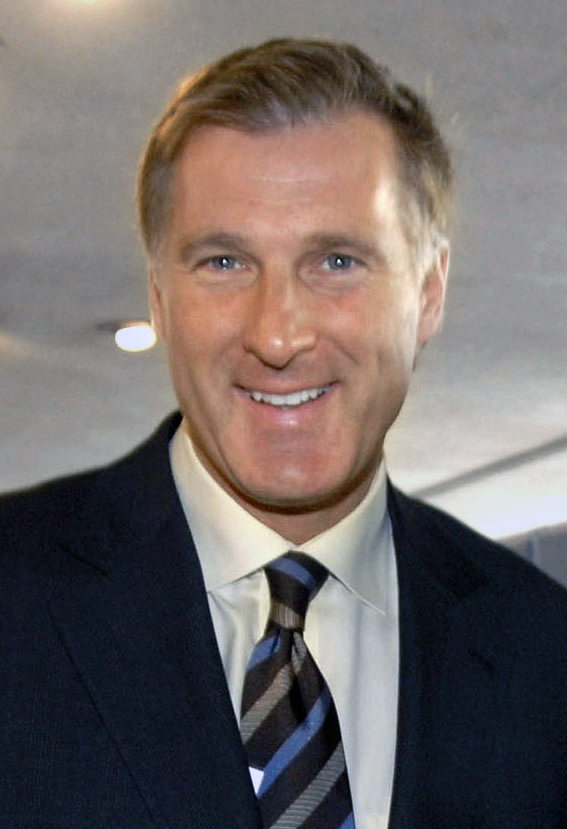
Conservative Leader Erin O’Toole said today that conservative-minded voters sick of the Liberal government should park their votes with the Tories rather than turn to the People’s Party of Canada (PPC) in this election.
Speaking to reporters at a campaign stop in London, Ont., O’Toole said his party is the only one in a position to replace the Liberal government and a right-wing vote split could lead to four more years of Justin Trudeau.
“There are actually millions of Canadians who are very frustrated with Mr. Trudeau. If they allow that frustration to do anything other than vote Conservative, they’re voting for Mr. Trudeau,” O’Toole said.
“There are five parties and there are two choices. More of the same with Mr. Trudeau or real change and ethical government with Canada’s Conservatives.”
O’Toole said Trudeau wants Conservative voters to “vote for smaller parties” rather than unify behind O’Toole’s candidacy.
CBC’s poll tracker has the PPC at 6.2% support, which is nearly four times what it was in the last election. Other trackers have the PPC at least a few points more than that, and it might be noteworthy that PPC-leaning voters are probably not be as interested in sharing their preferences with pollsters as supporters of more left-wing parties like the Liberals and Conservatives.
After the last election campaign, a CBC News analysis showed that — even with its rather dismal level of support — the PPC likely cost the Conservatives seven seats in the House of Commons by splitting the vote (six seats went to the Liberals, one to the NDP).
With polls suggesting PPC support is now well above its 2019 level, the party’s impact could be even greater in 2021.
While polls suggest some PPC support is coming from first-time or infrequent voters, there’s no question the PPC is drawing at least some support from former Conservative voters.
[…]
“The Conservative Party is not conservative anymore,” Bernier said today in response to a question about O’Toole’s warnings about a vote split.
“O’Toole has flip-flopped and adopted the Liberal program on the few remaining issues where there were still difference between the two parties, such as the carbon tax, gun bans and COVID passports,” Bernier said in an emailed statement. “Mr. O’Toole will have to live with the consequences of his failing strategy.”
Some of Bernier’s recent momentum is driven by his opposition to pandemic measures. The PPC leader has slammed the proposed federal vaccine mandate as a “draconian” and “immoral” measure.
A communist-party-connected publisher reprinted Justin Trudeau’s 2014 book Common Ground
Aha! I thought … yet more scandal! This time with direct pay-offs to Trudeau from his Beijing paymasters! Sadly, for the conspiracy minded among us, it’s not much more significant or scandalous than Barack Obama’s endorsement of Trudeau, as Kenneth Whyte explains:
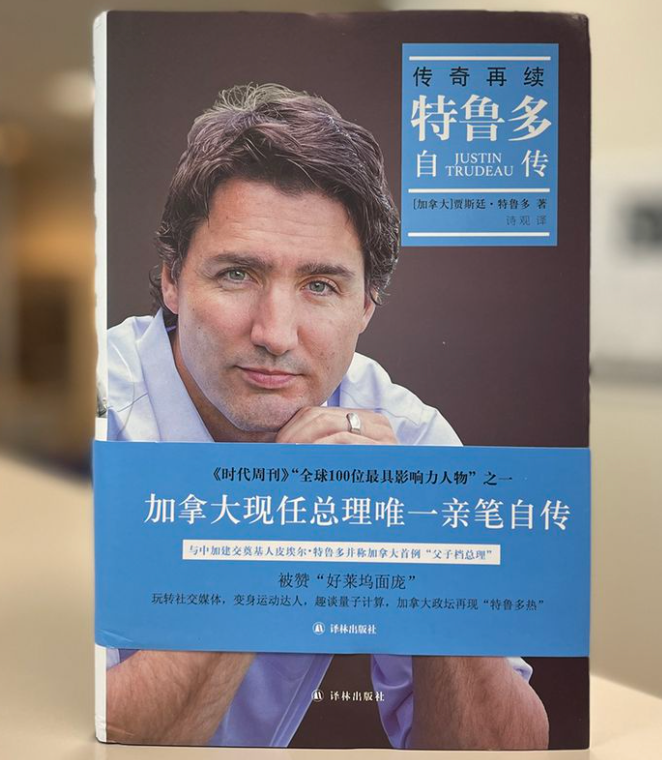
… the Globe & Mail reported that Justin Trudeau’s 2014 memoir Common Ground was republished in a Chinese edition in 2016.
Doesn’t sound like much of a story, does it? Foreign editions of Canadian books are released all the time.
What’s different in this case, says the Globe, is that the Chinese publisher is Yilin Press of Nanjing, part of the state-owned enterprise Jiangsu Phoenix Publishing and Media, which “takes operational direction from the propaganda department of the Jiangsu provincial communist party committee.”
Why would a propaganda wing of the communist party make such a deal? The Globe quotes foreign policy experts who say that the republication of Trudeau’s book is “a classic ploy” by Beijing to flatter a foreign leader. “They are trying to do anything they can to encourage him to look positive on China and the Chinese state,” according to one of the experts.
Says another: “Clearly, by publishing his biography they wanted to please him. They are the masters of propaganda.”
What do the Chinese hope to get out of courting Trudeau? “Beijing had high hopes it could persuade Canada to sign a free-trade agreement and was seeking Canada’s help in its global campaign Operation Fox Hunt to track down people it called criminals, many of whom were Chinese dissidents,” writes the Globe.
The Globe also finds it notable that the Liberals, at the time, were trotting Trudeau out to private events at the homes of wealthy Chinese-Canadians. The PM would do a little dance and the money would flow:
Chinese billionaire and Communist Party official Zhang Bin attended a May 19, 2016, fundraiser at the home of Benson Wong, chair of the Chinese Business Chamber of Canada. A few weeks later, Mr. Zhang and his business partner, Niu Gensheng, donated $200,000 to the Pierre Elliott Trudeau Foundation and $50,000 to erect a statue of Mr. Trudeau’s father.
So it all looks a bit unseemly.
I poked around and was reliably informed by someone in a position to know that Trudeau and his agent sold worldwide rights to Common Ground to HarperCollins Canada. That means it was up to HarperCollins to publish the book in Canada and also sell rights to its republication in as many foreign markets as possible. Trudeau would get a cut of revenues from those sales.
Except, as he further reveals, Trudeau had long since assigned any profits from the book to a charity, so he’s not being secretly bribed by copious amounts of money from the Chinese Communist Party’s propaganda budget (at least, not in this case, hedging just a bit …).
Should the PM, or someone in his office, have asked questions about Yilin Press and its connections to the communist party? Maybe, but it’s not like there was a free-market alternative down the street from Yilin. Every publisher in China is accountable to the communist party in one way or another. To get an ISBN number in the Chinese market, you have to go through the state, not because the state provides the service, but because it monitors all publications. Si Limin, chairman of the China Book Publishing Industry Association, is the former director of the News and Newspapers Department of the State Administration of Press, Publication, Radio, Film and Television. And so on.
As for the trade deal the Chinese were supposedly eager for Trudeau to sign? It was more the other way around. In 2017, the Liberals tried to convince Beijing to adopt Trudeau-style progressivism in return for free-trade with Canada. They were laughed out of town. The Chinese couldn’t even be bothered to pretend an interest in human rights to get a deal signed.
I have all kinds of problems with the ethical standards of the Liberal party, Trudeau’s personal judgment, those cash for access meetings, and his Chinese policy, but there’s nothing much to see here.
QotD: Gender stereotypes
Apparently, it is more to do with the content of your character than the content of your underpants.
Fraser Orr, commenting at Samizdata, 2018-12-08.
September 18, 2021
“Martin Gurri’s The Revolt Of The Public is from 2014, which means you might as well read the Epic of Gilgamesh“
In another of his interesting series of book reviews, Scott Alexander looks at a book from 2014 that seems to have done a great job of predicting the situation today, but doesn’t help in looking forward from today:
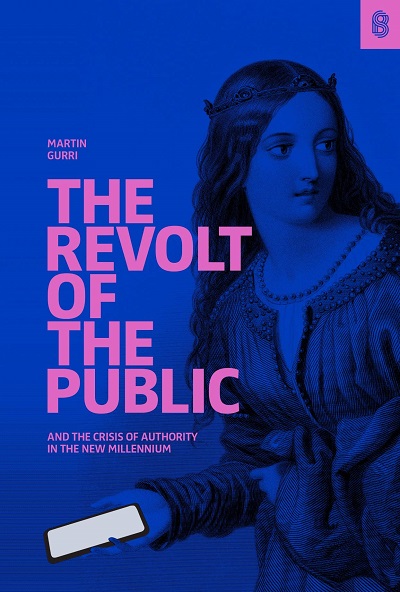
… It has a second-edition-update-chapter from 2017, which means it might as well be Beowulf. The book is about how social-media-connected masses are revolting against elites, but the revolt has moved forward so quickly that a lot of what Gurri considers wild speculation is now obvious fact. I picked up the book on its “accurately predicted the present moment” cred, but it predicted the present moment so accurately that it’s barely worth reading anymore. It might as well just say “open your eyes and look around”.
In fact, I can’t even really confirm whether it predicted anything accurately or not. Certainly everything it says is true. Anyone who wrote it in 2000 would have been a prophet. Anyone who wrote it in 2020 would have been stating the obvious. Was writing it in 2014 a boring chronicle of clear truths, or an achievement for the ages? I find my memories are insufficiently precise to be sure. It’s like that thing where someone who warned about the coronavirus on March 1 2020 was a bold visionary, but someone who warned about it on March 20 was a conformist bandwagoner — except about the entire history of the 21st century so far. Maybe the best we can do with it is read it backwards, as an artifact of the era when the public was only ambiguously revolting, to see how the knowledge of the coming age arose and spread.
We remember the Arab Spring, those few months in 2011 when revolts spread across various Arab countries and longstanding regimes were toppled by protesters with smartphones and Twitter accounts. Gurri hits the relevant beats, but doesn’t limit himself to the Middle East.
In Spain, a vague formless group called the indignados (or Real Democracy Now, or Youth Without A Future) took to the streets. For months, they filled public squares, streets, and tent cities. Some protests attracted tens of thousands of participants; a few, hundreds of thousands. Some of them were vaguely socialist, but it wasn’t exactly a socialist protest; in fact, the government they were protesting was dominated by the Socialist Workers Party. They were just sort of vaguely angry. From their manifesto:
Some of us consider ourselves more progressive, others more conservative. Some are believers, others not. Some have well-defined ideologies, others consider ourselves apolitical … but all of us are worried and outraged by the political, economic, and social landscape we see about us. By the corruption of the politicians, businessmen, bankers …
And so on.
At the same moment, hundreds of thousands of people were marching through the streets of Israel. The apparent trigger was a 25-year-old video editor named Daphni Leef who couldn’t afford an apartment near her job. She started a Facebook page saying people should protest the cost of living, one thing led to another, and soon 300,000 people were marching through the streets of Israel and Leef was a national hero.
[…]
Gurri argues all of this was connected, and all of it was a sharp break from what came before. These movements were essentially leaderless. Some had charismatic spokespeople, like Daphni Leef in Israel or Tahrir-Square-Facebook-page-admin Wael Ghonim in Egypt, but these people were at best the trigger that caused a viral movement to coalesce out of nothing. When Martin Luther King marched on Washington, he built an alliance of various civil rights groups, unions, churches, and other large organizations who could turn out their members. He planned the agenda, got funding, ran through an official program of speakers, met with politicians, told them the legislation they wanted, then went home. The protests of 2011 were nothing like that. They were just a bunch of people who read about protests on Twitter and decided to show up.
Also, they were mostly well-off. Gurri hammers this in again and again. Daphni Leef had just graduated from film school, hardly the sort of thing that puts her among the wretched of the earth. All of these movements were mostly their respective countries’ upper-middle classes; well-connected, web-savvy during an age when that meant something. Mostly young, mostly university-educated, mostly part of their countries’ most privileged ethnic groups. Not the kind of people you usually see taking to the streets or building tent cities.
Some of the protests were more socialist and anarchist than others, but none were successfully captured by establishment strains of Marxism or existing movements. Many successfully combined conservative and liberal elements. Gurri calls them nihilists. They believed that the existing order was entirely rotten, that everyone involved was corrupt and irredeemable, and that some sort of apocalyptic transformation was needed. All existing institutions were illegitimate, everyone needed to be kicked out, that kind of thing. But so few specifics that socialists and reactionaries could march under the same banner, with no need to agree on anything besides “not this”.
September 16, 2021
Who is the typical PPC supporter?
In The Line, Matt Gurney grapples with inadequate polling data to determine what the “average” supporter of Maxime Bernier’s People’s Party of Canada believes and who they are compared to typical Canadians:

Poll after poll has shown that the People’s Party of Canada, led by former Conservative Maxime Bernier, is surging in popular support. The party, which captured only 1.6 per cent of the vote in 2019, electing zero candidates, is now polling at closer to five or six per cent, or higher. These gains have not come at any obvious loss to any major party (the hapless Green party may be an exception, but there were only so many Green voters in the first place). While there is no doubt that some voters are bolting to the PPC from traditional parties, it seems certain — and polling suggests — that they are also drawing support from the nine million Canadians who were eligible to vote in 2019 but did not.
This is, to put it very mildly, worth watching. In a recent column here, drawing on polling information provided by John Wright, the executive vice president of Maru Public Opinion, we tried to establish what we could about a PPC supporter. They are not particularly remarkable; as noted last week, a typical PPC voter is a typical Canadian. They are fairly evenly distributed across all demographic segments and found in generally similar numbers in the various provinces. The earlier numbers were based on a fairly small sample size — the PPC’s low support on a national level has limited their numbers in any typical national-level poll. Last week, I said that more polling was necessary, to firm up the profile of who a PPC voter is and where they live. Wright has been doing that polling — the sample sizes are still modest, but a representative profile is beginning to emerge … not just of who a PPC voter is, but what they believe.
There is a degree of background context that must be established before we can move onto the numbers. When he presented me with his latest results on Tuesday, Wright noted that polling PPC voters is a particular challenge for his industry. The very concept of “the typical PPC voter” is rapidly shifting. The PPC base of even five weeks ago was a small fringe of grumpy people loosely assembled around a handful of vaguely libertarian policies, some anti-immigration blather and a disillusionment with the political status quo. (A typical PPC billboard encapsulates this unfocused dissatisfaction: “The Other Options Suck.”) Many polling companies track the attitudes of partisans of various affiliations by creating a panel of those partisans and then polling them over and over. Polling companies trying to track the PPC’s sudden rise, if they rely on such an identified panel of PPC voters that will be repeatedly surveyed, are capturing the PPC as it existed before the mid-August influx of new supporters. This is undoubtedly skewing our understanding of what the PPC voter, as they exist right now, believes. Wright has done four waves of polling in the last 10 days to update, as best as possible, our understanding of what the PPC voter believes today. He will continue to poll several times a week for the foreseeable future.
As to that August surge, as discussed in my column here last week, the best way to explain it is to look for something that recently changed — and something has: there are millions of Canadians who are adamantly anti-vax and anti-vaccine mandate/passport. The PPC surge began at the precise moment that vaccine mandates became a major issue in the federal campaign, and provinces began discussing their plans for certificates to verify vaccination status for domestic purposes. Pollsters needed a few weeks to notice the surge and verify it was real.
[…]
Roughly a third of Canadians (35 per cent) agree that the government is stripping away personal liberties; with Conservative and Green voters answering in the affirmative more often than NDP and Liberals. By comparison, 89 per cent of PPC voters believe the government is stripping away their liberty. Almost 90 per cent of PPC voters further agree that their governments are creating “tyranny” over the population. To put that in context, only about 40 per cent of Conservatives feel that way, with the other major parties way behind.
Oh, and here’s a cheerful one to chew over: Wright asked Canadians if they’d agree that “we are on the verge of a revolution in our society to take our freedom back from governments who are limiting it.” That question received 32 per cent support nationally — but an incredible 84 per cent from PPC supporters.
This sounds like the kind of thing we maybe ought to be paying attention to, eh?
I find it fascinating that the PPC appears to be motivating lots of people who haven’t been interested in voting by providing an option for them that isn’t just a red or blue coloured version of pretty much exactly the same policies and goals. I don’t expect the PPC to “break through” in this election, but if they can continue drawing the interest of those Canadians who feel disenfranchised by the Liberals and Conservatives, they can be a significant force for change in our political future.
September 15, 2021
Narendra Modi apparently doesn’t inspire mere biographies … he gets hagiographies
Scott Alexander reviews Andy Marino’s gushingly admiring Modi: A Political Biography:
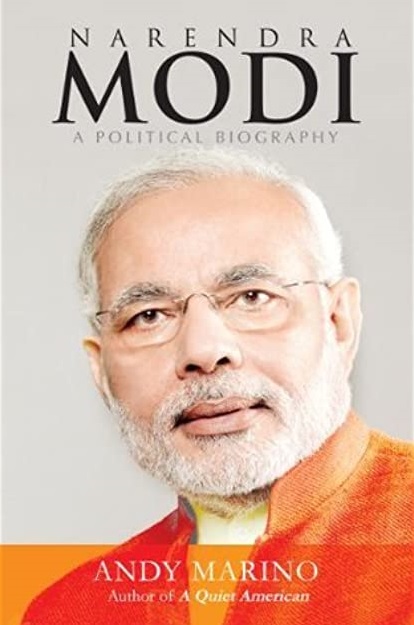
The author begins by writing about how Modi let him ride with him in his private helicopter and gave him unprecedented access to have “open-ended conversations” about “every aspect of his life”. The cover promises an objective evaluation, but on page 2, the author notes that “Objectivity does not mean flying in the face of incontrovertible evidence”, adding that “Modi has been the subject of the longest, most intense — and probably the most vituperative — campaign of vilification.” Marino promises to replace this campaign with “a narrative that is balanced, objective, and fair — but also unsparingly critical of [Modi’s] foibles” — which is an interesting construction, given how it contrasts criticism with fairness — and also pre-emptively declares the flaws he will be criticizing “foibles”. I’m not sure we ever get around to the criticism anyway, so it doesn’t really matter.
I am still going to summarize and review this book, but I recommend thinking of it as Modi’s autobiography, ghost-written by Andy Marino. I hope to eventually find another book which presents a different perspective, and an update for the past six years (M:APB ends in 2014, right when Modi was elected PM). Until then, think of M:ABP as a look into how Modi sees himself, and how he wants you to see him.
[…]
In 1975 the Emergency happened.
For thirty years, since its independence, India had been a socialist state. Not the cool kind of socialist where you hold May Day parades and build ten zillion steel mills. The boring kind of socialist where the government makes you get lots of permits, then taxes you really heavily, and nothing really ever gets done. “Even today the Representation of the People Act requires all Indian political parties to pledge allegiance not only to the Constitution but also to socialism.” The RSS [Rashtriya Swayamsevak Sangh] and its collection of associated right-wing nationalist parties supported Hindu nationalism plus socialism. Their arch-enemy, the center-left-to-confused-mishmash Congress Party, supported secularism plus socialism. Non-socialism was off the table.
In unrelated news, there was a food shortage. Indians took to the streets protesting Prime Minister Indira Gandhi (no relation to Mahatma Gandhi). Gandhi was heavy-handed in crushing the protests, which caused more protests, one thing led to another, and finally Gandhi declared martial law, a period which has gone down in history as the Emergency.
Gandhi immediately moved to arrest all her political enemies and shut down all newspapers that criticized her. The RSS was one of Gandhi’s main enemies and had to go underground quickly. Gujarat became a center for the resistance. So Modi, as an official in Gujarat’s RSS, ended up right in the middle of this. He remained a paper-pusher, but now he was a paper-pusher for freedom, scheduling meetings of resistance leaders, maintaining a master list of safe houses and trusted operatives, and keeping lines of communication open.
During a capital-e Emergency even paper-pushers can have greatness thrust upon them, and Modi ended up with responsibilities way outside his formal job description:
Chhayanak Mehta tells of how, after Deshmukh’s arrest, it was discovered that the papers he was carrying were still with him. These contained plans for the future actions of the [resistance], and it was essential to somehow retrieve them. To this end, Modi planned a distraction with the help of a female swayamsevak from Maningar. They went to the police station where Deshmukh was being held. While she posed as a relative and contrived a meeting with the prisoner, Modi somehow took the documents from under the noses of the police.
Or:
Modi was also responsible for transportation and travel to Gujarat of those opponents of Indra still at liberty … Modi too, in the course of his duties, was compelled to travel, often with pamphlets that could have got him arrested. To minimize the risk he became a master of disguise, something that came naturally to one who always paid attention to his appearance. On one outing, he would appear as a saffron-robed sanyasi; on another, as a turbaned Sikh. One time he was sitting in a railway carriage, hiding behind a thick black beard, when his old schoolteacher sat down next to the grown-up “urchin”. The disguise worked perfectly, but some years afterwards the teacher attested that as Narendra disembarked, he introduced himself and offered a hearty saluation.
Still, the Emergency ground on. One aspect the book doesn’t stress, but which I was surprised to read about when Googling the period, was the forced sterilizations. Under pressure from the US and UN to control exponentially rising populations, Indira had started various population control efforts in the 60s, all ambiguously voluntary. Over time, the level of pressure ratcheted up, and during the Emergency the previously-ambiguous coercion became naked and violent. “In 1976-1977, the programme led to 8.3 million sterilisations, most of them forced”.
How did this end? Gandhi called an election — during which she was predictably voted out completely and her party lost more thoroughly than any party has ever lost anything before. Her opponents’ campaign was based on things like “she just forceably sterilized 8 million people and you could be next”, which is honestly a pretty compelling platform. The real question is why she gave up her emergency dictatorship and called an election at all. According to the book:
It is more likely that in ending the Emergency Indira was thinking of herself, not India. She was aware of her growing international reputation as a tyrant, the daughter of a great democratic leader whose legacy she had damaged. As the journalist Tavleen Singh points out, the pressure to end the Emergency came simply from Indira Gandhi finding it unbearable that “the Western media had taken to calling her a dictator.”
(but before you interpret this as too inspiring a story of the victory of good over evil, Indira Gandhi was voted back in as prime minister three years later. We’ll get to that.)
Modi came out of the Emergency a rising star, appreciated by all for his logistical role in the Resistance. In the newly open political climate, the RSS was devoting more attention to their political wing and asked Modi to come on as a sort of campaign-manager-at-large, who would travel all around India and help friendly politicians get elected. He turned out to be really good at this, and rose through the ranks until he was one of the leading lights of the new BJP (Bharatiya Janata Party, “Indian People’s Party”). He spent the next two decades running campaigns, traveling the country, and getting involved in internal backstabbing (which he had a habit of losing in ways that got him kicked out of the party just before something terrible happened, leaving him as the only person untarnished by the terrible thing when they inevitably invited him back). Finally some of Modi’s political enemies failed badly in the leadership of Gujarat — one was expelled for corruption, another suffered several natural disasters which he responded to poorly. Modi had been accepted back into the party. He was beloved by Gujaratis, who still remembered his heroic work during the Resistance. He was the only person untarnished by various terrible things. By the rules of Indian politics, it was the party’s choice who would replace the resigning incumbent as Chief Minister of Gujarat, and as Modi tells it, everyone else just kind of agreed he was the natural choice (his enemies say he did various scheming and backstabbing at this point). So on October 7 2001, Narendra Modi was sworn in as Chief Minister of Gujarat, India’s fifth-largest state.
September 14, 2021
The Line‘s She-lection Bullshit Bulletin No. 4 … don’t bother questioning the timing
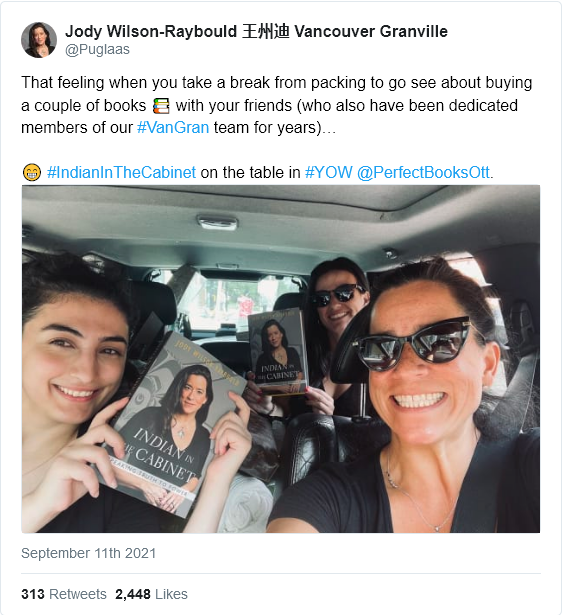
The latest installment of The Line‘s campaign bullshit tracker looks at the attempts by Liberal partisans to gin up some faux outrage over the timing of former Trudeau cabinet minister Jody Wilson-Raybould’s tell-all book:
First of all, we would like to specifically invite our Conservative and Liberal friends to take a few deep calming breaths and settle the fuck down about Jody Wilson-Raybould’s forthcoming book, Indian in the Cabinet, which will be out on Tuesday — but was splashed early in the Globe and Mail. The book will recount, among other things, JWR’s memories of the SNC-Lavalin scandal. The excerpt the Globe ran certainly doesn’t paint Justin Trudeau in a particularly flattering light.
But it doesn’t matter.
Seriously, our Conservative friends need to rein it in. The SNC-Lavalin affair was an example of the Liberals at their very worst; so utterly self-assured and self-righteous that any ethical or normative breach can be justified to themselves so completely that they’re genuinely shocked and offended that not everyone else buys the official story. However, alas, there’s no remaining life in this scandal. The very best-case scenario for the Conservatives is that the topic bubbling up again reminds some voters that they don’t love Trudeau, and why. But any big damage this was gonna do to Brand JT, it did literally years ago, and before the last election campaign. There are no remaining undecided voters who’ll swing based on a new book that dishes on a pre-COVID scandal.
But now to our Liberal friends, good Lord, people, chill out. We’ve seen quite a few of you, including some who ought to know better, muttering darkly about the “timing” of JWR’s book, landing as it is right before the election.
The book was announced in March, people. We all knew it was coming — so did the Liberals when they called the election. Was the book’s publication timed for maximum impact? Well, no shit Sherlocks. What, was JWR obligated to delay out of deference to the guy who kicked her out of caucus for defying him? Here’s some sage wisdom for the Libs out there: if you make enemies in politics, those enemies will eventually try to fuck you. It’s real deep stuff, we know. You’re welcome.
Meanwhile, JWR is selling books. This is what book selling is: her publisher accelerated the book’s publication date by a few weeks to land when it would have maximum public interest, and the greatest potential for earned media. JWR gets to stick it it to JT and maximize her sales before hitting the speaking circuit, where the real bucks get made.
Also, so what?
Stop gargling your own bathwater, people. We’ll read the book when it’s out, but it won’t swing the election.
September 13, 2021
“Only the most fanatical Justin Trudeau partisans will begrudge Jody Wilson-Raybould for her moment of revenge”
Howard Anglin responds to an early excerpt from former Trudeau cabinet minister Jody Wilson-Raybould:

Jody Wilson-Raybould, 30 January, 2014.
Photo by Erich Saide via Wikimedia Commons.
Reading the first excerpt of her book, I did find myself occasionally cocking an eyebrow at the portrayal of a wide-eyed innocent who somehow awoke to find herself in a den of partisan thieves.
It was, after all, the Liberal Party she had joined — the most ruthless and successful vote-winning machine in Western politics this side of Mexico’s PRI — not the parish altar guild.
But setting aside questions of systemic hypocrisy and looking only at the SNC-Lavalin imbroglio, it is as clear today as it was in 2019 that Wilson-Raybould was right and Trudeau was wrong.
She was right as attorney general to rebuff political pressure to offer SNC-Lavalin a deferred prosecution agreement — a slap on the wrist that would have seen the engineering and construction company avoid criminal conviction and remain eligible for more federal contracts — and Trudeau and his office were wrong to pressure her to consider it.
Now, she is fully justified in reminding us of that fact. And if the book’s self-righteousness message is belied by the calculated timing of its release, well, she has earned the right to say “I told you so” at the time of her choosing.
As far as the election goes, the most important revelations are about Trudeau’s character.
To constitutional law nerds like me, however, the highlight is Wilson-Raybould’s disagreement with the prime minister over the role of the Attorney Genereal, including her description of a freshly briefed Trudeau expatiating scholastically on the nuances of the Shawcross doctrine before she drily punctures his condescension with the comment: “You have been talking to a lawyer.”
Coming from someone who was until a few weeks earlier “his” lawyer, at least in his capacity as head of government, the comment is doubly ironic.
Wilson-Raybould had, by her account, explained the doctrine and its implications at length to Trudeau, as well as to his principal secretary, Gerry Butts, and the Clerk, neither of whom is a lawyer but both of whom were nevertheless dispatched to try to explain their version of it to her and her lawyer chief of staff.
September 12, 2021
Small signs of positive change in the culture wars?
Andrew Sullivan is hopeful that the small signs he mentions here are not just straws in the wind, but the beginning of a real reaction against “the Successor Ideology” among the ultra-woke cultural elite:
… both The Atlantic and The New Yorker have just published long essays that push back against woke authoritarianism and cruelty. Since both magazines have long capitulated to rank illiberalism, this is encouraging. And since critical theory is an entirely elite-imposed orthodoxy, it matters when the ranks of the elite crack a little.
Anne Applebaum links the woke phenomenon to previous moral panics and mob persecutions, which is where it belongs. She too begins to notice the obliteration of due process, individual rights, and mercy among her crusader peers:
Even if you have not been suspended, punished, or found guilty of anything, you cannot function in your profession. If you are a professor, no one wants you as a teacher or mentor (“The graduate students made it obvious to me that I was a nonperson and could not possibly be tolerated”). You cannot publish in professional journals. You cannot quit your job, because no one else will hire you. If you are a journalist, then you might find that you cannot publish at all.
Applebaum’s Atlantic piece is a good sign from a magazine that hired and quickly purged a writer for wrong think, and once held a town meeting auto-da-fé to decide which writers they would permanently anathematize as moral lepers.
Similarly, it was quite a shock to read in The New Yorker a fair and empathetic profile of an academic geneticist, Kathryn Paige Harden, who acknowledges a role for genetics in social outcomes. It helps that Harden is, like Freddie DeBoer, on the left; and the piece is strewn with insinuations that other writers on genetics, like Charles Murray, deny that the environment plays a part in outcomes as well (when it is clear to anyone who can read that this is grotesquely untrue). But if the readers of The New Yorker need to be fed distortions about some on the right in order for them to consider the unavoidable emergence of “polygenic scores” for humans, with their vast political and ethical implications, then that’s a step forward.
The profile also puts the following woke heresy into the minds of the Upper West Side: “Building a commitment to egalitarianism on our genetic uniformity is building a house on sand.” And this: “Genetic diversity is mankind’s most precious resource, not a regrettable deviation from an ideal state of monotonous sameness.” The New Yorker is also telling its readers that there are around “thirteen hundred sites on the genome that are correlated with success in school. Though each might have an infinitesimally small statistical relationship with the outcome, together they can be summed to produce a score that has predictive validity: those in the group with the highest scores were approximately five times more likely to graduate from college than those with the lowest scores.”
All of this is empirically true. But if this is empirically true, critical theory, which insists that absolutely nothing but white supremacist society leads to inequalities, is dead in the water. Refuted. Proven false by reality. Finished — even as it continues to be the premise of other countless pieces The New Yorker has run in the past few years. At some point, this will require a measure of rethinking, a moderation of the left’s absolutist blank-slatism just as the evidence is finally disproving it once and for all. The Successor Ideology, remember, holds that genetics play no role in human society, and that all inequalities are a function of the environment. Take that absolute claim away — which is to say to subject it to empirical testing — and it crumbles. And The New Yorker just took it away.
And then, in the better-late-than-never category, The Economist, the bible for the corporate elite, has just come out unapologetically against the Successor Ideology, and in favor of liberalism. This matters, it seems to me, because among the most zealous of the new Puritans are the boards and HR departments of major corporations, which are dedicated right now to enforcing the largest intentional program of systemic race and sex discrimination in living memory. Money quote: “Progressives replace the liberal emphasis on tolerance and choice with a focus on compulsion and power. Classical liberals conceded that your freedom to swing your fist stops where my nose begins. Today’s progressives argue that your freedom to express your opinions stops where my feelings begin.”
The Economist also pinpoints the core tenets of CRT in language easy to understand: “a belief that any disparities between racial groups are evidence of structural racism; that the norms of free speech, individualism and universalism which pretend to be progressive are really camouflage for this discrimination; and that injustice will persist until systems of language and privilege are dismantled.” These “systems of language and privilege” are — surprise! — freedom of speech and economic liberty. If major corporations begin to understand that, they may reconsider their adoption of a half-baked racialized Marxism as good management. Maybe that might persuade Google not to mandate indoctrination in ideas such as the notion being silent on questions of race is “covert white supremacy”, a few notches below lynching.
September 11, 2021
Thursday’s debate was “a grand Kabuki theatre, increasingly divorced from any grounded reality about our fiscal situation, or our ability to deliver on complex programs or problems”
In The Line, Jen Gerson offers her observations of the debate on Thursday night among most of the federal party leaders — missing, of course, the participation of the PPC’s Maxime Bernier who was pointedly not invited:
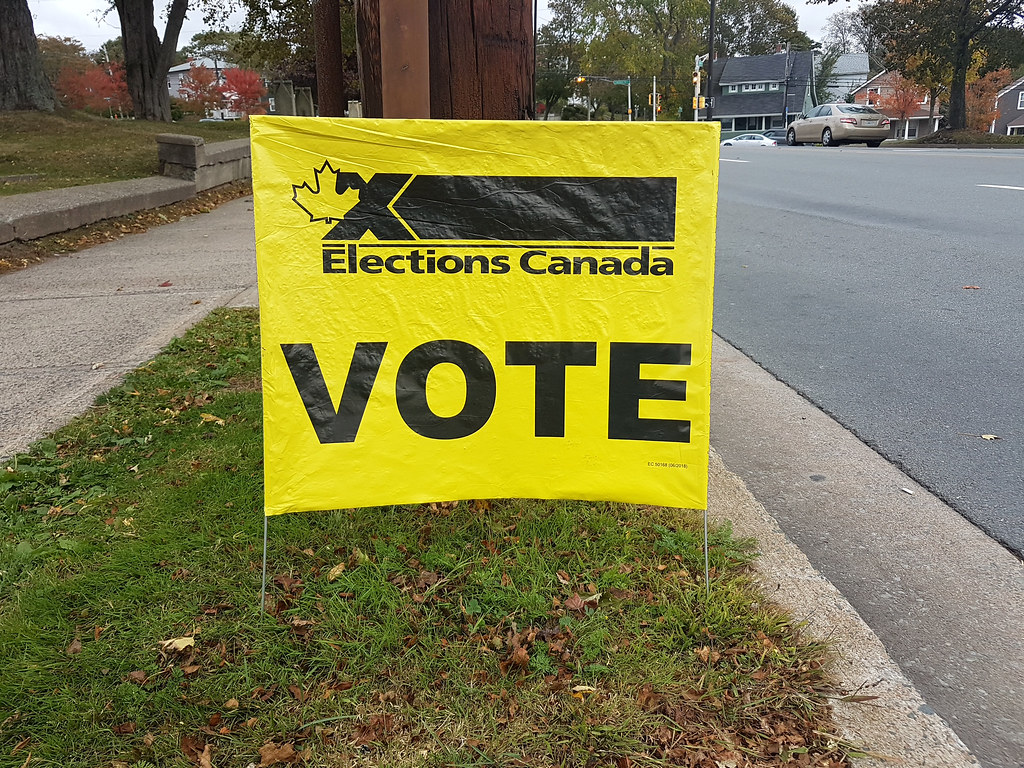
“2019 Canadian federal election – VOTE” by Indrid__Cold is licensed under CC BY-SA 2.0


No one can be said to have “won” such an exercise. You “win” these “debates” not by proposing the best policies, or offering competing philosophies, or even by presenting the best rhetoric. Rather, a “winner” is determined by who comes off the best to a general public that largely doesn’t follow the minute differences of respective platforms.
By that measure, no one really won Thursday’s debate, but Trudeau especially did not win it. I imagine that one of the problems of being raised as a spectacle of wealth, privilege and popularity is that it doesn’t quite prepare you for the moment when the worm turns, when people learn to dislike you for all the right reasons; when you are no longer given the proper deference and respect you feel is owed to you.
Trudeau came off as defensive, and flustered, taking hit after hit from other party leaders on topics ranging from his record, reconciliation and, especially, his self-interested decision to call a party in the first place. That he lacks a credible answer to why we’re holding this election at all three weeks into this campaign is a deep failure, one large and deep enough to consume his prospects of forming a majority government — and his hold on the party leadership along with it.
Annamie Paul offered the best performance of the night by far, and demonstrated that the Green party as a whole is unworthy of her. Whatever private internal dramas that may be unfolding, in public that party condemns itself to obscurity by refusing to get behind a woman who is, by every measure, impressive.
Bloc leader Yves-François Blanchet made himself into an idealized avatar of a whiny and aggrieved Quebec nationalism that puts Alberta to shame. It takes a real special lack of self-awareness to imagine that Quebecers have had it rougher in this country than Indigenous people. Or that Blanchet, by virtue of his French ancestry, has suffered from greater oppression than, say, Annamie Paul. One day, the rest of Canada is going to stop humouring these insulated, thin-skinned delusions — but not before Quebec’s seat count declines relative to the rest of the population’s. In the meantime, Blanchet’s ability to beam pure DGAF energy into the English debates at least made him seem like a human, albeit a delusional and unpleasant one.
By this measure, Erin O’Toole “won” the debate by not losing it. I can’t remember a single thing he actually said, and in such a setting this can only work to his favour.
I mean, what is there to say? On actual substantive policy issues, I couldn’t escape the sense of watching a grand Kabuki theatre, increasingly divorced from any grounded reality about our fiscal situation, or our ability to deliver on complex programs or problems.
QotD: Racism, anti-racism, and cognitive dissonance
Okay – but any public discussion that both reviles the idea that black people are less intelligent than others while also lustily demanding that it’s “racist” to submit black people to cognitive challenges is hopelessly incoherent. We disparage rape culture, diet culture – this exemption culture is premised on a basic assumption that it’s unsavory to require serious challenge of black students Because Racism.
No. You don’t get past racism by creating new forms of it. Scrapping traditional challenges should only be on the table after black kids have mastered the challenge anyway. Zora Neale Hurston gets the final word:
It seems to me that if I say a whole system must be upset for me to win, I am saying that I cannot sit in the game, and that safer rules must be made to give me a chance. I repudiate that. If others are in there, deal me a hand and let me see what I can make of it, even though I know some in there are dealing from the bottom and cheating like hell in other ways.
The current “woke” consensus is that Hurston was wrong on this, that she was expecting too much. I would just love to see one of today’s Elect in a room with Hurston trying to tell her where she was going wrong.
John McWhorter, “Revisiting Classics at Princeton”, It Bears Mentioning, 2021-06-09.
September 10, 2021
By Gandhi’s reckoning, the PPC is entering stage three (“First they ignore you, then they ridicule you, …”)
In The Line, Matt Gurney says that the dying media will have to start taking Maxime Bernier and the PPC much more seriously if the recent “blips” in the polls turn out to be accurate:
To riff off the old song, there’s something happening here, though what it is ain’t exactly clear. Like it or not, we’re going to have to start paying attention to the People’s Party of Canada and its leader, Maxime Bernier. If polls are to be believed, they’re having a great election.
The PPC hasn’t warranted much attention before. It has largely served as a vanity vehicle for Bernier, who probably can’t believe he’s been able to keep himself out of an ordinary job this long. The party is a mixture of populist outreach and pie-in-the-sky pseudo-libertarianism. It has proposed a smattering of policies, but none of them are much more than a talking point or meme. They are often summed up as a “far-right” party — or at least further right than the Conservative Party of Canada — but it feels overly generous to place them firmly anywhere in particular on the political spectrum. Their organizing principle has seemed to be anger with the status quo, and a feeling of alienation from the majority consensus on most political views.
The PPC took just under 300,000 votes in the 2019 election, or 1.6 per cent of ballots cast. It was a rounding error on a fringe, and seemed set to stay that way. This, combined with a history of dogwhistle racism, is why journalists and political analysts paid it little attention (and that includes yours truly).
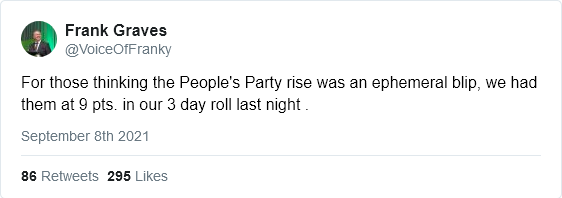
Something seems to be happening, though. The party has climbed in the polls, with some showing they’ve climbed by a lot. There are important caveats: Some of this can be written off as within-the-margins-of-error blips in the numbers. Perhaps there is some methodological quirk that is causing polling companies to overestimate the PPC’s standing. Maybe frustrated people are parking their vote there for a time but will come back to one of the traditional parties when actually making their x on a ballot.
So yeah. There’s all kinds of ways to rationalize this into a nothingburger, if you’re so inclined, but the fact remains there is a trend, consistent across different polls, from different companies, and over an extended period of time. It really does seem as though the party is set to double, triple or maybe even quadruple its support, relative to the last election. The latest Ekos poll has them at nine per cent. That’s an outlier on the high side, but if they came even close to that, the PPC would eclipse the Green Party of Canada’s best-ever showing. By a lot.
My friend John Wright is a pollster with decades of experience, and the executive vice president at Maru Public Opinion. He called me this weekend to tell me that something was up with the PPC’s numbers — I’d already realized the same, at least on an intuitive level, but he had the numbers to back it up. His numbers are broadly similar to what’s showing up in other polls. I asked him what he could tell me about the typical PPC voter, and he said there isn’t a ton of information about them, but pulled what data he could find.
The typical PPC supporter, based on polls as recent as last month, is … pretty normal, actually, at least demographically. They are fairly evenly distributed across every segment of Canadian society. No province has a wildly high or low number of PPC supporters (Alberta was a bit higher than the others, but only a very small bit, and with an overall small sample size). They are found fairly consistently across all age groups and economic and educational classes. The only really notable divergence in Wright’s numbers was on gender lines — men are twice as likely to support the PPC as women.
QotD: Prole nationalism and the globalist elite
E.M. Oblomov, “The Case for National Realism: Diversity is the hallmark of empires, not democracies”, City Journal, 2019-01-02.
September 8, 2021
The Line‘s She-lection Bullshit Bulletin No. 3 … scary black fully semi-automatic assault machinegun edition
The folks at The Line continue their good work in pointing out some of the bullshittiest bullshit the politicians spew on the campaign trail. This week has been all about politicians promising to crack down even harder on the hunters and sport shooters who keep driving their pickup trucks (plastered with Trump bumper stickers, of course) into downtown Toronto to shoot their scary black fully semi-automatic AK-15 or AR-47 assault machineguns with chainsaw bayonets at innocent gang-bangers at 3 in the morning:
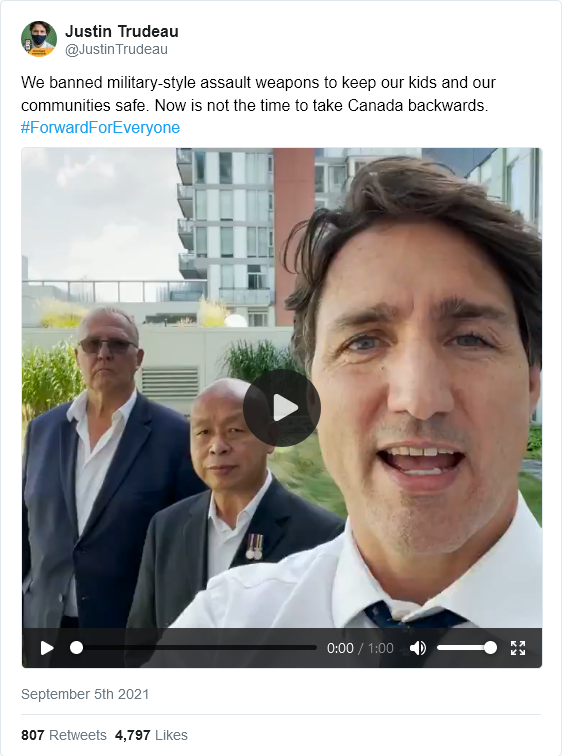
It is hard to know where to even begin picking through the bullshit that Canadians have had dumped atop their heads this week on the gun-control file. Both the Liberals and Conservatives hurled their share, but the worst offenders were by far the incumbents who claimed to ban “military-style assault weapons”.
Let’s start with this: Canadian law categorizes guns into three categories depending on their technical specifications: length, ammunition calibre, mode of operation, and the like. The categories are licensed and regulated differently. It can get pretty complicated. Despite their near-constant use, the terms “assault rifle”, “assault weapon” or the even-scarier sounding “military style assault weapon/rifle” have no specific or universally recognized meaning, including under Canadian law and firearms regulations. They aren’t part of or used by the categorization system.
This is essential to understand: because the terms have no specific and universally held meaning, these campaign-ready phrases can be appended to pretty much any type of rifle, whatever its actual legal category under our law. And that’s how we all found ourselves aspirating bullshit this week.
Most gun experts would generally classify an assault rifle/weapon as a rifle that fires medium-powered (or higher) ammunition and is capable of a “full auto” mode — that is, the weapon will continue firing as long as the trigger is held down. This results in a rapid volley of bullets at a cost of diminished accuracy (the recoil makes the firearm difficult to hold on target). These firearms typically have their ammunition kept in detachable magazines of 20 or 30 rounds each. When a magazine is emptied, it can be replaced by a practiced user in moments.
These sorts of weapons have been banned in Canada since the 1970s.
In 2020, the Liberals used an executive order — an Order in Council — to change the classification of several broad categories of until-then legal rifles, with the effect of preventing sales and further restricting most lawful uses for owners. None of these firearms were assault rifles/weapons by any reasonable standard. All are capable of semi-auto operation only, meaning one round is fired for each pull of the trigger. Under Canadian law, the magazines are limited to five rounds (there are some rare exceptions but five is the law).
Sigh. Still with us?
So the Liberals chose firearms linked to tragic events in Canada or abroad, like the AR-15, deemed these “assault weapons” and then banned them. But there was nothing meaningful or rational about this ban; it was was entirely a matter of political messaging. Numerous other rifles — firing the exact same ammunition from the exact same size of magazine at the exact same semi-automatic pace — remain legal and for sale to any licensed would-be purchaser. This isn’t an oversight. It’s just that the Liberals’ political goals were met by simply banning rifles linked to tragedies and ignoring the rest.
That’s the key thing to understand about what the Liberals did — it was always bullshit policy. But it sounds good to Canadian voters who don’t know fuck-all about guns. In that way, it’s meeting the Liberals’ needs.
Conservative leader Erin O’Toole quickly abandoned his party’s pledge to revoke the Liberals’ 2020 order-in-council once someone noticed and called attention to it. This should not be a surprise to anyone who has paid attention to O’Toole in the past … he’s what we used to call a “Red Tory” — really just a Liberal wearing a blue suit.


