Quotulatiousness

December 11, 2021

Another front opens in the “War On Christmas”

Filed under: Cancon, Media, Politics, Religion, USA — Tags: , , , , — Nicholas @ 05:00

In The Line, Jen Gerson looks at the latest offence against mainstream views of the Christmas season:

it was impossible not to get sucked into the blossoming horror of Santa Inc.

The eight-part television show made for HBO Max by comedians Sarah Silverman and Seth Rogen may soon attain the record of one of the most poorly rated television series of all time. And watching but a brief trailer, it’s not hard to see why.

I mean … Jesus. If you were trying to craft a perfect example of hate-bait for the reactionary right in a lab, this is pretty much what it would look like. It’s got woke politics, feminism, hatred of white guys and a pot shot in the War on Christmas neatly tied up in a claymation bow. The fact that the show is fronted by comedians who are Jewish has dug this mess into the very ugliest, muddiest trench of the culture war.

[…]

If you want to create an outrageous, bawdy Christmas movie that features a miserable and bored Mrs. Claus giving head to Santa, or a gag with a miner’s hat filled with dildos, there’s nothing wrong with that. But there’s a very specific audience for “sausage party” humour — lacrosse-playing young white men, and older white men who wish they were still young white men who could play lacrosse. In other words, people who look like Seth Rogen.

And do you know what that crowd doesn’t generally enjoy?

Thinly veiled manifestos on how awful white men are; the terribleness of corporate America, and a show featuring a lot of downtrodden women complaining about health insurance and lack of maternity leave.

On the other hand, if Santa Inc. was trying to appeal to the #resistence pussy hat and rainbow tattoo crowd, certainly a woke-appropriate message is here for them. But, does this crowd need to be so lectured? Meanwhile, the juvenile humour is off-putting. Is the feminist set going to keel over laughing because one of the female reindeer characters brags about having a threesome with Donner?

Lol. Thud.

There’s no sophistication here. No clever set up or punch line. It’s just a story about an angry female elf who wants to be Santa Claus that pretends to be funny by leaning on sex jokes.

Raunchiness is fine for a cheap laugh. It relies on the taboo of shock and sex to generate an emotional reaction. But, man, one of the most popular music videos of the last few years was Wet Ass Pussy. Who even notices swearing anymore? Who is shocked by a scene in which the main character’s mother bangs the Easter bunny?

This kind of lazy humour is old hat. It’s boring.

So, no, Santa Inc. is not good.

Pretendians in Canadian academia may resemble “those legendary Klan gatherings where everyone is an uncover FBI agent”

Filed under: Cancon, Politics — Tags: , , , , , — Nicholas @ 03:00

After recounting the rise and fall of Carrie Bourassa, Ed West looks at other examples of white people deliberately passing themselves off as members of First Nations groups and other disadvantaged groups:

Carrie Bourassa with media.
Lead photo in Geoff Leo’s article for the CBC – https://www.cbc.ca/newsinteractives/features/carrie-bourassa-indigenous

… then some serious allegations came to light casting doubt on Morning Star Bear’s fitness for office: Bourassa, it turned out, was white. Her forebears were all Russian, Czech and Polish farmers, who while the Metis struggled with the arrival of the Europeans were back in Tsarist Russia, living lives of unbridled white privilege as agricultural workers.

The response was merciless anger. Bourassa’s colleague Winona Wheeler, an associate professor of Indigenous Studies at the University of Saskatchewan, told the Canadian Broadcasting Corporation that what she did was “abuse” and “theft”, “colonialism in its worst form and it’s a gross form of white privilege.”

Another called her “the modern-day Grey Owl” in reference to the famous early 20th century English conservationist who had managed to convince the world he was Native American, rather than being Archibald from Hastings.

Bourassa’s outing was followed last weekend by that of Jessica Bardill, an “indigenous” language speaker at Montreal University who was reportedly suspended because of doubts about her race. And who could have suspected she was white?

Bourassa and Bardill are hardly exceptional: the past two years have seen at least half a dozen similar racial unmaskings, almost all female academics. Is this the result of the strange racial spoils system created by affirmative action, or does it reflect the cultural emptiness felt by some North Americans, the unbearableness whiteness of being?

Among them is Suzy Kies, an indigenous “expert” in – yet again – Canada, on whose advice a Catholic school district burned 30 library books about indigenous people, removing another 4,700. Kies had become quite a prominent figure on all matters indigenous; again, how could they have possibly noticed?

One suspects that a conference of Canada’s indigenous educators would turn out like those legendary Klan gatherings where everyone is an uncover FBI agent, or that meeting of Holocaust survivor memoir writers where both were fake.

Many of these “indigenous” experts had risen far by telling white liberals what they wanted to hear, confirming their worldview. The same was true of @Sciencing_Bi, who enthralled Twitter last spring with her powerful denunciations of sexual misconduct in higher education. The mysterious young woman had grown up in Alabama, a member of the Hopi tribe, but had “fled the south because of their oppression of queer folk”. Sadly, Sciencing Bi contracted Covid in April 2020, having been forced by her cruel university to do in-person teaching just at the point when that issue was becoming a culture war hot topic, and died, quite unusually for someone so young.

December 8, 2021

What if the refugee flow was crossing the Channel the opposite way?

In The Critic, Joel Rodrigues considers what the media narrative would say if the constant stream of migrants from the EU to Britain was reversed, as all the major media outlets predicted would happen if Brexit went through:

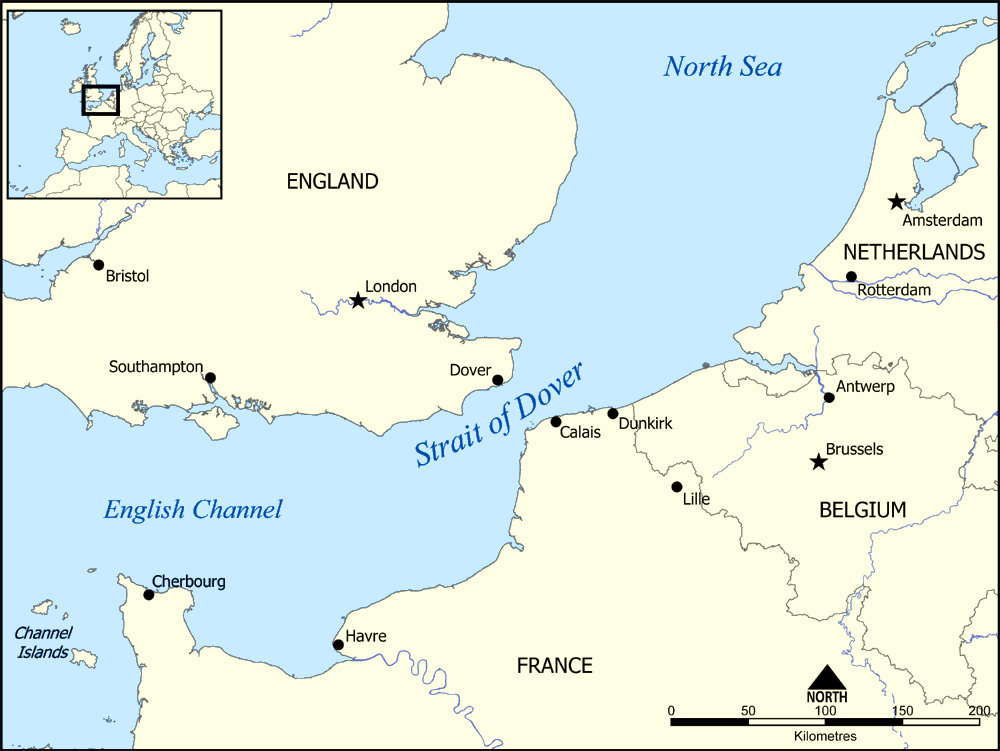
This map shows the location of the Strait of Dover between England and France, and part of the English Channel and the North Sea. It also shows nearby towns such as Dover, Calais, and Dunkirk.
Image created by NormanEinstein via Wikimedia Commons.

Imagine “tent” cities on the Kent coast, similar to “the Jungle” that existed in Calais up until 2016. These camps are the type of camps that the Remain campaign (wrongly) warned would spring up if Britain voted to leave the EU, as part of their Project Fear campaign. The tent cities are full of migrants, hoping to reach the French coast and the “sunlit uplands” of the European Union.

The camps are filthy, riddled with violent crime, and it is here that people traffickers sell spaces on dinghies to cross the channel for thousands of pounds a ticket. The British police and immigration services are aware of undocumented people living in squalor in the camps, but largely do nothing.

Occasionally a camp is cleared to placate the locals, but it quickly springs up somewhere else. The British government make no effort to document, accommodate or process the migrants living in appalling conditions on its territory. Instead, it blames the “pull factor of the EU’s single market”, saying that many of these migrants have family in France and want to live in a French or German speaking society. A junior British minister suggests that the black market economies in the EU are also a pull factor, and that there are a “lack of safe asylum routes” into the EU.

People smugglers continue operating from the British coast, and the migrant camps expand. Dinghies are now launched daily from the UK towards the continent. Police are aware of the launches, but do nothing. The RNLI and Royal Navy escort these flimsy boats until they are in EU waters, despite their not being seaworthy. Thousands succeed in making the crossing.

Then, tragedy strikes when a boat sinks. Statements are released from the British and French governments lamenting the loss of life. Trying to find a solution, Emmanuel Macron writes a letter to Boris Johnson urging increased collaboration, with joint patrols if necessary, to prevent a repeat of the tragedy.

The British government issue a response claiming that the perfectly conciliatory letter is in fact unacceptable, a “threat to British sovereignty”, and that France is uninvited from crisis talks. British media later reports that in a meeting with some of his advisors, Boris Johnson branded Emmanuel Macron as “a clown in charge of a circus”.

Imagine the media commentary and narrative in the UK surrounding such a situation, especially post-Brexit.

“Migrants die fleeing racist, Brexit-ridden, plague island,” says an op-ed in the Guardian. The comments are largely agreed that Boris Johnson is personally responsible for each of their deaths.

“UK condemned as using migrants to destabilise the EU’s single market,” reports the BBC. Parallels are also drawn in The Times between Boris Johnson and Belarus’ Lukashenko. There are mass demonstrations outside Parliament as the crisis worsens.
One can imagine the EU Commission swiftly and publicly denouncing the UK and drawing up sanctions. The Labour party would likely call it a national scandal, and demand resignations, as well as accusing the government of taking a hardline stance as cynical electioneering.

I searched for public domain or Creative Commons images of the English Channel migrant crisis, but came up surprisingly empty, hence the generic map to illustrate this post. I had expected to be inundated with lots of heart-rending images of desperate refugees, but not this time…

December 7, 2021

How are things going in Honduras?

Filed under: Americas, Economics, Government, Politics — Tags: , , — Nicholas @ 05:00

For those not following the Honduran experiment with ZEDEs (las Zonas de Empleo y Desarrollo Económico — Zones for Employment and Economic Development) also known as “charter cities” or “model cities”, Scott Alexander provides a handy summary of the situation in the wake of the recent Honduran elections:

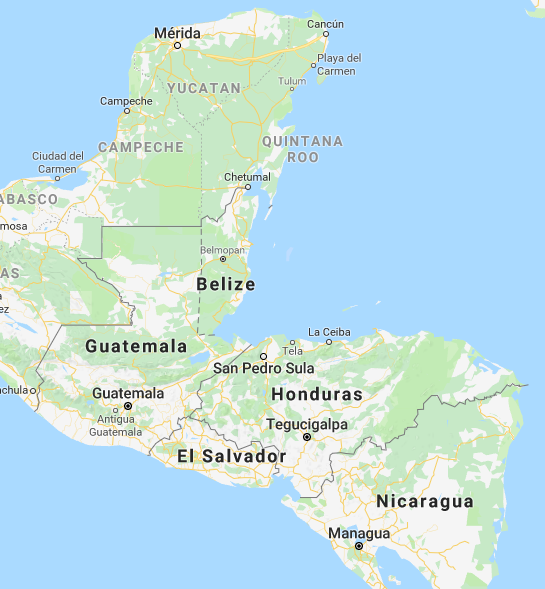
Honduras, Guatemala and El Salvador
Image via Google Maps.

The socialist opposition has won Honduras’ election and pledges to fight against charter cities there. “Immediately upon assuming the presidency, we are going to send the National Congress an initiative for the repeal of the ZEDE law,” incoming president Xiomara Castro said.

This was what everyone was afraid of. But the last party tried pretty hard to protect ZEDEs from trigger-happy successors, and the constitution currently says that the only way to get rid of them is to win two consecutive 2/3 votes to do so, then give the existing projects ten years to wind down.

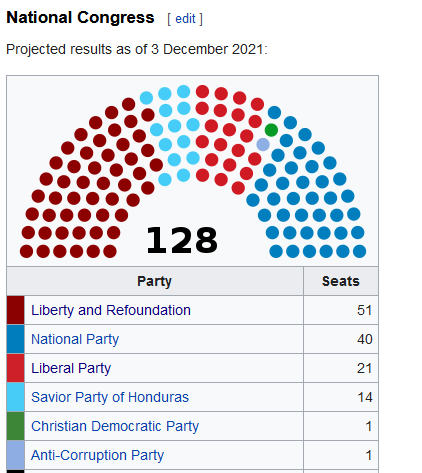
Can the socialists get a 2/3 majority? Wikipedia predicts the incoming Honduran Congress will look like this:

Liberty and Refoundation (the socialists) will probably enter into a coalition with the Savior Party and have 65/128 seats for a bare majority. They need 86 votes for a 2/3 majority, which in theory they can get if the Liberal Party agrees. The Liberal Party seems centrist and hard to pin down, but this article includes the following great quote:

    “The Liberal Party opposes the ZEDEs because, above all, they undercut our national sovereignty, and because we don’t want them to become hideouts for extraditable criminals,” said [Liberal Party leader Yani] Rosenthal, who served a three-year prison sentence in the United States for money laundering and participating in a criminal scheme with the Los Cachiros cartel.

Rosenthal kind of goes back and forth elsewhere, but in the end I think he’ll vote with the socialists on this. Still, there’s some speculation that his party might not vote as a bloc, and even a few defectors would be enough to prevent a supermajority.

In theory, even if the socialists win two consecutive votes, they have to give the projects ten years to wind down. Ten years is forever in politics, and probably before then the capitalists will get back into power and say never mind, everyone can keep doing what they’re doing. The socialists are aware of this and say that their supplementary strategy is to have everything about the ZEDE law declared unconstitutional.

This should be a hard sell, because ZEDEs are a constitutional amendment, plus the current Supreme Court explicitly ruled a few years ago that they were constitutional. But apparently the Honduran Supreme Court can declare constitutional amendments unconstitutional if it really wants. And the new government will get to appoint a new Supreme Court in two years, and although the exact process is complicated, they may be able to get people who agree with them on this.

Also, incoming president Castro is married to Manuel Zelaya, a former president who tried to pull an Andrew Jackson after the Supreme Court ordered him to stop holding an illegal referendum to change term limits in his favor. He ordered the military to hold the referendum anyway, and was only ousted after the military couped him instead. So this is not exactly a family known for their deep respect for the exact wordings of laws or court rulings (not that anyone in Honduras has really excelled on that front). See further speculation eg here and here. And here’s Mark Lutter from Charter Cities Institute on the elections and the future.

December 3, 2021

A bureaucratic mandate for never-ending intervention — induced offensensitivity

Theodore Dalrymple notes the increasing reach of the bureaucracy in policing everyday language in a supposed attempt to protect the easily offended feelings of minority groups, but really in yet another way to increase the role of bureaucrats (and their staffing and budget allocations):

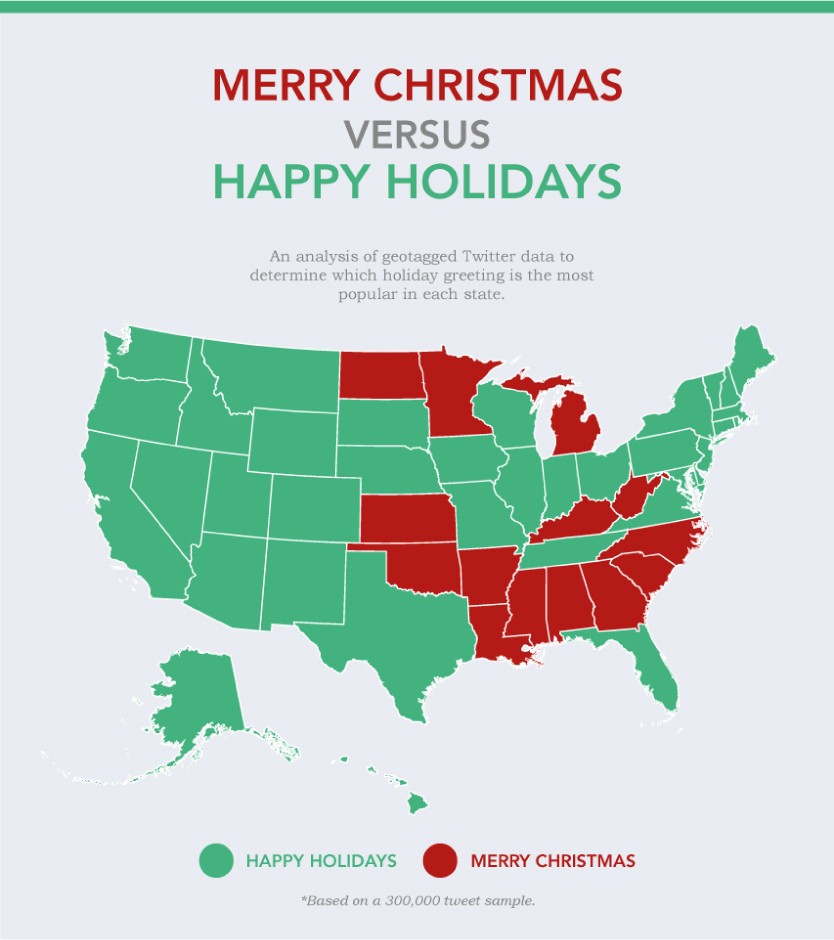
Original infographic from Treetopia – https://www.treetopia.com/Merry-Christmas-vs-Happy-Holidays-a/304.htm

Underlying the bureaucratic desire to reform language are two assumptions: first that it is the duty of bureaucrats to prevent offense to people occasioned by the use of certain words, and second that they know what words will give offence to people.

Of course, there are only certain categories of people who needed to be protected from taking offence: that is because, in the estimate of their would-be and self-appointed protectors, they are very delicate and can easily be tipped into depression or states of mind even worse than depression.

Whether it is flattering, condescending or downright insulting to consider people so delicate that they cannot hear certain words that were hitherto considered innocuous, I leave to readers to decide. For myself, I think that to regard people as psychological eggshells is demeaning to them, but other may think differently.

But the question still arises as to whether the people supposedly in need of bureaucratic intervention actually do take offence at the allegedly offensive words, such as Christmas, when they are uttered.

This is not as straightforward a question as might at first appear, for people can be taught or encouraged to be easily offended, especially if they will derive certain advantages, political, social or even financial, from being, or claiming to be, offended. If you pay someone to be ill, he will be ill; if you pay someone to be offended, he will be offended.

It is in the interests of bureaucracies that the population should become hypersensitive, for then it will run to the bureaucrats for so-called protection from offensiveness.

A hypersensitive population creates endless work for the bureaucrat to do: he will have constantly to adjudicate between the claims of those who have taken, and those who have allegedly given, offence. Conflict and stoked-up anger are to him what fertilizer is to corn.

For much of the population, hypersensitivity becomes a duty, a pleasure and a sign of superiority of mind and moral awareness. In addition, it is an instrument of power. And, of course, habit becomes character. What may have started out as play-acting becomes, with repetition, deadly sincerity.

People who have had to be taught what microaggressions are because they have not noticed them eventually come to believe in their reality and that that they have been subjected to them. Then they start to magnify them in their minds until they seem to them very serious: they become self-proclaimed victims.

There are two things that victims seek in our law-saturated world: revenge and compensation. Neither of these things can be achieved without the aid of a large apparatus of bureaucrats (civil-litigation lawyers are bureaucrats of superior intelligence who are usually endowed also with a modicum of imagination).

December 2, 2021

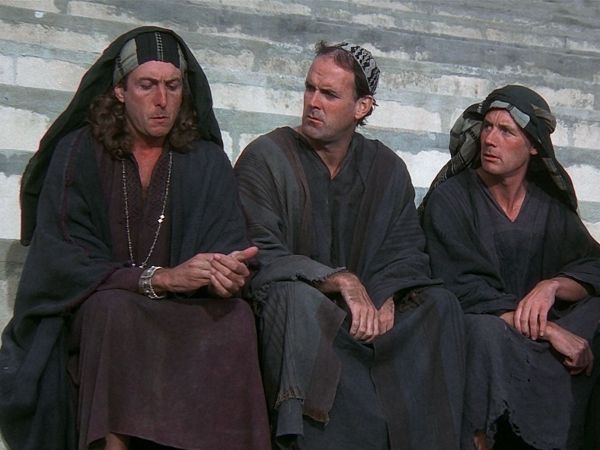
“Good idea, Judith. We shall fight the oppressors for your right to have babies, brother. Sister. Sorry.”

Filed under: History, Humour, Media, Politics, USA — Tags: , , , , , , — Nicholas @ 03:00

The power of Python compelled Stephen Green to write this:

Stan: “I want to be a woman. From now on, I want you all to call me ‘Loretta’.”
Still from Monty Python’s Life of Brian, 1979.

Of all the jokes, gags, and barbs thrown in every direction, Jesus is the only figure shown respect. Monty Python trouper Eric Idle later said of Jesus, “What he’s saying isn’t mockable, it’s very decent stuff.”

For a non-believing, take-no-prisoners comedian like Idle, that’s practically a whole-hearted endorsement.

Instead, the film — Python’s only real film, the others were basically collections of sketches, even Holy Grail — is anti-authoritarian, anti-fanaticism, anti-nihilism, and anti-humorless prigs.

Life of Brian is, however, very pro-funny.

The Pythons even saved their sharpest barbs for political extremists and self-deluded lefties.

Case in point on that last observation: The classic Colosseum conversation between the would-be revolutionaries of the Judean People’s Front.

Or was that the People’s Front of Judea?

Regardless, take two minutes (clip below!) to bask in the comedic good sense that would get the cast and entire production crew canceled in our times.

The postmodern Left should probably cancel everyone who laughed at this scene, just to be safe.

Anyway, point-by-point, Monty Python satirically dissected the then-nascent cultural trends that have since come to dominate not only our culture, but also our politics and even our private lives.

Enjoy … although I will admit that re-watching this today, the laughs were a bit more bitter than they were when I first watched Life of Brian nearly 40 years ago.

December 1, 2021

Polling bias in a time of pandemic

Filed under: Britain, Government, Health, Media, Politics — Tags: , , , , — Nicholas @ 03:00

At The Daily Sceptic, Mike Hearn looks at the often incredible poll results turned up by YouGov that seem to indicate that well over half the population of Britain are budding medical fascists who want nothing more than a full-on pandemic tyranny from now to the end of time:

Recently YouGov announced that 64% of the British public would support mandatory booster vaccinations and another polling firm claimed that 45% would support indefinite home detention for the unvaccinated (i.e., forced vaccination of the entire population). The extreme nature of these claims immediately attracted attention, and not for the first time raised questions about how accurate polling on Covid mandates actually is. In this essay I’m going to explore some of the biases that can affect these types of poll, and in particular pro-social, mode and volunteering biases, which might be leading to inaccurately large pro-mandate responses.

There’s evidence that polling bias on COVID topics can be enormous. In January researchers in Kenya compared results from an opinion poll asking whether people wore masks to actual observations. They discovered that while 88% of people told the pollsters that they wore masks outside, in reality only 10% of people actually did. Suspicions about mandate polls and YouGov specifically are heightened by the fact that they very explicitly took a position on what people “should” be doing in 2020, using language like “Britons still won’t wear masks”, “this could prove a particular problem”, “we are far behind our neighbours” and most concerning of all – “our partnership with Imperial College”. Given widespread awareness of how easy it is to do so-called push polling, it’s especially damaging to public trust when a polling firm takes such strong positions on what the public should be thinking and especially in contradiction of evidence that mask mandates don’t work. Thus it makes sense to explore polling bias more deeply.

[…]

Given the frequency with which large institutions say things about COVID that just don’t add up, it’s not entirely surprising that people are suspicious of claims that most of their friends and neighbours are secretly nursing the desire to tear up the Nuremberg Code. But while we can debate whether the chat-oriented user interface is really ideal for presenting multi-path survey results, and it’s especially debatable whether YouGov should be running totally different kinds of polls under the same brand name, it’s probably not an attempt to manipulate people. Or if it is, it’s not a very competent one.

When I was much younger, I’d very occasionally get a call on our land line from a polling firm. I’d sometimes take part in the poll, although I don’t recall every seeing any of the polls I took part in being published later. After a few years, I stopped taking part and now I hang up as soon as it’s clear that the call is from a polling company. Apparently I’m far from alone in this learned aversion to dealing with polls:

Online panel polling solves the problem of low phone response rates but introduces a new problem: the sort of people who answer surveys aren’t normal. People who answer an endless stream of surveys for tiny pocket-money sized rewards are especially not normal, and thus aren’t representative of the general public. All online panel surveys face this problem and thus pollsters compete on how well they adjust the resulting answers to match what the “real” public would say. One reason elections and referendums are useful for polling agencies is they provide a form of ground truth against which their models can be calibrated. Those calibrations are then used to correct other types of survey response too.

A major source of problems is what’s known as “volunteering bias”, and the closely related “pro-social bias”. Not surprisingly, the sort of people who volunteer to answer polls are much more likely to say they volunteer for other things too than the average member of the general population. This effect is especially pronounced for anything that might be described as a “civic duty”. While these are classically considered positive traits, it’s easy to see how an unusually strong belief in civic duty and the value of community volunteering could lead to a strong dislike for people who do not volunteer to do their “civic duty”, e.g. by refusing to get vaccinated, disagreeing with community-oriented narratives, and so on.

In 2009 Abraham et al showed that Gallup poll questions about whether you volunteer in your local community had implausibly risen from 26% in 1977 to a whopping 46% in 1991. This rate varied drastically from the rates reported by the U.S. census agency: in 2002 the census reported that 28% of American adults volunteered.

QotD: When mere teaching isn’t enough, indoctrination takes over

    There is no such thing as learning loss. Our kids didn’t lose anything [during the pandemic]. It’s okay that our babies may not have learned all their times tables. They learned resilience. They learned survival. They learned critical-thinking skills. They know the difference between a riot and a protest. They know the words insurrection and coup.

So says Cecily Myart-Cruz, president of the United Teachers Los Angeles union. A union representing 33,000 teachers and associated educational staff.

“Education is political”, says Ms Myart-Cruz, who boasts of her ability to act with near-impunity, and whose list of Intolerable Things includes cognitive testing, “structural racism”, border controls, policing, and the supposed “privilege” of parents who would like their children to actually learn things, including times tables. Our Mistress Of Higher Purpose struggles to comprehend why parents might object to their children’s education, even in basic skills, being supplanted by the nakedly self-serving and increasingly weird activism of the people paid to teach them those basic skills. Instead, she endorses claims that such objections must be driven by “white-supremacist thinking”.

David Thompson, “Activism Farms”, DavidThompson, 2021-08-31.

November 30, 2021

QotD: Getting to dystopia

Filed under: Liberty, Media, Politics, Quotations — Tags: , — Nicholas @ 01:00

I’d like to pick up on that first thought of mine: When I was a kid and watched sci-fi movies set in a futuristic dystopia where dehumanized individuals are mere chattels of an unseen all-powerful machine policed by commissars in identikit variety-show tinfoil suits in a land where technology has advanced but liberty has retreated, I always found the caper less interesting than the unseen backstory: How did they get there from here? And […] we’re now in the getting-there-from-here phase.

Things are changing very fast. And, if we don’t fully understand why they’re changing and where they’re heading, we’re going to end up in one of those dehumanized dystopias — and very soon.

Mark Steyn, “Live Around the Planet: Tuesday January 22nd”, Steyn Online, 2019-01-22.

November 29, 2021

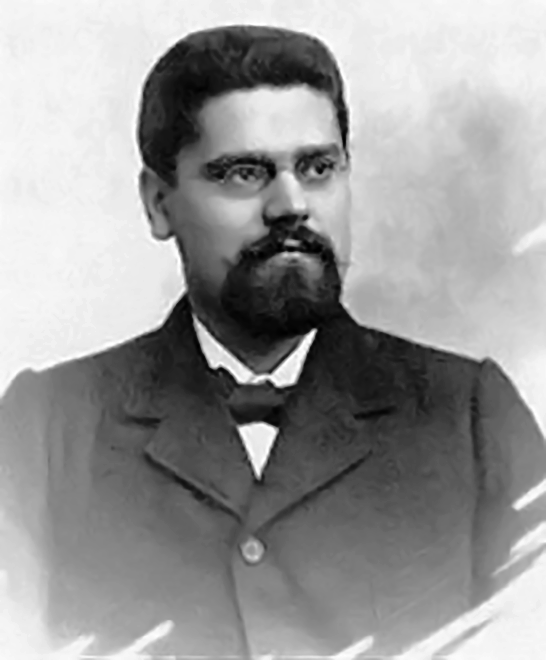
Giovanni Gentile, “the ideological father of Fascism”

Filed under: Europe, History, Italy, Politics — Tags: , , , , — Nicholas @ 03:00

Emmanuel Rincón on the Italian philosopher who created the ideological underpinnings of Benito Mussolini’s Fascist movement:

Giovanni Gentile
Undated photograph probably before 1930 via Wikimedia Commons.

Giovanni Gentile, a neo-Hegelian philosopher, was the intellectual author of the “doctrine of fascism”, which he wrote in conjunction with Benito Mussolini. Gentile’s sources of inspiration were thinkers such as Hegel, Nietzsche, and also Karl Marx.

Gentile went so far as to declare “Fascism is a form of socialism, in fact, it is its most viable form.” One of the most common reflections on this is that fascism is itself socialism based on national identity.

Gentile believed that all private action should be oriented to serve society. He was against individualism, for him there was no distinction between private and public interest. In his economic postulates, he defended compulsory state corporatism, wanting to impose an autarkic state (basically the same recipe that Hitler would use years later).

A basic aspect of Gentile’s logic is that liberal democracy was harmful because it was focused on the individual which led to selfishness. He defended “true democracy” in which the individual should be subordinated to the State. In that sense, he promoted planned economies in which it was the government that determined what, how much, and how to produce.

Gentile and another group of philosophers created the myth of socialist nationalism, in which a country well directed by a superior group could subsist without international trade, as long as all individuals submitted to the designs of the government. The aim was to create a corporate state. It must be remembered that Mussolini came from the traditional Italian Socialist Party, but due to the rupture with this traditional Marxist movement, and due to the strong nationalist sentiment that prevailed at the time, the bases for creating the new “nationalist socialism”, which they called fascism, were overturned.

Fascism nationalized the arms industry, however, unlike traditional socialism, it did not consider that the state should own all the means of production, but more that it should dominate them. The owners of industries could “keep” their businesses, as long as they served the directives of the state. These business owners were supervised by public officials and paid high taxes. Essentially, “private property” was no longer a thing. It also established the tax on capital, the confiscation of goods of religious congregations and the abolition of episcopal rents. Statism was the key to everything, thanks to the nationalist and collectivist discourse, all the efforts of the citizens had to be in favor of the State.

November 28, 2021

QotD: Hidden political pay-offs as “book advances”

Filed under: Books, Business, Media, Politics, Quotations, USA — Tags: , , — Nicholas @ 01:00

Anyway, as I’ve complained many times before, these “advances” given to leftwing figures are not advances at all.

True advances are, well, advances against expected future royalties. That’s why they’re called “advances”.

People expect that a J.K. Rowling book will produce at least $5 million in royalties, so you give her a $5 million advance on those royalties. You’re giving her a payment on her royalties in advance of actually seeing those sales.

But you do expect them.

You don’t pay her fresh royalties until the royalties she generates exceeds the initial advance on royalties you paid her.

When she makes $5 million and one hundred dollars, you send her a fresh check for one hundred dollars.

When these major media conglomerates, all left-leaning and most with business before the government, give millions to Hillary Clinton and Hunter Biden and Andrew Cuomo, there is no one at that company that expects the books will ever make that much in royalties.

They’re just payoffs. Or disguised political donations.

It’s not an “advance” if you cannot show a plausible stream of sales which will meet or exceed that “advance”.

Personally, I’d love to see some kind of law on this subject to force these large media corporations to prove that they have a genuine, rational belief that a Hunter Biden book will make $10 million in sales (which would justify a million dollar advance, assuming a royalty of 10%).

And I’d like to see their corporate officers sign certifications for the government that they’re not fudging the numbers. And that they understand that there might be prosecutions for perjury if they do lie about expected future royalties.

Much like people in the financial sector are constantly required to sign.

Why should media corporations be immune from such requirements?

And I’d love to see these disguised campaign donations treated and limited just like actual campaign donations.

Or, better yet: No “advances” for serving politicians, declared politicians who are running, or any politician ten years after his term of service ends. They can just take their royalty checks as royalties actually accrue.

If Hunter Biden really sells $10 million in books — LOL — then he’ll get that million dollars eventually in royalty payments. They’ll just come over the course of a year or two rather than all at once in an “advance” on future earnings.

If not — then not.

This isn’t stopping them from getting paid for books they sell — it’s to stop mega-media-corporations with business before the government, and a strong desire to pay off politicians they like, from giving “advances” to favored politicians that bear no relationship whatsoever to the actual expected royalties the books will generate.

Ace, “Ethics Agency Might Claw Back Cuomo’s $5 Million ‘Advance’ For His ‘Book'”, Ace of Spades H.Q., 2021-08-27.

November 27, 2021

How Andrew Cuomo got megabucks for his (ghostwritten) book on the pandemic

Filed under: Books, Business, Politics, USA — Tags: , , , , — Nicholas @ 05:00

In the latest issue of the SHuSH newsletter, Kenneth Whyte details how former New York state Governor Andrew Cuomo managed to get a $5.1 million advance from Random Penguin for a book that was mostly written by Cuomo staff members and an outside ghostwriter:

Penguin Random House contacted Cuomo’s agent about writing a book on March 19, 2020, about three weeks after the first COVID-19 case landed in New York. Cuomo was a TV darling in the early days of the pandemic. On July 1, his agent got back to Penguin Random House to say he’d written 70,000 words and he was ready to make a deal. How did a governor of America’s hardest-hit pandemic state produce a fat manuscript in three months flat? It appears he had his staff and a ghostwriter author the book for him, in violation of state ethics prohibitions against the use of any state resources or personnel to produce the book.

Meanwhile, Cuomo’s office was churning out doctored statistics to make his pandemic policies, particularly around nursing homes, look better than they deserved.

July 8, Cuomo’s book went to auction. Penguin Random House kicked things off with a $750,000 offer and wound up winning with a bid of $5.1-million. It was a triumph for Cuomo, and not his first in the publishing world: about seven years ago, he took HarperCollins for a $700,000 advance on what the New Republic called an “overlong … cliché-ridden, and hopelessly dull” memoir, All Things Possible. That one sold 4,000 copies in hardcover, a number that would warrant an advance of maybe $10,000.

Several weeks after the auction, Cuomo was asked by the media if he got a lot of money to write the book. “Well,” he replied. “Only if I sell a lot of copies.” Which is not how it works. Advances are non-returnable, and he’d banked $3.1 of the $5.1 before publication. The rest of Cuomo’s advance was spread out over two more years, presumably for tax purposes.

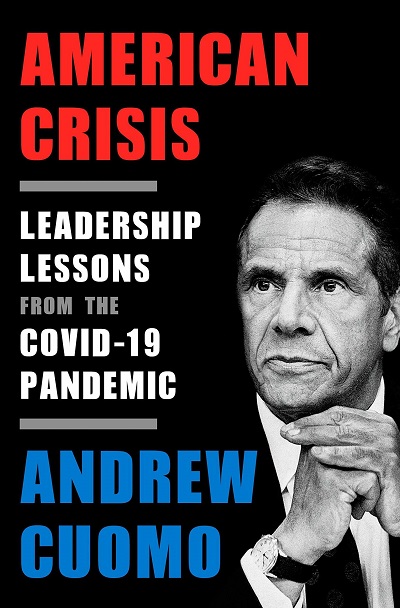
Weeks after the grandly titled American Crisis: Leadership Lessons from the COVID-19 Pandemic was released in October 2020, Cuomo was hit with the first of a long series of sexual harassment allegations. He was forced to resign in August 2021. By then, it had also emerged that Cuomo’s office had covered up roughly half of the fatalities among state nursing home residents during the pandemic.

American Crisis managed to sell at least ten times more copies than Cuomo’s previous book, which is progress, I suppose, but still a nightmare for his publisher. A sale of 50,000 copies might warrant a solid six-figure advance. But $5.1 million? Disastrous.

November 24, 2021

Rousseau versus “original sin” in modern-day culture

Filed under: Books, Media, Politics, USA — Tags: , , , , , — Nicholas @ 03:00

In UnHerd, Mary Harrington ponders the two irreconcilable camps struggling for cultural supremacy in western countries, as most recently highlighted by the Kyle Rittenhouse trial in Kenosha, Wisconsin:

Portrait of Jean-Jacques Rousseau (1712–1778) by
Maurice Quentin de La Tour, circa 1753.
Wikimedia Commons.

The Rittenhouse argument is just such a case. It’s powered by a profound disagreement about human nature: one that fuels many of the most intractable modern culture wars, from Mumsnet bunfights about babycare to arguments about classroom discipline and what the police force is for.

Are humans naturally good given the right circumstances? Or are we flawed and in need of threats and guidelines to keep us on the straight and narrow? The split is a legacy of radical ideas stretching back to the revolutionary 18th century.

Perhaps the most famous proponent of intrinsic human goodness is Rousseau, who claimed in Emile (1762) that children are born virtuous. As Rousseau sees it, we only need freedom, love and the right environment to spontaneously come to an understanding of what’s right.

When Emile was first published, it stood in stark challenge to the then-dominant view, emerging from the Christian tradition, that humans are tainted by “original sin”. From this vantage point, we’re naturally flawed, and must always struggle against our less virtuous instincts. Rousseau’s claim so appalled adherents of this then-dominant view that copies of his book were burned in the street.

Today, though, the boot is on the other foot. The high-status view among contemporary elites is unmistakeably Team Rousseau.

At the tiniest scale, it’s expressed in the school of parenting that believes it’s wrong or even cruel to teach children how to live. I’ve written before about the currently popular ideas of “attachment parenting” and “gentle parenting”, which emphasise self-discovery in a loving environment over routine, authority or punishment — and about how these views skew wealthy and liberal.

In education settings, the same idea appears as “child-centred pedagogy”, an approach that emphasises individual pathways and discovery over rote learning and teachers as authority figures. And at the biggest scale, it crops up as the claim that all the root causes of crime are external to humans: poverty, trauma, discrimination and so on. From this perspective, if we could only replace policing with tailored community services that eliminated these root causes, there would no longer be any crime.

Even outbreaks of mass public disorder are treated by Team Rousseau as an unfortunate-yet-understandable response to bad governance: when BLM protesters in Baltimore toppled a statue of Christopher Columbus last year, the Democrat politician Nancy Pelosi responded by shrugging it off as a natural expression of that community’s wishes. If the community doesn’t want the statue, she said, “the statue shouldn’t be there”. From this vantage point, public unrest is something akin to the weather: a naturally-occurring phenomenon in which leaders must strive to create the conditions for goodness, or else “people will do what they do”.

November 23, 2021

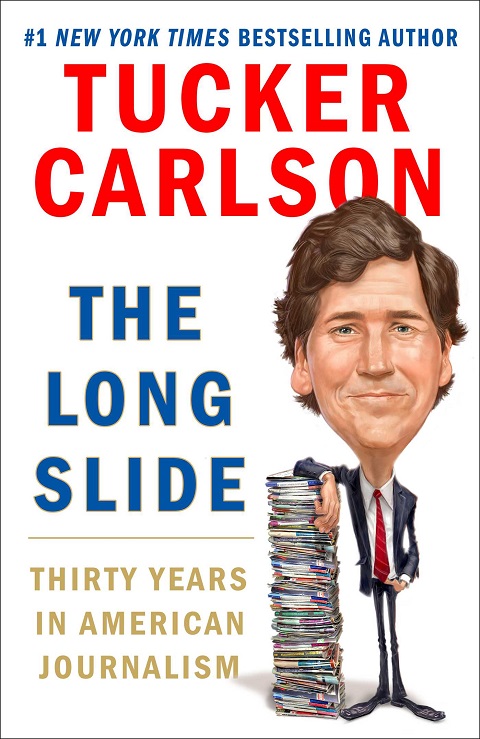
Tucker Carlson’s new book The Long Slide

Filed under: Books, Media, Politics, USA — Tags: , , , — Nicholas @ 03:00

Wilfred M. McClay reviews Carlson’s collected essays for First Things:

Tucker Carlson has become such a fixture in the world of cable-television news that it’s easy to forget he began his journalistic career as a writer. And a very good one at that, as this wide-ranging and immensely entertaining selection of essays from the past three decades serves to demonstrate. Carlson’s easygoing, witty, and compulsively readable prose has appeared everywhere from The Weekly Standard (where he was on staff during the nineties) to the New York Times, the Spectator, Forbes, New Republic, Talk, GQ, Esquire, and Politico, which in January 2016 published Carlson’s astonishing and prophetic article titled “Donald Trump is Shocking, Vulgar, and Right”. That essay has been preserved for posterity in these pages, along with twenty-two other pieces, plus a bombshell of an introduction written expressly for the occasion. More of that in a moment.

The first response of many of today’s readers, particularly those who don’t like the tenor of Carlson’s generally right-populist politics or the preppy swagger and bubbly humor of his TV persona, will be to dismiss The Long Slide as an effort to cash in on the author’s current notoriety by recycling old material to make a buck. That was my assumption when I first opened this collection. But the book has an underlying unity, and a serious message. It evokes a bygone age, an era of magazine and newspaper journalism that seems golden in retrospect, and is now so completely gone that one must strain to imagine that it ever existed at all. The simple fact is that almost none of these essays could be published today, certainly not in the same venues: They are full of language and imagery and a certain brisk cheerfulness toward their subject matter that could not possibly pass muster with the Twittering mob of humorless and ignorant moralists who dictate the editorial policies of today’s elite journalism.

Carlson’s writing style reflects the influence of the New Journalists such as Tom Wolfe and Hunter Thompson, who brought a jaunty, whiz-bang you-are-there narrative verve and high-spirited drama to the task of telling vividly detailed stories about unusual people and places, generally relating them in the first person. Carlson’s prose is not as spectacular as Wolfe’s or as thrillingly unhinged as Thompson’s. But it has its own virtues, being crystal clear, conversational, direct, and vigorous, never sending a lardy adjective to do the work of a well-chosen image, and never using gimmicky wild punctuation or stretched-out words to fortify a point. He’s a blue-blazer and button-down-collar guy, not a compulsive wearer of prim white suits or a wigged-out drug gourmand wearing a bucket hat and aviator glasses. But many of Carlson’s writings give the same sense of reporting as an unfolding adventure, a traveling road show revolving around the reactions and experiences of the author himself.

Carlson usually shows a certain fundamental affection for the people he writes about, even if he also ribs or mocks them in some ways. In particular, there is none of that ugly contempt for the “booboisie” and ordinary Americans that one finds, for example, in the pages of H.L. Mencken, and in a great deal of prestige journalism. Instead, he reserves his contempt for the well-heeled know-it-alls who genuinely deserve it. In that sense, the Carlson of these essays does not seem very different from the Carlson of today. He always has been a bit of a traitor to his class, and commendably so.

November 20, 2021

QotD: Cheating with both hands

Filed under: Media, Politics, Quotations, USA — Tags: , , , , — Nicholas @ 01:00

The linked analysis of these four events is very easy to read [here] – or so say I, but for five years my work was researching aspects of statistical anomalies, so here is my summary for anyone who feels differently.

Batches of counted votes can be very unbalanced towards either candidate or they can be large, but there is a strong inverse relationship between the two. The paper analyses a lot of data to show the improbability of both very unbalanced and very large. This is a good test because it tends to get past fraudsters, who are focussed on the raw margin of votes more than the ratio or the batch size.

A secondary tell – and this one is already well-known in fraud detection in third-world countries – is improbable ratios of the losing candidate to minor candidates, e.g. Trump getting little more than twice as many votes as the minor candidates in the second Michigan anomaly when the state’s average (calculated including that data point) was 31 to 1. The paper finds this combination of grossly-violated size-margin ratio and grossly-violated Trump-to-third-party ratio particularly suspicious (as do I). It also computes what happens if you pull these four data points in towards merely the 99th percentile of the size-margin relationship – leaving them still anomalous but not so wildly implausible. (Biden loses his alleged lead in all three states.) It also notes some related statistical oddities.

My guess is that the idea of the US waking up to what I’d woken up to – Trump the heavy odds-on favourite – terrified his enemies. Their pre-election narrative was that Trump would at first “appear” to win, after which “days and weeks of counting” (Zuckerberg) would show he had lost. But while Zuckerberg promised to “educate” America to believe in that, I think someone in the early hours of the 4th panicked that if the US electorate woke up to a bookies-call-it-for-Trump breakfast on Wednesday morning, that would never be erasable from the US mind, no matter how many votes they then “found”. So they made sure that didn’t happen. (You never know: it might yet be that what they did to prevent that becomes equally hard to remove from America’s consciousness. You don’t have to be a statistician to think a sudden step function in a smooth graph looks odd.)

So the good news is that my memory for numbers is working fine. The bad news is that I may lose a night’s sleep next election. The very first of the four anomalous points went into the Georgia vote totals soon after 6:30 AM my time – half-an-hour after the normal rising time of Donald Trump and Margaret Thatcher, I am told. (I guess the reason I’m not PM or president is that I’m usually asleep then.) When I first glanced at the results, I thought Georgia was surprisingly close given e.g. the Florida result, but if I’d missed the other three oddities as completely as Georgia’s, I’d have been far less cautious in reviewing the outcome.

Niall Kilmartin, “Good News! I can believe my eyes”, Samizdata, 2020-12-01.

« Newer PostsOlder Posts »

Powered by WordPress