Quotulatiousness

October 5, 2022

“The centre ground on domestic policy and public services is Corbynism with a union flag on it and the word ‘British'”

Filed under: Britain, Economics, Media, Politics — Tags: , , , — Nicholas @ 03:00

Ed West on the decidedly conservative cast of many British voters’ core beliefs:

Jeremy Corbyn, then-Leader of the Labour Party speaking at a Rally in Hayfield, Peak District, UK on 25th July 2018 in support of Ruth George MP.
Photo by Sophie Brown via Wikimedia Commons.

It wasn’t until I was a fairly grown up that I learned just how conservative many Labour voters were. My parents’ Labour-supporting friends had mostly belonged to what Ken Livingstone called ‘the party of the metropolitan pervert’, London types who worked in creative industries or the public sector and held ultra-liberal views (at least for the 90s). But out there in the real world there were all these Labour supporters who were even more Right-wing than my dad, whether on crime, immigration, Europe, sexual relations or pretty much any social issue. They just wanted, in Blackadder’s words, a few less fat bastards eating all the pie.

That is pretty much where the public are now. As Aaron Bastani put it: “The centre ground on domestic policy and public services is Corbynism with a union flag on it and the word ‘British'”.

Although Jeremy Corbyn lost decisively in 2019, many have forgotten the political lesson of the Corbyn era — that it wasn’t his economic policies that put people off, but his lack of patriotism. He came from that long line of Quaker-Unitarian radicals who have always been seen as too sympathetic to Britain’s enemies, whether it was Robespierre, Napoleon, the USSR, Irish republicans or Islamic radicals.

Corbynomics is certainly more popular than what the current Tory Party is offering, especially that served up in the recent mini-budget, after which it could be said that things are developing not necessarily to the Government’s advantage.

I don’t have strong opinions on the aborted 45% tax cut; it didn’t seem very wise, or fair, but I’m not sure how drastic it was; Robert Colvile in The Sunday Times suggests that the proposal was not as bold as people make out. Yet it seems to be hugely unpopular, except with the Institute for Economic Affairs.

But I’m not convinced that makes it bad.

The IEA’s Kristian Niemietz has repeatedly pointed out that free-market economics is generally quite unpopular, and during the depths of the Brexit dispute he wrote a piece opposing what he called “Bregalitarianism”:

    The Bregalitarian loves to wallow in faux-indignation every time an opponent – which can be a Remainer, but it can also just be a more cautious, less enthusiastic Brexiteer – mentions the possibility that not everyone who cast a vote on 23 June 2016 was fully aware of all the possible ramifications. “How DARE you suggest that 17.4 million voters are stupid!”, cries the Bregalitarian. “How DARE you be so patronising and insulting!”

    I find this Bregalitarian rhetoric deeply disingenuous – and never more so than when free-marketeers engage in it … Here’s a little home truth: if you are a free-marketeer in Britain in 2018, you are part of a small and unpopular minority. The vast majority of the British public disagree with you on virtually everything. There is majority support for a (re-) nationalisation of energy companies, the railways, water and bus companies. There is majority support for rent controls and various price controls.

    As a free-marketeer, you probably want, if not fully privatised, then at least mixed systems of healthcare and education, with much greater private sector involvement. If so, you are almost alone in Britain with that view. There is also majority support for a lot more government regulation, a lot more government interference with private business decisions, higher taxes and a larger state.

Indeed, public opinion on economic issues is quite eye-watering: a full 28 per cent of British adults want banks to be run by the state, and 30 per cent even want internet providers nationalised. A quarter want travel agents nationalised.

October 4, 2022

“… apparently the future of science is BAJEDI (Belonging Accessibility Justice Equity Diversity and Inclusion), which is quite a bit cooler than mere DEI”

Filed under: Bureaucracy, Government, Politics, Science, USA — Tags: , , , — Nicholas @ 03:00

And you thought the stuffy old National Science Foundation was only supporting pale, stale, cisgendered white male research? Think again!

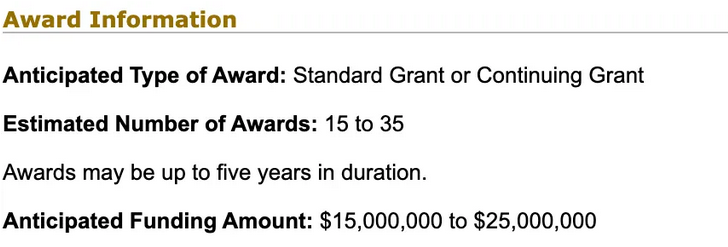
I’ve written many times about the National Science Foundation and its increasingly politicized conception of “science”. As an independent federal agency with a nearly $9 billion budget, the NSF is a behemoth in the world of academic science, shaping research agendas and the future of the professoriate. And apparently the future of science is BAJEDI (Belonging Accessibility Justice Equity Diversity and Inclusion), which is quite a bit cooler than mere DEI. Here’s a current funding opportunity for scientists:

The federal agency that funds research projects like “Probing Nucleation and Growth Dynamics of Lithium Dendrites in Solid Electrolytes” is moving hard into the business of social justice, with career-making grants that will focus STEM researchers on the problem of racial grievances. Here’s how much money is available for that racial equity program:

The premise underlying this turn toward equity-focused science projects is that “science scholars who are underrepresented in STEM produce higher rates of scientific novelty”. Innovation is grounded in race and ethnicity; the more gloriously intersectional you are, the more creative you become. Imagine the boldness of a transgendered Asian Pacific Islander astrophysics, and how much newer and fresher our conception of the universe is when it doesn’t come from straight white males.

And so the NSF wants to fund “diversity champions” who will freshen up our science with BIPOC innovation — which means adding more sociologists to the team of geophysicists: “When developing proposals, the PI team should acknowledge the need for increased engagement from social and behavioral science experts to address issues related to BAJEDI in the geosciences and include these best practices and experts in proposed projects.” […]

It’s a real cultural revolution in the world of academic science.

October 3, 2022

“Still, what about the boys?”

Filed under: Health, Media, Politics — Tags: , , , , , , , , — Nicholas @ 05:00

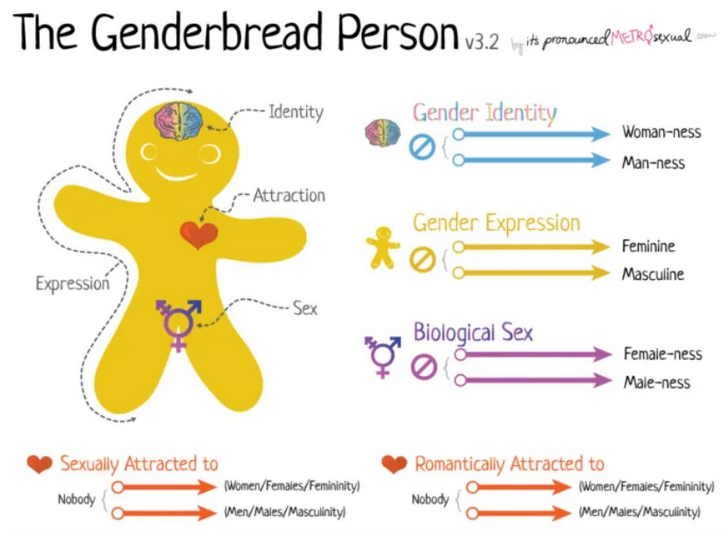
Janice Fiamengo on the far-from-impartial emphasis of concern on young people being pushed toward radical “solutions” to gender dysphoria:

Last year, conservative educational institution Prager U published “Why Girls Become Boys“, a short video by journalist Abigail Shrier, the author of Irreversible Damage: The Transgender Craze Seducing Our Daughters, published in 2020. Shrier’s focus is evident from the titles: girls. Previously, Shrier had been profiled in an interview with Candace Owens when she was still working on the book. Though the interview is now three years old, its canvassing of teen transitioning — in a discussion that moves from concern about girls being “seduced” into trans, to anger at society’s failure to protect girls from boys who transition — provides a fairly accurate representation, I believe, of conservative positioning on this subject. Girls who transition are seen as victims; while boys who transition are seen (if they are seen at all) as predators.

This double emphasis is clear in the interview. Shrier and Owens describe the collusion of media influencers, the public school system, woke punditry, and medical authorities to encourage girls (but not boys, it seems) to consider their gender identity “fluid”. Feelings of discomfort are too readily interpreted as signs of a trans identity. Girls can be made to believe themselves trans very quickly, sometimes simply from viewing one or more internet videos; and schools are not required to tell parents if their daughter begins identifying as male. From age fifteen, girls can find gender clinics willing to prescribe testosterone without their parents’ consent; a girl can have her breasts amputated as early as age sixteen. The lifetime of dependency on hormones (their consequences unknown), the risky surgeries, and the tragic missed opportunities — of motherhood in particular, but even of having breasts — were emphasized by both pundits.

It’s almost impossible to imagine these two women discussing the tragedy of losing a penis, of being denied the opportunity to become a father, of being denied the joy of male sexuality.

From this point, the conversation moved seamlessly into discussing the victimhood of girls forced to share their private spaces — and of course their sporting competitions — with biological males (often called “men” as in “Men are invading girls’ sports”). These males are not discussed as vulnerable innocents duped into taking body-altering hormones or undergoing dangerous surgeries. No imaginative effort was spent on why these boys want to live as trans female. The underlying assumption seemed to be that boys’ transition, far from being an attempt to relieve real distress, is an act of appropriation of female experience. The boys were depicted as aggressors who invade girls’ locker-rooms and deny girls opportunities (or, even worse, masquerade as trans in order to prey on girls sexually). Are there boys made uncomfortable in their change rooms or other private spaces by the presence of biological girls? The question seems never to have occurred to Shrier and Owens.

Shrier and Owens agree in decrying feminism for failing to protect girls and for failing (allegedly) to affirm femininity and girlhood. “Girls aren’t being told how wonderful it is to be a girl!” Their own feminist — or at least female-centered — assumptions are clearly evident in their conviction that the trans phenomenon is about multiple harms to females, harms which must always take precedence over the legitimate needs and experiences of males. And in fact, contrary to what Shrier and Owens seem to believe, there are many feminists who vehemently denounce biological male incursions into female bodies and spaces; many of them, such as Meghan Murphy, Julie Bindel, and Sheila Jeffreys, to name only a few, advocate from an avowedly anti-male perspective.

Shrier might respond that the overwhelming majority of adolescents who believe themselves to be trans are female (as she states in her Prager U video). This may be true (a recent Psychology Today article puts the number at greater than 80% female) but does not mitigate my objection. Teen suicide is about 80% male (more on this later), but it is hard to imagine concerned pundits ignoring the troubles of girls. Many discussions of teen suicide, in fact, make much of the fact that girls attempt suicide more often than boys, downplaying the fact that boys carry out their suicides in such distinctively high numbers. Don’t get me wrong: I have no objection to a focus on girls’ difficulties in adolescence — except when it improperly ignores and even maligns boys.

It wasn’t all that long ago that the vast majority of young people seeking “gender-affirming” therapy were males hoping to become trans-females. In the last few years, that proportion has flipped completely.

October 2, 2022

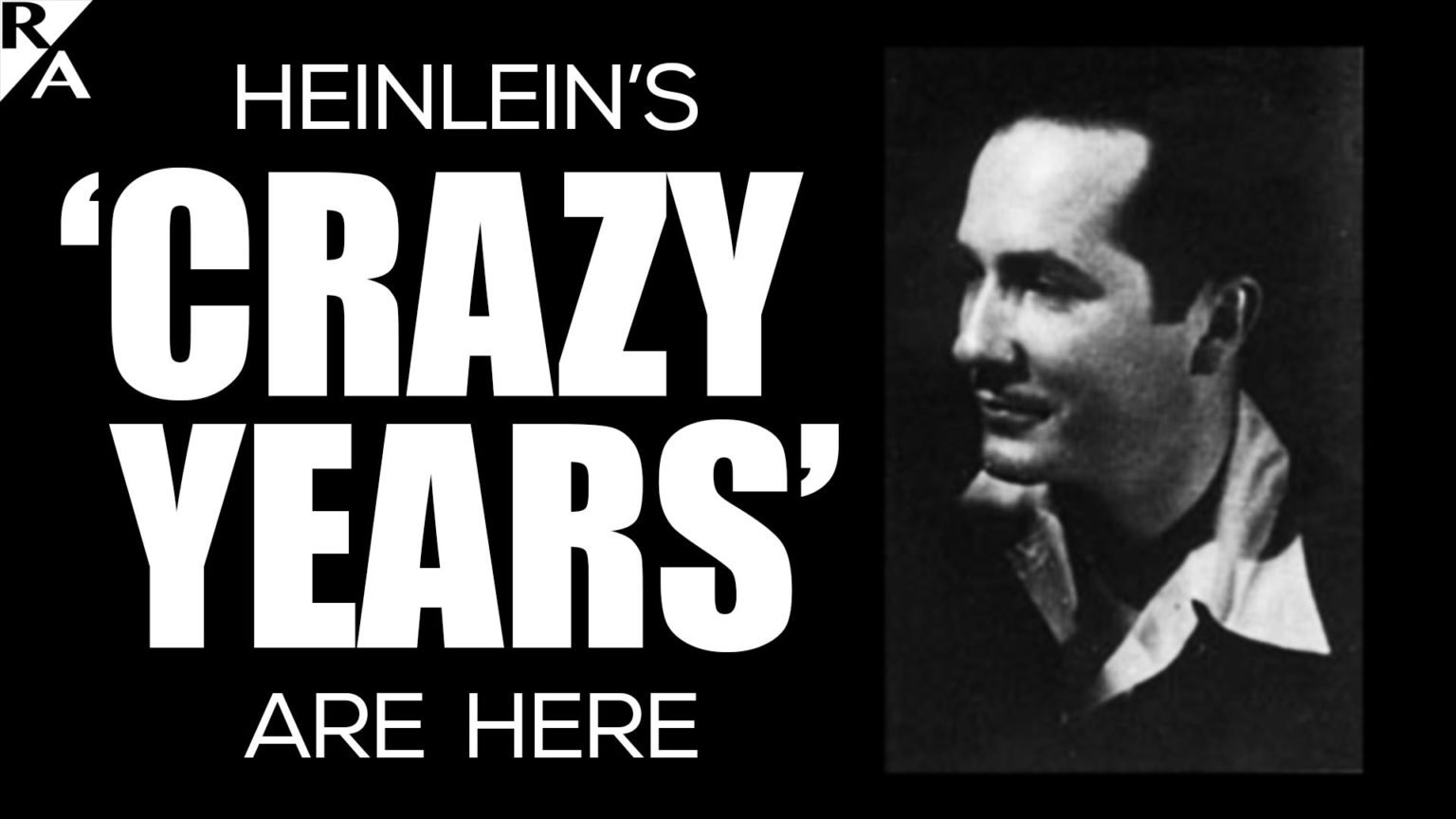
Robert Heinlein’s “Crazy Years” have nothing on real headlines in 2022

Filed under: Books, Media, Politics, Science, USA — Tags: , , , , — Nicholas @ 05:00

Ed West on what he calls the “triumph of the blank slate” in western culture:

As a depressive conservative who always sneered at the new atheist movement, I’ve enjoyed a certain, almost masochistic smugness about the way the sharp decline in American religious practice has led to a proliferation of wacky beliefs. I told you so, I laugh, as our boat heads for the rocks and certain doom for all of us. And every month I read something else in the media which makes me think, with the best will in the world and a sincere belief in improving our lot, that country’s ruling class is losing its grip on reality.

To take one recent example, an article in the Atlantic recently made the case that separating sport by sex doesn’t make sense, because it “reinforces the idea that boys are inherently bigger, faster, and stronger than girls in a competitive setting — a notion that’s been challenged by scientists for years”.

The author stated that “though sex differences in sports show advantages for men, researchers today still don’t know how much of this to attribute to biological difference versus the lack of support provided to women athletes to reach their highest potential”.

Quoting an academic who claim “that sex differences aren’t really clear at all” the author reported of some studies showing that “the gap they did find between girls and boys was likely due to socialization, not biology”.

On a similar theme, a few weeks back the New York Times ran a piece arguing that “maternal instinct is a myth that men created”. In the essay, published in the world’s most influential newspaper, it was stated that “The notion that the selflessness and tenderness babies require is uniquely ingrained in the biology of women, ready to go at the flip of a switch, is a relatively modern — and pernicious — one. It was constructed over decades by men selling an image of what a mother should be, diverting our attention from what she actually is and calling it science.”

Even the most prestigious science magazines increasingly make claims about sex that a decade ago would have seemed wacky. Just recently, Scientific American stated that “Before the late 18th century, Western science recognized only one sex — the male — and considered the female body an inferior version of it. The shift historians call the ‘two-sex model’ served mainly to reinforce gender and racial divisions by tying social status to the body.”

If you find any of these beliefs strange, then you might need to “educate” yourself about “the science” because this is the direction of travel now. This kind of stuff is everywhere, growing in popularity in all areas, but all ultimately having the same common inheritance — the blank slate.

Yet what is strange is that such ideas are triumphant, even as the scientific evidence against them mounts up, with the expanding understanding of genetics and the role of inheritance. The tabula rasa should by all rights be dead, indeed it should have been killed twenty years ago with the publication of one of the most important books of the century so far, Steven Pinker’s The Blank Slate.

With its subtitle “the modern denial of human nature”, Pinker’s worked looked at the various ideas that had emerged out of academia and into wider society: that rape was not about sex, that hunter-gatherer societies were peaceful, that sex differences were learned, all of these beliefs having the common theme that humans are born with infinitely malleable minds and that that life outcomes are entirely shaped by society.

Pinker felt, quite reasonably, that many of these comforting beliefs were on the way out. Of the idea that differences in intelligence were entirely environmental, he wrote that “even in the 1970s the argument was tortuous, but by the 1980s it was desperate and today it is a historical curiosity”. And yet this historical curiosity continues to flourish, and 20 years after publication, the blank slate is stronger than ever. More so than in 2002, it’s taboo to discuss the genetic components of human intelligence or the biological factors involved in differing male and female behaviour. The ground has shifted – towards the blank slate.

Pinker is an optimistic Whiggish liberal who has since produced books looking at the decline of violence and making the case that things are getting better — that’s taken a wobble this decade, but I think he’ll be proven right, even if I think the new atheist-aligned cognitive psychologist has a slight blind spot about religion. In the Blank Slate he argued that worthy progressive goals should not rest on untrue scientific assumptions about human nature. When those ideas are proven false, the political argument will crumble too — and yet this hasn’t happened. Instead the taboos just grows stronger.

October 1, 2022

American Empire, question mark

Filed under: Books, China, History, Politics, USA — Tags: , , , , , , , — Nicholas @ 03:00

An interview with Niall Ferguson in the Dartmouth Review by Lintaro Donovan revisits Ferguson’s 2005 book Colossus in light of what has happened during the nearly two decades since it was published:

TDR: In your 2005 book Colossus: The Rise and Fall of the American Empire, you advance the thesis that the United States is an empire in denial and that such denial will be our undoing, both domestically and abroad. Does that thesis still hold in the world of 2022?

NF: I think it has withstood quite well the test of nearly 20 years. If you recall, the analysis was that the United States was trying essentially an imperial enterprise in Afghanistan and Iraq and that there were three deficits that were going to make it fail. There was the manpower deficit, because people really did not want to spend that much time in Afghanistan and Iraq – hence the short tours of duty. There was the fiscal deficit, which was already obviously a problem and has only gotten worse. And then there was the attention deficit. The prediction was that the US [BREAK] public would become disillusioned with these endeavors just as it became disillusioned with Vietnam. And if anything, the surprising thing is how long it took to get out of Afghanistan.

I wouldn’t have predicted it would be 2021. I expected it sooner than that. But I think that the overall framing of the US as an empire-in-denial works because it’s so deeply rooted in the way Americans think about themselves and the language that their leaders use. What was odd was that some neo-conservatives back then really were willing to say, “We’re an empire now”.

Of course, it kind of blew them up politically so that they’re now an irrelevant bunch of never-Trumpers. So I feel that book stood up remarkably well to the test of time. I’d stick by it.

TDR: What I’m hearing from your answer is that our denial is sort of endemic to what Americans are and that there were issues that were already present before the invasion of Iraq. Do you think that there’s any personality in American public life today who might be able to get us out of our denial and fix these issues that you’re talking about?

NF: No, because I think, if anything, the kind of aversion to empire has grown on both the left and the right. And so you have different versions of it.

Those wings, the progressive wing of the Democratic Party and the Trumpian wing of the Republican Party, are much stronger than they were then. I don’t think we are going to see any revival until the US suffers the kind of attack that it suffered at Pearl Harbor or 9/11.

Until there’s a punch landed, what will happen is that the US will try to exercise power through indirect means like sanctions or getting Ukrainians to fight Russians or arming the Taiwanese. And, in that sense, I think we’ve reverted to a Cold War playbook without calling it a cold war.

The problem is that we aren’t as far ahead [of China] economically and technologically as we were relative to the Soviet Union. If you’re doing a cold war with China, you have to reckon with quite a formidable antagonist, but that I think is where we are.

It’s amazing how far there is now a bipartisan consensus that China’s the problem. The continuities from the Trump to Biden Administration are very striking in that respect. I don’t see that changing until something bad happens, whether it’s a showdown over Taiwan that the US actually loses, or the collapse of Ukraine, which I guess is a conceivable if now unlikely scenario, or another terrorist attack, though I think that’s not especially likely these days.

The other thing to watch out for is the Middle East. Basically, as in the Cold War, you’ve got the potential for a crisis to happen. The problem for the US is that it’s quite overstretched. If there’s a crisis in Eastern Europe and a crisis in the Far East, say Taiwan, and one in the Middle East, then the US is going to be completely unable to respond to all of those.

It’s already in the position that it can’t give Stinger and Javelin missiles to the Taiwanese, because they’ve already been given to the Ukrainians and we can’t actually make that many new ones. It feels like we are doing Cold War but with quite a bit more overstretch than was true certainly in the 1980s.

QotD: The Left does not handle political reverses gracefully

Filed under: Law, Media, Politics, Quotations, USA — Tags: , , , — Nicholas @ 01:00

While this [recent progressive losses on religious school funding, gun control, voter ID, the repeal of Roe v. Wade] all may seem like fun and games to us, keep in mind that for the Left, this is the most serious business they’ve had to face since the 1960s. Being reversed in the courts — repeatedly, openly — represents a massive monkey wrench in their “march of progress”. And as I discussed last week, the Left has been accelerating the imposition of its agenda over the past two decades to the point that it cannot slow down or back off without the risk of losing everything. It’s truly all or nothing for these folks now. And they realise this.

The Left is absolutely right to fear all of this because these things represent the furtherance of a growing trend towards decentralisation that I’ve been talking about recently. This is bad for them because the Left’s whole program — and I’m talking about going back for at least two centuries — has been based on the centralisation of power into its own hands. Everything the Left does is predicated upon the “principle” of coalescing power into its hands in government, NGOs, woke corporations, and a constellation of other institutions that all coordinate together to advance the progressive agenda. Due to our place in our current demographic-structural secular cycle, this decentralisation is nigh inevitable, but that doesn’t mean the Left won’t (literally) burn through a lot of social capital fruitlessly trying to stop it.

These recent Supreme Court rulings represent real loses for their program at the most sovereign level in our government. This, in turn, signals openly their loss of control over that institution. This is why we’re seeing increasingly desperate ideas being floated for ploys to take back the SCOTUS, from packing the Court to (somehow) convincing 2/3 of the states to gut it completely. They know they’ve lost control over it as an institution, so they’re perfectly willing to dynamite it (hopefully not meaning that literally), like an ex-girlfriend who takes a baseball bat to a guy’s X-Box rather than just giving it back to him like a sane person would do. In the space of a few short years, the SCOTUS has gone from hero to zero in the Left’s eyes, since for them everything is situational in nature. Once something, anything, outlives its usefulness to them, it goes up against the wall.

The thing to understand from this is that these losses the Court has handed to the Left are real things. They’re not just some kind of plot to “mobilise their voters” to win the midterms in November. While lefties may often be cunning, they are also arrogant and in many ways kind of dumb. These people are really not out here playing some grandmaster game of four-dimensional chess. They’re desperate, which is why they’re willing to engage in such blatant attempts at gaming the system through naked procedural manipulation. They’re the ones who are suddenly finding themselves in the place of having to operate outside of “our sacred norms” by refuting the legitimacy of institutions that go against them.

Bear in mind that the Left’s entire view of legitimacy is predicated on this “ever-forward march of progress”. To “move backwards” is to show weakness, to reveal a chink in the armour of the dialectic of inexorable progress. This sense of legitimacy, in turn, was based upon their capture of the various power-generating and power-wielding institutions, including the Supreme Court, since the “right” people now had possession of the means to remake society. What a lot of people forget is that the whole “march of progress” since the mid-1960s occurred because of this institutional takeover. Their judicially imposed agenda has never really “won the argument” on any issue. They just used social and political force to achieve their goals, followed up by media-driven social pressure and anarchotyranny to “encourage” conformity among the general population. So yeah, especially with something like the repeal of Roe v. Wade, their whole program is in jeopardy. The post-Roe stance on abortion adopted in 1973 was the truly radical stance on this issue, but they don’t want you to realise this.

Theophilus Chilton, “The Left Is in a Precarious Place”, The Neo-Ciceronian Times, 2022-06-29.

September 30, 2022

Witness about to testify on Bill C-11? Time to break out good old Parliamentary bullying and intimidation tactics!

Filed under: Cancon, Government, Politics, Technology — Tags: , , , , — Nicholas @ 03:00

It’s had to believe, but the Liberal government continues to defy expectations in their continued mission to prevent public participation in political processes, as Michael Geist documents here:

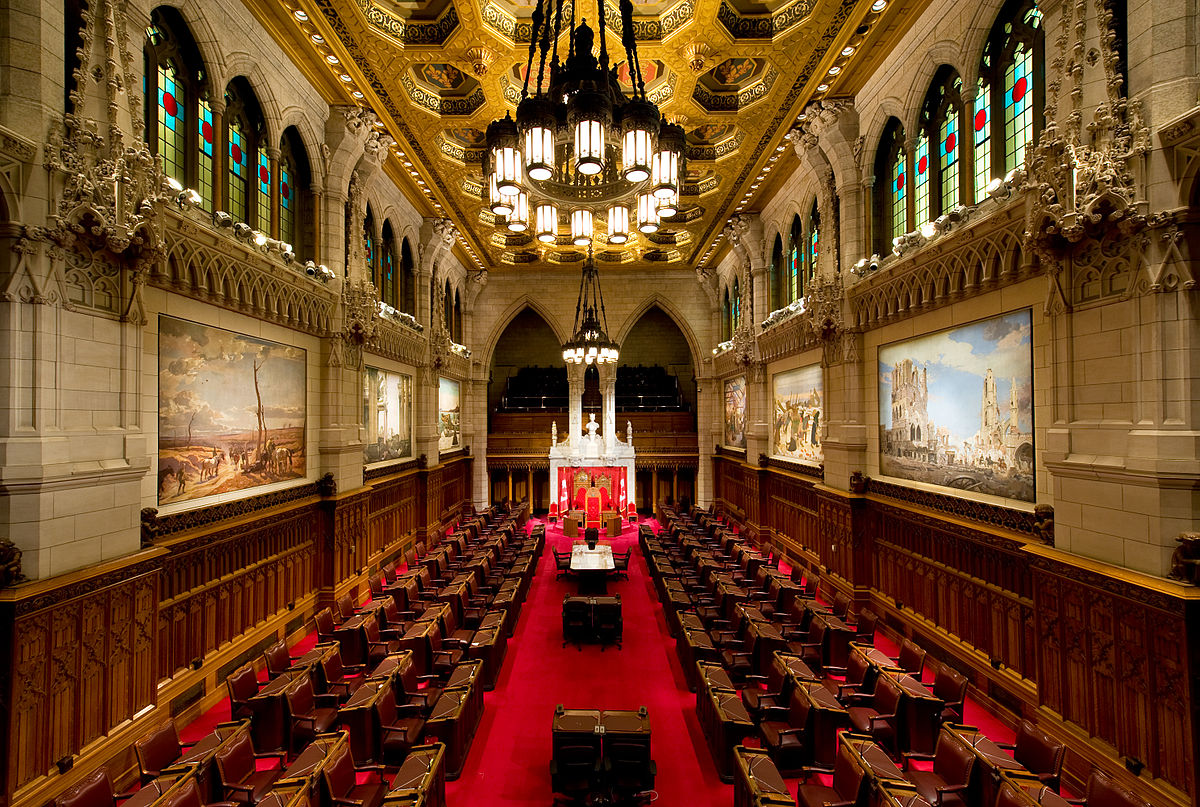
“In the east wing of the Centre Block is the Senate chamber, in which are the thrones for the Canadian monarch and consort, or for the federal viceroy and his or her consort, and from which either the sovereign or the governor general gives the Speech from the Throne and grants Royal Assent to bills passed by parliament.”
Photo and description by Saffron Blaze via Wikimedia Commons.

The Senate Bill C-11 hearings have provided a model for the much-needed, engaged, non-partisan inquiry that was largely missing from the House committee’s theatrics in which the government cut off debate on over 150 amendments. But this week those hearings attracted attention for another reason: serious charges of witness intimidation and bullying by government MPs, most notably Canadian Heritage Parliamentary Secretary Chris Bittle (yes, the same Bittle who last month suggested I was a racist and a bully for raising concerns about Minister Pablo Rodriguez silence over Canadian Heritage funding of an anti-semite as part of its anti-hate program).

The Globe and Mail reported late on Tuesday night that Bittle – together with his colleague, Liberal MP Lisa Hepfner – had sent a letter to the Lobbying Commissioner to seek an investigation into the funding of Digital First Canada, a group representing digital first creators. The letter may have been shopped around to other MPs as Liberal MP Anthony Housefather has told the Globe he did not sign it. DFC’s Executive Director, Scott Benzie, had appeared before the Heritage committee months ago and Bittle used his time to focus on the organization’s funding. Leaving aside the fact that government MPs reserve these kinds of questions only for critics of Bill C-11 (there were no similar questions this week from Ms. Hepfner to the Director of Digital Content Next, whose organization supports Bill C-18 and counts Fox News among its members), the timing of Globe story was incredibly troubling. The Lobbyist Commissioner letter was apparently filed nearly two months ago and Benzie had been assured that he was compliant with the law. Yet the story was presumably leaked to coincide with Benzie’s appearance before the Senate committee last night.

The letter and leak smacked of witness intimidation and bullying with the government seeking to undermine critics of the legislation hours before a Senate appearance. Indeed, the entire tactic felt like the policy equivalent of a SLAPP suit, which are used to intimidate and silence critics through litigation. By the end of the day, the tactic had clearly backfired on Bittle and the government. Conservative MP John Nater filed a point of privilege in the House of Commons, arguing that Bittle had attempted to intimidate a Senate witness.

    I rise on a question of privilege, for which I gave notice earlier this same day, regarding the conduct of the member for St. Catharines, who attempted to intimidate Scott Benzie, a witness appearing before a committee of the Senate studying Bill C-11, an act to amend the Broadcasting Act and to make related and consequential amendments to other acts, as reported yesterday by the Globe and Mail.

    While I appreciate that this attempt to intimidate relates to proceedings of a Senate committee currently studying Bill C-11, the culprit in this case is a member of the House, and that same witness appeared before the House of Commons Standing Committee on Canadian Heritage during its deliberations on Bill C-11, an appearance where Mr. Benzie, no doubt, first established himself as an undesirable witness for the government on the merits of Bill C-11.

The government response was surprisingly muted with MP Mark Gerretsen simply asking for a couple of days to formulate a response, perhaps recognizing that defending Bittle would mean defending the indefensible.

September 28, 2022

QotD: Yearning for the “endless now”

Filed under: Media, Politics, Quotations, USA — Tags: , , — Nicholas @ 01:00

My guess — and I am NOT an art historian, I can’t stress that enough — is that this reflects the increasing emphasis on the individual [in the late 15th century]. Which, again, is tied to the acceptance of linear time — the desire to be commemorated as an individual, unique person, not as a type. The more people who could afford portraits, the more people wanted them, and the more the individual commemoration mattered. High-medieval “portraits” are extremely accurate as funeral sculptures, but illustrations in manuscripts are often little better than stick figures.

By the (I think) 16th, and certainly by the 17th, centuries, you’ve got portraits of people as Classical throwbacks — contemporary figures tricked out in Roman togas and whatnot. This is the full acceptance of linear time — you can move a distinct individual both forward and back along not just the course of his life, but the course of linear history.

Contrast this to the Juggalos, whose first impulse in any situation is to take a selfie … but who never, ever look at those selfies. Basic College Girl “culture” is often described as narcissistic — lord knows I’ve done it enough myself — but the funny thing is, for as self-involved as they are, they have almost no pictures of themselves hanging around. They don’t decorate their office cubicles with pictures of their families. Nothing could be easier than “flipping” through a digital photo “book”, but they never do. They go to extraordinary lengths to arrange the perfect selfie … but then they could instantly delete it, for all the impact it has.

I think this is because they actively shun the idea of linear time. When I was a young man, every girl had a photo album in her dorm room, and part of the “getting to know you” process was flipping through it with her. Half the fun was seeing the brutal fashions of yesteryear; you both had a good laugh over it.

I think that would be actively painful for Juggalos, and not just because they can’t stand to have others see them as less than 100% perfect at all times. Rather, I think the problem is the fundamental one — they don’t want to be reminded that time passes.

They want the endless now. They want to be ghosts.

Severian, “The Ghosts (II)”, Founding Questions, 2022-05-18.

September 27, 2022

Is Kayla Lemieux the leading edge of LGBT tolerance or a “dude gaming the system”?

Filed under: Cancon, Education, Health, Politics — Tags: , , , , — Nicholas @ 05:00

Back on September 16, I posted a link to the then-breaking story of the teacher in Halton whose prosthetic breasts had poked into news headlines everywhere: “This is either the teacher of the year (come on, you know that’s inevitable because reasons) or someone doing an epic physical and psychological parody of our culture right now.” It’s nearly two weeks later, and we’re still not really clear on which of those two possibilities is closest to the truth. At PJ Media, Athena Thorne is making a case for the epic prank case:

There is the most titillating rumor being bandied about the interwebs right now. And while it may or may not be true, it’s certainly food for thought. It concerns “Kayla Lemieux”, the infamous trans-woman shop teacher at Oakville Trafalgar High School (OTHS) in Ontario, Canada.

An anonymous poster on an online forum recently made a claim about Lemieux’s shop class back when “Kayla” was still Mr. Kerry Luc Lemieux. The post reads:

    This dude is gaming the system. An anon here yesterday was in this dude’s class. This teacher was almost fired for ‘toxic masculinity’ last year, as well as not embracing woke culture. He’d drop redpills to his class, such as how silly gender neutral bathrooms are. The school board hates him.

    He’s now upping the ante to exploit the very clown world the school and society itself created. His long game is most likely to get fired, and then sue for discrimination. There is no other explanation… No better way to troll clown world than to become an over-the-top caricature of a woman.

File this allegation under “Huge if True” (lol). Imagine for a moment that the anonymous person is telling the truth. If that is the case, then this teacher is the greatest hero the sane world has fronted yet.

If Lemieux is indeed pranking the school board, then he is a genius. When images of the trans-busty high school shop teacher began spreading like wildfire online, the outrage was swift and formidable. OTHS and the Halton District School Board (HDSB) went on the defensive — and it quickly became evident that they had painted themselves into a corner with their mindless commitment to “inclusion”.

“We are aware of discussion on social media and in the media regarding Oakville Trafalgar High School. We would like to take this opportunity to reiterate to our community that we are committed to establishing and maintaining a safe, caring, inclusive, equitable and welcoming learning and working environment for all students and staff”, said OTHS in an email sent to parents and obtained by feminist news site Reduxx.

September 26, 2022

Canada, a confessed “ongoing” genocidal state, has no moral grounds to criticize China, Russia, or Iran

In Quillette, Jonathan Kay expresses his frustration as Canadian Prime Minister Trudeau’s performative moral posturing and virtue signalling for his globalist comrades comes back to bite him in the ass … again:

Kamloops Indian Residential School, 1930.
Photo from Archives Deschâtelets-NDC, Richelieu via Wikimedia Commons.

… [Iranian President Ebrahim Raisi] also threw in an attack on Canada’s treatment of Indigenous peoples, declaring that “bodies of hundreds of children were discovered in mass graves in a [former residential] school.”

The issue of supposed unmarked Indigenous child graves dominated the Canadian media in the latter half of 2021. But as I reported in Quillette several months ago, no “mass graves” were ever found. In fact, even the Indigenous groups that initially reported ground-penetrating radar (GPR) survey results consistent with the possible presence of unmarked burial sites weren’t talking about “mass graves”. Rather, the invented mass-graves claim was popularized by a badly botched New York Times May 28th, 2021, story written by reporter Ian Austen. (For a definitive debunking, see Terry Glavin’s account in Canada’s National Post).

In the 16 months that have passed since the unmarked-graves story broke in late May 2021, not a single body has been found, nor any human remains. And so even the less sensational allegation that 215 individual unmarked child graves lie buried under the grounds of a former Indigenous residential school in Kamloops, British Columbia, now seems doubtful. Nor have bodies or human remains been recovered at any of the other former residential-school properties where GPR surveys were conducted.

Yet that didn’t prevent Prime Minister Justin Trudeau from lowering flags on Canadian public buildings for more than five months, nor from speaking publicly as if bodies were already being dug up. And aside from the National Post, not a single major Canadian media outlet has admitted its role in feeding the unmarked-graves social panic that exploded last year, and which often included lurid speculation that the supposed grave sites not only contained the remains of Indigenous children, but that these children had been murdered through methods worthy of a horror-movie plot.

Given this, what can Canadian public figures say to Raisi now that he’s throwing spurious moral equivalences into our faces? Nothing. In making the false claim that “bodies of hundreds of children were discovered in mass graves in a [former residential] school”, the man is merely reading our own officially sourced misinformation back to us.

This isn’t the first time that Trudeau has managed to maneuver Canada into this kind of mortifying position vis-à-vis the world’s tyrants. Last year, when Canadian lawmakers voted to denounce China’s treatment of Uighurs in western Xinjiang as a form of genocide, Trudeau and his Cabinet abstained. The suspected reasons for that move were complex. But they included the fact that Canada was, by its own description, morally compromised on the genocide file: Back in 2019, Trudeau had explicitly acceded to the (absurd) claim that Canada, too, was guilty of “genocide” — this one against Indigenous women. Indeed, according to the official report that precipitated Trudeau’s mea culpa, this supposed Canadian genocide remains ongoing.

“We’ve credentialed people for membership in a series of high-cultural-status groups on the basis of their ability to chant slogans and perform rituals; they are coreless”

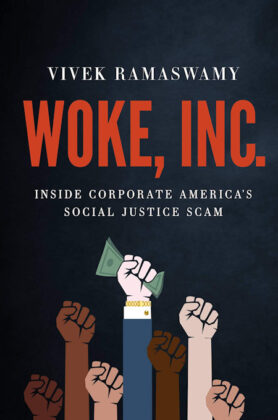
Chris Bray on Vivek Ramaswamy’s book Woke, Inc.:

Vivek Ramaswamy was trying to close a deal, so he went to do some relationship building over dinner at an investor’s house. As dinner ended, the investor’s son came downstairs to greet the visitors, and he turned out to be a high school senior who was applying to Harvard. By the most remarkable coincidence, Vivek Ramaswamy is a Harvard grad, so the kid asked for some advice on getting in. Stand out, the Harvard grad told the Harvard applicant. Have something that makes you different than all the other applicants. Oh, the kid said, yeah — I got that. It turns out the seventeen year-old son of a venture capitalist had started a non-profit to fight against global sex slavery, which did indeed impress the admissions office and did indeed get him into Harvard. When Ramaswamy ran into the kid again, a few years later, he was shopping for Wall Street internships — and had moved on from the whole sex slavery thing, which had by then served its purpose.

Ramaswamy’s book Woke, Inc., a title published last year that seems to be gaining new momentum now as its author takes on corporate ESG posturing, accurately promises to take readers “inside corporate America’s social justice scam”, though I don’t love everything he offers as a solution. He clearly is reporting from inside: He’s a Harvard grad, a Yale Law grad, a former hedge fund employee, and a former pharmaceutical CEO. (Those credentials make you trust his argument, right?)

The thing the kid did, dummying up a quick thing to fight global sex slavery to get it into his admissions package, is a version of a maneuver that Ramaswamy finds all over the woke corporate world. The highly woke consumer products company Unilever is passionate about taking deep notice of intersectionality and serving women of color, and it partners with UN Women, “a nonprofit branch of the UN dedicated to advancing gender equality and empowering women”. Also, dozens of women who work on a Unilever tea plantation in Kenya were gang-raped in front of their families, an event that was coupled with a dozen or so murders, and Unilever declined to provide them with substantial support or assistance: “Unilever said the attacks on its plantation were unexpected and therefore that it should not be held liable”.

Unilever provides money to UN Women, Ramaswamy concludes, and UN Women provides Unilever with “moral cover for the Kenyan massacre”. Woke Unilever is a façade for, you know, Unilever. It’s a strategy, one example of many, and Ramaswamy argues that the “arranged marriage” between wokeness and corporate capitalism was born out of Occupy Wall Street: Here’s a check, now let’s stop talking about TARP and start talking about white privilege.

You should read Woke, Inc., so I won’t go on summarizing. But without going deeper into Ramaswamy’s argument, which reflects a series of increasingly familiar observations about social class and the function of wokeness, the point is the inauthenticity and shallowness of corporate social justice posturing, all of which is meant to protect the core of the project — to provide cover for business practices that might otherwise be criticized. It’s a show, a performative and manipulative posture. You could easily make comparable arguments about wokeness and power in academia, media, or government.

Now, to take all of this and pivot to an argument that will satisfy absolutely no one, if the social justice façade is a façade — shallow, performative, calculatedly purpose-serving — then there’s a good chance the branch managers of the globalist project will drop it when it slides out of fashion. The kid who, wanting a career on Wall Street, did the sex slavery nonprofit thing just long enough to get into Harvard: That kid is a middle manager now, and he’ll recite slogans about white privilege or not, as Current Thing demands, as long as the checks still cash. We’ve credentialed people for membership in a series of high-cultural-status groups on the basis of their ability to chant slogans and perform rituals; they are coreless.

QotD: “Comrades of proven worth”

Filed under: Britain, Economics, History, Politics, Quotations, Russia — Tags: , , , — Nicholas @ 01:00

This would be funny if it wasn’t quite such a jarring reminder of how the Soviets used to manage matters. The revolutionary vanguard were not held to the same standards as everyone else because, you know, they were the revolutionary vanguard, leaders of the people. They thus got all the nice apartments in central Moscow as they had to be close to the Ministries where they directed the peasants. They didn’t have to share the apartment because they needed to rest after their labours. And surely those working for the workers should be well rewarded?

So too they didn’t have to line up for the scraps of whatever rotting junk the ration stores had. The KGB, for example, had its own commissary just around the back of Lubyanka – I know, I’ve shopped in it. And higher ranks simply never needed to go shopping at all, the nomenklatura had the government delivery service. Ocado for commies but only really important commies.

This all came under the rubric of comrades of proven worth…

Tim Worstall, “Emma Thompson Is A Comrade Of Proven Worth To Extinction Rebellion”, Continental Telegraph, 2019-04-19.

September 24, 2022

The end of crisis culture – “[Y]ou can’t go on having a culture of crisis if people stop showing up for it”

Chris Bray on the inevitable endgame of “all crisis, all the time” culture:

The journalist John Tierney has described the Crisis Crisis, “the incessant state of alarm fomented by journalists and politicians”. What we’re experiencing now is the Crisis Crisis crisis, the emerging crisis caused by the Crisis Crisis. Over and over again, interventions in some invented or overhyped form of the crisis, undertaken in the hysterical spirit of the Crisis Crisis, cause a form of the Crisis Crisis crisis, which eventually results in a course correction that may or may not be fully apparent for a while. Skip right over the next paragraph if you don’t need to see examples again.

The Sri Lankan government intervenes in climate change by instantly ending the use of commercial fertilizers in agriculture, which causes a dangerous decline in the production of food. The German government intervenes in climate change by declaring a commitment to 100% clean energy, which causes dangerous instability in the availability of actual energy (“committing national suicide“), with some help from the Nord Stream shut-off valve, which nobody ever could have seen coming. The Dutch government intervenes in climate change by declaring an intention to limit agricultural production, which doesn’t cause anything yet, because Dutch farmers won’t stand for it, but final outcome TBD.

All over the world, things that work stop working because of excessive and unwarranted interventions led by people who cry crisis and throw sand in functioning gears. Dutch agriculture was just fine; then the government decided to help end the crisis. The interventions — the interveners, the people who get in the way — are harming us, when their harm could be prevented by literal nothing, by the simple choice to not perform the interventions. What we need is for the interveners to go play Risk in their basement or something, and forget their important duty to help.

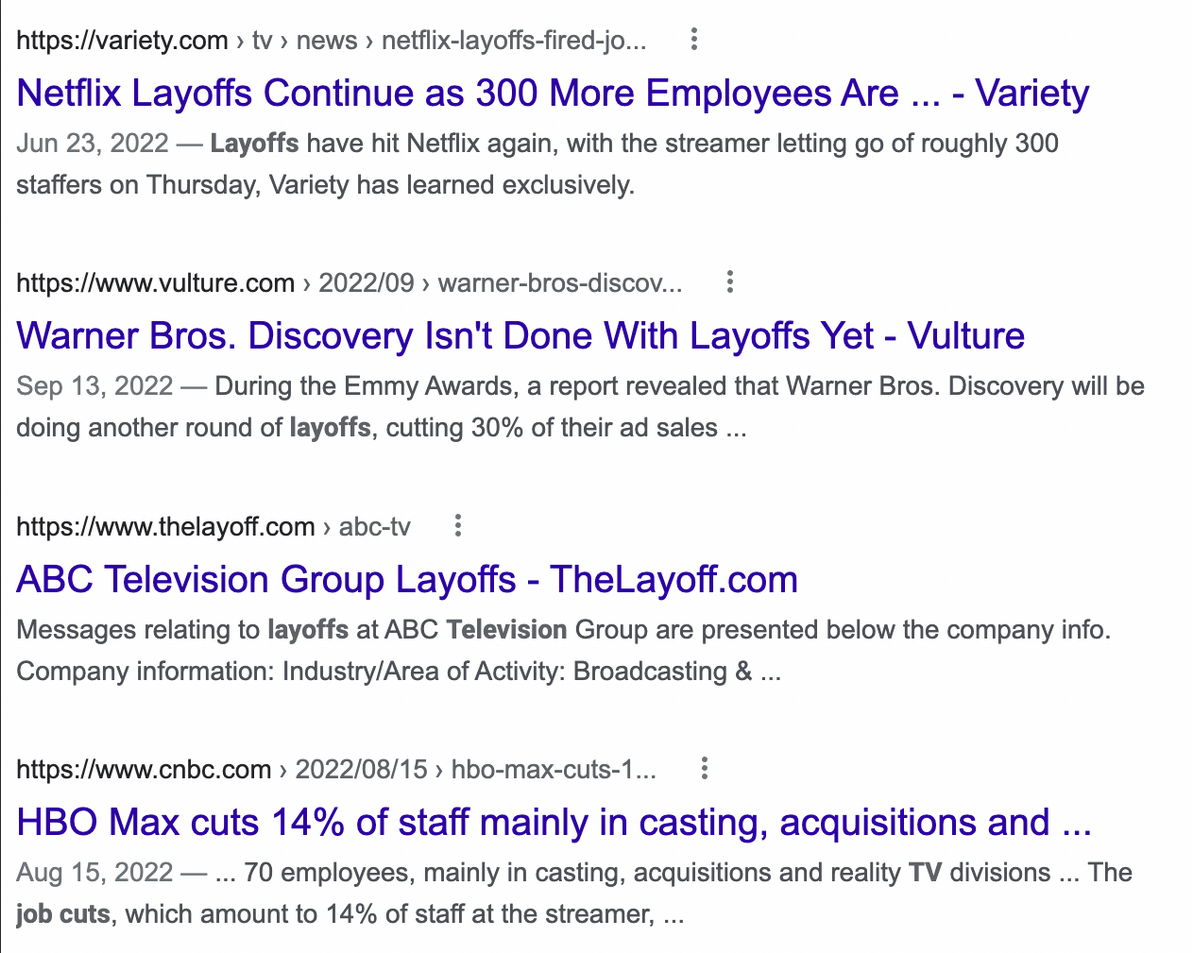
The entertainment industry has had its own intervention, famously described on Substack, in woke-facing talent purges and narrative shifts and insulting “It’s Ghostbusters … but with WOMEN!” reboots. And now some hint about the endgame of the one big cycle of fraud comes from woke Hollywood — which has pounded audiences with The Message for years, resulting in a catastrophic loss of audience. The result is starting to look like this:

The social justice intervention in Hollywood storytelling is harming Hollywood; the intervention in that industry is causing the decline of the industry. At some point, people stop eating shit.

September 23, 2022

Sarah Hoyt on the Overton Window

Filed under: Media, Politics, USA — Tags: , , , , — Nicholas @ 03:00

At According to Hoyt, Sarah considers the Overton Window:

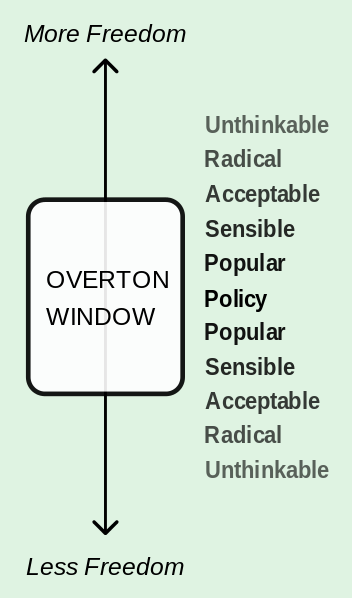
Diagram of the “Overton Window”, based on a concept promoted by Joseph P. Overton (1960–2003), former director of the Mackinac Center for Public Policy. The term “Overton Window” was coined by colleagues of Joe Overton after his death. In the political theory of the Overton Window, new ideas fall into a range of acceptability to the public, at the edges of which an elected official risks being voted out of office.
Illustration by Hydrargyrum via Wikimedia Commons

The Overton window is not natural to human society. It is the product of the mass-information-media-entertainment era.

No?

Sure, in some villages, or some other places, there are things you can’t see/say. That is usually because someone in that society, be it a village or a nation, is going to get under your nose for saying it. (At one point, you could get arrested in Portugal for shouting “Portugal is a sh*tty country!”)

Having “Unsayable” and “Unthinkable” and “if you say that in public you’ll be shunned” is always a sign of an oppressive society, whether the punishments are physical or mental, beatings or mere shunning.

Having beliefs that are beyond the pale — in fact, the existence of the pale — are a sign of an unhealthy society, one in which a truth is being enforced that is different from reality.

No? Fight me.

Look, yeah, sure, there are things people in all eras didn’t discuss in certain company due to manners or delicacy. One didn’t discuss sexual acts in front of children, not equipped to understand them, in most of the west since the onset of Christianity. One didn’t say certain things in front of elders either. “Gentlemen don’t discuss politics or coitus”. But that was a matter of — in a small gathering, or a confined society — keeping the social gears lubricated, and keeping disagreements at bay. What “couldn’t be said” varied.

However, the Overton window is something else. It is “you can’t report certain things, even if they are true, at the risk of becoming a social pariah”.

It avoids discussions of really important things, like how our kids are being sodomized by public education. Or how welfare really doesn’t contribute to the welfare of anyone. Or how Child Protective Systems is a money-laundering scam, in which kids die. Or how our government-funded science has become all government and almost no science. Etc.

It encourages rape rings like Rotherham, and has most of the black population of the US believe they are more at risk of police shootings than whites, which is plainly not true, but can’t be said, because the media has deemed saying so is “racist” (Somehow.) So people live in fear, rather than knowing they’re not at higher risk than anyone else.

And while speaking of risk, the media, and its control of information and encouragement of shunning dissenters, has led to fear of a “slightly more dangerous” flu, and led to elderly people living their last years in isolation and terror, and also led to our kids being isolated into loss of social function.

Furthermore, the only way to keep the Overton window over a whole country is to enforce strict control over the media, and even social media, and to ruthlessly crush down dissenters, so that everyone appears to agree, leading to shock-rejection of those who manage to break through the wall of government-encouraged-enforced lying.

A wall that they try to keep even when the lies are patently absurd and harmful. (Like the idea anyone who dislikes the Biden reign of terror is a terrorist or insurgent, or for that matter racist.)

The Overton window can suck what I don’t have.

QotD: Ron DeSantis for Caesar?

Filed under: Government, Politics, Quotations, USA — Tags: , — Nicholas @ 01:00

Oswald Spengler suggests that we’re in for a period of Caesarism, which is warlord rule that maintains the trappings of the old system. It might be as simple as [Mussolini]’s old litmus test: Do the trains run on time? But, since this is Clown World, fake and gay: Are the lights on for more than two days running?

Ron DeSantis, for example, has gotten a lot of Grillers’ panties moist, and while that’s one of the strongest possible arguments for the proposition that he’s just another Swamp Thing — Ace of Normies might not remember how hard he used to squeeeee for fucking Paul Ryan, but I do — it’s nonetheless true that Ron DeSantis has acted at least kinda sorta like … what’s the word?

Ah yes: An adult.

Ron DeSantis’s response to Covid was pretty much exactly what even the most flaming moonbat liberal governor would’ve done as late as 1990, because there were still some grownups in politics back then. Now that the entire Swamp is filled with autistic Mean Girls with PMS, the State can’t carry out even its most basic functions. Governors still have real power […], and there are a few of them that aren’t totally retarded, and so I’d imagine we’ll see a period of retail-level Caesarism — the lights are on three days a week in Nebraska; quick, everybody load up the Conestoga wagon and head for Omaha!

Severian, “Friday Mailbag”, Founding Questions, 2022-06-17.

« Newer PostsOlder Posts »

Powered by WordPress