Quotulatiousness

October 30, 2022

Andrew Sullivan on the rise of Rishi Sunak (or was it “Rashid Sanook”?)

Filed under: Britain, History, Media, Politics, USA — Tags: , , , , , — Nicholas @ 05:00

In the free-to-cheapskates excerpt from his Weekly Dish newsletter, Andrew Sullivan contemplates the differences between how Barack Obama was seen as a historical figure to the US media and yet that same media can’t manage to see how Prime Minister Sunak is “the British Obama”:
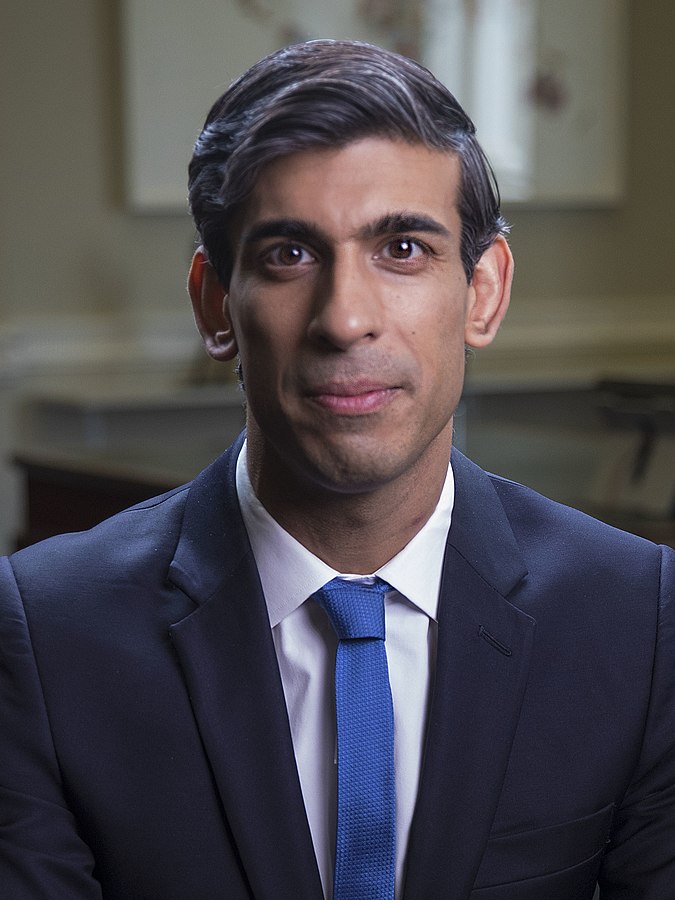
Rishi Sunak shortly after becoming Chancellor of the Exchequer in 2020.

In his inimitable way, Joe Biden this week celebrated the rather remarkable fact the the new Conservative prime minister in Britain is the grandson of Indian immigrants:

    As recently as today, we’ve gotten news that Rashid Sanook is now the prime minister. As my brother would say, “Go figure.” And the Conservative party! … Pretty astounding. A groundbreaking milestone. And it matters! It matters!

He got the name wrong, but he’s Joe Biden. He gets names wrong. But unlike many on the left, especially the woke left, and perhaps because he is old enough to remember the after-effects of colonialism, Biden could bring himself to see what a staggering moment it is. It really is. It has gotten a bit obscured in the incredible mess of recent Tory politics. But staring us in the face is a historic shift.

It’s an Obama moment, after a fashion.

[…]

No, Sunak didn’t run an inspirational campaign like Obama. He’s not an orator even close in skill, he hasn’t won an election in his own right, and he didn’t come out of the blue. But he’s even younger than Obama when he took office — just 42, five years younger than Obama when he became president, and, unlike Obama, a slip of a thing and only 5’7″. And, for understandable reasons, Sunak seems much less worried about the cultural and political aspects of breaking the race barrier than Obama was.

Sunak is, for example, an openly practicing and proud Hindu. He lit Diwali lights around 11 Downing Street and took his oath on the Bhagavad Gita. That’s not someone running from his heritage. And he is also a Brexiteer from conviction, and, unlike Truss, a fiscal conservative who’s a realist about what can and can’t be done in a period of extraordinary economic stress for Brits and massive post-Covid debt.

All of this suggests something too many liberals have forgotten. These countries of alleged “white supremacy” have less racism than almost anywhere else in the world. It is hard to imagine a non-white president of France or Germany or Italy — let alone China or Russia or anywhere in Central Europe. It is hard to think of another empire that was deliberately unwound by its architects, and who then, within two generations, installed the grandson of former colonial subjects to its most powerful office. And Obama, of course, was twice elected with more heartland white support than Hillary Clinton.

Sunak has, moreover, been selected by the Tory party — that bastion of alleged bigotry that has already had three female prime ministers in its history, and now also a non-white man, James Cleverly, as foreign secretary, and a woman of Indian ancestry, Suella Braverman, as home secretary. Three of the top four ministers of state in Sunak’s cabinet are non-white. The new chairman of the Conservative party is Nadhim Zahawi. I’m telling you this because the US MSM — who are usually obsessed with racial representation in every single mundane situation — suddenly aren’t that interested, when some of their woke priors are rattled.

This is true of the broader American left. A faction obsessed with racial “equity” cannot take a moment to observe a historical moment of extraordinary proportions. Some, like Trevor Noah, have even completely invented a racist “backlash” against Sunak that simply hasn’t happened, apart from one call on one radio call-in show. (I was on BBC Radio this morning talking to an interviewer who was simply baffled by the projection.)

Noah has the excuse of being a comedian. But the New York Times‘ coverage has been almost as ludicrously slanted as its usual coverage of post-Brexit Britain, and it quickly ran two op-eds by British leftists trashing Sunak. Every story that refers to his ethnicity always slams his class “privilege” — i.e. that his parents were middle-class children of immigrants. This morning, the paper ran another hit-piece on Sunak’s wealth. The only benefit of his Indian ancestry appears to be that he will help the Indian diaspora in Britain itself. The incredible arc of imperial history finally coming full circle? Barely a mention.


QotD: Thatcher’s legacy

Filed under: Britain, Economics, History, Politics, Quotations — Tags: , , — Nicholas @ 01:00

… it was not the Labour Party’s tribunes of the masses who evicted her but the duplicitous scheming twerps of her own cabinet, who rose up against her in an act of matricide from which the Tory Party has yet to recover. In the preferred euphemism of the American press, Mrs Thatcher was a “divisive” figure, but that hardly does her justice. She was “divided” not only from the opposition party but from most of her own, and from almost the entire British establishment, including the publicly funded arts panjandrums who ran the likes of the National Theatre and cheerfully commissioned one anti-Thatcher diatribe after another at taxpayer expense. And she was profoundly “divided” from millions and millions of the British people, perhaps a majority.

Nevertheless, she won. In Britain in the Seventies, everything that could be nationalized had been nationalized, into a phalanx of lumpen government monopolies all flying the moth-eaten flag: British Steel, British Coal, British Airways, British Rail … The government owned every industry — or, if you prefer, “the British people” owned every industry. And, as a consequence, the unions owned the British people. The top income-tax rate was 83 per cent, and on investment income 98 per cent. No electorally viable politician now thinks the government should run airlines and car plants, and that workers should live their entire lives in government housing. But what seems obviously ridiculous to all in 2013 was the bipartisan consensus four decades ago, and it required extraordinary political will for one woman to drag her own party, then the nation, and subsequently much of the rest of the world back from the cliff edge.

Thatcherite denationalization was the first thing Eastern Europe did after throwing off its Communist shackles — although the fact that recovering Soviet client states found such a natural twelve-step program at Westminster testifies to how far gone Britain was. She was the most consequential woman on the world stage since Catherine the Great, and the United Kingdom’s most important peacetime prime minister. In 1979, Britain was not at war, but as much as in 1940 faced an existential threat.

Mark Steyn, “The Uncowardly Lioness”, SteynOnline.com, 2019-05-05.

October 29, 2022

QotD: Camille Paglia’s “Amazon” Feminism

Filed under: Liberty, Politics, Quotations — Tags: , , , — Nicholas @ 01:00

I am an equal opportunity feminist. That is, I demand the removal of all barriers to women’s advance in the political and professional realms. However, I oppose special protections for women, such as workplace quotas or campus procedures that favor women during sexual assault complaints. I want total equality before the law.

In my view, special protections of any kind infantilize women. My code of Amazon feminism is based on the empowerment of the individual: Women must not regress to a pre-feminist past to become passive wards of the state.

Camille Paglia, interviewed in “Feminist critic Camille Paglia: ‘Merkel is an important role model for mature women'”, DW, 2017-06-01.

October 28, 2022

“Real Trussnomics” has never been tried, cry the disgruntled free-marketeers

Filed under: Britain, Economics, Government, Politics — Tags: , — Nicholas @ 05:00

Kristian Niemietz investigates the economic theories that Liz Truss and Kwasi Kwarteng attempted to implement during their very brief moment in power:

British Prime Minister Liz Truss, 1 May 2022.
Official portrait via Wikimedia Commons.

Over the past couple of years, I have written a lot about how socialists always disown every socialist project as soon as its failures become apparent, and then go on to claim that the project was never “really” socialist to begin with. The idea of socialism is pure, noble and flawless. It cannot fail. It cannot be refuted by real-world evidence. It can only be “badly implemented”, “distorted” or “misappropriated”.

In recent weeks, however, the rhetoric of “Yes, but … not like that!” has not come from socialists talking about Venezuela or Nicaragua, but from disgruntled free-marketeers [https://www.reuters.com/world/uk/trusss-demise-ends-revival-thatchers-libertarian-economics-2022-10-20/] talking about the ill-fated Truss/Kwarteng government.

Whenever this happens, inevitably, within a few minutes, my Twitter notifications fill up with comments like “Oooh, so what you guys are saying is, Trussism-Kwartengism wasn’t real free-market economics? Real free-market economics has never been tried? Hmmm, what does this remind me of? An idea for your next book there, eh, Herr Niemietz?”

Fair enough, I suppose! It would be a bit rich of me to complain about that. My work on socialism was, after all, was not just about socialism per se, but also, more broadly, about the lack of accountability in the world of ideas. If you argue that people should be held to account for the track record of the ideas they advocate, you cannot credibly complain when you find yourself at the receiving end of that.

And, yes, admittedly, in recent weeks, disgruntled free-marketeers really have sounded very much like Continuity-Corbynites. “Truss and Kwarteng had the right ideas, their plan was just terribly executed”; “Truss and Kwarteng were never given a chance, the entire media establishment immediately ganged up on them”; “Truss and Kwarteng were undermined by their own party at every step of the way” – we have heard this all before, just substitute “Corbyn” for “Truss”, and “McDonnell” for “Kwarteng”.

So I cannot blame people for making this comparison. But that does not mean that I have to accept it: I believe that this is a fundamental false equivalence, and I would like to explain why.

(I should, at this stage, make clear that the IEA has no corporate view, so I cannot speak for any of my colleagues or ex-colleagues, or people from other pro-market think tanks. Where I refer to what other people have said, I will specifically say so.)

October 27, 2022

Rishi Sunak becoming PM apparently – wait for it – proves that systemic racism is still a thing in Britain

Filed under: Britain, Media, Politics — Tags: , , , , — Nicholas @ 03:00

You’d think the first non-white British PM would help dispel the constant claims that British society is still deeply racist, but as Theodore Dalrymple shows, that underestimates the political need to use “racism” as a rhetorical stick to beat the electorate with:

Rishi Sunak shortly after becoming Chancellor of the Exchequer in 2020.

The new British Prime Minister, Rishi Sunak, is the son of Punjabi immigrants from East Africa. You might have thought that this would satisfy, or at least please, the anti-racism lobby, by demonstrating that British society is an open one, not completely sclerosed by racist prejudice: but you would be wrong.

An opposition member of parliament called Nadia Whittome, herself of Indian origin, tweeted that Sunak’s appointment to the highest political position was not a victory for Asian representation.

This follows the assertion not long ago by Rupa Huq, another Member of Parliament of Indian subcontinental origin, that Kwasi Kwarteng, former Prime Minister Liz Truss’s short-lived Chancellor of the Exchequer, was only “superficially black” because he spoke what in England is called the King’s English. She said that, listening to him on the radio, one would not even know that he was black. Instead, he spoke like the highly educated person he was, which in Huq’s opinion was incompatible with being black. Whites are not the only racists.

The remarks by these two female politicians, all the more significant because they were spontaneous rather than deeply considered, reveal something about the nature of modern identity politics: that the function of minorities (whether racial, sexual, or other) is to act as vote-fodder for political entrepreneurs of a certain stripe. It’s therefore the duty of minorities to remain the victims of prejudice against them and not to rise in the social scale by their own efforts: To do so is to betray the cause and above all their supposed leaders.

The reason that Whittome considers that Sunak’s appointment isn’t a victory for Asian representation is that, although of Asian origin, his parents (his father was a doctor) had him expensively educated and Sunak is now a multimillionaire, unlike most people of Asian origin — to say nothing of most whites.

There are, of course, other ways in which he isn’t representative of the Asian, or any other, population, the most important of which is that he’s of far above-average intelligence. (I must here point out also that while a certain level of intelligence is a necessary condition for a successful political career, it’s far from being a sufficient one.)

Representative government doesn’t mean that the representatives in the legislature or government must reflect the population demographically, such that — for example — 5 percent of them must have IQ’s of less than 70, though increasingly it may appear that they do. Nor are a person’s political or social views straightforwardly a reflection of his or her own economic position: If they were, Engels (who was a factory owner and rode to hounds) would never have been Marx’s collaborator, and Marx himself would not have written Capital, for he was no more proletarian than is King Charles.

October 26, 2022

You apparently only need to worry about inflation if you’re one of the “little people”

Filed under: Economics, Media, Politics, USA — Tags: , , — Nicholas @ 05:00

Tom Knighton was angered by a recent comment from a well-to-do type who is frustrated at all the “needless” worry about inflation when there are “bigger concerns” in play:

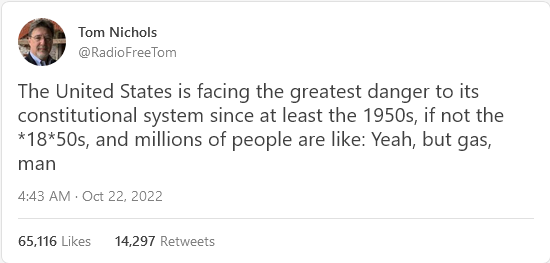
I really don’t like talking about my personal life too much, but I kind of feel like I have to. It started a couple of days when Never Trumper Tom Nichols tweeted this:

Frankly, I’m still pissed about it three days later.

You see, it must be nice for Nichols to view this as a problem of perspective, that people just aren’t seeing the forest for the trees because gas is a tad high.

I can’t be one of those people.

For the record, I think of myself as a working-class writer. I don’t make those six-figure salaries and socialize with the elite at cocktail parties. I make enough to support my family of four in what many could generously term a modest lifestyle.

And I’m OK with that. While I want more, I love the fact that my work life is what it is and I have tons more freedom to do what I want throughout the day.

These days, though, things are different.

You see, while Nichols pretends it’s just people a little grumpy about gas prices, I see the harsh reality that people like him never will.

I’m the guy looking at the time before the next paycheck and realizing that we might not have food in the house for a day or two. I’m the one trying to decide how to stretch the last $40 in our bank account to cover those couple of days and praying it will. I’m also the one who knows that two years ago, this wasn’t a problem.

Hell, a year ago, it wasn’t an issue.

And I don’t make awful money, all things considered. I can only imagine what it’s like for those whose families don’t bring in what I normally make.

For Nichols to get worked up because people don’t see any existential crisis but do see the harsh reality slapping them in the face day in, day out sounds an awful lot like “Let them eat cake” to me.

Unfortunately, that’s what folks like Nichols think.

Nichols, who seems to believe in expertise based on his previous work, is talking about stuff he knows nothing about, things he lacks the expertise to comprehend.

The current inflation isn’t just some mild inconvenience. It’s not one of those things where we all can just shrug and push through until better times. It’s real and it’s here and it’s hurting people like me.

That gives me a certain amount of expertise because this is my life and my livelihood. This is how my family suffers.

I’m very much with him on this, as rising inflation is already a pretty big concern for us and it doesn’t look like it’ll get better any time soon.

October 25, 2022

Rishi Sunak becomes Britain’s latest Prime Minister

Filed under: Britain, Media, Politics — Tags: , , , , — Nicholas @ 05:00

I don’t know how the oddsmakers rate the new PM’s chances, but there’s bound to be money made and lost on how long he sticks around. In The Line, Andrew MacDougall wishes Rishi Sunak good luck in his new post:

Rishi Sunak shortly after becoming Chancellor of the Exchequer in 2020.
Wikimedia Commons.

It says something about the current dysfunction in British politics that the elevation of a third prime minister in a matter of just two months — without a single vote cast, by anyone — is seen as a relief. So all hail the new PM Rishi Sunak, a.k.a. the man who lost to Liz Truss eight weeks ago, as he takes the wheel of this drunken nation.

Sunak won the leadership of the Conservative Party — and through it, the premiership of the country — in the short and sharp race triggered by the spectacular end of the Trussterfuck all of (checks notes) four days ago. With the declared support of nearly 200 of his Parliamentary colleagues, Sunak was able to see off challenges from former prime minister Boris Johnson and current House Leader Penny Mordaunt. Both Mordaunt and Johnson declined to seek a vote by the party membership, prioritizing “party unity” instead.

It will now be up to the 42-year old Sunak, an MP for only seven years, to deliver that party unity. And good luck, as they say, with that. Because the Tories are now riven into warring factions which appear to have no more in common with each other than Jagmeet Singh does with success.

Yeah, it’s that bad.

A good first step for Sunak would be to not repeat the errors of the Truss … era? When you’re in a hole, stop digging, etc. Thankfully, Sunak already has credibility here, having spent the summer telling everyone that Truss’s economic policies would be disastrous. The former chancellor of the Exchequer is, thank Christ, well acquainted with economic reality and is expected to continue the new course set out by Jeremy Hunt, the current chancellor, who has spent his time erasing all of the dick-and-ball doodles Truss scribbled onto the economy. This will surely please the international bond markets, who are the actual rulers of the United Kingdom. It will also please mortgage holders, whose payments are now expected to go up less than during Trussonomics.

But it won’t please everyone.

Robert Hutton in The Critic, for one, welcomes the new robot PM:

The morning had been hugely enjoyable, hours of watching Tory MPs rushing to endorse Rishi Sunak while there was still time. Boris Johnson had suddenly disappeared from view, claiming that he could have won, easily, but had decided not to try. Penny Mordaunt tried her best, and claims to have come within touching distance of the 100-nomination threshold, but, just before Sir Graham Brady was going to announce the result, she issued a statement saying that she hadn’t made it. It was, of course, significantly more gracious than Johnson’s. For all the claims that his time on holiday has made him a more thoughtful and humble figure, his Sunday evening statement suggests he is as much of a petulant man-child as he ever was.

And so to the desk-banging. In fairness, the appointment of Rishi Sunak as leader and prime minister-in-waiting was, for a lot of Tory MPs, an unexpected and huge relief. People who six long weeks ago thought they’d never see the inside of a ministerial car again now glimpse a future bright with possibility, at least as far as they personally are concerned.

[…]

The oddity to the day was that we hadn’t heard from our incoming prime minister. In fact, he didn’t seem to have spoken a word in public since the start of September. Finally he popped up, and we worked out why they’d been keeping him away from the cameras.

It was a brief statement, throughout which he stared at a point just off camera, giving the impression to the viewer that he was looking over your left shoulder, hoping to catch the eye of someone more interesting who was standing behind you.

He opened by paying tribute to Liz Truss “who has led with dignity and grace through a time of great change”. Or, as the rest of us call it, “September”. His delivery was awkward, as though he had read about public speaking in a book, with frequent random pauses. “I am,” he said. “Humbled. And honoured. To have the support of my parliamentary colleagues. And to be elected as leader. Of the Conservative. And Unionist Party!”

Sebastian Millbank, on the other hand, sees Sunak as heralding the end of British sovereignty:

Sunak will be praised, despite being arguably the most privileged man in British politics, as being a triumph for diversity and social mobility, Britain’s first ethnic minority Prime Minister. But he’s also our first Californian Prime Minister — a man who believes heart and soul in the Silicon Valley “Californian ideology“, and boasts of his time in Stanford as a formative experience that gave him a “bigger, more dynamic approach to change”.

In choosing Rishi Sunak in a panicked attempt to retain power and calm the markets, Tory MPs have signed away what is left of British sovereignty over our own affairs. You will hear claims that “this is how the British system works”, that in a parliamentary democracy he need only win the confidence of parliament, and does not need to go to the country.

This is sheer and utter nonsense. The Conservative majority was elected, in its current form, on the basis of the 2019 manifesto, with its promises to strengthen the public sector, heal regional inequality, and reclaim sovereignty over our borders, law and finances. If Sunak and his party no longer intend to honour those commitments, they must win a fresh mandate in a general election.

October 23, 2022

“It’s starting to be noteworthy how often people in government record their important conversations”

Filed under: Cancon, Government, Liberty, Media, Politics — Tags: , , , , , — Nicholas @ 03:00

From the kindness of his heart, Paul Wells decided to make this column available to cheapskate non-paying subscribers like me because he feels it needs to be seen by a wider audience. The topic is the ongoing inquiry into the Trudeau government’s invocation of the Emergencies Act and it’s certainly promising to stay entertaining for a while (unlike the vast majority of such inquiries):

A screenshot from a YouTube video showing the protest in front of Parliament in Ottawa on 30 January, 2022.
Photo via Wikimedia Commons.

The goal of it all is to permit Rouleau to decide whether the Emergencies Act was used properly when it was invoked, for the first time in its 34-year existence, by the Trudeau government to end the mess in Ottawa’s Centretown. But it’s also a deep dive into conflicting ideas of police doctrine, the best look we’ve had at the stressed and dysfunctional city administration in Ottawa. And while we haven’t yet heard much about the Trudeau government’s processes, that’s coming. The prime minister and seven of his senior cabinet ministers, with their deputies, will testify soon.

Nobody can keep up with it. For Ottawa reporters it’s as though we’ve dragged ourselves for a decade through a desert of talking points and euphemisms into an oasis of unbelievable information bounty. The temptation is to gorge. I took Wednesday off, only to learn that Diane Deans, the city councillor who was heading the Ottawa Police Service Board when the mess began, secretly recorded the call in which she informed Mayor Jim Watson that she’d gone ahead and negotiated the hiring of an interim police chief Watson had never heard of. […]

Aaron Sorkin couldn’t have written it better. Deans tells Watson she’s found a new police chief for him in the middle of the worst public-security crises of their lives. He tells her it’s a terrible plan. She asks whether he’ll vote to remove her from her post and he won’t say, which of course is the same as saying. They talk about what to do next, in a way that leaves room for each to have an understanding of what they agreed that’s incompatible with the other’s. It’s gold. The consensus on Thursday among Parliament Hill people I talked to who’d heard the tape was that conversations like this happen all the time in workplaces across the capital, as of course they happen around the world. It’s just that usually in governments, as in most large organizations, any sign of their existence is buried under lakes of Novocaine.

It’s starting to be noteworthy how often people in government record their important conversations. Almost as though people were increasingly worried they might be lied about. When Jody Wilson-Raybould did such a thing three years ago, it was possible for her ex-colleagues to clutch their pearls and protest that such a thing just isn’t done. But after months of claims and assertions about what RCMP commissioner Brenda Lucki told the RCMP detachment in Nova Scotia, nine days after the worst mass murder in Canadian history, it’s handy to have a recording, isn’t it.

By this emerging standard, Patricia Ferguson is old-fashioned. As far as we know she didn’t record her meetings. But she did break open a notebook methodically, like clockwork, to write detailed longhand notes after her conversations. Those notes are hard to reconcile with the portrait Deans painted in her testimony a day earlier, of Peter Sloly as a lone good man, standing up for proper policing in the face of heckling and even racism from the city’s old guard.

In Ferguson’s version, it sounds like Ottawa’s cops were all reasonably good but they were cracking and colliding under immense pressure.

Ferguson described an Ottawa Police Service already worn down by the beginning of this year. There had been retirements, resignations, a high-level suspension and a suicide before and during the COVID lockdowns, followed by Black Lives Matter protests with the attendant internal soul-searching and external scrutiny every North American police corps faced.

And then the convoy hit. And then it stayed. This last was more of a surprise than it should have been.

The late stories out of Wednesday’s testimony were from Pat Morris, an Ontario Provincial Police superintendent in charge of intelligence-gathering. He dumped a bunch of old OPP “Project Hendon” reports, a term of art for the force’s intelligence-gathering operations, onto the commission server. Those reports were sent regularly to the Ottawa police as the various truck convoys approached the capital. Ferguson testified that she didn’t become aware of them until just before the trucks arrived. Which is too bad. What the OPP had found was a very large group of protesters from all over. They did not pose an organized threat of violence, though the Hendon reports acknowledged that confrontation can always escalate and that “lone wolf” extremists could well be tempted to join the crowd. But all the trucks represented a huge problem anyway, because they had rapidly growing funding — and no plans to go home at any point.

October 22, 2022

Taking Out the Trash: What We Get Wrong About Recycling

Filed under: Economics, Environment, Government, Media, Politics, USA — Tags: , , , — Nicholas @ 02:00

Kite & Key Media
Published 24 May 2022

Recycling is essential to protecting the environment, right? Well … it’s complicated. Many of our recycling practices are largely ineffective. And many of the materials it would be most beneficial to reuse barely get recycled at all.

In the 1980s, the recycling movement really took off thanks to the viral story about a trash barge called the Mobro.

In 1987, the Mobro floundered at sea for six months trying to find a port that would accept its load of garbage. The Mobro was rejected by port after port because of unsubstantiated rumors that it was carrying hazardous medical waste.

The Mobro‘s journey put the issue of waste management in the forefront of Americans’ minds. We were told recycling would solve our waste management woes — reducing trash in landfills and facilitating the reuse of plastics. Turns out, recycling isn’t the panacea we imagined it would be.

For starters, we’re not running out of landfill space. If you took just the land in the country that’s available for grazing — and then used just one-tenth of one percent of it — it could hold all the waste Americans will produce over the next 1,000 years.

As for recycling … well, it’s complicated. Take plastic, for instance. Making new plastic is actually cheaper than recycling old plastic. And the newest, high-tech methods of recycling plastic generate carbon emissions 55 times higher than just putting it in a landfill.

Many localities that used to profit from their recycling programs are losing money. Prince George’s County, Maryland, made $750,000 on its recyclables in 2017. A year later, they lost $2.7 million. Recycling has become so expensive that hundreds of local governments have stopped doing it.

Fortunately, there is one area of recycling that has potential: electronic waste. In recent years, only about 30% of e-waste — the remains of discarded computers, cell phones, TVs, etc. — has been recycled, which doesn’t make much sense. It’s packed with valuable metals and rare earths that we rely on for everything from consumer electronics to military technology.

Adding e-waste to the mix could save recycling as we know it. It could make the practice profitable again. And it could be better for the environment.
(more…)

October 21, 2022

“The function of elected officials in California is the performance of symbols, the narcissistic status dance”

Chris Bray on the essentially performative nature of law-making in California:

That mayor is gone, now, but her rotating crop of replacements aren’t noticeably more committed to the quotidian reality of the city, 3.4 square miles of crumbling streets. They’re busy with the climate action plan, and with their very very serious regional outreach to achieve social justice and climate justice and, you know, something something justice something. They are performing their symbols.

So start with this premise: The function of elected officials in California is the performance of symbols, the narcissistic status dance.

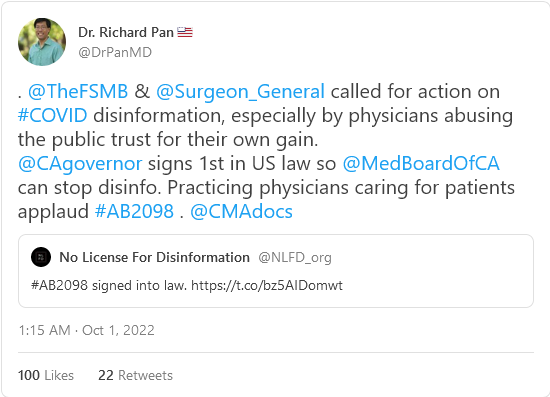
Doing just that, the bumbling halfwit Richard Pan, a pediatrician turned Big Pharma water-carrier, has succeeded in the passage of his “disinformation” bill, AB 2098. Here’s how the legislative counsel explains the bill:

    Existing law requires the applicable board to take action against any licensed physician and surgeon who is charged with unprofessional conduct, as provided.

    This bill would designate the dissemination of misinformation or disinformation related to the SARS-CoV-2 coronavirus, or “COVID-19,” as unprofessional conduct.

But, as Igor Chudov notes, the bill — now the law — defines away its purpose, declaring that misinformation is “false information that is contradicted by contemporary scientific consensus contrary to the standard of care”. (And disinformation, the law says, is merely misinformation spread with “malicious intent”, disagreeing with the consensus plus being mean and bad.)

Being a longtime admirer of Richard Pan’s unique mind, I adore the definition of falsehood as something contrary to the consensus. It’s true, you moron, ’cause lots of people believe it! (The earth is at the center, and the sun revolves around it! Go to your room!) But back to Chudov’s good catch: The law evaporates if you can show that the consensus isn’t, and European public health regulators, among others, are doing that work. So if a doctor violates the consensus by telling a patient that the mRNA injections don’t prevent infection or transmission … okay, hold on a second.

So Senator Pan wishes to burn the witch, but he defines “witch” in such pudding-soft language that he gives the witch-burners nowhere to stand without sinking and vanishing. His declared purpose evaporates in the sloppiness of his mind. But he gets the symbol, declaring that he has declared that the witch should be burned. He gets his tweet.

The brief career of Liz Truss as British Prime Minister

Filed under: Britain, Politics — Tags: , , , — Nicholas @ 03:00

As I was typing the heading for yesterday’s post on former British Chancellor Kwasi Kwarteng, it occurred to me that I might need the same phrasing for the Prime Minister … but I expected her to stumble on a few more weeks or months rather than following Kwarteng out the door this quickly:

Edmund Burke – one of the great theorists of the state – argued that for a government to rule successfully, it must have consent. Liz Truss lacked that consent; she moved like Thomas Hobbes’ Leviathan, ruling with an iron fist towards her economic vision without the consent, explicit or implicit, to rule in that manner and pursue that agenda.

Her economic programme was wholly unsuitable for the climate and deeply damaging. The result was that her reign, like Hobbes’ state of nature where nobody had the political legitimacy to rule, was nasty, brutish and short. It has left the mantle impossibly difficult for her successor.

Liz Truss has become the first prime minister since Neville Chamberlain to never face a general election whilst in office, and her successor will be under immediate pressure to call one. The economic situation is far more dire than it was before her disastrous mini-budget, and trust is shattered. This is before expected interest rate increases could tip millions into unaffordable mortgages, and the expiry of the energy support scheme (except for targeted support). Whoever takes over will face crises on multiple fronts that may prove impossible to arrest.

There’s rarely been a political downfall that didn’t merit at least a nod to the famous bunker scene:

If you haven’t seen Downfall, you’ve almost certainly seen its most famous scene. As shells fall on Berlin and the Red Army advances, Hitler sits in his bunker and listens as his generals lay out exactly how bad the situation is. One by one, his options are whittled away until eventually it sinks in that all that awaits is total defeat, humiliation, and annihilation.

On an entirely unrelated note, as Liz Truss returns to her bunker underneath the big table in the Cabinet Office Briefing Room, difficult conversations are happening in Downing Street. It’s 11am on a Thursday morning …

Penny Mordaunt attempts a cheerful smile. She does not succeed. “Prime Minister – the Labour party has made a breakthrough across a wide front. In the South they are taking Bedfordshire and Norfolk. In the North, the Red Wall is broken. In the East and West, losses are limited because fish don’t vote. But indications are that even the haddock are pretty gloomy about your prospects.”

Truss waves this away. “Don’t worry. Kwasi’s resignation will bring it under control.”

The Cabinet exchanges uneasy glances. Mordaunt steps forward from the crowd. “Prime minister … Kwasi …”

Jacob Rees-Mogg finishes the thought. “Kwasi is briefing against you in the Times. He says you have weeks remaining in office.”

An awkward silence develops, extends. In this room, time now has no meaning. Glaciers run like rivers. The sun and moon flicker across the sky. Empires rise and fall, newly sapient species emerge, flourish, and die off. Eventually the universe undergoes total heat death, frozen into stasis until a spark suddenly appears; a second big bang. Energy. Light. The reinvention of particle physics, and eventually an earth, evolution, Britain, and

“Prime Minister?”

“Yes. I see.”

A second pause, blessedly shorter. Mordaunt and Rees-Mogg glance nervously at each other. Eventually, Truss settles on a response: “Would everyone who has briefed against me in the last week please leave the room.”

In Spiked, Brendan O’Neill makes the argument that Britain is now a political wasteland:

So Liz Truss is out. After just 44 days her premiership is no more. “I’m a fighter, not a quitter”, she said in parliament yesterday, and now she’s quit. Her premiership deserves to live in ignominy. Not necessarily because her blunders were so spectacular – though many of them were – but because of what this strangled-at-birth stint in Downing Street tells us about British politics more broadly. Which is that it’s a wasteland. An ideological void. A dustbowl of ideas. The lack of even the faintest glimmer of leadership material anywhere in the Westminster circus is horrifying to me. Trussism is but a symptom of a wider malady afflicting our political class.

[…]

Let’s go beyond Truss and Hunt and ask what this all tells us about the Conservative Party. This is the oldest political party in Europe, arguably the world. It’s the party that gave us Peel, Churchill, Thatcher, properly historic figures. Which birthed so much of the legal and political order we live under. Which The Economist aptly called “the world’s most successful party”. And which once reached, through Conservative Associations, the Church and other formal and informal networks, into communities across the land.

Now it’s a hollow machine, bereft of strategy, in dire want of ideas, out of touch with the public, disorientated, and infamous for having a PM who couldn’t last a naff, paltry 50 days in Downing St. The factional Tories cheering Truss’s demise are fools. Your entire party is indicted by this shitshow. And by the fact that your big replacement for lame Liz – Hunt – is a man so disconnected from British people, British history and British politics that he prefers EU oversight to national sovereignty, technocracy to belief, and “competence” to passion. Congrats!

To see the true state of the Tory Party, look no further than a comment piece penned by one of its former leaders, William Hague, this week. “Ideology is dead: it’s competence we need now”, the headline said. In short, you’ve had your fun with Brexit and Boris and the mad populist experiment – now it’s time for the adults to come back into the room and take control. Not only is this undemocratic (14million people voted for Boris to be PM, no one voted for Hunt to be de facto PM). Not only is it anti-political. Not only is it bureaucratic, stiff and unabashedly concerned more with making the trains run on time than with inspiring the people with proposals for a genuinely better life. It is also an admission that they have no ideas left. That the once great Conservative Party is completely out of steam. That Westminster itself is knackered. “Competence” is the last refuge of the visionless. They’re finished. Kaput. Clueless. Not just Liz, all of them. The need for a political overhaul has never been so pressing and so great.

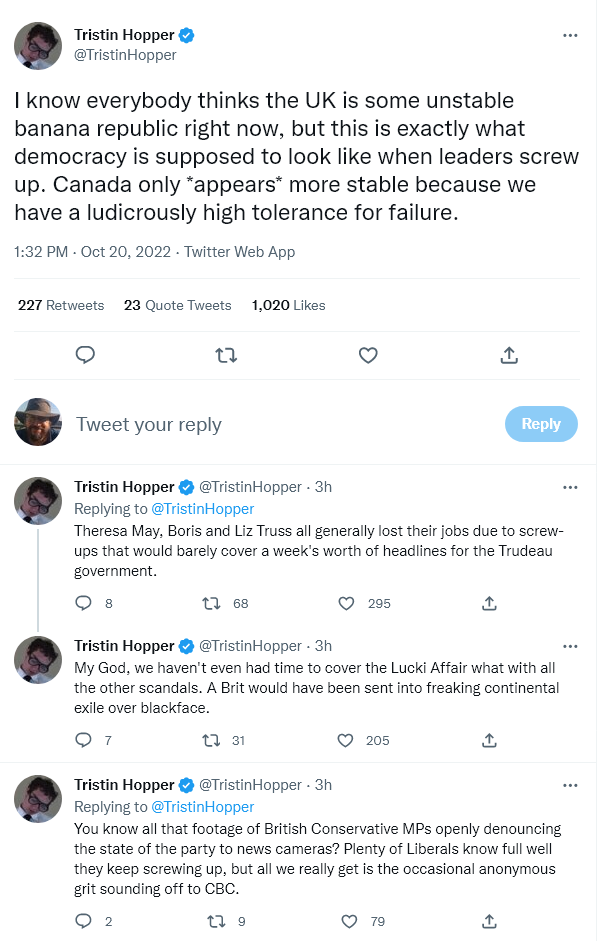
Despite the “bad optics”, as Tristin Hopper points out here, this is what’s supposed to happen when the PM gets it totally wrong, and Canadians have no grounds to criticize Britain here:

October 20, 2022

The brief career of Kwasi Kwarteng as Chancellor of the Exchequer

Filed under: Britain, Government, Media, Politics — Tags: , , — Nicholas @ 05:00

Dominic Sandbrook had the misfortune of having fever dreams in which he found himself pursued by Kwasi Kwarteng. I sympathize, having recently had similar fever dreams, though lacking Mr. Kwarteng’s participation. His very brief time as Chancellor was as unpleasant for all concerned as it could have been:

Detail of a photo of Kwasi Kwarteng at a meeting with the US Ambassador, 25 August 2022.
Photo by the Office of U.S. Ambassador to the United Kingdom via Wikimedia Commons.

Nightmares about public failure are very common. There can be few readers who haven’t dreamed about turning up to an exam entirely unprepared, or about walking onstage having neglected to learn the lines. Anecdotal evidence suggests that the more you care about such things, the more likely they are to haunt you, which is why they’re so common among academic high-achievers. So perhaps Kwarteng himself, whose academic credentials are second to none, has had such dreams. And if he did, here’s the twist. His nightmares came true.

What happened to Kwarteng on Friday — and again yesterday, when Jeremy Hunt ripped up his mini-budget, poured petrol on the debris and set the whole thing alight — was more than your standard political sacking. It was a humiliation on the grandest possible scale, as the Chancellor was forced to fly back early from Washington, with some 6,000 people gleefully tracking his flight, before Liz Truss delivered the inevitable bullet. He had been in command at the Treasury for just 38 days, saved only from a post-war record by Iain Macleod’s heart attack in July 1970.

It’s hard to think of many British political figures with such a catastrophic trajectory. Kwarteng had been Boris Johnson’s Business Secretary since January 2021, but it’s a safe bet most ordinary punters had never heard of him. Then, suddenly, he was Chancellor, with a breathtakingly radical plan to defy the markets and turbo-charge a new era of growth. Then, equally suddenly, he became the most unpopular Chancellor in the history of the Ipsos-Mori poll, with even less public support than Denis Healey after the International Monetary Fund bailout in 1976 or Norman Lamont after Black Wednesday in 1992. And then he was gone, and it was all over. What a career!

You might assume from all this that Kwarteng is a fool. But he really isn’t a fool. Giving school talks, I’ve twice come across people who taught him, and both told me he was the cleverest boy they’d ever known. Were they wrong? Obviously not, for when you look at his biography, it’s a proud parent’s dream. At prep school he won a national history prize; at Eton he was a King’s Scholar and won the Newcastle Scholarship for philosophy, a competition examined by Stephen Sykes, Bishop of Ely and former Regius Professor of Divinity at Cambridge.

Kwarteng himself went to Cambridge, where he got a double first, twice won the Browne Medal for Latin and Greek poetry and even won University Challenge. He was a Kennedy Scholar at Harvard. He did a PhD on William III’s attempt to reform the coinage in the 1690s. And he’s written history books — two of which I reviewed at the time. “Well-researched and crisply written, Kwarteng’s book is a lot better than most MPs’ efforts,” I wrote of Ghosts of Empire, which examined the legacy of Britain’s rule overseas. “A politician with a sense of nuance: whatever next?”

For much of his gilded life, then, Kwarteng knew only success. And when he looked forward, he could reasonably expect more in the future. When he daydreamed, he surely imagined himself as a titanic reforming Chancellor to rank alongside William Gladstone or Sir Geoffrey Howe — and perhaps even as Prime Minister. And now? He’s the answer to a quiz question, the 38-day Chancellor whose tax bombshell exploded in his own face. To put that another way, if he were an England football manager, he’d be the love child of Steve McClaren and Sam Allardyce.

Omnium consensu capax imperii nisi imperasset. “All would have agreed that he was capable of being emperor, if only he had never been it.” So wrote Tacitus of the short-lived Roman emperor Galba — who, in fairness, lasted almost seven times longer in his top job than Kwarteng did at the Treasury. It’s a line that often recurs in British political commentary. I’ve seen it applied to Prime Ministers as diverse as Lord Rosebery, Arthur Balfour, Sir Anthony Eden, Harold Wilson, Gordon Brown and Boris Johnson. Perhaps that tells you something about the job — an office in which, one way or another, failure is almost guaranteed.

Canadian firearms law – as deliberately opaque and confusing as the human mind can concoct

Filed under: Bureaucracy, Cancon, Law, Media, Politics — Tags: , , , , — Nicholas @ 03:00

In The Line, Tim Thurley peels back the covers and provides a glimpse of the inanities, stupidities, and political opportunism that shape Canadian firearms legislation:

A typical arrangement of guns seized by Toronto Police back in 2012. Most of these weapons would be in the “restricted” or “prohibited” categories under the Firearms Act, and pretty much by definition not typically available to the majority of Canadians.

Canadians often assume our government is doing its best. Not the politicians, sure, but there is a broad assumption that at least the bureaucrats tirelessly working behind the scenes to implement political decisions must have a grasp on the facts and exhibit some consistency in decision-making. In few places is there a larger discrepancy between this perception and the grimmer reality than in how the government classifies firearms.

I’ve long had an interest in firearms policy. Those familiar with it will know how onerous the Access to Information process is and wonder why I partake on my own time and dime; I can answer only that a graduate M.Sc. thesis on legislative impacts on firearm homicide and time working in politics and government have made me a glutton for punishment. More seriously, it’s a fascinating field, and I have some insight into political and policy processes. And as any specialist in a hot-button policy area knows, there is nothing more frustrating than seeing bad policy enacted in your field again, and again, and again.

Firearms are classified into three categories under the Firearms Act: non-restricted, restricted, and prohibited. All three require a separate level of licence, obtained with escalating difficulty after multiple courses and checks. (Prohibited licences are no longer issued to the regular public, but some Canadians hold them as part of a grandfathering in of prior licence holders.) Each category is primarily determined by firearm design. A simple overview: restricted firearms are some rifles and most pistols, prohibited firearms are shorter-barrelled pistols or fully automatic (or converted to another mechanism therefrom), and non-restricted firearms are anything else meeting the legal definition of a firearm, typically meaning typical hunting rifles and shotguns.

That’s a simplified version, but that’s the system.

In theory.

In practice, as my requested documents confirmed, firearm classification in Canada is an opaque and byzantine nightmare. A messy plethora of firearms which meet the functional criteria for being non-restricted, subject to the least stringent oversight and controls, are prescribed by regulation as either restricted or prohibited, and therefore subject to more controls or outright banned. Since functional differences are accounted for by law and did not apply in these cases, the deviations must have another explanation.

In short, politics.

Take the 2020 Nova Scotia attacks. Despite the unlicensed murderer smuggling his firearms from the United States, the Liberals took the opportunity to issue an executive Order-in-Council that banned a bunch of legally owned Canadian guns mostly because it was an easy wedge for the next election. The facts of the case were irrelevant, as was the fact that the banned firearms were responsible for a minuscule fraction of Canadian homicides. The government did not even bother writing the ban by how the firearms functioned, which while unhelpful from a homicide-reduction perspective, would have at least been a coherent position. The order, among other things, simply identified a few well-known guns by name and banned those.

This is where the concept of “variants” matters. When a firearm is designated by regulation as restricted or prohibited, the designation includes all variants of the firearm, which then receive the same classification. This makes sense. Ridiculous as classifying firearms by name over function already is, it would be yet more ridiculous if a mere renaming by a manufacturer, for instance, was sufficient to evade a legal classification.

Most ridiculous of all is that the public does not and cannot know what constitutes a “variant”. The Firearms Act does not define it. The Canadian government does not define it. Nor do its agencies, even the one responsible for determining variants: the Royal Canadian Mounted Police.

The Mossberg Blaze 47 saga is illustrative of this problem. It is uncontroversial to assume that a precise mechanical copy of an original Russian AK-47 with a different name and slight design changes is still an AK-47. But when Mossberg, the manufacturer, slapped a plastic frame bearing some resemblance to Kalashnikov’s famous design on its Blaze rifle — a cheap, non-restricted, rimfire rifle suitable for, at worst, a particularly aggressive colony of rabbits — that new gun, dubbed the Blaze 47, somehow transformed from an unthreatening small-game rifle to a dangerous AK-47 variant prohibited under Former Prohibited Weapons Order No. 13.

The amazing transformation of a simple .22LR plinker into a facsimile of a dangerous “black fully semi-automatic murder machine”.

These head-scratching decisions have confused firearm owners and manufacturers, who wasted decades trying to understand how the government decides to classify their guns. It all seemed very random.

Surprise! It is!

October 19, 2022

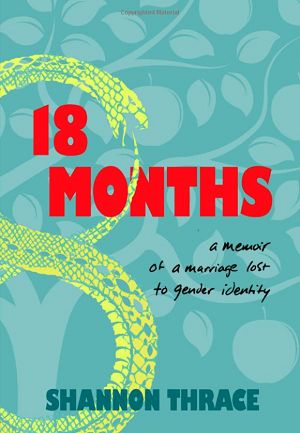
Jonathan Kay reviews 18 Months by Shannon Thrace

Filed under: Books, Health, Media, Politics, USA — Tags: , , , , , , , — Nicholas @ 05:00

At Quillette, a review of a new book on the breakdown of a once-happy marriage when one partner decides that mere transvestism isn’t enough any more and becomes transgendered:

The trans community is diverse, especially when it comes to attitudes toward sex. As writer Angus Fox noted in a seven-part Quillette series, When Sons Become Daughters, some biologically male trans-identified teenagers live a sexless existence; and are drawn to puberty blockers and androgynous aesthetics precisely because they seem to offer safe harbour from male sexual development. In the case of middle-aged men who abruptly adopt a trans identity later in life, on the other hand, it can be the opposite: the presentation is often hyper-sexualized.
(more…)

Luxury beliefs in action

Filed under: Britain, Media, Politics — Tags: , , , , , , , — Nicholas @ 03:00

In The Critic, Sebastian Milbank looks at the young vandals, er “activists” who decided that throwing soup on a famous painting was a totally sensible and reasonable thing to do in order to direct our attention to their luxury beliefs:

On Friday Phoebe Plummer, a 21-year-old graduate student and activist, threw a tin of soup over a Van Gogh painting in the National Gallery, before proceeding to glue herself to the wall. “What is worth more, art or life?” she shouted in a manner reminiscent of an especially tiresome student at the Oxford Union. Whilst Phoebe didn’t exactly make it to Oxford, she was the beneficiary of a £15,000 a year boarding school education. Having rich parents probably helps if your lifestyle involves dying your hair pink, covering yourself in glitter and getting glued to a succession of defaced public monuments. The legal fees alone must be a headache.

That said, perhaps the organisation she cheerfully acts in the name of — Just Stop Oil — can foot the bills. After all, it’s a registered charity funded by the US-based organisation The Climate Emergency Fund. The Fund boasts on its website that “We provide a safe and legal means for donors to support disruptive protest that wakes up the public and puts intense pressure on lawmakers”, not to mention “Our robust legal team”. The charity comes with endorsements by high profile organisations such as fashion magazine Marie Claire and the backing of donors like the group’s co-founder, oil heiress Aileen Getty who is quoted as saying, “Don’t we have responsibility to take every means to protect the Earth”.

I can think of other organisations that provide “A safe harbour for donors” and put “intense pressure on lawmakers”, not to mention having “robust legal teams” — though they generally feature rather more Italian accents and bodies dumped in the river, and rather fewer celebrity endorsements (Frank Sinatra could not be reached for comment).

The Just Stop Oil organisation itself is even more explicit about its willingness to countenance potentially illegal means. In its FAQ section it calls for people to “use tactics such as strikes, boycotts, mass protests and disruption to withdraw their cooperation from the state”, and announces that they “are willing to take part in Nonviolent direct action targeting the UK’s oil and gas infrastructure should the Government fail to meet our demand by 14 March 2022”. Well the date has past. “Will there be arrests?” the next section asks. The answer? “Probably”.

Quite why organisations that openly fund illegal — sorry “disruptive” — protest, and hire teams of lawyers to avoid the legal consequences, are allowed to enjoy charitable status, let alone avoid investigation by the authorities, is beyond me. Nor is it clear to me how attacks on works of art, or stopping traffic in the road, can attract support for environmental causes, or challenge those who profit from ecological destruction.

The answer lies with the nature of the radical environmental movement, which is often starkly at odds with many of the finest traditions of ecological and anti-industrial thought. Early critics of industrial capitalism like Ruskin and Morris were as concerned with the protection of traditional culture as they were with the destruction of the natural world. Their humanist challenge to industrialism was to call for the return of craft, the embrace of localism, a built environment on a human scale, and an economy that fed the spiritual as well as material needs of mankind.

Theodore Dalrymple on the mindset of the perps:

Youth is often said to be an age of idealism, but if my recollection of my own youth is accurate, it could also be characterized as an age of self-righteousness liberally dosed with hypocrisy, at least when it has known no real hardship that isn’t of its own making.

The two girls who threw a tin of soup at a Van Gogh in the National Gallery in London and then glued themselves to the wall certainly evinced a humorless self-righteousness and self-importance: indeed, they seemed almost to secrete it as a physiological product. They were part of a movement of dogmatic and indoctrinated young people called Just Stop Oil that’s currently making a public nuisance of itself in this fashion in Britain, holding up traffic and causing misery to thousands, in what it believes to be the best of all good causes, saving the planet.

[…]

Youth suffers from both fevered over-imagination and a complete absence of imagination. This is the natural consequence of a lack of experience of life, in which limited experience is taken as the total of all possible human experience. Youth accepts uncritically its own wildest projections and doesn’t know the limitations of its own knowledge. It believes itself endowed with moral purity and allows for no ambiguity, let alone tragic choice. It’s sure of itself.

The young women who threw soup at the Van Gogh probably didn’t know that, even if the man-made climate change hypothesis were wholly correct, they lived in a country that produced about 1 to 2 percent of the alleged greenhouse gases in the world, so that even if their action put a complete end to that contribution (a most unlikely outcome) it would make absolutely no difference whatever to the fate of the planet. Their action certainly caused the public irritation and expense, and its most likely long-term outcome is a costly increase in surveillance and security at the gallery because the two of them were able to do what they did with such ease.

However, they were probably dimly aware, or had the good sense to know, that it would have been inadvisable for them to make their gesture in some country responsible for a far greater proportion of the alleged causation of climate change than their own—China, for example. Cowardice, after all, is the better part of self-righteousness.

« Newer PostsOlder Posts »

Powered by WordPress