
Much of Mukerjee’s case against Churchill rests not on his actions but on his various racist comments about Indians, and Bengalis in particular. Most of these have been taken out of context. Churchill was certainly no friend to Indian nationalist leaders, most of whom he regarded as moralising humbugs. He was an unashamed imperialist, like many of his generation, and committed to maintaining India’s unity within the British Empire. He had a strongly-held conviction that too sudden and rapid a move to democracy and independence would tear the subcontinent apart on sectarian lines, a fear that events would justify.
On the other hand, Churchill repeatedly voiced his admiration for the gallantry of Indian troops, noting in his war memoirs: “The unsurpassed bravery of Indian soldiers and officers, both Moslem and Hindu, shine for ever in the annals of war. Upwards of two and a half million Indians volunteered to serve in the forces … The response of the Indian peoples, no less than the conduct of their soldiers, makes a glorious final page in the story of our Indian Empire.”
Despite his fears about Indian independence, Churchill’s views noticeably mellowed over the years. On 5 February 1942, Churchill proposed in cabinet to visit India to make its Congress leaders an offer of postwar independence, in return for their supporting the war effort. But instead the war cabinet sent its senior Labour minister, Sir Stafford Cripps, known for his friendship with Congress leaders. When the Cripps mission failed to meet their demand for immediate independence, Congress launched the Quit India movement of civil disobedience against the Raj and resolved to offer only passive resistance to the Japanese invasion.
On being informed of this in September 1942, an apoplectic Churchill exclaimed to Amery: “I hate Indians. They are a beastly people with a beastly religion.” He was referring to Hinduism, rather than Islam, given loyal support for the war effort from the Muslim League. Churchill saw Gandhi’s decision to launch the Quit India movement in the middle of the war as a stab in the back when Britain most needed and deserved loyal support.
He also (like many Indian liberals and socialists) saw Gandhi’s political fasts as a form of emotional blackmail. And he was appalled, as were many Congressmen, by extreme nationalists such as the Bengali leader Subhas Chandra Bose joining hands with Hitler and the Japanese, a fact not calculated to endear Bengalis in general to Churchill.
Churchill’s abusive comments about Gandhi, Indians and Bengalis need to be seen in that context. They also need to be seen in the context of his penchant for making outrageous comments that he didn’t really mean in order to shock or tease.
Zareer Masani, “Churchill and the genocide myth”, The Critic, 2020-12-06.
August 2, 2026
QotD: Churchill’s views on India
August 1, 2026
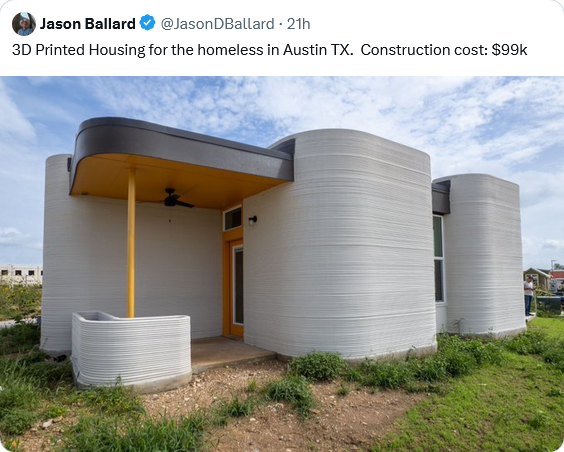
Homelessness isn’t the real problem … it’s feral humans
Many well-meaning people see “homeless” individuals on the street and think the problem is that these individuals don’t have homes. An obvious solution occurs: we’ll just give them homes so they won’t need to sleep rough on the streets. What a great idea! With the best of intentions! What could possibly go wrong?
The real problem isn’t that there aren’t enough homes … some of those “homeless” people on the street actually do have places to sleep but for one reason or another choose not to. The real problem for most of them is that they’ve gone feral:
If you give problems the wrong names, you can’t understand them.
If you can’t understand problems, you can’t fix them.
There are almost no homeless people in America. There are only feral humans.
A homeless person is someone whose distinguishing feature is not having a home. I was homeless once, for a day, when the lease on one apartment expired before the next one was cleaned, repaired, and ready.
I parked a moving van full of my worldly possessions at my university, and slept on a couch in the student commons.
That’s “homeless”.
“Feral” is when a human cannot live within society, or comply with the basic expectations required for membership.
Yes, they do not have homes.
But this is not their distinguishing feature. Because they also don’t have jobs, sanity, sobriety, manners, morals, or hygiene.
Which is why they do not have homes.
If you give them a house, because you think they are “homeless” rather than “feral”, then they will simply repeat, within that structure, the same feral behavior.
And soon that structure will be uninhabitable.
Which, for certain people, is the whole point.
A man whose job is to sell 3d printed houses isn’t trying to fix the feral-human problem. He’s trying to sell 3d printed houses.
And it’s one hell of a lot easier to sell them to bureaucrats who aren’t spending their own personal money.
It doesn’t matter if 3d printed houses suck to live in. It doesn’t matter if the feral humans trash them. Nobody in this equation cares about the feral humans, even the feral humans themselves.
And nobody in this equation cares about the taxpayers. If the feral humans are still feral, then the 3d house grifters can sell more gimmick houses, and the bureaucrats can spend more of someone else’s money.
If a violent political upheaval becomes necessary, this will be very unpleasant for everyone involved, but at least afterwards, we will all be able to use the feral humans, bureaucrats, and grifters to fertilize the garden of new homes.
Which will be made out of bricks.
Update, 2 August: Welcome, Instapundit readers! Have a look around at some of my other posts you may find of interest. I send out a daily summary of posts here through my Substack – https://substack.com/@nicholasrusson that you can subscribe to if you’d like to be informed of new posts in the future.
July 30, 2026
Support for capital punishment is the opposite of a luxury belief
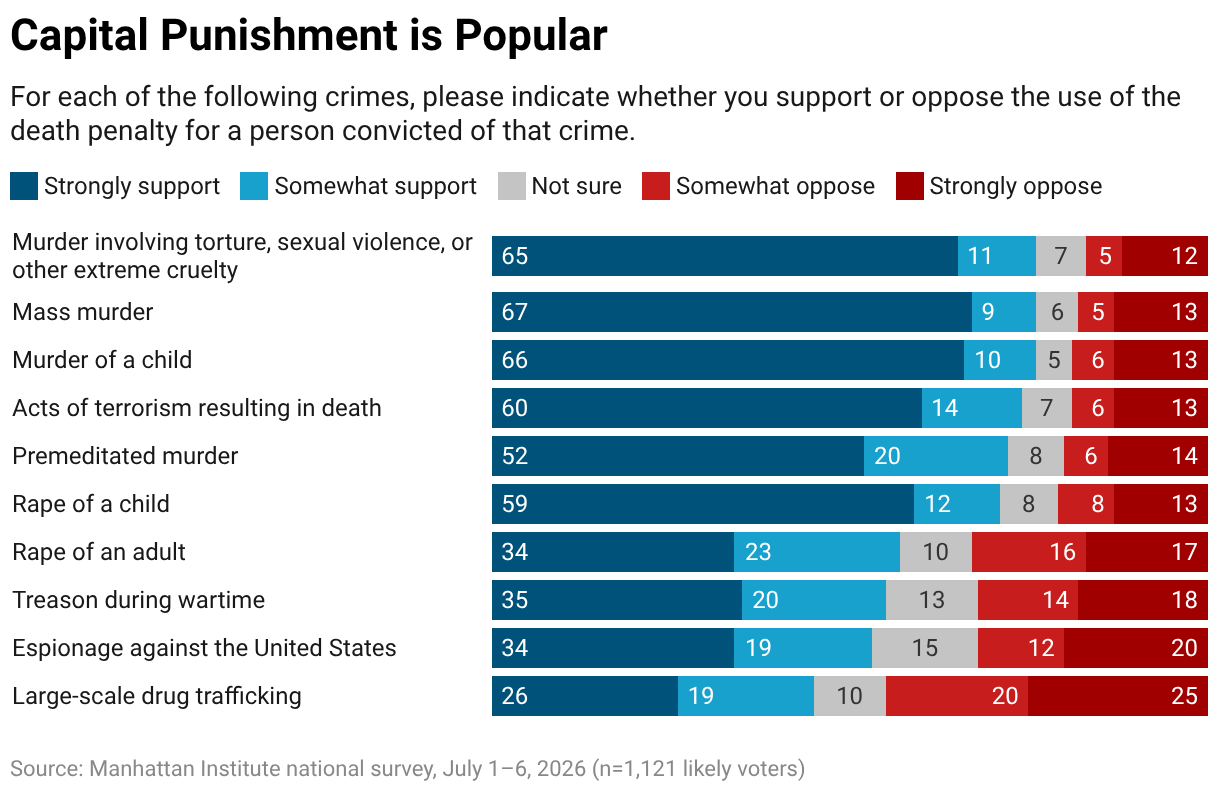
As noted in City Journal, support for capital punishment is overwhelmingly high … which is why politicians and wealthy progressives whole-heartedly oppose it. As you probably know, a “luxury belief” is one that is usually held by people who will not be in any way impacted by the downstream effects of that belief. It’s not the wealthy and privileged who suffer when murderers get out of prison, so they are generally all in favour of ever greater leniency in sentencing and easing parole conditions. Poor and middle class people are more likely to suffer when violent criminals return to their communities, which is why they generally want longer incarceration for violent crimes and favour capital punishment for certain abhorrent acts of murder. Charles Fain Lehman has more:
Those findings undermine the narrative, routinely advanced by death-penalty abolitionists, that capital punishment is on the decline because the public has turned against it. In reality, both public opinion and the current composition of the Supreme Court militate in favor of expanding the death penalty’s use — and, specifically, relaxing many of the arbitrary and undemocratic restrictions imposed on it by courts over the past several decades.
Abolitionists have based their case for declining public support on polls such as Gallup’s, which for nearly a century has asked respondents if they are “in favor of the death penalty for a person convicted of murder”. The share in favor has indeed dropped steadily since the 1990s, from a 64-point difference between support and opposition to just a 6-point split today.
That question, though, artificially reduces support by asking about all murders. Under current precedent, only certain heinous murders — those in which jury-determined aggravating factors outweigh mitigating factors — are eligible for the death penalty. There is likely far more support, for example, for executing Dylann Roof specifically than there is for executing all murderers generally.
The new MI poll illuminates this point. It asks about support for capital punishment under a variety of circumstances. The result is lopsided endorsement in the event of, for example, murder involving “extreme cruelty”, mass murder, or the murder of a child — all supported by 3-to-1 margins. Death for premeditated murder generically has 72 percent support, suggesting that even clarifying intent significantly increases support for capital punishment.
Notably, the poll also finds majority support for executing those who rape a child (71 percent) or an adult (57 percent). Yet neither offense would, absent a concurrent murder, be death-eligible. The Supreme Court ruled that applying the death penalty to non-murdering rapists violated the Eighth Amendment’s prohibition on “cruel and unusual punishment” in 1977’s Coker v. Georgia, a prohibition it extended even to child rapists in a 2008’s Kennedy v. Louisiana. With certain exceptions for crimes against the state, the Kennedy majority asserted, a crime that did not result in the taking of someone’s life was categorically ineligible for the death penalty.
Both decisions were justified by reference to the court’s “evolving standards of decency” test. First introduced in 1958’s Trop v. Dulles, the test has led the court to understand “cruel and unusual punishment” through its interpretation of “the evolving standards of decency that mark the progress of a maturing society”. That lens allowed it to reach the conclusions it did in Coker, Kennedy, and numerous other narrowings of the use of the death penalty. In combination with the aggressiveness and gamesmanship of the capital defense bar — which spends decades filing often-frivolous procedural motions to keep clearly guilty clients alive — the result has been a steady choking off of capital punishment.
Update, 31 July: Welcome, Instapundit readers! Have a look around at some of my other posts you may find of interest. I send out a daily summary of posts here through my Substack – https://substack.com/@nicholasrusson that you can subscribe to if you’d like to be informed of new posts in the future.
Canadian conservatives need different leaders, say Liberal media
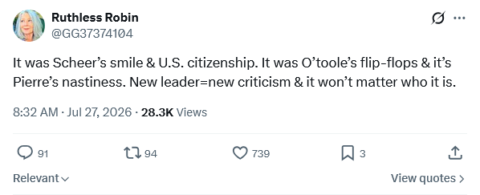
Unlike the Liberals and NDP, whose leaders get a media honeymoon that sometimes lasts for years, Conservative leaders are never given the slightest break by presstitutes paid by the Liberals. (Anyone further to the right than the centrist Conservatives get almost no media attention at all, as Maxime Bernier can attest.) L. Wayne Mathison responds to “helpful” suggestions for how the Conservatives can get rid of their current unpopular-with-the-state-media leader and replace him with someone more “acceptable”:
The pattern is obvious.
Scheer was supposedly too awkward. O’Toole was too inconsistent. Pierre is now too aggressive, too divisive, too nasty. Change the leader and the criticism changes with him. The objective stays the same: keep Conservatives apologizing, retreating and replacing leaders while the Liberals remain the default governing party.
The elite Red Tories never wanted Pierre Poilievre as leader because he threatens the arrangement they are comfortable with. They prefer a Conservative Party that manages Liberal policies a little more efficiently, attends the right receptions and never seriously challenges Ottawa’s permanent political class.
Put on the economics hat and the incentives become clear. The people closest to government often do very well under bigger government. Consultants get contracts. Lobbyists gain influence. Bureaucracies expand. Well-connected corporations receive subsidies and protection. Housing owners watch scarcity drive up their assets. Ordinary workers get higher taxes, weaker wages, expensive housing and declining public services.
Pierre’s real offence is that he speaks directly to the people paying the bill.
Canada has nearly every advantage a country could ask for: energy, minerals, farmland, fresh water, educated people, stable institutions and access to the largest market on Earth. We should be one of the wealthiest and strongest countries in the world. Instead, our political class keeps managing scarcity, blocking investment and teaching Canadians to expect less.
Conservatives should stop chasing approval from commentators and insiders who will never support them. Back Pierre. Defend the principles. Make the economic case clearly.
Prosperity should not be reserved for the people who already know how to work the system.
The best investment the Liberals ever made was buying the loyalty of the relic media with a dollop of cash from the government’s coffers. They already were mostly onboard with the Liberals — those that didn’t think the NDP was too far right — but the financial leash made even the mavericks think twice about substantive criticism of the man who co-signed their pay cheques.
Update: Fixed missing URL.
Intramural conflict in the progressive “big tent”
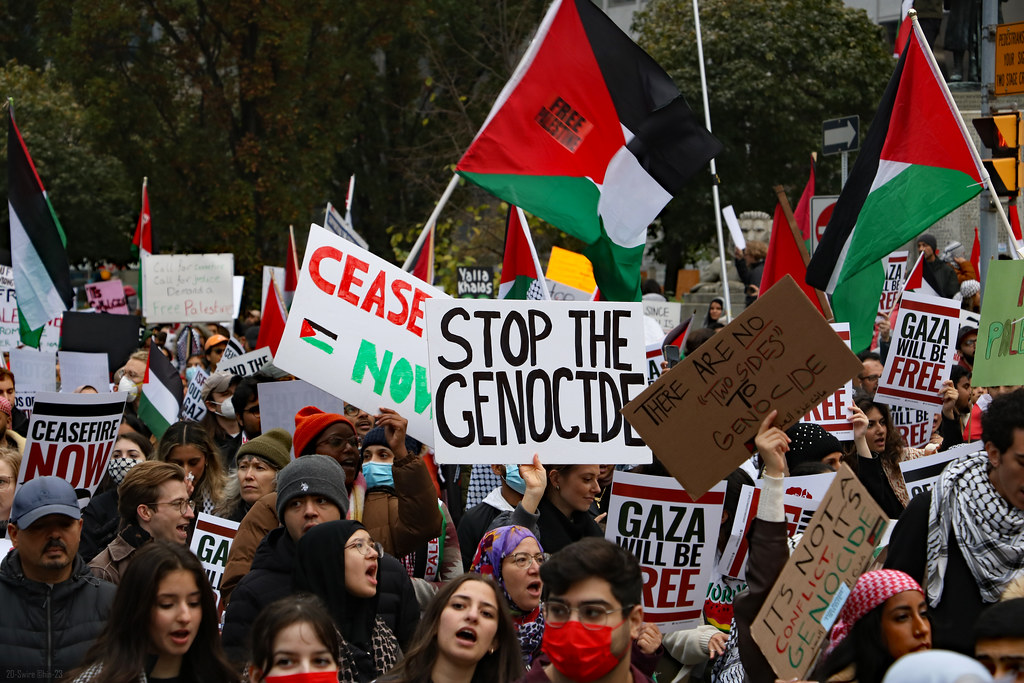
On the social media site formerly known as Twitter, L. Wayne Mathison identifies some of the major fault lines among the temporary coalition-of-convenience on “the left”:
“Free Palestine/Anti-Israel protest” by Can Pac Swire is licensed under CC BY-SA 2.0 

 .
.
The modern woke worldview keeps colliding with reality because it sorts people into fixed moral categories: oppressed people are presumed good, while designated oppressors are presumed guilty. Once that framework takes hold, facts become secondary.
That is why some progressives can condemn “Christian nationalism” before breakfast, then struggle to name radical Islam when an Islamist attacks the very people they claim to defend.
The contradiction is obvious. Radical Islam is deeply hostile to homosexuality, women’s equality, free expression and secular liberalism. Pretending otherwise does not make anyone tolerant. It makes society dishonest and vulnerable.
This does not mean every Muslim is dangerous, nor does it justify collective blame. It means an ideology should be judged by what it teaches, what its extremists do, and whether its institutions openly confront the problem. The same standard should apply to every religion and political movement.
The woke response is usually predictable: redirect attention toward the far right, blame Western society, or accuse anyone raising the issue of hatred.
That protects the ideology, but it does nothing to protect ordinary people. Compassion without boundaries becomes negligence.
A healthy society needs openness, but openness is not the absence of judgment. Immigration, asylum and multiculturalism require enforceable limits, cultural confidence and a clear expectation that newcomers accept the laws and basic freedoms of the country receiving them.
You cannot build social trust by demanding that citizens ignore obvious conflicts. You cannot defend gay people while excusing movements that despise them. You cannot defend women while tolerating misogyny from politically protected groups.
Reality does not care which side has the approved slogans. Eventually, contradictions collect a human cost.
July 29, 2026
The American Deep State’s biggest experimental laboratory
On Substack, John Carter links to the latest of kulak’s fascinating-and-unsettling Anarchonomicon posts with this introduction:

Kulak’s thesis here is that English Canada generally, and Toronto specifically, is ground zero for a lot of the more insane gay race communism trends because America has been using Canada as a testing ground for psychological operations since the 1950s.
That sounds kind of nuts but he makes a plausible case. Since Canada is technically a foreign country, intelligence agencies don’t face the same limitations they do at home. Since Canada is almost culturally identical to the US, what works in Canada will generally work domestically (and all the GAE psyops are ultimately aimed at America’s domestic tax cattle).
Kulak also brings the receipts here, showing how things like MeToo and GamerGate seem to have been prefigured by similar movements in Canada a couple years before.
One thing he misses is land acknowledgements, which began spreading in Canada in 2013 or so, and have since started appearing at American and Australian universities. I don’t know for sure that they started in Canada, all I can say is that it was Canada where I first noticed them, and where they have become ubiquitous.
Multiculturalism is another Canadian export, developed here in the 60s and rapidly introduced all over the Western world. The prime ministers who introduced it were American puppets, and the ideology itself has a very broadly American “nation of immigrants” feel to it.
Anyhow, you motherfuckers, two can play this game.
On the land acknowledgements, the first time I encountered it was at my son’s university graduation ceremony, but his university had a big First Nations specialization so it didn’t seem too outlandish at the time. Since then, of course, pretty much every event in urban Canada seems to feature a land acknowledgement and they don’t appear to be optional any more.
Anyway, on to kulak’s post on “The Battle for the Mind of North America”:
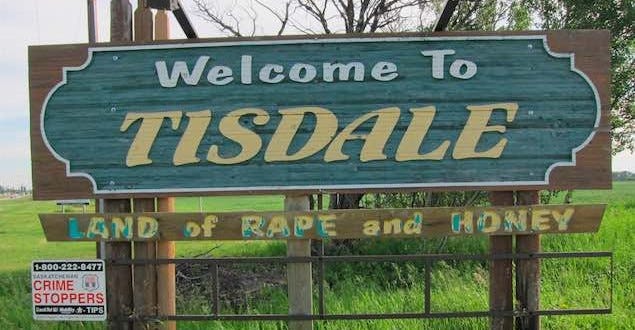
The Land of Mind-Rape and Honey
Canada is/was a nice enough place to visit or grow up … several large nice cities surrounded by tons and tons of quaint and cute functional “Mainstreet USA” style quirky little towns.
The “Rape” refers to Rapeseed, the primary ingredient in Canola Oil, the unhealthy seed-oil. (they named it “Canada Oil” because “Rape Oil” might make people hesitate)
But when you scratch at the surface there’s something profoundly deeply wrong with Canada. You can feel it. You can see it when you look out your window or when you turn on your television. You can feel it when you go to work … when you go to church … when you pay your taxes.
and the Canadians are quite pleased to tell you just what that thing is:
America.
Funnily though, when you ask what Americans have done to them or what is wrong with America, they’ll tell you things about moral degeneracy and perfidy of Americans … no different than what the American elite and the US Government expresses about its own populace.
For reference: Canada is a vassal of the US.
It has been since the 1960s when the British lost the Suez Crisis and the American Deep State backed “Multiculturalism”, an end to “God Save the Queen”, legalized sodomy, ended prayer in public schools, demilitarized Canadian education (which til the 60s included rifle practice, marching, and survival training) … and oh ya a new flag.
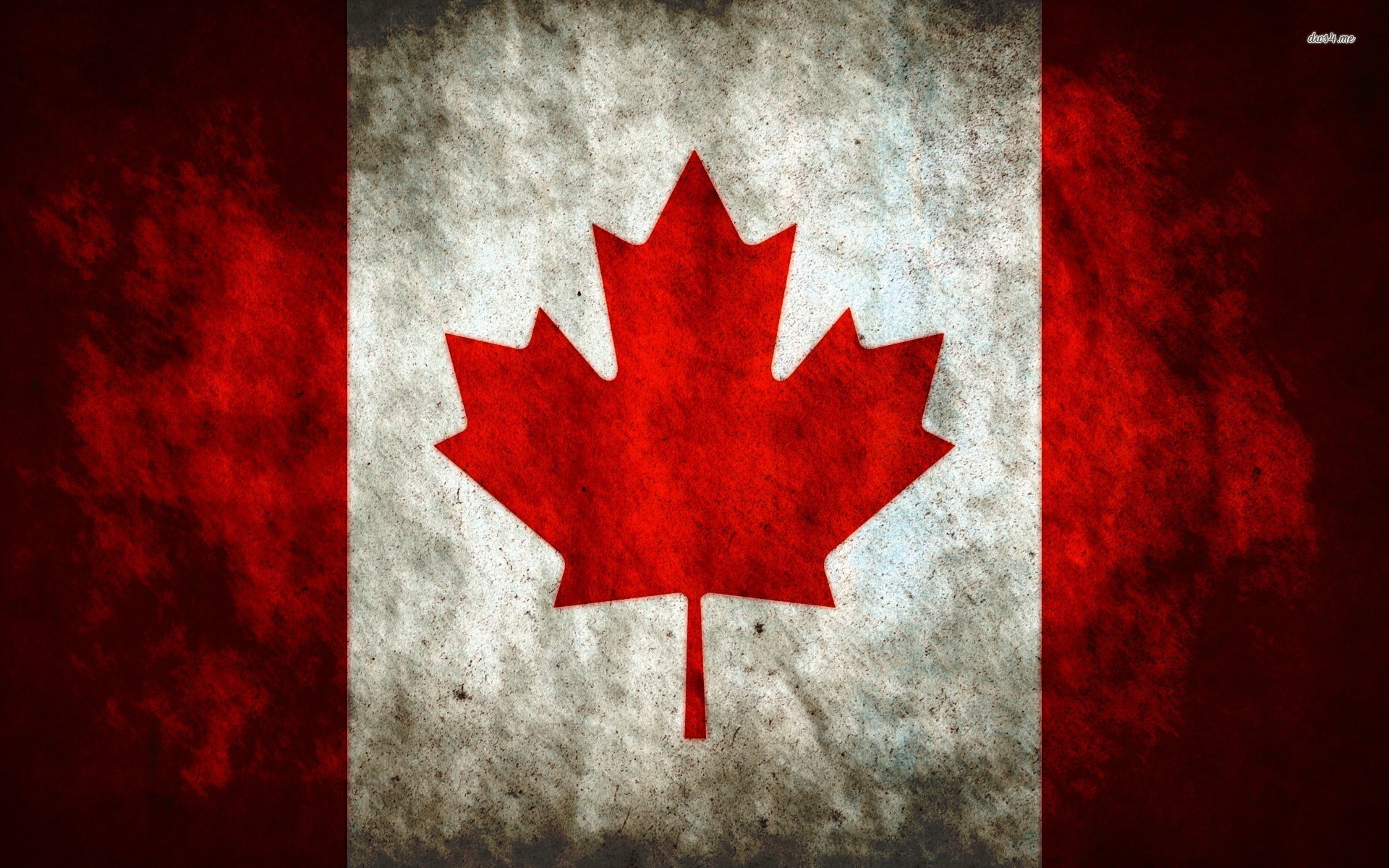
The Canadian flag, adopted in 1964 … which the very year should be a “red flag”. Is in fact, an American flag. It is the symbol of America’s diplomatic and espionage victories over the British Empire and its final conquest of Canada.
Canada’s entire culture, defined by being British, Imperial, warlike, frontier militiamen (Indeed Canada’s 1950s culture in many ways resembled Washington’s and Jefferson’s colonial American culture more than America did) … was ripped out in the course of a decade … quite intentionally and by design.
Indeed Canada was the testing ground for the Global American Empire’s psychological cultural program.
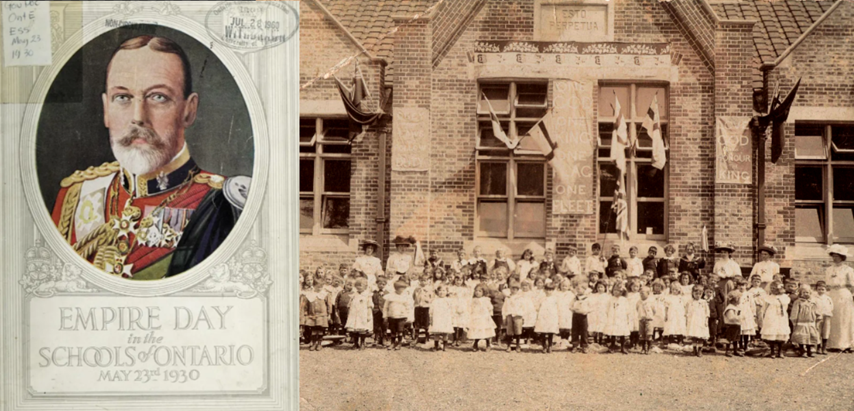
To get a feel for just HOW aggressively Canadian culture was purposefully ripped apart … I encourage you to flip through the various programs for “Empire day in the Schools of Ontario” up on archive to see English Canada’s actual natural culture. (I will be writing about this in more detail in another piece.)
And Please Note: The British did nothing comparable … the “Narnia” age of Canada coexisted with The Fabians, George Bernard Shaw, and the basically open communist treason of the actual British Aristocracy.
The mottoes on the posters: “Obey/ the Law/ Follow/ Duty”, “One God/ One King/ One Flag/ One Fleet”, “Love God and Honour the King”
This was immediately ripped out by State Department’s assets like Pearson and Trudeau in the 60s and 70s in favour of “Multiculturalism”.
How does the one Canada: Royalist, Militaristic, Patriotic as Can Be, defined by the three institutions of Church, Militia Armoury, and the old-style High School ruthlessly enforcing standards … More akin to Cadia from 40k than a 21st century country … How did it transform into the modern Canada within living memory?
How do you destroy the entire culture of a country and replace it with an entirely new culture in front of its population’s very eyes … without resistance and without protest?
Well that’s the problem that was solved here.
Canada was the testing ground for all of the American Government’s cultural occupational weapons it would go on to use on Europe and on its own people.
Terms like “melting pot”, “racism”, “tolerance”, “the open society” … These of course has all been coined by American Jewish and Communist activists (“Racism” specifically is a Trotskyist doctrinal term of art propagated by Trotsky’s personal pamphlets, and you should call any “Conservative” who ever uses the term a Communist traitor).
However it was in Canada that top down US foreign policy institutions first applied the current model to a country which they had conquered without a war.
Indeed when one looks into “Denazification” in Germany or the US occupations of France, Italy, or Japan you find little to no overlap between the language, structure, and even values of the “Democratic”, “antifascist”, and “Peaceful” occupational ideology and modern Globohomo.
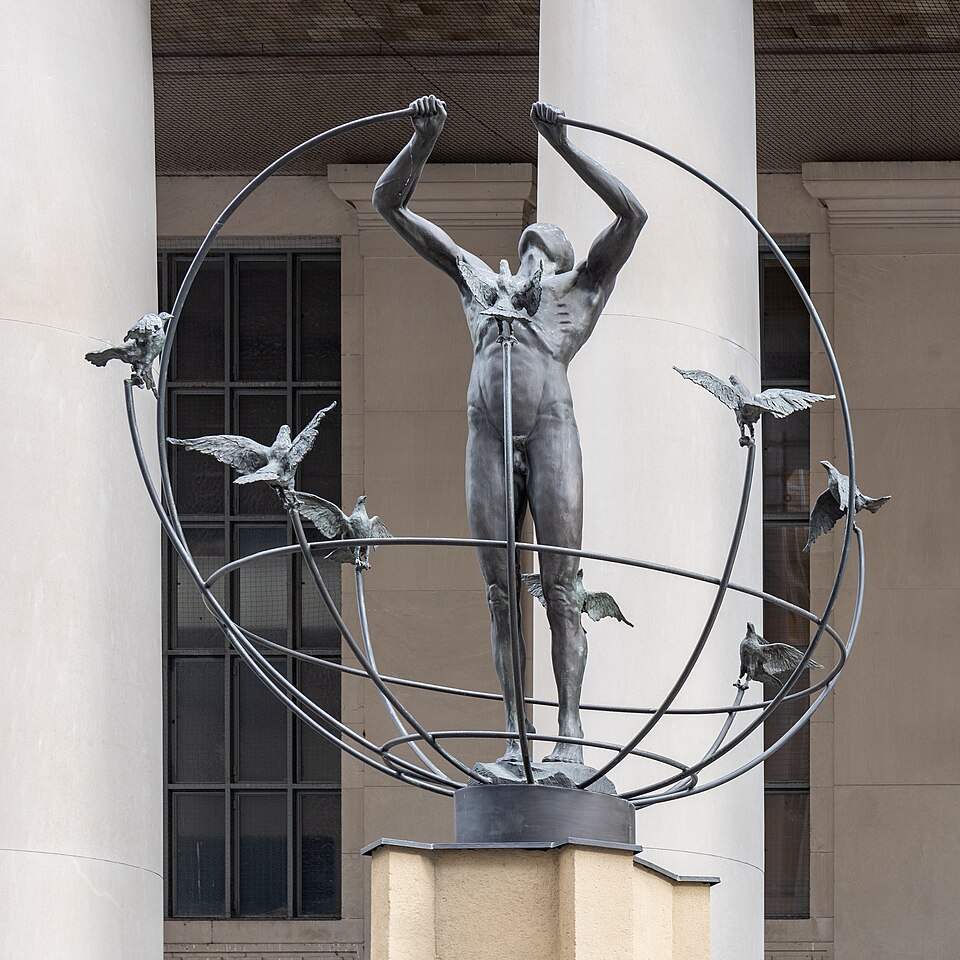
“Monument to Multiculturalism”. Toronto. Erected 1985. (The “Monument” can be interpreted two ways … the man and doves working together to build a unified world … or the man is unwittingly cooperating in his own caging and enslavement)
Whereas in Canada the US occupational ideology EXACTLY resembles modern globohomo. From the outset.
Pierre Trudeau’s first major political moment was the 1967 decriminalization of homosexuality.
Britain’s new PM is yet another Net Zero fanatic
At The Daily Sceptic, Chris Morrison points out that moving from Manchester to Downing Street has not changed Prime Minister Andy Burnham’s devotion to the climate change agenda and Net Zero fanaticism:
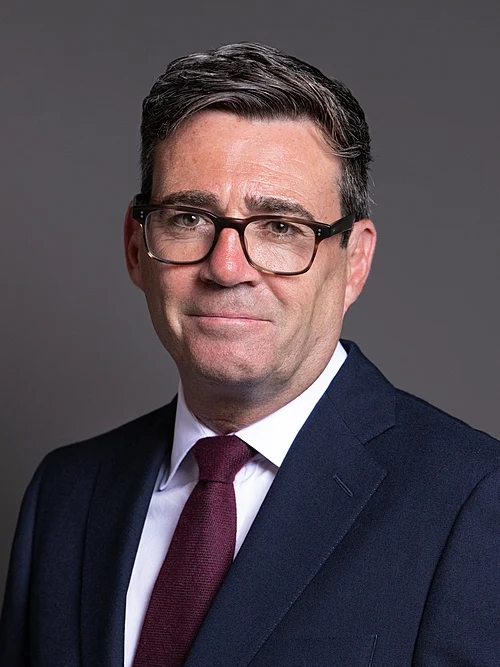
Prime Minister Andy Burnham’s official MP portrait, July 2026.
© House of Commons via Wikimedia Commons.
Praise the Lord, a Saviour from the North walks amongst us. The UK’s new Prime Minister Andy Burnham has apparently hinted that a tad more oil and gas might be taken from Britain’s remaining treasure trove lying undisturbed in the North Sea. Is this a push back on fanatical Net Zero treason as some commentators have suggested? Probably not. As always there is no need for conspiracy theories – just look at what they supported and said in the past. The new Energy Secretary Miatta Fahnbulleh is a green blob-funded whack job straight out of central climate casting, while the new tee-shirt wearing top dog is all signed up to the evil, society-destroying Climate and Nature (CAN) Bill.
It didn’t take long for the bill promoter Zero Hour (ka-ching, Green Blob money) to list the new Prime Minister as one of 193 MPs who support the proposed private member’s CAN legislation that will cut the country’s entire use of hydrocarbons – domestic and overseas – to just 10% within 10 years. Zero Hour notes of Burnham: “In 2024, as Mayor of Greater Manchester, he backed the Climate and Nature Bill because he recognised that Britain needed bold, science-led action to tackle the climate and nature crisis”.
Other more accurate interpretations are available along the lines that the bill is an abominable neo-Marxist Trojan horse that would lead to mass starvation, death and almost immediate industrial and societal collapse. With little or no hydrocarbons available from any source, food supplies would be cut in half due to a lack of fertiliser, while most medicines would be unavailable. In the regular periods of wind and solar drought, particularly in the winter, thousands would die in their blacked-out and unheated homes. Thankfully, the bill failed in the House of Commons when it was debated last year, but a terrifying 200 MPs agreed with its vile contents. Over 90 Labour MPs, all the Greens and LibDems plus two crackpot Tories said they supported the bill.
We can but pray that the two unhinged Tories, Sir Roger Gale and Simon Hoare, are currently receiving sympathetic re-education treatment as the Kemi Badenoch-led Conservative party now rushes towards the Net Zero exit. Similar classes of course are required for wayward Tories who believe that men can become women, and open borders lead to civilisation contentment.
Just three reasons come to mind to explain the heavy support for the House of Commons horror show.
- Rank stupidity: If the IQ score of any supporter was much lower, steps might have to be taken to ensure regular watering.
- Blinding ignorance: Five decades of dumbed-down education must take some blame, but the inability not to use at least one critical-thinking brain cell is worrying.
- Tunnel-vision zealotry: Overwhelming desire to re-order society along State-controlling communist lines – and if the majority kulaks get it, too bad. Inventing a climate crisis without a scintilla of conclusive proof is justified to create an equal, virtuous, brave new post-truth world.
Of course, allowing the two North Sea fields Rosebank and Jackdaw to open is little more than re-arranging the deckchairs on the Net Zero Ship of Fools. Thanks to the 2008 Climate Change Act and later amendments made by the Conservative Prime Minister Theresa May, Britain is legally committed to short-order Net Zero destruction. Unless the legislation is torn up, new drilling is likely to be challenged in the courts. As 2050 looms closer, lawfare will likely stop almost all new projects where emissions are likely to arise from using hydrocarbons.
The small Burnham North Sea relaxation, along with the removal of 5% VAT on electricity bills, is an obvious electoral ploy to disguise the fact that Britain now has some of the highest energy costs in the industrial world – and they are likely to get a great deal higher in the future.
The Korean War Week 110 – The Democratic Candidate – July 28, 1952
The Korean War by Indy Neidell
Published 28 Jul 2026In Chicago, the Democratic Party chooses Adlai Stevenson as their candidate for the Presidential election to be held November 4th; he’ll square off against Dwight Eisenhower, the Republican candidate. Also, in the US, the steelworkers strike comes to an end. In Korea, torrential rains prevent action on the ground this week, though the UN continues its summer aerial bombing campaign of the north in the skies.
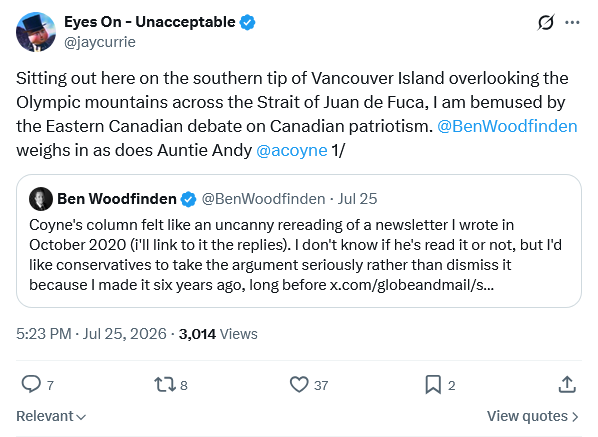
The changing nature of Canadian patriotism
On the social media site formerly known as Twitter, Jay Currie contrasts the kind of patriotism most Canadians grew up with against the politicized version hijacked by the Liberals as a tool in their never-ending quest to re-shape Canadians in their preferred image:
Sitting out here on the southern tip of Vancouver Island overlooking the Olympic mountains across the Strait of Juan de Fuca, I am bemused by the Eastern Canadian debate on Canadian patriotism. @BenWoodfinden weighs in as does Auntie Andy @acoyne
The current version of the debate is focused on whether the Conservative Party is “patriotic enough”. In less fraught times that would translate to “love of Canada” but now it comes down to anti-American and, more importantly, anti-Trump enough.
Probably because, after twelve years of Trudeau/Carney there is very little “Canada” left to love. We’re a post-national, genocidal, nearly European entity ruled from an embattled Ottawa beset by Americans, Chinese and our own separatists.
From the Ottawa/Toronto point of view Canada’s singular attribute is our willingness to punch Trump right in the nose. And woe betide the traitors like Smith, Moe and Frechette who are not willing to get behind Captain Canada as he takes his roundhouse swings.
And the Conservative Party is failing on the patriotism front precisely because a significant part of it thinks punching the Yanks in the nose is possibly the dumbest thing they have ever heard. Why the Hell would we do that?
On the Auntie Andy/Woodfinden scale of patriotism this disqualifies the CPC from ever winning a federal election because only Canadian Patriots should be allowed to command the Ottawa ramparts eyes firmly fixed on the perfidious Yanks.
As a thought experiment try to define Canadian patriotism without reference to the US or Donald Trump. I assure you it can be done. The way you do it is begin with the ground you are on. Where is it? What is it? What can you see?
Now, think about your neighbours, the stores you go to, the pub you like, the golf course or soccer field or swimming pool you prefer, the schools you went to, the teams you played on, yes, your favourite NHL team, vacation spot, drive.
Essentially these and hundreds of other details are the ground truths of your Canada and it is that Canada where your patriotism begins. The Canadian flag, the Peace tower, your favourite version of “Oh, Canada” are all abstractions of this ground truth.
People don’t fight for “King and Country”, they fight for their children, their spouse, their parents, their neighbours. That is where the real loyalty lies. It’s acutely local and it accretes across time, across generations.
The Liberal Party project of the last half century has been to replace this hyper-localized patriotism with an synthetic, denatured, atomized Patriotism which defines itself by what it is against, not what it is for. It is a deeply unsatisfying project.
The fact the CPC is wary of this synthetic patriotism is to its credit. Looking at its messaging in the last election at least a part of the CPC understands that Canada is the ground you stand on, not an invention of Ottawa. It’s the right message.
At Without Diminishment, Carl Vallée identifies one of the structural strengths of the left that allow them to concentrate on achieving and maintaining power: unity of vision across all progressive parties.
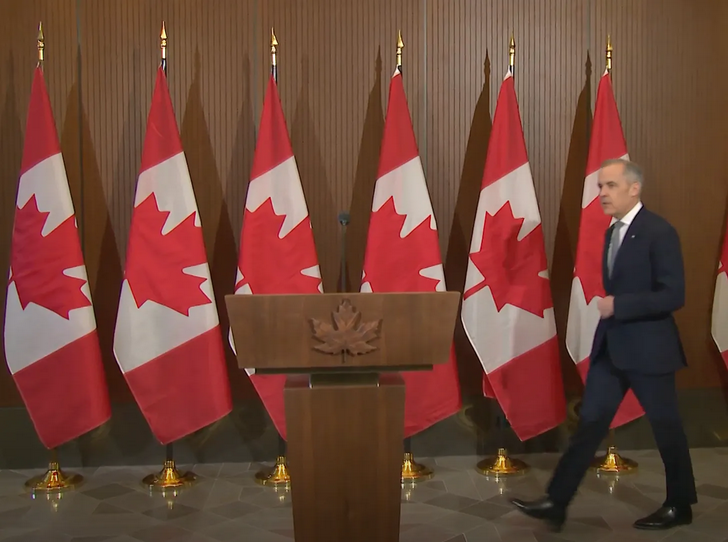
Exit Trudeau, enter Carney.
It must be admitted that the Liberals have dominated the political landscape for much of the past century, enabling them to weave their own partisan symbols and values into the fabric of Canadian institutions.
The federal state as it exists today is a legacy of Liberal Party rule. Pierre Trudeau’s Charter of Rights and Freedoms fundamentally changed the trajectory of this country, but the ideology underpinning it had begun to take shape even before his time. Whether one considers multiculturalism, mass immigration or the red maple leaf flag, Canada is a country whose institutions naturally lean, if not lurch, to the left.
Therefore, conservatives must swim against the current, almost perpetually. Why is this? I submit that it stems from the fact that Liberals in both English Canada and Quebec are ideologically closely aligned and share a common vision of Canada. The left often looks much the same everywhere. Certainly, its values, methods and codes of communication are identical across the Western world.
In Canada, Liberals will not hesitate to weaponise the state to ensure their values endure. The alignment between Liberals in Quebec and English Canada has been critical to their electoral success.
Conversely, the right are more locally rooted and provincial, and are therefore less inclined to share a broad common vision with their compatriots across the country. This poses a challenge to both the coherence of Canadian conservatism and its electoral arithmetic.
Conservatism in Quebec is not libertarian, and here we envisage using the state to advance nationalist and conservative ends. What we conserve in Quebec is not what our friends in Western Canada or Ontario seek to conserve.
Arrayed against our alliance of local political traditions are the Liberals, who share and promote a single, pan-Canadian narrative. The inability of the right to offer a catch-all vision capable of rallying the anti-Liberal vote partially explains the electoral success of the Liberal Party over the past few decades.
Structurally, the 1982 rupture over the imposition of the Charter has made this phenomenon almost permanent, despite the efforts of prime ministers Brian Mulroney and Stephen Harper to rally coalitions against the Liberals. Neither was able to prevent the Charter from entrenching itself as Canada’s new national narrative, despite the explicit opposition of Francophones, one of the country’s founding peoples.
If there is a fault, it does not lie solely with the pan-Canadian conservative movement, but also with Quebec’s bleus, who failed to invest in the Conservative Party of Canada, the only political party capable of rivalling the Liberals. As a result, the Quebec vote is split between the Conservatives and the Bloc Québécois, whose voters are much less left-wing than the party’s current leadership. In the 2025 federal election, the combined Conservative and Bloc vote in Quebec actually exceeded the Liberal vote.
July 28, 2026
The establishment pretends not to understand why AfD is still on the rise
Normally, I get my updates on German politics from eugyppius’ Substack, but this article is from the New English Review with Bruce Bawer reporting:
… even as the problematic aspects of Islam become increasingly manifest, mainstream politicians and journalists in Germany feign puzzlement over the growing popularity of AfD, which ever since its founding in 2013 has been characterized by the German establishment as heralding a Nazi renaissance. How, the German elites pretend to wonder, can so many voters transfer their loyalty from seasoned, sensible, upright political leaders to ragtag radicals who bring to mind Munich putsches and Nuremberg rallies? How on earth can they have become so misguided? Such is the coy approach of Jochen-Martin Gutsch in a recent article for Der Spiegel, in which he takes a spin around the former East Germany in purported search for an explanation as to why the “far-right” AfD has won majority backing in that part of the Bundesrepublik.
Gutsch’s first move is to act astonished at the fact that an AfD gathering in Salzwedel, Saxony-Anhalt, drew ordinary-looking families, plus “[a] surprising number of young people in their twenties, smartly dressed in blazers”. What, no Hitler Youth uniforms? Gutsch’s line is that he’s just plain perplexed by the numbers: “in the state of Saxony-Anhalt, the AfD is currently polling at more than 40 percent. In the ARD Deutschlandtrend poll, the AfD is in first place; it’s even the most popular party, nationwide.” But it’s one thing to read the numbers, another thing to see all these – gasp! – ordinary-looking people flocking to show their support. This is what really blows Gutsch’s mind, or so we are meant to believe: the “normalization” of AfD, the party’s growing “acceptance”, its rapid “transformation into a mainstream party in the east”, all of which was, in Salzwedel, brought to vivid, terrible life before his eyes.
Ten years ago, Gutsch recalls, AfD received 20 percent of the vote in Saxony-Anhalt, and he, for one, was sure that it had peaked. He’s from eastern Germany himself, and he thought he knew his neighbors. He was wrong, and now, he claims, he’s alarmed – unlike his “friends and colleagues sitting in Hamburg, Cologne, or Munich, who give a friendly, bored look when I talk about the AfD. For them it’s still far away. Somewhere ‘over there’, whereas for me it’s a reality I can’t escape.” Therefore, he tells us, it’s important for him to make unravel the mystery of the AfD‘s remarkable rise in the polls.
Of course, the reason for the rise of AfD is obvious to anyone who’s been following developments in Western Europe for the last quarter-century or so. More and more voters have been demanding that immigration, especially from Muslim countries, be drastically curbed, if not altogether ended, and that the unassimilated masses who’ve already relocated to Western Europe from the Muslim world – only to swell the welfare rolls and the crime statistics – be sent back to where they came from. We’re told that the Berlin Pride killer, Abdul Ballout, belongs to “Islamist circles” in Germany. Why, ask AfD voters quite reasonably, should there be “Islamist circles” in Germany?
Yet Gutsch is, or pretends to be, blind to such concerns. His initial hypothesis, as he heads into the east, is supposedly that AfD is gaining popularity there because of economic hardship. But no, when he drives through Brandenburg now, he encounters prosperity. The city of Großräschen, once the Ruhr of East Germany, became a “ghost town” after 1990; now it’s thriving again, with the unemployment rate a mere seven percent, the old lignite mine converted into a lake with “a lovely beach” lined by “white houses” with “luxury SUVs parked out front”. Why, then, asks Gutsch, are the residents of these stately homes casting their ballots for AfD?
A veteran local politician tells Gutsch that he travels often to Bochum, in western Germany, which, compared to Großräschen, is an economic basket case. And yet the residents of Bochum are “more easygoing” than those in Großräschen. They possess a “fundamental optimism”. They “trust” and “respect” their political leaders. “What beautiful words”, Gutsch comments. He’s not being ironic. To be sure, he understands why eastern Germans aren’t brimming over with love for their leaders, whether in Berlin or Brussels. Many of them are old enough to remember 1990, when the once-mighty East German state “crumbled … before their very eyes.” One might add that before 1990, that same state was the very picture of totalitarian tyranny, as chillingly depicted in the film The Lives of Others. And before that – well, you know. Then there’s 2015, when Angela Merkel opened the floodgates to insufficiently vetted Muslim immigrants, who proceeded to cause mayhem in both east and west.
But why, then, do so many western Germans still “trust” and “respect” their leaders? It seems baffling. Yet to listen to Gutsch, loyalty to the political establishment remains the way to go – the only intelligent, mature, and reasonable option. When he talks with an AfD politician, Karsten Hilse, to get the latter’s perspective on things, he’s lost at sea. In Hilse’s opinion, mainstream German politicians are too obsessed with “tolerance”; they have at least a degree of hostility toward Germany; and they accept without question the preposterous ideologies of gender and climate-change.
Mis-, Dis-, and Malinformation defined
Gawain Towler kindly provides a précis of a behind-the-paywall essay discussing misinformation, disinformation and the less-well-known malinformation, as governments on both sides of the Atlantic rush to codify new laws to further restrict the freedom of speech of their citizenry:
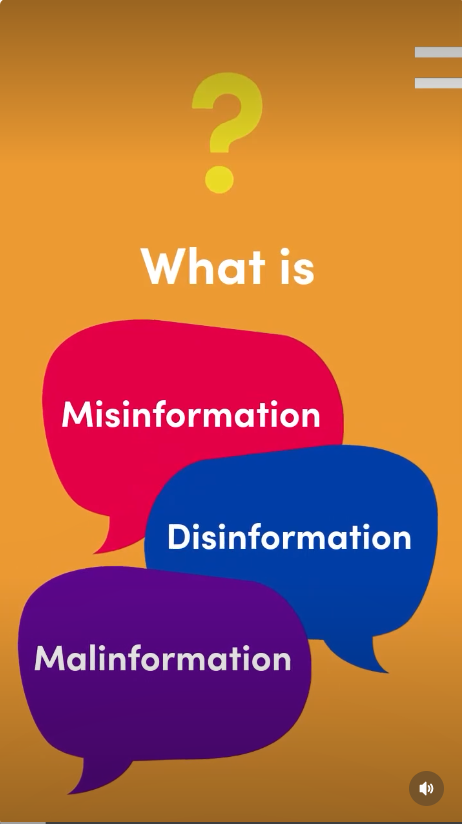
The essay examines “malinformation”, a term coined in 2017 and now embedded in official doctrine on both sides of the Atlantic, and I argue that it exists for one purpose, to give the state a category under which accurate speech can be treated as a harm. I start by Channelling Ambrose Beirce’s Devil’s Dictionary, with a dictionary entry defining the word as information whose defect is that it is true. Thereafter I proceed to trace its origins, its spread through British and American officialdom, its intellectual kinship with behavioural government, and its practical operation, before closing with a demand for its formal abolition.
First the taxonomy itself. The doctrine of “information disorder” rests on a triad. Misinformation is false and innocent, disinformation false and deliberate. Both turn on falsity. The third category does not. CISA, the American cybersecurity agency, defines malinformation as based on fact but used out of context to mislead or harm, and the Department of Homeland Security’s advisory council calls it the intentional spreading of genuine information with intent to cause harm. The offence, the essay observes, is not lying but telling the truth on purpose. The term’s coiners, Hossein Derakhshan and Claire Wardle, applied it narrowly to revenge pornography, miscaptioned photographs and weaponised leaks, and the essay concedes these are real phenomena. But the concept escaped its paddock. Within four years it had migrated from a Council of Europe research paper to the letterhead of a federal agency and thence into British government training materials.
The British chapter centres on RESIST 2, the Cabinet Office counter-disinformation toolkit issued to government communicators in 2021. The toolkit reproduces the triad, admits the categories are hard to distinguish in practice, and resolves the difficulty by instructing officials to stop asking whether material is true and to focus instead on the harm it can do.
The essay treats those five words as the whole doctrine laid bare, truth demoted from test to complication. From the Cabinet Office the word trickled downward, into Local Government Association guidance, a Stockport Council webpage, even a Met Office blog. The essay notes a telling exception. Ofcom and the Electoral Commission, bodies with statutory exposure and lawyers, avoid the word entirely. Its distribution across the state maps the distribution of accountability. Where courts can reach, the concept hides.
The American experiment, the essay argues, ran to destruction. CISA’s mis-, dis- and malinformation team spent the early 2020s flagging content to platforms, much of it neither foreign nor false, drawing a House Judiciary Committee report accusing it of collusion and camouflage. When Missouri and Louisiana sued, the case reached the Supreme Court as Murthy v. Missouri, where the government prevailed not on the merits but on standing. The essay relishes the irony of a Justice Department litigating for its own right to withhold context. Britain played a damper version. After Big Brother Watch revealed that the Counter Disinformation Unit had monitored lawful speech by journalists and parliamentarians, the government refused substantive disclosure and renamed the unit National Security Online Information Team (NSOIT), in the tradition of Windscale becoming Sellafield.
The essay then traces the doctrine’s parentage to the habit of mind exemplified by the Nudge Unit. RESIST had different midwives, but both traditions live in the Cabinet Office and both treat the citizen as an object of professional influence. They embraced during Covid, when SPI-B recommended raising the perceived level of personal threat through hard-hitting emotional messaging while the information machinery flagged sceptical commentary, some of it correct. Fear turned up on one wing, information turned down on the other.
July 26, 2026
The Alchemy of Finance by George Soros
Handre discusses the book George Soros wrote (or had written) after he gained a huge sum of money by speculating against the Bank of England in the 1990s:
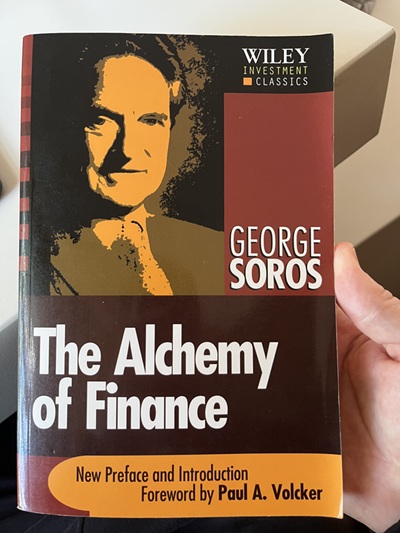
George Soros made a billion dollars betting against the Bank of England in September 1992, and then he wrote a book explaining that markets are fundamentally irrational. Notice the tension there.
The Alchemy of Finance, published in 1987, gives you Soros’s theory of reflexivity. The idea runs like this: participants in a market do not observe prices from the outside. They shape the reality they are trying to measure. Their biased expectations feed into prices, prices feed back into expectations, and the whole thing spirals away from any “equilibrium”. Soros presents this as a devastating blow to the neoclassical economists who model markets as tidy machines grinding toward a single clearing price.
He is right, but misses one fundamental point. The equilibrium fetish deserves a beating. Ludwig von Mises and Friedrich Hayek spent decades explaining that the market is a process, not a photograph, and that no equation captures the discovery going on inside it. Prices carry dispersed knowledge. Entrepreneurs guess, act, and get corrected by profit and loss. Soros rediscovered a slice of this in his trading room, and called it “alchemy”.
But, Soros treats his “far from equilibrium” boom-bust sequences as proof that free markets are inherently unstable and require an adult (usually a central bank, sometimes Soros himself) to supervise them. He points at the credit bubbles of the 1980s and sees capitalism failing. He never asks who prints the credit.
The Federal Reserve does. Cheap money floods in, entrepreneurs misread the artificially low interest rates as real savings, and they pile into projects that cannot pay off. That is the boom. The bust arrives when reality collects its debt. Soros describes the symptom with real skill and misses the pathogen entirely.
So the man who broke sterling by exploiting a currency that politicians pegged at a lie somehow concludes that governments need more discretion, not less. The 1992 pound was a government price-fix collapsing, exactly as Mises predicted such fixes always do.
The reflexivity part is spot on, but send the bill for the bubbles to the people with the printing press.
QotD: Progressives know they’re on the “right side of history”
Whatever happens, then, happens either exactly as they foretold — even if they never bothered to actually prophesy, or to even think about it at all until just this second — or is a temporary victory by the forces of evil, a temporarily successful holding action against the inevitable Triumph of Progress.
It’s a fascinating chicken-and-egg conundrum: Did the Left take to Marxism because they’re so invincibly self-righteous, or does their sanctimoniousness come from their dedication to Marxism? It doesn’t really matter, because the practical effect is the same either way: Their consciences are completely short-circuited. They can do the most awful stuff with a smile on their faces, because “awful” is relative, comrade – as you’d know if you had the proper proletarian consciousness; if you understood things from History’s perspective, as they do.
Severian, “Escriva Ch.8: Examination of Conscience”, Founding Questions, 2022-06-26.
July 25, 2026
Modern careers – the permanent protest class
Although L. Wayne Mathison mentions this as a Canadian phenomenon, I believe it’s endemic to the Anglosphere and probably all of the former “first world” democracies:
“Free Palestine/Anti-Israel protest” by Can Pac Swire is licensed under CC BY-SA 2.0 .
After watching this, my takeaway is simple: Canada has developed a small, permanent protest class that moves from cause to cause, looking for confrontation, attention and social-media status.
These people are not trying to persuade anyone. They want to control the space, silence opponents and punish anyone who records what they are doing. The cause changes. The tactics do not.
There are extremists on both sides, but the organized activist left has become especially comfortable deciding who is allowed to speak, report or even stand in a public place. Too often, well-funded NGOs and unions provide the money, organization, legitimacy and political cover that keep this protest machine running.
Politicians, journalists and institutions then excuse the behaviour because they sympathize with the slogan on the sign.
A democracy cannot survive on selective free speech. Protest is a right. Intimidation, harassment and mob rule are not.
July 24, 2026
To Zohran Mamdani, “working class” means earning less than a million a year
Rob Henderson coined the fantastically useful phrase “luxury beliefs”, and regularly points out examples of people expressing beliefs that allow them to virtue signal at little or no cost, yet if the ideas were implemented would harm those not as privileged as the speaker:
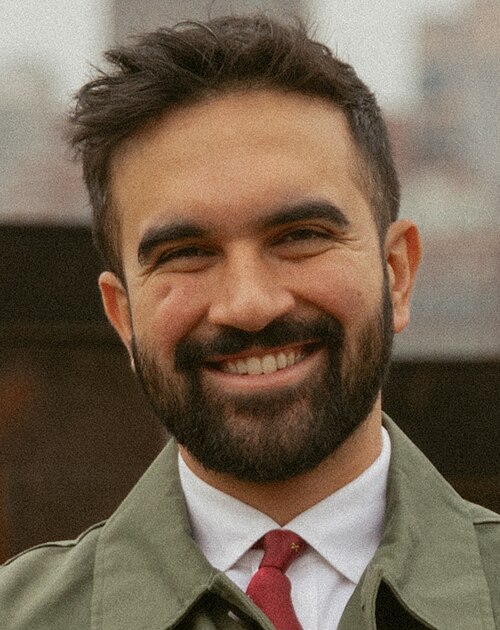
New York City mayor Zohran Mamdani, 10 February 2024.
Photo by Kara McCurdy via Wikimedia Commons.
In a recent New York Times interview, Zohran Mamdani, New York City’s socialist mayor, struggled to define “working class”.
At one point he was asked point-blank, “How do you define the working class?”
Mamdani replied, “I think if you have to work to pay your bills, I think that that is one definition of being a part of the working class”.
After some pushback from the interviewer, Mamdani said he would draw the line at “about a million dollars a year”. I have no idea how he can say that without any embarrassment, but that’s why he’s a politician and I’m not. Say what you will about him, but the man knows his base. These are the people who claim to be the champions of women yet — and please forgive what has now become a hackneyed line — can’t define what a woman is, and they claim to be the champions of the working class, yet can’t define what the working class is. Or they redefine both terms to be so expansive that they could potentially encompass just about everyone.
This is where the luxury belief class has steered us.
Anyone who isn’t a millionaire gets to be working class now. It sounds absurd but that’s where we’re at now. Remember during the primaries in 2015, Bernie Sanders said that “the millionaires and the billionaires” need to pay their fair share? At some point over the past decade, he dropped “millionaires” because he became one. Now you see the millionaires condemning only the billionaires. Mark my words, at some point in the not-too-distant future, you will see the billionaires disparaging the trillionaires. Maybe inflation will hasten that phenomenon.
Anyway, in that Mamdani interview, the focus on defining class by money is revealing.
People often conflate social class with economic class. This allows us to talk about the former while pretending we are talking about the latter.
It is easier to discuss income than educational pedigree, accent, hairstyle, clothing, taste, or zip code.
But education usually signals social class more clearly than income does.
Research has found that parental educational attainment is the most important objective indicator of social class. This is because, compared with parental income, parental education is a more powerful predictor of a child’s future lifestyle, tastes, and opinions. If your parents went to college but you didn’t, you’re still middle-class or higher. Not working class.
Education shapes habits, networks, and outlook long after the degree is earned. Higher education bestows cultural capital: patterns of speech, tastes, opinions, and expectations about life. Income may rise and fall over a lifetime. The worldview formed in selective institutions usually endures. By that standard, college graduates, regardless of earnings, are not working class.
Education also shapes political views more strongly than income does.
In 2021, Ezra Klein pointed out that “We tend to think of class as driven by income” but that “A high school dropout who owns a successful pest extermination company in the Houston exurbs might have an income that looks a lot like a software engineer’s at Google, while an adjunct professor’s will look more like an apprentice plumber’s. But in terms of class experience — who they know, what they believe, where they’ve lived, what they watch, who they marry and how they vote, act and protest — the software engineer is more like the adjunct professor.”
Plainly, a PhD who takes a job driving a taxi will tend to vote like other PhDs, not like other taxi drivers, especially if he or she also has a parent with a college degree.
It was so much easier to recognize the British classes, at least back in the 1960s that is:
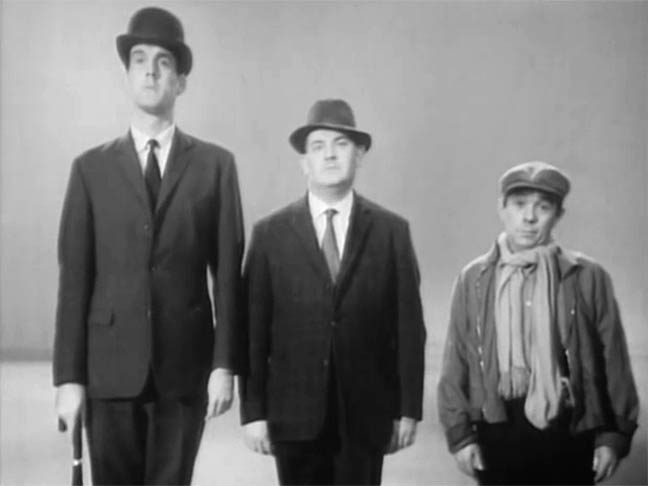
John Cleese, Ronnie Barker, and Ronnie Corbet as the avatars of the British upper, middle, and lower classes
Original version from The Frost Report, 7 April 1966.


